ClackyAI's Li Yafei on Vibe Coding: Laziness Is the Force That Drives Human Progress

One person can build a product, serve a crowd, and still live well.
Yafei Li has been an entrepreneur since 2014 — more than a decade now. He didn't pay much attention to names in his first two ventures, but by his third, he'd become convinced that a good name is half the battle. The "Clacky" in his AI coding product ClackyAI comes from the sound of a programmer hammering on a keyboard.
Li himself has been hammering on keyboards for 20 years. He was once one of Sangfor's fastest-rising R&D leads, a devoted Rubyist who founded the Shenzhen Ruby community and found his first co-founder there. In 2021, ZhenFund invested in ClackyAI's Pre-A round through its parent company Zhijian Tiancheng.
In his view, AI coding is progressing through a clear evolution: L2 (code completion) → L3 (codebase planning) → L4 (autonomous action). L4 isn't mature yet; L3 is where the moment is. And ClackyAI is an L3-level Agentic AI CDE — a cloud development environment.
ClackyAI combines the agentic capabilities of Devin — automatically handling commits and pull requests — with the copilot-style error-checking and reference features of Cursor. Built on a native AI agent architecture with engineer-controllable task planning and execution, it aims to make AI-generated code land just right. That's Li's product vision for ClackyAI.
As ClackyAI opened its beta invite, we sat down with him to talk through the product logic and his own "aha" moments using the tool.

L3 Coding: Humans and AI Split the Work Fifty-Fifty
Q: Introduce yourself and what you're building with ClackyAI.
Yafei Li: Hi everyone, I'm the CEO of ClackyAI. ClackyAI is a cloud-based L3 Coding Studio we just launched — the best possible starting point for building professional products.
Q: You mentioned that you didn't care much about names in your earlier ventures, until you founded ShowMeBug in 2019 — a technical assessment platform for practical programming — and realized "a good name is half the battle." Where did "ClackyAI" come from?
Li: Clacky comes from the sound of typing on a keyboard, and in English it carries a sense of automated programming. It captures a universal, concrete feeling. I also hope that one day it will really type and code for us humans.
Q: What's the positioning of an L3 Coding Studio in the AI coding landscape? You called it "professional" — how do you define that?
Li: Today's models can roughly match a junior-to-mid-level engineer, but capability growth has hit a plateau. The right product form for this stage isn't full automation (L4) or human-led assistance (L2), but L3: humans and AI split the work fifty-fifty.
Many AI tools can whip up demos quickly, but there's still a gap to a genuinely usable product. We want users to build complete, deployable products on ClackyAI using standard tech stacks — with backend logic, using frameworks like Django in Python or Rails in Ruby, backed by real databases like MySQL and PostgreSQL. That's what we mean by professional-grade.
Q: From the case studies on your website, every task involves building with real language frameworks, with databases and backends. Any recent cases that stuck with you?
Li: Let me start with my own. I've been an engineer for over a decade, maintaining a personal blog the whole time — writing code, writing content, buying servers, getting ICP备案, all DIY. I've made over 600 commits to that blog, on and off.
Recently I tried rebuilding it with ClackyAI. The experience felt remarkably like having an engineer develop it for me. I'd just input requirements, and it would build out features quickly. For example, I spent an hour integrating a content moderation feature — something that would have taken me a week before.
Another one that impressed me this May: a user who'd graduated less than two years ago wanted to build an AI tools showcase site. He wasn't familiar with the tech stack, so ClackyAI automatically recommended frameworks — Next.js for frontend, Express for backend — and within a few weeks he'd deployed a fully functional, good-looking product.
He didn't really understand code, but he had some sense and was willing to jump in.
A lot of products get stuck between demo and production. We want ClackyAI to help people cross that chasm — from 0 to 1, from 1 to 10, to 100, and beyond.

Laziness Is the Engine of Human Progress
Q: The first line on your personal blog reads, "Laziness is the engine of human progress." That philosophy seems baked into ClackyAI — helping people get from 0 to 10 faster. What capabilities in AI coding and agents excite you most?
Li: I made that my blog's slogan years ago. Laziness is the key driver of human progress. Think about food delivery, smart homes — say a word and the lights switch, the curtains draw. That's laziness at work. People want to do less repetitive stuff and focus on what matters most.
Back to coding: I've been a full-stack engineer for over 20 years, and I know building professional software isn't simple. There's a lot of know-how involved.
But with generative AI's creative power, we no longer need to sweat every detail. We can focus on product requirements and business architecture instead.
That said, it's still not realistic today to build great products with zero coding knowledge. But if you're willing to touch code, if you can read logic without being intimidated, you have a shot at building something successful.
We have users who aren't deeply technical but have good instincts and are willing to try. We want to minimize that gap. I don't want you worrying about routing or syntax — I want you confidently layering business requirements onto a mature framework, developing and iterating step by step.
Q: You mentioned programmers evolving into architects, and users with limited technical skills but good instincts being able to participate. There's been a lot of buzz lately about Vibe Coding. What's your take?
Li: We've always been bullish on Vibe Coding — we just couldn't find the right words to describe it before the term caught on.
It vividly captures a state: I'm not writing code, but in a sense I am writing code — I'm participating and deciding as a reviewer.
I think it requires a shift in identity for us humans. Before, we might have had to engage with every logical detail. In the future, we'll be architects of the whole system — making decisions, building frameworks.
AI coding products are leveling up, but there's still inevitably a learning curve. As people say, "Vibe Coding is happy, Vibe Debugging is painful."
We're trying hard to bridge that debugging gap and make the friction as small as possible.
Q: Many generative AI tools are chasing the Vibe Coding experience. How do you see the human-AI collaboration evolving in AI coding?
Li: We designed a cloud development environment (CDE) primarily for AI. AI schedules resources and works independently inside it, avoiding the security risks of local execution.
The ideal state right now is a fifty-fifty split between human and AI. Over time, the human role will shrink — AI might handle 80%, 90%.
Eventually, software development could become an assembly line. AI automatically breaks down requirements, executes through the pipeline, even deploys the product. That's our vision for ClackyAI's evolution.

Coding Is the Last Critical Piece to Move to the Cloud
Q: Why build ClackyAI now?
Li: Coding is inherently global. Back in 2016, during my second startup, I wanted to build a technology-driven company.
Our thinking then was: CI/CD, requirements management, test management — all had moved to the cloud. Only coding remained local. We believed development was the last piece of the cloud puzzle.
By this third venture, I'd moved from number two to number one in 2019, with more control over the process. After securing ZhenFund's investment in 2021, we started exploring the cloud programming direction — the CDE engine — and how to apply it across scenarios.
The turning point came last April, when model capabilities advanced and the AutoGPT wave of agent products took off. Agent success rates were only 4% then, but we decided to dive in and deeply integrate AI. Now that rate has hit 50%.
Local development habits have been cultivated for 20 years, but the time for personally writing every line of code is running out. AI will介入 more and more; human labor will gradually decrease.
Q: Have you had an "Aha Moment" interacting with ClackyAI?
Li: Yes — for example, when importing a project, it automatically sets up the development environment right away. Globally, we might be the only ones doing this.
Many tools jump straight to writing code, with the agent installing the environment as an afterthought. That's actually the biggest gap in the development process. Environment configuration is so complex that it's the highest barrier to entry for human programmers.
We're trying to automate this with AI, getting your environment ready. When our users, myself included, see it — "wow, this is incredible" — the database is connected, the project is running, days of manual work saved.
Another interesting thing: sometimes you only have a rough idea in mind, not described in detail, and the solution it gives is better than what you imagined. Like when I said I wanted a blog sharing feature — it found the right place for it, implemented it cleanly, and filled in the details. That moment, you think, "Yeah, that's the aha moment."
Q: Across your ventures from Cywin to ShowMeBug, what's been your biggest lesson?
Li: The essence of entrepreneurship hasn't changed. It's always "make something people want."
People say programmers have no money and won't pay, but that's superficial. Cursor has already shattered that perception: when your value is strong enough, users will pay.
Entrepreneurship should return to first principles — starting from a non-consensus insight, seeing the mountain as not-a-mountain, then going deep and doing one thing exceptionally well. AI coding is exactly that. It's刷新 many people's认知 and opened up the programmer market, because AI coding is the easiest scenario to close the loop.
Over the past 20-30 years, computing infrastructure was the bottleneck; demand was far from unleashed. SaaS tried to cover everyone with standardized products, with limited personalization. But if AI coding becomes rich enough to drop R&D costs from millions to hundreds of thousands or even tens of thousands, customized demand will explode — massively.
Some worry efficiency gains will put programmers out of work, but I see short-term fluctuation, long-term explosive growth.
Q: So you don't think AI coding will be winner-take-all, but rather many vertical niches and professional know-hows will emerge?
Li: Exactly. ClackyAI is fundamentally a system, a productivity base, but the application layer will blossom in a hundred flowers. In the past, a thousand people with the same need might still be too niche — but not anymore. What people call "one-person companies" now — one person building a product at very low cost, serving a small group, and making a good living.
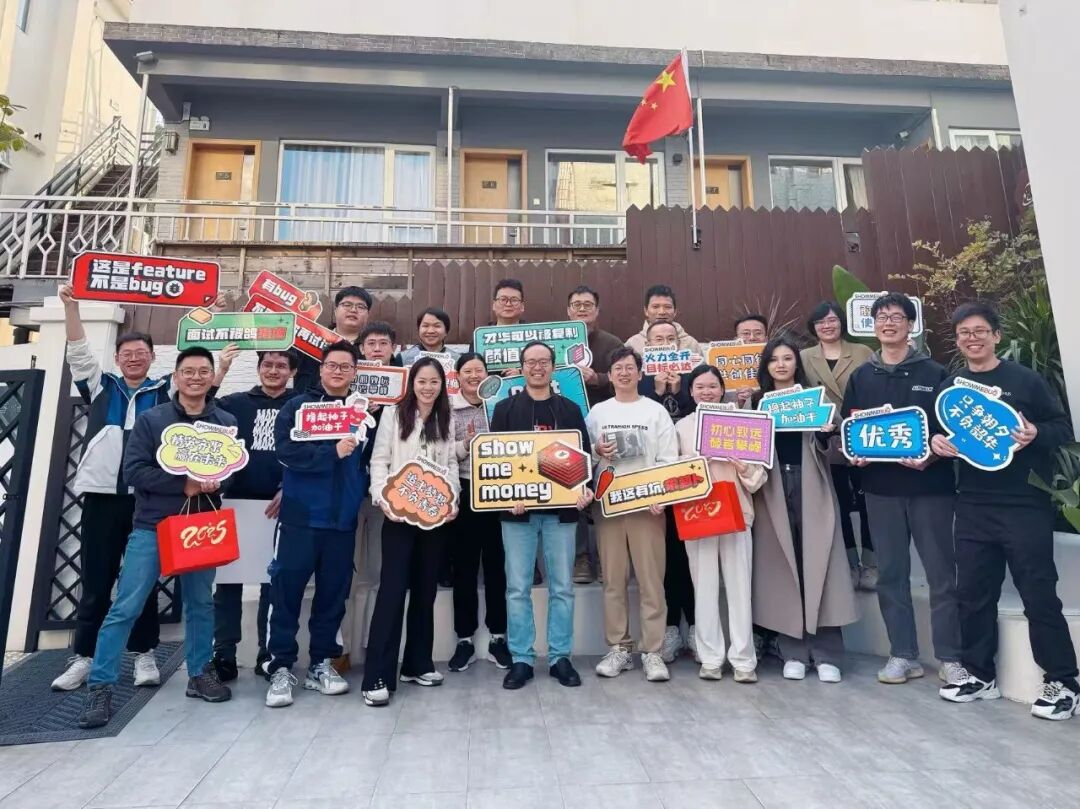
Early team photo of ClackyAI

The Best Place to Build Professional Products from 0 to 1
Q: You mentioned that entrepreneurship often starts from a non-consensus insight. Looking back, what's the most important non-consensus decision that turned out to be right?
Li: AI CDE. Even today, it's not consensus. Survey the programmer market, especially senior developers, and many will say: "Make me give up Vim? You'd have to break my legs first."
But I've always believed that whether it's Vim or any traditional editor, they were fundamentally designed for humans. Today we face a completely new development paradigm: human-AI collaboration. This bidirectional adaptation system can't serve humans alone, nor can it rely purely on AI automation.
Many people see this direction too, but find it too hard — they either detour to plugins or stay on the local IDE path. We're one of the few teams genuinely going cloud-native, and we started early. I believe in six months, a year, this will become the new consensus.
Q: Forming new consensus takes time and effort. ClackyAI is cloud-based — isn't the migration cost high?
Li: It depends on the developer. There are those building from 0 to 1, and those maintaining mature products from 1 to n. For the latter, migrating an existing system is genuinely hard. But we also want to encourage people to build more professionally from Day One.
Previously, realizing an idea took enormous time finding designers, writing PRDs, hiring engineers — especially coding was exhausting. But today with cloud-based preset environments, you input an idea and we help you directly build out a page using standard tech stacks.
Say you want to start a blog — you don't have to use static pages. We'd suggest trying Python + Django, full-stack and easy to pick up, good for quickly validating new ideas. Easy to pull down and deploy later. The whole 0 to 1 process becomes lighter, then you iterate toward n.
We're tackling this in two phases: first solve the build problem, help developers make that first step properly professional; later let AI deliver more value.
Q: In one year, three years, five years — what do you want ClackyAI to become? Including that shift from fifty-fifty human-AI collaboration to 80-20 — how long until that happens?
Li: The endgame we see is a "software factory."
You input a requirement, and the system automatically breaks it down, generates, deploys — full pipeline completion. Whether that vision takes 5 years or 10, we're not rushing. What matters is being in the game now.
Step one: we want to become the go-to tool for anyone building professional products from 0 to 1. As AI capabilities advance further, human involvement will keep shrinking toward that 80-20 split. We want to become deeper infrastructure for developers, bringing more projects onboard and using AI to complete more complex system builds.
Q: In that journey toward the endgame, what will ClackyAI's moat be?
Li: At this stage, our core is polishing an AI-native cloud development environment, gradually building data flywheels and brand advantage. In the end it may become an efficient, full-chain solution that naturally develops ecosystem advantages.

Don't Fear Code in the Future — Believe
Q: You first touched computers in middle school in 1996. Did any of your later learning experiences influence your entrepreneurship?
Li: As a kid I always wanted to understand how computers worked. That's why I insisted on building my blog from scratch, managing the source code and domain myself — I wanted to know how CPU and memory interact, how instructions execute. That curiosity about底层原理 carried over into how I think about entrepreneurship.
I've always believed that real long-term value comes from doing solid work, not telling pretty stories. Everyone's talking AI today, and it's easy to talk about — but we need to know AI's boundaries. Current models haven't had a qualitative leap in performance, and training isn't fact-based; they optimize around human preferences, making hallucinations common.
Coding is precisely a scenario with extremely high accuracy requirements. Our cloud development environment aims to eliminate hallucination risks from the底层 up, keeping generative AI within controllable bounds.
I don't believe AI will fully replace coding, at least not short-term. Many "no-code" illusions ultimately still resolve back to code. We encourage people to be willing to touch code — developers, product managers, entrepreneurs, even investors. Anyone who dares to get their hands dirty can build something. That's a kind of dream.
Q: People are talking about "AI First" again. What's your view? How does ClackyAI internalize this?
Li: Last year we were constantly emphasizing AI First, AI Native. This year we barely mention it — it's the default assumption now.
We put it into practice first. By late last year, when ClackyAI had an internal usable version, we required the team to use it daily. Now everyone on the team pushes 10-20 pull requests on the product every day.
We're strongly engineer-minded and encourage experimenting with tools. We use mature CI/IDE tools on the market too — constantly comparing, building together.
Q: Do you personally use a lot of AI tools?
Li: I try one or two almost every day. When I have time I write reviews, which slowly get absorbed into the product.
Q: If you had advice for young entrepreneurs, what would it be?
Li: Entrepreneurship is maybe only 30% about capability. But if you don't do it, you don't even get that 30%. Stay at the table, and opportunity comes.
My advice: learn by doing, do by learning, keep rolling your capabilities forward. Spend three years going deep on something, and your understanding will surpass most people. One day when you're better than most entrepreneurs, or you catch excellent timing, you'll have a big opportunity.
Don't be anxious. It's a good era.
Q: For first-time ClackyAI users, what's the one thing you most want to tell them?
Li: Go for it, be bold. Don't fear code — believe.

Text | Cindy & Neya
Podcast | Xin
Editor | Wendi