Dancing with Love: Zhang Huaiting on Serial Entrepreneurship — Why Education Deserves Another AI Makeover | Tsinghua Campus Tour
At a technological inflection point, you have to throw yourself in to seize the era's opportunities.
On November 30, ZhenFund hosted a sharing event on AI entrepreneurship. ZhenFund managing partner Yusen Dai joined Moonshot AI president Yutong Zhang, Aiwuwei founder Huaiting Zhang, and Manus co-founder Tao Zhang at Tsinghua University for an in-depth dialogue on innovation and the future.
This past March, Aiwuwei launched its first AI product, the Aixue app, introducing digital human teachers into one-on-one classroom instruction. It can now deliver entire AI-taught classes at the middle school level with zero human intervention. Aiwuwei hasn't just achieved this — it's the first to do so at scale, with monthly revenue already reaching eight figures. More and more students are experiencing an entirely new way of learning.
On March 6, 2023, Huaiting Zhang and his former Gaotu colleague Wei Liu — previously general manager of Gaotu Classroom — decided to start a company after a single ten-minute phone call. They discussed two questions: Could the current wave of AI drive fundamental change in productivity and business models? And was education still worth doing?
Both answers were "yes." They believed they were the right people for the job.
As AI technology evolves rapidly, the paradigm of education is shifting — but adoption speed varies across domains. Education is an industry with extremely low tolerance for error; the first thing an education company must do is "not make mistakes." Beyond that, Aiwuwei hopes to achieve true personalization: whether a student is shy, confused, or talkative, they can be guided appropriately, realizing the ancient ideal of "education for all, teaching according to aptitude." Whether it works or not — completion rates, accuracy rates, and renewal rates will tell.
From joining Baidu at age 27 to two entrepreneurial ventures, Huaiting Zhang also used this event to share his origin story as a founder. For him, entrepreneurship is an actively chosen way of life, a front-row seat at the beginning of an era, and something that makes "tomorrow more exciting than yesterday."
As a former core leader of Baidu's Fengchao advertising system and co-founder of Genshuixue (later Gaotu), Huaiting Zhang may be the entrepreneur best positioned in China to answer the "AI + education" question. ZhenFund has been fortunate to support Aiwuwei from the angel round onward, exploring the future of education together.
The full transcript follows.

Two Questions About the Future of Education
Yusen Dai: More than a decade ago, you were one of the leaders of Baidu's Fengchao team, winning Baidu's highest internal award. Ten years ago, as co-founder and COO, you started Genshuixue (Gaotu Education), which reached a peak market cap of over $30 billion. Most people would say you'd already made it. Yet in 2023, you decided to start again. Why? And why this moment?
Huaiting Zhang: Fear of getting old.
Shimon Peres, the former prime minister of Israel, once said: If what you're going to do tomorrow doesn't excite you more than yesterday, you're old. Boredom is worse than death.
I've always felt that life is about waking up every morning knowing exactly what you're going to do — and being eager to do it. As long as you maintain that excitement, your life force stays young. Conversely, if you wake up every day feeling there's nothing worth doing, everything devoid of interest, it's easy to age.
I once read an explanation: if you're using your brain every day, your brain cells keep regenerating, and you actually stay younger more easily. I came to Beijing for school 30 years ago, and I still feel as excited and eager to do things as a young person every day.
In 2019, after my previous company went public, I retired.
During that period, there was nothing I had to do each day, and my state wasn't actually very good. Just the other day I was talking with a friend who achieved financial freedom after Baidu's 2005 IPO. He also went through a long period of boredom and emptiness, became increasingly decadent, and eventually started another company. He said he's now preparing for his third startup.
Entrepreneurship gives you something worth getting excited about every day, a reason to get out of bed — it's a lifestyle that truly keeps you young. So when the ancients said "born in hardship, die in comfort," this is roughly what they meant.
Yusen Dai: In 2023, education had just been through the "double reduction" policy. "AI + education" was still a non-consensus direction. Why did you choose this path in March?
Huaiting Zhang: Many people say important decisions require repeated deliberation, but I think if you can't figure something out in a day or two, you probably won't figure it out in a week or a month either.
My first startup: my partner and I knew each other for ten days, talked four times, and decided to do it.
This time in 2023, Wei Liu — my former Gaotu colleague and former general manager of Gaotu Classroom — and I decided to start a company after a ten-minute phone call. Coincidentally, about an hour after we hung up, Yusen messaged me saying ZhenFund had done research and believed education might be the lowest-hanging fruit among AI application scenarios, suitable for entrepreneurship, and asked if I had any ideas.
I still clearly remember it was March 6, 2023. Wei Liu and I only discussed two questions.
First, how is this AI wave different from the last one? Can it really bring transformation to productivity and business models?
Second, is education still worth doing? Should a market-oriented team be the one to truly introduce AI technology into education? Are we the right people?
Both answers were "yes." We confirmed it with each other in ten minutes.
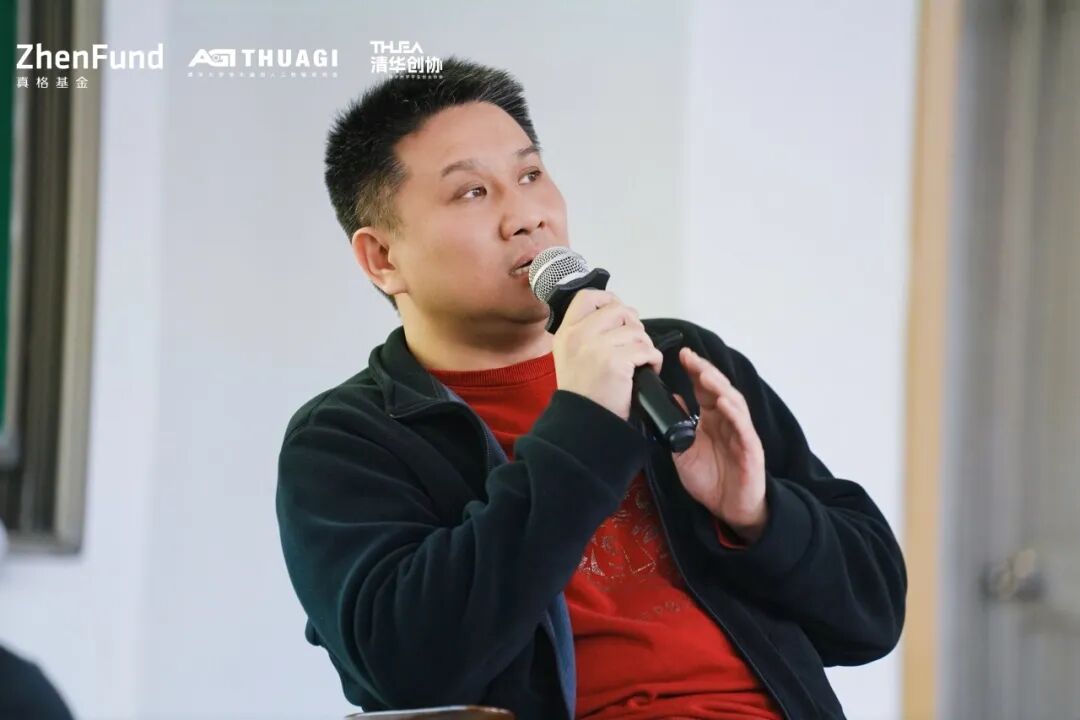
Huaiting Zhang speaking at the event
Looking at today's landscape, AI technology is at an inflection point of explosive growth — internationally it's a battle of giants, domestically the overall trend is positive but development is uneven. The real competition in this period is competition over talent cultivation paradigms and efficiency. From this perspective, I believe the space for AI education is enormous.
What is traditional education? Offline interaction is broadcast-style — if you have a question, it's hard to get immediate interaction, and knowledge absorption efficiency is very low. Online education expanded the broadcast range, solving the problem of "education for all," but without sufficient time and human resources, it still couldn't achieve teaching according to aptitude.
But with generative AI, it's possible to transform services into manufacturing, giving everyone "immediate attention, immediate interaction, immediate improvement." This is a paradigm shift in education that hasn't happened in thousands of years, giving the "impossible triangle" of low cost, high quality, and large scale its first real chance of being broken.
We can do it, it's worth doing, and there's a real opportunity to change the long-standing education paradigm.

Betting on Technology at the Inflection Point
Yusen Dai: You were exceptionally skilled at scaling organizations at Baidu and Genshuixue (later Gaotu). Now you're starting from zero again. What do you see as the advantages of startups in the AI era? How do you face competition from the giants?
Huaiting Zhang: In 2020, two leaders of ByteDance's education business invited my partner and me to meet at Marnay Meadow. We discussed what future education would look like. At the time, both sides were competing fairly intensely in online education, but that didn't stop us from discussing the future paradigm of education.
I believed at the time that recommendation systems couldn't achieve true "thousand-person-thousand-faces" personalization at the level that generative AI can today, let alone provide personalized education services at scale. So I said the direction was right, but the technology timing hadn't arrived yet. Real business execution needs to satisfy a PEST condition: P for policy, E for economy, S for social habits, T for technology. The technology simply wasn't ready then.
Until 2023, when we saw GPT-4's release and realized technology was approaching a critical point. It's certainly not fully mature, but it's precisely at this inflection point that you need to dive in to truly capture the dividends of an era in transition.
Past online education was a highly labor-intensive industry, extremely dependent on organizational capability — essentially "managing people." But in the AI era, our internal requirement is to internalize the organizational capability of managing tens of thousands of people into an intelligent agent system, letting technology-driven gradually replace management-driven.
Industries like education, healthcare, and law — not purely virtual worlds — are hard to turn into AI products with 100 million users overnight, because users' tolerance for error varies completely across different scenarios. A simple example: if a recommendation for an ad or short video is wrong, it's no big deal. But if you hand your child over to an education product and it tells you "I'm 80% accurate, 20% chance I might get it wrong," would you dare use it? So even in the AI era, because scenarios differ and error tolerance requirements differ, the pace of development naturally won't be the same.
At this stage, our strategy is still intelligence-driven, but must have human backup; as intelligence iterates continuously, human involvement will gradually decrease. Today we're "intelligent system + human management"; in the future we'll gradually move toward "primarily intelligent system." First human, then human plus intelligent, then intelligent plus human, ultimately toward true full intelligence.
Yusen Dai: Aiwuwei built the world's first truly AI-native curriculum, with monthly revenue in the tens of millions. What technical challenges did you overcome to get there?
Huaiting Zhang: We've achieved fully AI-taught classes for Chinese, math, English, physics, and chemistry across grades 7, 8, and 9, with individual sessions lasting 1-2 hours and zero human involvement. From explaining definitions, interactive problem-solving, drawing inferences, to real-time error correction, the AI tutor can personalize interaction style, pace, and problem difficulty based on each student's real-time performance.
Currently, we're the only ones globally who have achieved this at scale, with tens of thousands of students interacting on the platform weekly. Our concurrency is so massive that Volcano Engine engineers are stationed on-site. The difficulty is genuinely enormous. Because we have to ensure:
First, problems can't be taught wrong.
Second, students have many different states — some are shy, some can't understand no matter how you teach them, some love to chat, some don't like studying. How to teach? How to pace? How to motivate? How to give students a sense of achievement? Our analysis shows that if a student gets 100% right or 100% wrong in a class, they won't come back. So in interactions we need to probe the boundary of student ability, stretch them slightly higher, so they feel both accomplished and willing to keep learning.
We also have to handle real-time generation concurrency, latency, and other issues. We use photorealistic digital humans, not cartoons, with lip-sync; teaching English requires pronunciation correction; encountering proper nouns that even large models can't recognize requires context algorithms to compensate. Not to mention noisy learning environments requiring voiceprint recognition to verify it's the same person, or judging emotional state to decide whether interaction pace needs adjustment — these are all real requirements.
Finally, there's the cost problem brought by concurrency. Startups must be cost-sensitive. Cloud computing power generally charges by peak concurrency; we have to find ways to smooth peaks and fill valleys, satisfying users while reducing costs. I think what everyone learns in school is more theory and technology, rarely thinking about the relationship between finance, legal, cost optimization, user behavior, and business logic.
If you're interested in the future, you can join a startup team or do your own projects — the real experience is completely different from textbooks.
Yusen Dai: In 2005, you joined Baidu when it listed on NASDAQ. Now this is your second startup. How do you think about the choice between joining a startup versus a big company?
Huaiting Zhang: People think, does a completely financially free person accumulate a little more each year over fifty or sixty years, or earn decades of future money in one moment?
Look at today's wealth rankings — if you follow a path of "1 million year one, 2 million year two, 3 million year three," you'd never reach today's wealth, and many on the lists are quite young. The core is going with the trend, opportunities that the era gives us. The real difference often lies in thinking and timing.
After graduating in 2003, I also joined a listed company, but after two years felt it wasn't for me. The thinking and organizational style were relatively traditional — I could even foresee what the next 20 years would look like and how much I'd earn. So I decided to go out and look for opportunities.
The internet was just rising then. I interviewed at Baidu and found all conference rooms had transparent glass walls. I saw someone in shorts and slippers leading a group of engineers clattering into a meeting room — I thought this was pretty fun. Baidu didn't have many people then, but gave me a feeling of "relaxed yet energized."
I had five offers then: Microsoft, IBM, Huawei, and Sybase were all traditional software; only Baidu was internet, and they gave me some stock. Startups didn't have much money then, and I didn't know what stock was for — I just remembered the Nasdaq bubble had burst, and NetEase's stock had fallen below $1. I was scared too, but I felt this company represented a new philosophy, so I went.
I was 27 when I joined Baidu, stayed nearly ten years, and by 2014 when BAT market caps peaked, mobile internet was arriving, and I felt I could go out and do something. Mobile internet was beginning to combine with traditional industries, so I went into education, using technology to transform education — the direction felt right.
In 2019, after the company went public, I felt the passion had faded somewhat, and a new round of productivity revolution seemed to hit a bottleneck, so I stepped out to do investing.
In 2023, I saw generative AI arrive. This capability is fundamentally different from recommendation systems back then, and I felt "this is doable" — so I returned to entrepreneurship.
Looking back, all three of my choices were at the beginning of an era, finding places that matched my values and culture. Whether at Baidu, Genshuixue (later Gaotu), or Aiwuwei, I hope to create organizational cultures that are technology-driven, loved by young people, and willing to change the world.
So both times we set mission, vision, and values from day one, telling the team where we're going, how we'll get there, and what kind of people we are.
If you want to grow fast and achieve greater wealth accumulation, the most important thing is going with the trend. Either try it yourself, or join a company you truly believe is great.

Building Moats at the Intersection
Yusen Dai: What are Aiwuwei's values?
Huaiting Zhang: Our mission is "Love and AI help everyone become a better version of themselves"; our vision is "To become a trusted growth partner for everyone"; our values are "Love yourself, love your partners, love the world." Take care of yourself first, then you can lead a team and influence those around you. When an organization has sufficient strength, it can try to change the world.
Yusen Dai: How do you attract technical talent?
Huaiting Zhang: I think there are three things most important to technical talent.
First, sufficient respect. We provide an environment that encourages innovation, tolerates failure, and truly reveres technology — letting technology realize its value.
Second, I believe every technical person has a hero's dream. Our generation grew up reading Jin Yong and Gu Long, with a certain martial arts romance in our hearts, and technology is today's martial arts world — everyone has a chance to leave their own story in this world. We want to give people that space and opportunity.
Third, let people know this organization is reliable.
Today it's easier for me to attract talent because if you trace back China's AI talent, many come from the former Baidu Fengchao modeling team — like 4Paradigm's founding team, Kuaishou's founder and core backbone, Xiaohongshu's core technical lead, and so on. So I tell people: just focus on doing good work, transform the world together, and you'll be rewarded.
Yusen Dai: How does a startup face fierce competition from giants?
Huaiting Zhang: Cross-domain talent is actually most likely to forge a new path. Though I have some machine learning background, I didn't go directly into building models when I started companies, because I felt the integration of models and education itself has huge business moats.
Look back at the online education era: Baidu had Chuanke, Taobao had Taobao Education, Tencent had Tencent Classroom, ByteDance had Dali Education. But none of these big companies truly succeeded in the end. What emerged was a company called Genshuixue (later Gaotu).
There used to be a "gene theory" — an organization's cognition and DNA determine what it can do. Having money and traffic doesn't mean you can necessarily do things well. What matters most is having deep enough cognition at the intersection, moving fast enough, and continuously building moats.
Yusen Dai: A product can't rely solely on model capability improvements, right?
Huaiting Zhang: Today anyone can use Doubao to ask questions. It can answer, and I can judge whether it's right or wrong — but which parent would hand their child over to Doubao to teach?
Education has extremely low error tolerance. So we must optimize specifically for education scenarios in both models and business operations, ensuring no mistakes, to truly deliver for parents. This is the most fundamental business logic of education.
Yusen Dai: What kind of talent are you looking for now?
Huaiting Zhang: Our current goal is to become a global top AI education company. If not number one, at least top three. We welcome people in voice, digital humans, large models, strategy, and engineering.
Q: Will Aiwuwei do early education for ages 3-5?
Huaiting Zhang: If you download the Aixue app, it already lets 5-year-olds do phonics through interactive, game-style AI teaching.
But we won't necessarily build all products ourselves in the future. We hope to establish the paradigm and let more people participate in building together. Perhaps in the future, on the Aixue platform, various people will contribute various capabilities, teaching each other knowledge, and it will become a truly decentralized, full-coverage learning interaction platform — that would be more interesting. It's impossible for one company to build all education products.
Q: How do you get students and parents to accept AI education and be willing to pay?
Huaiting Zhang: Look at learning outcomes.
We're not a tool product that you use today and abandon tomorrow. Customers are genuinely willing to pay real money for long-term learning on the platform.
In the end, just look at a few metrics: completion rates, interaction levels, answer accuracy, renewal rates — all the answers are there.

By Cindy