Black Myth's First Investor Daniel: After Investing 60 Million for 20%, He Doubled Down With Another 100 Million

ZhenFund's investment philosophy and the Black Myth story.
miHoYo's "Big Brother" Liu Wei (Dawei) left a comment on a Moments post: "I'm going to make a bold claim right here: the strongest investor in China's gaming industry over the past five years is Daniel, bar none."
The person who posted that is Wu Dan (Daniel) — the first person to invest in Black Myth: Wukong. Seven years ago, through Hero Games, where he served as president, he invested 60 million RMB in Game Science for a 20% stake. Until Tencent came in in 2021, Hero Games was its sole investor and largest external shareholder.
What nobody knew: beyond the 60 million equity investment, Hero Games poured in at least another 100 million RMB into the Black Myth: Wukong project. That additional 100 million made Hero Games the project's sole co-producer.
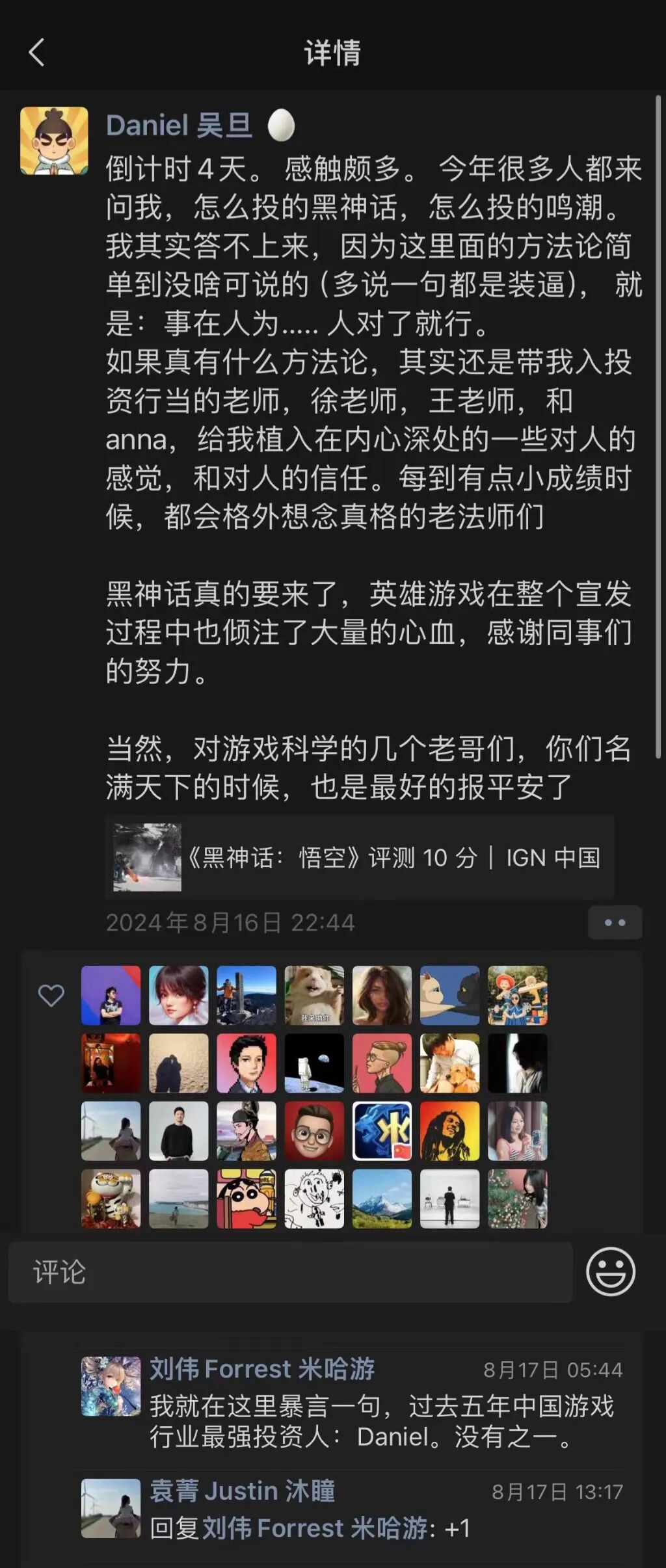
Daniel's Moments post
In fact, from an investment perspective, Kuro Games — whose global blockbuster Wuthering Waves launched in the first half of this year — may be Daniel's more successful case. Since his first investment in 2017, he kept increasing his stake, at one point holding as much as 49%.
He's a sharp-eyed strategist, but more importantly, a true friend who stands beside founders. When Game Science greenlit Black Myth: Wukong, he immediately followed up with 100 million RMB and helped the team relocate to Hangzhou, finding them a secluded workspace in the mountains. He even lent them his father's car in Hangzhou for founder Feng Ji (Yocar) to get around.
When Black Myth launched, Daniel wrote on Moments: Lots of people asking how I invested in Black Myth, how I invested in Wuthering Waves. "I honestly can't give you a method, because the methodology here is so simple there's nothing to say (any more would be showing off). It's: it all comes down to people... get the people right and you're good. If there really is a methodology, it's what my teachers who brought me into investing — Teacher Xu, Teacher Wang, and Anna — implanted deep in me: a feel for people, and trust in people. Every time there's a small win, I miss the old wizards at ZhenFund extra hard."
In 2012, Daniel, then working in audit at Deloitte, met Anna (Anna Fang, founding partner and CEO of ZhenFund) at a dinner.
Anna recalls: "After the meal he said he wanted to join ZhenFund, and wanted to talk to me. I thought, we have no budget, we're still paying rent, what's this handsome guy doing here? But we were making spreadsheets every day and needed someone for finance, and we could afford the salary. Fine, come help us with some reports."
Back then Daniel liked wearing shorts and slippers to work, obsessed with gaming all day, not writing memos. Teacher Xu (Bob Xu, founder of ZhenFund) told Anna: Don't make him do finance stuff, just let him look at games — he could become China's best gaming investor.
A year and a half after joining, Daniel became the youngest VP in ZhenFund's history. In his three years there, he invested in Superhero, Crisis Action, and Vainglory, at one point capturing 70% of successful mobile game startups in the market. Later he transitioned from investor to entrepreneur, co-founding Hero Games with Ying Shuling.
Last week, Daniel returned to ZhenFund to talk with us about the people-first philosophy behind his investment decisions in Black Myth: Wukong and Wuthering Waves. After so many years in gaming, the key remains "starting from the person themselves."
Below are excerpts from our conversation.

Daniel (left), who loves cooking, making breakfast at an Airbnb
During his freshman summer, he once trained in a hotel kitchen in Hangzhou
Teacher Wang (right) noted:
"Daniel's scallion oil noodles were a must-eat at ZhenFund's early project meetings"
01
"Setting Aside All Business Conditions, I Wanted Him to Succeed"
Q: Going back to that moment — Yocar left Tencent's Asura with old colleagues. Was this a white-horse project everyone was fighting over?
Daniel: Honestly, they were a team that some people definitely valued and others definitely didn't (laughs). Polarizing reviews. Looking back objectively, there were probably other offers, but none matched mine in valuation and speed of payment. Of course, my decision speed and payment speed were definitely influenced by ZhenFund. When I was there, Teacher Xu pushed a reform called the one-page TS (Term Sheet), which deeply shaped my investment style.
Looking back now, many say the Black Myth team was impressive because they made Asura. But if you know the industry, Asura was a project that spent enormous money back then with insufficient commercial returns. At the time, the only metric people used to evaluate a game team was "can they make money, how strong is their commercialization ability?" That was definitely questioned by many. But at the same time, their content capabilities and production experience made many people's hearts race.
Q: How did Hero Games end up investing? Asura was famous in the industry, but Tencent didn't invest, NetEase didn't invest.
Daniel: I think it was a mutual selection. The two giants didn't invest — either slow decision-making, or they didn't want to, or they couldn't match my valuation, any of these could be true.
I believe many people felt this team lacked commercialization ability, too idealistic. But in the end, it didn't succeed through commercialization ability — it succeeded to some degree through idealism. Or as the founder put it, pragmatic idealism.
But after talking with them, I was resolute, absolutely resolute, wanting to sign and wire money the very next second. Hero wasn't very famous then either — we were also a startup, somewhat like ZhenFund's early days as a new fund. But ZhenFund's training gave me the instinct in that moment: I knew only by being fast enough, "fierce" enough, sincere enough, could I get what I wanted.
Q: What drove that "resolute, absolutely resolute" decision?
Daniel: After talking with Yocar, it was so rare. Talent like this.
First, I was already running Hero by then, and going deep into R&D made me understand "industrialization level" — how to get many, many people working on one project with good coupling, arranging the pipeline well, making production highly efficient.
I had a simple judgment then: assuming games move forward, industrialization level is the most important thing. Industrialization level is built on project experience. You can't have that industrialization experience without having been through a 200-300 person project. It's complex — understanding pipelines, tools, and so on.
In all of China, people with large-project experience were very few: Tencent's Asura and Moonlight Blade, NetEase's Justice — just these three or four big MMO projects, very few. This kind of project experience was 100% scarce.
Second, my first impression after talking was that he's an all-rounder. Game industry producers come from technical, art, design, or operations backgrounds — all have weaknesses to some degree. But Yocar truly understood everything. He had strong aesthetics, understood design, understood some technical aspects, all with deep comprehension.
And he was highly intellectual. Talking with him felt like talking to a biologist — theoretically he could have pursued a biology PhD. But simultaneously he was deeply humanistic, able to discuss math, philosophy, creative expression, macro environment, just like Teacher Wang (Wang Qiang, ZhenFund co-founder) — someone who'd read every book.
I didn't know how all these things would eventually crystallize. At the time you couldn't imagine all of this would ultimately be realized in the product Black Myth: Wukong. But in that moment I was deeply drawn in. Simply: genius, all-rounder.
Q: What did you talk about in that first meeting? I heard it was less than half an hour.
Daniel: First meeting was in Shenzhen. Yocar told me the team's history and their thinking behind Art of War: Red Tides. His conversational style was very strategic — you wouldn't think he was a game producer. He always started with, let me give an example, today there's The Wandering Earth, what does this prove? Theoretically what kind of market should China have? A macro-to-micro way of explaining things.
There was another interesting conversational detail. The trailers for Asura and Hundred Generals were extremely high quality, like films. I asked why these trailers could be so good. He said, you know what I did in college? Every day in my dorm I was obsessed watching commercials, hundreds of them.
That's the kind of person he is. What's Yocar like? Look at his Moments — every few days he recommends an animation, every few days a film, every few days a book. He's forever swimming in all kinds of content works. All his recommendations are described in rhyming doggerel; if one day his Moments post suddenly doesn't rhyme, there'll be a pile of comments questioning, why no rhyme today?
Q: In 2017 Hero invested 60 million for 20%. That was serious money for that era.
Daniel: This guy was, after all, someone with real credentials. Thinking about it then, I had to invest regardless. Talent this scarce, a team this scarce, project experience this scarce.
Actually, suddenly encountering a 60 million project, you still have to grit your teeth. At ZhenFund I'd been doing deals in the millions... it was like doing angel investing the whole time, then suddenly encountering an angel project that needed Series B money.
Q: Actually Hero invested aiming at Art of War: Red Tides — the team hadn't started Black Myth: Wukong yet. How was the decision made to greenlight a single-player game? Why another 100 million?
Daniel: Before the team officially started Black Myth: Wukong in 2018, they had made 3 products: from Asura, to Hundred Generals, to Art of War: Red Tides. Simply put, roughly every 3-4 years a product since 2012 (actual development time for Asura unclear).
The situation then was, after finishing Red Tides, the team was in a relatively lost state, with not much money left in the account. We talked at Xianggan Farmhouse in Shenzhen — amazing food, highly recommend. I asked him, what now?
After careful discussion, Yocar shared his thoughts. What he said in that Xinhua interview, it was all real and objective. How he viewed the single-player market, how he viewed this opportunity, and so on. For me, what moved me most was still the state he showed. A kind of constant self-reflection first, the ability to look inward for causes when facing difficulties or failures.
The gist of what he said was: we have to understand ourselves first. This team of ours can't make purely commercial games. We have our own aesthetic convictions, our own convictions about gameplay. We don't love or experience enough of those purely commercial games to make them well. We should make something that moves us.
For me, if this team couldn't do commercial games and didn't really want to, then they should take another shot at making what they loved.
At the time, my decision was really based on a few key judgments — the major assumptions that had to hold for this to work. 1) That the single-player market actually existed, that there was a real opportunity there. 2) That telling Chinese stories well came with major tailwinds from the era we were in. 3) That this team could actually tell Chinese stories well, and had the capability to produce a AAA-quality game.
Of these, 1) and 2) had already been validated by the film industry, which had run ahead and proven that these big stories worked.
- was what I cared about most. I deeply believed this team had the ability to truly tell Chinese stories and to make AAA games. I remember Yocar's exact words at the time: "A person must bind their cause to the rise of their nation and people to gain maximum momentum. This is the most朴素 sentiment and the most basic rationality." That was his attitude toward this whole thing.
And in their body of work, what came through was their understanding of Chinese culture, their love for it, and their ability to productize it through their own aesthetic sensibility — all of which convinced me that despite how hard AAA game development is, they had what it took.
Telling Chinese stories well is a grand命题. Many people fake it, but he's real.
Q: What did the rest of Hero Games think?
Daniel: Most of the company was against me. Actually, after we finished Art of War: Red Tides, there was still opposition to this team within the company — at least among the people who had worked on that project... most of them ended up leaving Hero.
And to some degree, committing to a project at this level meant competing with other internal teams for resources. After all, the company's money was finite.
Q: But from your perspective, there are so many games with better business models out there, so many more profitable paths. Even if he could make the first single-player game like The Wandering Earth, why not invest in other projects that could bring higher returns?
Daniel: To some degree, you just want him to succeed. For Yocar as a person, stripping away all commercial considerations — I want him to succeed.
If he didn't succeed, I'd feel不甘 on his behalf. There was genuinely that emotion in it. This was also something the humanistic side of ZhenFund gave me. I really wanted a piece of Chinese culture to emerge in this form at some point. I really wanted to play a game like this, and I deeply believed this team could make it.
02
"The Hardest Part Is His Temperament"
Q: Many people say Black Myth: Wukong's success was a matter of the right time, place, and people.
Daniel: The timing was absolutely critical. When we greenlit this project, our starting point was the massive success of Wolf Warrior and The Wandering Earth. We judged that if a work broke through the ceiling on technology and quality, national pride would definitely translate into major commercial performance.
Journey to the West is a Chinese story. This team had made Asura, so they were already a bunch of "Journey to the West scholars" — that's a term the team taught me. When you build an IP, what takes the most time is actually world-building and creature design. Like, if I'm drawing a monster today, what does it look like? That requires enormous research. So theoretically, if they kept making games in one style, they'd get smoother and smoother.
At that point, the best-selling single-player game in China had moved about 100,000 copies. We projected Black Myth: Wukong at 10 million copies. (It hit 10 million across all platforms within three days of launch.)
The hardest part was actually pulling off something like The Wandering Earth — that came down to the team's capability. But we judged they had it.
Everything after that was just walking forward, trying things out, enduring hardship, exploring uncharted territory. The first trailer dropped and got over 50 million views on Bilibili. That was great.
Q: Did you think about the worst-case scenario after release?
Daniel: The worst case would be mediocrity. You sell, say, one or two million copies.
From an investor's perspective, what worried me most wasn't selling 100,000 copies — then you'd know the market didn't exist. It was selling one or two million, stuck in the middle. Not enough money to make the next game, not impressive enough to raise funding for the next one. You'd be stuck. That's the most painful scenario.
Q: As a founder, what's Yocar's most critical trait?
Daniel: On one hand, he genuinely, deeply loves his country — I mentioned this above. Wanting to do this and being able to execute it both stem from that deep love for every aspect of his homeland. On the other hand, from my perspective, the hardest thing about a founder isn't how good their R&D skills are. The hardest part is his temperament.
When massive流量 pours in, a lot of people lose their heads. After that first trailer hit 50 million-plus views, all kinds of people started coming to him. He told me, "Daniel, help me block all of it. We need to shield ourselves from all outside interference right now."
They even deliberately moved from Shenzhen to Hangzhou. Why? Because they judged that the team's temperament mattered. In Shenzhen, someone could come poach you at any moment. Hangzhou was a quieter, more suitable city. Plus, they basically went into retreat in a mountain outside Hangzhou, which was genuinely "bitter." Once when I visited him in Hangzhou and rode in his car, he said a full tank of gas lasted him three months. I mean, I burn through a tank in no time.

Game Science Hangzhou Studio
They had one mantra internally: done is better than perfect. This was something Yocar emphasized to me every time I visited.
In game development, you have to keep subtracting. You must have a sense of project boundaries. A lot of projects stretch to ten years, or budgets spiral endlessly. Honestly, from a professional game perspective today, this game probably still has plenty of issues, and players have plenty of nitpicks. But we knew clearly that completion itself was the breakthrough.
Black Myth: Wukong had seven partners in its organizational structure. Every interview says these seven partners endured hardship together. They suffered for years and never fell apart. That massive amount of content at the end was the result of everyone pulling together.
He even leveraged all of Hero's capabilities. Before launch, Hero's entire publishing team — dozens of people — voluntarily lived in Hangzhou to help him ship the game. It's hard to get someone to live in another city for a month or two, but Black Myth: Wukong had the power to unite people around it. He made you feel like you were fighting for an ideal, that you were part of this ideal. It was genuinely inspiring.
I also remember something Teacher Xu once told the team — I forget the occasion. He said that of all the companies he'd invested in, the founders who truly succeeded were the ones who felt gratitude toward him.
When you finish Black Myth: Wukong, players see a long list of credits. There are many, many Hero people on that list — people from the Hero team who helped him during Art of War: Red Tides, some of whom played no functional role in Black Myth: Wukong's launch. But he was grateful to them. That was probably part of his temperament too, and it was very warming.
"I Look for Self-Consistent Talent"
Q: When you're deciding whether to invest in a game team, what questions do you ask?
Daniel: Well, it's like this, (laughs hesitantly, takes a tactical sip of water) back when I was at ZhenFund, I was curious what other investors asked. The happiest thing was going with Anna to meet big shots, just listening to what the大佬 talked about — felt like great absorption.
But when I actually started running Hero, I realized investors and teams care about two different things. So I think ultimately it's not about what questions I ask — it's about having the level.
Your level definitely comes from spending time with founders, understanding what they're thinking. What they're thinking is what you should ask. When you don't understand what they're thinking yet, whatever you ask is wrong.
Because I'm only in games, I understand what everyone in this industry is thinking too well. At Hero, I manage R&D, publishing, investments — theoretically every direction games encompass. When making investment decisions, this genuinely drives a lot for you.
Q: What are your criteria for judging a game producer's capabilities?
Daniel: The most important capability for a game producer is macro-level thinking. Whether for single-player or online games.
Games have many mechanics, systems, numerical design — all nested and coupled together. You have to think from the start about how they couple, whether my target audience is broad or niche, how all the creative vision, art, and technology extend from this core. The perfect state is: I write a立项 proposal today, listing five objectives. Three years later I look back, and those objectives haven't changed. That's the most impressive — thinking with extreme clarity from the start.
Most people only stay at the first level: "I want to make something fun." But they can't articulate user segments, system architecture — that means the thinking is incomplete, and they won't make money. Games fear nothing more than unclear thinking and rework.
Then there's game aesthetic. Game aesthetic converges with the direction they want to make. Because their game aesthetic is the type of games they love playing, and experience in that game type determines their倾向性 in production. If you read Wang Shuo all day, what you write will be that style. Soul-like games might seem niche, but if their growth rate is fast enough, it can still support your investment thesis.
I invested in Kuro Games because I realized the producer of Wuthering Waves was a genius. Born in 1990, his game production experience was extremely shallow at the time. But I found his aesthetic and visual sense perfectly suited for making cool二次元 games.
If you knew this space, the successful二次元 games at the time were mostly Japanese cel-shaded. But a relatively硬核, slightly realistic style was also a massive赛道 in二次元. No one was doing it then. This producer was young and hadn't completed a full game, but he knew this culture intimately, was obsessed with it. More importantly, his way of thinking was macro-complete and micro-stunning, so I invested decisively.
Q: What can you determine in a first meeting?
Daniel: To some degree, it's still about process contact. I later realized that, say, if you're discussing investment with someone today, I'll suddenly show up unannounced at their office building, say come down for a smoke or a tea. You want to chat in unguarded moments, in informal settings. That draws out more.
Q: In long-term process contact with founders, what do you look for as good or bad signs?
Daniel: What I constantly observe is whether they're focused on what they're good at, staying constant and unchanging.
The top priority is absolute conviction at the strategic level — you can't change direction blindly. The gaming industry has one defining characteristic: a single strategy affects you for at least three years. You decide to make this game today, say at a cost of a billion RMB a year. If you switch strategic direction in year two, that billion is burned for nothing. You have to constantly remind yourself not to change course for any reason, not to chase hot trends.
The second priority is organizational structure — it must align with your production factors. Then I look at what makes the founder and management team happy, and what upsets them. Many small grievances stay buried inside, and suppressing them for too long becomes toxic. I pay close attention to this because it directly affects organizational stability.
Q: From your early days at ZhenFund grinding through game investments to now, more than a decade later, has your lens for evaluating game teams changed?
Daniel: Back at ZhenFund, what I cared about most was raw talent. People make things happen, so I only thought about the people.
What I focus on now is coherent talent. That coherence is critical. It comes from many layers — your conviction in what you're doing, the fit between you and your investors, organizational structure. If a project needs many people, management capability has to keep pace. It's still about what it takes for something to succeed, and there are always a few key elements behind that. Break down the elements, then see if this person can handle them.
Q: For game creators, what's the last mile from good to great?
Daniel: The last mile is your ambition. It's definitely not for money — it's for your vision, your product ambition. The energy behind that is enormous.
You have to have that level of ambition. Because the process is brutally hard. Gaming is the most overtime-heavy industry in the world. You're always working late, always trial-and-erroring, always iterating in uncharted territory.
Q: How do you identify whether someone has that kind of energy?
Daniel: It's the feeling from talking with them. When they're nothing, who do they want to become — that's the example I look for.
Q: What are your investment principles?
Daniel: It has to be extremely early-stage — probably from my ZhenFund background.
I need publishing rights for the first product. Then continuous follow-on investment; deep stacking is critical. Only when these three points come together can you maximize returns.
Q: A project where everyone says it's bad but you think it's good, versus one where everyone says it's good — which do you prefer?
Daniel: Things are deeply dialectical. Suppose you ask many people, everyone says it's bad, but you feel it's good. Then you can go all-in on it.
What I worry about most is when everyone says it's good. Then you wonder — why should this opportunity be yours? Why does this project belong to you? Once intense competition forms, I definitely pull back.
Basically for every investment I make, when I ask others, there's plenty of skepticism — that actually makes me feel more secure. Of course, the precondition is my ZhenFund experience gives me confidence and logic in my own investment decisions.
Q: Sounds like you only bet on dark horses. Does betting on white horses ever work in gaming?
Daniel: Very few pure white horses have made it in gaming.
Because if you're a white horse, that means you already have strong successful titles. Strong successful titles mean path dependency. Path dependency means you're still competing in areas where traditional giants excel.
What does an industry reaching maturity represent? It means whatever you're trying to outcompete on, the giants will spend ten thousand times the time or resources to outcompete you on.
Q: You moved from VC into industry. What advice would you give to pure VC institutional investors now?
Daniel: Investing is a process of stripping away ego. You have to be a blank sheet to truly understand others. My advantage is I'm naturally a blank sheet — that's my personality.
Sometimes you've already thought a hundred times that a direction won't work. Maybe it's just their current direction that won't work, but the person is solid. You have to avoid misjudging because of ego.
There are three angles to view people. You can look up at them, look down at them, or look straight at them. Personally, I prefer to always start by looking straight at them. If gradually you start looking up at this person, that might be when you should double down.
Q: You've said you actually don't have much time to game now, just a bit for leisure. When you use yourself as a measuring stick for teams, how do you keep that stick sharp?
Daniel: The refined measuring stick isn't actually for products — it's for people. Once that stick forms, it forms. I rarely spend time refining it now.
The prerequisite for good product taste is people's taste. There are still many dimensions to figure out about people.
"The Next Era of Gaming Investment Opportunities — We'll Know in Two or Three Years"
Q: Over all these years in gaming, what have the biggest hits done right?
Daniel: I think the biggest hits all come from doing what others can't do. Genshin Impact was like this back then; Black Myth: Wukong is like this today.
Because gaming isn't rocket science — spend enough years and anyone can make something. What's hard is whether you have the guts and patience to do it.
Q: Is the investment success of Black Myth: Wukong replicable?
Daniel: I think it's not replicable. The core creative team is also hard to replicate. What this team can do, others can't. Gaming is extremely talent-dependent, just like film is director-dependent.
From my personal judgment, younger developers today would find it hard to make this kind of single-player game. Why?
A game like Black Myth demands very high humanistic depth from a person. Older developers have lived through more eras, more life experiences — more sediment. The younger generation grew up in relatively smooth, happy circumstances; they can't make games with this kind of weight. Going forward, maybe in ten years, looking at the young generation inspired by Black Myth: Wukong — maybe they're fifteen or sixteen now, saying I want to make something like this. Then possibly.
The next era of gaming investment opportunities — we'll really know in two or three years. Right now I'm basically not investing at all.
Q: You're not investing (in external gaming startups) now — so what are you doing?
Daniel: I'm very focused on building Hero Games. I've been working on my own projects, now with over 2,000 people.
Because you get so much positive feedback from investing, you end up wanting a work that's truly your own. Of course, this also relates to objective规律 [objective规律 → objective规律/objective规律]. The stage Hero Games is going through might be what the Black Myth team went through when they were making Asura. Gaming can't escape the规律 [规律 → 规律/规律] of needing accumulation, needing沉淀 [沉淀 → 沉淀/sedimentation]. I'm spending more time now getting Hero's team to accumulate and沉淀 [沉淀 → 沉淀/sediment] on the right things.
Q: What are you waiting for these two or three years?
Daniel: In two or three years, AIGC will become a major variable, and that should bring a new round of shifts in investment thinking. But right now AIGC hasn't truly taken shape. It's improved efficiency somewhat, but not enough.
Q: When we see a new technology emerge, there's often a "tech + gaming" trend — Web3 games, AI games — but they rarely seem to pan out.
Daniel: I think it's always gaming plus something else.
Always. It's what I said about focusing on the team, not getting distracted by new directions. I've seen countless gaming entrepreneurs pivot to Web3 when it emerged — I wouldn't invest in those people dead or alive. First, they don't love games, so how could they possibly make good games? Very simple logic.
Many people ask me, should we make a Vision Pro game? I say we don't need to make Vision Pro games, because what we're grinding at every day is content production capability. It's quality on one hand, efficiency on the other.
Suppose Vision Pro really becomes mainstream. Based on our quality and efficiency itself, we'll provide the best content. It's not about doing it early that lets you provide good enough content. These are two different logics. Back when everyone said invest in a mobile gaming company to disrupt Tencent eventually. No. In the end Tencent crushes that market, because its production quality and efficiency are there — the market just matured.
What you want to capture is what giants can't do. Either the giant can't attract that talent — for example, ACG talent doesn't like joining giants — or the giant doesn't have the organizational efficiency to do it. You only need to focus on these.
"Be in Enough Pain Yourself, But Give Everyone Else Hope"
Wang: Back at ZhenFund, we saw you as a person of temperament — a gentle, glowing kid. But that person, later at Hero, now managing 2,000+ people, became a number-one who stands on his own. From entering ZhenFund as a gaming investor, to founding a company, to becoming CEO — what's been your biggest growth?
Daniel: The biggest growth has actually been enough pain.
I used to be very easygoing — sit in meetings with my leg crossed, the team felt no pressure. Now I'm not in that state. I force myself to not smile.
You realize many things must be done brutally. When the company transformed, I started by cutting hundreds of people. Later I had to turn off my phone. The pain was in team members' wives texting me saying my child is only a few years old, how dare you do this to us?
That transformation cut deep, and gradually you find some rhythm. Cutting people has to be one clean cut — not some today, some tomorrow, some the day after, which constantly erodes morale. One clean cut, and those who remain know it won't be them.
Throughout company management, you finally discover the hardest thing is finding your own weaknesses, or rather, the hardest thing is always understanding yourself better, and learning to work with yourself. For example, though I'm relatively strict on the surface now, I'm not someone who can really push a team hard internally — so I delegate that to people who can push.
If I'm a Liu Bei in this company, the people who complement me must be Guan Yu, Zhang Fei, Zhao Yun types who wield the whip. Strategists don't fit me — you must be a warrior. Also, because I'm not a harsh person, I don't crack the whip, which means people who work with me long-term must be highly self-driven. I don't like spending too much time teaching or mentoring people.
These past few years at Hero I've gone through a major cycle transition. Major internal adjustments, mindset adjustments. For me, first set the specific direction, then adjust the mindset, let a small group get rich first, then use that small group to卷 [卷 → 卷/involution] the rest. Slowly build this feeling and positive, upward卷 [卷 → 卷/involution] internally. My investments, for me, are about letting a small group get rich first to drive internal team卷 [卷 → 卷/involution] — they're a benchmark, and of course these benchmarks are quite big now, possibly industry benchmarks even...
I write an annual internal letter to the company now. I don't travel during Spring Festival — stay home in闭关 [闭关 → 闭关/seclusion] writing the letter, and gradually feel the shifts in my own thinking.
This is also something I learned at ZhenFund. Didn't Teacher Xu write letters too? The power of written words far exceeds the power of speech. After writing more, I realized I'm not bad at this, I can actually write.
In 2017 I wrote why we couldn't be a publisher anymore and needed to transform. In 2018, why we needed to make certain types of games and how. In 2019, how our organization needed to evolve from small teams to industrial-scale management. In 2020, what we still needed to watch out for during our transformation, and how the external world was changing — stuff like that. I keep at it every year.
Why are big companies so easy to manage? Everyone on Honor of Kings is pulling overtime every day. Nobody in gaming outworks the big companies, because they have this obvious "let some get rich first to help others get rich" effect. One project team makes that much money, and everyone at Tencent knows it — so everyone works just as hard as they do.
Startup teams don't have this capability. You don't have someone who got rich first up ahead, so you have to create one yourself. For me, I did it through investing, using the power of ecosystems. To some degree, Tencent probably works the same way — they also got investing right first. The Four Little Dragons back then, League of Legends, Dungeon & Fighter, CrossFire — all investments. Then they used that to drive an internal R&D transformation, which built the empire they have now. Actually, when I first started working on Hero Games, I studied a lot of their strategies and thinking.
You have to work your way down layer by layer, and first of all, you can't rush. You need to find the underlying pattern of how things develop, need to be especially patient. You need to observe them, accompany them, let them grow that way.
Q: What impact will Black Myth: Wukong have on Hero Games going forward?
Daniel: Not much impact. We extracted strong publishing capabilities through the process. As co-producer, we handled much of the publishing work. Things like how to select KOLs and KOCs? How to do cross-industry collaborations? Going through all that, we actually leveled up our experience significantly.
We learned a lot from this process. For example, we now have an entire algorithm for KOL management. We've developed our own algorithm based on views, reach, and the logic behind them — we can precisely calculate which KOLs deliver the best livestream sales results. This actually helps us with every game we make going forward. You have to go through a game launch and publishing cycle like this, test it out, to actually develop and refine your algorithm.
Q: What's your approach to self-improvement? Some people read, some think, some chat.
Daniel: My approach is to talk to lots of people, do everything possible to talk to the most impressive people. I'm also quite fond of reading.
Q: What's your greatest talent?
Daniel: I think my greatest talent is having no shame.
Let me tell you a story. Nobody knows this one, I'm sharing it for the first time today. When I first joined ZhenFund, my business card said "Analyst." But the gaming industry was already taking off then, and my problem was I needed to meet the big bosses in the industry and sell games to them. So I went and printed my own cards that said "ZhenFund Partner." I still have that card, haha. You have to figure things out yourself.
For example, when I first met Anna, I proactively asked if she could recruit me? Shamelessly selling myself to Anna.
Teacher Wang: I knew about the business card thing, you know why? Back then you once took me to Shanghai to meet a student returning from abroad, and you showed me that card. I said, just use it quietly, haha. Teacher Xu didn't know either.
Anna: ? (face of shock, turns to everyone) Don't you all go learning bad habits!
Daniel: Right, that's how I got to know Zhou Yahui. So you still have to come up with your own moves, this is hard to teach directly. Haha.
Teacher Wang: Daniel himself is also a case study of ZhenFund's people-investment philosophy. So Anna, when you brought Daniel in, how did you judge him then?**
Anna: I always joke that it was because he was cheap.
But definitely not because of that. First, I genuinely felt that at that time, anyone who really wanted to join ZhenFund — I'd be willing. To this day, all of us still have eyes only for ZhenFund, we'd never apply anywhere else. If you say you want to make money, you could go to a big institution. You have to love this thing, love angel investing.
When Daniel first came to ZhenFund, he was always playing games, not writing memos. Teacher Xu had Daniel switch to gaming investments. I learned how to read people from Teacher Xu, learned to follow talent and find each person's spark. People absolutely shouldn't do what they don't want to do.
Teacher Xu truly changed Daniel's direction. What I regret is that he got poached by Lao Ying to go do what he's actually good at: founding a gaming company.
(Daniel then continued sharing two hours of off-the-record content)

2012, ZhenFund on a team retreat in California, just two years after founding
Daniel in the center
Recommended Reading