Emperor Jin: I Want to Make a Spiritual Successor to *The Invisible Guardian*

The most important meaning of choice is to experience life.
"This is a decision with far-reaching consequences. Choose carefully!"
In Dihuangjin's world, choices are never easy.
From directing The Invisible Guardian in 2019 to Game of Fame in 2024, and now Jiangshan Beiwang in 2025 — the branching paths grew from three to nine, then to over 20,000 in the first chapter alone, so many that the system couldn't even process them. His way of telling stories keeps evolving.
But one thing never changes: he loves to tell the story of a person's entire life, from youth to old age. Only by stretching the timeline can choices acquire their sense of destiny.
He removed the fast-forward button and the progress bar. For 600 minutes, you can only follow the story forward, making decisions under countdown pressure that echo across chapters, across time, across space.
Since its launch in November 2025, Jiangshan Beiwang — this alternate-history live-action interactive film game — has accumulated over 4,000 reviews on Steam, with estimated total revenue reaching tens of millions.
That day he posted on Weibo: "Guess I've paid off my debt to The Invisible Guardian."
In 2015, he graduated from the Shanghai Theatre Academy. Having traveled all the way from Ya'an, Sichuan to Shanghai, he realized early on that staying in this city would require more radical choices.
In 2019, while still making games at Tencent, he met ZhenFund. He faced another crossroads: stay or start a company? He was in his twenties, brash and ambitious. Even against others' advice, he walked out.
In 2023, carrying the halo and glory, the shackles and constraints left by The Invisible Guardian, Dihuangjin once again stood at a fork in the road.
His life has had many branches. On another path, he might have been a lawyer, a host, or continued climbing the corporate ladder. But the person sitting before us now is director Dihuangjin.
You never know what the road not taken would have been like.
Sometimes, he too feels his own life resembles an interactive film game.
Returning to that "decision with far-reaching consequences" — if he could do it over, he'd likely still take this more radical path, to tell a story that makes people cry, burn with passion, seethe with anger, and feel the thrill of satisfaction.
"This time, may you leave no regrets."

Life Is Like an Interactive Film Game
Q: You just finished shooting your new series last week. What interesting things happened on set?
Dihuangjin: There was a horse-riding scene.
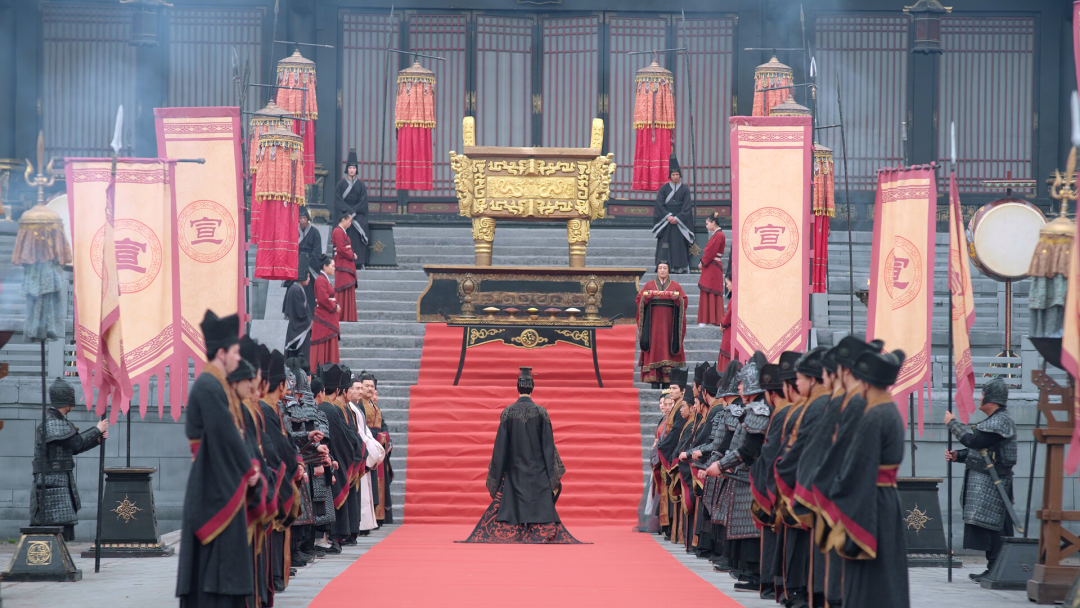
Horses are incredibly difficult to control, especially on a film set. This was Zuyue's first appearance (the daughter of Zu Kun, a famous Northern Expedition general in Jiangshan Beiwang), and we wanted to capture her as fierce and commanding. The scenes before it ran long that day, and we didn't get to it until late at night.
There were eight horses total. Our design was to have them gallop in from a distance, stop at a designated spot, hold position while delivering lines, then count down three-two-one. The horse would step forward, then hold again.
Talking about it now, it sounds absurd. The assistant director, the horse trainers — everyone was trying to talk me out of it: "Director, forget it. It's too late, and we still have fight scenes after."
I said: "Here's the deal. We'll give it one take. One try. If it doesn't work, we drop it."
It worked on the first try.
Everyone was stunned. I never really believed in fate, but that was the first time I felt something like it. Later during shooting too — people ask why we're praised for cost control? It's like heaven was helping us.
We were filming in Hengdian right during the return of the southern damp season. The weather forecast called for rain every single day. But we had so many exterior day scenes — either convert to interiors or rent rain tents. Rain tents are priced by the day: small ones 3,000 RMB, large ones 6,000, up to 9,000. Once you rent them, that money's gone whether it rains or not.
So every night we discussed one question: Do we gamble that 3,000?
Don't rent it. Take the bet.
The next day, no rain.
One day, the forecast called for a downpour. Everyone on set had the same thought in their heads: If it's not raining, shoot fast. We finished the exterior day scenes, moved to interiors, and less than five minutes later — torrential rain.
That moment, everyone was marveling: Heaven helps. Heaven truly helps.
It makes you feel like the set has its own spirit. Our entire shoot came in on schedule, with no delays or reshoots due to uncontrollable factors.
Another time, we were shooting a wind shot. For the image to work, the flag had to be billowing. Right before rolling, someone in frame called out: "Wind, come."
Everyone knew — the wind wasn't going to come.
But the moment those words fell, the wind arrived.
Q: I saw you once said you feel your own life is like an interactive film game.
Dihuangjin: In the process of building a company, I think the most important thing is making choices. Because you never know how the road you didn't take would have turned out, or whether you'll regret it.
In 2019, when I met ZhenFund, I was still at Tencent. I faced a choice: stay at Tencent or start my own company?
If I had been in my thirties, I probably wouldn't have started a company. But I was a guy in his twenties, young and full of fire. My family kept calling to persuade me not to give up a big tech opportunity. I was actually doing well at Tencent, with a clear promotion path.
I told my dad: "If years from now I stay at a big company, I'll regret it more. Starting a company might also lead to regret, but it won't hurt as much."
At least you fought for it.
I constantly encounter these "decisions with far-reaching consequences" — Option A or Option B.
The biggest difference between life and games is that you never know what the other path looks like. But even if you choose wrong, it's fine. As long as two out of three options are moving your stats in a positive direction, that's enough.
I love interactive film games because they create such strong immersion. We design many life-like choices that let you experience different lives. In The Invisible Guardian, you experience a mole's entire life. In Jiangshan Beiwang, an emperor's. In Game of Fame, a comeback from rock bottom.
The most important meaning of "options" is experiencing life.
Q: Do you regret any of these choices you've made?
Dihuangjin: Only for a moment, then you keep fighting. If I chose the more radical option, I never regret it. At my age, with my personality, this is the kind of choice I need to make.
Q: Where are you from originally?
Dihuangjin: I'm from Ya'an, Sichuan. For someone from a small city, the biggest shock of coming to a big city for college was realizing I didn't want to go back to small-city life. If I was going to stay in a big city, I had to make more radical choices.
Q: What did you do before making games?
Dihuangjin: I studied broadcasting and hosting arts, but I loved games and interned at a gaming channel during college. If I hadn't gone this route, I might have become a host or esports streamer.
But as luck would have it, right after graduation some friends pulled me into a project. We desperately wanted to make something like 428: Shibuya Scramble, a Japanese platinum hall-of-fame game. We wanted to make our version of it, which became the prototype for The Invisible Guardian.
As we worked, we started making interactive short dramas too. In 2015 I made a lot of interactive short dramas, but the concept was too early — everyone was still doing long dramas or web films. No one paid us any attention. If we had stuck with it until now, that might have been a good path too.
See? Another choice, right?
Q: The process of making choices is like an interactive film game.
Dihuangjin: The Invisible Guardian ended up doing very well. If it had failed, my life might have slowly returned to its original track.
But it succeeded.
For someone in their twenties just entering society, having a massive label suddenly pinned on you — the pressure is enormous. So I often joke with people: "The Invisible Guardian gave me both halo and glory, and shackles and constraints."
It locked me onto this path for ten years.
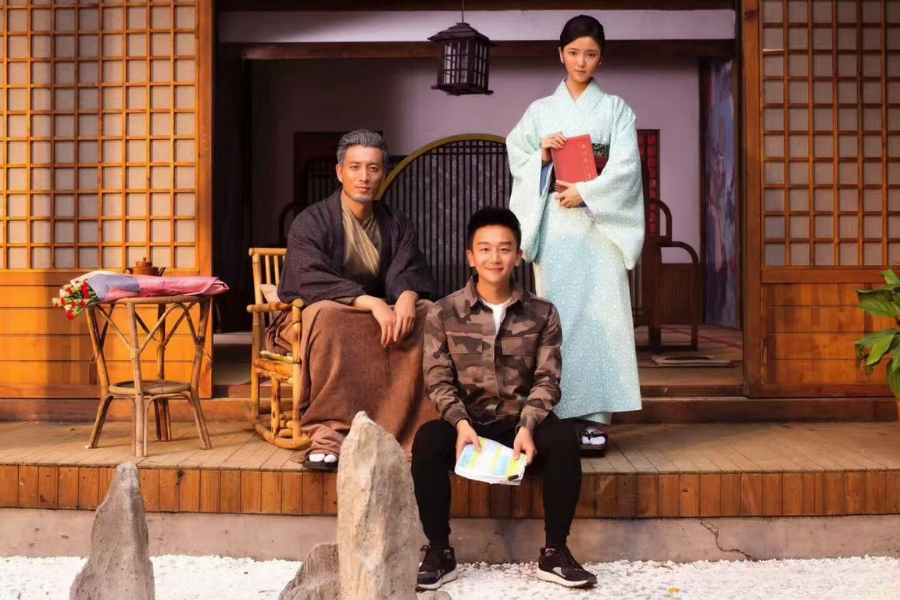
In 2017, Dihuangjin (center) with two actors from The Invisible Guardian — Mutou (left) and Chunzi (right)
It also gave me a heavy perfectionist burden, a benchmark that's nearly impossible to surpass. All these years I've felt that no matter what, I have to make another product like that. If I can't, there will always be a knot in my heart.
Even if one day I leave this industry and do something else entirely, whenever I think back on this, I'll probably feel a sense of failure.
For entrepreneurs, state of mind is crucial. Success and failure often have no clear boundary. Maybe one step forward is success, one step back is failure.
But when you need to take that step forward, you must have the spirit for it.
Q: You don't come from a big tech background or traditional game development. What advantages and limitations has this brought you?
Dihuangjin: More advantages than limitations, because I don't carry industry baggage.
There are things only someone like me would do. In Jiangshan Beiwang, there's a scene where Chen Wan'er meets with Prince Jing and plays the zither — every shot crosses the axis. Someone with formal training would never do this, but I insisted.
Why? Because from that angle, Chen Wan'er looked more beautiful.
I've always believed one thing: beauty trumps professionalism.
So when editing, I scrapped the original version entirely and used all cross-axis shots. After cutting it together, the cinematographer and editor both came to talk to me, but I said: "It's fine. This is how we're doing it."
I don't care about crossing the axis, or whether something fully complies with professional standards. I only care whether the final product looks good. Whichever angle looks best, I use that angle for everything.
I'm not constrained by industry tradition. When people tell me about big-name actors, industry rules — I don't care much. I look at one thing only: whether it serves my product, whether it serves my users.
I deeply enjoy the feeling of people seeing my work.
Q: Do radical options in your games also lead to different endings?
Dihuangjin: They do.
Radical choices always mean higher risk, but potentially greater reward.
In Chapter One of Jiangshan Beiwang, if you choose "raise troops in rebellion," there's a 1/4 chance of going straight to the finale. If you follow Chen Wan'er's advice and choose to "clear the court of evil ministers," we randomly trigger one of two endings. One is defeat and death. The other is ascending to the throne. The probability is 25%.
Some people tried seven or eight times without triggering it. Some hit it on their first try and said: "How did I become the chosen one?"
You directly unlock the Liu Xiu script — Northern Expedition all the way, reclaiming lost territory, finally becoming emperor, with none of your companions dying. It's the best possible ending.
The Meaning of Live-Action
Q: Have you been watching AI-generated animated dramas lately?
Dihuang Jin: I actually enjoy watching short dramas and AI-generated animated dramas in my free time, but I haven't tried making them myself. I keep my hobbies and work separate.
People often ask me: Can short dramas be made interactive?
The audiences are completely different. People who watch short dramas won't enjoy interactive games — in fact, they'll probably leave bad reviews. They'll think: "This isn't satisfying at all. Why make me choose? Why can't I save everyone? Why can't they all love me?"
I've always had this intuition: Short drama users are inheriting the audience from traditional TV dramas and variety shows — free to watch, monetized through ads. Interactive games are inheriting the audience from movies — selling tickets, you come in to experience a story.
Only the medium has changed, the content format has changed, the storytelling method has changed. Short dramas went from horizontal to vertical screens; movies moved from theaters to online. But the underlying experience they provide hasn't changed.
Short dramas are light entertainment, giving you that satisfying rush. But movies deliver emotional value — a higher-level emotional experience, even a kind of self-actualization.
I enjoy watching dramas, but what I make is movies.
Q: Using live actors requires a lot of coordination. Why still use real people?
Dihuang Jin: People often ask: What's the real meaning of live-action interactive film-games?
Some think this is just a transitional form — story games evolving from Galgames toward large-scale interactive narrative games like Detroit: Become Human or Beyond: Two Souls. But I can't think that way.
Live-action has crucial significance. I can feel from player reviews that live-action interactive film-games reach a broader audience than traditional games.
At the time, The Invisible Guardian even had grandparents playing it. Because the story was set during the War of Resistance, their generation already had an emotional connection to that era, and they played very seriously. They didn't feel like they were playing a game — they felt like they were watching a story.
If I were making a 3D game like Detroit: Become Human, this would almost never happen. Because as soon as you have 3D modeling, requiring WASD controls, mouse controls — people who don't normally play games won't participate.
But whether it's The Invisible Guardian or Game of Fame, you get this strong sense of immersion. If you took The Invisible Guardian's spy story and compared it directly to Lurk or The Disguiser, the plot wouldn't measure up. Yet people still discuss them together. Because with immersion, an 8-point story feels like a 9.
Immersion comes from a very typical feedback mechanism.
Many animal experiments are about feedback. Feed a mouse while simultaneously delivering electric shocks, and the mouse forms a feedback loop. Games work the same way. Defeating a boss drops gold; failure brings punishment; clearing a level brings rewards. Games immerse people through constant feedback.
We just placed that feedback mechanism inside the narrative, making players choose every 3-5 minutes. Every choice is a moment of thought. After you choose, the story gives you feedback — maybe a line of dialogue, a plot development, an emotional trigger — building from simple to complex.
After 10, 20, 30 of these, your immersion far exceeds simply watching a story.
Q: Is live-action cheaper?
Dihuang Jin: Definitely cheaper than 3D narrative games like Detroit: Become Human.
Live-action shooting can be completed within two months. But with modeling, you need extremely detailed micro-expression adjustments — massive workload. Just the art alone takes 1-2 years. Many games don't need this level of detail because players focus on combat, equipment, stats, visual effects.
But story games are different. You need characters to express genuine emotions. I view live-action shooting as this product's "art work" because it accomplishes visual expression. Live actors don't need complex technical processing. An actor just needs one expression, one glance.
Q: Why did you want to make live-action interactive film-games?
Dihuang Jin: Because one day it will expand into mainstream view.
I don't fully define interactive film-games as either games or dramas. It's a new content format. Its medium isn't limited to Steam. In the future it could appear on phones, iPads, even devices we haven't seen yet. It's telling stories in a new way.
From ancient times to now, only one industry never declines: content.
The content industry doesn't suddenly peak in one era, nor is it completely abandoned in another. Humans fundamentally love hearing stories. You can tell stories for a lifetime. But the methods of storytelling keep changing, keep iterating.
I don't cling to any creative philosophy.
From The Invisible Guardian to Game of Fame to Jiangshan Beiwang, my creative approach keeps changing, keeps iterating. But one thing never changes: I'm always trying to make a good-looking, captivating story that delivers high emotional value.
As for how to achieve that, the methods can vary endlessly.
When we first made The Invisible Guardian, we used a "life or death" design. Choose wrong, you die immediately. But the barrier was too high. Many users who were essentially watching a drama would die a few times and then refuse to keep trying or thinking.
With Game of Fame, no matter what you chose in the prologue and chapter one, you'd get a decent ending — but then the difficulty was too low.
With Jiangshan Beiwang, we tried to make choices not give immediate feedback. After you choose, the story continues. But maybe in some later chapter, you suddenly realize that someone you cared about wasn't saved.
The story keeps going. Only at the very end does your posthumous title give a final verdict on your life — were you an Emperor Wen, an Emperor Jing, or an Emperor Guangwu?
But in this process, new problems emerged. Early on with The Invisible Guardian, the programming was simple. Because The Invisible Guardian only had three major endings: the Red Line, the Japanese Line, and the Beautiful New World Line. The program only needed three judgments.
Game of Fame had nine possibilities. We wanted the system to automatically determine which route the player experienced, but found it too difficult, so we just hardcoded all nine outcomes exhaustively.
But with Jiangshan Beiwang, we were completely stumped.
After the script was finished, the system calculated: from prologue to chapter one alone, there were over 20,000 combinations.
Q: Jiangshan Beiwang doesn't even have a "save" option.
Dihuang Jin: That was intentional.
Many narrative games like Detroit: Become Human rely on saves to solve the multi-branch problem. In the past, The Legend of Sword and Fairy essentially also used saves to handle multiple routes.
At first nobody realized how absurd this was, until we made Jiangshan Beiwang.
Save the teacher or don't save the teacher — you make a choice in the prologue, but the value doesn't feedback until chapter five. If you reach chapter five and discover you didn't save the teacher, and want to go back and choose differently, replaying from the beginning would be a terrible experience. So we need to let you jump directly to that node in chapter five to choose again.
But here's the problem: You've walked many different branch paths, all of which can lead to this node. Which path should the system judge that you took?
The Invisible Guardian and Game of Fame never encountered this problem. This time we used a rather extreme method: calculate all possible paths as much as possible, and give the most likely optimal solution that matches player intent.
The AI will infer — you came back because you want to save the teacher — then exhaustively calculate all paths you've walked, and compute the most reasonable path to make this choice valid.
This is the ultimate problem for narrative games after removing saves. If we rate plot complexity, I think Jiangshan Beiwang only achieved 4-5 points, but our writers are already capable of much more complex scripts. The question is: what about the programming?
If this technical hurdle is truly crossed, narrative games might welcome new development. Because it solves a key problem: making people who don't play games not feel like they're playing games.
No save interface, no game UI, no typical game elements. You think you're watching a drama, but you're actually playing a game. To reach a more mainstream level, this step must be taken.
Another point that needs to be crossed is the "choose wrong and die" design.
For most users, this experience is very disruptive. But we can't completely eliminate death endings, because stories still need to converge.
AI is working to expand story breadth, making stories infinitely branched. But we're doing the exact opposite — we're quietly converging stories.
Whether a player buys your game depends less on price and more on whether they feel it's worth their time. If a story has too many branches, the writer's difficulty rises exponentially. Writing one good main line is already hard; making all side branches excellent is nearly impossible. Players might happen to walk into a boring branch, play for two hours, and say: "This game is so boring."
What we do is try to prevent players from reaching those boring branches, converging the story into a few main lines we consider the most excellent.
Q: The game progress bar can't be dragged either.
Dihuang Jin: Right, that was intentional. We removed playback speed too.
Film-games and traditional viewing have different logic. Traditional film is one-way output — viewers just input time. But film-games are a two-way relationship; players need to think and participate. If missing key information due to fast-forwarding or dragging causes worse experience later, it's lose-lose.
People who truly enjoy playing games won't care about skipping on the first playthrough.
We also control pacing in story design, cutting all filler content, keeping only the essentials. Even if the player natively has speed controls, I specifically requested they be removed.
Q: To reach a more mainstream audience, should the plot and choices be more complex or simpler?
Dihuang Jin: The options should be more complex, but the story should be more focused.
This is very contradictory. I want options to be richer, but the story simpler, while also not making players feel the options are meaningless. Reconciling these three things is difficult. We're slowly summarizing methods — like categorizing options into types: value-based, emotion-based, life-or-death, etc., then controlling their proportions in each chapter.
We generally stick to one rule: a choice every three to five minutes. But sometimes we break it — there's one stretch that goes twenty minutes without any choice at all. When you truly know what you want, you know when to use them and when you can skip them.
The one creative principle I've always held to is to never hold to any creative principle.
Iterate based on user feedback. Just tell the story well.

I want to make a sequel to The Invisible Guardian
Q: You mentioned feeling a lot of pressure before making Fame and Fortune.
Dihuang Jin: The pressure was enormous. Two or three years into entrepreneurship and I still didn't have a single finished work.
In early 2023, I faced a "far-reaching choice":
Option A: Film all of Fame and Fortune
Option B: Film just the first third of Northern Expedition
Funds were limited. I didn't have confidence that I could tell the massive story of Jiangshan Bei Wang (Gazing North at the Rivers and Mountains) at that point. Even today, I believe Jiangshan Bei Wang can't match The Invisible Guardian at the script level — and it'll be hard for many years to come for any work to reach that level.
I set a very high bar for myself: I want to make something that rivals, even surpasses, film and television.
When you judge every script in your hands by that standard, eventually they all look like garbage.
My parents helped me enormously. They told me: "Go make Fame and Fortune. Starting something is always better than staying trapped in anxiety, endlessly wondering what to do."
So I went for it. I chose A.
I decided to pour everything into getting Fame and Fortune done first. I even posted on Weibo at the time: "Fame and Fortune is the most suitable product I can make with my current strength and resources."
At first, I didn't even dare put my name on it — I always felt it was somewhat embarrassing. Later, people on the team would tease me about it constantly: "What's this, Fame and Fortune isn't your own child anymore?"
But after launch, players gave it consistent praise and feedback. Even though we hadn't revealed who made it at all, some people guessed: "This has to be his work."
Later, making Jiangshan Bei Wang also faced a very practical problem: our budget was pitiful, less than half of what a film or TV project would get. But we did it anyway. It didn't matter. I've always believed I'll do better than last time. That's how I gradually shed the baggage, the knots, the things weighing on me from back then.

Q: How did you settle on the theme?
Dihuang Jin: We looked at many historical dynasties and finally settled on the Wei, Jin, and Southern-Northern Dynasties. That era had success and failure; chaos and perseverance. The people of that time were chaotic, incompetent, barbaric, corrupt, foolish — but one thing never changed: the Northern Expeditions.
They just kept marching north, kept fighting, for over a hundred years, until they finally recaptured Chang'an.
I was especially moved by this. So this idea stayed with me and became something I held to.
Q: Do you pursue perfection in your creative work?
Dihuang Jin: Definitely. It was precisely pursuing too much perfection in the past that created such a heavy burden for myself. But later I realized there are too many things in reality that perfection simply can't achieve.
Q: Now that you've put down the baggage and proven yourself, what comes next?
Dihuang Jin: When I first talked with ZhenFund, I said I absolutely had to make another Invisible Guardian. But as you work, you discover that this isn't simply about "making a product." It has the potential to become a new way of telling stories.
It's a bit like fate. Whenever I feel like I can leave this industry, some new reason always emerges to keep me here. If Jiangshan Bei Wang were already finished, and I'm still suffering through writing stories every day, could I just leave the industry? Go make AI comic dramas, embrace the new wave of the era?
I absolutely could. I still have that choice now. But in the process of making interactive film-games, it keeps giving me new reasons to feel this is worth continuing.
Somehow, I've walked all the way here.
Q: You've read many player comments. Which one left the deepest impression?
Dihuang Jin: My favorite line, one that many people have said: "This is the spiritual successor to The Invisible Guardian."
For so many years, what I've been trying to prove is this: I can make another product this good.
I've always wanted to make a sequel to The Invisible Guardian. I feel like I've carried a lot inside — toward the audience, toward friends, toward myself. At the very least, I've done what I said back then. I've made it real.
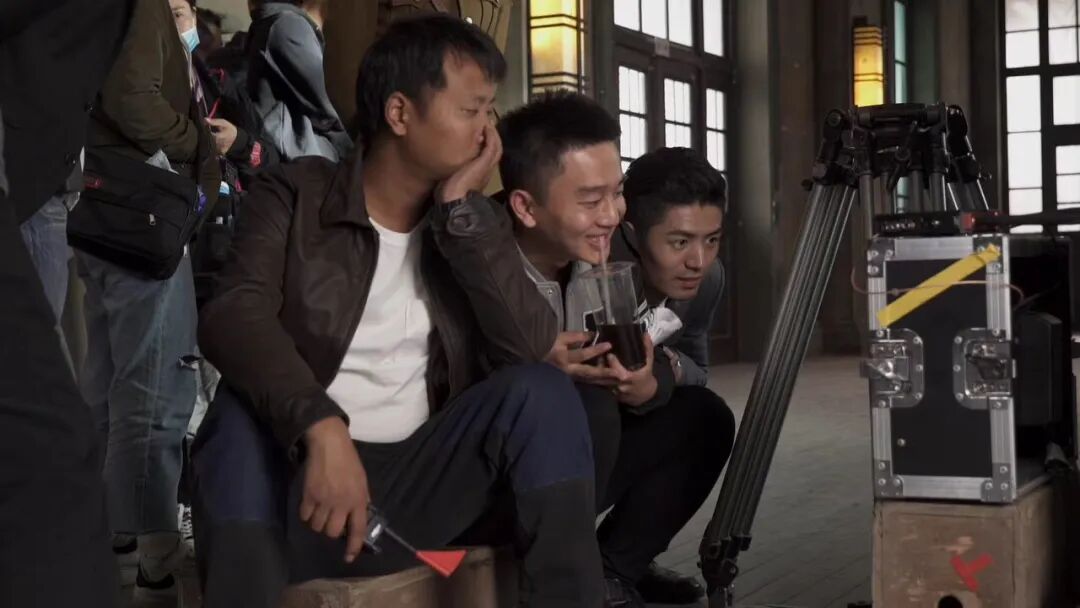
On the set of The Invisible Guardian

Both Breadth and Depth
Q: What barriers does the interactive film-game still face today?
Dihuang Jin: I think film-games still need three breakthroughs today.
First, defining a quality benchmark for products.
For many years, this benchmark has been unstable. Because The Invisible Guardian set such a high content benchmark back then — so high that many people wanted to reach it but couldn't, and we ourselves struggled too. Then Love Is All Around set a market-level benchmark. It showed you how far this market could be expanded.
What should a qualified work in this market actually look like? I want to make a market-recognized product on a replicable foundation.
After the benchmark is established, the second step is moving toward more mass-market platforms.
Current platforms still have limitations. We're also facing a choice now: whether to stick solely with Steam. Steam's DAU is growing fast — it could very well become a more mass-market platform in the future. Another possibility is that film-games find a more mass-market platform outside of Steam.
The third step is solving the triangular contradiction I mentioned earlier: narrative focus, option richness, and simplicity of experience.
Only when all three levels are solved do I think film-games can, while maintaining their current high emotional value and high story value, truly reach broader and wider circles. This is imaginable.
Q: When do you feel a script is ready? Ready to shoot?
Dihuang Jin: When it makes you cry, fires you up, makes you angry, gives you that rush.
Sometimes I'll call people from the company to listen through scripts with me, to tell them the story. I don't particularly listen to what opinions they give me — I first observe their reactions. If that reaction is the reaction I want, I know the story is probably heading in the right direction.
Q: A Douban user said besides "played," Jiangshan Bei Wang should have a "watched" tag.
Dihuang Jin: I don't want to draw a distinction between these two. Existing vocabulary may not fully capture its essence — in the future, I might need to invent a new word to define it.
Q: You mentioned that choices in the game don't give immediate feedback. Why is that?
Dihuang Jin: Because I design many plot threads and characters connected to you throughout the story. Your choice won't immediately affect your current path, but it will more or less influence some character's future fate. When you reach that node, you'll discover: this person's fate has already changed.
Q: But some endings can't be changed.
Dihuang Jin: A certain character dies, you sacrifice everything — this is to reach that height. If I truly gave you the possibility to change all of this, it would lose its original value.
For every product we consider whether to add a happily-ever-after ending. Everything is beautiful, but the narrative impact weakens considerably.
We also try our best to preserve this possibility for users. In Jiangshan Bei Wang, we left one branch that could extend into a sequel or DLC. At the imperial edict moment, if you firmly choose to accept the decree and your older brother really releases your princess, you'll take your princess northward, giving the whole story a "to be continued" feeling.
We want to keep making sequels, keep extending downward.
In every story, I leave 1-3 major branches that can continue to extend. At those branch nodes, perhaps everyone is still alive. Your older brother is alive, your princess is alive, you're alive, everyone is still there.
I can keep telling the story.
Q: You mentioned wanting to capture the spirit of The Invisible Guardian. What is that spirit?
Dihuang Jin: Most people, after finishing Jiangshan Bei Wang, give it positive recognition as an excellent interactive film-game work. For me, that's enough.

A Down-to-Earth Content Creator
Q: How would you define yourself as a creator?
Dihuang Jin: A down-to-earth content creator.
I'm not a creator who particularly emphasizes self-expression or pursues extreme artistry. I serve the user. If the user is happy, I'm happy.
I also participate in cost design throughout the process of making every product. I decide where to spend money and where not to. This might be extremely painful for an artistic creator. But for me, it isn't.
My core mission is to take a story users love, make it at a reasonable cost, and present it to everyone in a reasonable timeframe.
Many people call me director, but "director" is not the most important part of all my work — it only ranks fourth. The director in the entire film-game workflow is more like the art director in traditional games.
My working state is more like a product manager or producer.
Q: Why choose history?
Dihuang Jin: After The Invisible Guardian, I kept searching: what kind of subject matter suits interactive film-games?
I feel it must involve a lot of interrogation of human nature, along with many difficult choices.
History has proven that espionage is a naturally suitable genre, and so is Detroit: Become Human with its exploration of how humanity and technology might coexist in the future. Another direction I find crucial: political intrigue.
Once you enter the realm of political intrigue, the imperial court becomes a natural stage.
I basically just went with my gut and chose a path of no return. I can't say I saw everything clearly from the start, that I somehow knew this stage was meant for me. It was more about taking it step by step, gradually finding my footing.
As I always say, my creative philosophy is: don't cling to any creative philosophy.
Q: Do you think stories that capture audience interest always revolve around a core master theme, or do they evolve over time?
Dihuang Jin: They evolve.
People say we stitched together a lot of historical references. Where do these come from?
I spend a lot of time on Douyin, reading news, watching Bilibili. In recent years, many historical dramas keep resurfacing on Douyin — Ming Dynasty 1566, Yongzheng Dynasty, The Great Emperor Han Wu, The Rule of Zhenguan.
I take that as proof audiences love this stuff, so I'll make it.
Q: Any recent works that moved you?
Dihuang Jin: For games, Detroit: Become Human.
For TV dramas, The Knockout left a deep impression recently. I loved it. In the future, I might want to create a compelling villain too.
I cried uncontrollably at the final toasting scene. I want so badly to tell stories like that. If it weren't just a drama but truly an interactive film-game, I think I'd cry into my next life.
Q: Why are you so easily moved by small details?
Dihuang Jin: I'm still a sentimental person at heart. Sometimes a tiny short video on Douyin can make me cry. I get moved by this kind of emotion, and I really want to pass that emotion on to others.
Q: Do you think a good work should go against the tide?
Dihuang Jin: A good work definitely doesn't follow the crowd, but if you truly go against the current, it's hard to make it good. I think a good work must have something it insists on. You have to first understand the psychology of mainstream users today, then design your story.
Life, You Have to Make It Dreamlike
Q: How do you make stories respond to user needs while staying alert to not following the crowd?
Dihuang Jin: I operate on instinct. I deliberately maintain a state where my tastes stay roughly at the same level as users', keeping my life as close to theirs as possible, then use experience and intuition to make products.
If you asked me to analyze why with a set of data, I couldn't do it.
I also struggle with many stories I create. Like, I love The Legend of Sword and Fairy, and I want to make an "interactive version of Sword and Fairy." But clearly that's not possible right now. Because in a youthful, passionate story like Sword and Fairy, "choice" is secondary.
Like Luffy in One Piece: "I'm going to be King of the Pirates" — nothing in this world can stop me. Or Li Xiaoyao in Sword and Fairy: "I want to become a great swordsman and roam the world with my blade."
No one asks in stories like these: where does the money for roaming the world with your blade come from.
They don't answer these questions.
My life leans toward the dreamlike. But my work is extremely grounded — so many choices and compromises demand I become someone else.
I was in pain for a long time, deeply split, and only recently made peace with myself. What I see and experience at work gets woven into the main storyline; the more dreamlike, idealistic parts of my life get tucked into side quests.
Maybe one day, I'll actually make the passionate stories I love.
An early short interactive photo-drama shot near Jing'an Temple in Shanghai
Q: How did you come to describe life as dreamlike?
Dihuang Jin: Life, you have to make it dreamlike. If you don't hold onto your ideals, you can't survive.
Q: Making peace with yourself is genuinely hard.
Dihuang Jin: It's so hard. You have to accept so much disappointment, yet find things in life you can still hold onto.
One major discovery The Game of Fame gave me: many external difficulties are imagined by yourself. Once you actually do it, you find it's not that hard. Once you get past the psychological barrier, the hardest part is already behind you.
Q: What do you still want to do but haven't?
Dihuang Jin: I want to make The Game of Fame 2, Jiangshan Beiwang 2, and a Northern Expedition DLC. I have many stories I love that I want to turn into real games.
Q: How do you tell a good story?
Dihuang Jin: You have to understand the flow state of users as they experience the story. You have to put yourself in their shoes first, use your own experience to judge whether the story can move you. If a story can make you cry at an 8 out of 10, users might cry at a 3.
Stretch the Timeline, and Choices Gain a Sense of Destiny
Q: If you rewind the entire plot line to the very beginning, when did you first discover you loved telling stories?
Dihuang Jin: I liked making things up as early as elementary school. I couldn't draw, but I'd draw stick-figure comic strips, drawing and narrating them myself.
I played games differently from others too. Most people play Warcraft to build bases, train troops, fight battles, win matches. Not me. I'd usually turn on a cheat, put myself in god mode, spawn eight different races, give them different resources, and watch how they developed in this world.
I'd make up stories for them — have the Night Elves crown a new king, set them on a campaign against someone.
I could immerse myself in this for an entire afternoon.
By college, I loved organizing sessions to watch others play murder mystery games. I especially enjoyed being the game master. Mediating relationships between players, sometimes giving weaker players a little help — it felt a bit like debugging a game.
It seems I've always liked different things from other people.
What I enjoy more is constructing a story in my own mind and having it accepted by others. Watching them immerse themselves in that story excites me.
I have so many stories running through my head every day. Something magical — I used to have continuous dreams, like TV series.
The one that left the deepest impression was a "zombie siege" dream I had while at the Shanghai Theatre Academy, which took several nights to finish.
The dream started from our dorm room. A zombie burst in and pushed me from the sixth floor. I fell onto the sports ground, where a group originally having a sports meet had all turned into zombies. Then I started fleeing through Shanghai, all the way to some pier in Pudong, where there was a ship. Below the pier was a half-open door leading to a shelter.
One dream, spread across five nights.
Q: If you have continuous dreams, maybe in another world you're actually living through these things.
Dihuang Jin: I've always believed human life is like film stock, already fixed in a higher dimension.
Like me picking up a cup right now, saying a sentence — these are all already written. We're just playing along this track.
Many things seem arranged by some unseen force. Success or failure, good or bad. Everything is the best arrangement.
I actually get afraid when something especially good happens, always feeling like something bad must follow to balance it out. Once our producer messaged at 3 a.m. after overtime, saying his car broke down, something got caught in the tire, all warning lights on.
My first reaction was: this is a good thing.
The next day, we received approval for release.
After enough of these incidents, you increasingly believe some things are arranged — just that the timeline might be three years, five years, or ten years.
Perhaps this world has an inescapable set of rules.
Q: Do you think life is like an interactive film-game?
Dihuang Jin: Similar, but definitely not, because I can't go back.
The pressure of choices in games isn't as great as in life. Interactive film-games just try to make you conflicted, but life's conflicts echo for a long time.
A well-made interactive film-game is essentially about telling life. Many of our stories like to tell a person's whole life, from youth to old age. Only by stretching the timeline do many choices gain their sense of destiny.
An early interactive game Goddess Alliance by Dihuang Jin, where he served as director while also playing a faceless male lead
Q: Do you imagine your own destined ending?
Dihuang Jin: The best ending I can imagine definitely won't happen, and neither will the worst. The real result usually falls somewhere in the middle, in a state you never imagined. Once I realized this, I stopped envisioning the future much.
It's like gaming — the top ranks depend more on management, card-counting, these abilities, but taking first place largely comes down to luck.
I later approached product-making the same way. If you treat a massive hit as first place, it's something you can't force. If you always chase this target, you'll suffer. But I found that if I play 20 rounds, 30 rounds, I'll eventually take first once.
With a large enough sample size, you always have a chance to reach the top.
Fast, Compromise, Digest Change
Q: Film and TV production has many uncontrollable factors.
Dihuang Jin: There will definitely be much you need to compromise on.
On set you have to make many impromptu adjustments. Like the horse I mentioned earlier — the script says the horse walks over, stops, then on 3-2-1 walks forward. But if you've shot eight takes and it still won't cooperate, you definitely have to compromise.
The uncontrollable elements are mainly weather, human factors, and all kinds of sudden changes.
In daily work, many problems you can digest with time. If someone has an issue, you can solve it slowly over a month or two, but filming doesn't allow that.
If filming drags on another month, the budget can't sustain it — something will definitely go wrong. So you can't wait for things to resolve slowly; you have to make decisions in a very short time.
I think this is a crucial ability for a director on set: knowing which decision does the least damage to the work.
Q: How long does it generally take us to shoot one?
Dihuang Jin: Sometimes half a year, sometimes a year, sometimes three years, even five. You never know when the script will finally be ready.
Sometimes I even fool myself. For a while I thought Jiangshan Beiwang was something we made last year, but when I checked, we shot it in 2025 and released it in 2025. A lot of people didn't realize that — I didn't realize it myself. It happened that fast.
Q: Where do you usually shoot?
Dihuang Jin: Everywhere. During that period we were like a swarm of locusts gone mad, running all over the place, luggage always in the car.
Q: What does your daily routine look like now?
Dihuang Jin: I divide my year into several phases.
The first is pre-production — writing scripts, making plans. During this time my life is very regular. Get up in the morning, coffee, wash up, exercise, go to work, then sit down for the entire day. Whether you actually write anything or not, you have to sit there all day, without fail.
Sometimes I get to a state where, at two in the morning, I type a line in Word: "Tomorrow me, hello, please, stop revising!"
The next day, the first thing I do when I sit down is delete that line along with everything I wrote yesterday.
The most painful thing about creation is that you can't see the progress bar.
The script for Jiangshan Beiwang went through several iterations where we'd finish the script, even make a demo, then scrap everything and start over — and this happened twice. We'd be at 98% progress, then reset to zero and begin again from scratch.
The second phase is production — running everywhere, no idea what tomorrow holds. Every day you're rapidly handling unexpected situations on set and in post. My life becomes completely irregular. Even my bathroom schedule becomes irregular.
The third is recovery. After a busy stretch, I start thinking about future plans — what to do in 2026, 2027, how the company should develop, which of the many opportunities in front of me to choose. I don't think you should make decisions when you're too tightly wound. During this phase I deliberately make myself more relaxed. Sometimes even when a deadline hits, I won't act on it.
After making these choices, I return to the phase without a progress bar.
Q: What's your superpower?
Dihuang Jin: Making options.
Q: What's behind that?
Dihuang Jin: I really like designing experiential scenarios where people complete stories within them — this goes back to when I played Warcraft. I really like first building an underlying world view or story framework, then leaving space for others to fill in.
Q: You're very clear that you create for others.
Dihuang Jin: I never create for myself. Everything I do is loyal to the essence of a product, not to some form of self-expression.
A Charming and Lovable Villain
Q: Why do you like villains?
Dihuang Jin: Because they're passionate. A villain's growth is always passionate. Parents dead, climbing up from nothing, no cheats, relying entirely on being cold-blooded and ruthless, decisive in killing, defeating all opponents, finally becoming the big boss. How could someone like that be defeated by "friendship"? My WeChat signature has always been that line from Pokémon: "A charming and lovable villain."
Q: What do you see as your weaknesses?
Dihuang Jin: I struggle in "king-tier" matches.
I can climb from Gold all the way to Diamond, Grandmaster, very high ranks in a field. But that very top layer, I usually can't reach.
I'm the same when I play games. I like hybrid characters that can both deal damage and take hits, wanting to try a bit of everything. But asking me to push one single point to the extreme — I can't do it. Because the highest level requires very meticulous management, you need to understand many details, you need to set obstacles for your opponents.
But interactive film-games force me to push one point to the extreme.
Given my personality, I probably would have abandoned interactive film-games long ago to do something more interesting. So from the start I deliberately treated it as work. You can abandon a hobby, but not work — it forces you toward higher ranks.
Q: Do you want to play in the king tier?
Dihuang Jin: If one day I really get to that position, I'll still go for it.
Q: You mentioned you're from Ya'an. Any memorable stories?
Dihuang Jin: I was at Ya'an Middle School during the Wenchuan earthquake.
That afternoon I remember very clearly. I happened to be thinking of skipping PE class. If our building had actually collapsed that day, I probably would have been the person in the newspaper.
Earthquakes are truly terrifying.
First reaction: someone's shaking your bed. Second reaction: something's wrong, even the windows are shaking.
I lived on the fifth floor, the top floor. If I ran downstairs, I'd likely be buried in the stairwell. But if I lay underneath, my upper bunk might provide some support — at least I'd be the first one dug out. I quickly grabbed my phone and some food, hid under the bed.
Looking back now, I don't know how I made that judgment so quickly at that age.
Childhood photo of Dihuang Jin at Ya'an Zoo
Q: You were making choices very early on.
Dihuang Jin: I don't think anyone actually likes making choices — we're all forced into it. I think human nature is to avoid choosing. Why do so many people like power fantasies? Because they don't make you choose. Everyone lives, everyone gets saved, everything ends perfectly.
Q: So why do you still set up so many choices in your games?
Dihuang Jin: I like watching others make choices.
I'm a completionist player, I want to see everything. But with choice-based games, the first playthrough is always the best. You don't know what the other path holds, you experience it with curiosity, you savor it with regret.
That feeling is the best.
Text | Cindy