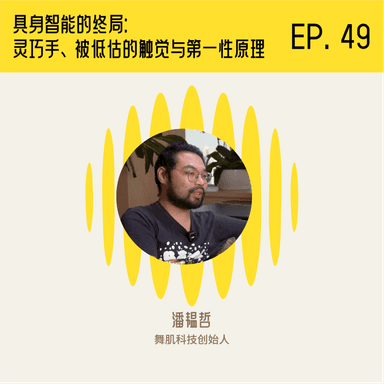

On September 17, Wuji Hand 1.0 officially launched. Weighing just 550g per hand, its 1:1 human-hand morphology and 20DoF (active degrees of freedom) dexterous hand design redefined the boundaries of robotic fine manipulation.
In 2018, Yunzhe Pan, fresh from graduating with dual degrees in computer science and chemistry at UIUC, returned to China to start a company. He walked away from an internet industry where "the smartest minds only research how to get people to click more ads," and chose robotics instead. With no background to speak of, he taught himself from YouTube. The more he watched, the more he wanted to try it with his own hands — to make a product that would astonish everyone.
To him, robotics is a discipline you can see and touch. All physical quantities, reasoning, and inference are tightly linked by logic. During two months at home last year, with just a computer and an internet connection, Pan straightened out an entire theoretical framework along a single thread of logic and wrote his own textbook, Rigid Body Mechanics for Robotics.
In 2023, we met Pan for the first time. In an empty auto parts factory, he slapped a bag on the table and clattered out all kinds of motors, then introduced each one — what it was, its performance, how its winding structure differed. This was devotion pushed to its extreme.
On the embodied intelligence track, full of waves and foam, every parameter — solution, pricing, delivery speed — can determine whether a startup lives or dies. But hardware has its own rhythm. Pan has always believed that "hardware products must go through round after round of trial production to expose problems one by one."
From day one of his startup, there has been only one problem he wanted to solve: Can a dexterous hand achieve human-level capability?
This time, he found his answer.
Robots are like a kind of black magic01:08 Dual degrees in CS and chemistry from UIUC, returning to China to start a company after graduation 01:47 Teaching himself hardware through YouTube videos, deciding to build robots 02:49 Where the dream began: watching Gundam and Neon Genesis Evangelion as a child 03:30 The origin of Wuji Technology's name: "As I rise and dance, the beauty is captivated"
First principles of learning04:29 The core of learning is having a problem you want to solve 06:07 With one computer and one internet connection, you can learn all the knowledge in the world 07:06 Writing two professional robotics textbooks during lockdown 08:41 Jobs-style product thinking: connecting all the dots
Building hardware means exposing problems through endless debugging09:47 Can a dexterous hand really achieve human-level capability? 10:12 Two-finger grippers are just a tiny fraction of what dexterous hands can do 11:35 Finding your position and competitive edge in the market 13:20 Round after round of testing: the marathon philosophy of hardware R&D
Tactile sensing, the underestimated problem in embodied intelligence15:04 Tactile sensing is an underestimated problem, as important as CMOS sensors 16:20 Efficiency, safety, and high-density data collection 17:30 Core limitations constraining tactile technology development
Redefining the dexterous hand18:51 Seeking young people of extreme devotion and genuine insight 21:29 Entrepreneurship starts now 21:48 In the future, manipulation of the physical world will be done by robots
Active degrees of freedom (Active DoF) directly determine a robotic hand's ability to interact with its environment. Traditional partially active + underactuated solutions (such as the more common 6-12DoF designs on the market today) offer certain cost advantages, but rely on passive mechanical structures to adapt to objects. They struggle with high-precision tasks like pinching thin sheets, gripping chopsticks and fountain pens, turning keys, or playing musical instruments — remaining confined to lab-grade pick-and-place operations.
Wuji Hand 1.0 achieves a fully direct-drive, ultra-highly integrated 20DoF design. Degrees of freedom × control precision = generational gap in dexterous hand technology, and 20DoF is the golden watershed for anthropomorphic operation. On this foundation, Wuji Technology keeps single-hand weight under 550g, reducing the burden on embodied robots.
The "Seriously Speaking" official listener group is now live 🎉
Scan the QR code to add the ZhenFund assistant and join the youngest, most tech-forward, most vibe-filled community space. Get the latest episode updates first, and future opportunities for face-to-face Q&A with special guests — let your voice be heard by more people. See you in the group!
Executive producers: Neya, Ruitong, Cindy
Post-production: Yanaego
"Seriously Speaking" is a general business podcast produced by ZhenFund, where the ZhenFund investment team will share the latest hot topics and industry insights with leaders from various fields.
Founded in 2011, ZhenFund is one of China's earliest angel investment institutions. Since its inception, ZhenFund has been actively seeking out the best entrepreneurial teams and era-defining investment opportunities in artificial intelligence, chips and semiconductors, robotics and hardware, healthcare, enterprise services, new energy, cross-border expansion, and consumer lifestyle.
ZhenFund — your first stop for entrepreneurship!