Fiverr CEO's Leaked Internal Memo and His 10,000-Word Response: 99% of AI Companies Are Froth

AI won't help ordinary developers go from 1x to 10x. It will only turn 10x developers into super developers.
This April, a public letter posted on X by Fiverr's CEO went viral.
He didn't mince words: AI is coming for your job. Whether you're a programmer, designer, product manager, data scientist, lawyer, customer service rep, salesperson, or finance professional — AI will find you.
The "simple tasks" of the past will vanish. "Hard problems" will become the new normal. "The impossible" will be the next frontier. If you're not already an expert in your field, you may need to consider a career change within months.
The message was blunt, unsparing, and it struck at the collective anxiety about AI and work. Perhaps it was this sense of crisis — of being caught in the wave — that has allowed Micha Kaufman to steer Fiverr through nearly every internet-era inflection point.
In 2010, as the PC internet gave way to mobile, and as O2O models and the gig economy were just emerging, Kaufman and Shai Wininger founded Fiverr, an online platform connecting freelancers with people who needed their services. They named it Fiverr because every service on the platform originally cost five dollars.
In 2013, Fiverr launched its iOS app, officially entering the mobile internet era. Starting in 2017, it acquired video creation platform VeedMe, content marketing platform ClearVoice, and digital marketing agency SLT Consulting, expanding its reach in social media marketing services.
He has acquired ten companies. After each acquisition, Fiverr updated its internal "acquisition playbook." The process never began at the negotiation table — it started with the very first conversation. Kaufman once said: "If you're not thinking about integration on Day 1, you've basically already lost."
In 2019, Fiverr went public at a $650 million valuation. The following year, the pandemic hit, remote work surged, and Fiverr's business exploded — annual revenue reached $189.5 million.
But in the AI era, do people still need gig work? As technology shifts again, how do we protect our livelihoods and keep building our professional capabilities? Micha Kaufman — a founder who believes in technology as a driving force, a man who has helped countless freelancers find income, an angel investor — will discuss new work, new skills, and new value in the age of AI.
This content comes from 20VC. Below is the full translation by ZhenFund.

-
AI is replacing human work, but also redefining human value: When standardized tasks go to machines, human irreplaceability lies in aesthetic judgment, moral discernment, and unconventional innovation.
-
99% of AI startups will be eliminated within a year or two: The market will clear rapidly. What survives will be either foundational infrastructure companies like OpenAI, or application-layer products that focus on vertical scenarios and actually solve problems — just as Google and countless apps emerged back in the day.
-
Don't be the X.1 version of an existing product: True innovation isn't optimizing what's already there. It's finding new problems and delivering genuine incremental value.
-
Speed is the greatest moat in AI entrepreneurship: In a market full of froth and extreme uncertainty, whether you can outpace others in trial-and-error, validation, and staking your claim often determines whether your company survives.

AI Is Coming for Your Job
Harry Stebbings: You recently sent an email to your team saying: "AI is coming for your job, and honestly, mine too. This is a wake-up call." Why did you want to send that email?
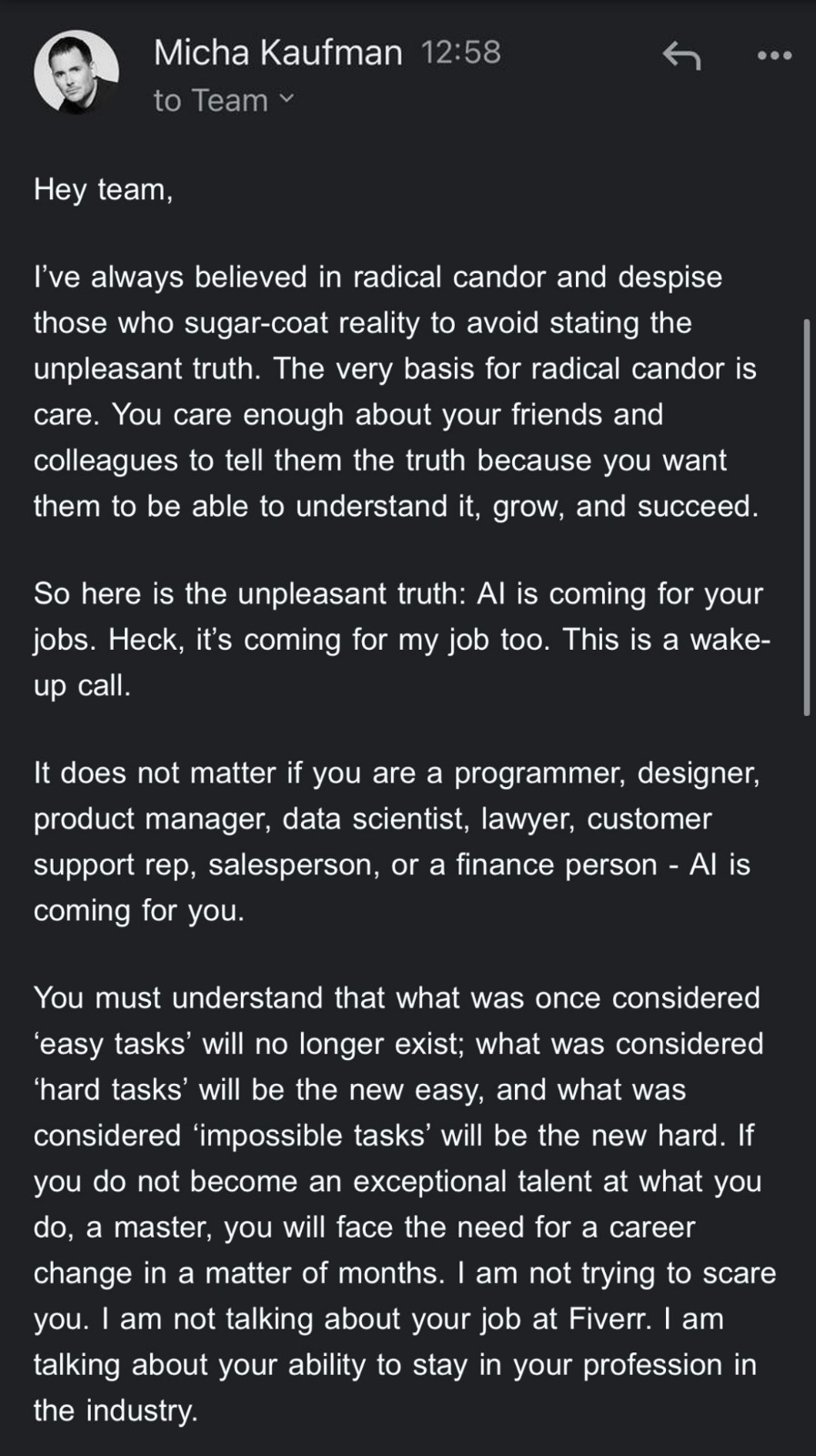
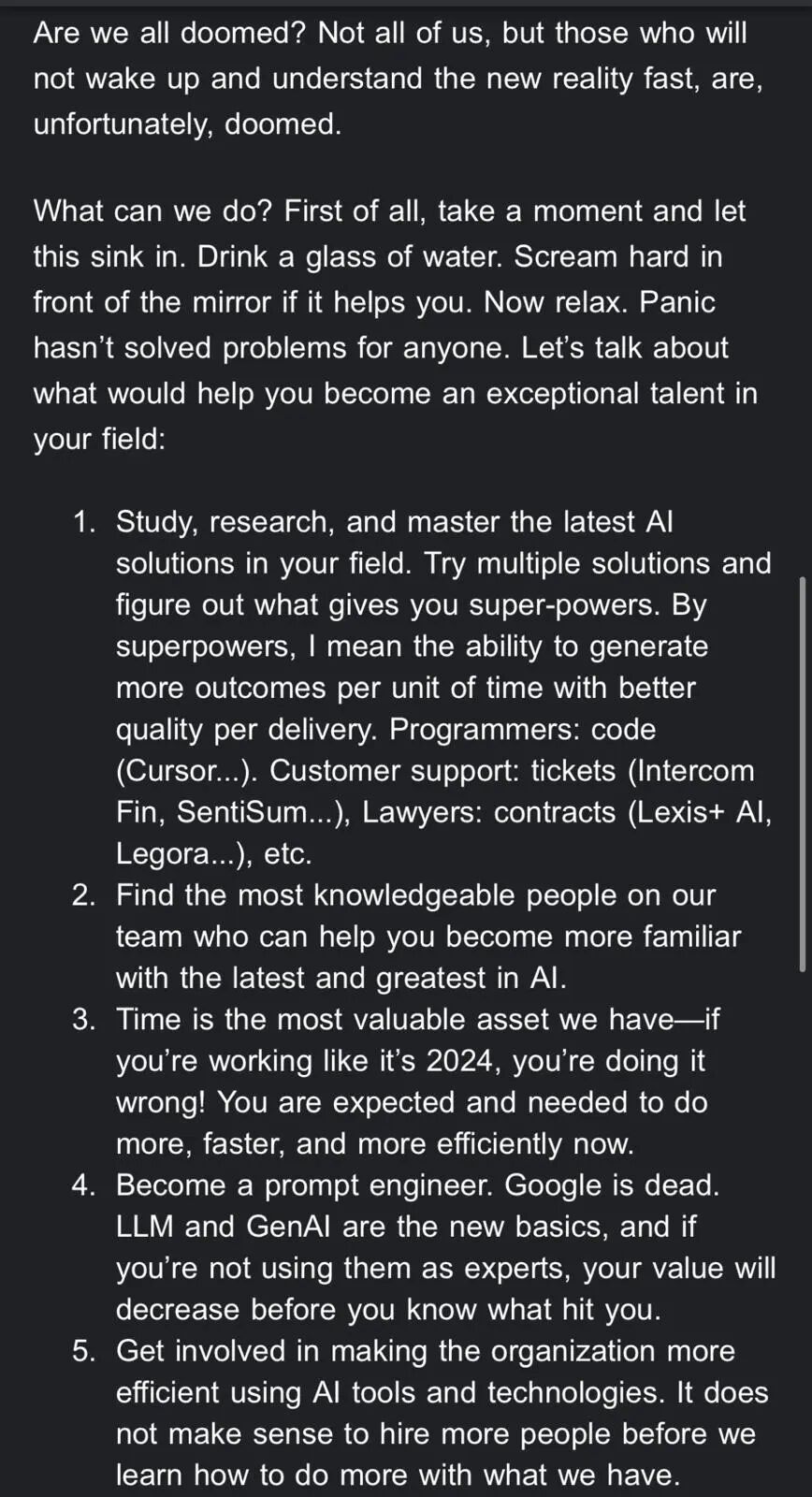
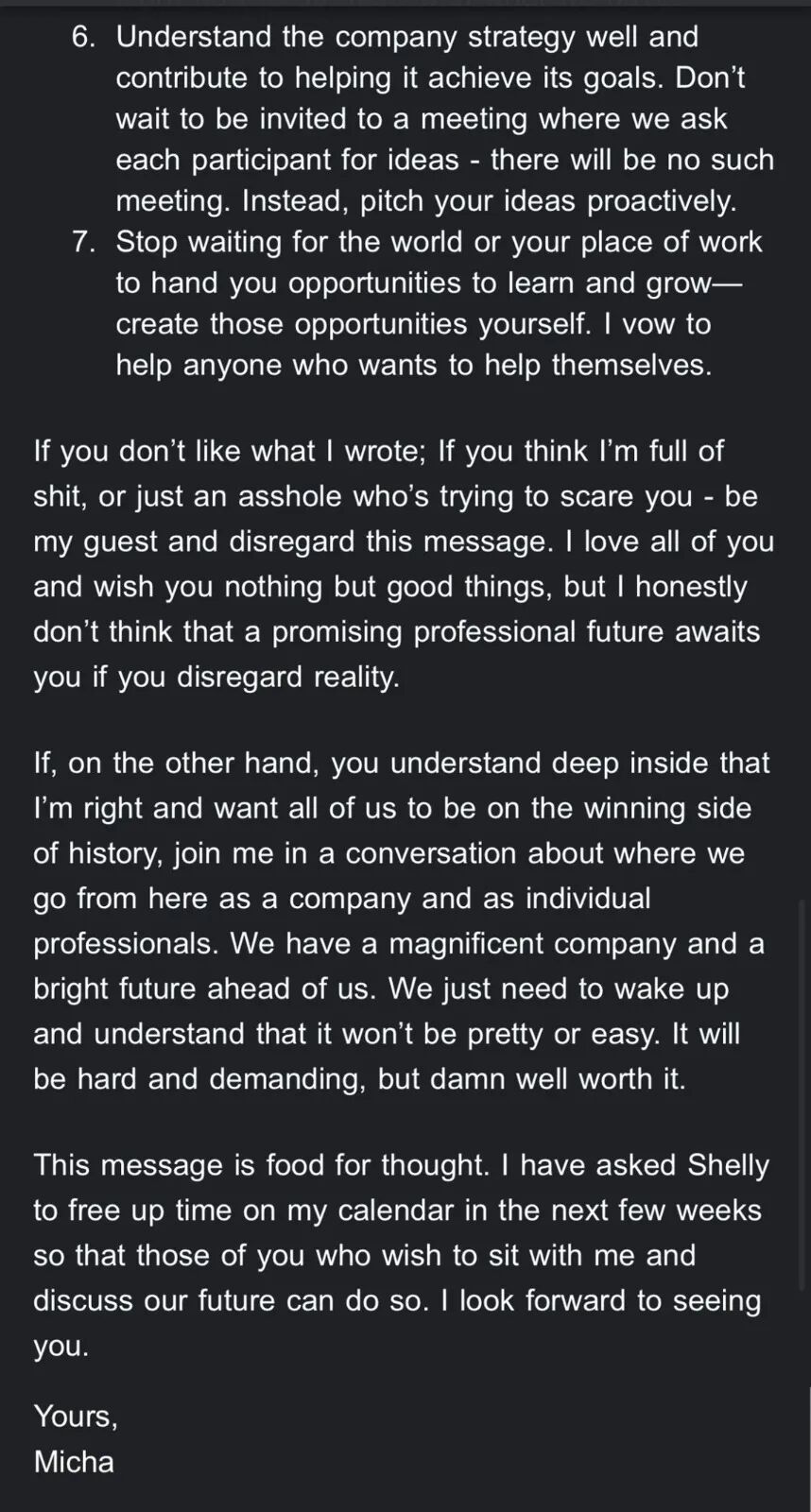
Kaufman's full public letter on X (scroll to view)
Micha Kaufman: The idea had been building in my mind for a while. Partly out of frustration — seeing how many people hadn't yet realized this awakening was happening.
I told the team directly, no sugarcoating. I just wanted to throw some ideas out there and see if they sparked discussion. So I had my Chief of Staff book a 50-person conference room, sent an email saying I'd be there with my laptop for three hours, and whoever wanted to talk could drop by.
When I walked in that day, at least 250 people had crammed in. I hadn't prepared anything. I was just planning to chat casually. It turned into me dumping everything in my brain to the whole room.
Harry Stebbings: Can we talk about what you said that day? We're both pretty direct. I want to ask: when you saw how Chegg, the online education platform, was essentially being replaced by AI, and people started saying Fiverr could be next — what did you tell those 250 people?
Micha Kaufman: I was pretty direct. I told everyone: Ideally, whatever you're doing right now, I want you to figure out how to automate 100% of your job. You probably won't get there, but that's the goal.
The first reaction many people had was: Does that mean I'm useless? If I can automate everything I do, does the company still need me?
My answer was: Exactly the opposite. If you can automate everything you currently do, it means you've freed up 100% of your time to think about things that can't be automated.
You can spend your time on nonlinear thinking. You can participate in strategic discussions. Actually, it was while writing that email that I suddenly realized something important: when we truly understand how AI expands our capabilities and changes how we work, it's also forcing us to rethink what "human" value means.
When functional work is taken over by machines, what still makes you different? Is it your sense of beauty? Your ability to distinguish right from wrong? Your creativity and unconventional thinking? What makes you you?
AI is forcing us to fundamentally rethink human nature itself.
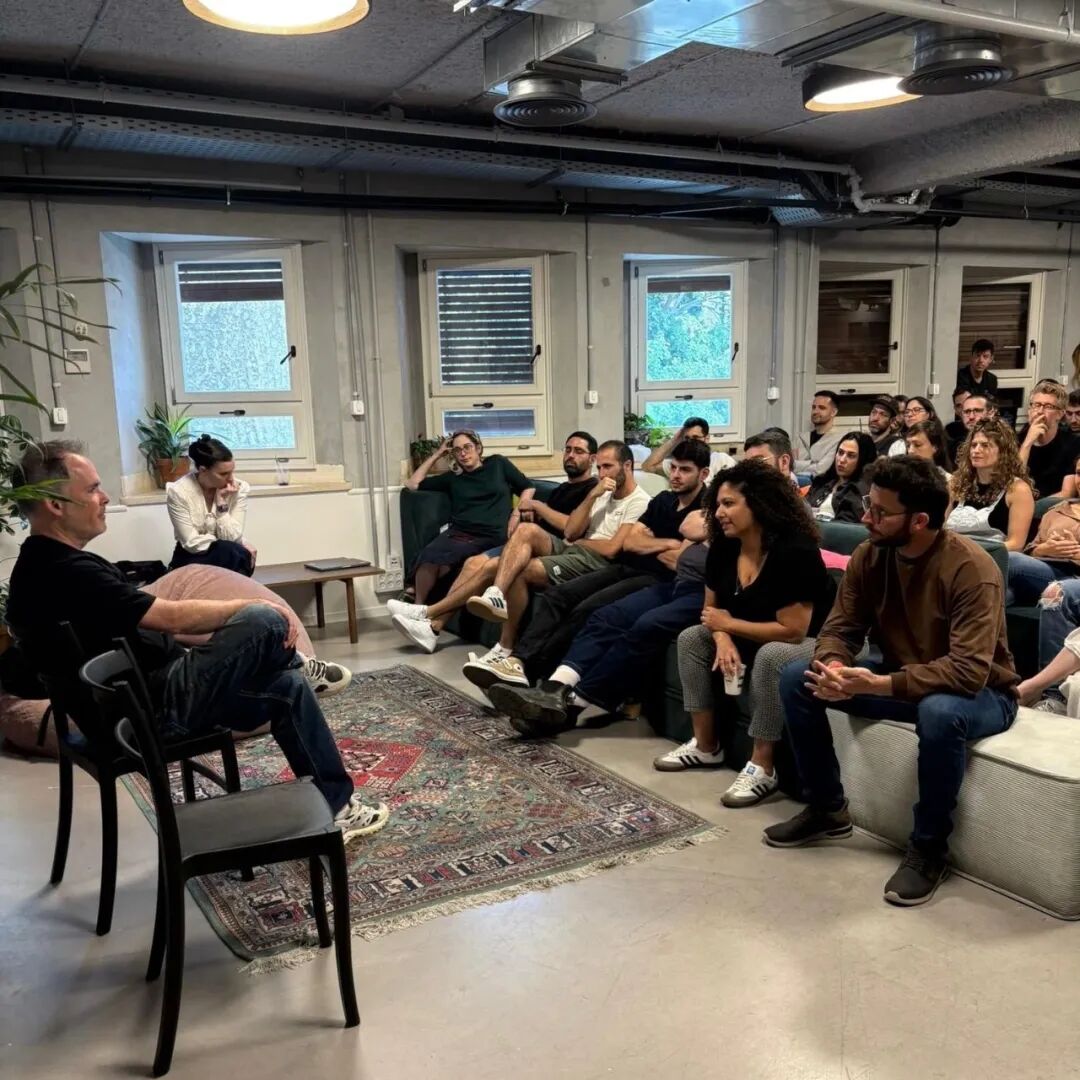
After sending the email, Kaufman (left) spoke with 250 employees in the conference room
Harry Stebbings: You mentioned rethinking human nature, and part of human nature is vulnerability and fear. We instinctively avoid things that seem threatening. I was just in a board meeting ten minutes ago where a CEO said: "My team doesn't want to embrace AI. They're scared. They think AI will replace them." As CEO, how do you drive AI adoption without sending your team into fear?
Micha Kaufman: I'll be even more direct. Look, in tech, a lot of people are quite young. I've been building companies for nearly 30 years. When I started working, I understood one thing: as a professional, you have to constantly update your knowledge base and keep creating value for others.
But somewhere in the past decade or so, a narrative took hold that companies have a responsibility to make you better. I told my team very clearly: that's completely wrong.
If you want to become a better person, a better partner, a better father in life — who does that depend on? Yourself. So why, in the workplace, do you think I should be responsible for making you a better employee?
Honestly, if you're not willing to invest time in improving yourself, not willing to face reality — you're done. I have no obligation to manage your career.
But who will I take responsibility for? I'll help those who want to grow, who are willing to go through this process. If you're willing to help yourself, I'm right there with you. That's my commitment. But if you don't want to, you can leave. It's not that you're done at Fiverr. It's that you as a person are done.
No company will want to hire someone who isn't even willing to invest in their own growth. The era has changed. Everyone needs to think hard about where they're spending their time.
Harry Stebbings: As you were saying that, I was sitting there thinking, "No, I completely disagree!" In a marriage, partners push each other and help each other grow. But you're also right — everything still has to start with yourself.
Micha Kaufman: But if you fundamentally don't want to become better, if you're not even willing to invest the most basic time and energy, no one can help you. I can provide resources for your growth, but I'm not your father. I'm not responsible for your life.

Will People Still Want to Work in the Age of AI?
Harry Stebbings: Speaking of which, I want to ask a question that might sound a bit pessimistic. Jason Lemkin, founder of SaaStr, is a friend of mine, and he's been saying lately that a lot of young people don't want to work anymore — the passion and commitment just aren't what they used to be. What's your take? How many people do you think are genuinely willing to embrace the changes AI is bringing?
Micha Kaufman: If you try to predict the future based only on the present, you're bound to be wrong. We're in an era where the outlook is murky and everything is changing by the minute. The situation right now reminds me of the dot-com bubble. Back then it was ".com," now it's ".ai."
I come across 40-plus new startups every single day. Everyone is trying to cope with information overload.
But I don't think this chaos will last forever. Our current state is too unstable, so judging the future by today's standards doesn't mean much.
As for whether people still want to work, the answer is simple: it depends who you are. If you don't want to work, there's not much to say. You can leave, and I won't waste my time trying to figure you out.
I run my team on one basic assumption: the people who want to work — whether for survival, self-expression, or meaning — will naturally stay.
We spend most of our lives working. If work has no meaning, life becomes excruciating. If you don't want to work, you'll either end up poor or become a burden on society and your parents. That's what people mean by "waking up." You need to wake up and grow up.
Human nature is competitive. Biologically, we're wired to fight for resources and reproduce. You want to drive fast cars, fly business class, skip the line. These things don't fall from the sky — you have to earn them through your own effort. What I care about is the meaning of work.

Clone Time Hits Zero: Is the AI Bubble About to Burst?
Harry Stebbings: That's one of the things I love about this job: I can admit where my experience falls short, and you've got 30 years of it. So I want to ask you — you said this AI startup wave feels like the dot-com bubble. What signs are you seeing right now that tell you this is a bubble?
Micha Kaufman: I mentioned that I see 40-plus new startups every day. The market simply can't support this many players. In fact, this bubble started forming 8 to 10 years ago.
Lots of companies are chasing the same customers with more or less the same features. This is oversupply, plain and simple. There's a finite number of companies any market can sustain.
Market clearing happens in different ways. Sometimes a batch of companies just collapses; sometimes there's consolidation. But in many verticals — take cybersecurity, for example — usually only one or two players survive. Winner takes all; everyone else gets nothing.
The environment has completely changed. I've been thinking a lot lately about a concept I call "clone time": if you build a decent product, how long does it take someone else to copy you?
Twenty-five years ago, that cycle was roughly a year, depending on complexity. When we built Fiverr 15 years ago, anyone trying to copy us would have needed 6-9 months. But today, with AI, that time has shrunk to ten days or less. For simple projects, the barrier is essentially zero.
Countless new products get built every day, but most of them aren't differentiated and don't create real incremental value — they're basically just replicating what already exists.
There's another phenomenon that's hard to quantify but worth discussing: product "breadth." In the past, building a complete product was like climbing Everest. You spent ages preparing, climbing step by step, and when you finally reached the summit, you discovered there were ten more mountains waiting.
But now, AI is like giving you an elevator. Whether you're using Lovable or something else, it drops you 300 feet from the summit. You can build a pretty decent little product with ease, maybe even stand on the peak. But the real challenge starts from the ground. How do you distribute it? How do you acquire users? How do you build a moat?
My sister built an app. It's nice. But that's the reality of the AI era: anyone can build something, but the value of these things is probably close to zero.
Harry Stebbings: I want to push back on your "clone time" point. With a platform like Fiverr, the real value isn't what the frontend looks like or how the payment system works — it's the brand, the distribution channels, the trust between service providers and clients. Those are the hardest things to replicate. So does speed of copying still matter?
Micha Kaufman: You're absolutely right, but there's a but. Less than nine months after we founded Fiverr, roughly 30 copycats had already emerged. A few years later, that number grew to thousands.
There was intense debate inside our team. One camp wanted to go on the offensive and take down every imitator. They felt it was unfair — how could others just take our ideas and hard work?
But I leaned toward a different view: we actually had two core advantages.
First, we were among the earliest to do this, and we moved fast enough. I've always believed entrepreneurship is a race. When you're running, you can only look one direction: either ahead or behind. But if you keep looking back while running, you slow down, or you fall. So you have to keep your eyes on the finish line and keep accelerating.
Second, we truly understood the problem we were solving. Others might copy the surface, but they didn't know what we were actually doing. We had the "magic" you mentioned — product, channels, brand — but more importantly, we had nine months of head start, and during those nine months, we were planting seeds. Planting brand, planting influence, building community — these things can't be copied.
But if today you can clone a mature product in ten seconds, who would still spend time building from scratch? In this environment, success depends more on luck. Luck has always mattered, but entrepreneurs without first-mover advantage need to be incredibly, incredibly lucky.
And right now, many entrepreneurs are just making marginal tweaks to existing products. Their imagination is limited, and their problem awareness isn't sharp enough. If you're building something small, the outcome will be small too.
So as I said earlier, AI is forcing us to rethink human nature. Founders today should seriously ask themselves: why am I starting this company? Not to build the "X.1 version" of some product, not to make the "next generation" for its own sake, but to solve a real problem.
The Faster Products Can Be Copied, the More Important Founders Become
Harry Stebbings: I invest too, and I might put money into 20-plus companies in a single category. I recently backed an LLM optimization engine, for example. Now there are dozens of companies in every direction, unlike ten years ago when there might have been two or three. As an investor, how do you judge and filter?
Micha Kaufman: At the end of the day, you have to look at this wave of technological change from first principles.
If technology is fully democratized, it ceases to be an advantage. The moment OpenAI launched its product in November 2022, its go-to-market was already extremely democratized — because it was free. You can't get more accessible than free.
Everyone feels like they've gotten smarter: writing faster, researching deeper. But so has everyone else. AI raises everyone's capabilities and pulls everyone back to the same starting line. Technology keeps getting more powerful, but it doesn't give you a unique edge. The real difference comes back to the most fundamental question: who are the people?
Technology evolves, business models shift, directions pivot — but people make the decisions. So when I look back at every investment, I ask: who are the founders? Do they have talent? Do they truly believe in what they're doing? Are they opportunists, or do they have conviction? Can they handle change? Can they think from first principles?
I've invested in dozens of companies. The most successful ones were often ones I didn't favor at first — because the problem looked too hard, the market too small, the team dynamics messy. But they had exceptionally strong people.
Harry Stebbings: Any specific examples? Something you initially didn't believe in that ended up being huge?
Micha Kaufman: One of them is already public. We invested at seed stage. The direction was extremely difficult, the problem was hard, and the founders' relationship was rocky at first. Honestly, there were plenty of reasons it should have died. But it didn't.
An investor in Etsy once described their company with a line I deeply agree with: "I invested in this company because it should have died at least seven times, but it didn't." That tells me everything I need to know about the team's strength.
I lost touch with them for a while, and then one day they said they were going public. I thought: no way? That's insane. The project ended up returning over 50x. So at the end of the day, it's all about the people.
Harry Stebbings: I always say, when evaluating early-stage deals, I look at only three things: are the founders right, is the direction right, is the deal fair. If all three check out, you invest.
Micha Kaufman: I agree. That framework has never changed, and it never will.
99% of AI Companies Are Foam
Harry Stebbings: You just drew a parallel between the dot-com bubble and the current AI frenzy. So do you think we'll go through a similar bursting in the coming years? Or will the exponential development of core technology sustain this enthusiasm and funding?
Micha Kaufman: If you ask me, out of these 1,000 AI companies, 999 won't survive the next year or two. The market is ruthless.
As I said before, most companies aren't asking genuinely interesting questions or creating enough valuable innovation. They just see a wave and jump on it. That's not wrong in itself, but eventually the market will clear, just like it did with dot-com.
But the companies that truly solve problems and keep creating value will make it through — Amazon did back then. In this ".ai" wave, new core players will definitely emerge. You can already see some shadows of who they might be, though it's too early to say who becomes the next Google. But the path is similar: from CPU to GPU, applications will see a wave of development. It's just too early to tell right now.
But what is certain is that a reckoning will come first — starting with investors. At some point, they'll say: "I'm out. Not putting in another dollar. Go figure out what you're actually doing first." And that will dry up the market.
Building an AI company today, you run into two fundamental problems: first, how do you capture user attention; second, how do you keep it. On both counts, the vast majority of companies are failing.
We're still in an extremely early stage. The existing market capacity is nowhere near enough to support this many players, and products that users are actually willing to pay for are few and far between.
Why is this happening? Mainly because two critical things are missing: regulation, and expensive technology. By "expensive," I don't mean stuff you can buy for a few dozen or a few hundred bucks. I mean genuinely costly, high-barrier foundational capabilities that only a handful of companies can afford. These are the technologies that will truly create separation — and they're the other path through which the market cleanses itself.
Copyright Is Dead — So Why Do We Still Create?
Harry Stebbings: What do you think is the most interesting question right now?
Micha Kaufman: Many things. For instance, have we already accepted that "authenticity is dead"? Can we still tell the difference between human and non-human? But there's an even bigger question: in this world being reshaped by technology, what role do humans actually play?
My view is that you, me, all of us — we've always positioned ourselves as the center of the universe. If that's the premise, then everything should revolve around us. But can we accept losing that center position?
AI is eating the entire world. It will keep evolving to a point where it no longer needs human oversight or intervention. Even though it's trained on content created by humans, it doesn't necessarily care about us. It learns everything we create, mixes it all together, and generates something new — without telling you whose it was, without acknowledging anyone.
For example, someone could take Harry's content and make a podcast with it. It might sound decent, but at the end of the day, it's just generating something. What truly worries me is: if this trend continues, where does the motivation for humans to keep creating and sharing come from? If everything gets swallowed, blended, stripped of its source — why would we keep making content?
As humans, we need feedback. We want our creations to be seen, to have impact. That's why people are willing to open-source code, why we share proactively. Because others build on what we've done. But if ultimately nothing of ours remains, what's the point of creating?
Harry Stebbings: But a lot of AI-generated content these days — short videos, for example — isn't bad quality. Why do you think it lacks value?
Micha Kaufman: The problem isn't the content; it's the creator. When quality content gets fed into AI training and creators receive no attribution, no feedback, no compensation, the game changes. Copyright is dead, overnight.
Harry Stebbings: What do you mean by that? There's still plenty of audio and video content out there.
Micha Kaufman: Looking at human history, Homo sapiens appeared roughly 300,000 years ago, and progress was linear for the longest time. Then Gutenberg invented the printing press. It enabled knowledge to spread widely. People became knowledgeable, expressive — and started creating. The printing press allowed works to be copied, circulated, and to inspire more people.
In 1710, Britain enacted the Statute of Anne — the beginning of modern copyright. Its logic was simple: if you want to encourage people to create and share, give them two rights. First, attribution — your name belongs on the work. Second, monetization — you can earn money from it.
This system held for 500 years, underpinning the entire modern media industry and internet ecosystem.
But now, AI skips this layer entirely. It doesn't cite sources, doesn't give attribution — it just swallows content whole, pulverizes it, recombines it. Copyright is effectively dead in any meaningful sense.
If original creators aren't recognized and aren't incentivized, will they still create? Will they still share openly? I don't know if this will actually happen, but I have to raise the question. Not as CEO of Fiverr, but as an ordinary person, as a father.
For the past 500 years, we've made life better through creating and sharing. I don't want that path to end here. Humans should be at the center of the world. When we do a podcast like this and let AI use the content — that's your choice. But if one day we're no longer producing content for humans but for machines, then we've truly lost our center.
Harry Stebbings: Your views on AI are remarkably candid, almost unfiltered. As CEO of Fiverr, do you feel an obligation to speak out on this? I know a lot of public company CEOs face considerable pressure around AI usage.
Micha Kaufman: I don't see it as pressure — more as responsibility. Throughout history, former giants now litter the landscape, companies that didn't survive, mostly because they couldn't weather the technology waves.
In past cycles, a technology wave might last 7-8 years. Now? The intervals between waves are getting shorter and shorter. You have to spot where the next wave is coming to catch the right rhythm.
As CEO, your job is to find opportunity in every technological shift, then figure out next steps. But most companies can't do it — even highly successful ones. Many haven't even caught the first wave before getting swept away.
Harry Stebbings: What's your biggest challenge in preparing for that next wave?
Micha Kaufman: Someone once asked me, what's it like being a CEO right now? I said, it's like being a captain in a storm, and someone asks you: "So, how's being a captain?"
Wet. Dark. Can't see a mile in any direction.

Moore's Law Is Dead — In the AI Era, Speed Is the Only Way Out
Harry Stebbings: You really think that? Looking back at your 15 years at Fiverr, how is this phase different for you?
Micha Kaufman: My father reached a very senior position in the semiconductor industry. The most beautiful thing about that industry for decades was that it followed Moore's Law. As long as Moore's Law held, you could project what computing power would look like in 10 years, how small chips could get. It was a kind of certainty — we almost miss that era now.
We had a clear logic for projection. Now, everything moves too fast. Every time someone asks me, "What do you think the industry will look like in five years?" I laugh. You can have a sense of direction, but anyone who claims they can precisely predict AI five years out — they probably don't see reality clearly.
Harry Stebbings: Why does that question make you laugh? I actually think looking forward is the right thing to do. Someone asked Google co-founder Sergey Brin, "What will search engines look like in 2030?" He simply said: "I don't know. We just take it year by year."
Micha Kaufman: We should absolutely keep asking these questions. But we also need to recognize that this chaotic moment isn't suited for linear prediction. There's too much noise.
Harry Stebbings: But don't you think the AI industry is already commoditizing, with so many open-source models like DeepSeek emerging?
Micha Kaufman: I don't see it that way. We haven't reached the point where AI is truly in a pricing phase, let alone AGI, let alone superintelligence. We're close, but not there yet. So right now is actually a window for enterprises to test the waters.
Harry Stebbings: What do you make of the increasing concentration of value? Companies like Anthropic, OpenAI, NVIDIA, TSMC, Google, Meta, Microsoft — these 0.0001% super-players with trillion-dollar market caps seem to dominate everything, while everyone else is on the margins. Does that gap concern you?
Micha Kaufman: It's not fundamentally different from the cloud services market. Look at AWS and Azure — they've been an oligopoly for a while. There are tons of cloud providers, but only two and a half actually hold 80% market share. That dynamic has been around for years.
Harry Stebbings: Would you consider taking the company public?
Micha Kaufman: Of course. Why not?
I'm actually quite pro-IPO, for many reasons — you just need to pick the right timing. But if you think going public means you can manipulate market sentiment or control your stock price, then I'd suggest don't do it. That's a terrible idea.
For those with long-term thinking, willing to play the long game, going public is a good option.
Harry Stebbings: But I hear that capital markets value "predictability" above all else. Doesn't that make it harder to support long-term projects with no visible short-term return?
Micha Kaufman: If your capital structure is stable and you can consistently generate free cash flow, then you can drive growth on your own. If your execution is strong and the market has confidence in you, then even if you want to do something radical, financing won't be too difficult.
Harry Stebbings: In five years, will you have more engineers or fewer?
Micha Kaufman: Probably more.
Technology has reset competition to the starting line. You can now do the work of three people, but so can your competitors. So what do you do? You have to do more, move faster.
In an uncertain market, one of a company's biggest advantages is speed. The actual ability to push things through and get them done quickly.

Speed Plus Direction Equals Real Momentum
Harry Stebbings: But isn't there a case where more becomes a burden? HubSpot recently said they wrote too much code, built too many features, and couldn't ship any of it — it actually slowed them down. What's your take?
Micha Kaufman: Being able to do more doesn't mean you should keep doing more. That's critical.
So I never use the word "speed" with my team. I use "velocity." Speed plus direction — that's what real momentum is.
You can sprint all you want, but if you're pointed the wrong direction, you're just running in circles. You write a mountain of code that never ships — the problem isn't output, it's that you never fixed the infrastructure bottleneck in the first place.
Your real priorities are wrong. Instead of endlessly stacking features, ask yourself: what is actually blocking us right now? Rather than building a pile of things, get the foundation right first.
And honestly, you're probably working on stuff that doesn't even need to exist. Stop. Don't waste the time.
I brought this up in a team meeting once. After that email went out, 250 people crammed into one conference room. When I was thinking about "momentum," I was really thinking about how to continuously drive down the cost of failure.
At the end of the day, most of what companies do ends up failing — it's just that nobody volunteers to tell that story.
A company at Amazon's scale might be running 5,000 experiments simultaneously. If they all fail, fine. But if you put ten engineers on something for three months and then realize you were pointed wrong, that's way too late. If one person spent three days and quickly validated the failure, that's actually a win.
So what we need to do is lower the cost, so we can experiment more. I'm always thinking about how to double or triple output per unit of time while improving quality. But if you can think that, so can everyone else. We're all back at the starting line. So what do you do? You need an extra edge.
I think the developer profession is about to change dramatically. AI will turn people who are already 10x into super-developers — not help average people grow from 1x to 10x.

Marketing Will Be the First Function Disrupted by AI
Harry Stebbings: If engineering and technical teams are becoming more important going forward, which roles today do you think might not exist in five years?
Micha Kaufman: People's first guess is usually customer support, but the biggest shift I've seen at Fiverr has actually been in marketing.
If you look at what copilot tools are doing, they're handling exactly the parts engineers don't want to do: hunting for open-source code, copy-pasting, checking documentation, finding libraries, evaluating whether something works, reviewing security, forking and modifying. That whole workflow is essentially Google search plus copy-paste — mechanical, repetitive. You think, is this what humans should be doing? This is what machines should do.
But marketing isn't like that. We haven't seen an AI tool yet that empowers marketers the same way it empowers engineers.
At the end of the day, we're still marketing to humans. Whether it's text, images, audio, video, scripts, copy — it all has to be perceived by humans, understood by humans. That requires a deeper understanding of human behavior, not just chasing efficiency.
The problem is, a lot of people are seduced by AI tools, thinking everything can be automated, and they end up pointed the wrong way. AI isn't as all-powerful as you think — at least not yet.
Harry Stebbings: Completely agree. I spend a lot of time studying social media distribution. But honestly, if you're at a big company like Virgin, NatWest, Chase Bank writing "we are pleased to announce our new product launch" — you're done, AI can write ten of those in ten seconds.
But if you're the kind of person who's great at viral distribution, sharp on context, knows how to catch trends, use memes, understand meme culture, and write content with real tension — that's a real skill. Right now I'd pay a million dollars to hire someone like that to run social media and I still couldn't find them.
Micha Kaufman: Exactly. So I think, across all roles, junior marketing staff are the most easily replaced by AI — even faster than programmers. Because even if a programmer uses AI to write code, they still have to read that code, debug it, get it running. Even a junior programmer usually understands the logic.
Marketing is different. Once AI steps in, there's basically no barrier to entry. That means this field will see the highest degree of automation and the most dramatic change.
Harry Stebbings: Have you changed your management style at all? Has the rise of AI adjusted how you express yourself or communicate?
Micha Kaufman: I don't use AI to write — that's very important to me. I've talked to other public company CEOs about this, even joked that we should just build our own AI investor relations assistant. Then we wouldn't even need earnings calls, wouldn't need to write shareholder letters — AI writes them, AI answers questions.
A lot of this material is consumed by machines anyway, for trading, sentiment analysis. Might as well feed it a standard format, more efficient.
Harry Stebbings: In private conversations with other CEOs, are you more inclined to believe that AI progress is actually faster than people publicly acknowledge, that mass unemployment will arrive sooner? Or do you think it's still early, not as strong as the public imagines?
Micha Kaufman: I think most people's rational baseline is this: we're not far from that tipping point of large-scale unemployment.
Of course, if AI turns out to be slower than that, great — everyone can breathe. But if it really is that fast, you'd better start preparing early. That's the safer bet.
No company has done mass layoffs because of AI yet. But organizations that were already bloated are moving.
I mentioned this in my email too: before we say we need to hire more people, first look hard at whether the people we have are truly operating at full potential.
That's why I've always believed in keeping team structure lean, but without obvious weak spots. If one day you really need to cut costs, you need to know exactly which 50 people you can let go first. If you already have that list in your head, you might as well act on it sooner.
We need to figure out how to maximize the output of our existing team before deciding to hire. If we do hire, those people have to be AI native.
Whether you're coming in for legal, finance, or customer support, you need to have an intuitive grasp of how this era works. I'm not going to teach you from scratch.
Harry Stebbings: Is there one cost you'd most like to cut but can't move on yet for some reason?
Micha Kaufman: If I could, I would cut marketing spend without hesitation. But only if your business can grow organically without it.
If your organic growth is strong enough, you start asking yourself: is this dollar I'm spending to acquire a new customer really worth it?
The only reason I haven't cut it isn't attachment — it's that we haven't reached that point yet.

Rapid Fire
Harry Stebbings: What's one belief about AI that you've changed your mind on?
Micha Kaufman: When AI first entered public consciousness, it was because OpenAI was advancing this technology as a non-profit. At the time I thought this would be a globally collaborative transformation, decentralizing the power of technology so more people could access it rather than concentrating it in the hands of a few. But reality changed my mind pretty quickly. Especially once OpenAI shifted toward a paid model, I realized things wouldn't go the way I'd hoped. As a foundational technology, I had wished it would be more open.
Harry Stebbings: Elon is clearly pro-open source, Sam is pro-closed. Which side are you on?
Micha Kaufman: AI is a very fundamental technology engine — from my perspective, I'm still more on the open source side.
Harry Stebbings: Say you have a kid just graduating from college, about to enter the workforce. What advice would you give them?
Micha Kaufman: I'd give the advice before they even go to college — don't go.
Unless you're going to college to date, socialize, and drink, then that's different. If you need someone to drag you out of bed every day, force you to attend class, scare you with exams to learn anything, then maybe college is what you need.
But over 90% of emerging professions today can be self-taught, and faster. Don't like reading books? Watch videos. Don't want to watch videos? Listen to audio. Still not working? AI can generate content tailored to how you learn. To me, college is just a waste of time.
Harry Stebbings: Looking back at Fiverr's history, is there any opportunity you didn't seize that you still regret?
Micha Kaufman: We had the chance to build OnlyFans, and we chose not to.
Actually, in a very early version of Fiverr, we saw the signs. We hadn't opened that category of services, but search terms in the backend started showing coded language frequently. People were sharing on social: go search X on Fiverr, you know what I mean.
We could have done it. But from the founders' perspective, that wasn't the direction we wanted to take.
Harry Stebbings: Will Fiverr be the last company of your life?
Micha Kaufman: I don't know. It is for now. But I spend a day or two each year doing a "leadership audit" on myself.
I ask: am I still the right person to lead this company? I evaluate my energy, my commitment, my curiosity, and my results. If I'm no longer contributing maximum value to the company, I have to face reality.
I have a rule: if I wake up for five consecutive days and my first thought is "I don't want to do this," then I really don't want to do it. Sometimes it's losing passion, sometimes it's falling out of love with the business, sometimes life is calling you elsewhere. A day or two of bad state is fine, but if it's several days in a row, something deeper is going on.
Harry Stebbings: When are you happiest? Do you think life is about happiness? Nick Storonsky was on the show and said: "Life isn't about happiness, it's about success, and only success brings happiness." What do you think?
Micha Kaufman: I think life is about meaning. When you pursue something meaningful, there will be pain in the process, and there will be joy. But that's real life. As long as you're still doing something that feels meaningful to you, you're fundamentally happy deep down.
Harry Stebbings: Last question. How do you want to be remembered? What will your grandchildren say about you?
Micha Kaufman: I see myself as part of a kind of lineage. My parents and grandparents passed down values that mattered deeply to them, and those became central to who I am as a person, as a husband, and as a father.
I've always believed that giving is more powerful than taking. I can't stand people who just take. Maybe they'll remember me as someone who gave. The world doesn't owe you anything — that's one of the core values I teach my kids.
I also tell my children that home is always a safe place. No matter what happens to you out there, come home and we'll figure it out together.
That doesn't mean suspending judgment — it means not crushing them with it. Your intention is to help them. That same principle bleeds into how I manage: this intense but honest style.
In how I operate, I think of myself as an artist too. I express myself through creating: a company, a product, a community, even a movement.
So if you ask how I want to be remembered? A builder. An artist.

Text | Neya
Editor | Cindy