Genspark Founder Jing Kun: AI Will Bring a 3-Day Work Week, Ushering in the Era of Vibe Working

We release new products almost every week, and 80% of our code is written by AI.
A single tweet from Andrej Karpathy turned Vibe Coding into the latest trend in AI applications. It emphasizes total immersion in the vibe, embracing all possibilities, and forgetting that code even exists. You don't need to write a single line of code. You don't even need to know what code is.
Its arrival opened up another possibility for AI applications. Vibe Coding doesn't just change how we use tools — it changes our mindset in how we interact with technology. But this may only be the beginning. What happens when this easy, natural, language-first way of interacting seeps deeper into everyday work?
Eric Jing, founder of Genspark, has his answer. "This might sound a little crazy, but I believe AI will gradually push society toward a three-day work week. And this shift will be kicked off by a movement I call Vibe Working."
From Vibe Coding to Vibe Working is a redefinition of work itself. As Genspark CTO Kay Zhu said at VentureBeat Transform, a conference for enterprise technology decision-makers: "Our vision is simple. We want to bring the experience that Cursor gives developers into everyone's workspace." They want not just programmers, but everyone, to have a freer way of working.
On stage, Kay demonstrated how Genspark Super Agent breaks existing workflows. He had Genspark call Matt Marshall, founder of VentureBeat, to ask if his speaking slot could be moved to before Andrew Ng's. "It's the kind of call I didn't really want to make myself, so I just had the Agent handle it," he said with a smile.
A team of 24. Zero ad spend. Eight major products launched in ten weeks. $36 million ARR in 45 days. Genspark's rapid growth shows that autonomous agent platforms have left the lab and proven commercially viable.
Following Genspark Founder Eric Jing: Seeing AGI Arrive, Jing published three more essays under the title "Seeing AGI," exploring how AGI will arrive, how humanity should respond, and how to build AI-native teams. All of these focused on the relationship between humans and AI. The fourth essay lands on an observation that even surprised him: AI is changing not just what we can do, but how we feel about "work" itself.
He believes that as long as humans maintain creativity and a learning mindset, we can accomplish many things that were previously impossible. As William Gibson put it: "The future is already here — it's just not evenly distributed." Whoever takes that first step will feel the future sooner.
Below is the full translated text of the fourth essay, compiled by ZhenFund:
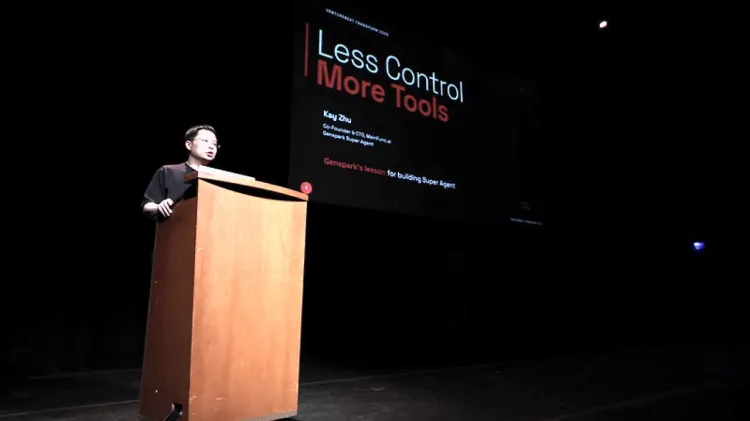
Genspark CTO Kay Zhu at VentureBeat Transform
Like most people, I endured work-related stress for many years. Whenever I felt overwhelmed, I'd console myself: this pressure means something, grinding through hard problems would make me more creative. That was my way of coping with stress, my way of staying motivated.
But something unexpected happened over the past year and a half. As I began collaborating more and more with AI, I found I no longer needed my old psychological routines. It wasn't that I was deliberately avoiding stress — the feeling of work itself had genuinely changed. I wasn't so wound up anymore. Working with AI felt more like doing something with a partner. The process of solving problems became lighter, more fun.
This shift is what I call Vibe Working. I believe this change in experience signals an evolution in how humans collaborate with AI.

What Is Vibe Working?
To understand Vibe Working, you have to start with Andrej Karpathy's definition of Vibe Coding: "Fully immersing in the vibes, embracing exponential change, forgetting that code even exists."
He was describing an entirely new way of programming: no longer obsessing over controlling every detail, but flowing with AI's capabilities, accepting its suggestions, not reviewing line by line, but conversing with it to let it fix and adjust itself, rather than debugging every bug yourself.
I gradually realized this state extends far beyond programming. Vibe Working is what happens when you bring this mindset into all kinds of work — strategy, design, writing, analysis, planning. Its essence is no longer feeling that everything must be under your control, but truly handing tasks over to a super-smart partner and then enjoying the collaborative process.
At this point, you're no longer "using an AI tool." You're improvising and co-creating, like a group of jazz musicians, or a team with seamless chemistry. What you produce is alive, because it wasn't executed step-by-step, but emerged naturally from genuine creation.
What struck me most was the emotional shift. Traditional work feels like a battle against resistance — gritting your teeth through layers of obstacles, forcing yourself to find solutions. Vibe Working is riding the wind and waves, going with the flow. After a session, you're not drained — you're energized. Not relieved, but genuinely excited, because you enjoyed the creative process.

How I Found My Way to Vibe Working
For me, getting to Vibe Working was gradual. In early 2023, I was using AI like most people: drafting emails, summarizing documents, answering specific questions. These were still just tool-like uses.
The real shift happened when we were developing Genspark's AI Slides feature. Making presentations had always been time-consuming and draining: spending weeks researching, learning new concepts, distilling arguments, writing outlines, then asking colleagues to help polish the visuals.
The first time I used Genspark Super Agent's AI Slides, I was completely stunned. It automatically consulted multiple sources, generated persuasive content, and designed a complete, professional visual presentation — all in one seamless flow. Its breadth of information gathering far exceeded mine. The design style was something I wouldn't have done. The arguments it made were ones I'd never considered, yet hit the mark precisely. What used to take weeks now took 5-10 minutes.
The psychological shift was profound. At first my internal monologue was: "This isn't good enough." "There's a mistake." "It's just okay." But gradually it became: "This is incredible." "This is so much better than what I could do." "So what do I even do anymore?"
That was when I realized something essential about human psychology: When we haven't been surpassed by machines, we instinctively find fault. But once their performance clearly exceeds ours, our reaction becomes a deeper self-questioning: "What can I still contribute?"
Everything changed after that. When I truly acknowledged that AI was genuinely better than me in many ways, I stopped resisting it and started flowing with it. I even felt my body physically relax. Our relationship shifted from "human and tool" to genuine collaboration. I entered the state of Vibe Working.
I began to think that when results fall short, it's usually not that the AI isn't good enough, but that the context I provided wasn't clear enough. Good AI collaboration, like collaboration between people, depends on clear communication.
This shift made me psychologically lighter, physically more energized, and more efficient.
This change didn't just happen to me. The entire Genspark team went through a similar psychological leap. We now launch new products almost every week, with 80% of our code written by AI. Counterintuitively, the more AI does, the less stressed I feel, and the more my efficiency rises exponentially.
I believe this shift will soon become consensus. Every individual, every organization, will experience this psychological turning point and rediscover the meaning of work.

The Four Stages of Vibe Working
Through extensive practice and observing team changes, I've distilled four stages of human-AI collaboration:
Stage One: Using with Skepticism
We ask, AI answers, but subconsciously we find fault. The loop in our heads is: "This isn't good enough." "There's a mistake." "It's just okay." We still tightly control direction and decisions, constantly questioning AI's output. This is where most people start, and where many get stuck. It's not that AI isn't capable — we simply haven't truly acknowledged its abilities.
Stage Two: Efficient Task Delegation
We begin handing specific tasks to AI while handling overall strategy ourselves. But we still approach it from a top-down angle. This collaboration model does improve efficiency and preserves traditional work divisions, but we're still thinking like managers, not co-creators, so we naturally fail to unlock AI's exponential potential.
Stage Three: Flowing Collaboration
The real psychological shift begins here. We acknowledge that AI has already far surpassed us in many areas, so we let go of control and flow with it. Collaboration becomes a genuinely unfolding dialogue — AI challenges our assumptions, and we push back with questions. Our mindset starts to change: "If the result isn't good, nine times out of ten it's because I didn't use it right." At this moment, we enter the state of Vibe Working, and pressure begins to ease.
Stage Four: Creative Symbiosis
This is the ideal state. We co-create with AI in real time, back and forth, no longer keeping score of who thought of what first. When work ends, what we feel is excitement, not exhaustion; energy, not relief. Traditional "planning" dissolves, replaced by genuine emergent creation. Those solutions are alive because they come from real collaboration, not pre-written programs. Once you've experienced this state, traditional ways of working feel slow and constrained.

How to Enter Vibe Working Faster
The real barrier was never technical — it's psychological. Most people still treat AI like they're giving orders to an assistant. But the shift to Vibe Working happens the moment you start seeing AI as a smart colleague.
Start small. You don't need to bring it into your most important work projects right away. Try having AI write a report, or make a slide deck, completing it entirely through prompts without manual edits.
You can also be more candid about your confusion, building context through multi-turn conversation. Instead of asking "How do I solve X," try: "I'm trying to understand X, but I'm fuzzy on Y, and I'm worried about Z."
This is where the magic usually happens. When you stop just seeking answers and start articulating your thinking process, AI truly begins co-creating with you.
Stop approaching AI with a "testing" mentality, treating it like a tool that's constantly being graded. Don't expect one prompt to solve everything either. Instead, reframe it as a super-smart colleague — someone you have an ongoing conversation with, continuously refining together.
Try thinking: "AI is my smart partner. It needs context, not mind-reading."
I want to be candid: I'm writing these essays not to promote my product, but to genuinely share my feelings with friends and peers. But I must mention this: to date, Genspark is the only platform that truly supports agentic, full-process collaboration. The prerequisite is that you're willing to let go of old work habits and truly commit to experiencing the state I'm describing.
The sooner you break free from old mindsets, the sooner you'll reap genuine efficiency and ease.
Finally, I want to say: we are witnessing the emergence of an entirely new way of working. It is fundamentally different from the pressure-driven, constantly draining state we've grown accustomed to.
Vibe Working isn't just about efficiency gains — it's about reclaiming time and ease from work. That time that work used to devour, you can now spend with family, or pour into things you truly love.
This shift is inevitable.