HubSpot CEO In-Depth Interview: Behind the $10B+ Market Cap, on AI Strategy and Hybrid Pricing | Z Talk

AI is the greatest enabler in the history of SMBs.

Z Talk is ZhenFund's column for sharing insights.
Founded in 2006, HubSpot is an all-in-one CRM platform primarily serving SMB (small and medium-sized business) customers. In recent years, HubSpot has deeply integrated AI products into every aspect of its platform, enabling AI-driven intelligent marketing, sales, and customer service. By the end of 2024, HubSpot's market cap exceeded $35 billion.
In 2020, Yamini Rangan joined HubSpot as Chief Customer Officer and later succeeded founder Brian Halligan as CEO.
Recently, Yamini discussed HubSpot's product and pricing strategy after integrating AI capabilities, and shared in depth the challenges and strategic adjustments she faced after taking on the CEO role.
This content comes from the 20VC podcast. Below is the full translated transcript.

- Embedding AI into the product, monetizing through the platform as a whole: HubSpot aims to embed AI products into its platform, focusing on customer value rather than maximizing immediate revenue, using hybrid pricing based on actual customer usage and effectiveness.
- HubSpot vs. Salesforce: The B2B market is not winner-take-all. Nearly every B2B application category has multiple competitors. Although HubSpot and Salesforce have some customer overlap, HubSpot remains focused on delivering excellence for companies ranging from 2 to 2,000 employees.
- AI as an enabler for SMBs: SMB operations face three constraints — human resource constraints, budget constraints, and expertise constraints. AI can help alleviate these limitations, allowing businesses to access professional support across multiple areas without relying on large budgets.
- "Deep integration" of AI features vs. "simple add-on": The best way to think about leveraging AI and integrating it into your product is — can this feature shift from novel and interesting to indispensable? Can it become an essential part of the end user's workflow?

Hybrid Pricing Based on Seats and Usage
Harry Stebbings: I want to start with your experience becoming CEO. HubSpot is a $31 billion market cap public company — the scale is staggering. What's it like to become CEO in that situation?
Yamini Rangan: Succeeding a founder as CEO is both an honor and a formidable challenge. I'd been at the company about a year and had always deeply admired the decisions Brian and Dharmesh made in building and scaling the company — their conviction about SMBs, about building and refining the platform, and about treating culture as a product. I really identified with those decisions and loved them.
The benefit of working with founders is that they know the company inside and out — they successfully grew it from a tiny startup to a public company. But that collaboration also creates a lot of work. When leadership transitions, you have to think through so many things: communication frequency — are you sending 20 emails a day or 2? And communication depth — are you discussing strategy and product, or the entire business? Whichever approach you choose, you need to make sure all the important points get covered.
What do you do when problems arise? When you hit obstacles or a decision fails, how do you respond? It takes tremendous effort. Like any relationship, the CEO has to commit first, then work hard to make it function well.
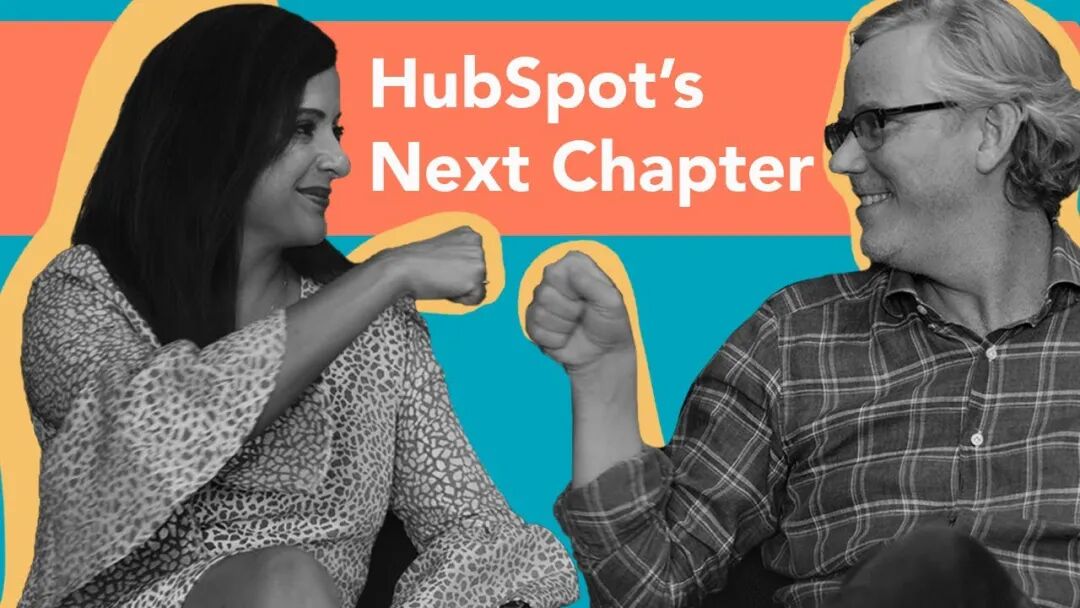
Yamini Rangan succeeds Brian Halligan as CEO
Harry Stebbings: That's why I'm single. Now I get it. Building a CRM tool from scratch in a market that was already highly mature — that kind of unwavering conviction is truly remarkable. As a public company CEO, can you still have that conviction? Financial markets react so strongly to decisions.
Yamini Rangan: Yes, you have to have conviction to run a public company, especially when your decisions are counterintuitive. You need to forget that you're a public company CEO and return to the fundamental beliefs you hold dear. I was just at a non-deal roadshow with investors today, talking to them all day. They actually appreciate your conviction about the business — that's what they want to hear.
When we explain to them why we make certain decisions, why we focus on our segment, they understand our story.
Harry Stebbings: In your view, what's the most counterintuitive decision HubSpot has made?
Yamini Rangan: I can think of a few things, like pricing. When AI entered the public consciousness in November 2022, we quickly started building products. In fact, we halted our existing product roadmap and began creating new ones. Everyone kept asking how we would monetize these products, how we would commercialize them. What we firmly believed was that there would be an AI product embedded into every hub and module of the platform. This means the monetization model would be based on the platform as a whole.
I get asked the same question about ten times a day: how do you plan to monetize? We're monetizing through our existing products and building on that foundation. I think this is counterintuitive because many companies are charging in all sorts of ways — by usage metrics, credits, outcomes, and so on. But we believe that in the face of disruptive technological change, you first have to focus on customer value.
Harry Stebbings: As a venture capitalist, I love making bold statements without data to back them up. So when it comes to outcome-based pricing, I think it's almost impossible unless there's zero human effort involved.
Like, "I did 80% of the sale, but your Agent only did 20%, so I don't want to pay 100%." How do you think about when we'll truly achieve outcome-based pricing, and whether it's really the next-generation AI solution?
Yamini Rangan: It's being discussed everywhere, right?
Harry Stebbings: Absolutely.
Yamini Rangan: Pricing by number of users? Or getting rid of seat limits entirely? Pricing by outcomes, or by credits?
Harry Stebbings: But for a horizontal product like HubSpot, you'll have some customers using it to manage LPs, like I do at my fund — that's a high-value use case. Then a flower shop has a low-value use case. There's no way you can price the same outcome the same way.
Yamini Rangan: Completely agree. Our long-term pricing model will be hybrid, incorporating both seat-based pricing and some usage-based pricing.
Outcome-based pricing is very difficult to implement. For the reasons you mentioned: how do you verify outcomes? Especially when you're providing a platform that can be used to resolve tickets, schedule meetings, write blog posts, or create social media content. The outcomes vary enormously — how do you verify them? For our customer base of SMBs, a simpler approach is to focus on usage effectiveness rather than outcomes. Essentially it's about usage volume — how many credits did you use? Did you use certain features on our AI platform?

A Growth Mindset Is Essential as AI Technology Evolves
Harry Stebbings: You mentioned some aspects of the CEO transition were difficult, others smoother. Tell me about changes in HubSpot's culture or strategy since you became CEO — changes that might not have happened under Brian.
Yamini Rangan: You know, I think we're moving from a "hypergrowth phase" to a "maturity phase." One thing I heard when I first joined HubSpot was: "We don't like process." Process was almost a dirty word — everyone avoided it.
But as the company scaled and teams spread across multiple locations, we had to introduce some process management. One adjustment I made was tightly connecting strategy, priorities, and business outcomes.
When you're running a mature company, it becomes especially critical to clarify what the most important work is. That's the essence of strategy. As an organization, first, we look at what our most important work is. Second, priorities — based on our strategic direction, what are the key tasks you need to accomplish this year? That's priorities. Third, outcome commitments — based on this year's work, what do you commit to achieving, and are you accountable for that outcome?
This "strategy-priorities-outcomes" management framework is what I've been focused on for the past few years.
Harry Stebbings: Can you give an example of what you mean by strategy?
Yamini Rangan: Strategy has three parts. It's simple. First, focus and dedicate ourselves wholeheartedly to our customers — everything starts with the customer. Second, make our product simple, fast, and unified. Third, have a growth mindset and keep growing ourselves.
As a company scales and becomes more distributed, this "strategy-priorities-outcomes" framework becomes essential. I think Brian is exceptional, and he would have accomplished a great deal if he had stayed, but I'm not sure he would have introduced this kind of structured framework and process.
Harry Stebbings: For me, I firmly believe that hard work leads to better outcomes. Though many people disagree with me on that. But nobody wants someone on their team who doesn't have a growth mindset, right?
Yamini Rangan: That's actually not true.
What I mean is, people love the comfort of doing the same thing day in and day out. Look at AI — one of the things we're discussing across the entire company is, can we be the first to adopt AI? Can we learn how to use prompts? Can we start using AI every single day?
The answer is, not everyone wants to do that, because they feel comfortable where they are. Some people are perfectly content doing what they've done for the past ten years.
I think the opposite of a growth mindset is complacency, or even being anchored to your own long-developed expertise. Asking questions, staying curious, learning, adapting — these mindsets are not a given in any company, nor are they necessarily natural at the individual level. And as companies get larger, there will always be a subset of people who prefer that comfortable state of "I've done this before, I know how to do this."
Harry Stebbings: I completely agree with you, and that's fair. I probably just personally dislike those people. But you're right, it's quite common in large companies.

Alignment Matters More Than Strategy
Harry Stebbings: After becoming CEO, what did you have to adapt to?
Yamini Rangan: The biggest shift from any role to CEO is the sheer number of stakeholders you have to manage. You're now dealing with not just the board, investors, and founders, but also a massive number of employees across different teams. That means there are many critical stakeholders watching you, judging you — that's the first thing.
One thing I've gradually adapted to is that no matter how hard I try, I can't make all stakeholders happy. At any given moment, I might make a decision that's excellent for customers; at another moment, I might make a choice that satisfies employees; and at other times, I might make a decision that pleases the board but that investors don't fully agree with. You can never reach that perfect equilibrium where you're exceeding everyone's expectations.
So how do you make decisions? You mentioned this relates to resource allocation — I prefer to call it resource alignment. Have you heard the saying "Culture eats strategy for breakfast," that company culture's influence far exceeds that of strategy?
While the first priority is setting strategy, the even more important task for a CEO is coordinating and aligning all resources to execute that established strategy. As teams expand and become more distributed, different departments will head in completely different directions.
Harry Stebbings: Can you explain that? Where was there misalignment, and how did you bring things into alignment? What was the result?
Yamini Rangan: Imagine your sales team is sprinting to hit this quarter's numbers, while your customer success team is focused on retaining customers and reducing churn. These two goals aren't always aligned. Meanwhile, the product team might be pushing hard to launch a new product.
In this situation, every department is insisting on what they believe is the right direction — how do you get them coordinated?
They're all optimizing their own subsystems; how do you get them to align with the overall system goal? The key is recognizing that most work in large companies is fundamentally cross-functional, not confined to a single functional area. Most companies develop a functional mindset as they grow: what does my team need to do? How should my department optimize?
So real alignment is about whether we can more clearly define what actually drives the company forward. I gave our strategy as an example earlier — I want the product to be easy to use, fast, and unified.
And this is absolutely not just the product team's job. Marketing needs to communicate this value proposition to customers. Sales needs to demonstrate it so customers understand and buy into this value. Customer success needs to ensure we actually deliver on this promise in practice. These are all highly cross-functional priorities.
If I emphasize to the team that HubSpot's top priority right now is making the product easy to use, fast, and unified, then all sub-departments will optimize around this strategic goal and collectively drive toward it.
In most organizations, the problem isn't just resource allocation — it's when you allocate resources, is there duplicate work? Have you clarified what resources need to achieve in a specific timeframe? Do we understand what the overall goal is? If something goes wrong, is it clear who takes responsibility to ensure the goal is ultimately achieved? That's the crux of our work. Once you build this kind of system, you start to see the flywheel effect kick in.

CEOs Need to Switch Between Management Modes
Harry Stebbings: I was thinking about my conversation with Jay Simons last night — he said I absolutely had to ask you about the difference between a "wartime CEO" and a "peacetime CEO." How do you think about the difference between these two management modes?
Yamini Rangan: It's true, CEOs need to manage companies in different modes, with different optimization priorities. In "wartime," you have to optimize for execution speed; in "peacetime," you need to focus more on building consensus around strategic direction.
These two modes are completely different, and as CEO you have to be comfortable with both.
Are you naturally good at one? The answer is, you have to master both and operate in multiple modes. Sometimes you'll feel like you're sprinting all year. Then you need to focus on execution speed, clarify annual goals, and get the team to single-mindedly chase that year's "North Star metric." But when you need to get everyone to buy into your strategy, it's a completely different situation. You're holding roundtable sessions, getting everyone aligned on priorities.
These two execution modes are fundamentally different, but you have to master both. Sometimes you even need to switch modes within a year or within a few months.
Harry Stebbings: You just talked about the importance of speed. Can you share a moment when you moved very quickly but should have slowed down? What did you learn from it?
Yamini Rangan: I've been receiving performance reviews consistently. For the past 25 years, every single review has had one theme: slow down.
This goes completely against my nature, because I instinctively gravitate toward speed. I started in sales, and when I was first promoted to sales manager, that was the first time I heard the feedback to "slow down" — because my team couldn't keep up with my pace. You need to explain the reasoning behind things, ask more questions rather than just giving answers. I have a sticky note on my computer that's been there for about ten years, and I still can't remove it. It says: "Slow down. Ask more questions."
That's the lesson I learned. My operating mode has always been about speed and execution efficiency. But I've found that when you take the time to provide context to your team, when you ask more questions so they can find the answers themselves, when you get them involved in the organization's goals — that's when you can go much further.
Sometimes you optimize for speed, only to look back and find you're the only one still running. So what I've learned is that when you need to make adjustments or change direction, you have to invest significant time in building context. You need to explain the "why" behind doing something, not just the "what." It's a process of "slowing down to go further."

From SMB Focus to Mid-Market
Harry Stebbings: When you talk about how you make major decisions and provide context for them, I find that fascinating. This is also something people suggested we discuss — the "transition" of your customer ICP, or more precisely, the upgrade in customer positioning, which is embracing larger enterprise customers. Why did you decide to expand into the mid-market and enterprise when HubSpot was originally focused on SMB?
Yamini Rangan: That's a great question. When I joined HubSpot in January 2020, I observed how the company operated — how marketing, sales, and customer service worked — and realized we were essentially running HubSpot on HubSpot.
At that point we were a company with 4,500 employees, already far beyond the scope of our Target, Segment, Zone, and ICP, but we were operating incredibly well. We were HubSpot's "Customer Zero," and our product was fully mature.
The next question was, can you build a partner ecosystem, and can you get the entire company behind moving upmarket? To be clear, we're still talking about companies of 2 to 2,000 people, not 20,000 or 200,000-person enterprises. We're still focused on our originally defined target customer base, but the opportunity to serve thousand-person companies and help them grow in marketing, sales, and customer service is massive, and our product already had that capability.
The next step was to incorporate this into strategy and mobilize the entire company to serve a larger customer segment. It turned out to be a successful strategy.
Harry Stebbings: But doesn't that mean building a completely different business? Because you need to massively scale SDRs (Sales Development Representatives), BDRs (Business Development Representatives), AEs (Account Executives), and customer success teams — these are very complex GTM functions. Does that mean you essentially have to build a completely different company?
Yamini Rangan: No, I don't think it's that different, especially from how we actually implemented it. We were already serving 200-person companies, then expanded to 500-person companies, then to 1,000. There's a misconception that at this point you have to adopt a completely different operating model and hire a ton of enterprise sales reps to close deals. But in reality, that approach breaks the system and the company culture.
Yamini Rangan: The right approach is a gradual one. First, you get the product to fit perfectly for the next tier of customers — say, moving from 200-person companies to 500-person companies. Then you upgrade the following year based on what your sales and support teams need, making sure they can serve 500-person companies. After that, you gradually expand to 1,000, 2,000, and beyond.
It's a much more effective way to expand your market. We've been leveling up our existing sales team and our partner ecosystem so they can keep pace with this progression. And as we move upmarket, we can keep driving product innovation.
Harry Stebbings: Across these different stages, where do you see the most significant shifts? From 200 to 400, then to 800, even to 1,500 — was there any point where you felt, this is fundamentally different from what came before?
Yamini Rangan: It becomes meaningfully different when the customer's buying process shifts from "I'm making this decision myself, I have the budget" to "I need to get this through a committee that includes IT, procurement, security, maybe even the board." At that point, you have to level up your sales team, because selling to a buying committee is completely different from selling to an individual owner, a solopreneur, or a VP of marketing. How do you design a rational, effective buying process for large customers?
I believe continuously building expertise allows the team to integrate more deeply into the buying process, which in turn creates a flywheel effect for the business.
Harry Stebbings: As you move toward larger employee bases, it seems like you're gradually entering Salesforce's territory. HubSpot used to always emphasize "we're not competitors," but now it looks like you actually are, to some extent, right?
Yamini Rangan: This is an enormous market, and B2B applications are not winner-take-all. Unlike consumer apps, where one app comes in and captures 90% of the market, B2B is nothing like that. In virtually any B2B application category — whether it's HR, finance, recruiting, or CRM — there are multiple players. I think we perform exceptionally well in the 2-to-2,000-person segment because we have excellent product-market fit and go-to-market fit. Salesforce has an unmatched position in the enterprise market. There is some overlap at the upper end of the segment we're targeting, around 2,000 people.
Salesforce might say, "We have the full enterprise stack," and we will overlap to some degree. We do compete in certain parts of that segment, but we remain focused on the entire SMB market — serving companies from 2 to 2,000 people.
Harry Stebbings: Where do you think they're better than you? What makes you say, "We can learn from that. We respect that, and we're happy to borrow from it"?
Yamini Rangan: I always respect and learn from competitors. The best competitors make you better. Salesforce is exceptional at marketing, at storytelling, at building narrative — we're deeply impressed by that and have benefited greatly from observing it.
Harry Stebbings: What do you think they should learn from you?
Yamini Rangan: Make the product easier to use. Customer platforms and B2B applications have historically not been. Part of our job is educating the market, guiding customers, and getting everyone to recognize the importance of "ease of use" as a feature.
Harry Stebbings: On that point about ease of use, Pat Grady told me I absolutely had to ask this: When you have incremental dollars to invest, how do you decide where to put them? Into improving the product to make the product-led growth motion smoother, or into the sales-led motion, which clearly drives higher ACV and reaches larger customers? How do you weigh that tradeoff?
Yamini Rangan: If forced to choose, I would prioritize the product. The more you invest in the product, making it more intuitive and consistent, the easier it becomes to ignite the sales and marketing engine.

AI Is an Enabler for SMBs
Harry Stebbings: I particularly want to talk about AI in SMBs, because you said something really striking earlier: "AI is the greatest enabler for SMBs in history." I remember thinking, that's the title of this episode. What do you mean when you call AI the greatest enabler for SMBs in history?
Yamini Rangan: The reality is, 50% of startups fail within five years of being founded. Starting a company is hard. Scaling it is even harder. For small and medium businesses in particular, they always operate under constraints — specifically three constraints: they can't rapidly add headcount; they have limited budget; and they lack expertise, without large teams of consultants and resources to draw on. Yet despite these constraints, SMBs have big ambitions. The reason I call AI an enabler for SMBs is that it removes these constraints one by one.
Take customer support, for example. If you leverage AI, you might not need to rush to hire that next support rep, alleviating the headcount constraint. In marketing, if you had unlimited budget, you could customize every message, but with tight budgets that's nearly impossible. Now AI can help you analyze your ideal customer profile, segment your market down to individual customers rather than broad groups, and dramatically improve conversion rates. You can even use AI to send personalized messages — no massive budget required. For the expertise needed in sales, you used to need pre-sales consultants, product demo specialists, solutions consultants — multiple experts to support the sales process. AI can handle demo content and provide critical assistance across multiple stages.
That's why when generative AI emerged, we were so excited — because it genuinely removes constraints for SMBs across the three core areas we focus on: marketing, sales, and service. It makes a complex technology incredibly simple.
Harry Stebbings: You mentioned sales tools can do these things, but if you actually talk to most customers, they've churned — they'll tell you these tools don't work well. And these products are all point solutions built for specific moments, like demos or candidate interviews. In your view, what's hype versus what's actually real?
Yamini Rangan: There's definitely a lot of hype. That's why we always use customer value as our North Star. As we mentioned earlier, some companies slapped AI features onto their products, charged for them, and ended up with customer churn. We're more focused on building excellent products, ensuring customers repeatedly use them and continuously derive value from them. Only then do we think about scaling, pricing, and everything else.
Harry Stebbings: What's the clearest signal so far?
Yamini Rangan: I think the signal is clearest in customer support. We have 1,500 customers, and within a few weeks, 42% to 45% of tickets were being handled automatically by AI — and that was just in a matter of weeks.
In year one, we resolved 35% of our internal tickets through AI, and now that's approaching 50%. This shows that AI scaling customer support works. Marketing too — driving conversion through more personalized emails enables marketing at scale. The technology is still early stage, but we're already seeing quite a few positive signals.

The Fast-Moving Companies Will Win
Harry Stebbings: Speaking of adding AI to products, how do you distinguish between simply adding AI and doing it the right way? For many growth companies like Notion, Canva — I think they've done well. But the concern is, AI is just layered on top of existing products. So what's the difference between "slapping it on" versus the right approach to integration?
Yamini Rangan: From the end user's perspective, if a product is merely novel and interesting, a user might try it for a day, come back every couple of weeks, or simply churn. That's the difference between novelty and indispensability. Indispensable means you use it every day. Without it, you can't do your job. So the best way to think about leveraging AI and weaving it into your product is: Can this feature move from novel to indispensable? Can it become something users can't do their workflow without?
Isn't this exactly the time to think big and iterate small? You start with a few use cases, then continuously build patterns based on how customers are using it.
Harry Stebbings: Are you concerned that integrating AI into your tools will lead to margin compression? Obviously your business is built on top of various models, and you have to give up a significant portion of revenue to the owners of these models. Using these models is expensive. It's more costly than simply running traditional HubSpot, isn't it?
Yamini Rangan: First, model costs and inference costs have come down dramatically. Look, from 2023 to now, that cost has genuinely decreased significantly. And I believe that cost curve will continue to decline.
I wish we had a margin problem. That would mean product usage is extremely high. I think we're still in the early stages of rolling out features, still working to get people using them daily. So I don't see margin compression happening. I've always believed inference costs will keep coming down — we won't encounter that situation. And we'll be able to create even more value for customers.
Harry Stebbings: Who do you think is actually best positioned? Is it startups without legacy code, more nimble? Growth companies at that 500-to-2,000-person scale? Or large companies like HubSpot?
Yamini Rangan: The companies that move fast will win. Whether you're a startup, a mid-sized company, or an established enterprise like HubSpot, if you can operate quickly and keep innovating, you'll win the market. HubSpot operates like a startup. We have speed, agility, focus, and urgency — that's who we are.
When we shifted our organizational focus to building an AI-first platform and developing all the related AI capabilities, we also recognized that we had to become even more agile and urgent. That has become embedded in our culture.
Harry Stebbings: Specifically, what have you done that you weren't doing before to move fast and stay nimble? Is it pushing decision-making down? Eliminating one-on-ones?
Yamini Rangan: I think the key is about increasing velocity and making cross-functional decisions. We've talked a lot about resource alignment. At a company like HubSpot, getting things done requires working across teams.
And cross-functional collaboration comes down to: who makes the decision? Is there clear ownership? What happens when something goes wrong or gets stuck? How do we unblock it? That's the speed we're trying to get people to rethink.
This ties directly into how fluent we are with AI internally and for our customers. Constantly asking: are you fluent in AI? Have you gotten better at writing prompts? Are you getting sharper on the various AI use cases within your function?
The more confident you are using AI every day, the more confident you'll be evangelizing AI to customers and getting them to use it.

AI as a Work Partner
Harry Stebbings: I want to ask — how do you personally use AI? You mentioned writing prompts.
Yamini Rangan: I do use it. My workflow has changed a lot. I've set up several projects in Claude.
Harry Stebbings: Why Claude?
Yamini Rangan: I mean, I use more than just Claude. I also have Gemini Gems.
Harry Stebbings: I'm just curious why Claude. I fed in a prompt about Yamini, I do this every episode. I tried it on Grok, Perplexity, OpenAI Deep Research, and Claude.
And Claude came back with this surprising response: "Yamini said this, she said that, ask her this question." I was surprised and thought, "Great, where did Yamini say that?" And it responded, "Oh, we didn't realize you needed her actual statements."
I was thinking, I'd ask you: "You said this." And you'd say, no I didn't. That's bad.
Yamini Rangan: You're talking about citations and sourcing, which does matter for certain use cases. I use Claude to write my LinkedIn posts.
Harry Stebbings: You find it better than OpenAI?
Yamini Rangan: In some cases, yes. And I have to tell you, I have a project for writing earnings scripts. I've actually fed in all my earnings scripts from the past 16 quarters.
Harry Stebbings: You just input the PDFs?
Yamini Rangan: Yes, basically documents of the past 16 earnings scripts. I put all that into the project, and when I'm preparing for the next earnings script, I give it some information — parameters around the story I want to tell — and have it use my writing approach from the past 16 quarters to help me write and think deeply about the content. It reasons through it, and if I need to make sure I'm conveying a specific message, I'll ask it to refine the content.
That process of reasoning, thinking, categorizing, analyzing, and then writing is incredibly useful. It dramatically shortens the time I spend on each earnings script.
Now I'll use Claude alongside a couple other models, run the same prompts to generate several versions, and pick the one I like better. That's really helped me sharpen my thinking.
Harry Stebbings: What's your process for writing earnings scripts? Do you do it all at once, or over multiple sessions? What does it look like?
Yamini Rangan: Earnings scripts are typically done in one sitting, one conversation. Usually on a Sunday afternoon, about three to four hours. It's really about structuring a clear narrative. Now I have a conversational partner, a reasoning, creative partner to work with.
I used to just suffer through Sunday afternoons alone. Now I actually enjoy it. I'll ask things like, "Does this paragraph convey what I'm trying to say? Analyze it," and if the analysis isn't quite right, maybe there's a different way to express it.
It really helps along the way. It's like my partner, and I actually enjoy it. Even though I said it's heavy work, I really love it. Writing earnings gives me a chance to reflect on the quarter, to think about what worked and how to tell that story to a broad audience.

SEO Is Shifting from Google to ChatGPT
Harry Stebbings: Speaking of today's SEO — I imagine a lot of HubSpot's traffic comes from SEO? And SEO is shifting from traditional Google and other search engines toward ChatGPT and other platforms. How do you think about that? Does it concern you?
Yamini Rangan: It does. And honestly, this has been happening for years, hasn't it? If you look at SEO-driven traffic, especially with AI-generated overviews and platforms like Perplexity, there's been a major shift. Search engines used to give you clickable blue links, you'd click and browse someone's website. Now search engines just give you the answer, which means you don't need to click. That trend will continue for some time.
Harry Stebbings: You'll see ads below. Then you might go to page two, page three.
Yamini Rangan: Exactly right. This doesn't surprise us. We actually started diversifying our content strategy three or four years before AI even became a factor. That included expanding into podcasts. We actually built a podcast network with millions of listeners every day. We also acquired several traditional email newsletters that publish daily, giving us another way to extend our reach.
Harry Stebbings: How do you think about the ROI on those media acquisitions? I know those are great assets, and credit to you for that. But how do you think about their ROI, like conversion and attribution, versus brand and marketing? It's hard to measure.
Yamini Rangan: These are primarily for distribution. They're top of funnel. I don't think there's a user who just listens to a podcast and immediately buys. It's about brand awareness, how users perceive the brand overall. Brand awareness building, and the multiple touchpoints it takes for consumers to develop stronger interest in a brand and ultimately convert — that's a multi-touch attribution model. I don't look at any single channel in isolation. I look at overall brand awareness lift across all our channels.
Harry Stebbings: When you think about this shift in SEO, it's really tough.
Yamini Rangan: The way we think about it: where are our customers? In the past, customers just came to our website. But now they're on YouTube, Instagram, TikTok, and LinkedIn. You have to be where your customers are, rather than just expecting them to come to you — which is what SEO used to help us do. That means our marketing strategy has become much more customer-centric, which I love.

Hybrid Pricing: Seats Plus Usage
Harry Stebbings: Now into my favorite quick-fire round. I'll make a short statement, you give me your immediate reaction.
Yamini Rangan: Sounds good, let's do it.
Harry Stebbings: What do you believe that most people around you don't?
Yamini Rangan: Pricing should attract revenue, not chase it. Most people think pricing is about maximizing revenue, which is why everyone asks about AI. How are you going to monetize it? What's the big move you're going to make next? How do we create value for customers first?
We've actually been lowering prices to increase the value we deliver, and that attractive value brings more customers. Many people think pricing is about extracting every dollar, maximizing revenue. But we're actually thinking about maximizing market share, which means you approach pricing completely differently.
Harry Stebbings: You can hold one public stock for 10 years. Can't be HubSpot.
Yamini Rangan: Microsoft. I've always deeply admired Satya Nadella — he's really done an exceptional job.
Harry Stebbings: What have you learned from Satya?
Yamini Rangan: First, he went all-in on cloud computing, and now AI. And how he used culture to transform the company — how he instilled a growth mindset and curiosity inside a company that was originally very siloed. I read Hit Refresh and was completely fascinated by it. I thought it was such a great example of company-building. The way he engages with customers, partners, investors, and emerging companies is all very admirable.
Harry Stebbings: If you could pick one board member you don't currently have but would most want to add, who would it be?
Yamini Rangan: Dario Amodei, CEO of Anthropic. I think he's exceptional — he has deep research capabilities and extremely robust safe-AI processes. He's really an extraordinarily capable researcher.
Harry Stebbings: I might get criticized for this, because my take on Anthropic might be controversial. What's something that's changed your mind in the last 12 months?
Yamini Rangan: Recently, my son was applying to college. I wanted him to stay in California — we live here, there are plenty of good schools. But he fell in love with the East Coast at first sight. I went on campus visits with him, saw how comfortable he was there, and it changed my mind. I decided to fully support him.
Harry Stebbings: Has being a parent made you a better leader?
Yamini Rangan: It's absolutely made me a more patient leader. I have two teenagers, and dealing with their issues often gives me perspective on the challenges I've experienced at HubSpot — which was also going through its adolescence around the same time.
Harry Stebbings: There's a really excellent book called How to Talk So Kids Will Listen & Listen So Kids Will Talk — about how to effectively communicate with children and teenagers. That applies to our situation somewhat.
Yamini Rangan: Interesting, I need to go buy a copy.
Harry Stebbings: Unlimited vacation, mental health days, no-meeting Fridays — are these signs of the "woke era" or part of company culture?
Yamini Rangan: We actually just made an adjustment — we moved from unlimited vacation to flexible vacation. That's part of a shift in our culture. A lot of the changes you mentioned happened between 2020 and 2021, when we as humans were experiencing a pandemic for the first time. Many people lost their lives, their livelihoods. Parents were still figuring out how to work from home.
I think that period genuinely required extra support. Now, we've refocused the company on customer outcomes and mission orientation. We just changed our vacation policy to flexible vacation — don't ask me how it's going.
Harry Stebbings: What worries you most about the world today?
Yamini Rangan: I recently saw a statistic: at our current pace of improving gender equality, it will take another 134 years to achieve it — across health, longevity, types of work, pay, all dimensions of equality. Another 134 years. That's really a very long time.
Harry Stebbings: Don't you feel like the work done in recent years is actually regressing? It's a sad reality. When the economy is good, people care more about gender equality. But when times get tough and tensions rise, gender equality gets quickly cast aside and becomes deprioritized.
Yamini Rangan: I know, it's really scary. It is concerning.
Harry Stebbings: Very scary. Similar to climate change — the pattern is much the same. As a public company CEO, what's the most unexpected thing or something people don't understand about the role?
Yamini Rangan: It's like a roller coaster. Every year brings new challenges, you never know what the next one will be, everything is constantly fluctuating.
Harry Stebbings: In such an unstable environment, do you find it difficult to self-regulate?
Yamini Rangan: I think you have to build good self-management practices to maintain inner equilibrium. For me, meditation and yoga have been anchors for a long time. They're incredibly important to me — they help me stay calm and centered.
So despite all the volatility, despite how much uncertainty comes with this role, how every year is completely different from the last, you have to find ways to ground yourself.
Harry Stebbings: One thing I've found difficult is that when a company reaches a certain scale, no matter how excellent everything else is, there's always one thing that's not quite right. HubSpot is no exception today — there's always some flaw. You know what I mean?
Yamini Rangan: Completely agree.
Harry Stebbings: And if you're a professional, you fixate on that one shortcoming. Ninety-eight percent of things might be great, but say there's an issue with the sales model.
Yamini Rangan: That's exactly right.
Harry Stebbings: Is there a question nobody's ever asked you that you wish someone would?
Yamini Rangan: You know what? I get asked this one question all the time: "Are you moving upmarket to enterprise?"
Harry Stebbings: That's a terrible question. Who asks that?
Yamini Rangan: I get asked this constantly. There's a misconception in the market that the only path to growth, to serving millions of customers, to becoming a large company, is moving upmarket to enterprise.
I really wish someone would ask: "Why are you so convicted about the mid-market?" And we would answer: "Look, enterprise is a massive market, but SMB still exists, and we want to define a category of mid-market software."
Five years from now, ten years from now, when you have guests on this podcast, I hope you ask them: "Are you a Salesforce-type company? Or are you a HubSpot-type company serving the mid-market? Or serving SMB?" That's a question I'd love to explore deeply.
Harry Stebbings: That upmarket question — I think it's truly awful, completely incomprehensible. You're absolutely right. I've really enjoyed this conversation, heard many great perspectives.
Yamini Rangan: Thank you so much for having me. This has been an unforgettable experience.

Translated by Xin
Edited by Wendi