Tsinghua Ph.D. Crosses the Desert, Searching for Green Hydrogen's iPhone Moment
Over the next five years, powering the AI era with affordable hydrogen.
This is what it feels like to have life roaring down the highway.
Yao Changsheng, founder of Hygreen Energy, finds that most of the moments he can still recall happened on the road: on boats, on trains, trudging through the desert with a worn-out bag. His bag always held company brochures and business cards, steeped in the entrepreneurial spirit of the reform-and-opening era.
Saudi Aramco's first investment in the Asia-Pacific hydrogen industry also happened on the road. One June day when the Saudi asphalt could melt the soles off your shoes, Yao took the earliest flight to visit Aramco's headquarters, having slept at the airport the night before. The free rest area in Dubai Airport's Terminal 2 offered only navy-blue benches and a few small sofas barely long enough to lie flat on — like a railway station from the 1990s.
There's a timeless texture to this kind of hands-on persistence.
Hygreen Energy was founded in 2021, dedicated to providing continuously leading green hydrogen solutions for global energy transformers. At Shell's Bremen site in Germany, at Shengyuan in Ordos, at Hinggan League in Inner Mongolia, green hydrogen produced from wind, solar, and hydro power is replacing coal, natural gas, and other fossil fuels, achieving zero-carbon emissions. In 2021, ZhenFund led Hygreen's angel round and has been a companion ever since.
To feel the presence of water, wind, and sand, Yao led his team to lakes, seas of dunes, and grasslands, where the eye could only take in vast expanses of color. More than words, awakened senses help one understand what they are actually doing, what kind of future is truly unfolding. Green hydrogen exists because of renewable energy.
As long as the wind and sun persist, it will not cease.

The team with Academician Ouyang Minggao in the Ordos desert
Yao Changsheng studied under Academician Ouyang Minggao, among the earliest in China to throw himself into the new energy wave. His decade at Tsinghua University shaped his commitment to innovation, to truth, to beauty. He understood that many things are determined by first principles and do not change. With a continuous supply of renewable energy, combined with AI and robotics, human society can advance toward a kind of infinite prosperity.
Over the past five years, the world has experienced a reshaping of the energy landscape. In the next five years, he believes the iPhone moment for green hydrogen will arrive, driving the AI era through affordable hydrogen energy.
More than a year after reaching a partnership with Saudi Aramco in 2024, he flew to Dammam for the second time. The more he flew, the more he read. During one trip, he came across a poem:
On Liupan Mountain's highest peak, the western wind lazily unfurls our banners.
Today the long cord is in our hands,
When shall we bind the azure dragon?
The afternoon after our interview, he had already shouldered his bag and was back on the road.

The iPhone Moment for Green Hydrogen
Q: Please introduce yourself and what you're doing now.
Yao Changsheng: Hello everyone, I'm Yao Changsheng. Hygreen Energy is a company focused on renewable energy hydrogen production technology and solutions. In recent years, we've made remarkable progress in China, Europe, and the Middle East, working with energy giants like Shell, TotalEnergies, Sinopec, and Saudi Aramco to jointly advance the global energy transition. I'd like to take this opportunity to talk with everyone about green hydrogen — a new but infinitely promising field.
Q: What opportunity did you see in 2021 that led you to found Hygreen Energy?
Yao Changsheng: When people think of hydrogen energy, they often think of hydrogen-powered cars for a long time, because in the development path of new energy vehicles, pure electric drive and hydrogen drive were seen as two parallel routes. But the green hydrogen we work on has only emerged in the past five years, and globally this is the first wave of investment. Green hydrogen is generally paired with large-scale wind and solar bases, used in hard-to-decarbonize sectors like energy, industry, shipping, and aviation to help them achieve deep decarbonization.
2021 was precisely the starting point of the global green hydrogen rise. At that time, we saw this as a field worth investing in, where we could apply what we had learned and seen to truly create technological value in industry and drive the energy transition.
If we abstract the entire energy system of human civilization into two categories, they would be electrons and molecules. Electrons encompass all electrical applications; molecules are traditional fossil fuels like coal, oil, and natural gas. What we do is use wind, solar, and hydro power, through Power-to-X (P2X) technology, to convert clean electricity into gaseous or liquid energy that can be stored for long periods and transported — that is, green hydrogen, a truly green fuel.
Essentially, we are making clean electrons into green molecules, to replace almost all fossil fuel applications. It is an industry connecting two trillion-dollar markets, and the core of it is the green hydrogen production we are doing.
Q: Why does green hydrogen have a color?
Yao Changsheng: Although people used to think hydrogen barely exists in nature, modern society consumes about 100 million tons of hydrogen annually. This hydrogen mainly comes from natural gas and coal, and is widely used in chemical synthesis. The food we eat every day is also related to hydrogen — hydrogen produced from carbon is made into synthetic ammonia, which becomes fertilizer. This hydrogen relies heavily on fossil fuels and has high carbon emissions, so it's called "gray hydrogen." "Blue hydrogen" is gray hydrogen paired with carbon capture technology, capturing and fixing emissions to make it "low-carbon hydrogen."
Green hydrogen is completely zero-carbon. Green hydrogen's raw material comes from water, its energy from light and wind, produced by renewable electricity, obtained through P2X technology. Although green hydrogen is a new field, the chemical reaction behind it is not unfamiliar. Oil and coal are essentially solid carbon carriers formed by 200 million years of solar deposition — just with an extremely long cycle. Today, we are obtaining green hydrogen from light and wind in milliseconds.
This is why hydrogen has colors — because colors represent different carbon emission pathways.
Q: You've compared Hygreen Energy to a company like Apple or Tesla. Is the current exploration of green hydrogen about finding the iPhone moment for the new energy industry?
Yao Changsheng: You could understand it that way. Although the industry is still early-stage, the past five years have seen tremendous changes in both technology and external environment. We've been through the pandemic, and through geopolitical shifts and the reshaping of energy格局. As a component of future energy, green hydrogen is inevitably affected.
But some things are determined by first principles and do not change.
First, green hydrogen will definitely become key to the energy landscape. Because renewable energy is crucial to energy security and transformation for many regions. Wind and light may be invisible and intangible, but they correspond to land. Where there is land, there is light; where there is light, hydrogen can be produced; where there is hydrogen, imported oil and natural gas can be replaced.
Second, from a long-term perspective, the continuous development of renewable energy is crucial to human prosperity. Green hydrogen is an energy system entirely built by technology and manufacturing, not dependent on natural gas extraction. Blue hydrogen's cost is heavily influenced by natural gas prices, but green hydrogen depends only on wind and solar resources and electrolysis technology efficiency.
If there is a continuous supply of renewable energy, combined with green hydrogen production, AI, and robotics, we can advance toward infinite prosperity for human society. But the prerequisite is that it must be "affordable." This requires continuously improving green hydrogen production efficiency and highly matching it with renewable energy fluctuations, thereby absorbing more wind and solar resources. This is also the technical direction we have been unwavering in.
From first principles, as long as we continuously make products that fit scenarios and customer needs, we won't be distracted by noise in the process.
If you're referring to the commercialization inflection point, I believe the so-called iPhone moment will arrive rapidly in the next five years. We see the logic of the industry shifting gears: the past five years globally were about exploring and demonstrating technology model validation, but the next five years will explore which scenarios can actually apply green hydrogen. Once business models are proven, they will quickly drive leapfrog advancement across the entire chain. I believe around 2027 we'll welcome such a turning point.
Q: You've also said in previous interviews that the cost decline of green hydrogen is inevitable, also a first principle. Can you walk us through that thinking?
Yao Changsheng: Green hydrogen comes from green electricity, and 70% of its cost today comes from green electricity. So there are several deterministic factors that are easy to break down.
One, green electricity production price. This has dropped very rapidly in recent years. In parts of northern China and the Middle East, power generation costs of one cent per kilowatt-hour were achieved quite early.
Two, green electricity matching capability. Traditional electrolysis technology cannot adapt to fluctuating power, so much electricity has to be curtailed. The more you can absorb and the better you match fluctuations, the higher the ultimate green hydrogen production efficiency.
Three, electrolysis efficiency. That is, using less electricity to produce more hydrogen, which directly determines hydrogen cost.
Four, overall investment price. This is closely related to the degree of scale.
Five, green hydrogen project operation and maintenance costs. This is highly related to digital technology, AI technology, and overall configuration design.
Except for the first point of green electricity price, which is determined by local endowments and generation technology, the remaining factors — fluctuation matching, electrolysis efficiency, equipment scale, and O&M technology — are all closely related to us. Our products have been developed around these points from day one.
All our units were standardized from the very beginning. This is a bit like making Coca-Cola — once scale comes up, it can drive rapid equipment cost decline. So real cost decline must come from technology, not from involution.
Q: What does first principles specifically mean to you?
Yao Changsheng: We've insisted on starting from first principles since product development, meaning defining products from the scenario itself, from customers' real needs.
First, this is an extremely large-scale electrolysis application scenario. Today we're talking about electrolysis plants from hundreds of megawatts to gigawatt scale, and this scale itself is key. From the design stage, we chose the alkaline hydrogen production system, theoretically avoiding the use of precious metals, because precious metals have a "reverse scale effect."
On the other hand, large electrolyzers are essentially chemical reactors. They are full of fluids — hydrogen and oxygen from electrolyzed electrolyte — so the uniformity and consistency of fluid distribution is extremely critical. We see that many electrolyzers in the industry follow the design of past small circular electrolyzers. Their origin was oxygen production in submarines, later continuously scaled up, but they weren't designed for today's large-scale, fluctuating, high-efficiency scenarios.
So from our very first machine, we insisted on making them square. Square distribution is more uniform on the horizontal axis, combined with internal flow field design to make bubble detachment faster and gas-liquid separation more thorough — this is our secret to achieving high efficiency and fluctuation adaptability.
We then expanded these standardized units into square stack modules, making scale expansion faster and O&M simpler. All of this comes from first principles, and respectively corresponds to the key cost items of green hydrogen: fluctuation matching, electrolysis efficiency, scale, and easy O&M.

Q: Can you tell us more about what your product actually is?
Yao Changsheng: Our product is a renewable-energy hydrogen production system. At its core is an electrolyzer. We provide customers with a self-developed, proprietary hydrogen production system, plus a supporting digital solution. Going further, we also offer end-to-end green hydrogen solutions for domestic and international clients.

When in Rome, Live as the Romans Do
Q: You mentioned earlier that 2024 was a breakthrough year for exports. What concrete progress did you make? I also saw that Hygreen Energy became Saudi Aramco's first-ever hydrogen sector investment. What did this year mean for the company?
Yao Changsheng: In 2023, right after the pandemic ended, we stepped overseas for the first time — you could say we were just making our debut.
But 2024 was a true globalization milestone for us. On one hand, in Europe we gained ongoing support from Shell and Total, and built local partnerships. On the other hand, in the Middle East we secured a strategic investment from Saudi Aramco.
At the end of 2024, I took the team to Saudi Arabia, to see NEOM, to see Prosperity Well — the first oil well ever drilled in Saudi Arabia. I wanted everyone to feel, in their bones, that when we say we want to be a global company, this isn't happening in some distant future. It's happening right now.

Yao Changsheng and the team at NEOM
This is completely different from the past. People used to think you should build a solid foundation in China first, then go abroad. But today, you have to move in sync with the era. Wherever your customers are, if they need you, you should be there working alongside them.
Q: Can you share the story of how Saudi Aramco came about?
Yao Changsheng: In April 2023, right after the pandemic, we attended Hannover Messe — the first fully open exhibition since COVID. There I met a client from the UAE, and I thought I'd take the opportunity to visit him.
The day before flying to the Middle East, I thought: since I'm already in that region, maybe I can also reach out to Saudi Aramco. So two young colleagues and I flew to Dammam to visit Aramco headquarters.
It was June. Saudi Arabia was so hot that shoes could melt on the pavement. We met with the head of Aramco's strategic investment team. He told us, "Your company is good, your direction is right — this is an area we've been committed to for the long term."
But he was also frank: Saudi Aramco had never invested in a project in China. We had very mixed feelings about that.
That trip to Saudi Arabia, we took the earliest flight in and flew back that same night. The night before, we slept at Dubai airport. Dubai's T3 serves international routes, while T2 mainly flies to Arab countries. T2 felt like an old Chinese train station — at night, people were sprawled across seats and the floor. We were among them.

Yao Changsheng and co-founder Gu Junjie on their first visit to Saudi Aramco
What we didn't expect was that this seemingly unsuccessful visit would open the door to what came next. As China-Saudi cooperation heated up, we became — quite fortuitously — the first project Aramco invested in after establishing its China office. Looking back, those scenes in the desert, at the airport, became the most memorable beginning to our partnership.
This always reminds me of that Steve Jobs quote: "You can't connect the dots looking forward; you can only connect them looking backward."
Q: Where do green hydrogen technologies stand, domestically and internationally?
Yao Changsheng: Over the past five years, countries worldwide have been rolling out their first flagship projects, each costing billions or even tens of billions of dollars.
In China, the best-known is the Kuqa project in Xinjiang, invested in by Sinopec to reduce carbon emissions in coupled oil refining. In Europe, the first large-scale offshore wind-to-hydrogen project is at Rotterdam Port, driven by Shell, also for low-carbon fuel production. In the Middle East, the first project landed in NEOM — large-scale solar and wind hydrogen production for export to Europe, for industrial and energy applications. In the US, the first project is in Utah, where a massive cavern was dissolved in a salt dome under a salt flat for hydrogen storage, then blended into natural gas generators, with the green electricity sent to California.
The applications are incredibly diverse. That's the natural character of hydrogen — it's like a kaleidoscope.
Looking at global first-wave investment: in 2020, green hydrogen projects that reached final investment decision totaled only about $10 billion. By 2025, cumulative investment has exceeded $110 billion. That's nearly one trillion RMB quietly flowing into this green hydrogen market.
Over the next five years, this logic will shift further as commercial closed loops emerge. These closed loops are activated by institutionalized demand: Europe's renewable energy governance rules, shipping regulations, and carbon tariffs will take effect in the next year or two. These policies have been brewing for years; once active, green hydrogen shifts from "optional" to "mandatory."
It's the same in China. Facing the "30·60" dual carbon targets, the 14th and 15th Five-Year Plans will continue expanding renewable energy installations, but grid integration is nearing saturation. So non-electrification applications will be strongly encouraged.
Two directions stand out beyond electricity: first, producing green fuels like hydrogen, ammonia, and methanol; second, coupling with high-carbon industries (like coal chemicals) to reduce emissions. These will become the new drivers for the next five years. China will continue pushing this industry forward on technology, supply chain, and market dimensions.
This is also what we find most compelling about green hydrogen. Demand is intense worldwide, and we're based in China with a global outlook — so we're in a very fortunate position to bring technology iterated rapidly in China to global partners.
Q: You've said Hygreen Energy is "born global." Five years ago, what scenario did you envision?
Yao Changsheng: A lot has changed in these five years. Today, in large-scale projects, we've already achieved green hydrogen costs below $2 per kilogram.
Five years ago, I didn't expect our globalization to advance this quickly. In 2021 we were still in the pandemic, with no end in sight. But the moment it ended, we went straight overseas.
The "born global" idea was because green hydrogen is needed everywhere. Some things are simply universal languages — technology, and ESG principles.
I've always believed the new globalization is deep localization. It's not putting products on shelves; it's working with local partners to cultivate markets, respecting their work styles, technical models, business rules, and every detail of culture — that's how you truly integrate.
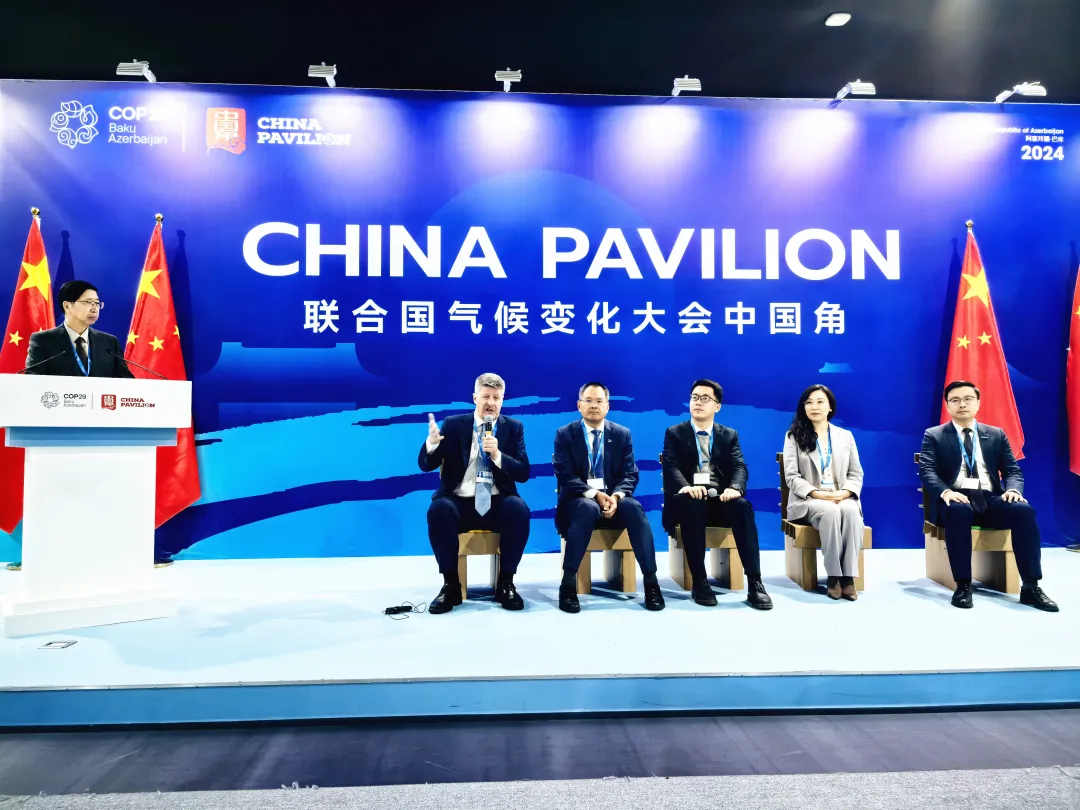
Yao Changsheng (far right) attending COP29
Q: Everyone talks "Day 1 global" now, but real落地 brings many challenges. What localization challenges have you faced? What have you learned?
Yao Changsheng: We often say, when in Rome, live as the Romans do.
Europe isn't a unified cultural bloc. France, Germany, Italy — their ways of thinking and doing business are completely different. When you're in southern versus northern Germany, southern versus northern Italy, the topics you can discuss, the jokes you can make, they're all different. So you have to listen to what they're saying, and you have to become friends with local partners.
Especially in Western markets, people deeply respect business rules, are willing to share benefits, commit to long-term cooperation, and value intellectual property. These are first principles of business. But in local competition, we sometimes overlook trust. Truly respecting local principles and embedding them in every team, every individual's code of conduct — that's a real challenge.
Q: Any memorable stories?
Yao Changsheng: Once we took a German colleague to a meeting with a Dutch client, and it turned out they didn't have much more common ground than I did with the Dutch.
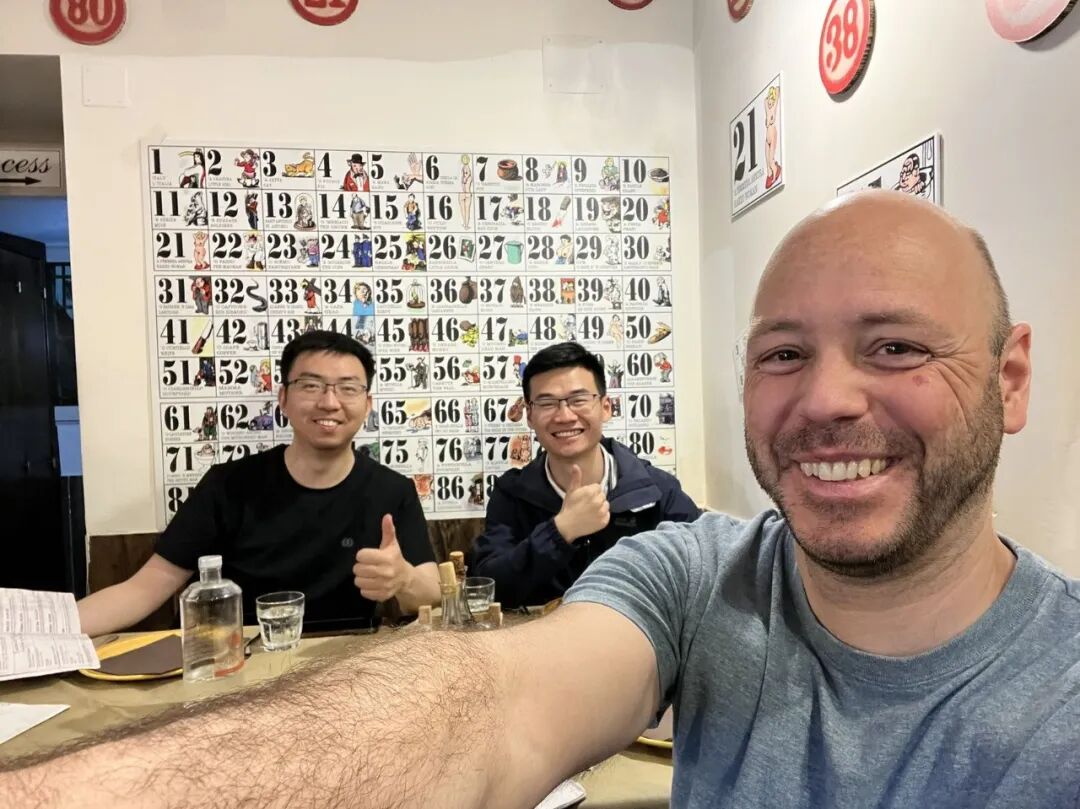
Hygreen Energy's German team members
Q: You said progress has far exceeded expectations. What's next for your global布局?
Yao Changsheng: Over the past five years, with differentiated products and support from leading customers, we've made significant commercial progress. Today we are a first-tier player in both China and global markets.
This year, a flagship project in the hydrogen industry will drive a shift in commercial logic for the next five years: the Xing'an League green methanol project for Maersk and Hapag-Lloyd. We are the wind-to-hydrogen partner for this project. The green methanol produced will fuel Maersk's oceangoing container fleet. Over 400 green methanol vessels are already on order and will enter service sequentially. Shipping is likely to become the earliest sector where green fuels achieve commercial closed loops, and we're fortunate to stand at the forefront of this era.
Over the next five years, hydrogen will unquestionably be placed in a more important position — from shipping to aviation, from decarbonizing high-carbon industries to integrated green power solutions.
We'll also explore Southeast Asia, providing energy for green AI data centers. The main driver of new electricity demand over the next five years will be rapidly growing AI compute, and the energy solutions matched to it will be critical.

The Next 5 Years and 50 Years
Q: The hydrogen industry has no shortage of large enterprises. As a startup, what is Hygreen Energy's advantage?
Yao Changsheng: That comes entirely from being tempered in the Chinese market. China's supply chain and rapidly iterating market gave us the opportunity to progress quickly. While overseas competitors need 24–36 months to deliver to customers, we can present a fundamentally different company and product capability almost every quarter.
So many people call China a "shark pool," but I see it as having given us a rare foundation. At the same time, the bigger opportunities often lie outside China. This goes back to what we discussed earlier: based in China, with eyes on the world.
If there's one lesson worth sharing, it's this: don't fear competition.
Q: We noticed that the 15th Five-Year Plan has listed green hydrogen as an emerging industry. What does this mean for future development, and for Hygreen Energy specifically?
Yao Changsheng: This is incredibly exciting. It's not just the 15th Five-Year Plan — over the past two to three weeks, the National Development and Reform Commission and the National Energy Administration have issued successive policies emphasizing the continued development of renewable energy, non-electrification consumption pathways, incentives for green fuels, and the coupling of green hydrogen with high-carbon-emitting industries like coal-to-chemicals.
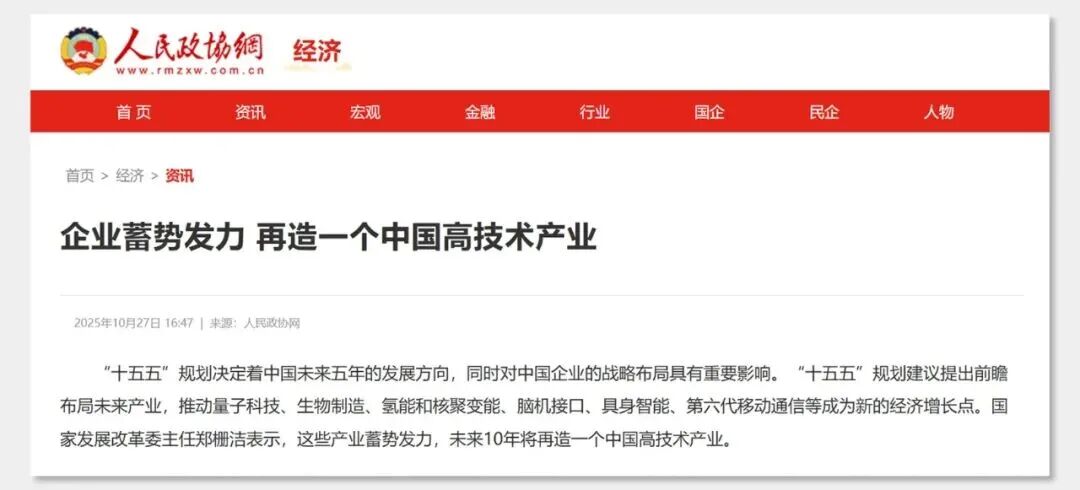
The 15th Five-Year Plan lists hydrogen energy as China's next high-tech industry
This series of policies not only points the way for the industry, but also amounts to explicit encouragement for what we're doing. We're working with Goldwind to supply green fuel to Maersk; with Conch Cement on Asia's first cement-green hydrogen coupling project for carbon reduction; and with Ordos Shengyuan Energy to advance green hydrogen decarbonization in coal-to-chemicals.
For us, the next five years represent the growth phase of the hydrogen industry. If the 14th Five-Year Plan was the incubation period, then the 15th Five-Year Plan enters the VC stage, and perhaps by the 16th Five-Year Plan, hydrogen will become a true pillar industry. We're fortunate to be positioned at the starting line of this growth phase across technology, market, and globalization.
Q: Every industrial transformation in history has been driven by energy. Looking at green hydrogen from a broader industrial perspective, what stage do you think it's at now? Has the energy industry reached a tipping point?
Yao Changsheng: I believe so.
Abstractly speaking, energy is a necessity, just like air, water, and food. It has both stock and incremental components: incremental demand comes from economic growth in developing countries and new technological needs, such as AI; stock demand comes from everyday industrial and economic activity.
Looking at supply forms, the energy landscape has always been clear. On one side, oil, natural gas, and coal; on the other, renewable electricity. They exist in a competitive dynamic, much like the large-scale shift from diesel to natural gas vehicles — a substitution within the stock. China's growing renewable electricity generation is also displacing thermal power, with many coal plants converting to peaker plants.
What role does green hydrogen play here? It can replace heavy fuel oil in shipping; be blended into natural gas as a substitute; power vehicles as a diesel alternative; and serve as long-duration storage before being converted back to electricity.
So in a trillion or even ten-trillion-dollar energy market, even a 1% share for green hydrogen represents massive opportunity. And once we hit the iPhone moment — when green hydrogen truly becomes affordable — its penetration will accelerate rapidly over the following five years.
Especially in countries without fossil fuel resources, it will quickly gain market position and deliver value across transportation power, industrial feedstocks, energy storage media, and other domains.
The space for green hydrogen is enormous.
Q: You mentioned there are many certainties and uncertainties in this process. If you had to pick one uncertainty from what you can see now, what would it be?
Yao Changsheng: The endpoint is determined by technology and first principles — that doesn't change. But before reaching that endpoint, we'll encounter "winds" from different directions: policy changes and geopolitics. So the greatest uncertainty still comes from policy and geopolitical disruption.
Q: Zooming out to global technology development, has there been anything recently that excites you and has held your attention?
Yao Changsheng: Although what we're working on is itself a frontier technology in a massive sector, seeing progress in other technologies is equally inspiring.
First, the acceleration in nuclear energy. I've spoken with some fusion companies, and recently we saw Shanghai establish a fusion company with 15 billion RMB in scale. Theoretically, when fusion technology combines with hydrogen energy, it could deliver virtually every form of human energy at extremely low cost.
People used to say fusion was "50 years away." But from my conversations with practitioners, that 50 years is likely to shorten at a visible pace.
Then there's the progress in AI and large models. I recently read an article by Vinod Khosla that introduced the concept of "infinite leisure." He argues that when infinite energy, AI, and robotics converge, human society could enter an age of abundance by 2040, where most goods and services are free and people can freely pursue what they truly love.
This aligns with what Elon Musk and Bill Gates have called "sustainable prosperity." We're fortunate that the work we're doing connects to such a grand vision.
Q: What ideas resonate with what you're doing now? What insights do they offer for how you think about the future?
Yao Changsheng: The biggest influence is Elon Musk.
I often tell my team the story of the first Starship. It was essentially welded together by water tower welders. This shows that many things can be traced back to their source, approached from first principles.
Like how Starship uses over 30 Falcon engines, with thrust exceeding the Saturn V that sent humans to the moon. The Saturn V was built from five massive engines, but if you make engines smaller and standardized, then control them systematically, you can iterate each basic unit at lower cost and faster speed, while achieving greater system-level results.

SpaceX's first Starship
Q: Are there specific scenarios or examples that illustrate how this philosophy has informed your approach?
Yao Changsheng: The biggest difference in our products is that all our basic units are standardized — very much like SpaceX's philosophy.
Our basic units are also called cells. Iterating cell performance drives stack performance iteration, and when combined with intelligent software and AI control algorithms, we achieve system-level efficiency gains.
It's like an EV chassis, where small battery cells are integrated into a large battery system with precise management of each cell. We take standardized units to the extreme, using systematic control to continuously improve overall performance.

The Search for Future Imagination
Q: Mike Maples Jr., author of Pattern Breakers, believes that great founders live in the future. What did you see that "will exist in the future but is lacking now"? And do you currently hold any "non-consensus but correct" views?
Yao Changsheng: We've been doing non-consensus things from the start.
When we first founded the company, many people said this technology was already mature — why bother with unnecessary innovation? While competitors were promising 10, 20 years of durability, we emphasized serviceability, and people asked if that meant our products broke more easily?
After we launched our product, some said: facing such large competitors, how could you possibly succeed? Their costs must be lower. Once we actually delivered products to customers, others questioned: in such an era of intense competition, can you find a commercialization path? Can your growth be sustained?
But why are we confident?
On one hand, we believe we're doing the right thing. This logic is based on first principles: ultimately, technology and scale determine the price of hydrogen.
On the other hand, our customers give us tremendous confidence. In working with them, we genuinely feel how energy transformers view this industry and the future.
Speaking of bigger non-consensus ideas, some things sound more plausible when Elon Musk says them, but when ordinary practitioners like us say them, it sounds like grandstanding. But everyone has the right to live in the future. Like how Musk and Bezos have both recently proposed putting data centers in space — I think that's a wonderful vision.
I've always believed that the greater application space for our technology in the future is on Mars. Electrolysis is fundamentally a technology platform, and Mars has 20% CO2 in its atmosphere and ice underground — water. CO2 plus water, combined with electrolysis technology, and we can obtain virtually all essential energy humans need: hydrogen, methane, oxygen, various hydrocarbons. So this technology will accompany humanity for a very, very long time. We're only at its beginning.
Q: In persisting with a non-consensus view, do these doubts and noise create significant psychological pressure?
Yao Changsheng: I don't think so.
If we're doing something new, pushing for change, it must be non-consensus; if it were consensus, it would necessarily be part of the stock.
I often tell my team: if all our competitors' technologies were already saturated, we would have no reason to exist. The value space we fill is fundamentally technological innovation. But we don't do oversaturated innovation — we use innovation to address the industry's core problems.
I also don't think non-consensus can exist with just one person. That's why I say, what truly leads industry change is our customers. They give us tremendous comfort — these true visionaries and strategists are pulling us forward.
They give us opportunity and confidence, and what we can do is our best to help them change the world.
Q: If you view your entire entrepreneurial journey as an arc, what were the key inflection points that shaped where you are today and your path forward?
Yao Changsheng: I think the most critical point was our insistence on building an entirely new product. This changed the industry. Without our company, the industry's evolution might have been somewhat different. Of course, other technologies might have emerged, but the overall timeline would likely have been delayed by several years.
If we're talking about moments that changed the company's fate, there are many. But most "company-defining moments" aren't that magical — they're often the lonely exploration of one or two people, later supported by more colleagues. I think most company-changing moments emerge this way.
Q: Entrepreneurship involves not just exploration and creation, but also mundane daily repetition. How would you describe your daily life right now?
Yao Changsheng: Most of my days are spent on the road, traveling for business. But you learn to enjoy the process. I often feel a kind of entrepreneurial spirit reminiscent of the reform-and-opening-up era three or four decades ago — carrying an old bag, whether through deserts, on boats, or on trains, going out to find opportunities, with nothing but company brochures and business cards inside.
I think it's great. It's a sign of vitality. In many industries today, you might have to work a bit harder to recapture that energy, but in our industry, anywhere in the world, you'll find people discussing the same needs, the same things. That alone is incredibly exciting.
Q: That does sound evocative of a particular era. How did your time at Tsinghua University influence your later entrepreneurship? We previously spoke with Qin Yudi, founder of Lianyu Technology, who also mentioned that Academician Ouyang Minggao's team cultivated many entrepreneurs.
Yao Changsheng: I spent nearly ten years at Tsinghua. I joined my PhD advisor Academician Ouyang Minggao and Professor Yang Fuyuan's team very early — in my second year of undergraduate studies. You could say I was deeply immersed in that team's culture during that period.
Those ten years at Tsinghua shaped my life values. The insistence on innovation, on truth, on value creation, on aesthetics — these profoundly changed me.
So in 2021, when we had the opportunity to bring alumni back together to start this company, many people saw not just the vision but were genuinely driven by the underlying values and sense of mission.
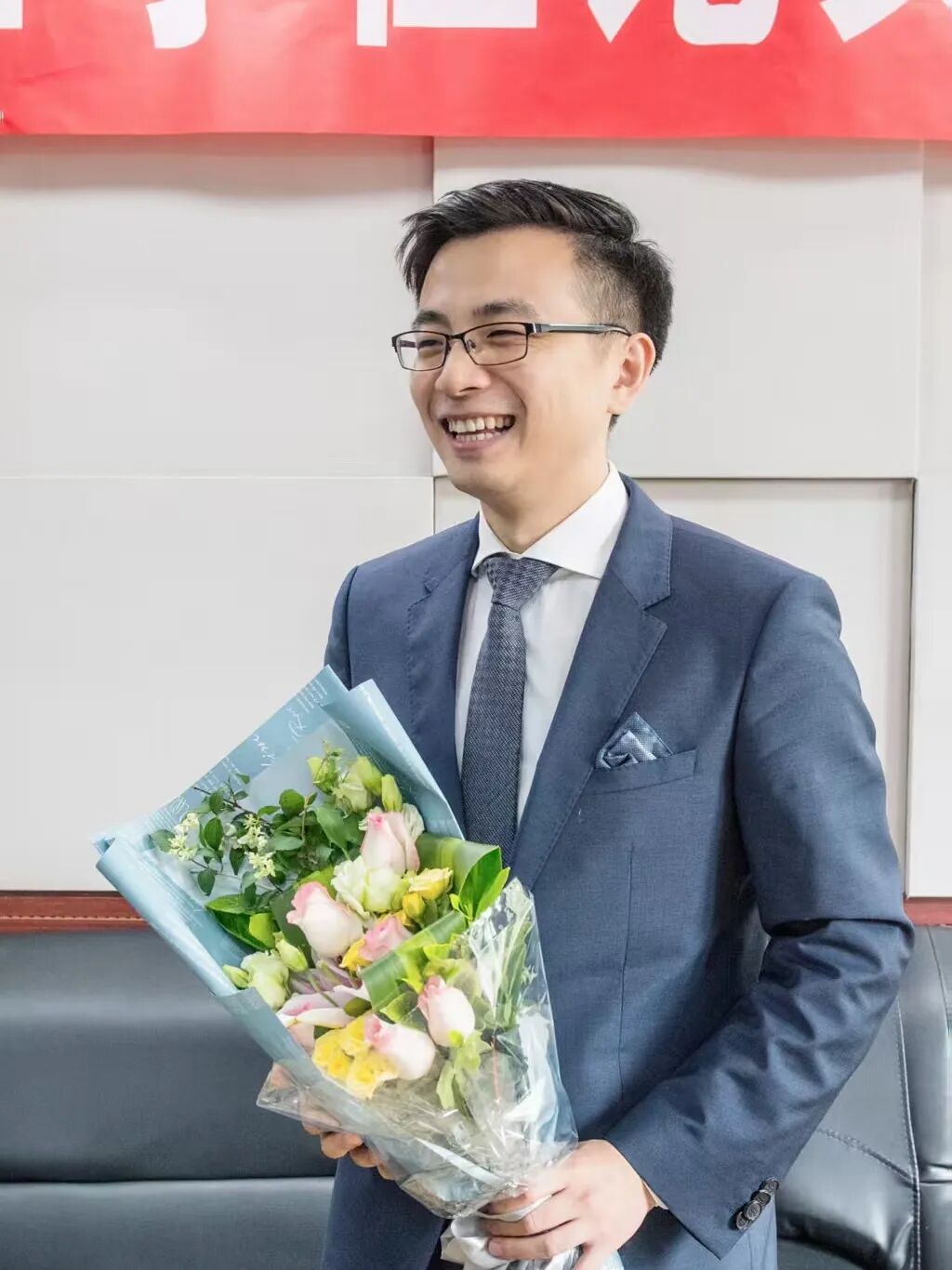
Yao Changsheng's PhD graduation photo at Tsinghua University
Q: How do you understand this "insistence on aesthetics"?
Yao Changsheng: Many things are connected to aesthetics. Whether it's product, market, brand, or the choice of partners, maintaining a broad standard of "beauty" matters. It's hard to make this very concrete.
Q: What's the ultimate goal in your mind right now?
Yao Changsheng: For what our company can see of the future, it's achieving cost parity for green hydrogen and opening up large-scale commercial applications across every sector. I believe that moment will come very soon.
Q: Do you have a vision for what the future world might look like?
Yao Changsheng: Using affordable hydrogen energy to power AI, and even support humanity's journey toward multi-planetary civilization.
If you had put this before, it was the kind of thing our generation read about in science fiction. Now there are already thousands upon thousands of people genuinely working on these things. If it doesn't happen in our generation, it certainly won't be far behind.
Q: What will be the first step?
Yao Changsheng: Continue driving down the price of green hydrogen.

Entrepreneurship on the Road
Q: If people were to associate three words with Hygreen Energy in the future, which three would you want them to be?
Yao Changsheng: Technology innovation, globalization, altruistic integrity.
Q: What's your superpower? Something you find easy that others find difficult?
Yao Changsheng: The ability to build trust.
This was actually the assessment the ZhenFund team gave me — that people quickly establish trust when communicating with me. Later I reflected on it, and my own understanding is to stay genuine, listen more, respect the other person more, and respond through action within your capabilities.
Every interaction between people, between companies, constantly tests your substance. So trust isn't one-time; it's more like a credit card, something that deepens and accumulates over time. But returning to the root, I think it's about insisting on genuineness.
Q: If you could give one piece of advice to young people who want to start a business, what would you say?
Yao Changsheng: I think externally, get out more to be with customers, go to the front lines, seek more opportunities; internally, genuinely listen to your team's ideas and give them a big enough stage and space.
Q: Over four years of entrepreneurship, has any perspective changed dramatically?
Yao Changsheng: I think two things have deepened. First, entrepreneurship is harder than I imagined. Second, the vision I see is bigger than when I started.
Q: When did you realize it was harder than you imagined?
Yao Changsheng: I realized it right from the start. The further you go, the harder the problems get. It's like playing a video game — you clear one level and find the next one harder, yet when you haven't cleared it, you're desperate to break through.
Q: And you're expanding the map even as you clear levels.
Yao Changsheng: Yes, and you can't go back.
Q: What do you generally do while traveling?
Yao Changsheng: I read. The more I fly, the more I read.
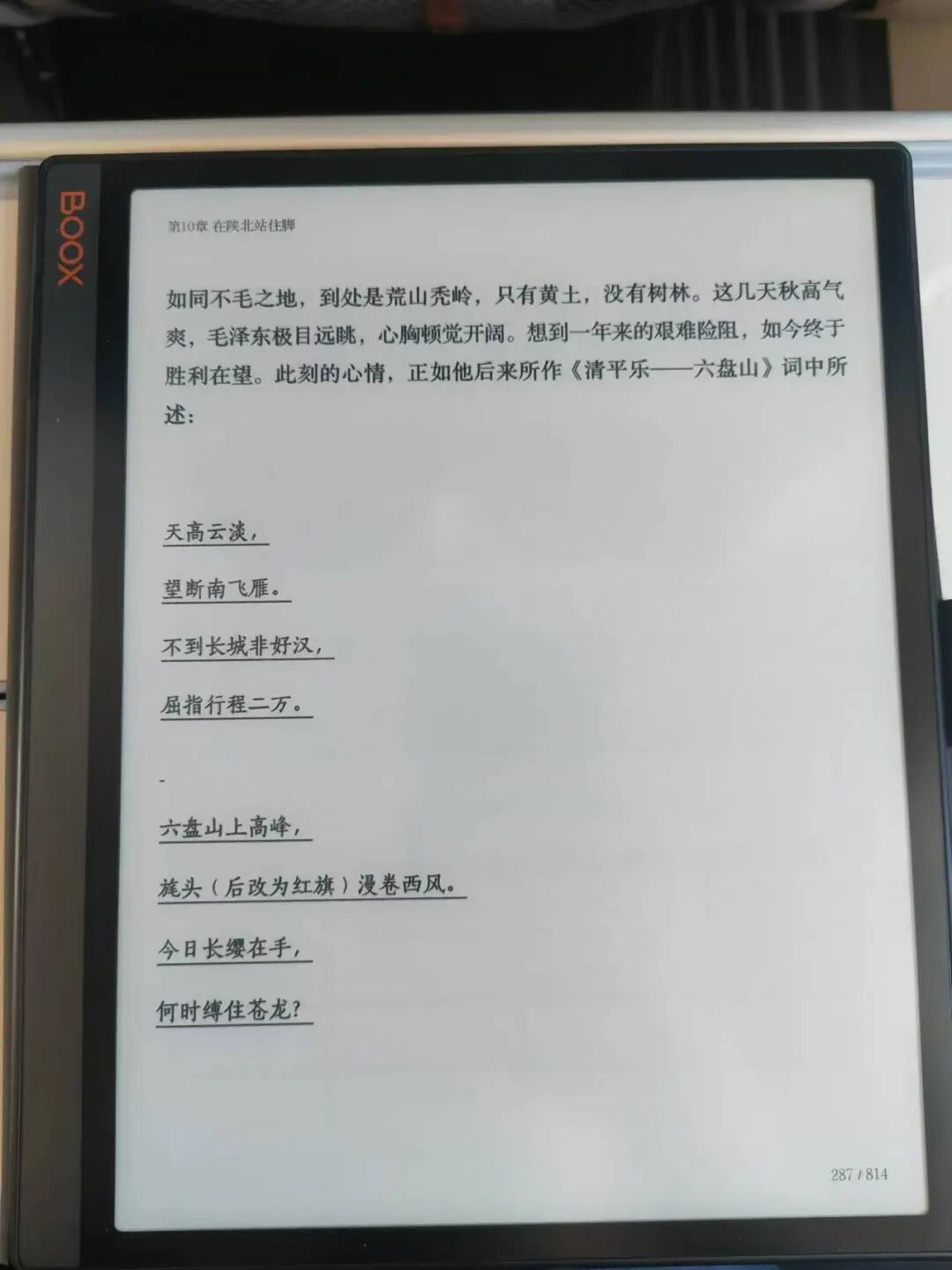
In 2024, more than a year later, books Yao Changsheng read on his second flight to Saudi Aramco's headquarters in Dhahran (by this time, they had already reached a partnership)
Q: What's the most recent book you've read?
Yao Changsheng: I've shared two recent books with the team. One is Life 3.0, about AI technology and AI society. The other is a record of Kazuo Inamori's work at Japan Airlines, written by his assistant Mr. Ota, about how Inamori — at 80 years old, after founding two Fortune Global 500 companies — took on a rescue mission and saved JAL within a year.
Q: Does the team regularly recommend books to each other?
Yao Changsheng: Yes, one per quarter.
Q: What's the book that influenced you most?
Yao Changsheng: Several books have had quite an impact during my entrepreneurial journey. One is called Build, by Tony Fadell, father of the iPod and co-designer of the iPhone, who later founded the smart home company Nest, acquired by Google. He talks about how to develop products and how to persist in your original intention to build a good company.
Q: It feels like every story you've shared happens while you're on the move. Where are you normally based?
Yao Changsheng: On the road.

Text | Cindy Podcast | Menmen & Cindy