What Did People Create in the 12 Hours After Kimi K3's Launch?

Unlock what comes next for you.
Early this morning, Moonshot AI officially released Kimi K3 — the company's most capable model to date.
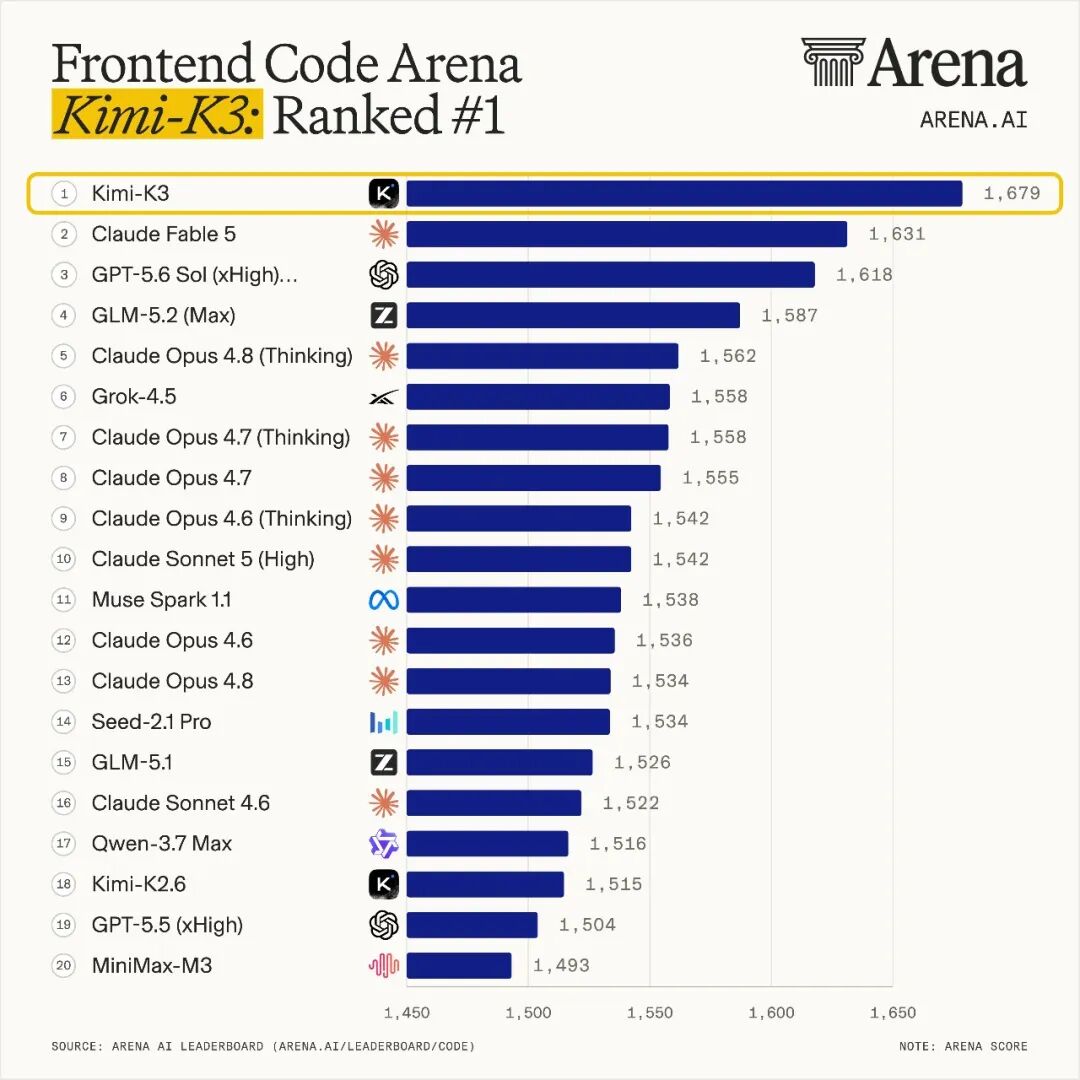
On the latest Code Arena leaderboard from Arena AI, which focuses on front-end programming, Kimi K3 scored 1679, climbing 17 spots to rank #1 globally, surpassing Claude Fable 5's 1631 and GPT-5.6 Sol's 1618.
Kimi K3 is a 2.8 trillion-parameter model built on KDA hybrid linear attention (Kimi Delta Attention) and Attention Residuals, with native visual understanding and a 1-million-token context window. It is the world's first open-source model at the 3-trillion-parameter scale, designed for frontier intelligence scenarios including long-horizon programming, knowledge work, and reasoning.
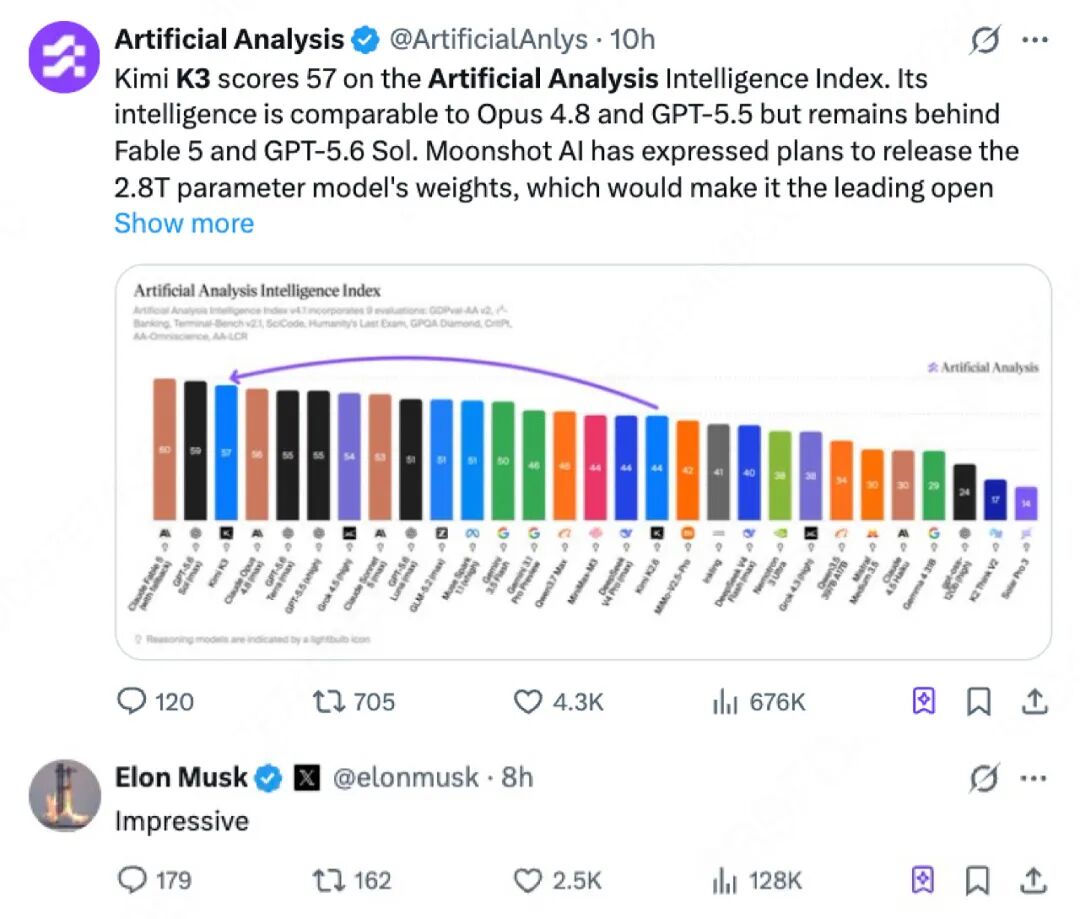
While Kimi K3 still trails the strongest closed-source models Claude Fable 5 and GPT-5.6 Sol overall, it demonstrated frontier-level capabilities across Moonshot AI's full evaluation suite and consistently outperformed all other models.
Leveraging its 1-million-token context window, Kimi K3 achieved 91.2 on BrowseComp, setting a new SOTA and surpassing both GPT-5.6 Sol Max and Fable 5 Max. Artificial Analysis also published its evaluation of K3, confirming its performance ranks third globally. Elon Musk even showed up in the comments to post: "Impressive."
Twelve hours after launch, how are people actually using Kimi K3? What can it really do?
We asked K3 itself. Here's what it said:

Give It a Theme, It Builds the World
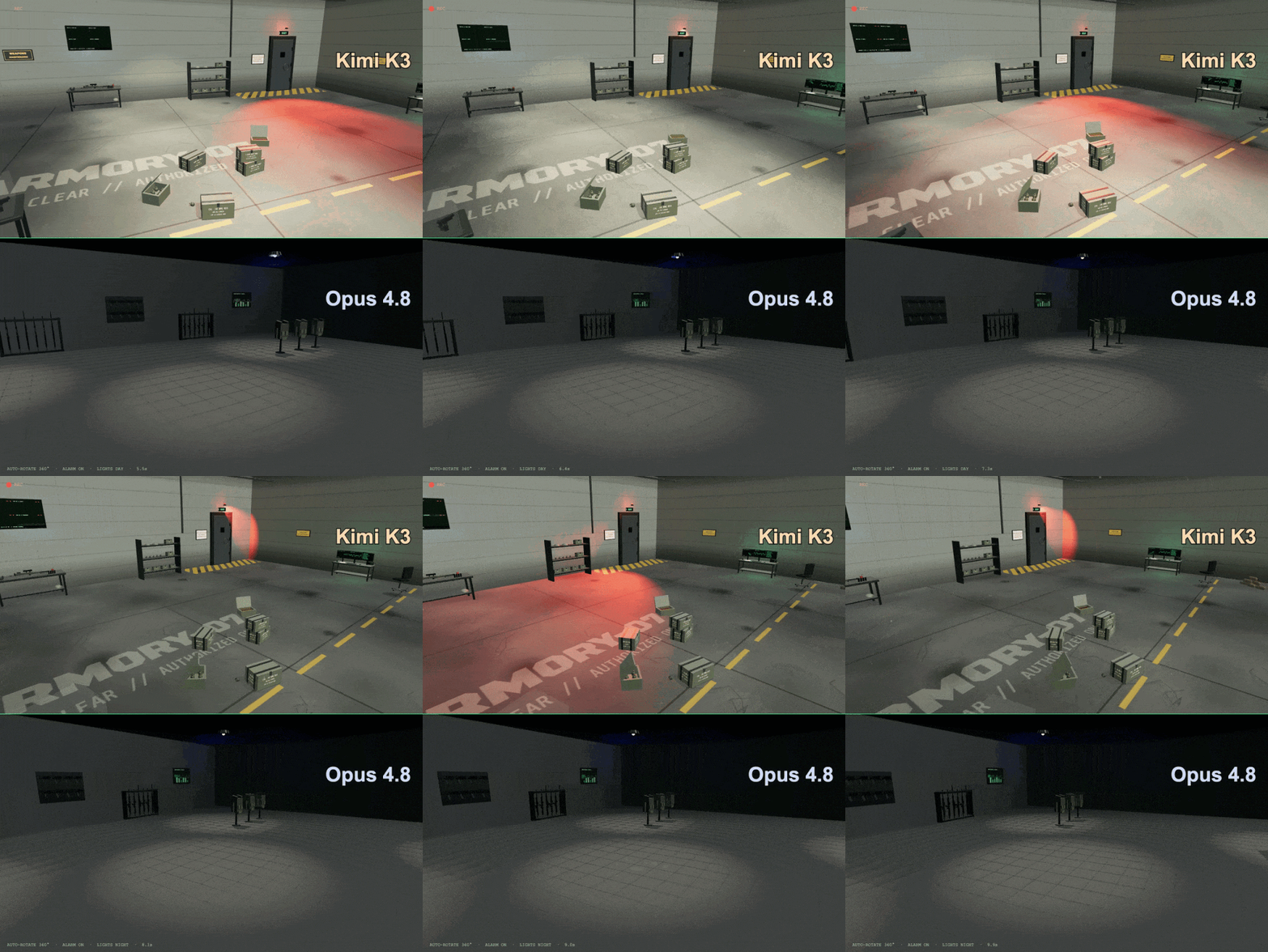
@Bhavani_00007 sent the same prompt to both Kimi K3 and Claude Opus 4.8: build an armory with lighting, props, and details.
K3's first challenge was understanding what "armory" actually means.
Source: @Bhavani_00007
So while Opus 4.8 delivered something closer to an early-development gray box — room, walls, floor in place — K3 kept pushing further: What does someone see first when they walk in? Which objects prove this place actually stores and manages weapons? What kind of lighting makes the space feel dangerous and real?
It added weapon racks, ammo crates, caution tape, wall signage, and scattered props. Different zones got different lighting — the center bathed in red, the depths left in shadow. Items weren't placed evenly but organized around sightlines and movement flow.
None of these details were in the prompt.
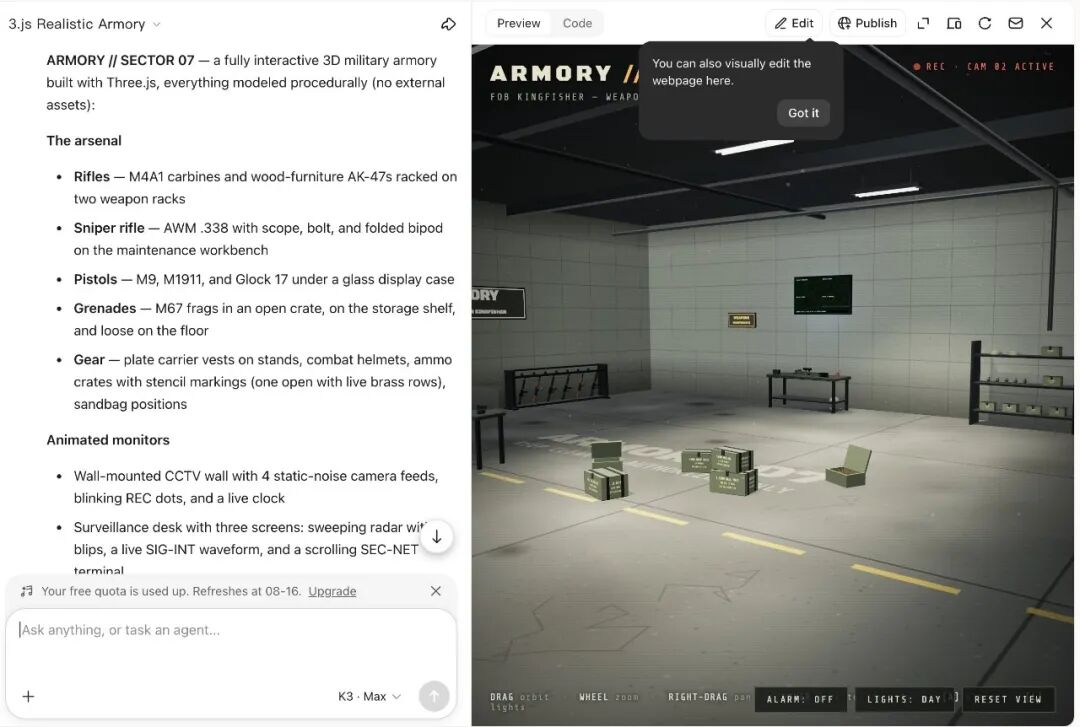
@Bhavani_00007's shared Kimi K3 prompt on X
This is exactly the convergence of 3D reasoning, programming, and visual capabilities that the official description points to: K3 is not executing literal instructions, but deriving a complete environment from a concept.
Give it a theme, and it actively fills in the world behind it.

What the Prompt Didn't Say
@chetaslua had both K3 and GPT-5.6 Sol build an operable ancient ballista in Three.js.
Receiving this instruction, K3's first response wasn't about what a ballista was actually used for.
K3 didn't treat it as an object waiting to be viewed. It placed the ballista on a nighttime battlefield. The player stands behind it, with city walls and targets in the distance, torches burning nearby. The camera enters the operator's perspective — users can aim, adjust direction, and fire.
GPT-5.6 Sol's answer was equally valid: the ballista centered in frame, parameters and operation info neatly arranged, more like a museum exhibit. Both models delivered functionality, but one answered "what does a ballista look like," while the other answered "what does it feel like to operate one."
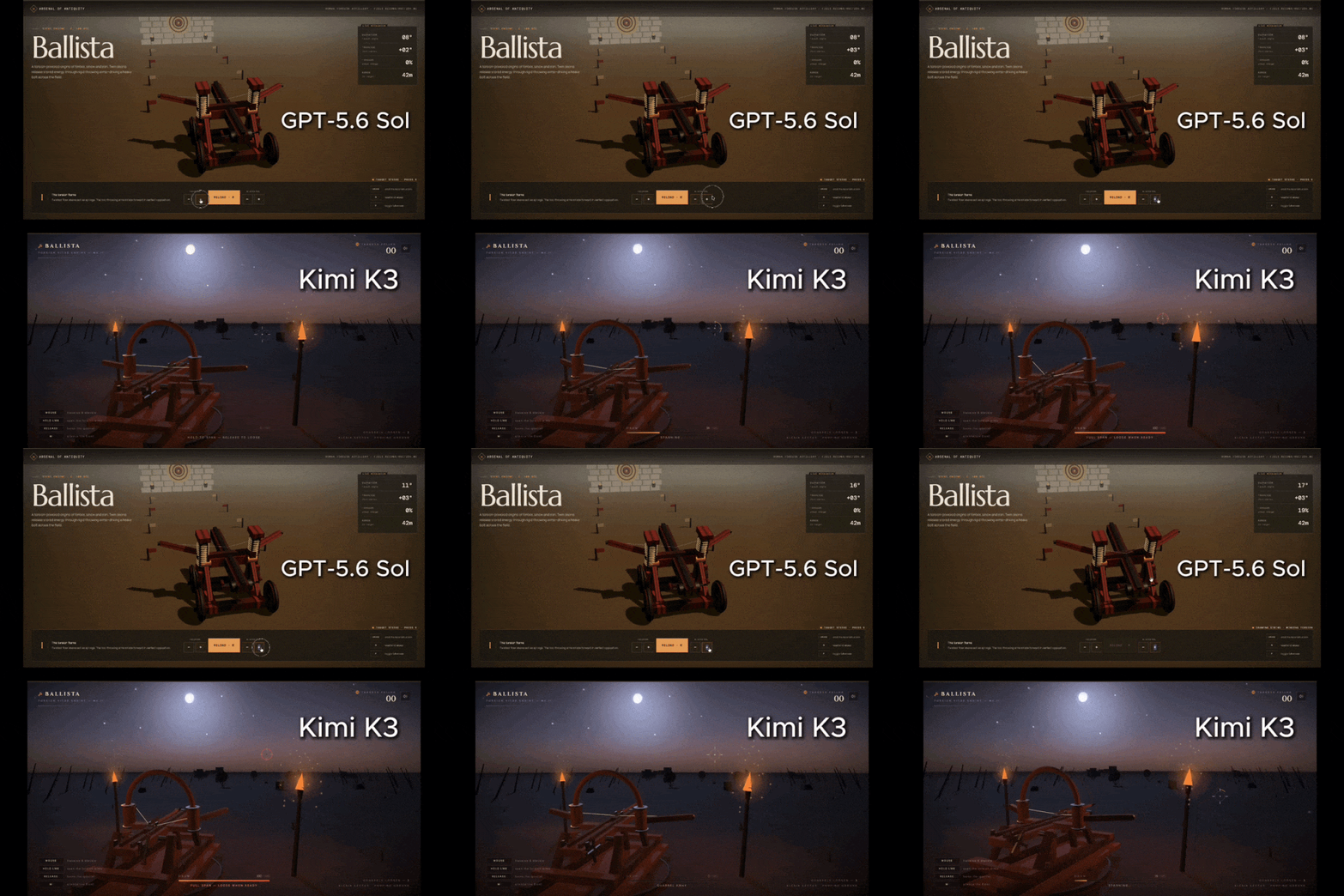
Source: @chetaslua
This is precisely what Moonshot AI described as "transforming concepts into fully playable interactive experiences."
Netizen @HarshithLucky3 called Kimi K3 Moonshot AI's Mythos moment.

600K Tokens, Uninterrupted Development
@ChrissGPT used three rounds of instructions — about 600K tokens — to have K3 build a first-person shooter combining CS:GO and Portal: players can move, aim, and shoot, with HUD, minimap, 3D levels, and portal mechanics all in place.
For K3, the real challenge wasn't writing any single system — it was ensuring that with each new mechanic added, everything before it still held together. After adding portals, movement still worked, aiming still worked, the minimap still worked. Those 600K tokens supported not just more code, but a continuously evolving, internally consistent development trajectory.
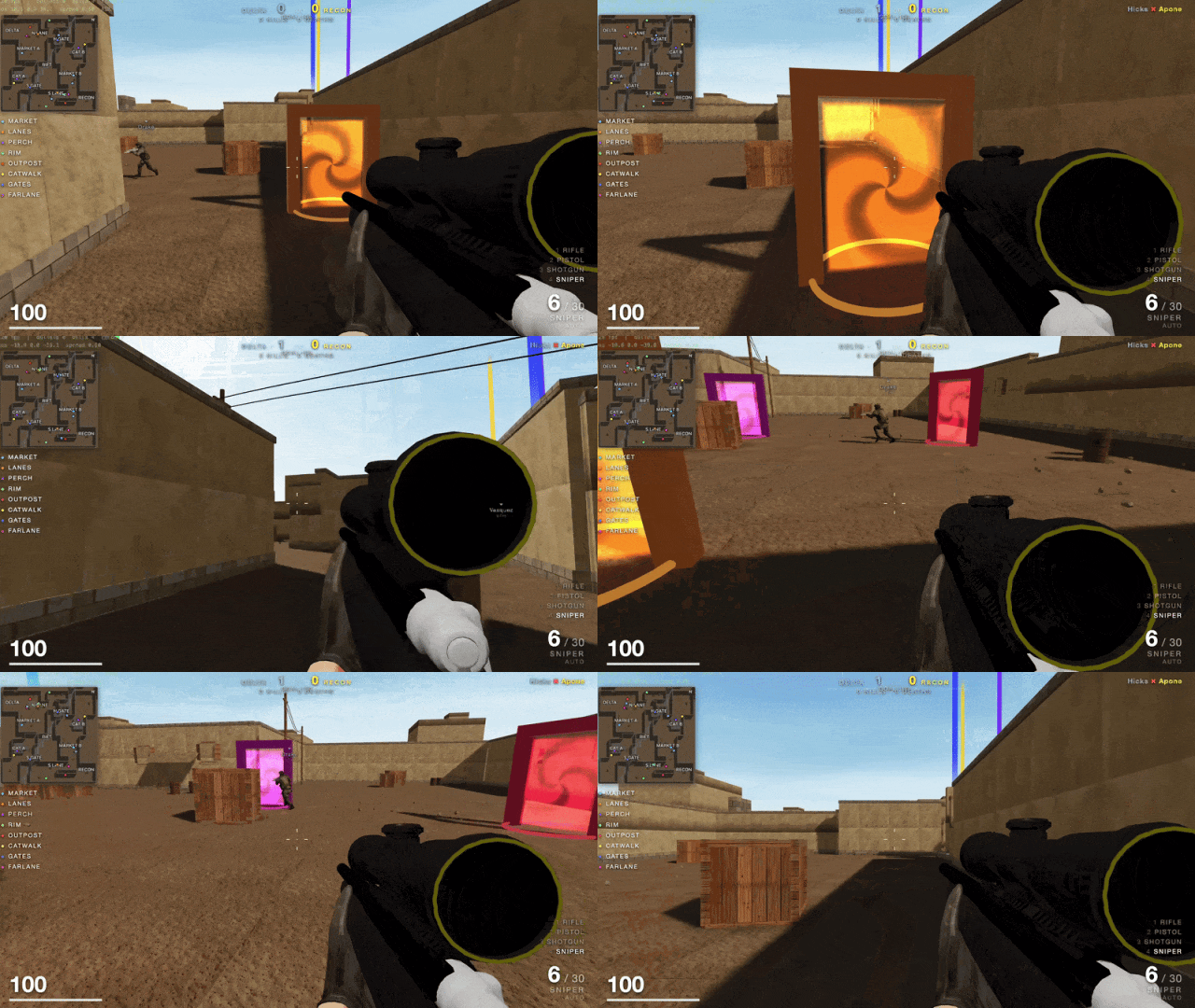
Source: @ChrissGPT
This is K3's core strength: its 1-million-token context and long-horizon coding capability.
It can sustain extended engineering tasks with minimal human supervision, understand large codebases, and coordinate terminal tool usage. Long context isn't just about reading more code — it supports a longer development trajectory.
The entire process cost just $3.24 in API calls. By Chris's calculation, the same token volume would cost $10.80 with Claude Fable 5 and $6 with GPT-5.6 Sol.

Understand the Feeling First, Then Choose the Visual
@filicroval tested front-end design.
Facing this task, K3's first response wasn't "what modules should the page have" — it was "what feeling should this product evoke."
Its answer: precision, hardness, speed, and the particular sense of power found in industrial manufacturing.
Every choice after that flowed backward from this feeling. Dark background, letting light fall on metal. The hero image wasn't a static product close-up but the moment a drill bit cuts into metal. Sparks, chips, and high-speed motion occupy center frame — the product isn't displayed, it's working.
GPT-5.6 Sol's approach was equally polished: off-white background, large headline, clean information hierarchy — a reliable premium product website template. The gap between them isn't in functionality, nor merely aesthetics, but in one following conventions while the other expresses judgment.
Author Filipe summarized this difference as taste.
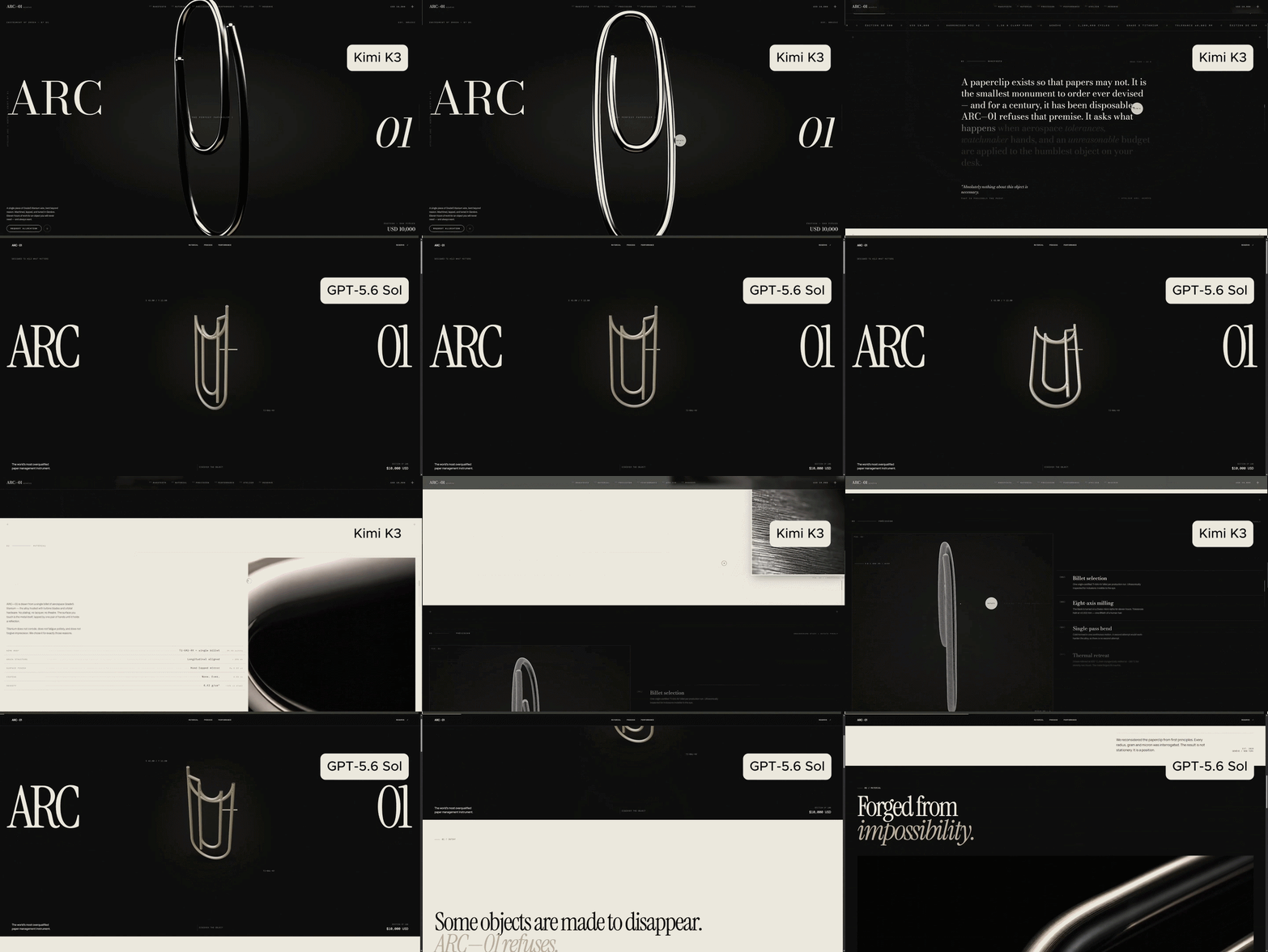
Source: @filicroval
Taste isn't just fonts, colors, or graphics. It means that among numerous defensible options, the model can judge which better suits this specific product. It knows when to restrain itself, and when a stronger image is needed.
From building detail-rich 3D worlds and developing interactive front-end applications, to handling large codebases and completing complex industry research, early users are continuously pushing the boundaries of what Kimi K3 can do.
Across these examples, K3 demonstrates a distinctive capability combination: long-horizon execution, spatial reasoning, visual feedback, and — remarkably — proactive aesthetic sense.
Having accompanied Moonshot AI since its founding, ZhenFund has also had the privilege of witnessing Kimi push the boundaries of intelligence again and again.
These cases may just be the beginning. A model's possibilities are defined collectively by everyone who uses it.
Now, use Kimi K3, and open your next possibility.


I don't see any Chinese text to translate in your message — only an image link. The image appears to show a chart or visual, but I cannot access or view images directly.
If you can share the Chinese text content from the image (by typing it out, copying from the source, or using OCR), I'd be happy to translate it according to the elsewhere.news style guidelines.