Elon Musk's Third In-Depth Interview with Lex Fridman: "Chopsticks Catching Rockets" Is the Key Technology for Building a Martian Civilization

Building a fully reusable rocket is the "holy grail" of orbital spaceflight.
Z Talk is ZhenFund's column for sharing ideas and perspectives.
On the morning of October 13 local time, SpaceX's next-generation Starship embarked on its fifth test flight. The launch tower's mechanical arms successfully caught the returning Super Heavy booster, achieving the first-ever "chopsticks catching a rocket."
Starship had previously conducted four launches. The first, in April 2023, exploded before stage separation. The second, in November 2023, achieved successful stage separation, but both the booster and spacecraft exploded shortly after. The third, in March 2024, also achieved stage separation, though the booster unexpectedly disintegrated after attempting its landing burn, and the spacecraft was lost during atmospheric reentry. The fourth, in June 2024, achieved stage separation with both components splashing down as planned in the Gulf of Mexico and the Indian Ocean, respectively.
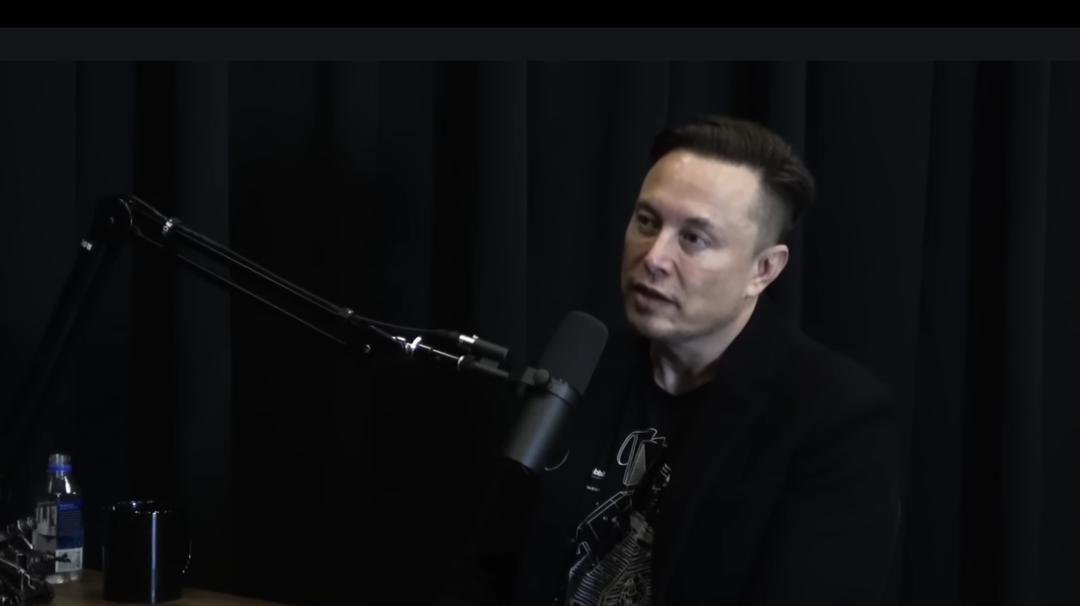
At the end of 2021, Elon Musk sat down for his third appearance on the Lex Fridman podcast, a two-and-a-half-hour deep dive covering Starship's importance for establishing a Mars settlement, SpaceX, human spaceflight, and the now-famous first principles thinking.
Below is the full interview, compiled by ZhenFund.
01
First Human Spaceflight: I Got Down on My Knees and Prayed
Lex Fridman: On May 30, 2020, SpaceX's crewed rocket reached orbit, seen by many as the first step in a new era of human space exploration. Over the past two years, these crewed missions have been a beacon of hope for me and millions of others, as our world went through one of the most difficult periods in modern human history. We've seen division, fear, cynicism on the rise, and a loss of our shared humanity when we needed it most.
So first, Elon, please allow me to say thank you. Thank you for giving this world hope and reason to be excited about the future.
Elon Musk: Thank you for saying that. I do want to do that. Humans obviously have many problems, and people sometimes do bad things, but despite all that, I love this species. I think we should make sure we do everything possible to have a great, exciting future — one that maximizes people's happiness.
Lex Fridman: I want to ask about the Crew Dragon Demo-2 mission, part of NASA's Commercial Crew Program and executed by SpaceX. This was SpaceX's first human spaceflight. How did you feel before launch? Were you scared? Excited? What were you thinking? The stakes were enormous.
Elon Musk: Yes, I was under tremendous pressure. We obviously couldn't let them down in any way, so the pressure was extreme.
I was certain that by launch time, nobody had any remaining way to improve the probability of success. We had racked our brains for every possible way to increase the odds, and there was nothing left — NASA too. We had done the best we could within our capabilities, so we moved forward and decided to launch. I'm not a religious person, but I got down on my knees and prayed for that mission.
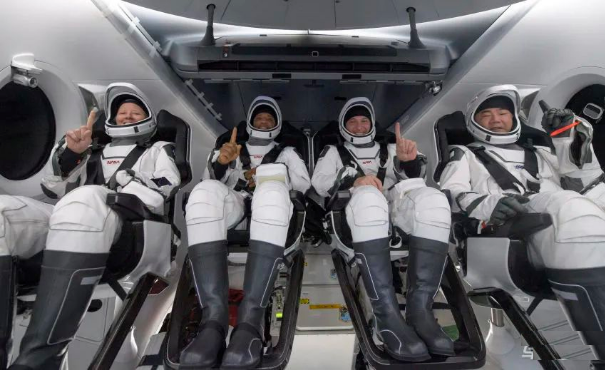
The four astronauts on SpaceX's first human spaceflight
Lex Fridman: When the spacecraft launched successfully, when it returned and landed safely, what did you feel inside?
Elon Musk: A massive sense of relief, like a weight lifted after intense pressure. I think as we became slightly more relaxed and validated these systems, there was definitely a lot of fun in SpaceX's subsequent astronaut missions.
I recommend everyone watch the Netflix documentary Countdown: Inspiration4 Mission to Space — it's excellent content, and I was personally inspired and encouraged. During that launch, I even felt somewhat exhilarated rather than tense throughout.
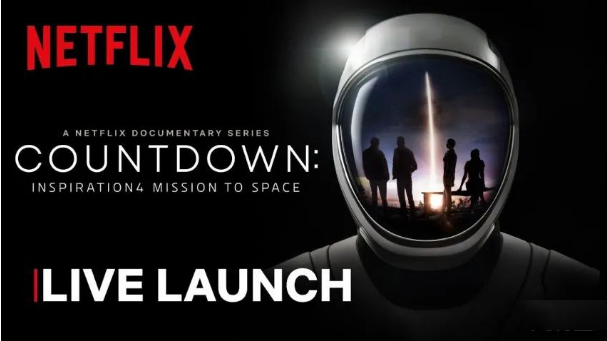
Netflix documentary Countdown: Inspiration4 Mission to Space
Lex Fridman: The Inspiration4 mission was the world's first all-civilian orbital flight, the first "civilian crew" in space travel.
Elon Musk: Yes, I believe that was the highest orbit humans had reached in 30 or 40 years. The only missions that went higher were the Hubble telescope servicing missions and, before that, the Apollo moon landing in 1972 — those were genuinely cool. As humans, we want to keep doing better, reaching higher.
I personally believe it would be deeply tragic if Apollo marked humanity's peak achievement. Humans walking on the moon was a level we once reached, but now 49 years have passed and we haven't been back a second time. Does that mean our civilization has peaked?
We must return to the moon and establish a proper scientific base there, like the scientific bases in Antarctica and other places around the world. From there, we can learn much more about the nature of the universe.
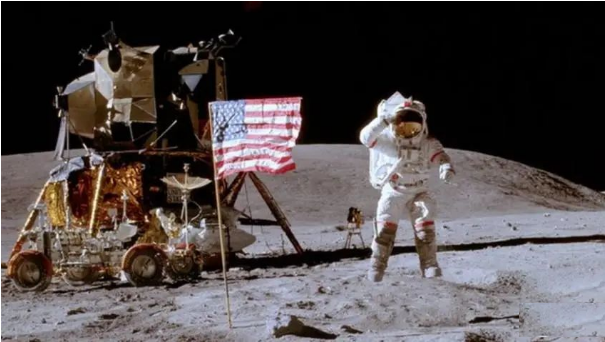
Apollo moon landing
I see all of this as connected. This is what I consider the next great thing — building a base, then sending humans to Mars, establishing a spacefaring civilization.
Lex Fridman: But because you're so busy handling all the difficult engineering challenges involved, can you still marvel at the wonder of it all? At space travel, at every rocket launch, especially the crewed ones? Or are you too overwhelmed by all the challenges you have to solve? It's been a while since SpaceX's first crewed flight on May 30 — you can now reflect on what it meant to you. At the time it may have been an engineering problem, but now it's becoming a historical moment.
What moments from the 21st century deserve to be remembered? For me, perhaps something like the Inspiration4 mission — it may be remembered as humanity's early attempt in a new era of space exploration.
Elon Musk: About this launch — something perhaps some people know, but most don't — I'm actually SpaceX's chief engineer, and I essentially sign off on all design decisions. So if anything is wrong with any piece of equipment, fundamentally it's my mistake. So I'm actually thinking about engineering design.
When I look at a rocket, my mind goes to factors that could go wrong and parts that could be improved — the same when I see the Dragon spacecraft. So while others might look at a rocket and say, "This spacecraft or rocket looks cool!" I'm like a meter constantly running, saying this is risky, that's problematic. It's a different feeling from how others see the product.
Lex Fridman: You've also said Starship is an extremely difficult challenge. So in the same way, if you could perfectly solve just one engineering problem on Starship, what would it be? Maybe engine efficiency, the weight of different components, the complexity of various things, or even something related to Starship's landing?
Elon Musk: None of those. What's currently most time-consuming is engine manufacturing, not engine design. I often say prototyping is easy, manufacturing is hard. We've designed the most advanced rocket engine.
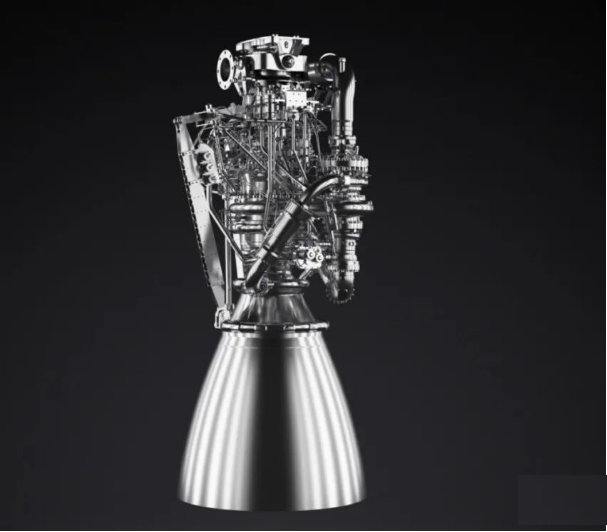
Starship rocket booster
The best rocket engine currently is probably the RD-180 or RD-170, basically Russia's dual-combustion-chamber, dual-nozzle engine. And I think whether an engine succeeds depends on whether it can put a spacecraft into orbit — our engine hasn't put anything into orbit yet, but in fact, it's the first engine to surpass Russia's RD series in performance.
Lex Fridman: The Raptor engine you mentioned — what makes it different from other engines? What do its distinctive aspects look like? What excites you most about its efficiency and how everything operates?
Elon Musk: The Raptor is a full-flow staged combustion cycle engine, operating at very high chamber pressure. So the key metric for engine quality is this chamber pressure number. This number is the pressure in the combustion chamber — the Raptor can operate at 300 bar, possibly higher. That's 300 times atmospheric pressure.
The current record is held by the RD engine's chamber pressure, around 267 bar. And increasing chamber pressure gets exponentially harder, so a 10% increase in pressure is like a 50% increase in difficulty, but this is what the engine needs to achieve higher power density.
So you get very high thrust-to-weight ratio and very high specific impulse. Specific impulse is the measure of rocket engine efficiency — it's essentially the effective exhaust velocity of the gases expelled by the engine. At very high pressure, you can have a compact engine that still has high expansion ratio, meaning the ratio between the exit nozzle and the throat.
You'll see rocket engines roughly in an hourglass shape. It's like a combustion chamber that narrows down, then connects to a nozzle. And the ratio of exit diameter to throat diameter is the expansion ratio.
Lex Fridman: Why is the Raptor an engine that's difficult to manufacture at scale?
Elon Musk: It's extremely complex, with many components and many exotic materials. To get this engine to work, we had to invent several alloys that didn't exist in current materials.
In a staged combustion system, especially a full-flow staged combustion system, there are many feedback loops within the system. Propellants and hot gases flow simultaneously to multiple different parts of the engine, and they recursively affect each other. So if you change something here, it creates recursive effects elsewhere, and that gets impacted too. It's very difficult to control. That's why no one had done this type of engine before.
The reason we chose full-flow staged combustion is that it achieves the highest theoretically possible efficiency. And to build a fully reusable rocket — which is essentially the "holy grail" of orbital spaceflight — you have to optimize everything. You need the best engine, the best airframe, the best heat shield, extremely lightweight electronics, and very clever control mechanisms. You have to minimize weight as much as possible.
For example, to save weight on landing legs, we're planning to catch the booster and ship with a tower instead of giving them landing legs. We're talking about catching the largest flying object ever built with a giant tower, using "arms" like chopsticks. Like the fly-catching scene in The Karate Kid, except the fly is much bigger.
It probably won't work on the first try. It's insane.
Lex Fridman: You mentioned that sometimes you doubt, that there are moments when you doubt whether this is really possible. It's so hard.
Elon Musk: The achievable part is, I think we will eventually get Starship to work. The question is how long it takes. How long do we need to get this done? How long until we can truly achieve full and rapid rocket reusability? It may take many launch attempts before it can achieve full and rapid reusability. But this approach is physically sound and feasible.
At this point, I'm confident in our success — it will emerge from all the results we get. At SpaceX, we have a team of geniuses working around the clock to make the vision a reality — the key to achieving a spaceflight revolution and making humanity a multi-planetary civilization is having a fully and rapidly reusable orbital rocket.
Never in history has an orbital rocket been fully reusable. This has always been the dream of rocket technology. Many people have tried, but none have succeeded. So this is a very difficult problem.
Lex Fridman: You know there are many people, including many experts, journalists, and the public, who have been skeptical about reusable rockets. Even if the probability of success isn't zero, it's still extremely difficult.
But you still threw yourself into it completely, as an engineer and as part of the team pushing this project forward and getting it done. What is the source of your strength and conviction?
Elon Musk: That's not how I think about it. To me, this is just something important that we should keep pushing on with everything we've got. I don't need a source of strength.
Lex Fridman: Giving up is not...
Elon Musk: It's not in my nature. I don't care about optimism or pessimism. Fuck it, let's get it done.
Lex Fridman: Can you zoom in on specific problems with Starship or any engineering problem you're working on? Can you try to describe your particular process of thinking through problems? And describe how you think about different engineering and design problems? Is there a systematic process? You've talked about first principles thinking, but is there a systematic process to implement it?
Elon Musk: Physics is the law, everything else is a recommendation. I've met many people who can break rules, but never anyone who can break the laws of physics.
First, for any type of technical problem, you have to make sure you're not violating the laws of physics. I think first principles analysis can be applied to any field and industry.
It's really about boiling things down to the most fundamental principles — the basic facts we're most confident are true, building your axiomatic foundation. Reason from there, then cross-check your conclusions against the axioms.
For example, some foundational principles of physics: are you violating conservation of energy or conservation of momentum? If so, it's impossible.
Another great physics tool is to think about limiting cases. If you scale something to very large numbers or down to very small numbers, how does the situation change?
Lex Fridman: Like when thinking about production volume and time?
Elon Musk: Yes, take manufacturing for example. I think it's a severely underrated problem. As I said, scaling an advanced technology product to mass production is vastly more difficult than designing it — orders of magnitude more difficult.
Suppose you're wondering, why is this part or product so expensive? Is it because we're doing something fundamentally wrong, or because our production volume is too low? You can ask yourself: okay, if our volume were a million units per year, would it still be expensive? That's pushing things to the limit.
If it's still expensive at a million units per year, then the cost isn't due to low volume — it's a fundamental design problem. You can focus on reducing complexity or modifying the design so this part isn't inherently expensive.
This is very common in rocket manufacturing because unit volumes are relatively low. So the common excuse is: "It's expensive because our volume is low. If you were in automotive or consumer electronics, the cost wouldn't be this high."
I'd say: "Now assume you're producing a million units per year. Is it still expensive?" If the answer is yes, then economies of scale aren't the issue.
Lex Fridman: Do you incorporate such thinking principles into manufacturing or supply chains? When you consider resources and raw materials, do you incorporate them into first-principles reasoning calculations, like how we'll make the supply chain work here?
Elon Musk: Exactly. Here's an example of thinking in limits — this method applies to manufacturing all products.
A good example of thinking in limits is, if you take any product, machine, or rocket, and look at the raw materials of the rocket. You'll find aluminum, steel, titanium, superalloys, specialty alloys, copper, and so on. Then you ask, what is the composition by weight of these elements? What is their raw material value? This sets the asymptotic limit of the device's cost, unless you change the materials. So when you do this, I call it the "magic wand number."
It's like if you had a pile of these raw materials, and you could wave a magic wand to rearrange the atoms into the final shape. This is the lowest possible cost you could achieve, and what really drives cost up or down is the effort required to get the atoms into the desired shape.
Lex Fridman: I want to tell a story first — I often chat with Jim Keller, who used to work with you.
Elon Musk: Jim did great work at Tesla.
Lex Fridman: So I think he was also inspired by you, that his way of thinking about problems should be similar to yours. Similarly, I think I've seen the same thinking in others who've worked at Tesla and SpaceX. It's clear they've all learned this way of thinking.
Not long ago, he and I were discussing how to reduce the manufacturing cost of the Tesla robot. Jim once told me that manufacturing the Tesla robot might not be expensive. We had an argument about it at the time — I didn't believe him. How could you reduce the cost of mass-producing robots? Because I had spoken many times with experts in academia and the humanoid robotics field, as well as companies like Boston Dynamics, and their humanoid robots were expensive to develop.
Then Jim explained to me how to think from first principles, how to reduce production costs. I think you have similar thinking about the Tesla robot and other complex systems — systems traditionally considered complex. You ask: how do we simplify everything?
Elon Musk: Yes, I think if a company is good at manufacturing, it can basically mass-produce, and the manufacturing cost of a product asymptotically approaches its raw material value plus any intellectual property you need to license. This is extremely difficult, but possible for anything.
So what often happens when a product is first designed is that people start with tools, parts, and methods they're familiar with, then try to manufacture the product with the tools and methods they already have. Another way to think about it is to imagine a Platonic ideal product or technology, whatever it might be. What is the perfect arrangement of atoms? What would be the optimal product? Let's try to figure out how to get the atoms into that shape.
Lex Fridman: It sounds a bit like an absurd idea from Rick and Morty. But once you actually start thinking about it, you realize this is indeed how you should think. Otherwise you might fall into inertia from the past.
Elon Musk: It's like an inertia function — people tend to use tools and methods they're familiar with. That's their default way of working and their habits. This approach leads to only being able to manufacture what those tools and methods can produce, but it's rarely the ideal form of the Platonic perfect product.
On one hand, ask "what can we build with existing tools?" But at the same time, ask "what would the theoretically perfect product look like?"
The theoretically perfect product is a moving target, because as you learn more, your definition of the perfect product changes. In reality you don't know what the perfect product is, but you can asymptotically approach a more perfect product.
Thinking about problems this way, you should ask: "What tools, methods, materials do we need to arrange the atoms into the required shape?" But people rarely think this way. It's a very powerful tool.
SpaceX Will Put Humans on Mars in 10 Years
Lex Fridman: Let's talk about Mars. You mentioned earlier, building a science base on the Moon and conducting some research there — that's very beneficial for the scientific community. But among seemingly impossible goals, the truly giant leap is putting humans on Mars. When do you think SpaceX will put humans on Mars?
Elon Musk: Best case is about 5 years, worst case is 10 years.
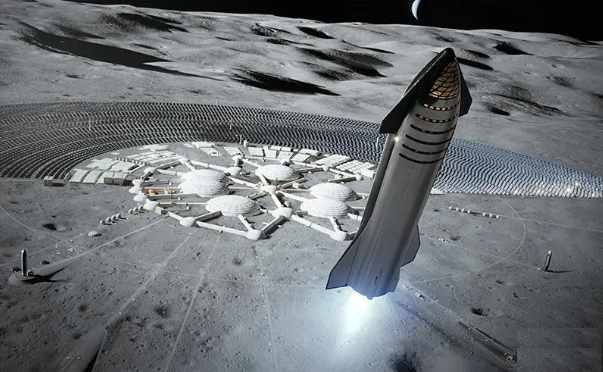
SpaceX's vision for an off-world base
Lex Fridman: What are the determining factors? Do you think it's engineering factors? Or are engineering factors not the bottleneck?
Elon Musk: Fundamentally, it's the Starship design. Starship is the most complex and advanced rocket ever built. I don't know what the determining factors are — maybe the scale of Starship, things like that. There will be many, because it's completely on another level compared to previous spacecraft.
So, the fundamental optimization for Starship is minimizing cost per ton to orbit, and ultimately minimizing cost per ton to the surface of Mars. Optimizing cost might seem like a commercial objective, but in reality, it's exactly what we need to optimize. Because there's a cost threshold — only when the cost per ton to Mars drops below this threshold can we afford to build a self-sustaining city. If it exceeds this cost, we simply can't afford it.
Even if you had a trillion dollars today, you couldn't buy a ticket to Mars. We need to make this a viable goal, make it technically possible.
But we don't just want to plant a flag like the moon landing and not go back for half a century. We want to settle on Mars, live there permanently. I think humanity needs to become a multi-planet species.
This might sound a bit esoteric, but over time, Earth is very likely to experience some kind of catastrophe — possibly resulting from human actions, or from some mutant external cause producing a global disaster, like what happened to the dinosaurs.
If that doesn't happen, if humanity somehow continues to survive, the sun will gradually grow larger and eventually engulf Earth. Earth might become too hot for human habitation in about 500 million years. While that's a long time, it's only about 10% longer than Earth has already existed.
So if you think about it, we're really remarkable right now. For the first time in 4.5 billion years, Earth has the possibility of extending life to planets beyond itself. The window of opportunity may stay open for a long time, but it could also be brief. Acting quickly while the window is open is prudent, in case it closes.
Lex Fridman: Nuclear weapons, pandemics, various threats — these should motivate us.
Elon Musk: Civilization could end with a bang or a whimper. If it's population collapse, that's a whimper. If it's World War III, that's a bang. These are all filled with uncertainty.
We should look at these issues probabilistically, not deterministically. There is a probability of some catastrophe on Earth. I think the future will most likely be good, but if we assume a 1% chance per century of a civilization-ending event — this estimate comes from Stephen Hawking, and I think he may be right — we should view becoming a multi-planet species as buying insurance for life itself, like life insurance for life.
We could bring Earth's plants and animals to Mars, infuse the planet with life, make it a second planet with life. They can't get to Mars themselves. If we don't take them there, they'll definitely go extinct when the sun expands, and then everything ends.
Lex Fridman: What do you think is the hardest part of establishing civilization on Mars? From engineering, economic, and anthropological perspectives — sending large numbers of people to Mars, who may never return to Earth.
Elon Musk: They certainly can come back. Some people will choose to return to Earth.
Lex Fridman: But many will choose to spend the rest of their lives there.
Elon Musk: Many will. The ships that go to Mars need to come back to Earth because they're extremely expensive. You can always take a ship back, but we can't not bring it back.
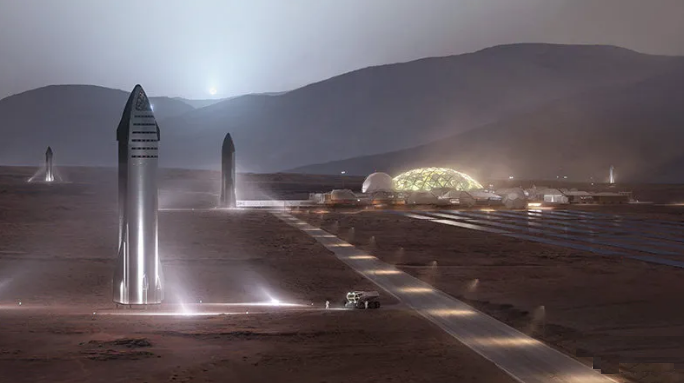
SpaceX's vision for a Mars base
Lex Fridman: Have you thought about terraforming Mars, actual construction matters? Or are you focused on the practical level of building ships to land on Mars?
Elon Musk: Of course I've thought about it. But first we have to solve how to get to Mars. If we can't even get to Mars, there's no point discussing anything else. As I said, the current cost of reaching Mars is extremely high.
Right now, the cost to deliver one ton to the surface of Mars is roughly $1 billion. You don't just need the rocket and launch — you need heat shields, guidance systems, deep space communications equipment, landing systems, and so on. So $1 billion is just a rough estimate. This is obviously far too expensive for creating a self-sustaining civilization, so we need to reduce this cost by at least a thousandfold.
Lex Fridman: Keep landing costs at $1 million per ton?
Elon Musk: Yes, ideally below $1 million per ton. But if we can't achieve that, we should ask what society can afford or is willing to spend to establish a self-sustaining city on Mars. Self-sufficiency is the key. Only when a Martian city can survive without relying on supply ships from Earth will we have truly crossed that threshold.
It's like being on a long sea voyage with all the supplies you need except vitamin C — you're destined to die. So we need to give the Martian city self-sustaining capability. I'm not sure this will actually happen in my lifetime, but I hope to at least see it gain strong momentum.
Then we can ask: what's the minimum tonnage needed to establish a self-sustaining city? There's a lot of uncertainty here, and I don't know, because you'd need to build massive infrastructure on Mars — probably at least a million tons. To achieve self-sufficiency, nothing can be missing. You need semiconductor factories and so on. Mars isn't very habitable, though there are many planets far less suitable. But Mars is definitely a planet that needs major renovation.
Lex Fridman: We should clarify — this is within the solar system.
Elon Musk: Yes, within the solar system. There may be some great vacation spots in the solar system. But we can't reach them.
Lex Fridman: Too difficult?
Elon Musk: Yes, extremely difficult.
Lex Fridman: I want to ask from a different angle. You mentioned physics as your starting point, and general relativity suggests wormholes exist. Do you think humans could use these to achieve faster-than-light travel?
Elon Musk: Wormholes are debatable. We currently don't know of any way to exceed the speed of light. There are actually some spacetime theories — having an object move at light speed within space, while also having space itself move. This is actually called warp drive, and this speed could exceed the speed of light. Like the universe in the Big Bang — the universe's expansion rate is much greater than the speed of light.
Lex Fridman: Yes.
Elon Musk: But the energy required to warp spacetime is so enormous, it's virtually unimaginable.
Lex Fridman: So, how much innovation do you have in rocket propulsion systems? Can you achieve a 10x improvement? Is there any breakthrough in physics that could bring massive efficiency gains?
Elon Musk: As I mentioned before, the true holy grail is achieving full and rapid reusability of orbital systems. Right now, Falcon 9 is the only reusable rocket. The booster can return and land, and we can recover the fairings, but the upper stage cannot be recovered. This means we have to spend at least the cost of an upper stage. You can think of the two-stage rocket as two airplanes: one large and one small. We can recover the large airplane, but not the small one. It's still very expensive — the upper stage costs at least $10 million.
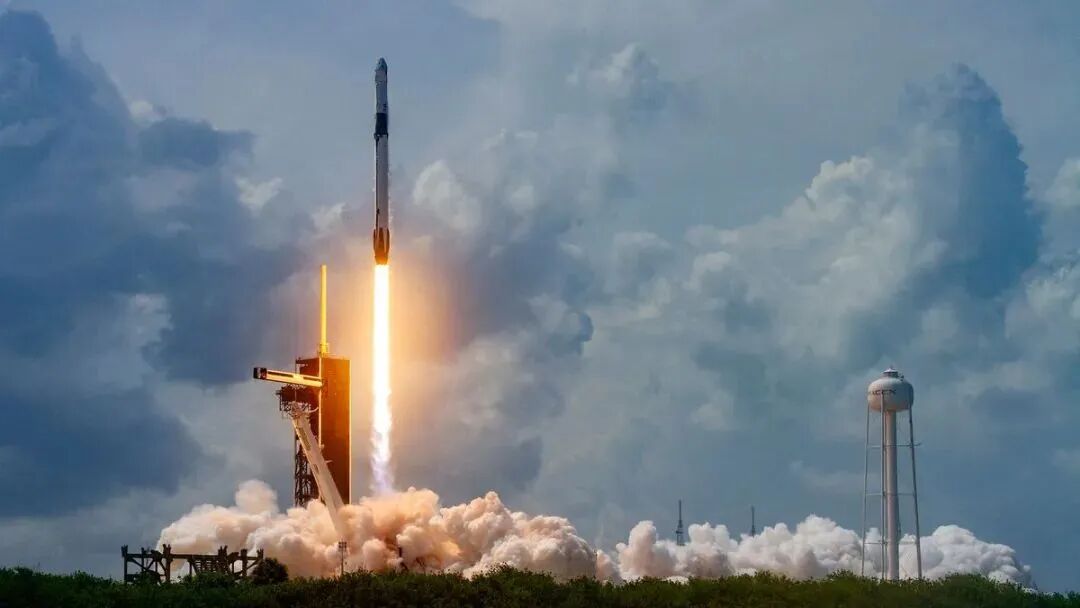
SpaceX Falcon 9
Moreover, the current reuse rate of Falcon 9 boosters and fairings doesn't reach the level we hope for.
Our minimum marginal cost per flight, excluding overhead, is probably between $15 and $20 million. This is already the lowest rocket launch cost in history. But if we achieve full and rapid reusability, we could reduce the cost per ton to orbit by 100x.
Think about it — if you had an airplane or a car, and every time you traveled you had to buy a new one, that would be absurd. But if you just refuel or recharge your car, that reduces your travel cost by 1000x. The same principle applies to rockets. Building rockets, these complex machines, is extremely difficult.
Therefore, if you can't reuse the rocket and have to throw away any significant part of it, that massively increases the cost. Theoretically, Starship could cost between $1 and $2 million per launch, carrying over 100 tons to orbit in a single launch. That's incredible.
Lex Fridman: Yes, incredible. So what you're saying is, the biggest challenge so far is making it reusable, not some major breakthrough in theoretical physics.
Elon Musk: There's basically no breakthrough. No new physics — just making rockets reusable. It's an extremely difficult engineering problem.
Lex Fridman: Just brilliant engineering. I want to ask a slightly philosophical, interesting question. Currently, you're focused on how to get to Mars. Once humans land on Mars, what form of government, economic system, political system do you think would be most suitable for humanity's early civilization? The interesting thing is, it also helps people imagine future Martian civilization.
Elon Musk: It will be a new frontier, and an opportunity to rethink the nature of government as a whole, like what was done when America was founded. Personally, I think Mars should have direct democracy, where people vote directly on things rather than representative democracy. Laws must be short enough for people to understand. And people need to be fully informed, with complete transparency about what they're voting on.
And don't be annoying like those cookies we have to accept. You have billions of people constantly clicking to accept cookies — just accept the damn cookie.
I think there's a fundamental problem: because we haven't experienced large-scale world wars for a while — obviously we all hope they never happen again — there's a lack of regulatory cleanup function. Wars, in a sense, serve as a cleanup. After wars, rules and regulations get reset. After World War I and World War II, rules and regulations underwent massive resets.
Now, if society has no wars and no regulatory cleanup or garbage collection function, rules and regulations just accumulate every year because they're eternal. People die, but laws don't.
We need a garbage collection function for rules and regulations. They shouldn't exist forever, because some rules and regulations end up having counterproductive effects. Even if well-intentioned, they can still backfire. Sometimes they're not even well-intentioned. So if rules and regulations just accumulate every year, eventually you can't do anything.
Like Gulliver tied down by thousands of tiny ropes — we see this in the US and almost every long-established economy, where regulators and legislators create new rules and regulations every year, but make no effort to remove them. I think we must make an effort to delete rules and regulations, and that's very important. But it will also be difficult. Because there will be special interests that depend on these rules, who have a vested interest in any rule or regulation, who will resist their elimination.
Lex Fridman: The problem is like the difference between C and Java, because it doesn't have built-in garbage collection. When you first mentioned the garbage collection analogy, I loved that.
Elon Musk: Something has to be done, otherwise the arteries of civilization harden over time, leading to more and more things becoming impossible to do. Almost everything has rules constraining it.
So I feel that, whether for Mars or Earth, there should be an active process to remove rules and regulations, and to question their existence. If we have mechanisms for creating rules and regulations, then rules and regulations can be viewed as the software or lines of code that operate civilization. There needs to be code accumulation, but also code deletion. Otherwise, after some period of time, they become obsolete bloatware that makes things difficult to advance.
Perhaps on Mars, any law must have a sunset clause, and require active voting to be maintained. These are just my suggestions or ideas — ultimately it will be decided by the people on Mars. But I think repealing a law should be easier than adding one, once you overcome the inertia of the law. Perhaps it could be something like: 60% vote required to enact a law, but only 40% vote required to repeal it.
Lex Fridman: You once said SpaceX might consider putting a literal Dogecoin on the moon, you once said Dogecoin is the people's currency, we discussed possible political systems on Mars — do you think Dogecoin has a chance of becoming the official currency of Mars, or the currency of the future?
Elon Musk: I think Mars itself needs to have a different currency from Earth, because the two planets are too far apart for currency to circulate synchronously due to the speed of light and other reasons. It has to be completely independent of Earth.
Lex Fridman: So Mars must have an independent monetary system?
Elon Musk: Yes, because Mars's closest approach to Earth is about 4 light-minutes, and its farthest point is about 20 light-minutes, maybe a bit more. So with a twenty-minute speed-of-light delay, you can't have synchronization. I don't know if Mars will have cryptocurrency in the future, but there should be a Mars-localized currency.
Lex Fridman: Should the people on Mars decide the form of the currency?
Elon Musk: Yes, the future of Mars should be decided by Martians.
03 The Hardest Part of Autonomous Driving Is Building the Vector Space
Lex Fridman: Tesla's Autopilot has achieved incredible things over the past six years. The reason I say it's amazing is because I know full well how challenging it is. I was at MIT, I deeply understood the difficulties of computer vision. I also had many colleagues and friends, I knew the ins and outs of the DARPA challenge, knew how difficult it was.
So when I first drove a Tesla car based on the original Mobileye autonomous driving system, I was skeptical. I didn't think the car could autonomously maintain a lane and create a comfortable driving experience for the driver. My initial intuition was that lane keeping was too difficult to solve.
Elon Musk: Actually lane keeping is relatively easy to do.
Lex Fridman: This is the difference between a prototype and truly creating a pleasant experience that can persist across hundreds of thousands of miles and millions of miles.
Elon Musk: We had to wrap a lot of code around Mobileye, it couldn't work on its own.
Lex Fridman: I'm referring to your approach to things — sometimes you start from scratch, sometimes you see what's out there and then decide to start from scratch. This was actually the boldest decision I've ever seen, where you built an entirely new autonomous driving solution from scratch, both in software and hardware.
It's been an incredible journey, and of everything I see now — hardware, compute, sensors and so on — what I care about and love most is the work led by Andrej Karpathy: dataset selection, the data engine process, neural network architecture, how networks are tested and validated in real life. Compared to ImageNet models in computer vision, this is like "real-world AI" compared to academia.
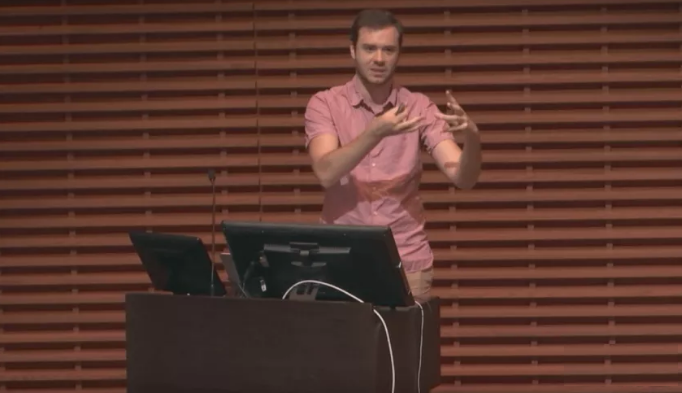
(Former) Tesla AI Lead Andrej Karpathy
Elon Musk: Andrej is amazing, he obviously played an important role. We also have many very talented people pushing this work forward. Ashok is actually the head of Autopilot engineering, Andrej was the head of AI direction. People give me, give Andrej a lot of credit, but people should realize there's more going on behind the scenes. Tesla's Autopilot AI team has gathered some of the most top-tier people in the world, which is why Tesla's autonomous driving software continues to make progress.
Lex Fridman: Over these five or six years of autonomous driving development, what insights have you gained about autonomous driving? You jumped into this field with some first-principles intuition, but no one knew how difficult it would be.
Elon Musk: From the beginning, I knew making cars drive autonomously was an extremely difficult thing, but as the project progressed, I found it was even more difficult than I imagined. The foundation of making vehicles drive autonomously is replicating how humans drive — human eyes perceive and process information with neural networks, ultimately completing driving behavior. And Tesla's FSD software is designed this way, basically using vision algorithms and neural networks to achieve autonomous driving. So to deploy FSD, we need cameras with advanced neural networks, presented in silicon form. Only then can true full self-driving be achieved. I don't think there's any other way.
Lex Fridman: What aspects of human nature do you have to encode into the machine? What do humans pay attention to when driving? For example, the machine needs to know what an open car door looks like — that's perception capability. The system must first solve the perception problem before it can further control and plan the car. You have to thoroughly study everything involved in driving, and there are many different edge cases.
Elon Musk: I don't think the difficulty lies in the control logic.
Lex Fridman: What do you think is the most difficult part of the entire problem?
Elon Musk: The most difficult part should be building an accurate vector space, because it requires too much software, and a large amount of code. After cameras perceive images and form digital signals, the digital signals need to be mapped into a vector space, ultimately being able to recognize cars, people, lane lines, curves, traffic lights, and so on. Once an accurate vector space is established, controlling the vehicle becomes as simple as playing a game, like playing GTA, Cyberpunk, and other games. Building an accurate vector space is difficult, but not insurmountable.
Lex Fridman: Yes, it's incredible how the human perception system maps photons to a vector space in the mind, but most people don't realize this.
Elon Musk: Actually your brain is processing massive amounts of data right now, presenting you with a very clear image. When we look around, we might see colors in the corners of our vision, but in reality, your eyes have almost no cone cells — color receptors — in the peripheral vision. Your eyes are actually "painting" these colors in the peripheral vision.
You don't realize this because your eyes are essentially filling in the colors. Additionally, there are blood vessels and some other irregular things in the eye, plus blind spots. But can you see your own blind spots? No. Your brain fills in these missing blind spots. You can do some experiments online, look at one point, then look at another point. If that point falls within your blind spot range, your brain will automatically fill in these missing parts.
The brain does massive amounts of post-processing when handling visual signals from the eyes. And even after obtaining all these visual signals, the brain is constantly trying to forget as much information as possible.
Perhaps the weakest part of the human brain is memory. Because memory is very expensive and limited for the brain, the brain tries to forget unnecessary information and reduces what you see to the minimum amount of information. The brain is not only trying to convert information into a vector space, but also working hard to reduce it to a minimal vector space containing only the most relevant objects.
You can try to "see" what your own brain is doing, or at least I can do this. When you're driving, try to consciously think about what your brain is doing. You'll find that you can see the car in front of you, but you don't have multiple perspectives like a camera. You actually only have two eyes, like cameras mounted on slow gimbals, with vision that isn't particularly good.
People are often distracted, thinking about various things — texting, or doing things they shouldn't in the car, changing radio stations, even arguing and so on. So think about how long ago it was since you last looked left or right, or looked back, or even looked diagonally forward to refresh your vector space.
When you look around, your mind is actually extracting those relevant vectors — simply put, objects with position and motion — and reducing them to the minimum amount of information you need to drive safely.
Lex Fridman: The brain can automatically edit the vector space, or further compress it into concepts and such. The human brain sometimes goes beyond vector space into concept space — what you see is no longer some spatial representation, it's like a concept you should know.
If you're near a school, you'll remember this as a concept, which is strange. Even though you don't see students at that moment, you'll think: drive carefully, watch out for students.
Elon Musk: You need to build the vector space, then make actual predictions about these spaces. For example, when you're driving, there's a truck ahead, and some kids preparing to cross the road. When you're relatively close to the truck, the truck blocks your line of sight and you can't see those kids anymore. At this point, what you're thinking is: where are these kids now, I need to predict their positions in advance.
Lex Fridman: For computer vision, recognizing moving objects — like when something disappears behind a tree and reappears — that kind of coherent tracking is incredibly difficult.
Elon Musk: That's exactly what we're working on — "object permanence." It's somewhat analogous to how human neural networks operate. As a person grows from infancy, there's a developmental stage where they acquire the perception of object permanence.
If you hide a toy or something behind your back and bring it out to show a baby, to that baby, every time you bring it out, it's appearing for the first time. It's entirely new. They can play peekaboo all day long. But as they grow older, they develop the perception of object permanence — they realize the object was actually there the whole time, it didn't disappear, it was just hidden behind you.
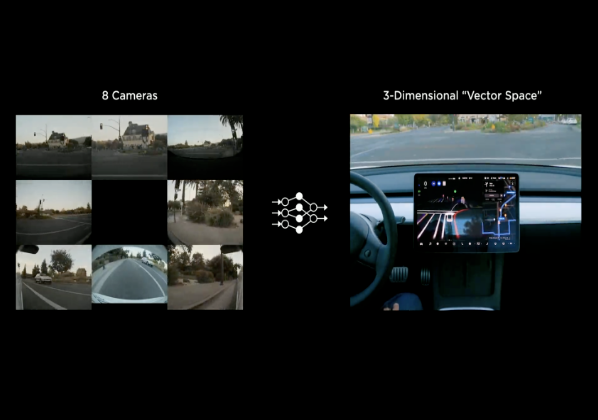
Tesla's eight cameras feed into a three-dimensional "vector space"
Lex Fridman: Sometimes I wish we never developed object permanence.
Elon Musk: Yeah. A major development in the car's neural network is the combination of memory across time and space.
You have to consider how long you want to remember things. Long-term memory has a cost. If you try to remember too much for too long, you can run out of memory. And if you remember things for too long, the information can become stale, plus you need to remember new things.
For example, say you have a five-second temporal memory. But suppose you're stopped at a red light, you see some pedestrians waiting to cross, and because of occlusion you can't fully see them anymore, but they might wait a full minute until the light turns green and they can cross.
You still need to remember where they were and that they're very likely to cross. So even if it exceeds your temporal memory, it shouldn't exceed your spatial memory.
Lex Fridman: Acquiring the data to learn all these concepts you described is an iterative process.
Elon Musk: Right, though we might change the name.
Lex Fridman: Well, I'm sure it'll be as brilliant as Rick and Morty.
Elon Musk: We've re-architected the neural networks in the car many times. Super crazy.
Lex Fridman: So every time there's a new version, do you rename it something more absurd, or more memorable and beautiful? Wait, I shouldn't say absurd.
Elon Musk: The full array of neural networks currently controlling the car has so many layers, it's extremely complex, so we didn't go that route. We use simple neural networks that basically do recognition on a single frame from one camera, then try to stitch them together. We have our own C compiler.
So to maximize performance, we're constantly optimizing our C compiler for maximum efficiency. In fact, we recently did a new REV command in our C compiler that compiles directly to our Autopilot hardware.
Lex Fridman: You want to compile everything with your own compiler?
Elon Musk: Yeah, there's all kinds of computation.
Lex Fridman: So that includes CPUs, GPUs, the basic stuff? So you're personally involved in writing compiler code too?
Elon Musk: Yeah, and we've got a lot of people on it. It involves a lot of hardcore software engineering, so we're also doing massive computation on the FSD computer, and we need to achieve the highest possible frames per second within limited compute capacity. Tesla has many extremely capable software engineers working to improve our computational efficiency.
Lex Fridman: If you want to achieve gaming-level frame rates, you need full resolution, high frame rate, low latency.
Elon Musk: Right, plus low jitter on top of all that. One thing we're doing now is eliminating post-processing of images through the image signal processor. For example, typical cameras do a lot of post-processing to make photos look prettier. But we don't care if the picture looks pretty — we just want the data, so our cameras collect only raw photon counts.
The images our system sees on the computer are actually far more than what people normally see. Two points that appear to have roughly similar light to the human eye may actually differ greatly in photon count. This means our cameras can see very well in the dark because they can detect minute differences in photon counts.
By removing image post-processing, we've improved latency by 13 milliseconds. Each camera saves roughly 1.5 or 1.6 milliseconds, and with eight cameras that adds up to 13 milliseconds saved.
How do we measure latency? It includes light entering the camera, camera data going into multiple neural networks, into programs written primarily in C with a small amount of C++, then the autopilot system issuing driving commands, and those commands being sent to the electric drive actuation units for acceleration, braking, or steering. Some controllers operate at 10Hz (once every 100ms), so that's already 100 milliseconds of latency. So we want to upgrade the electric drive system controllers to operate at 100Hz or higher (once every 10 milliseconds), which would reduce the overall system reaction delay.
Actually, jitter is more challenging than latency. Because latency is predictable. But if you have accumulated delays from the camera to the computer, then through a series of other computers, and finally to the actuators in the car, you can get quite significant variable delay — that's called jitter.
This makes it very difficult to accurately predict how to turn or accelerate the car. If you might have 150 or 200 milliseconds of jitter, you could be off by as much as 0.2 seconds. That makes a huge difference.
If your latency is fixed, you can anticipate it and say: "Okay, we know our information has a 150-millisecond lag." Meaning there's a 150-millisecond delay from the photon-level camera to when you can measure changes in vehicle acceleration.
However, if you have 150 milliseconds of latency plus 100 milliseconds of jitter, which could vary from zero to 100 milliseconds, then your latency could range from 150 to 250 milliseconds. Now you have 100 milliseconds that you don't know how to account for, and it's basically random. So eliminating jitter is extremely important.
Vehicles will be much more nimble with low jitter. These cars will have reaction capabilities and response times far exceeding humans, with superhuman handling ability. I think over time, the autonomous driving system will be better than James Bond.
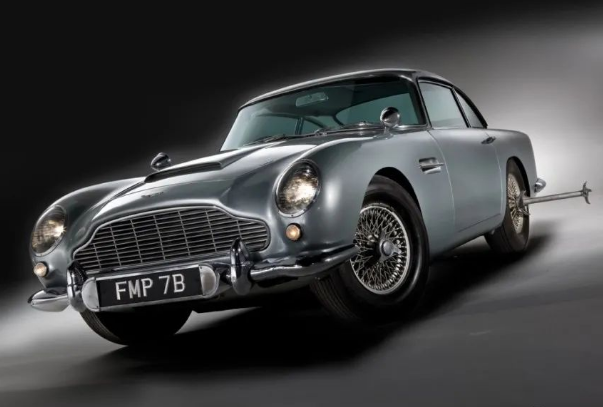
James Bond's car in the films
Lex Fridman: Looking back over the past six years, and toward the future, based on your current understanding, how difficult do you think solving FSD is? When do you think Tesla vehicles will achieve Level 4 FSD?
Elon Musk: I think full autonomy looks very likely, possibly achievable in 2022.
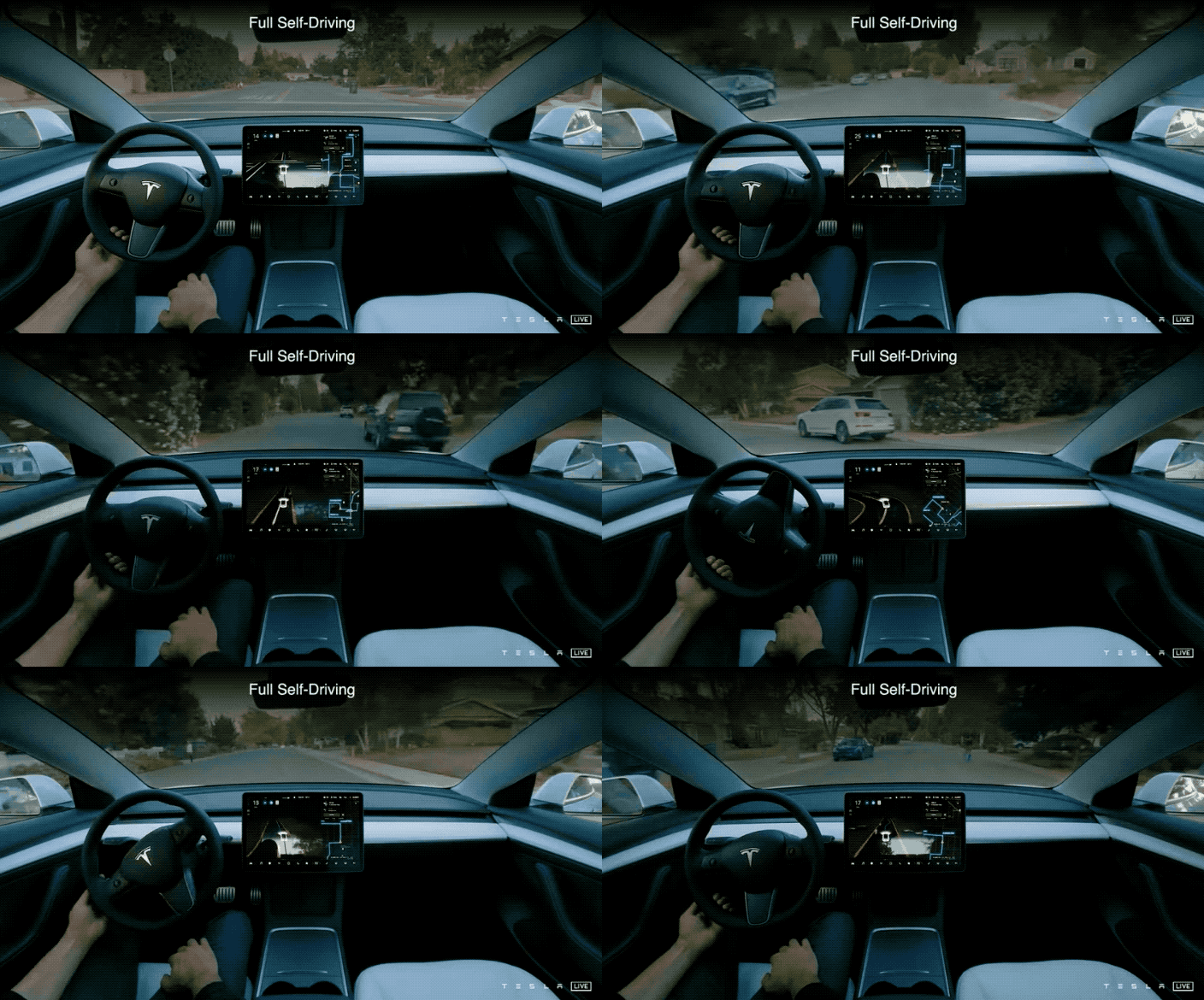
Tesla FSD demonstration
Lex Fridman: And how would that be achieved? Through the current FSD beta?
Elon Musk: Yes, anyone following Tesla FSD beta can see that the rate of required interventions is steadily declining. In edge cases, the driver can still intervene to get the vehicle out of dangerous situations. Interventions per million miles are dropping dramatically, and it looks like autonomy could be achieved in 2022, with FSD having a lower accident rate than the average human.
For this, we don't need to prove it to regulators — we just need an appropriate standard to demonstrate that FSD performs better than the average person. I think autonomous driving will be at least two or three times safer than humans, with two or three times lower probability of injury, and autonomous driving will simply be the better approach.
Lex Fridman: So Tesla has currently released FSD version 10.6, version 10.7 is already on the way, and perhaps 11.0 will appear in the not-too-distant future.
Elon Musk: Yes, we actually really hoped to release 11.0 in 2021, but 11.0 required rewriting a lot of fundamental neural network architecture, plus there were some basic improvements in creating the vector space.
Lex Fridman: So FSD 11.0 will have many qualitative leaps, and 11 is a pretty cool number.
Elon Musk: FSD 11.0 really will have a lot of fundamental improvements. The changes to the neural networks will bring much more performance improvement. There may be many issues at first, but it's very beneficial.
Like how we use alpha software — basically having to deal with a lot of C and C++ code, replacing portions of C++ code with neural networks, which Andrej Karpathy emphasized strongly. It's like neural networks gradually "eating" traditional software. Over time, there will be less and less traditional software, and more and more neural networks. The end result is still software, but more of it will be implemented through neural networks, with less based on heuristic algorithms. That's a major improvement.
Lex Fridman: So you want more and more neural networks all the time.
Elon Musk: But it's not entirely dependent on neural networks. The game is changing, but you still need to leverage a lot of C and C++ to build a neural network. The neural network recognizes, from limited data: this is a lane line; this is drivable space; this is a car; this is a bicycle or other obstacle. It's actually outputting appropriate vectors to C++ control code, rather than building those vectors in C. We've done quite well on this front, but we've reached a local optimum on the C side.
This is really a big deal. All the networks in the car need to migrate to surround video. There are still some legacy networks that aren't on surround video. Training efficiency also needs to improve, and it is improving.
We also need to migrate everything to raw photon counts rather than processed images. This is a major reset on the training side, because the system has always been trained on post-processed images. So we need to retrain everything with raw photon counts as the foundation, rather than post-processed images.
Lex Fridman: So this is a way to reduce complexity, to reduce the complexity of the whole process.
Elon Musk: Yes, the amount of code will also be reduced.
Lex Fridman: So you're fusing data from all sensors and simplifying the complexity of processing these cameras.
Elon Musk: Mainly relying on cameras.
Lex Fridman: Like humans, but we also hear with our ears.
Elon Musk: Yes, actually we need to incorporate sound too. We need to hear ambulance sirens or fire truck sounds, or if someone is shouting at you, so some audio input is needed too.
In fact, coming up with these ideas is very easy, but implementing them is extremely difficult. It's like proposing to go to the moon is the easiest part, and getting to the moon is the hardest part. There are many core engineering problems at both the software and hardware levels throughout the process, requiring adjustments to a lot of code, reducing latency. If we don't do this, the system won't succeed. And this is the main work of the engineers — they're like unsung heroes, absolutely critical to the project's success.
Lex Fridman: For me, what's happening out there, what Andrej is working on, it's all super exciting. The software infrastructure, everything running on the data engine — the whole process is like a work of art.
Elon Musk: The scale of it is unbelievably large. We wrote all this custom software for training and labeling, to achieve automatic labeling.
Automatic labeling is crucial because, especially when dealing with surround video, labeling surround video from scratch is extremely difficult. Having a person label a video clip takes a very long time, possibly several hours.
So our automatic labeling system basically applies massive computational resources to a video clip to pre-allocate and guess everything happening in this surround video.
Lex Fridman: And then you need to correct them.
Elon Musk: Yes. All humans have to do is adjust, like fixing errors. This increases productivity by 100x or more.
Tesla Humanoid Robot
Will It Become a Human Companion?
Lex Fridman: You said the Tesla robot will be useful in factories. I think humanoid robots are incredible for all robotics enthusiasts. I think humanoid robots, bipedal robots moving gracefully — it's so cool.
I care deeply about human-robot interaction showing such a human side. Do you think robots should work in factories? Or anywhere, like at home, becoming friends or assistants?
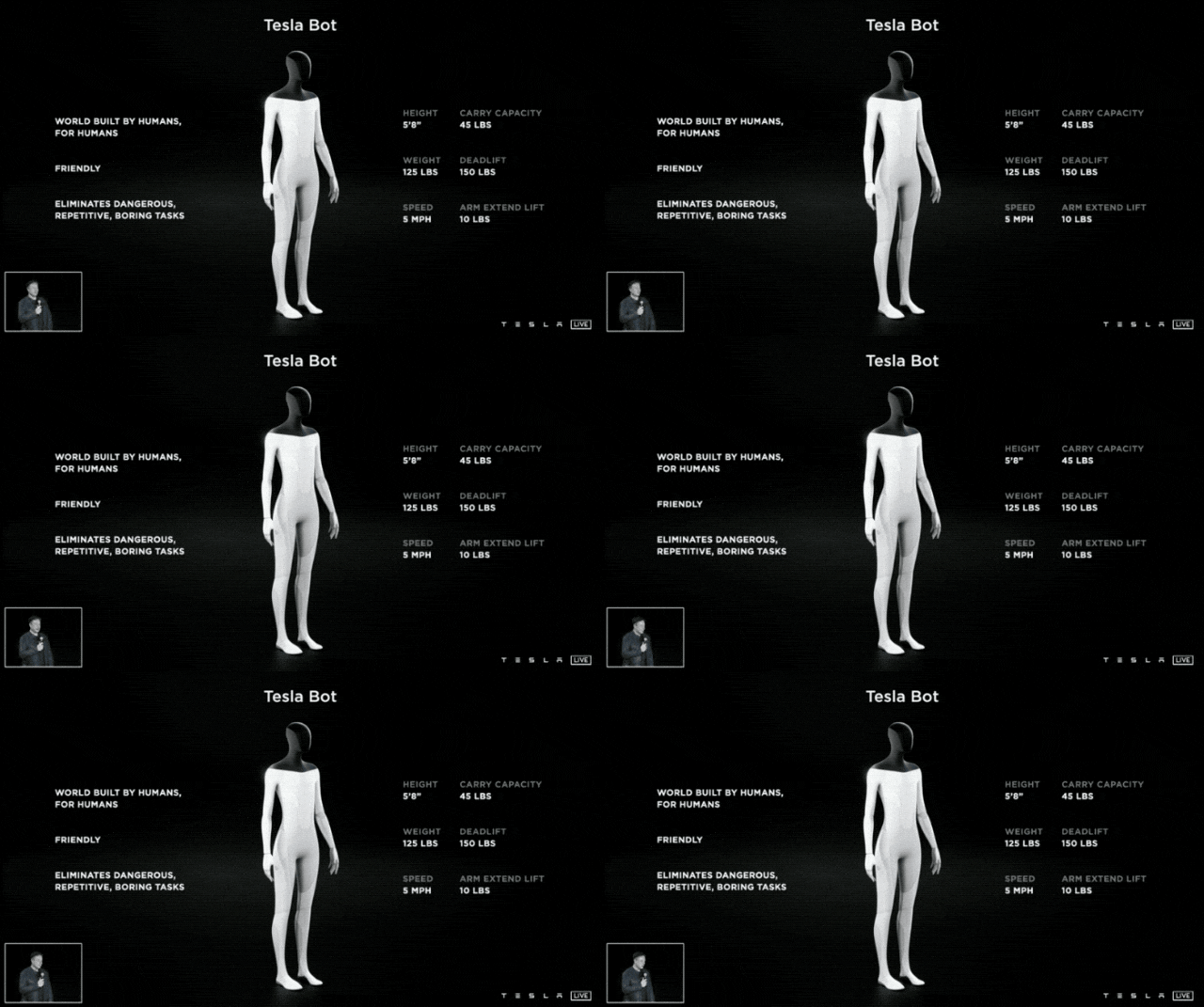
Tesla Bot specifications
Elon Musk: I think the possibilities are endless.
But this isn't Tesla's primary mission. Tesla's mission is to accelerate sustainable energy. That's genuinely something very useful we can do for the world, interacting with and helping the world in many forms.
I think there are many jobs in the future that people simply won't do without pay. Like washing dishes — if you're washing dishes all day, it gets irritating. Even if you really like washing dishes, would you want to do it eight hours every day? Or those dangerous jobs — jobs that are both dangerous and boring, with repetitive strain injuries. I think these are exactly where humanoid robots can deliver the most value. Our goal is to have robots do work that humans don't want to do. Obviously this will need to be combined with some form of universal basic income in the future.
Lex Fridman: Have you imagined a future with hundreds of millions of Tesla robots around the world, doing different jobs, executing different tasks?
Elon Musk: I haven't really thought about this, but I suppose something like that could happen.
Lex Fridman: Can I ask a crazy question? Tesla's fleet is accelerating and approaching 2 million vehicles — many with FSD. (Elon Musk: I think we've already exceeded 2 million.) Do you think the number of Tesla robots could exceed the number of Tesla cars?
Elon Musk: I think that's an interesting question. Usually I think about very distant things, but I actually haven't thought about the future of Tesla robots.
The robots are named Optimus Sub-Prime, because it's not a giant Transformer robot, but a general-purpose, practical robot.
Tesla has the most advanced AI for interacting with the real world, which we developed for autonomous driving. Combined with custom hardware and a lot of low-level software to make it run efficiently and maintain energy efficiency. If you have a massive server room with 10,000 computers, developing neural networks isn't that complex. But distilling it down to run on a low-power humanoid robot computer or a car — that's actually extremely difficult, and requires enormous low-level software work.
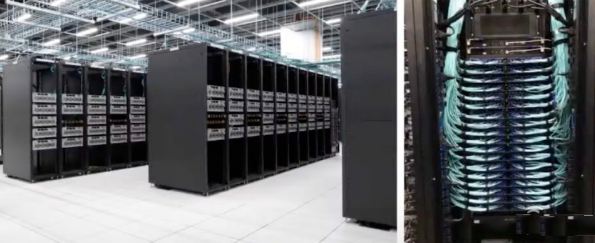
Tesla supercomputer
Since we're using neural networks to solve the problem of cars navigating the real world — cars can be seen as four-wheeled robots — extending this technology to robots with arms and legs and actuators is a natural progression.
The two harder aspects are making the robot smart enough, and having it interact with the environment in a sensible way. To achieve all this, you need both real-world AI and exceptional manufacturing capability. Tesla is very good at manufacturing, and has AI, so making humanoid robots work means developing custom motors and sensors different from those in cars.
I think we have the best expertise in developing advanced electric motors and power electronics, all of which can be applied to humanoid robots.
Lex Fridman: But you often talk about "love." Some things appeal to us, but not necessarily to everyone. The world is surrounded by tremendous loneliness. Many people want more companionship, friendship with others. Many people have dogs.
There seems to be a huge opportunity for robots to reduce loneliness in the world, help people connect with each other — in some ways dogs already achieve this. Have you considered Tesla robots playing this role? Or do you think Tesla robots should perform specific tasks and not interact with people?
Elon Musk: Honestly, I haven't considered it from the companionship angle, but I think it will actually end up being a very good companion. It could develop personally, and over time might develop a unique personality, rather than all robots being the same. And this personality could evolve to match its owner, or become a human's companion, their other half.
I find this interesting. Like a Japanese phrase I really like: Wabi-Sabi — subtle imperfections make something special. The subtle flaws in a robot's personality might make it an incredible companion, basically like R2-D2, C-3PO (the two robots from Star Wars).
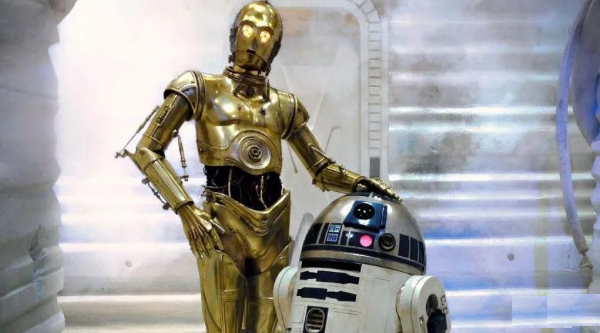
C-3PO (left) and R2-D2 (right)
Lex Fridman: From a robot's perspective, having some flawed characteristics is very good. In a general home environment, some flaws are endearing — you might fall in love with these flaws. But this is very different from autonomous driving, which operates in a high-risk environment where you can't screw up. So home robots are more interesting.
Elon Musk: Yes, in fact, if you imagine R2-D2 and C-3PO, they have many similar flaws and imperfections. They argue with each other over stupid things.
Lex Fridman: Are they really good at anything? I'm not sure.
Elon Musk: But they certainly add some quirky elements to the story. They make mistakes. This just makes people relate to their cuteness.
I think something similar could happen with Tesla robots. We're confident we can build them, but I'm not sure of the exact timeline. We might have a prototype around the end of 2022 or so.
Lex Fridman: It could connect with Tesla cars — that would be so cool.
Elon Musk: Yes, it will use the Autopilot inference computer. We've done extensive training for the Model S/Y/3/X, and the technology for recognizing real-world things can directly transfer to the robot. Though there are also many custom actuators and sensors that need to be developed.
Young People Should Try More, Read Extensively
Do Things Useful to Humanity
Lex Fridman: Beyond vector space, you'd need to add an extra module about "love." (Elon Musk: We could also use this module for cars.) It could be useful in many contexts. Like you said, many people argue in cars, so maybe we could help them resolve that.
You like learning from history, and you're also a fan of Dan Carlin's (Elon Musk: Yes, best podcast ever.) It's barely even a podcast. (Elon Musk: More like an audiobook.) I just talked to him, and he said you guys discussed military stuff and things like that.
Elon Musk: Yes, essentially, when rapid technological change is happening, engineering plays a critical role in the victory of battles.
Lex Fridman: Do you know a lot about World War II?
Elon Musk: We did a deep dive into fighter and bomber technology in WWII, but the discussion ended up going much broader. Because I was completely immersed in researching all the fighters and bombers in WWII — one country would build a plane, then another country would build a plane to beat that plane, then the first country would build another plane to beat that one.
What really mattered was the pace of innovation, and access to high-quality fuel and raw materials. So Germany had some amazing designs, but they couldn't manufacture them because they couldn't get the raw materials. They also had problems with oil and fuel — the quality was very inconsistent.
Lex Fridman: So design wasn't the bottleneck.
Elon Musk: Right. America had very stable fuel, very consistent quality. If you want to build a high-performance aircraft engine, the fuel has to be a consistent mixture, it has to have high octane, and it can't have impurities and things like that, or it'll foul up the engine.
But the Germans never had good access to oil. They tried to get it by invading the Caucasus, but that didn't work. Germany was constantly struggling with poor-quality oil. They couldn't count on supplying high-quality fuel for their aircraft, so they had to develop additives and things like that. Meanwhile, America had great fuel and supplied it to Britain too, which allowed the British and Americans to design ultra-high-performance aircraft engines. Germany could design engines — they just didn't have the fuel. And the quality of aluminum alloys they got wasn't as good either.
Lex Fridman: Did you talk to Dan about all this?
Elon Musk: Yes.
Lex Fridman: Looking at history broadly, when you see Genghis Khan, Stalin, Hitler — what do you learn from these moments? Does it help you understand human nature deeply? Understanding human behavior today, whether in war or as individuals or human behavior in general, any aspect of history.
Elon Musk: Yes, I find history fascinating. So many incredible things have happened, and they help you understand the nature of civilization and of individuals.
Lex Fridman: Does it make you sad that humans do cruel things to each other? Like the cruelty of power during WWII.
Elon Musk: I think most humans just get along and live their lives. War, disaster — these are actually intermittent and rare. If they weren't, humanity would quickly cease to exist.
Wars tend to get written about extensively by historians, while normal years where nothing much happens don't get written about much. Most people just want to farm and live the life they enjoy, being a villager somewhere.
Lex Fridman: Tim Dodd (the everyday astronaut) made a rocket family tree, a complete display of Soviet rocket history. Tim is super interested in the future, in spaceflight.
Elon Musk: Tim is really great, if you're interested in anything space-related. He's excellent — the best — at explaining rocket technology to ordinary people.
Raptor was originally going to be a hydrogen engine, but hydrogen has a lot of challenges. Its density is very low, it's a cryogen, so it's always liquid, very close to zero degrees, and you need insulation, so there are many challenges.
I was actually reading some materials about Russian rocket engine development. At least the impression I got was that the Soviet Union, Russia, and Ukraine were mainly moving toward methane-LOX engines, and there was some interesting ISP specific impulse test data.
They were able to achieve about 382 ISP with methane-LOX engines. I was like, wow, that's amazing. That's really impressive. When optimizing for cost per ton to orbit and cost per ton to Mars, it can actually be lower, and methane-LOX is the optimal choice. Part of the inspiration came from Russia's work on methane-LOX engine test platforms.
Lex Fridman: For young people in high school, in college, if they want to do something big in their lives, what advice would you give them?
Elon Musk: Try to do something useful. Do things that are useful to humanity, to the world. Being useful is hard. Very hard. Are you contributing more than you consume? Strive to make a positive net contribution to society — that's the goal.
Don't try to be a leader for the sake of being a leader. Very often, the leaders you respect are those who didn't want to be leaders.
If you live a useful life, that's a good life, a life worth living. As I said, I'd encourage people to use the thinking tools of physics and apply them broadly to life. They're the best tools.
Lex Fridman: When you think about education and self-improvement, what advice do you have? We have universities, we can self-study, we can practice, we can join a team we're passionate about early on, we can write poetry while road-tripping across Europe. How do you become useful, have more positive impact?
Elon Musk: Read a lot of books. Absorb as much information as possible, at least get a general sense of the landscape of knowledge. Explore at the edges, try to understand many things. Otherwise you might not know what you're interested in. Explore broadly, talk to different people, learn about different industries, do whatever profession you enjoy. Learn as much as possible, find meaning. Read and try a lot, find something that matches your talents and go do it.
This article was compiled from Lex Fridman's 2021 podcast, with reference to the original Chinese text from 36Kr Auto, and edited by ZhenFund.
Recommended Reading