LiberAI Unveils Liber-0: Long-Horizon Zero-Shot Emerges from 2.2 Million Hours of Human Data

Every precious fragment of human experience.
What happens when you ask GPT to design a test for robots?
The questions can get progressively harder. But there's a catch: no cramming beforehand.
LiberAI turned this thought experiment into reality.
In its latest release, the world action model Liber-0 faced a 60-task test designed by GPT-6. Each task was attempted 10 times, for 600 trials total. No robot demonstration data was collected for these specific tasks during training — the model had to perform cold.
The result: Liber-0's zero-shot capabilities extended all the way from pick-and-place to complex multi-step dexterous manipulation.
Behind this lies more than 2.2 million hours of human experience. LiberAI has transformed the dexterous operations people accumulate daily into generalizable capabilities that robots can draw upon.
In another full video released alongside, Liber-0 took on an even tougher job: making bubble tea.
The robot could now autonomously combine operational skills based on different flavor orders, completing a long-horizon bubble tea preparation — all in one continuous take.
From tackling problems it never trained on, to taking a bubble tea order, Liber-0's scaling path is demonstrating enormous potential for general capabilities to generalize into real-world applications.

Zero-shot tests, this time written by GPT
We've all seen plenty of robot demo videos.
What piques curiosity is usually what's behind the video: How long did it train for this task? Can it still perform with a different object? That smooth-looking long workflow — how much of it actually transfers to entirely new tasks?
The LiberAI team had GPT-6 design 60 tasks as a zero-shot test. The tasks were divided into three groups of 20, with difficulty increasing at each level.
- Group 1 is pick-and-place, or PnP, testing basic recognition and manipulation.
- Group 2 is Non-PnP, requiring operations beyond simple grasping — handling more complex contact relationships and object state changes.
- Group 3 is the most challenging: multi-step, long-horizon Non-PnP tasks. Here, the robot must continuously coordinate multiple dexterous actions to drive the task to completion.
The "zero-shot" condition is explicit: the model received no training on robot data collected specifically for these target tasks.
Liber-0 achieved success rates of 63.5%, 34.0%, and 10.5% across the three groups, for an overall rate of 36.0%. The most breakthrough result came in multi-step long-horizon tasks: without any target-task robot demonstrations, Liber-0 could already zero-shot complete cooking, packing food bags, and other continuous dexterous operations.
Long-horizon tasks are far more than stacking multiple actions. The robot must understand dependencies between actions, adjust grasping, contact, and operational strategies in a constantly changing physical environment, and overcome error accumulation to complete the entire task.
A 10.5% success rate remains early-stage, but it marks an important milestone: zero-shot generalization is beginning to extend from single actions to complex long-horizon dexterous manipulation, showing potential to tackle complex unknown tasks in real scenarios. As LiberAI's human experience data and model scale continue scaling, zero-shot capabilities are expected to expand to even more complex and diverse tasks.
On the same 60-task benchmark, LiberAI also tested Astra operating directly as a robot policy. Success rates were just 8.3%, 5.0%, and 1.7%. The experiment shows that general reasoning models still face significant challenges in fine physical manipulation, highlighting the value of physical-world models.
Liber-0 already supports integration with upper-layer agents like Astra. The agent tracks task state and dynamically adjusts intermediate goals, while Liber-0 translates plans into actual dexterous operations.
Liber-0's zero-shot breakthrough on long-horizon tasks also expands the possibilities for this combination: upper-layer agents handle understanding and planning for unknown tasks, while Liber-0 provides generalizable physical execution. As human experience data and model capabilities continue scaling, robots may increasingly autonomously decompose and execute complex tasks they've never trained on. From zero-shot generalization of single skills, to autonomous planning and zero-shot execution of complex long-horizon tasks, the path toward truly general robot intelligence is becoming clearer.
After watching the demo, you can design a test yourself.
Interestingly, LiberAI also built its object-level zero-shot test into an interactive online simulator (sim.liberai.work). Users can upload their own objects and observe Liber-0 manipulating them in a virtual environment. This tests object-level zero-shot transfer, complementing the earlier 60 task-level zero-shot tests.
This adds an intriguing dimension to the model release: the test subjects can come from you, right at your screen.
Anyone can bring their own objects and observe how the model handles them: which shapes are easy to manipulate, which objects trip it up, and how far existing experience transfers.
What exactly did 2.2 million hours of human experience learn?
Now you can bring your own problem and see how it performs.

Behind 2.2 million hours of human experience: What scaling pipeline?
2.2 million hours represents a dual threshold of data scale and engineering capability.
In Liber-0's human experience data, human video reached 2 million hours, pushing beyond the million-hour scale previously demonstrated by DYNA-2. Supporting this scale is LiberAI's complete automated data pipeline and data infrastructure.
Feeding massive amounts of human video into model learning sounds natural. With such rich experience, why can't it be used directly for training?
The difficulty lies in "directly." A video might show a hand rotating an object, but not clearly reveal each finger's position. Occlusion, viewing angle, and depth errors all make action reconstruction difficult.
LiberAI's approach is to make human experience truly transfer to robot actions.
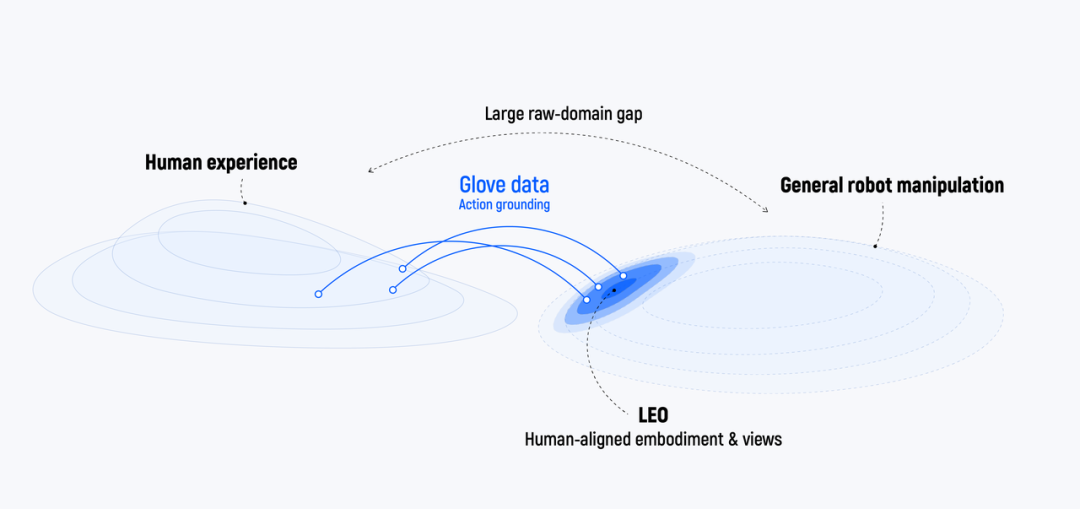
A key ingredient in the data recipe is the self-developed LiberSense Glove: with precise action grounding, it bridges the critical gap from "seeing an operation" to "learning to act" for massive human video.
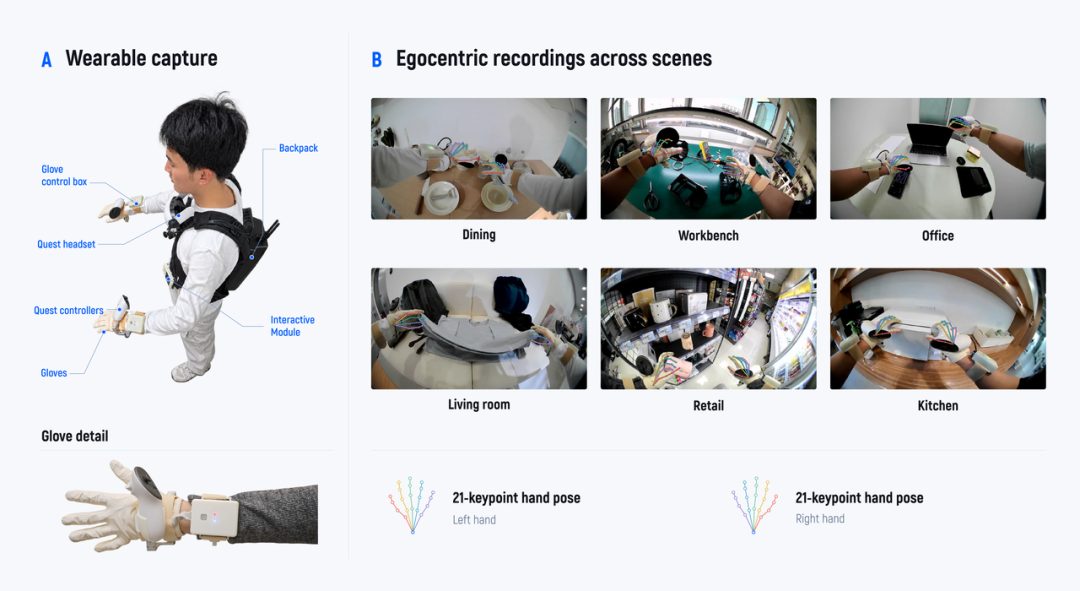
LiberSense Glove is a lightweight wearable capture system. By directly recording hand pose and motion trajectories, paired with first-person and dual wrist cameras, it synchronously captures "what the person sees" and "how the hand moves."
The internet contains rich operational experience, but generally lacks precise action supervision. LiberSense Glove provides reliable action anchor points, helping the model connect object changes in the frame with specific hand movements, thereby leveraging experience from even larger-scale video. High-quality action data thus becomes a "catalyst," unlocking the value of massive human video for robot manipulation.
This is especially critical for climbing the "Mount Everest" of dexterous manipulation. Multi-finger coordination, fine contact, and continuous adjustment all demand higher-quality action supervision, yet dexterous hand teleoperation data is difficult to scale.
LiberSense Glove opens a broader entry point: learning directly from people who use their hands proficiently every day, making rich human operational experience a source for continuous dexterous capability growth.
Currently, this equipment has been deployed at scale into in-the-wild real work and living scenarios. No robot setup is needed at the collection site — people simply wear the device and perform operations, leaving behind experience for the model to learn from.
The work human hands do every day is becoming the ladder for robots climbing the "Mount Everest" of dexterous manipulation.
Can embodiment difference become the next scaling dimension?
From teleoperation to UMI, a common approach is to make the collection end as close as possible to the deployment end: when facing embodiment differences, the first thought is how to minimize them.
LiberAI pushes further: if we directly tell the model "how the bodies differ," can the difference itself become a source of capability growth?
To this end, Liber-0 innovatively introduces unified embodiment representation, incorporating human height, arm length, hand geometry, as well as robot geometry and kinematic conditions, into the context for action prediction.
The model learns both "what to accomplish" and "how different bodies should accomplish it," establishing connections between body conditions and actions from experience of different bodies executing the same skill.
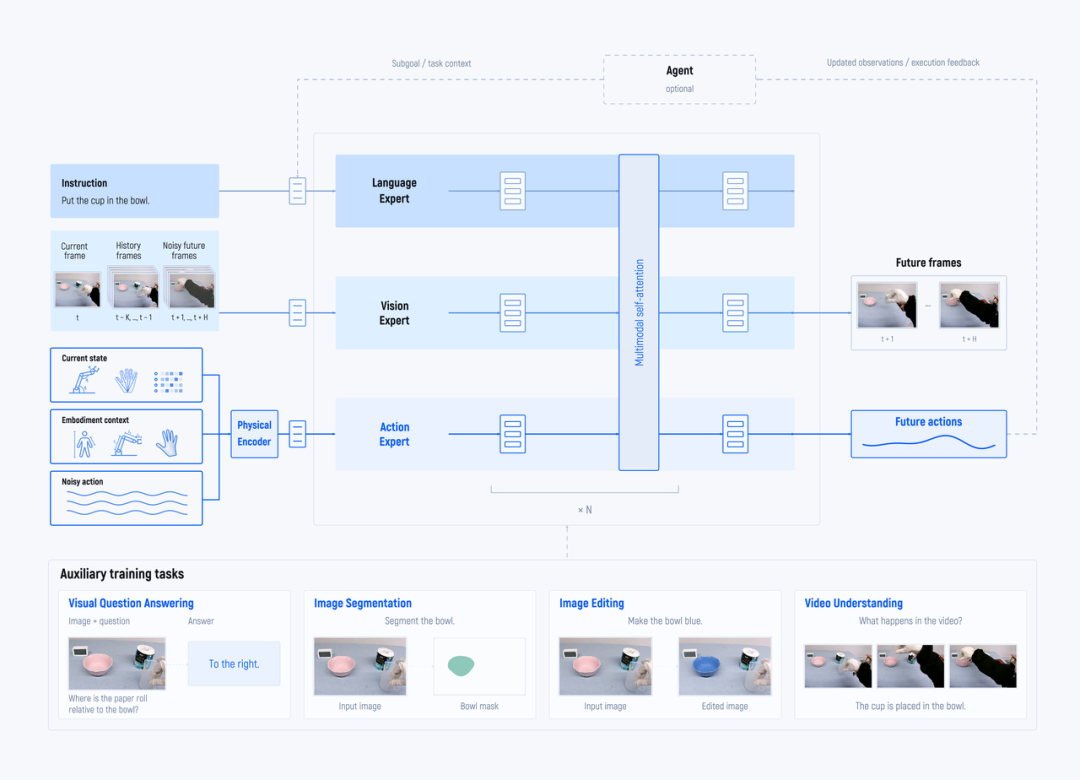
This gives embodiment the opportunity to become an entirely new scaling axis.
Beyond increasing data volume, one can expand body morphology coverage, letting more people's operational experience contribute to model capability growth. LiberAI's experiments provide support: with total glove data held constant, increasing demonstrator morphology coverage continued to improve robot manipulation performance.
Embodiment difference thus becomes a training resource worth actively expanding, opening new possibilities for skills to cross different bodies and transfer to robots.
The value of a full-stack approach lies not just in connecting every component, but in letting progress in each component amplify the others. More precise action data unlocks the training value of massive human video; richer body morphology expands the model's generalization boundary; and improved model capabilities can in turn guide data collection and embodiment design.
Through coordinated scaling of data, model, and embodiment, LiberAI is transforming the scale advantage of human experience into a growth engine for physical intelligence.

Emergence of intelligence: Can human motion demonstration "kill" real robots?
The key to scaling is ensuring every unit of data and every unit of compute delivers higher capability returns.
Which data is most worth investing in, most capable of driving model capability growth? LiberAI used a series of controlled experiments to find answers for this scaling "return on investment."
LiberAI conducted controlled experiments comparing different sources: self-developed glove data, internet human video, and open-source first-person data. Models underwent pre-training with each, followed by the same robot data for post-training.
These experiments used a 0-100 average progress score: full task completion earns points, and completing partial key steps also counts.
Among the compared data sources, glove data showed the steepest performance growth trend. When data scale expanded from 1,000 to 10,000 hours, PnP and Non-PnP average progress scores increased by 14.7 and 13.1 points respectively.
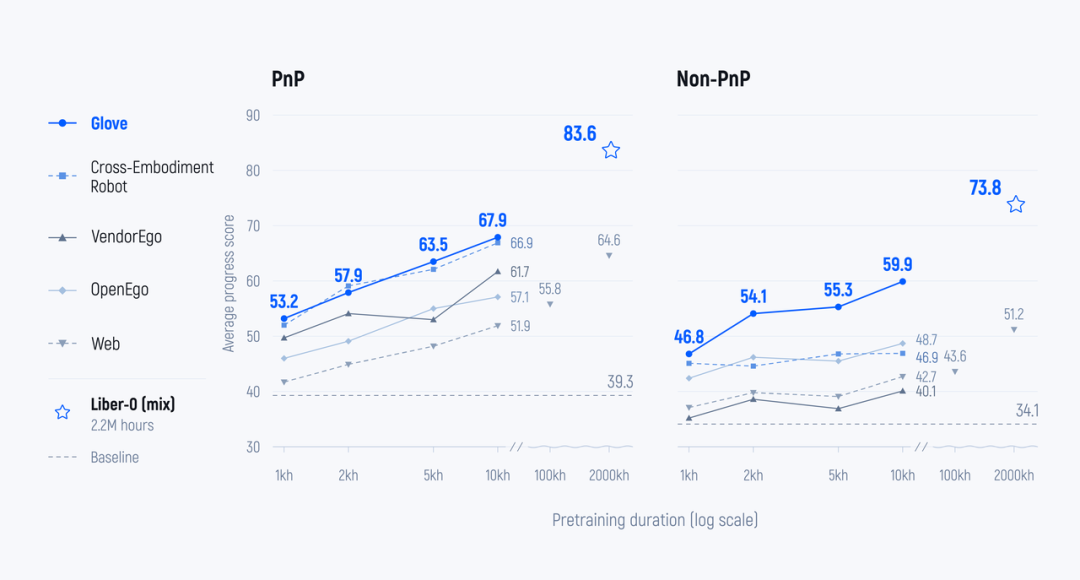
For Non-PnP tasks requiring fine contact and continuous operation, this result is particularly critical — precise action supervision is beginning to show its value.
But the next set of experiments is even more telling.
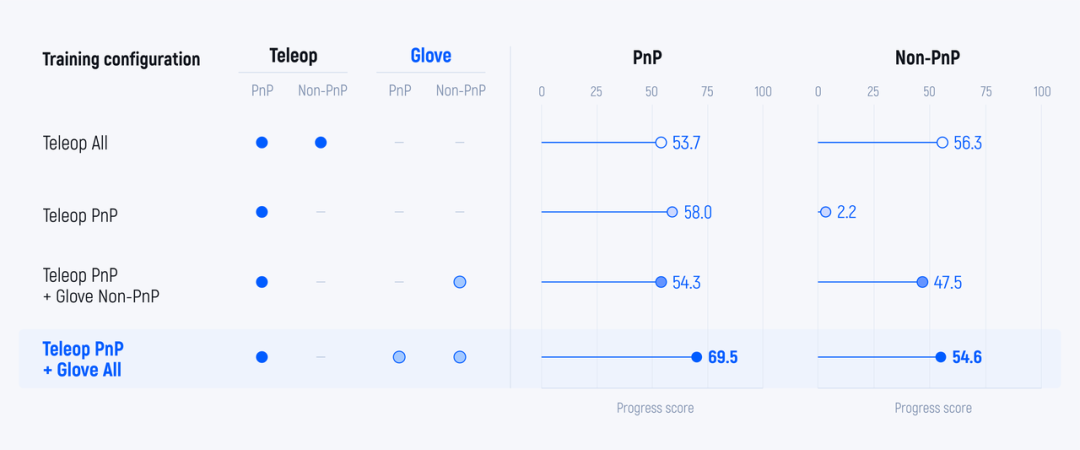
The team first provided the model only with PnP robot demonstrations. At this point, the model's average progress score on Non-PnP tasks was just 2.2.
Then, they added human Non-PnP operation data collected through gloves. Without adding corresponding robot demonstrations, the score jumped to 47.5.
Adding complete glove data covering both PnP and Non-PnP further raised the score to 54.6, approaching the reference result of 56.3 achieved with complete two-category robot demonstrations.
The most significant aspect of this experiment is where the skills came from.
Robot demonstrations provided no corresponding Non-PnP behaviors, yet the model acquired such capabilities through human operations. Glove data brought skills not covered by robot demonstrations — human physical data began playing the role of "teaching new skills."
If this transfer approach continues to expand, the space for skill collection expands with it: many operations robots haven't yet mastered but humans are already proficient in can enter model capabilities through human demonstration. Humans can more directly participate in new skill collection, and skill growth's dependence on real-robot teleoperation resources can be further reduced.
These experiments validate the value of human experience as a scalable skill source from multiple angles. LiberSense Glove makes human demonstration a low-cost, lightweight skill entry point.
As collection penetrates deeper into real work scenarios, human daily operations become model learning material, helping LiberAI打通 the rapid path from "human experience demonstration — model training — deployment validation," further transforming the scale advantage of human experience into speed advantage for commercial deployment.

Next stop: more than a cup of bubble tea
Zero-shot capabilities reveal the potential of generality. In specific application scenarios, questions become more practical: Can it fully execute a complex workflow? Facing new demands, can it flexibly adapt and complete tasks?
LiberAI's demonstration: making bubble tea.
After minimal post-training, Liber-0 can already execute long-horizon bubble tea preparation tasks, combining operational skills according to different flavor orders.
Two aspects merit attention.
First, execution of continuous complex dexterous tasks.
The preparation involves multiple irregularly shaped objects and a series of continuous operations — from picking up cups, adding ice, to using spoons for fine topping additions, squeezing syrup, adding tea base, and more. Only when each step connects smoothly is a cup of bubble tea completed.
Second, order variation.
A cup of bubble tea may seem like one task, but different flavors mean different topping combinations and preparation workflows. The model must call upon and combine learned operational skills according to new order requirements.
This is precisely where compositional generalization gets interesting: the same set of skills can combine into different complete tasks as demands change.
For actual deployment, this capability matters. Users won't always place the same order, and scenarios won't always repeat identically. Being able to adapt to different combination demands from existing skills means the model can potentially cover richer application scenarios, reducing the cost of case-by-case development and adaptation.
Making bubble tea is far from the endpoint of commercial deployment, but it already vividly demonstrates a path from general capabilities to concrete applications: accumulate generalization through pre-training scaling, adapt to specific workflows with minimal post-training, then cover more diverse demands through compositional generalization.
From GPT designing tests, to robots taking orders, Liber-0's demonstrated capabilities are extending along this path.

Becoming part of the physical world
Looking back at Liber-0's release, what truly merits attention isn't just a model performance breakthrough, but LiberAI's validation of a scaling path toward general physical intelligence: making massive human experience a source of capability for physical AI, letting robots gradually shed dependence on task-specific demonstrations, and autonomously tackle increasingly unknown physical world tasks.
From long-horizon zero-shot breakthroughs under GPT's random tests, to integration with agents like Astra for autonomous planning and dexterous execution, to completing bubble tea orders of different flavors, Liber-0 is letting general generalization capabilities step by step approach real applications. From zero-shot generalization of single skills, to autonomous composition and execution of complex long-horizon tasks, the future where robots flexibly respond to unknown tasks is already dawning.
Every piece of human experience contains a fragment of intelligence. Every observation, every touch, every interaction with the physical world carries accumulated human physical knowledge.
LiberAI is gathering these scattered moments from billions of daily instants, letting human intelligence cross bodily boundaries, moving from understanding the world to interacting with it, truly becoming part of the physical world.
Click "Read Original" to jump to the full technical blog:
https://www.liberai.com/blog/liber0