How MIT Engineers Built the Tool That 80% of YC Founders Use

Even if the market is tiny, as long as you're No. 1, you can establish mindshare and set the standard.
For years, I've walked alongside Tim Zheng and Apollo.io — from the earliest experiments with Braingenie to today, as Apollo's ARR crosses the $150 million mark. More than the outcome itself, this shared journey deserves to be told.
I met Tim at an MIT event organized by ZhenFund. He came up and introduced himself; only later did I learn his mother was a fan of Bob Xu. From that moment, I had strong conviction in him. That conviction was validated not only through Apollo's growth, but deepened by Tim's continual sharing of lessons on resilience, judgment, and trade-offs.
Tim's story has never been a myth of overnight success. Rather, it authentically illustrates the courage and determination required to build a truly great company. He openly acknowledges that the company went through a period of stalled growth — a crucible that breaks many founders. The product was immature, the go-to-market strategy lacked focus, and the core business loop hadn't truly come together.
Faced with all this, Tim and his team had no "silver bullet," which makes what they did all the more admirable. They chose rapid iteration and almost ruthless prioritization, focusing all their attention first on retention alone — pulling it from 4% to 40% — then rebuilding the product, driving usage, and step by step creating real, sustainable value for customers.
They also made a sober, disciplined decision: to set aside the chase for short-term trends, and instead invest time and energy for the long haul in becoming the best platform for teams to build their sales pipelines. Through that journey, one insight became increasingly clear: "Fix the core product loop first, and growth will follow."
In an era full of hype and froth, Tim's experience reminds us: truly sustainable success is always built on products customers love, and comes from long-term focus on core problems.
Today, more than one million GTM professionals choose Apollo to get their work done. To me, this measures Tim's achievement more truthfully than any revenue figure. He hasn't just built a company — he's created a platform that continuously empowers others.
As an investor, I'm deeply grateful that Tim, even at this stage, remains willing to share these experiences so that more people can benefit from them. His story is already compelling enough, and I genuinely look forward to Apollo's next chapter.
Anna Fang Founding Partner, ZhenFund

Let the System Generate Opportunities for You
Really glad to be here with all of you.
I've been working with ZhenFund for over a decade now; this is our second project together. Among all our investors, ZhenFund has been the most supportive and the most passionate. More importantly, they truly understand what we're doing. That feeling of being understood and trusted is incredibly strong.
Apollo.io is a company focused on marketing and sales. We currently maintain a database of 2 billion contacts, covering phone numbers, emails, and other contact information, while also providing a full suite of tools to help users send emails, make calls. In recent years we've been continuously integrating AI capabilities — letting AI automatically find the right people, write emails, make calls, even directly tell you who to contact, how, and when.
The entrepreneurial journey has been full of ups and downs. We once grew from 0 to 50 people, then went through shrinking from 50 down to just 10. That period was truly painful. Later, we made a firm decision to completely restructure our business model, shifting from sales-led growth (SLG) to product-led growth (PLG) and self-serve.
After the transformation, the business finally got back on track. Now our ARR is roughly around $200 million. We've stepped into many pitfalls along the way and paid plenty of tuition. I often think how much better it would have been if certain things had become clear earlier. But fortunately, it's never too late.
I also very much hope to learn more from all of you. Entrepreneurship in China and the US feels like two parallel tracks — there's so much each side can learn from the other. As long as there's genuine exchange, there will always be gains.
Let me start with a two-minute introduction.
Our goal is to consolidate all marketing tools on the market. We have a very large database, around 2 billion people. You can use it to find specific audiences — say, a certain type of BD person, or filter for companies using particular technologies, with specific revenue scales, or users who've visited certain websites or software.
Step one: the system helps you identify these people and provides their contact information.
Step two, we provide a full set of campaign management capabilities, letting you actually execute marketing and sales actions on top of this data.
This allows us to string messaging into a complete workflow: send an email first, then make a call, then send a LinkedIn DM. "Data" and "touchpoints" form a closed loop within the same system.
If you need to send an email now, you don't have to write it yourself — you can add an agent to do it for you.
All you need to do is give the agent a brief instruction. It will then complete several things in sequence: check this person's email information, scan their background online, look up relevant news or public materials, then combine this information to generate a truly personalized email for this individual.
On top of this, we're also building more complex orchestration, stringing together different software and actions to form complete automated workflows. The reason this wasn't usable in the past was that every step required you to manually click and write rules. Now we've introduced AI nodes: you don't need to configure nodes one by one, just describe in natural language what you want to do, and AI will automatically build out the logic for you.
What the system can do goes far beyond sending messages — it's essentially helping you generate opportunities more efficiently.
We're also continuously rolling out more interesting capabilities, like AI calling. Now AI can simultaneously dial 10-20 calls. Once someone picks up, it can seamlessly transfer to a human to continue the conversation. In the past, a salesperson might make 50 calls a day at most; now a salesperson plus AI can make 1,000 calls — the efficiency gain is obvious.
There are also some more familiar features. After a meeting ends, the Apollo.io system automatically generates a transcript, then automatically writes a follow-up email based on that information — covering what you discussed and what comes next.
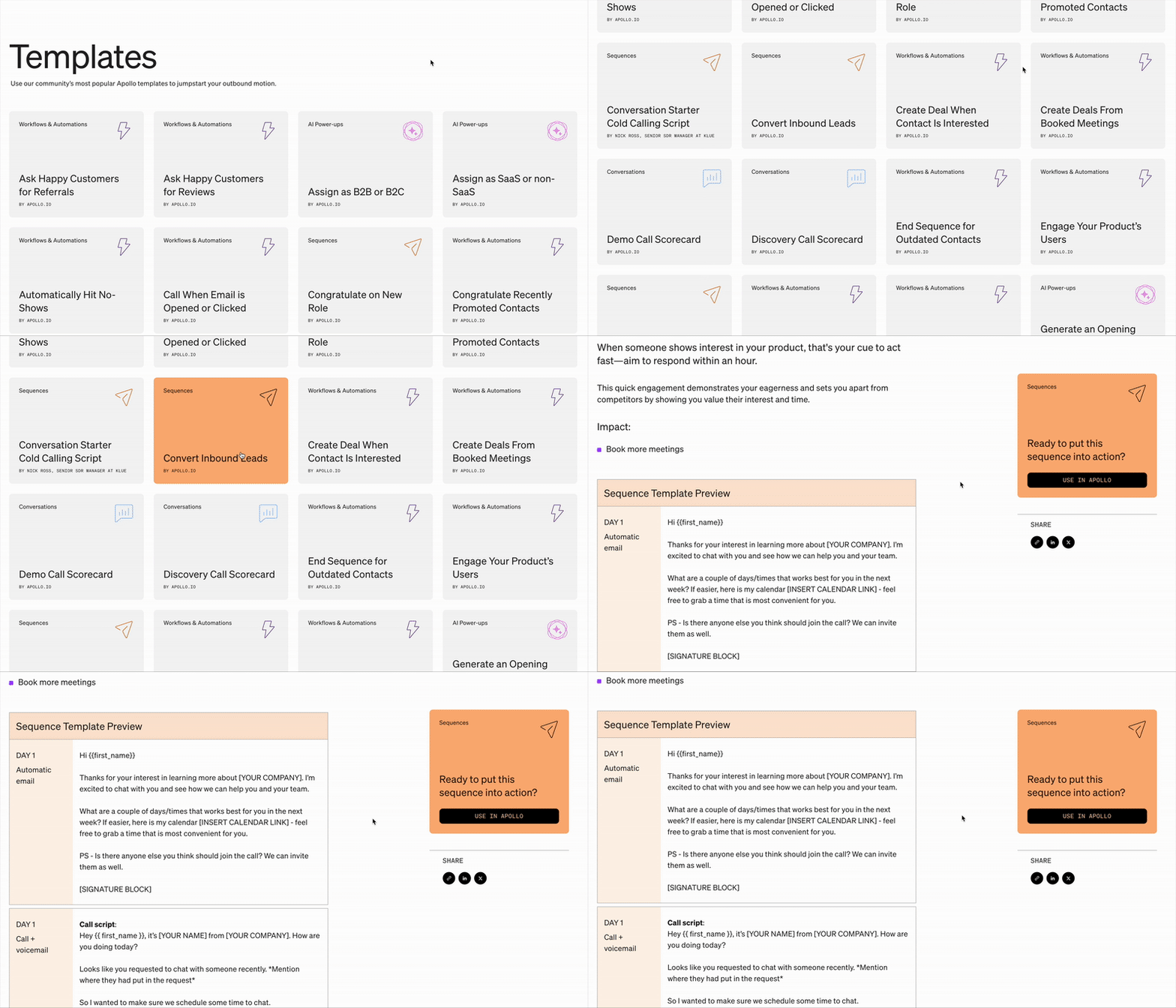
The above covers about 70% of our current functionality.
Because in the past, building a complete workflow or marketing campaign was complex — it might take 15 minutes or even longer. Now we've also added a chat interface: you just say something like "build me a workflow" or "help me set up a marketing execution process," and the system understands your intent, automatically building out the entire process step by step.
The whole process is like sketching on a whiteboard.
In the past you had to keep clicking buttons to complete configuration; now you just articulate your idea clearly, and the system will think and break it down itself, building the entire workflow in a minute. If the requirements are more complex, the system will even ask you back — what type, who are the target users — confirming details before proceeding.

Your Friends and Colleagues Are Already Using It
I'm a lot like many of you here — fundamentally an engineer, more accustomed to seeing problems through an engineering framework. For the longest time, I didn't understand GTM at all.
My first company was in education; our target users were high school teachers and students. I thought the product was excellent, but we only had 5,000 users and never knew how to attract more.
One weekend, I suddenly had an idea: in the US, almost all school and teacher email addresses are public. I wrote a script to scrape this information, then emailed them. Within five weeks, users grew from 50,000 to 150,000, and after a year approached 1 million. The product itself barely changed — but simply getting the marketing right drove 50x user growth. The impact on me was enormous.
Later I also asked friends in IT, HR, and other fields whether similar approaches could work for their markets. I gradually realized something: I'm better at building products, and hoped that if I built a good product, users would naturally come and spread it.
But if you just wait for organic product spread, growth tends to lag. Especially in education — I couldn't reach students directly, only teachers. But if one teacher liked the product, they might recommend it to four other teachers, and each teacher had a hundred students — growth would suddenly amplify.
This experience made me realize: some ideas' explosive power comes more from market and distribution than from the product itself.
Now almost all college students have LinkedIn or other public profiles; you can directly message them about your product. At first maybe only 1% would download, but gradually that rate rises to 10%.
When messaging, you don't have to say "I have a product, want to try it?" You could try "I built a tool — could you take a look, give me some feedback, tell me if it's useful?" Just changing the wording significantly improves conversion rates. Compared to teachers, VPs, IT people who process massive amounts of email daily, students are more likely to actually read your message.
If you're also a student entrepreneur, asking them for advice is already a great entry point.
Another phenomenon I find interesting: almost every school has an internal mini social network. Once two or three people at a school start using something, it quickly drives the whole school to adopt it. Especially when the system prompts you that "your friend" or "your classmate" is already using it, this natural diffusion from email, forms, and collaboration becomes very pronounced.

From 50 to 10 People, From $5 Million to $100 Million
It’s a lot like the AI market today — fierce competition in the early days. Back then, there were more than a dozen companies building marketing software, each ten times our size, and nearly all of them were going after enterprise customers. We knew that if we went head-to-head, we’d lose. Maybe we could land one decent-sized client, but by the tenth or twentieth, we’d be completely outgunned.
So we deliberately chose to start with SMBs. Enterprise deals had higher ACVs, but for an early-stage company, they were simply too hard. Today anyone can use our product for free, and our lowest paid tier is just $49 a month. That was a choice forced on us when we were on the brink of death, down to three or four months of runway.
In hindsight, my biggest mistake was severely underestimating GTM.
For the first few years, we relied heavily on hiring armies of SDRs to push the product. It didn’t work. On one hand, we were in the SMB market; on the other, we couldn’t break into enterprise. The ROI looked passable in the short term, but it quickly became unsustainable. For every dollar we spent on customer acquisition, we only got 80 cents back in revenue.
We had only raised a Series A, and our bank balance soon dropped to just a few hundred thousand dollars — yet we still had more than 10 engineers and over 40 sales and support staff on the payroll.
So the truly critical question became: When do you go all-in on sales? And when do you stop and try something else? I had to learn this the hard way, stumbling through it, and only now do I feel like I have some intuition.
Gradually, we realized we already had PMF. People genuinely loved our product. But we had failed to nail Channel Model Fit.
We were mainly serving SMBs with a $10,000 annual price tag. That’s cheap for enterprises but expensive for SMBs — many simply couldn’t afford it. Yet at the same time, $10,000 wasn’t meaningful for a salesperson either; a rep needed to bring in at least $30,000 a year to be worth it. We were stuck in a deeply awkward middle ground.
In the end, I made a painful but unavoidable decision: pivot completely to self-service. This wasn’t my first choice — the market forced us down this path. Many SaaS businesses simply can’t work without self-service. We slashed the price from $10,000 a year to $99 a month. Any higher, and SMBs wouldn’t buy at all.
The cost of this transition was enormous. The company shrank from over 50 people to just 10. The sales team was almost entirely cut, leaving only one person. Our entire production and collaboration model had to be rebuilt from scratch.
During that period, there was only one goal: survive, and get cash flow positive.
It took us nearly two years to truly align the product with the business model.
But one thing surprised me deeply. When the team was down to 10 people, everyone actually saw things more clearly. They understood that the old path was a dead end. With fewer people, each person’s mission became unmistakably clear, and the collective energy was far stronger than before.
Over the next year and a half, we went back to the most basic metrics and relearned everything from scratch: acquisition, activation, retention.
At first, our retention rate was just 4% — abysmal. So we focused almost exclusively on that one metric, ignoring everything else. It took a full year to pull retention from 4% to 40%. The process was crude but systematic: we broke down the problem piece by piece and fixed it step by step.
We experimented with many acquisition channels too. We had a database in the 200–350 million range, and we tried indexing portions of it on Google. When people searched for someone’s email address and didn’t know how to reach them, they’d land on our site. That brought a wave of organic traffic, but it was a flash in the pan — not sustainable.
What we eventually realized is that our most important acquisition channel was word of mouth. Today, 70% of new users choose us because of a strong recommendation. We started taking NPS very seriously, asking every user: “How likely are you to recommend this product to a friend?” Scores of 8 or above counted as positive. We found that the higher the NPS, the higher the viral coefficient — and it kept climbing.
We didn’t deliberately educate users or push specific features. We simply focused on doing NPS well, and it unexpectedly drove stronger organic growth. That was a huge surprise for us.
Once we got the conversion funnel working, the product itself barely changed for a year — yet revenue began growing steadily and consistently. Because we had finally found the right path.
We started from $5 million in revenue and, over two and a half years, climbed step by step to $20 million, $50 million, and then $100 million.

Becoming No. 1 at Email
Throughout this growth, we didn’t just avoid adding features — we cut a bunch of them.
We found that many features were used by only 0.1% of users. Data analysis showed that only one behavior was strongly correlated with retention: sending emails.
Once a user sent an email, their likelihood of staying jumped dramatically. But at the time, only about 5% of users could actually find the email-sending feature, because there were too many buttons and the interface was too complex.
So we did something radical: we cut every button except three — find people, send emails, see results.
The interface became instantly simple, and the number of users sending emails surged. For the first time, users could easily grasp the product’s core value — and retention followed naturally.
I personally love building new features, but this experience taught me something crucial: users may like many features, but what matters more is whether they can easily access the single most important value. Once they get that, everything else becomes secondary.
Many products become more confusing as they gain features. Sometimes what you really need to do isn’t add features — it’s delete buttons, maybe down to just one button, or even none at all. We debated this endlessly in board meetings, but it always came down to the same question: how do you let users capture value in one step?
On pricing, we stopped guessing and ran extensive A/B tests to gradually find a relatively optimal range.
We failed plenty of times, but there was one thing we did right. We once tried to make the product all-in-one, doing everything — but we were biting off more than we could chew. The things we wanted to do far exceeded the one thing we could actually do better than anyone else in the world.
In the end, we forced ourselves to focus on just one thing: the single area where we had the highest probability of becoming No. 1. Everything else, we let go.
The market was large enough that even 0.01% of it could make us a lot of money. So there was no need to do everything and fight everywhere from day one. We decided to narrow our focus, find a clearly defined and visible niche, and become No. 1 there first.
The specific wedge we chose: small teams of 1–20 people with customer acquisition and hiring needs.
We went directly to them and asked: What’s your primary outreach method? How do you normally get these email addresses? How do you do your outreach? How do you maintain your address book? We went through these basic questions one by one, aiming to truly understand and deeply serve this market.
Only after we had served SMBs well did we look back at enterprise needs. Many features were demanded by larger customers, but by then we had no money left. We had no money, no team, no funding, and almost no chance of raising more. At that stage, you learn one thing: how to say “no” to customers. They asked for features every day, but we had to refuse — we couldn’t do them, and we shouldn’t.
But something unexpected happened in this “survival mode.” In 2021, we suddenly discovered that many people knew about us and were using us — without us even realizing it. Investors started reaching out, asking if we wanted to chat or raise money.
I asked them: How did you find out about us? Their answer was direct: 80% of the startups we invest in are using you. And 80% of YC companies too.
That’s when I understood that some niches spread themselves. YC startups talk to each other. They ask: “What do you use for outbound?”
Once your penetration hits 10%, it can quickly jump from 10% to 70%, because you become the “default standard” — you become the paradigm for how they do outbound.
So the second key lesson we learned: build a small system first, capture 20% market share in a clearly defined group quickly, then take the next step. Our previous problem was ambition that outpaced our execution — we wanted to be No. 1 at everything, and ended up doing nothing well.
Most founders eventually converge on the same path: start from a very small, very specific niche, serve only one type of customer, drive penetration extremely high in that market, grow fast, then use the same playbook to expand into the next niche.
This is almost the standard playbook for American SaaS.
The key is which niche you choose, and whether you can truly become No. 1 in it. Even if the market is tiny, being No. 1 lets you build powerful mindshare and set the standard.

The Evolution of GTM Engineers
I think one of the biggest opportunities AI creates for companies is automating the repetitive, low-value work in marketing and growth: writing emails, making calls, following up automatically.
We’re a vivid example ourselves. We used to have about 15 SDRs doing outbound calls and outreach. Now we probably need only 2 SDRs to cover the same workload, with lower management overhead. Customer support, HR, and other functions have similar opportunities. This is everyone’s ideal state: more pipeline, less headcount.
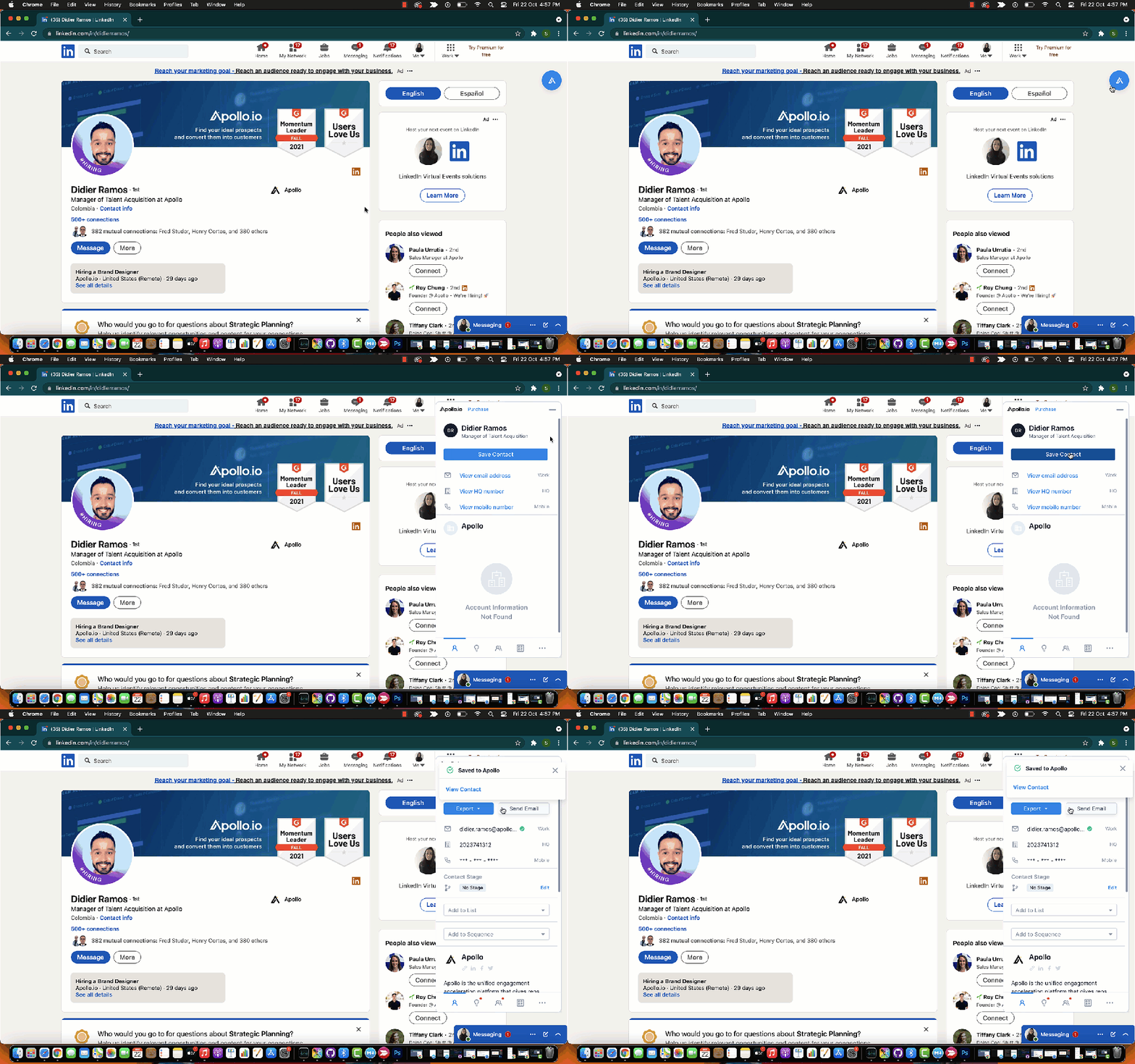
But we're also clear-eyed that opportunity is one thing, and actually executing on it is another. To achieve this kind of automation requires significant human effort behind the scenes. We spent hundreds of hours designing workflows, iterating, debugging, and building systems before it became something truly usable. So AI having potential doesn't mean you can use it right away.
How do you turn opportunity into results?
In the US, many successful companies have a critical role that resembles what I'd call a GTM engineer. They're not necessarily engineers in the traditional sense — more like Forward Deployed Engineers or Solution Engineers. They understand your business processes, your real needs, and your company's constraints and boundaries. Then they're willing to invest substantial time to help you actually install and debug the system. This process might take dozens of hours, but once it's working, that configuration can be replicated to more customers.
The Clay team has roles like this. AI software has no value if you buy it but never actually use it. You don't make money from software that sits unused. The logic is very similar to Salesforce: what truly determines success or failure was never "did you buy it," but "did you actually use it."
We've had similar experiences ourselves. For customer support, we implemented an AI solution built on Intercom, and the results were dramatic. Last year we had about 120 support staff; now we're down to 80, but ticket volume has doubled, with 60–70% handled by AI.
Over the next year, I think this model — where someone helps you configure, set up, and actually get the system running — will be critical in SMB and even enterprise scenarios.
Because AI isn't just automation; it has another crucial property: it can make systems both more powerful and easier to use. Many technologies can only do one or the other, but AI is one of the few that can do both simultaneously. It can genuinely create value directly.
We're also trying to productize this capability internally. We used to have a team of 40–50 people doing high-touch work. For every new customer, we'd spend five or six hours walking through: what marketing do you want to do? What's your ICP? What message do you want to convey? Then clicking buttons and building workflows step by step.
After we launched AI features, a lot of that button-clicking work was eliminated. At first, many colleagues' immediate reaction was anxiety: am I being replaced?
But we found that what actually happened was their time got freed up. What used to take five or six hours is now several times more efficient. They no longer need to spend time on tedious system configuration, and can instead invest more in higher-value work like strategy, creativity, and customer understanding.
If AI can accelerate this GTM engineer path over the next year, overall costs will drop significantly. For businesses, this is a massive opportunity. Because what companies truly lack was never the software itself — it's that last mile of getting the software running and embedded in their own workflows.
The technology is already there. The real biggest cost isn't the model or the features — it's the setup. Once setup is dramatically compressed by AI, overall sales costs get compressed too, and the growth curve becomes smoother and more linear.

Organizing Product Around Verbs
When launching a product, you always face a decision: on one hand, you want to push new features to more customers for testing and feedback; on the other, once you overcommit, you quickly take on heavier obligations and lose room to pivot.
So where's the boundary? When do you pull in the entire outreach team and push features to every customer? When do you keep it to a small cohort and validate first?
We've made many mistakes on this. Early on, we also wanted to target the mid-market, because that's the direction almost every company naturally gravitates toward — higher ACV, larger TAM. But they have one distinctive trait: endless demands.
They want a long list of features, many of which you clearly can't build, yet it's hard to say no. We spent nearly a year being pulled around by these new demands. Looking back, we realized most SMB users didn't care about any of this at all.
So if there's one thing I wish we'd done earlier, it's to really ground our energy and more decisively choose a segment — one where we genuinely had a shot at becoming No. 1 — and hold that position firmly. Choosing a smaller segment is also helping yourself. Their problems are more concentrated and clearer, your product decisions become simpler, and the path is easier to run.
Of course, in ten years we'll probably return to the enterprise market. We're already starting to move more systematically in that direction. We finally have sufficient resources, including a 30–40 person engineering team, to clearly prioritize and sequence what to build first. But that's a story for ten years from now.
If I go back further, one thing I think we did relatively well was learning to say "no." Not just to customers, but internally. This is still hard, because UI designers, engineers, and PMs all naturally want to build cool things. But the reality is, most of the time these things either go unused or are overly complex and end up breaking the main flow. So we've had to make very painful trade-offs again and again, taking components apart like Lego and rebuilding.
Cutting features is genuinely hard. The people whose work gets cut feel bad, like their output was rejected. But if you don't cut, the product only gets messier.
One small thing that later proved important was rethinking how we expressed the product. Previously, our product was organized more like a collection of nouns: calls, emails, tasks. Users had to understand where each module lived and how to string them together. But for most people, figuring out how to assemble these modules into a working workflow is extremely difficult.
So we started experimenting with organizing around "verbs" rather than "nouns." You're not looking for a feature; you're completing an action — like personally "sending" a message or "running" a workflow. We ran a design experiment where users first select "who do you want to do what to," and the entire interface and path adapts from there. This round of testing went well — at minimum, user comprehension and onboarding felt much more natural.
Finally, one point I think is especially important for anyone in enterprise. You must guard against the trap of constantly doing custom work to satisfy every customer need, until you effectively become an outsourcing shop. Once you go down that path, scaling becomes nearly impossible. You'll be pulled around by every customer and never achieve a unified product form.
The environment may be shifting somewhat. With vibe coding and AI-assisted development, many things will move faster. What used to require ten engineers might now be doable by one. This makes customization seem less scary, but it doesn't fundamentally solve the problem.
You still have only one product. You still can't truly maintain multiple versions of multiple products simultaneously. Especially in enterprise, complexity is never a matter of degree.

Great Products Let Users Create Content for You
Many people ask me what's most critical for growth on LinkedIn. Before answering, I usually ask a counter-question: who is your target customer? Sales, marketing, or HR?
In marketing, LinkedIn is indeed a highly effective channel because virtually your entire target audience is there. We have a competitor, Clay, that does exceptionally well on LinkedIn.
One lesson from Clay: it's important for the company to post content, but it's even more important to get your users to post content for you.
What Clay does particularly well is they have a large base of agency users. These agencies do outreach and growth for clients, and agencies themselves are highly motivated to produce content: sharing methodologies, case study breakdowns, showcasing results. This content naturally incorporates the product and carries extremely high credibility.
In other words, the most effective LinkedIn strategy is often not about how you post content, but about designing mechanisms that make users want to actively showcase their results. Once this is working, distribution efficiency increases dramatically and trust costs decrease.
Overseas users often don't care about your background. Just look at Manus — many Americans think the product is cool, but few are truly fixated on where it came from.
What actually influences user judgment is whether the product itself is good enough and trustworthy.

Simple, Restrained PLG
I don't think PLG should apply to all software.
Because it has a very specific precondition: individual users must be able to extract value first, and then organizational users can build on that to get greater value.
If you're selling an ERP system, you can basically only go top-down, because individual users can't independently perceive value and certainly can't start using it on their own. But products like LinkedIn, Notion, Slack — individuals can start using them, small teams can use them, and value becomes apparent quickly. Once six people are using it, sales stepping in becomes very smooth, because users have already tried it and already felt the value; sales is just pushing that final step toward enterprise adoption.
So PLG is especially important in SMB, because you simply don't have enough margin to support high-touch. The ideal path is to first attract users with a simple, restrained, self-service free version that enables self-propagation. Once usage reaches a certain scale, then push toward enterprise paid plans through sales.
Does your product have an entry point where "an individual can extract value first"? If yes, PLG isn't completely invalid; if not, you may need to go top-down.
Today, Apollo.io derives 55% of its revenue from the US and 45% from overseas. That international slice is highly fragmented — no single country accounts for more than about 3%, spanning France, Australia, Brazil, and others. We have no sales teams in any of these countries. Users find us on their own, try the product, see value, and pull out their credit cards.
This shows that PLG is absolutely viable across many countries. But the critical factor is whether your product lets an individual user capture clear value first. It always comes back to the product itself — can it get a single person hooked?
In the US market, my feeling is: it's massive, but the competition is brutal. Nearly every AI startup prioritizes America first because the market is mature and the team is already here.
But flip the lens to other overseas markets, and the opposite dynamic applies: precisely because local competition is weaker and the playbook differs, they can actually be easier to crack open. Take Brazil. Three years ago when we entered, a local sales software incumbent already held 70-80% market share. I casually assigned a fairly ordinary account manager to test the waters, with modest expectations.
He ended up crushing it. He told me Brazilian marketing works completely differently from the US: heavy reliance on WhatsApp and Facebook communities, more community-driven and aggressive diffusion — but pricing is the make-or-break variable. He was crystal clear: $99 won't fly in Brazil; it had to be $19, maybe $49 at the ceiling. If we could land in the $39-49 range, he was confident he could open the market.
We followed his advice. Within a year, progress was remarkably smooth, with virtually no competitive friction — because many large companies dismiss markets with low price points and localization requirements.
Our incremental cost was essentially zero. A one-hour monthly check-in with him, armed with nothing but a discount code. At the time we didn't even have a Portuguese interface; the product was English-only, and billing was in US dollars. Much of the infrastructure was unlocalized, yet it still performed exceptionally well. This experience deeply convinced me: the intensity of local competition, differences in channel structure, and whether your price band fits are often far more important than people assume.
There's another fascinating pattern: some countries adopt AI tools enthusiastically but have relatively constrained purchasing power. Brazil, for instance, has a highly active community of YouTube and social media users eager to experiment with every new AI tool, yet more cautious when it comes to actually paying.
Japan sits at the opposite extreme. Japanese users readily embrace tools and willingly pay for efficiency gains. Many Chinese companies discover that Japan can contribute a surprisingly high share of revenue.
We have virtually no international sales team, yet international markets generate roughly 50% of our revenue. This itself illustrates something: many markets can run on self-service and word-of-mouth diffusion — the key is whether you can identify the right price point, channel structure, and entry angle for that specific market.
If I had to capture our vision in one sentence: This is a direction that can genuinely change the world.
I'm an engineer by background. Building products, I know well. But taking a product to market is genuinely hard. If you nail this step, many great products previously trapped by distribution, reach, and sales challenges can finally get seen. Get it wrong, and even the best products may never lift off.
The reality is, doing GTM well requires strategy, team, complex operating systems — thousands of hours of effort, tens of millions of dollars. Only a tiny handful of companies worldwide execute this at truly top-tier levels.
But that's precisely why the opportunity is enormous: if you can productize and platformize capabilities that previously only elite companies possessed, making them accessible to more companies and more individuals, the impact runs deep.
Engineering and development have already entered their next phase. Anyone, anywhere in the world, who can code can create value. I believe the same transformation will come to marketing, sales, and growth. It won't necessarily take a decade — I think within two to three years, the trend will be unmistakable.
For me, this is a path worth committing to long-term. Not because it's a business, but because it can genuinely change the trajectories of many people and many companies.