Old Wang and His Big Fish

A Decade of Evolution for Flying Cameras
Sitting across from Wang Mengqiu, it's hard to call him "Old Wang."
When you ask about the decisive moments in Zero Zero Robotics' history, you hear the youthful audacity driving each decision. When you ask about the hardest days, you see him — "penniless in his pockets, empire-building in his mind." You can glimpse his wild years in New Zealand, long-haired and mountain-climbing and ocean-leaping, in how fluently he talks about the Koktokay ski slopes and the Banff Mountain Film Festival. Even Anna (founding partner and CEO of ZhenFund) recalls her hesitation back in 2015 when making that angel investment in Zero Zero: "Everyone thought he was too handsome."
"Old Wang" is a title earned over ten years at this company — that's what everyone up and down the org chart calls him now. A decade ago, Wang Mengqiu and co-founder Dr. Zhang Tong, both fresh Stanford graduates, returned to China and founded Zero Zero Robotics. From 2016's first-generation product "Hover Camera Passport," to 2022's HoverAir X1 flying camera, to the first half of 2024's Japan-market X1 Smart launch, to October's updated PRO and PROMAX — Zero Zero has been "the ten-year evolution of the flying camera."
After X1 Smart, PRO, and PROMAX broke crowdfunding records in succession, Zero Zero's headcount grew from 130-plus at the end of 2022 to 350. But the thing that's made him happiest this entire year? Seven former colleagues came back.
Old Wang says he's like the old man in Hemingway's novel. Storms and swells, eighty-four days at sea. Suffering every hardship, battling heaven and earth. But in the end, he caught his big fish.
The following is an interview with Wang Mengqiu.
01
"Our Core Is Called Not Flying"
Q: After our last article on HoverAir, many people asked — what's the difference between HoverAir and DJI?
Old Wang: HoverAir is a flying camera that records your life from a third-person perspective, with the lens facing inward.
As a passive device, cameras have had two modes of operation for over 200 years. One is lens-facing-outward: I go record the world. Traditional aerial drones essentially extend your hand several kilometers to capture the sunrise behind the mountain peak.
The other is lens-facing-inward to record our lives. When you flip through your parents' photo albums, there's a row of people standing there — this is Tiananmen, that's Huangguoshu Falls. HoverAir frees your hands, frees passersby and tripods, and captures that moment for you. Honestly, sometimes the most valuable thing in life is just these memories.
Q: How does this show up specifically in the product?
Old Wang: The X1 PRO and X1 PROMAX are ridiculously easy to operate. Our app's homepage is filled with user-uploaded videos — very everyday, life-documenting stuff. Many users buy one and then buy another for their parents. These aunties, these eighty-year-old guys — you never would have imagined them operating a drone.
HoverAir can take off indoors, land in your palm. (At this point, Old Wang demonstrates — the HoverAir lifts off and backs up three meters in the conference room.)
The core of aerial drones used to be flying — who can fly higher, farther, with more stable image transmission. Our core is called not flying. The consumers we want to serve are too lazy to fly. So we handle the flying for you — you don't have to.
Our long-term ambition is three E's: everyone, every day, everywhere. Every person, at any time, any place can use it. We're not quite there today. Because it's still not foolproof enough, can still get more intelligent.
Q: Actually, when you started ten years ago, DJI had already released its first product.
Old Wang: The flying camera track has always only had us. Something similar came out in September. But there's an English saying: "If the devil doesn't come to you, chances are you're not doing it right." If the devil isn't coming for you, you're probably not doing it right.
Q: Coexisting with DJI for these ten years, how do you view the relationship?
Old Wang: Before, there was no relationship. Now, it's companionship.
Q: What were you doing on the day NEO launched?
Old Wang: Eating, sleeping, washing my face, brushing my teeth. If there's competition, I think it started ten years ago.
People also often mention — do you guys have patents, IP protection? Let's be honest: patents and IP protection are tools for big companies to innovate. Patent lawsuits take two or three years just to sort out who's right, and behind it all it's just resource stacking.
Small companies shouldn't spend all day thinking about this and that, what are you doing? Just focus on yourself. You can only run faster, think clearer, always look forward. We're not some Bayi lord who finally fenced in an estate. We're scavengers — with bigger oases and distant horizons still in our hearts.
The HoverAir Story
02
From Launch to $1 Million, Just Two Hours
Q: HoverAir's new product launch started with the Japan market crowdfunding in March 2024. The Japan-specific X1 Smart weighs just 99 grams, and after crowdfunding launched, it broke through 200 million yen, shattering Japan's crowdfunding history. Why develop a product specifically for Japan?
Old Wang: Because their laws and regulations are right there — drones under 100 grams in Japan can be used without registration.
We had a slogan early on: "Every gram counts." The X1 Smart sacrificed the folding function, coming in at exactly 99 grams. Every single gram was shaved off one by one.
Q: Beyond the Japan crowdfunding for X1 Smart, X1 PRO and PROMAX also became Indiegogo's highest-funded global crowdfunding projects of 2024.
Old Wang: We just completed the X1 PRO and PROMAX crowdfunding in October, hitting $5 million.
In 2023, X1 also did crowdfunding — $1.8 million, second-highest globally. It took us a month to reach the first $1 million.
But for 2024's X1 PRO and PROMAX crowdfunding, it took just two hours to hit $1 million. By the end of day one, it was $2.1 million. We turned off all our ads because crowdfunding — you have to deliver before you can hand off to e-commerce — was already impacting our D2C.
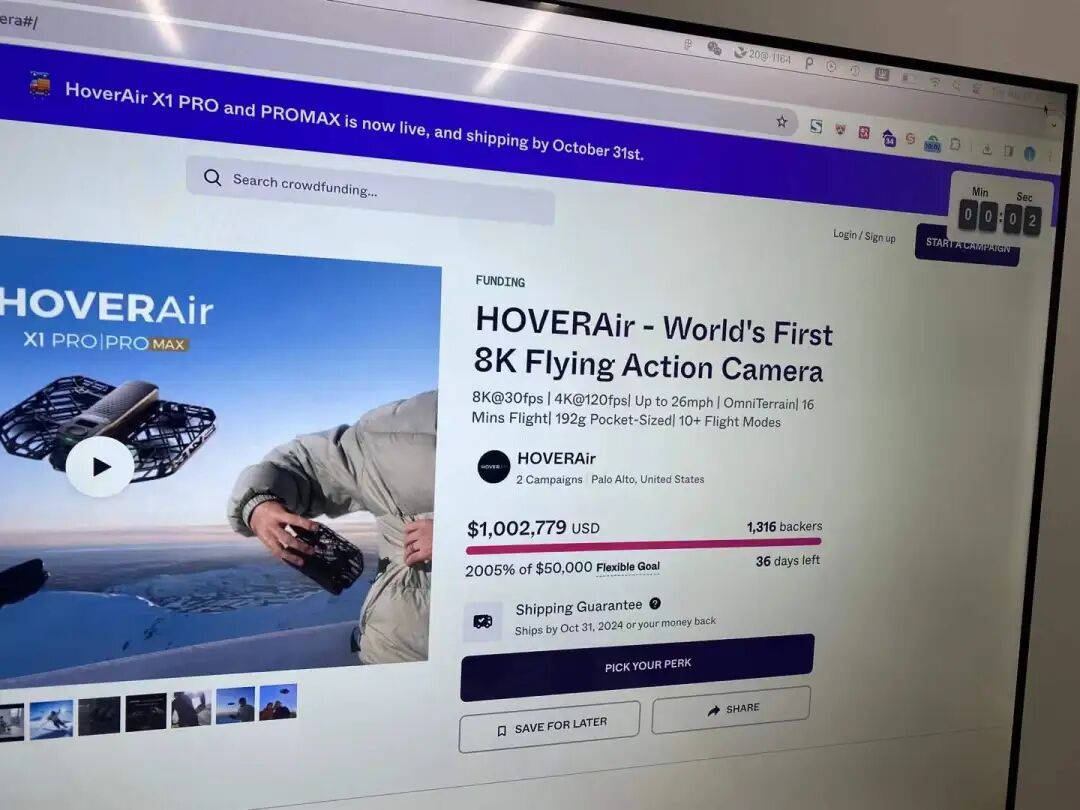
Two hours after crowdfunding launch
Q: In your view, is crowdfunding a must-do for a consumer electronics brand?
Old Wang: Not really. I think crowdfunding is mainly trading time for space.
You can look at it through an e-commerce logic. We're always crowdfunding this month, shipping next month — no empty windows. The only difference with crowdfunding is: you make noise in the market before the product is ready to ship, so you have some opportunity for micro-adjustments before full mass production.
Actually, expanding on crowdfunding — it's about how you view your relationship with users. Our users are everything to us.
Q: What was the situation the night crowdfunding went live?
Old Wang: It was genuinely a last-minute launch — we hadn't planned to go live. Market shifts meant we needed to make noise early. From decision to launch was two weeks. I hadn't done GTM (go-to-market) in so many years, this time I drove myself crazy and jumped in to handle it.
Went live at midnight China time. By 7-8 PM, still no official website, no TVC (commercial).
Indiegogo called from New York — we gave you all these resources, you're going to run empty? You're not some scam company, right? I said don't worry, wait a bit, it'll all be there. Because it was so rushed, everyone had been grinding for two-plus weeks, no sleep for 48 hours before launch.
Later, we basically finished about an hour before going live. I posted a Moments photo — melon seeds laid out, a plane placed beside them, ready for the exam to start.
Three minutes after launch, over 100 users had already placed orders. Our design colleague Shuangshuang dropped a crying emoji in the group chat — "they're not respecting our labor at all?" Because that TVC was four minutes long. Hahaha, pretty funny.
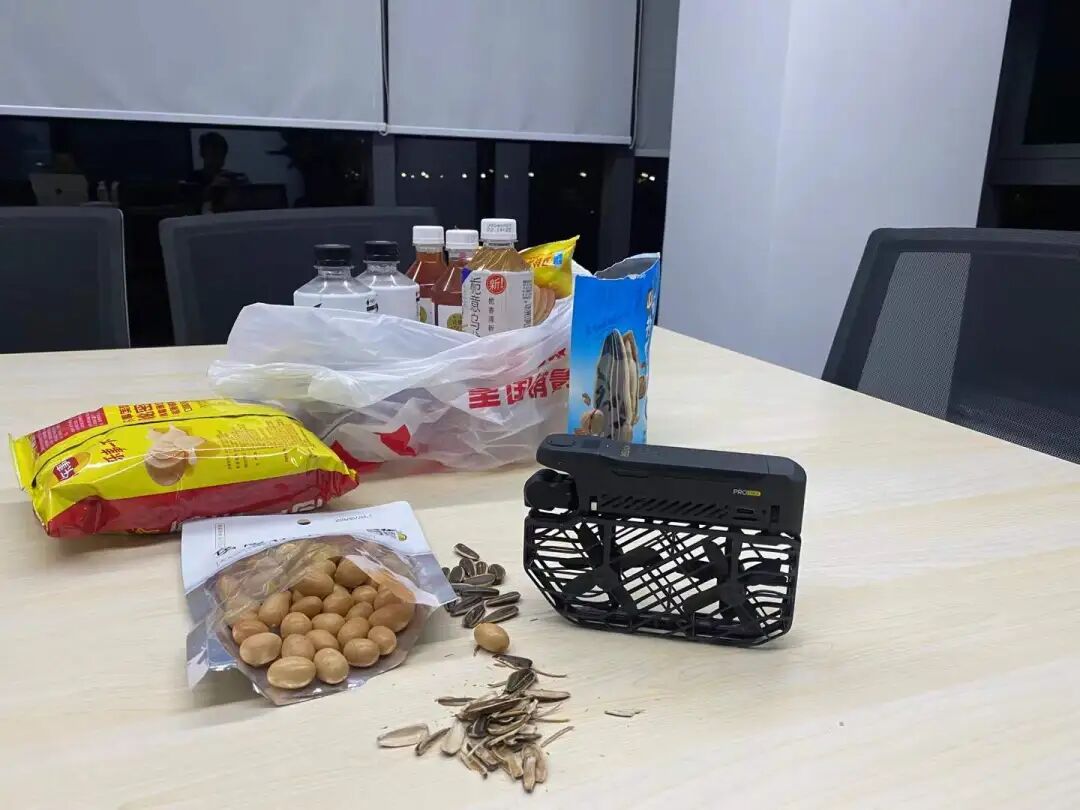
Old Wang's Moments post: "Summer vacation ends, back to school exam"
Q: After this crowdfunding wave took off, how did you sustain the momentum?
Old Wang: It was a mess, hahaha.
Because we started shipping very early — software still had lots of updates needed, but we figured let users get it sooner, start playing with it. Still naive. Some users just wanted a complete product, but everyone more or less forgave us because the product itself still exceeded expectations.
Q: Compared to last year's X1, what are the main improvements in X1 PRO and PROMAX?
Old Wang: It's a bit like iPhone 16, 16 Pro, and 16 Pro Max.
X1 is really a very everyday, mass-market product — city walks, family outings, skateboarding, cycling, jogging. The core is giving you free third-person-perspective recording. It's like we took a film crew — jib arm, slider, cable cam, plus a Steadicam personal cinematographer — and stuffed 125 grams into your pocket. That's what Zero Zero has been doing for ten years.
X1 PRO and PROMAX amplify X1's capabilities in several directions. First, stronger autonomous flight — can track and execute camera moves at higher speeds and in lower light. Maximum tracking speed reaches 40 km/h, won't lose you even cycling or skiing.
X1 PROMAX goes even further — same flight performance as PRO, but maxed-out imaging: can record 8K at 30fps. 8K, under 5,000 RMB — we're the only one.
We also designed some fun accessories. Like the mini remote: when cycling, you can mount it on handlebars, wrist strap, or clip it to your collar — no need to turn back and look at the aircraft.
The magnetic snap design on the remote accessory is oddly satisfying too. One user DM'd me asking — did you guys actually test how many times this magnetic snap can handle? I asked why. He said he's had it four days, feels like he's played with it at least ten thousand times, haha.
Then there's this portable smart charging case — can add 40 minutes of flight time in -20°C environments.
A run down the slopes at Koktokay takes maybe two to three minutes. Even the 7-kilometer Olympic courses — for an intermediate skier like me, ten minutes max. But the lift line back to the top? Twenty minutes, easy. That's when you pop the aircraft in the case. Not flying? It's charging. And you can review your heroic runs while you wait.
It was literally designed for skiing. In November it was officially announced as the official flying camera of U.S. Ski & Snowboard.
Q: How does Hover's palm takeoff and landing work? For safety, you added a propeller guard.
Wang: No one who actually studied aircraft design would do this. Putting a guard over the propellers blocks 25% of the aerodynamic surface and adds 20% more weight.
It was incredibly hard for us to pull off. Why is the X1 so expensive? Look — it's just 1 millimeter thick, but it needs serious structural strength. The X1's guard is milled from a single sheet of carbon fiber, cut piece by piece on a CNC machine. The cutting bits broke constantly. Those four plates cost more than the main body itself.
But what I wanted to build was something that interacts with people. Hover should take off from your hand. That's what closes the distance between human and machine.
The X1 PRO and PROMAX guards are made from HEM ultra-tough material — lighter than carbon fiber. Soft, but it won't break. Isn't that just like Chinese martial arts? Yielding overcomes hardness.
We put a small piece of the guard material in the box with a label: "try to break me."
A friend told me his kid rigged it to a heavy bed frame, hung a rope from it, and sat on it — finally snapped it.
Q: Before Hover's breakout last year, what did you do right?
Wang: Because last year we finally scraped together enough to make our own branded products. All those years in between, you were just surviving month to month.
Q: After the X1 launch, revenue and headcount shot up. Did your mindset change?
Wang: Not really. The only thing was feeling gratified that people were gradually accepting and embracing the flying camera category.
Our users are genuinely adorable. One day this girl in Xiamen called our customer service like crazy. Turns out she forgot her Hover on a trip and wanted us to check if there was a local store — had to buy one, she said, or the whole trip was wasted.
Then there was this auntie, hilarious. Her kid broke the gimbal. We told her, auntie, we have a care plan, we'll fix it free. Three days later, still no shipment. We reached out — has it been sent? Where is it? She said not yet, because she'd been sad for three days and couldn't bear to part with little Hover. You can't make this stuff up. Really touching.
Q: What's the next challenge for Hover's products?
Wang: So many. I think we're doing okay now, but not easy enough yet.
We can save our aunties and big brothers even more time, shoot better, shoot cooler. Right? Absolutely. We let our work speak for itself — build the product first.
Zero Zero is the kind of company that might not have a tomorrow, but everything we do is planning for the best possible tomorrow. A colleague just joined and messaged in the group: "Lao Wang, what I love most about you is that your pockets are empty but your head is full of empire-sized dreams."
Hover User Gallery
"Who even likes this feeling of being swallowed by blue?"
03
A Bunch of Idealists Boarded a Ten-Year Pirate Ship
Q: You weren't doing flying cameras at the very beginning.
Wang: When I first came back, I was doing mobile coupons — haven't talked about that in years. Nothing to do with aircraft, drones, flying cameras, none of it.
Anna (ZhenFund founding partner and CEO) told me when she invested: "Mengqiu, congratulations, great job, just back in China, your team looks solid, contracts to sign." She probably doesn't even remember.
The moment I stepped out of Anna's office, I couldn't keep up the act. Can't fool yourself. The mobile coupon thing looked decent on the surface, some million-yuan contracts to sign, but it fundamentally didn't work. I'd just poached the team from big tech companies four months earlier — how was I supposed to tell them we were done?
I bought a ticket and flew to Anhui, spent three days in Huangshan. Forgot my charger, bought one at a local shop. But the moment I boarded the plane, I was free — because I'd already let it go.
Q: Why the moment you boarded?
Wang: First, boarding meant I'd decided to face life head-on. The coupon thing was done. On that judgment, I was still rational — China's market wasn't right for it.
In economy there was a small screen playing a documentary about the great wildebeest migration in Africa. A young wildebeest got caught by a crocodile, and the mother stood at the riverbank, helpless, watching her calf get dragged underwater. I felt devastated. This mother was experiencing the most painful moment of her life, and she didn't know a camera was recording it from afar.
You know what I mean — we'd talked before about life feeling like The Truman Show, like nested dolls. I started thinking: if there were a third-person perspective recording life, the meaning of it would be different. In that moment everything suddenly connected, clicked into place. This was destiny shaped by personality.
Q: When did you first get the idea for a flying camera?
Wang: 2004-2005, it'd been planted in my mind for a long time. I was studying at Otago in Dunedin, New Zealand — a lot of Antarctic expeditions launched from there. Before I even finished undergrad, I was into mountaineering and rock climbing, hair past my shoulders, basically a wild man.
In 2004, the Banff Mountain Film Festival came through on its world tour, screened at our school for two days. That year there was a nominated film, Alone Across Australia, about this guy Jon Muir who crossed Australia alone. Fascinating — basically a madman. He'd climbed all the 8000-meter peaks in the world, then ran naked to the poles, called it the fastest round-the-world trip.
Later, out of challenges, he crossed Australia from south to north alone — one rifle, one cart, one dog, 128 days. Left a deep impression.
But you know how he filmed it? Walk 50 meters, climb a 20-meter hill, set up the camera, climb back down 20 meters, walk back 50 meters. Right then I thought: if there were a third-person perspective recording this, he wouldn't need 120 days, he'd finish in 90. So the seed was planted early.
Q: What did Tong (Zhang Tong, Zero Zero co-founder) think?
Wang: After I got to Huangshan, I called Tong late at night. He was in the U.S. then, studying part-time.
I said the old thing wasn't working, blah blah blah. He said he understood. Then I said I had an even crazier idea — I want to make a flying camera. Isn't that ridiculous? You know what I mean? We had zero consumer electronics DNA.
The next day Tong called me. He was in the U.S., I was in Huangshan. "Hello, about what you said yesterday, I've been thinking," and then he said, "I feel like I have to tell you this — I don't know if you'll do it, but I really want to. So when I do it later, don't say I'm copying you."
(Wang claps) Forced onto Liangshan, you know? I said I'll do it, why wouldn't I? I asked — can this thing even be made? How? We don't know anything.
You know what he told me? "We're mechatronics engineers" — Tong has a PhD in mechatronics from Stanford — "there's nothing in this world we can't build." Pure bluster. Looking back ten years later, we had no idea what we were talking about.
That kind of blind confidence — and it was settled. Settled, so do it. Mutual hustling, mutual goading, each pushing the other into the abyss. A bunch of idealists. Boarded this pirate ship, ended up doing it for ten years. Pretty interesting, really. But pretty good too.
Q: Some media reported that after Blackbird (Zero Zero's first product) launched, you took inspiration from birds and spent four years developing the dual-rotor drone Falcon, investing nearly 200 million yuan. From 2018 to 2019, the company lost 60-70 million yuan annually. For three years you survived on foreign aid tech R&D contracts. By early 2020, pandemic time, company cash flow hit zero.
Wang: We started in 2017, launched in 2019, mass-produced in 2021. Four full years. Nearly killed us.
This one. Very cool, very handsome. Let me show you, you've definitely never seen it. Really my baby, my BB.
Our core engineers came specifically for this, gave up their own startups, just for Falcon, just to work with me. So it's hard to say whether it was success or failure.
Q: Why make Falcon?
Wang: We couldn't survive. The original thinking was: consumer aerial drones were a mature market with big growth, not fully competitive. We'd make a product to keep everyone fed.
But our people didn't want to copy or imitate, just couldn't do it. We thought no, we have to make something new, better, more system-efficient. This one had 50-minute flight time.
By the time it was done, imaging performance and platform computing power were a full generation behind. Who waits four years for you? We made 5,000 units, sold them, stopped.
Q: Was this Zero Zero's hardest moment?
Wang: When the dual-rotor was taking shape, an overseas company wanted to acquire us, proposed a partnership. The whole deal dragged six or seven months, then fell through.
In one month, the company went from 140 people to 70. The entire software and algorithm team was hollowed out. Every day people lined up to cry to me. What could I do? One colleague's wife was about to give birth, they'd bought a place inside the Fifth Ring Road. Everyone thought they were getting acquired and set for life, lifestyles adjusted — then I had to ask them to tighten their belts again.
Even though it was like that, I did two things I don't regret at all. First, I never told anyone who wanted to leave not to go. Because I didn't know if we could survive, I hate overpromising. I really didn't know. By then I'd borrowed over 30 million.
Second, I asked every one of them: where are you going? Let me see, because I know whether you're a fit. If there was a good opportunity, I'd refer them. Doing reverse recruiting every day, sending my own people out.
But wherever you go, don't let anyone point at you and tell you what you can and can't do. Because what you did at Zero Zero, you built with your own blood and sweat. I can only give you that confidence.
I still have the year-end party photo from then. Everyone at my table was leaving next month. I'm there laughing and joking, everyone's bawling their eyes out.
But you know what made me happiest this year? None of this stuff. You know I have 7 old colleagues who came back.
My very first engineer, Teacher Yang, came back on July 7th. I was so happy, genuinely so happy. Can't describe how happy. Was going to do a homecoming program, don't need to now. Anyway, I'd been fostering them at various places, now they're all back.
One of our app team members handed in her resignation — she's going to study in Italy. I sat down with her to talk it through, and she explained why she chose that school, why Italy, that she wants to study interaction design. I listened and felt relieved. No problem, go for it. She's on the quiet side, a bit tomboyish.
Toward the end she said, "I really want to tell you — if it weren't for my two years at Lingling, I wouldn't have had the courage to go study in Italy."
I was so happy. "I'm lending you to the Italian people for a while. If you finish and decide Western life isn't for you, come back."
There's another thing I don't really talk about outside. Once I got wasted on a team-building trip with our Shenzhen crew and jumped onto a table. Later in the company-wide group chat, I just said: "You all know what it's like out there. I really can't do anything about that. But at Lingling there's one thing: good people must get their due."
Ah, so many stories. These young women and men have been soaking into my soul day after day, turning me from a big demon into a big abbot. Hahaha.
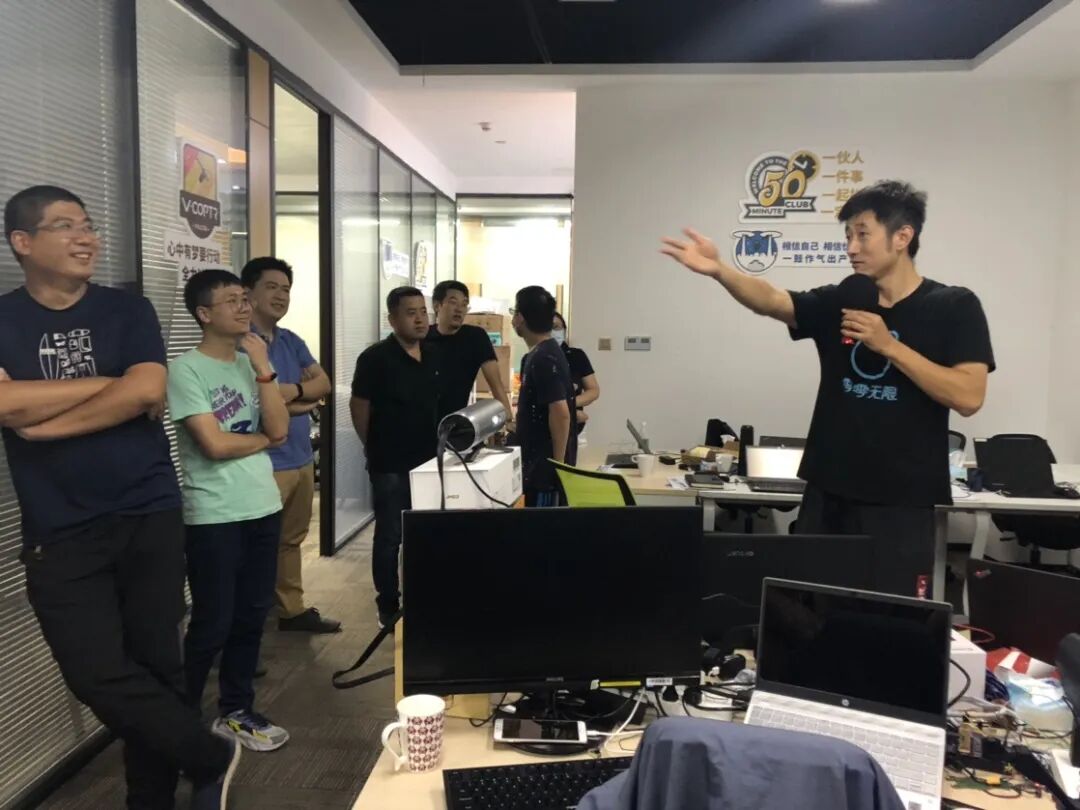
Early days at the Lingling Tech office
04
Float up just a little, and you won't get pinned down
Q: You mentioned "character determines destiny." What's your character? What's your destiny?
Lao Wang: No logic at the foundation, very emotional. But the upper layer has been tortured by years of scientific training, so very rational. A deeply split personality.
You talk about life, personality, being human. A person is just that little bit of something. What I cared about most in the entrepreneurial journey was this band of brothers and sisters along the way. Everyone's been talking about Journey to the West lately. Wasn't Sun Wukong happy enough as a stone monkey? Flower-Fruit Mountain, his monkey tribe, just playing around — life goes on.
But he was given this mission by chance, so he went to fetch the scriptures. Fighting demons all the way, getting bullied by Tang Monk at the drop of a hat, having to look after that good-for-nothing Zhu Bajie, and Sha Wujing being so stubborn and pedantic. How many times did he cry?
But because of these deep emotional bonds with these people, he could never go back to being a monkey. You become human.
Q: When did you go from monkey to human?
Lao Wang: The biggest difference between monkey and human is whether you have feelings. Whether there are people worth giving your feelings to. Before, I was a monkey. Not exactly cynical, but just thinking — as long as I'm having fun, isn't that enough?
Once you get used to suffering together, you become human. Look at the word "company" — its real meaning is the people who accompany you. Now we've got 350-plus brothers and sisters, many with me for ten years. Can't say all 350-plus are family, but dozens definitely are. Dozens of opposite-sex siblings, nieces, nephews. Life just gets amplified like this.
Q: Have you ever cried?
Lao Wang: I'm genuinely the steel straight guy type, can't cry.
But at the year-end party last year, they really got me. Broke my defenses. I'm usually the jokester, mainly telling bits to make everyone laugh. But before the opening, marketing put together a video — a montage of all our user footage.
They didn't even give me time to breathe afterward, just shoved a microphone in my hand. Had to open with a slight choke in my voice.
Mainly because of what? I told everyone then, I said I feel loved. Really that feeling. Because they were all so happy. Everyone in the video — running wild, waving, holding their kids, or riding skateboards — I didn't see a single person crying in front of a Hover camera.
People like our stuff, enjoying the passion and beauty of life. Just this feeling of gratitude, choked me up a bit.
Q: Can you send me the crying video?
Lao Wang: The crying video really won't work, but marketing might have it.
Q: Actually the video wasn't even that sentimental.
Lao Wang: That moment just felt truly grateful. What I want to convey to the whole company, every person in the company, every user — is this word: freedom. Thought about it for a long time at first, why is this thing called Hover, "Hafu." The literal translation is levitation, it describes a mental state I've really wanted to have.
Our crew is too grounded in the mundane, can't drift too far from the ground. Too far and you can't feel human warmth, joy and sorrow — gotta stay close to the ground. But everyone's life is pretty hard. Finally getting your kid settled after a midnight fever, or coming home after moving bricks all day, shutting the door and feeling how heavy it is. Life really is quite heavy.
I'm dead tired all day, but after everything's done at night, thinking about the product to make tomorrow, or some technical challenge. At that moment, because of my inner love for this thing, it lifts me up that tiny distance from the ground. And I'm free. I can freely, gracefully float through this human world, no one can pin me down.
The heavier the pressure and responsibility life gives you, the stronger the love you need to lift you up, to give you that little bit of buoyancy. It's actually a state, light and airy. Float up just a little, just a little, and you won't get pinned down here.
I later found out there's a high school music festival in Hangzhou called "Buoyancy Music Festival." Really great, if we ever have some money we'll sponsor them.
Q: So where did the name Lingling Tech come from?
Lao Wang: For a while people asked me, why is your company called Lingling? We were struggling so hard to get orders then, so I said — because we have zero revenue and zero profit. Hahaha.
Lingling, on one hand — we're all engineers, computer science straight guys, we think 00 is binary, pretty special.
On the other hand, every person's life starts from zero, and eventually returns to zero. But when you connect two zeros, it becomes ∞, containing all possibilities.
Don't we all have to return to zero anyway? Might as well read the script carefully along the way. Even as an extra, put in some effort, right? Make your own inner experience more real, and that's that.
When I was little I especially hated "the Doctrine of the Mean," thinking why does everything have to find the middle point? Now I really understand it differently. Though of course these are all my fallacies, put this out and probably a bunch of people will curse me.
Q: Bad publicity is still publicity.
Lao Wang: Thank you all. Don't want to be famous at all. Clarifying first — people fear fame, I fear getting big.
But really, after going through so many things, you discover everything is a kind of balance. Without walking to both extremes, without experiencing the great good and great evil in your own heart, you don't qualify to say you've found the middle point.
Look at the Four Books and Five Classics — my name covers two of them.
Q: Is that why? Saw your video channel is called Mencius Chunqiu.
Lao Wang: Hahaha, half. I was born in the first month of autumn.
Buddhism is pretty interesting too. Used to think, what is this "lay down the butcher's knife and become a Buddha on the spot"? Too unprincipled, how does that work? Later I thought carefully, this saying is only half finished. You have to first pick up the butcher's knife, hack and slash wildly, before you can lay it down. But most people never even found that knife in their heart, never picked it up.
Q: When did you pick up the knife?
Lao Wang: That dark history definitely can't be told. Anyway, it's left hand fighting right hand, battling yourself.
Battled until I discovered I'm still a very kind person — not putting gold on my own face here. Battled countless times, finally found that kindness is what brings more peace of mind.
I remember there used to be a crazy monk in New York, really interesting. Ate meat, drank, all kinds of mess, but was a living Buddha — forgot his name. He had one line I thought was especially good. He said between complete irresponsibility, cynicism, and being super serious and earnest, there's this little gray zone. This zone is called humor. That's the most exquisite thing in life.
Too serious, that person's too boring. Too unreliable, that won't do either, right? Just floating in this middle zone, that's more interesting.
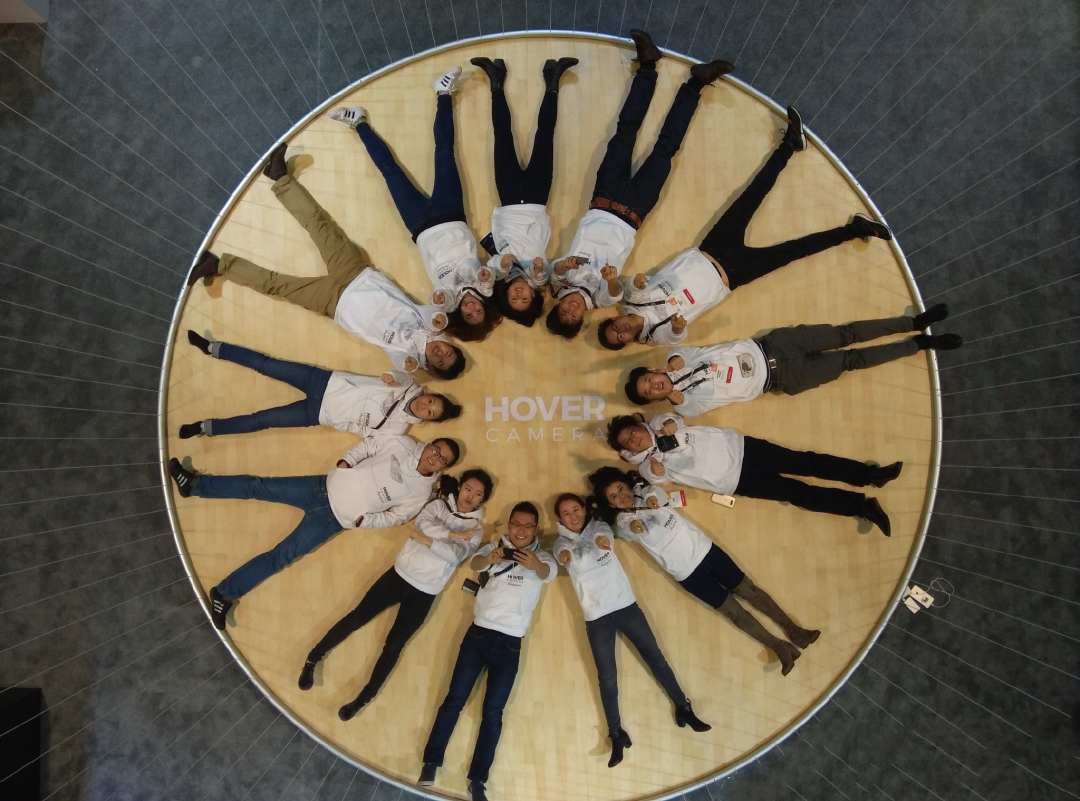
In 2017, Lingling Tech's first product Hover Camera made its global debut at CES
A ruthless person, a person with outsized ambition
Q: What were you doing during the low points?
Lao Wang: I loved watching the Four Idlers of Kuaishou back then. You know what those guys do? Four dudes — one moving mountains, shoveling away at a mountain every day. One grinding an iron rod into a needle, rubbing that iron stick daily. One dripping water wears through stone, slapping water every day. And one filling the sea, throwing stones into the ocean every day. Watching these four was incredibly stress-relieving. Because no matter how you look at it, that guy is a million times more boring than you, hahaha, but everyone persists every day.
Life sometimes has these wonderfully strange things. For a while I started wearing braces, and I felt — as long as I'm still wearing the aligners every day, the company should still be here.
Every morning brushing my Invisalign aligners was a bit like koweling and burning incense. It's just a belief, you need an anchor point. The more vulgar the better, the more boring the better, the more ordinary the better.
Q: What do braces have to do with the company?
Lao Wang: Nothing, just because times were hard. Creating my own religion. I felt all my faith was in these braces. Like I was really scared of the dentist then, and he told me I could stop wearing the aligners.
Q: If you weren't doing Lingling Tech, what would you be doing?
Lao Wang: Find a temple to knock on the wooden fish. Hahaha, joking. If I weren't doing Lingling Tech, I'd probably be frustrated and unfulfilled.
I know myself very well. In my bones I'm truly a ruthless person. A person with outsized ambition. I would rather die alone than do something not worth it.
Q: If you could do Lingling Tech over, what would you do differently?
Lao Wang: Nothing, really.
Q: Any regrets?
Lao Wang: No.
Q: None at all? Move made, no take-backs.
Lao Wang: Never gambled. Sometimes I joke — the biggest difference between us and Auntie Ma downstairs is Auntie Ma goes to Macau to pull slot machines, thinking she'll win every time. From day one I knew losing was the high-probability event.
About two or three years ago, I was flying from Shenzhen to Beijing, three hours. Somehow dug up a copy of Hemingway's The Old Man and the Sea from home, a thin little booklet.
Sat on the plane the whole way, tears streaming, face wet. Washed my face for three hours straight, drank two bottles of water. Reading The Old Man and the Sea as a kid, the teacher taught you the central theme, you thought it was a story about struggling against nature. Suffering through hardships, fighting heaven and earth.
But reading it again this time, got to where it says, "But that was the thing that I was born for" — he knew himself that he was born to catch the big fish.
Eighty-four days, not a single catch. Storms and rough seas, and still he went out every single day. And then didn't he finally land that giant marlin, right? In the fight, the fish dragged his boat along, and then his left hand cramped up — "Why is it always you?" he said. "Always you that cramps." So he looped the line across his back, try not to let go. Wouldn't let go.
When the sea finally calmed a little, and the fish tired, he spoke to it: "I wish so much you would surface, just let me see how magnificent you are."
By the next day the sharks had stripped the great fish to bones. The old man towed the skeleton back to shore. Wow — the whole village rushed to the boat, never seen a fish so large. The old man went back to his little shack. All he wanted was a good sleep.
Why was I like that that day? You know? I feel so lucky. I really feel so incredibly lucky. Cause I'm that old man who caught his fish.
A special offer from Hover ✨
Click "Read More" for a limited-time exclusive discount on the X1 PRO | PROMAX. Free your hands and capture the moment — starting today.
Recommended Reading