OMOWAY Founder He Tao: The Second Half of Life, Riding the Wave of Next-Generation Intelligent Mobility
There's nothing more thrilling than starting a company.
By Ziyi Zhang
Edited by Silai Yuan
In his first year away from XPeng, He Tao tried everything he could for fun. Europe, the US, Southeast Asia — he traveled "like crazy," climbing mountains, surfing, sailing, chasing whatever gave him an adrenaline rush.
Eventually, the thrill wore off. Strolling through an American gated community, he watched retired executives obsess over their gardens, tinkering with automated irrigation systems, and saw his own future staring back at him. "It felt terrifying."
He Tao says he can't sit still. Having experienced the highs and lows of business battles, he's addicted to the rush of adrenaline surging through his heart. Many founders are similarly "risk-addicted" — some chase increasingly dangerous extreme sports, others keep building companies. He chose the latter.
So in 2024, amid the bustling streets of Indonesia, surrounded by the roar of gas-powered motorcycle engines, He Tao decided to build vehicles again — except this time, overseas, and this time, electric motorcycles.
Indonesia is the world's third-largest motorcycle market. According to AISI, the Indonesian Motorcycle Industry Association, total motorcycle sales reached 6.24 million units in 2023, with total ownership of roughly 120-130 million units — equivalent to one motorcycle for every two to three people. For almost every young Indonesian leaving home after graduation, the first gift they receive is a motorcycle.
Counterintuitively, motorcycles in Indonesia aren't cheap. Japanese brands Honda and Yamaha control over 95% of the market, with mainstream products priced around 10,000 RMB equivalent. Many people take years to pay off their motorcycle loans.
The parallels to China's auto market a decade ago are hard to miss.
Meanwhile, the Indonesian government has set aggressive targets: 2 million electric motorcycles on the road by 2025, rising to 13 million by 2030. The massive gap between current reality and these goals, combined with a population of 286 million with an average age of 30, clearly implies unlimited commercial potential.
In 2024, He Tao formally established his new company — OMOWAY. The team is impressively stacked: Jiao Qingchun, former VP at XPeng, serves as co-founder; members include Xiao Zhiguang, former head of XPeng's autonomous driving; Zhang Lihua, former design director for the XPeng P7; and Chen Bifeng, former head of VIVO Indonesia, who joined to lead market expansion. Last June, OMOWAY unveiled its first smart electric motorcycle prototype, the OMO X, in Jakarta.
OMOWAY's OMO X became the world's first self-balancing smart electric motorcycle to achieve mass production and delivery. Beyond that, intelligence became a key metric for the OMO X — automotive-grade chassis, independent suspension, double wishbone, reverse assist, and more, all packed into this single vehicle.
OMOWAY, founded by XPeng co-founder He Tao, has completed consecutive Pre-A and Pre-A+ funding rounds totaling tens of millions of dollars, led by HSG and Starship Capital respectively, with all existing institutional shareholders — ZhenFund, Huiyou Capital, and He Tao himself — continuing to follow on. The funding will primarily support mass production delivery and global market development. This round comes just six months after OMOWAY's previous funding announcement, and two years after He Tao left XPeng.
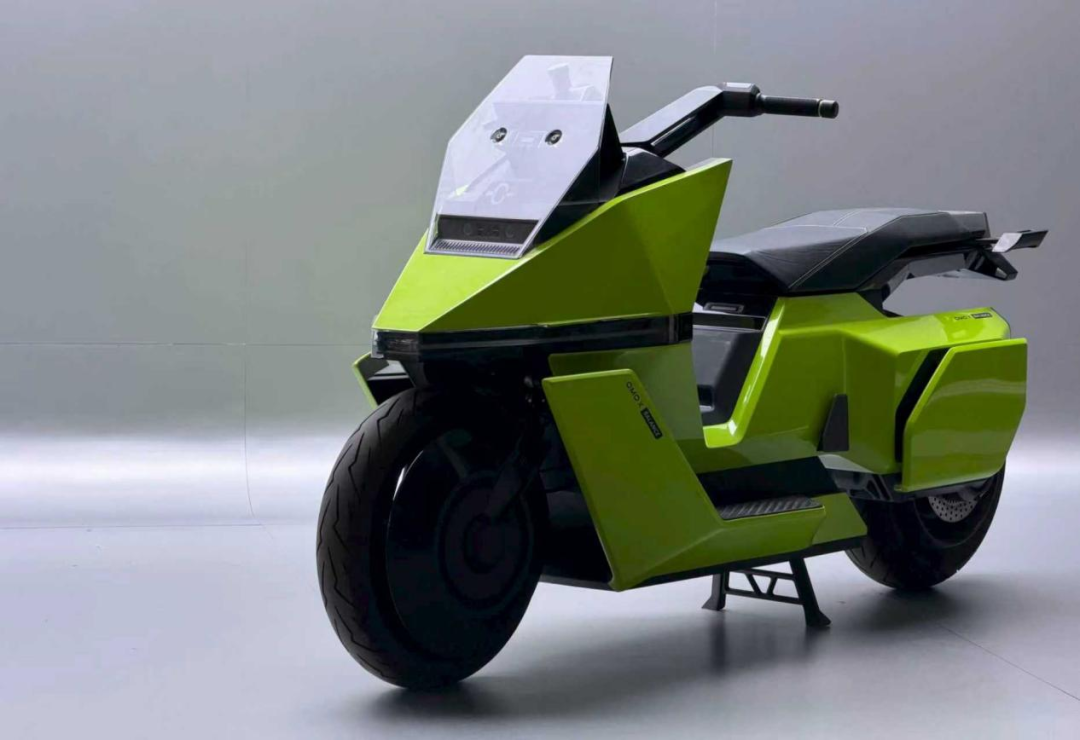
The OMO X prototype, soon to hit the market
The eve of an explosion in Chinese new-force vehicle manufacturing seems poised to happen in overseas markets. But in He Tao's view, the electric motorcycle experience must be several times better than gas motorcycles to have any chance of replacing them. And the overflow of China's automotive supply chain capacity gives companies enough of a generational advantage.
Southeast Asia is just the first step. In the trillion-dollar global motorcycle market, Southeast Asia represents roughly 25%, with Indonesia alone accounting for half of that. He Tao believes choosing Indonesia means not just selecting a market, but driving straight into the heart of the global motorcycle industry.
Going overseas remains unfamiliar territory for He Tao. He tells his team not to be arrogant, not to think they're descending from a higher plane to crush the competition. But he can't help reflecting that things have gone relatively smoothly — after seeing how cutthroat China's auto market is, nothing overseas scares him anymore.
In fact, before building electric motorcycles, He Tao had never even ridden one. He's started now, though he hasn't learned any tricks yet. In OMOWAY's office lobby, alongside their own prototype, sits a BMW motorcycle and a red Ducati that belongs to He Tao himself. He Tao wears a light leather jacket, his hair slightly wavy, no sign of middle-aged spread — the fast pace of entrepreneurship keeps him young.
We spoke with He Tao for three hours about his new venture, his company, and his obsessions and aspirations.

"I love seeing lots of people using what we build"
Q: Honestly, not many people with your level of success start over from scratch.
He Tao: I think life needs some excitement, and entrepreneurship is the ultimate thrill. Before starting this, I went to the US and saw those people in gated communities — former company executives spending their days figuring out how to maintain their gardens, installing fully automated watering systems. I found it terrifying.
I don't think ease is necessarily a comfortable state. You have to get through the days somehow. Lying in bed is one day; getting up and doing something is another. And what excites me is large-scale manufacturing. I love seeing lots of people using what we build — that gives me a rush. I'm not going to talk about meaning or purpose; at least this keeps me fulfilled and happy.
Q: Your product came together quickly. How did you manage the pace? Especially facing Indonesia as such a unique overseas market.
He Tao: We understood neither the product form nor the overseas market. We only started seriously researching the market at the end of 2023, established the company in July 2024, and began work on our first product around August. We spent over half a year just repeatedly asking: who exactly is our audience?
I think this matters enormously — you have to personally understand local consumers, smell the market, before you can build something suitable. We're a consumer-facing company after all. Like building cars back then, consumer needs vary widely; you have to see which segment fits you.
Our entire product strategy shifted many times. Initially we wanted to build supplementary household transportation — relatively low-speed, refined short-distance vehicles, like a second bike for families that already owned a gas motorcycle. But we later realized that market was actually the electric bicycle market, with too low a barrier to entry, unsuitable for us. It wasn't until around July-August last year that we decided to target the mainstream market, to replace existing Honda and Yamaha products.
Q: Why did you decide to cut into the mainstream market then? What opportunity did you see?
He Tao: Partly inertia. Back at XPeng, our first car targeted families' second vehicle. But the timing is different now. When XPeng started in 2014, batteries were expensive and range was poor — you could only build supplementary vehicles. But after so many years of China's EV development, both the supply chain and intelligent technology have matured. I believe electric motorcycles can completely replace gas vehicles directly, becoming young people's first vehicle.
Second, Indonesia's environment differs from China's — the concept of "supplementary transportation" barely exists. Most families have two vehicles, but both are primary transportation. For anything over 5 kilometers, you definitely take a motorcycle, because they have so few public transit options.
I think this is also the advantage of a startup — you can pivot faster. We don't hire consulting firms for research; we go ask ourselves, find local motorcycle associations, talk to typical consumers one by one.
Q: Was anything in your research unexpected?
He Tao: What surprised us was that despite lower purchasing power than China, motorcycles sell for quite a lot. By local income levels, a motorcycle is basically their equivalent of a car. And the experience of these motorcycles remains stuck in the last century.
We saw that most households have at least two adults, and each must buy their own. Indonesia alone has 120 million units, Southeast Asia as a whole 300 million. At 10,000 RMB per unit, plus replacement cycles, that's hundreds of billions annually. This is genuinely a massive market, a good entry point.
To buy a proper motorcycle costs at least 8,000-9,000 RMB. The 2,000-3,000 RMB products from China's two-wheeler manufacturers in the past replaced people who used to walk or bicycle — for real transportation, you still had to buy gas motorcycles.
Q: Why are they so much more expensive? Is it production costs?
He Tao: A major reason is long-term monopoly. Honda holds 80% of sales; two Japanese companies control over 95%. You can imagine how around 2000, a Santana sold for 200,000 RMB — now it's unimaginable that a car at that level could command that price.
Indonesia lacks industrial foundation, especially in the fuel vehicle market — gas vehicles are more complex than electrics, with engines and transmissions. So I think this is an opportunity for Indonesia: if electrification can follow China's path, there's a chance to develop its own supply chain. There are local entrepreneurs building electric motorcycles now; I hope they succeed. I don't want this market monopolized by one or two players — better to have four or five leading companies in Southeast Asia, that's healthier.
Q: When you started, did you want to do something vehicle-related and then chose motorcycles, or did Indonesia decide it for you?
He Tao: I didn't necessarily want to stay in vehicles. I did initially consider cars — after 20-plus years in autos, there simply aren't new opportunities domestically. Looking at Southeast Asia, the auto market is tiny, not a good choice either.
Visiting Indonesia, seeing streets packed with motorcycles was quite shocking. Locals said it was like Guangzhou in the 1990s. I asked about prices — surprisingly expensive, over 10,000 RMB, and still gas-powered with an experience not worth the price. I wondered if this was China's electrification opportunity ten years ago, except happening on two wheels.
I want to build something at scale, to see people's lives genuinely improve from using my product — that matters enormously to an entrepreneur. And for my second venture, I want to build a major company. Small things are hard to find satisfying.
The more I dig into motorcycles, the higher the barriers seem — requiring 10 years, demanding quality and scaled manufacturing. That suits my background of running massive factories shipping tens of thousands of units.
Q: Many electric motorcycle companies went to Indonesia in 2022-2023. Why didn't they succeed?
He Tao: To replace an existing product, the minimum requirement is that the new product must be better than what's there.
Second is timing. Before 2023, lithium batteries for motorcycles were extremely expensive. Although China had many electric two-wheelers, over 90% used lead-acid batteries, so the lithium two-wheeler industry never achieved scale. Going to Southeast Asia then, a 2-3 kWh electric motorcycle would sell for nearly 30,000 RMB, mostly battery cost.
But in 2024, lithium battery prices dropped very fast, approaching automotive lithium prices. Three factors: new national standards, more companies adopting lithium, and automotive battery capacity overflow.
So timing matters enormously. Previous products were more expensive than gas motorcycles and not as good. Our strategy is similar pricing to gas motorcycles, but operating costs at 1/5 to 1/7, similar lifespan, with much better experience and comfort.

Redefining the Electric Motorcycle: Self-Balancing Technology and Automotive-Grade Supply Chain
Q: What pain points did you discover in Southeast Asia from your on-the-ground exploration?
He Tao: First, terrible traffic. Motorcycle traffic jams are the worst because you constantly have to put your feet down, and the roads are muddy and dirty — exhausting. Second, road conditions are much worse than China, very bumpy. Third, riding times are long — for ordinary Jakartans, commuting 30-50 kilometers is normal, taking one to two hours.
To address these, we put automotive independent suspension on motorcycles — a first for the industry — making potholes much smoother. To solve the exhaustion from traffic jams, I later put self-balancing on the agenda. And for range, we designed for charging every three days. These differ quite a bit from China's situation.
Q: OMOWAY achieved the world's first mass-produced, delivered self-balancing vehicle. Technically, why hadn't anyone done this before?
He Tao: Some tried, but didn't do it well, didn't achieve market delivery. To do it well requires solving stability, reliability, power consumption, cost, and durability.
First, technology path selection matters enormously. Some approaches adjust center of gravity (swinging the battery) — batteries are heavy, swinging them around is neither safe nor responsive. Some adjust the handlebars, which fights the rider for control. Some use inertia wheels (flywheels), making the bike extremely heavy.
Choosing the right technical path is crucial. Beyond the path, you need technical capability — predicting rider movements, if the rider's weight shifts right, how to help them balance — this requires reinforcement learning, not rule-based solutions. You also need engineering capability to drive costs down and control weight. It's actually a long chain, quite complex.
Q: How does the self-balancing system work in complex road conditions?
He Tao: Every system has boundaries. Fall into a big pit, and it definitely can't balance. Early on, I had users actively press a button to enter self-balancing — at red lights or in congestion, press once and it balances, feet can rest. If they want to exit, press again.
You still have to find their scenarios, solve their problems. Even a roly-poly toy will fall if you kick it hard enough.
We currently only do low-speed balancing; at high speed, users balance themselves. I won't claim this system is lightning-fast, but if you lean, it immediately corrects you.
Q: Were you nervous building this? After all, no self-balancing motorcycle had ever reached market delivery before?
He Tao: I estimated the difficulty from the start, solving problems step by step.
I also want to talk about why I'm so committed to this — it's actually connected to what I want to do next.
The endgame of automotive autonomous driving is Robotaxi; the endgame of two-wheel autonomous driving is unmanned instant delivery. Food delivery riders use two-wheelers now because of maneuverability and low cost. But if unmanned delivery becomes possible, efficiency improves massively.
Two-wheel unmanned delivery has lower safety requirements than passenger autonomous driving because it carries goods, not people — comfort doesn't matter. So I now have two versions: one with self-balancing, one without. The version without self-balancing, I want to add the balancing function but keep the price low, scaling out. Even if I don't make money on hardware, if I can replace delivery riders in the future, that's a massive robotics application scenario.
We've actually researched this direction for a long time. For two-wheel delivery, we're considering how to handle small steps, how to navigate inside residential complexes versus outside — many problems to solve, but the broad technical direction is sound.
Q: Is data collection and analysis harder for motorcycles than cars?
He Tao: We're doing small-loop assisted driving, not full-process autonomous driving. Things like congestion following, red-light self-balancing, automatic parking and charging at home. We won't do full-scenario passenger-carrying two-wheel autonomous driving — the hardware cost is unbearable, and the value isn't that great.
Q: Beyond self-balancing, what else is several times better than gas motorcycles?
He Tao: Automotive-grade chassis, independent suspension, double wishbone, plus reverse assist. Motorcycles are hard to push out; we can make them back out by themselves.
Also vehicle connectivity, remote monitoring, keyless entry, Bluetooth keys — commonplace in China, but absent from gas vehicles.
Q: What safety improvements have you made?
He Tao: Motorcycles originally have terrible visibility, just those small rearview mirrors, so we added surround-view functionality, monitoring the environment to provide warnings. The self-balancing system also improves safety. The reason we started with passenger-carrying self-balancing is frankly to let the technology land first, solidify it, so we have more confidence going deeper later.
Over a million people die globally in motorcycle accidents annually. Many cases involve the bike falling, the rider getting thrown, then being run over by following vehicles. So making the bike harder to fall through technology dramatically improves safety.
Also the chassis — we followed automotive logic, decoupling steering from suspension. Traditional motorcycles often combine steering and suspension; hitting a small stone transmits vibration directly to the handlebars, easily causing loss of control and tipping. Now we've separated them: suspension handles shock absorption, steering handles direction, so road surface bumps don't affect handlebar stability.
Q: Why didn't motorcycles do independent suspension before?
He Tao: This is hard to explain — think about how before new-force automakers, independent suspension was only for luxury cars. Now technology has cascaded down. A 50,000 RMB car has independent suspension now — doesn't it drive much more comfortably? I think when an industry is monopolized for too long with fixed players, good technology gets sold in tiers.
China's auto industry developed this way too — good cars had digital displays, bad cars had mechanical gauges. Now every car has digital displays.
Our approach is bringing all high-end configurations down — high-end isn't actually that expensive. Independent suspension doesn't cost much more than non-independent, but previously you'd need double the price difference to get it. Now many cars have rear-wheel steering — who could have imagined that before?
Q: How do you control supply chain costs?
He Tao: Our cost control is quite good; at mass production we'll have solid gross margins, much higher than automotive.
We use automotive suppliers for many key components. First, quality is good; second, prices are cheap.
Chinese motorcycles previously had poor quality because of inferior materials, breaking after two or three years and exiting the Southeast Asian market.
We must pay attention to this, and fortunately our advantage is automotive.

Infrastructure, Competition, and Self-Iteration
Q: Facing Honda and Yamaha's 90% market share in Indonesia, won't competition be fierce?
He Tao: This is both advantage and disadvantage. The advantage is having only one competitor. Honda has been making easy money for over 20 years, with no motivation to push new products — the same models barely changed for decades. That's the opportunity. You know why we can pry open offline channels? Because traditionally, many offline dealers invested heavily, carried lots of inventory, but got the smallest cut.
We took many local dealers to test ride in the Bali mountains; many signed on the spot, even putting down deposits. This shows the product and model moved them. Now many dealers want to build our 3S stores.
Our competitive disadvantage is Honda's deep brand penetration. People think buying a motorcycle means buying Honda. So we must build a clearly better product, slowly accumulating word of mouth. We're building communities now, finding passionate early adopters, listening to their feedback, radiating outward from this group.
Last month I went with product managers to research users; they gave us very serious feedback. First make the product good, respect consumers — this is a long-term endeavor.
Q: As a new brand, how do you handle maintenance and after-sales?
He Tao: We're already building our dealer network, with nearly 20 signed, requiring them to operate 3S stores (sales, spare parts, service). We'll assign regions to dealers; they open their own stores, we provide training on how to repair, replace, and diagnose. We'll also develop diagnostic tools to identify which component has issues.
Early on we definitely can't match Honda's density. If customers wait too long, we'll provide replacement vehicles. Most important is customer satisfaction. Core components like battery packs are locally assembled; we'll set up central warehouses, and stock sensors and other parts.
Q: Do you use dealers for all offline sales?
He Tao: Yes. Direct sales are too heavy. While there's brand pride, it's not self-sustaining — less motivation than dealers. Especially in overseas local markets, you must find experienced local dealers with existing customer resources; subsequent vehicle replacements are all opportunities. Going direct from 1 to 100 is too hard. Later our customer base will inevitably expand slightly downward; I need to broaden my product line.
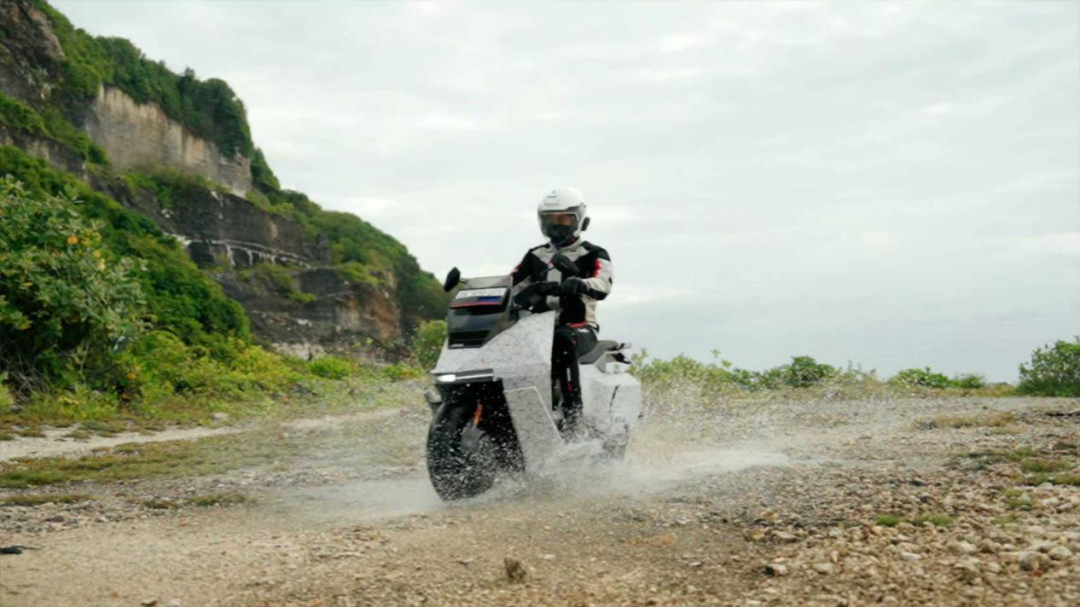
OMO X road testing in Southeast Asia
Q: How do you solve range anxiety for long-distance riding?
He Tao: Jakarta is a city with very long riding distances; daily commutes of 20-50km are common. We designed for charging every three days, meeting daily charging needs. And 95% of Indonesians live in single-story homes, so home charging is very convenient.
We'll also build some fast-charging stations, but motorcycle fast chargers are much lower power than automotive — at most four or five kilowatts. For annual homecoming trips, which happen once a year, they can also fast-charge at stores, getting back in two hours.
Q: Many electric motorcycle companies in Indonesia do battery swapping. Do you?
He Tao: I don't think consumer-facing battery swapping is very necessary. It's hard for one person to ride 100 kilometers daily; our range is sufficient. Battery swapping requires massive investment and easily traps you. Europe pushes swapping because people in apartment buildings can't charge at home; Indonesia charges easily at home. Also swapping leads to inconsistent battery ages. And now battery capacities are getting larger — one unit weighs 7 kilograms. Some previous electric motorcycle companies split them into two units, carrying one to charge, but this causes unequal charge levels, and internal losses when both batteries are inserted.
Q: Some say doing electric motorcycles locally is an infrastructure business. What do you think?
He Tao: If you call it an infrastructure business, you're diminishing the importance of the product. Product is core; electric motorcycle infrastructure is much less than cars. No need for superchargers — fast charging only needs a few kilowatts, no grid infrastructure needed. Factories are simple too, just final assembly — no massive stamping and welding, compared to automotive processes, it doesn't need so many sheet metal parts, very little welding.
Q: If the barriers aren't high, why can't many companies build good electric motorcycles?
He Tao: It's a chain problem. R&D and design didn't consider manufacturing; wrong suppliers found; quality control systems inadequate. Why bicycle-makers can't build good motorcycles — they're used to applying bicycle thinking.
We're running tests now, hundreds of thousands of kilometers, high-salt corrosion tests. The motorcycle industry has no mandatory standards; we're applying automotive standards, like crash tests where the frame can't break. This relates to both attitude and capability.
Q: Locally, motorcycle purchases mainly rely on financial institution loans. How do you handle this?
He Tao: Early on we'll partner with multiple financial institutions. Initially we may not make money from financial institutions — as long as they're willing to cooperate. Once volume grows, we can discuss revenue sharing.
Q: Honda's gas motorcycles have a key advantage — they hold value extremely well in the used market. But won't electric motorcycles have problems in used market circulation, with batteries as an aging component?
He Tao: Gas motorcycles have more aging components. From this angle, electric motorcycles have no disadvantage versus gas. Whether something holds value ultimately depends on product quality — good quality, high consumer recognition means it holds value. China and Indonesia differ here; China's problem is excessive competition, new car prices dropping too fast making old cars worthless. But Indonesia isn't as cutthroat as China. And as a new brand, we'll reference Honda's resale value, possibly introducing buyback policies, like guaranteed three-year buyback. We did this at XPeng; very few people actually came back to sell, but it gives consumers and financial institutions peace of mind.
Q: If everyone goes overseas, won't this get cutthroat too?
He Tao: Some failed cases in previous years scared people back. The ones making money are those doing low-end assembled electric bicycles, selling for 1,000-2,000 RMB with terrible quality. In 2023, Indonesia sold 1 million electric bicycles; 2024 sold 2 million, but motorcycle sales weren't affected, still growing — showing the motorcycle market is separate.
Even if people enter now, as long as it's not China's malignant price-cutting competition, I'm not worried. This industry's characteristic: small players can't do it well, big players haven't taken it seriously yet — this is the opportunity.
Q: Listening to you, everything sounds quite easy?
He Tao: Maybe I tend to show the good side.
Q: So were there bad times?
He Tao: For example, deciding exactly what product to make — that was long and torturous. At the time, considering whether to make a larger vehicle; the advantage is carrying more people, disadvantage is harder to turn.
Otherwise, not too many difficult moments. Actually, once you've done China's auto market, everything else feels manageable.
It was too cutthroat before — whatever you had, others had too, and cheaper. You really didn't know what to do.
Now we can focus on building a good product, without much funding pressure. Before, whatever others did, whatever funding they raised, would make you anxious, make everyone浮躁 [restless] and miserable.
Now I can proceed at my own pace; my mentality is much better.
Q: I heard you used to have a bad temper. What about now?
He Tao: I used to have a terrible temper; I've changed now. Lose your temper casually and you won't hear the truth — that was a small lesson for me. I used to think I knew everything; later realized there's much I don't understand, so now I restrain myself from voicing opinions unless others don't speak up.