OpenAI's Flagship AI PDF Tool: This Wrapper Product Hit 500K Users in a Year With a Team of 5 | Z Talk

Why Won't Wrapper Products Get Crushed by ChatGPT?
Z Talk is ZhenFund's column for sharing ideas and perspectives.
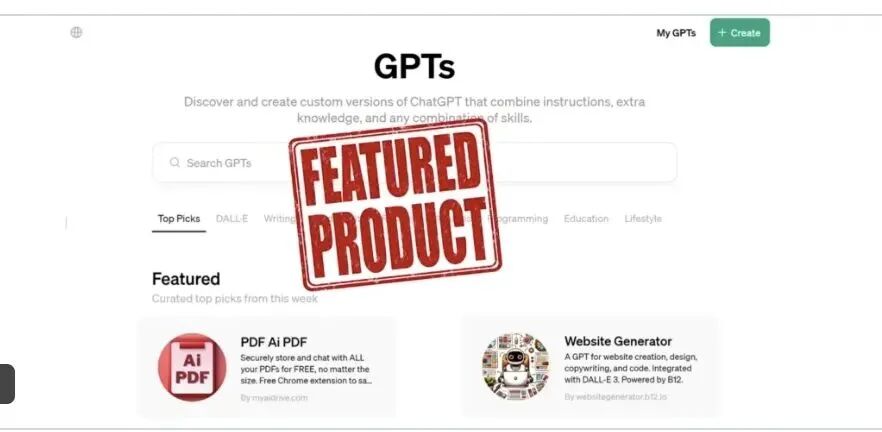
AI PDF is a tool that helps users summarize, chat with, and organize PDF files. It launched at the end of last year. In less than a year, AI PDF has grown rapidly to roughly 500,000 registered users, completed over 2 million conversations in the GPT Store, and been repeatedly featured by OpenAI.
As the founder and CEO of AI PDF, Vicente Silveira has grown accustomed to hearing his own "death countdown": when OpenAI announced that users could upload documents directly, people assumed all GPT wrapper products were finished. Yet today, AI PDF is one of the most popular AI PDF readers in the world — achieved with just a five-person team and a single funding round.
In a recent interview, Dan Shipper — also a founder building GPT wrapper products — sat down with Vicente Silveira for an in-depth conversation about how AI wrapper products survive, why small scale and specialization become strategic advantages in a company's early days, and why wrapper products won't simply get crushed by ChatGPT.
This article is republished from Founder Park. Here is the full text:
01
Taking PDF functionality to the extreme
Q: For those who don't know, you're the CEO of AI PDF. One of the largest AI PDF readers globally. Since launching at the end of last year, you've already reached roughly 500,000 registered users, completed over 2 million conversations in the GPT Store, and nearly 3,000 paying subscribers since you started charging.
What I find most interesting, especially in these early days of AI — and still now — is this notion that these AI PDF companies are just flashes in the pan. But I think you're building a really interesting business, and you're also representative of this wave of AI entrepreneurship with lean teams.
Your company reached break-even without raising much money. I know you only did one friends-and-family round, not a lot of VC. A lot of people think you can't build a good business that way, but I think especially with AI, small teams can quietly build really great businesses.
Tell us about your business and your philosophy.
Vicente Silveira: I have a "days since death" timer, tracking how long it's been since we were last declared dead, because we get pronounced dead every so often. But actually, our business keeps growing. What's funny is that when OpenAI first allowed PDF uploads in ChatGPT, a lot of people said products like ours were finished, and some of our competitors did give up. But we stuck with it.
At the very beginning, ChatGPT had just come out, and I was doing prompt injection testing on it and found some issues. I emailed Greg Brockman at OpenAI, and he replied saying it was interesting. He said I had a good background but there wasn't a suitable role right now, and to wait a few months. So I asked if I could get API access or join the new developer program — and that's where we started.
We tried a lot of ideas, but the PDF-related project took off immediately, because this was one of the first problems people wanted to solve with AI. Dealing with large numbers of PDF documents is genuinely painful, and PDF is the dominant cross-platform document format, so people naturally gravitated toward it.
Q: If ChatGPT has a PDF reader, why do people still use your product?
Vicente Silveira: When we first built this product, we didn't even have a place for users to upload PDFs — we just had them provide links, and our servers would fetch the content. A lot of people gave us Google Drive and Dropbox links, but because we were growing so fast, we got flagged as a malicious crawler. So Google and Dropbox started restricting our IP.
This created a terrible user experience because people would hit error messages. So we thought, why not let users upload files directly? At the time, we assumed nobody would actually do this. My co-founder Kartik thought it looked intimidating. But surprisingly, within a week, our domain became the #1 linked domain, surpassing Google and Dropbox.
We realized that users willing to use ChatGPT and willing to tinker with plugins were risk-taking early adopters, so we built for them.
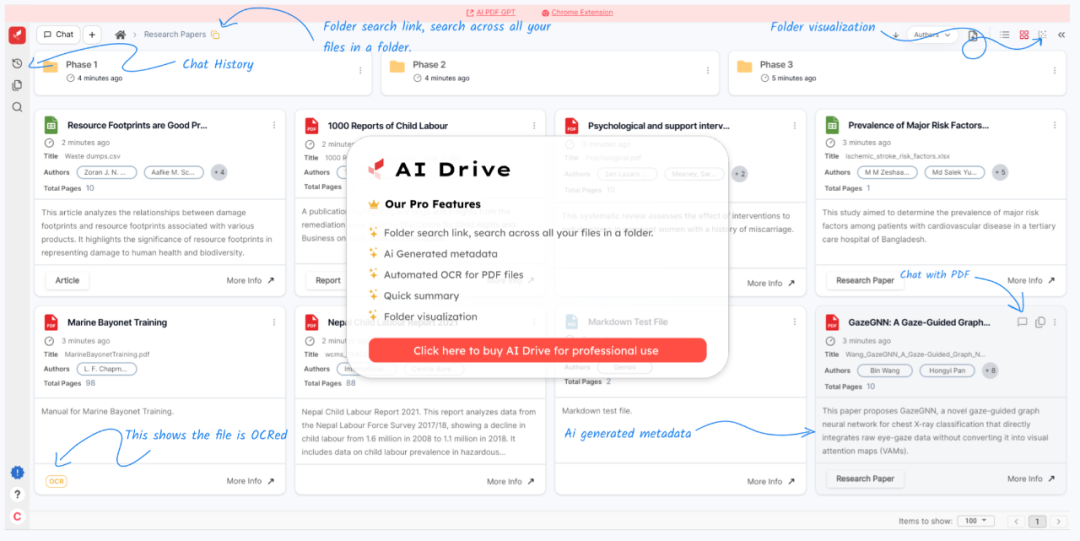
To return to your question — why do people still use our product even after ChatGPT added this feature — it's because they don't want to just upload one file and be done. They want to upload entire folders. Even now, I think ChatGPT only allows 20 files, while we have users with over 150,000 files in a single account. We support multi-level folders. No other platform supports this, but it matters because users need a low-friction experience, and respecting the folder structures they've created is part of that product experience.
Q: It sounds like users stick with your product because you're always one step ahead of ChatGPT. Why don't you think they'll eventually add multi-folder uploads too? Like NotebookLM lets you open many files. Does this worry you? Or do you have some strategic thinking about why you can go deeper than ChatGPT or Gemini?
Vicente Silveira: I think these companies, especially ChatGPT, are focused on developing artificial general intelligence and building a good enough product that many people use, so they can collect training data to feed back into their systems. I don't think they'll focus on any particular direction — mainly they want to hit minimum viable coverage across core use cases.
Think about Loom — why could Loom get acquired for nearly a billion dollars. Loom just records videos, but they did that use case exceptionally well. YouTube had the technology and didn't do it. Vimeo had the technology and didn't do it. All the major providers had the technology and didn't do it. But Loom seized that use case. For us, we've seized the use case of letting users complete end-to-end workflows with their document collections.
02
Precise enough target users
Q: As you said, ChatGPT and Claude are general-purpose tools with very broad use cases. When people use ChatGPT and Claude, they discover specific use cases they didn't know existed before.
We have a product called Spiral that automates a lot of creative work — writing headlines, brainstorming tweets, things like that. You could do this with Claude too, but Claude isn't designed specifically for it. We believe that as people use these general tools, they'll discover AI use cases and problems to solve, which creates opportunities for entrepreneurs to provide specialized solutions for specific people and specific workflows. For us, that's marketers and creators with very particular workflow needs — products designed specifically for them serve them better.
I'm curious, because a key point in my theory is that you need a specific user base to provide strong support for this kind of workflow. But it sounds like you're moving upward, toward more generality. Do you have a specific user base in mind?
Vicente Silveira: We get asked this a lot. What's interesting is that our target users are technically early adopters, risk-taking geeks, who also happen to work with large volumes of documents in their actual jobs.
All of these characteristics matter. They're not just early adopters — because many ChatGPT and Claude users are just exploring possibilities, they don't have actual work to do, they just want to understand the technology and be able to discuss it with others. Our target users aren't like that.
Our target users are geeks who have real work to do right now and large volumes of documents to process. This combination of characteristics defines our user base. Who exactly are they? Lawyers, researchers, accountants, writers... These different types of users share something in common: they all come to the platform with large volumes of documents, and they have work to complete right now — they want to get it done in new ways, AI-first ways.
Another point I want to emphasize: our angle compared to platforms like Claude or ChatGPT is different — we're essentially giving an AI Agent a cloud drive, which is quite different from simply letting an AI Agent access some files. The Agent in our AI Drive can create new files, update file metadata, browse file structures, and so on. It's actually driving this cloud drive to complete the user's work, because so much work involves processing large volumes of documents. This is significant, and it's not where other platforms are focused.
Q: Why do you think other platforms don't make this a priority?
Vicente Silveira: Because I don't think it's necessary for achieving their goals. And it introduces new problems and risks they may not want to deal with. This platform is better suited for users who enjoy exploring and tinkering. For example, with our product, I can access your chat history files on your behalf and use search tools to retrieve them. This is a controversial and risky feature that large platforms wouldn't be willing to implement.
Q: So your core users are early adopters of new technology. I think it's so cool that you treat chat content as files. Though this does appeal to a specific type of user.
03
Core product philosophy: solve real problems
Q: There are users like me — information enthusiasts across different industries, like lawyers or accountants. But your marketing doesn't seem particularly targeted in this way; it talks more about AI PDF's general features. Why is that?
Vicente Silveira: We're adjusting this because our product keeps evolving. Looking back, I often advise people to start as simply as possible. We began with just a plugin — a simple API. My servers were running on Replit. We discovered the market this way. But at that time we were just a plugin, unable to operate independently.
There was no web app, no account system, no direct relationship with users. Users had to go to ChatGPT, enable the plugin, and find us there.
It wasn't long ago, but it feels distant now. Back then we were just an add-on to ChatGPT. But we discovered that users needed a complete environment for handling AI and files, and they needed to verify file content. As you can see on the right side of AI Drive, there's the original file for reference.
More importantly, we realized that for the foreseeable future, competition among major model providers would continue — Google, Anthropic, OpenAI, and possibly X. These providers all offer unique model capabilities. I heard you mention on your podcast that you've tried Claude and other products. Users all want the latest and greatest technology. If you upload files to ChatGPT, and tomorrow Claude has a better reasoning model, you have to re-upload everything. We provide a unified platform where you can use all models.
Q: Your approach is interesting: take the first step, build a plugin, get it working, discover customers need something different from how they use ChatGPT, then build a new product. Then gradually add features.
This differs from another approach — some people start with an idea, make a deck, raise funding, build a team, and spend a year turning the vision into reality. Both approaches work, with their own trade-offs.
One trade-off I see is that your eventual product ended up quite different from where you started, so there's a constant need to adjust between public marketing and current product reality. For those who present their complete vision from the start, their problem isn't this — it's whether anyone wants the product. I'm curious how you chose this approach?
Vicente Silveira: You're right, there are different approaches, and I have founder friends who chose different paths.
First, consider what suits you. For us, this all started as a weekend project between me and my co-founder Kartik, driven purely by our passion.
Another thing is that although it feels like the AI era has arrived, we're actually still in the early stages of the AI cycle. The stability and productivity of this technology aren't yet clear. In this short time alone, we've gone through many changes. We recently spoke with a company that spent years building their own PDF extraction model. They tried GPT-4 and it completely surpassed years of their work. Microsoft published an excellent paper comparing their years-developed privacy information detection model against GPT-4 — GPT-4 won decisively. This was just the first wave of major change, and the transformation continues. When we first built, chat functionality wasn't even very good. Now chat works well, and there are multimodal chat features and more. If you look at what Sam Altman and others are doing, they say AI will become more powerful and become true agents. Applications advance while foundation models keep evolving.
By building for early adopters, we're solving real problems. This matters because they all have their own jobs. We're able to track market developments and avoid becoming like ICQ in the early internet — ultimately irrelevant. So for us, this is both strategic and defensive.
Q: Let me make sure I understand what you're saying. You take an explorer mindset, get product to market quickly. It sounds like you're saying that by serving early adopters, you can keep up with the latest technology and avoid falling behind. How do you make the connection between getting to market quickly and staying current through serving early users?
Vicente Silveira: I think early users give us more room to experiment. For example, the Agent features we've introduced into the product. Most users are accustomed to regular chat, but early users push us forward — they want Agent capabilities to accomplish more tasks.
We're working hard to collaborate with our core early users while also listening to those already moving ahead. Early adopters give us more tolerance for experimentation because features like Agents aren't fully mature yet. Sometimes they work great, sometimes they get stuck. But they genuinely want to see how this technology will develop. That's why this type of user helps us advance both core use cases and cutting-edge use cases simultaneously.
Do what big companies can't do
Q: I think this ties directly to what we've been discussing about competition: if you're a very small team, how do you compete with companies like OpenAI, Google, or Notion?
I think you're exactly right that when you're a big company, you have to serve many users, making it hard to take risks.
For a while, the feeling around AI was that AI would be smart enough to never make mistakes, and big companies could do anything startups could. I've always felt this wasn't true. Big companies always find ways to mess things up. Not because they're not smart. Just because big companies can't take risks.
I recently bought a fitness tracking app that I love. But it has an AI feature, and this AI is incredibly mediocre — it basically says nothing useful. The reason is they have to make it work for the most average user. Because they're a big company, it would be terrible if it said something risky.
But this means as a big company, the experience you can provide is in many ways inferior to what small companies can offer. Small companies can decide to serve users who don't care about imperfections, decide to explore the boundaries of what's possible.
Vicente Silveira: Yes, I completely agree. The only reason startups have opportunities to rise is because of some core weakness in incumbent enterprises. And usually that weakness is their customers. Big companies are powerful because of their large customer bases, but it's precisely because of this that they also find it hard to take risks with these customers.
For example, consider a mainstream spreadsheet product. To meet customer needs, these companies have invested enormous resources developing features and even provide dedicated training courses for users. Users use these products daily, expect a consistent experience, and also want a little AI sprinkled in — like "AI dusted on top of the product."
But to fundamentally transform this experience — making AI the core, where users no longer click buttons but tell an Agent to complete tasks — this shift is too radical for existing customers. Generally speaking, this kind of fundamental change is what big companies struggle to do.
This is why startups have opportunities — companies like yours and ours can introduce entirely new ways of working. We have an analogy: imagine how very wealthy people operate. They get complex things done through smart assistants who deeply understand their needs and handle all the complicated operations behind the scenes. We believe the future direction of AI will closely resemble this model. Of course, we're still far from this goal, but we're steadily moving closer.
Seizing this opportunity to build this kind of new experience is crucial, and it's what we're working to achieve.
Q: Completely agree. This is also something I often write and think about — people have always hired various assistants, and the problems they solve overlap significantly with what AI will be able to do in the future. Maybe AI can do new things that hiring a personal assistant can't. But there's certainly a lot of experience to draw from.
Take me — I run a media company and employ many people: editors, writers, designers. I think if you want to understand the future of media, the key isn't that creative teams will disappear, but that individual creators can from the start accomplish many things I currently need to hire people to do. I'll still have many employees, just working at a higher level. Because someone editing video might suddenly be able to edit twice as much.
I'm curious — at your business scale, you could probably raise VC funding. Why only friends-and-family funding?
Vicente Silveira: Honestly, our fundraising experience was a bit complicated. At first it felt amazing, like we were about to raise a lot of money, even considering whether to raise more. But then the process started dragging out. I felt like I was back working at Meta, spending all day revising pitch decks and meeting with VCs. Meanwhile users kept asking us for new features, and at that time it was just me and Kartik. I really hated that feeling. Since we could monetize directly, let's just do that and figure out the rest later.
Also, by then the first wave of AI investment frenzy had passed, and everyone was being cautious. From a product perspective, we were still quite dependent on OpenAI and ChatGPT then, unlike now. So for these reasons, we decided to focus on product first, and I think it was the right decision.
Q: Very interesting. Do you think you'll raise funding in the future? Or what does your growth path look like?
Vicente Silveira: Probably. Mainly we want to be careful and deliberate about when to raise, why to raise, and how to use the investment. This comes back to the question of how much human labor and software startups will need in the future. We think it's actually less than conventional wisdom from the past 5-10 years would suggest. We want to make sure we do it right and avoid what Bill Gurley described — some companies getting lazy after raising money — that's what we want to avoid.
I also want to connect this to what we discussed earlier about experience differences, and how to save costs through being lean.
Take product onboarding flow. When you sign up for our product, our onboarding is terrible. Yours is beautifully done — I tried your Spiral, I loved it. So we're thinking, okay, we need to improve onboarding. What I want to do is have AI handle user onboarding. What does this mean? Instead of using some third-party product that needs configuration, or building from scratch ourselves, we give you an AI assistant that knows our product. It knows where you came from — for example, we have a landing page specifically for lawyers, so if you came from there, you're probably a lawyer.
It would say: "Hey, here are our product features. Want to upload a file and I can demo it for you?" Just let AI do this work. We just hired someone for this — their job is literally managing this little assistant, making sure it completes its tasks. Of course, as AI gets more capable, it can do more and more. So it's an iterative mindset — we think as we hire more people, they'll manage different AI assistants within the product, and these assistants will complete specific jobs for users and for the company.
To use AI well, learn to be a manager
Q: I love this idea. I've been talking about what I call the "allocation economy." What you're describing fits this perfectly — in the allocation economy, you're not doing specific execution work, you're doing management work: managing the allocation of intelligence resources, managing various AI assistants. In this model, management skills become more important than they are now, and need to be more widely distributed. This is a fascinating idea.
I'm curious — you mentioned that smaller teams with less funding can now accomplish more than 10-15 years ago. Can you quantify this difference specifically?
Vicente Silveira: Absolutely, this change is visible everywhere. I can give an example from working at Meta. Meta certainly has money. Before generative AI, as a product manager, if you wanted to understand something about a feature — like what main issues users were encountering — you'd have to find someone on the support team. Their job was to compile this feedback into reports. This could take a day, or longer if they were busy, depending on your question's priority.
Now all of this can be done directly with AI. This is just one example of how, with today's tools, we can accomplish more efficiently what previously only big companies could do.
Q: Yes, exactly. Looking at applications we've developed internally — if someone is technically well-rounded with enough support, they can build a product that previously took a year in 2-3 months. It's genuinely remarkable. I may be a bit biased against VC, I've always been reluctant to raise funding. We raised a small amount in 2020, about $700,000, and recently a bit more, roughly $150,000. This scale is laughable in VC eyes — they'd say "what can you do with that?" But for me, we've raised under $1 million total and have developed several products and companies. I think there will be more in a year.
Speaking to the meaning of fundraising — theoretically you spend months raising money, can hire more people, invest more in growth, compress what would take a year into three months. That logic still holds, but the situation has changed. By using AI properly, you've already gained much of this acceleration effect, which is interesting. Of course, everyone else can use AI too. So to some extent, extra funding still helps, but for technical teams, funding has always been relatively accessible. I think people who truly know how to use AI are actually rarer — harder to find than capital. For many technical teams in Silicon Valley, people don't use AI much in daily work because they feel "I'm better than AI" or something. Though this is changing, people who really go deep with AI are indeed much more productive.
Vicente Silveira: For us, productivity has increased at every level. I have a software engineering background — wrote code early in my career, then moved to business and barely touched code. But with generative AI, it's like going from a bicycle to an e-bike — suddenly you can climb hills effortlessly, it's incredible.
I say I have two mentors: one is AI, the other is my co-founder. I find that even for someone like him, a world-class engineer, efficiency has improved dramatically. So regardless of your level, you can become stronger. This is genuinely true.
I think public awareness of this is still very insufficient. I really like your podcast because it helps spread this idea: AI is for everyone. If you only look at mainstream media, you'd think AI will either kill you or take your job, and the rich will get richer. What kind of message is this? What impact does this have on ordinary people? It just demotivates them, strips away their agency. The reality is exactly the opposite.
You just said people should learn to be managers — actually, as soon as you use AI, you're practicing being a manager. You just need a phone to use AI. You start delegating tasks. If AI doesn't do well, you realize your instructions weren't clear enough — this is an important part of management work. Then you improve your prompts or questions. You also check AI's output and judge whether the quality is good.
Q: Obviously, large-scale AI adoption involves many complex social and economic issues. But people often overlook how powerful it is as an immediate skill-leveling tool. For example, we have colleagues internally for whom English isn't their first language — they speak English fluently but their writing is relatively weaker, which limits their access to job opportunities, promotions, or certain tasks. But since ChatGPT emerged, the situation completely changed. They can immediately write fluent English, which opens opportunities they didn't have before, and they didn't have to do anything.
This is also what I want to show on the program — tell people some simple ways to get started, while also sharing what people at the forefront are doing, to help more people level up. Hopefully by raising the floor, we can create more economic opportunities for people. If I were 11 years old right now, I'd definitely be chatting with ChatGPT all day.
While many worry about AI companies being too aggressive in releasing products to the public, from another angle, we're fortunate to live in a world where all companies are working to make AI as cheap as possible. Imagine the alternative: if IBM had invented this technology, maybe for the first 15 years only the Department of Defense could use it — that would be terrible. I can think of many opposite scenarios, like only wealthy big companies having access to this powerful intelligence tool. If forced to choose, I prefer the current world where everyone can use it.
Vicente Silveira: You're right. Hopefully more people can see this. Because this is the first technology revolution I've witnessed firsthand. Now most people have access to it from the very beginning of the revolution, but that wasn't true before — PCs were expensive at first. I grew up in Brazil, we couldn't afford them, we had to smuggle parts and assemble Frankenstein computers. Same with mobile phones when they first came out — people couldn't get them for a long time, and connectivity was poor. But now it's different — as long as you can access the internet on your phone, you can use AI, and AI doesn't require much bandwidth.
The development trend we're seeing now is moving from simple Q&A-style conversation — where I ask a question and AI answers — to AI Agents, where I give it a task and it executes. This brings many new possibilities. We spend a lot of time now developing tools for AI Agents, which is interesting because you have to consider whether tools are easy to use, whether they behave as expected, and so on. Some people say when AI can do everything, there'll be nothing left to do. But using the wealthy person analogy — even if you're rich enough to hire many people to start a company, most of the time it still won't succeed, because you need leadership, talent, vision, and perseverance to organize these people and make the company truly successful. I think AI Agents are the same.
Q: There's a strange misconception that with AI Agents you don't have to think anymore. But have you managed people? Humans are general intelligence themselves, but managing people is hard too. It's certainly a different experience from doing things yourself, but even when others help you, you have to learn how to delegate tasks.
New managers all face this problem: how much should I delegate? Should I micromanage? If I micromanage, things will get done exactly how I want, but then I've lost the point of managing — I might as well do it myself. If I delegate, I have more time for other things or to think at a higher level, but the results may not meet expectations. This is exactly what many people complain about with AI now: "It doesn't do well, I could do it faster myself." This is identical to the problem managers face.
Even in a world with super capable AI Agents, there's still a lot of invisible work to do — defining task scope, choosing appropriate resources, having taste and vision to know what you want. Maybe eventually AI can do these too, but until then, in the process of using AI Agents, a lot of human skill and talent is still needed to guide them.
Recommended Reading