Guizang: From Prompt to Harness, Context Is Everything
A UI Designer and His 300,000 Lines of Code
When we launched Token Grant, what we wanted to support was a new generation of founders and creators emerging in the AI era.
Guicang is emblematic of this group.
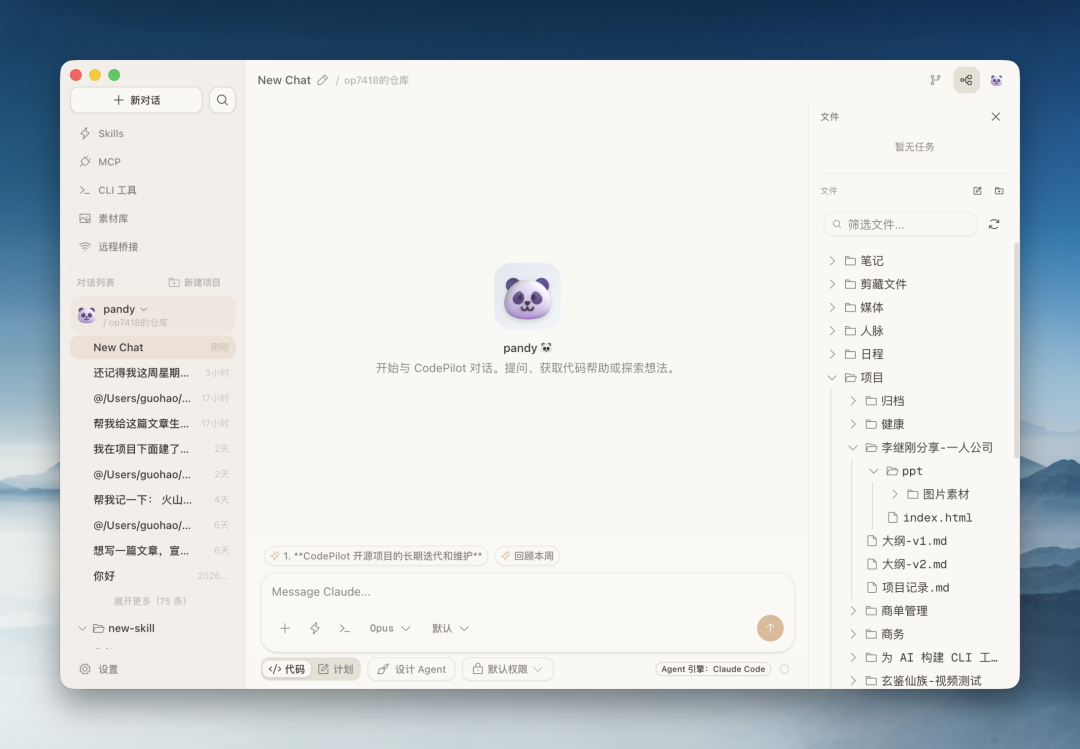
He was originally a UI/UX designer who started writing god-tier prompts from the moment ChatGPT launched — some say he practically "kept half the AI content creator economy afloat." In recent months, he began vibe coding and built CodePilot. What started as "just a UI for Claude's command line" evolved into an experimental playground for Harness, context, and AI Native product forms.
What truly drives all of this isn't programming ability in the traditional sense. It's understanding problems, product judgment, and the sustained ability to mobilize AI to complete complex tasks. He packed ten years of experience into skill.
Token Grant exists to support people standing at the edge of this shift.
We hope it becomes thrust at your starting line: if you're already building new tools, products, or organizations with AI, you don't need to wait until everything is ready.
Build first. Ship first. Let users find you. Let the world give you feedback.
Then let the future grow itself.
Koji, Partner at ZhenFund

From Prompt to Harness
Q: Introduce yourself and what you're working on now.
Guicang: I used to be a UI/UX designer. In recent months I started vibe coding and built a product called CodePilot.
Q: What's the biggest change Harness Engineering has brought? As someone who's exceptionally good at writing prompts, do you still have an advantage?
Guicang: The core of a prompt isn't the prompt itself — it's the entire problem-solving approach and mindset embedded within it.
If you're genuinely good at writing prompts, Harness will actually raise your ceiling significantly. Before, you could only plan tasks within extremely limited context and length. Now you have a full toolkit: memory, skill, CLI, MCP.
Your code, images, even prompts in different modalities can all be woven into an integrated workflow. Your prompts become longer, more generalizable, and higher-ceiling.
Q: After that ceiling rises, what becomes the most important ability?
Guicang: First, initiative. Second, learning ability. Third, taste.
It's not necessarily one specific kind of taste. It's your unique experience in your current industry — the aesthetic and judgment accumulated from years of learning, working, and content consumption, embedded in your body.
Everyone's context is different.
Q: What prompted you to apply for Token Grant? Was there a particular moment in the process that stood out?
Guicang: Haixin (experimental filmmaker, AIGC artist) sent me a form. I clicked in and thought: "Wow, this is good."
I was curious about ZhenFund's philosophy on funding agents, so I filled out the application.
What struck me most was how streamlined the whole process was. That represented a kind of trust and respect. I dread complex processes and constraints, but there was none of that this time. So I've been aggressively recommending Token Grant to developer friends lately.

Token Is Raw Material for the Virtual World
Q: What was the first thing you did after receiving Token Grant?
Guicang: Bought tokens. Then bought two more accounts.
Q: What is Token, to you?
Guicang: Token is the raw material for a 3D printer in the virtual world. The most common material for 3D printing is PLA. It's universal, but what gets printed from it is always different.
Q: How many tokens did you spend today?
Guicang: I've been busy with physical world stuff since I woke up. My highest month was 76 million tokens. A lot of people talk about the "100 million token club," but I found my output is high while my token consumption isn't particularly large. Many people consume a lot because they use tokens concurrently — running multiple worktrees or agent teams. I can't handle that. I can't review it all.
Q: When was the last time you felt "this token was especially well spent"?
Guicang: All my energy right now is going into maintaining one project.
Its overall token consumption isn't that dramatic, but the output is terrifying. I pulled the data: the project has accumulated over 300,000 lines of code written, and after all the back-and-forth deletions, 110,000 lines remain in the project.
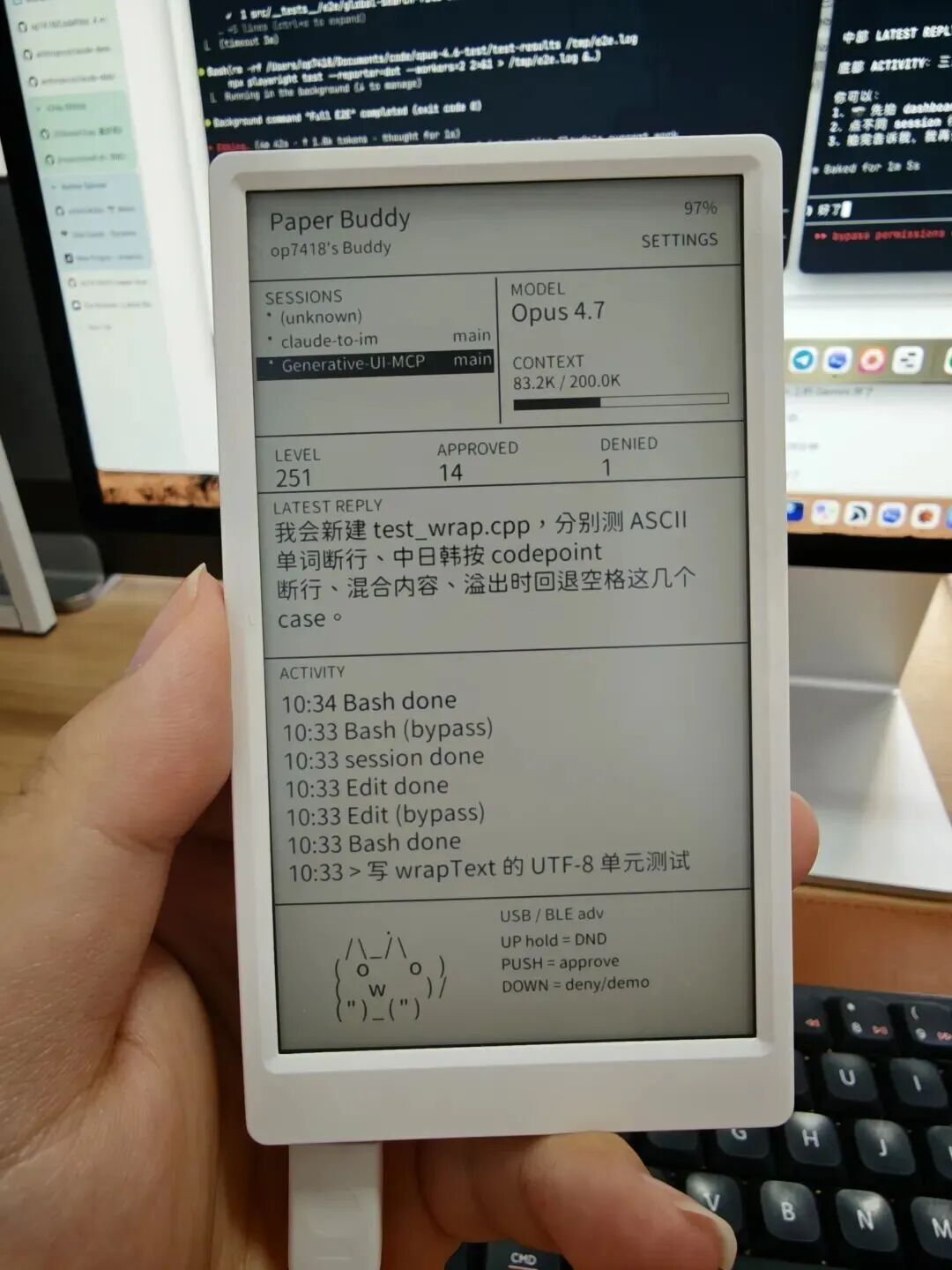
Another one is Claude Buddy, which I've been playing with recently. I wrote a hardware firmware for it — an e-ink screen. I discovered for the first time that the cost of building AI hardware has dropped to this level.
Another particularly important thing is product thinking.
I plugged it into my Mac via USB and told Claude Code: "Here's an official project, but my device is different. I'm using this device now, help me modify it." In an hour, it produced a complete firmware for me.
It's not ordinary software — it's a complete system. The entire device serves only this one purpose.
This affected me deeply. Before, I didn't want to touch hardware at all. I'd learned about breadboards and Arduino in school, and the process was excruciating because the code logic is completely different from normal development. Now I don't care — just throw it at the problem and it's done.
After finishing this, I bought a bunch of other hardware to keep experimenting.
Q: If you had unlimited tokens one day, what would you do?
Guicang: What's limiting me now isn't tokens — it's myself.
Tokens are already接近无限 for me, because I can't consume them all. Within a limited 24 hours, I still need to eat, sleep, maintain normal life.
But token quality can improve.
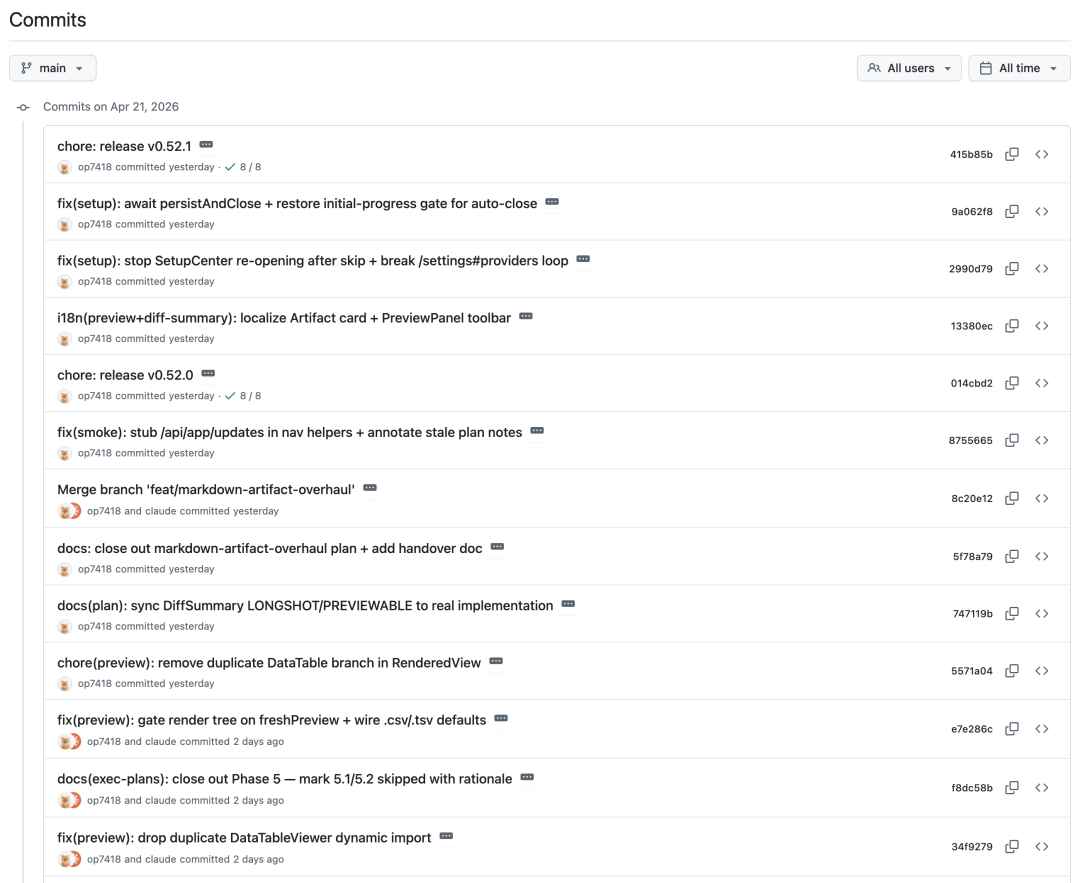
I ran a statistic earlier: I have hundreds of commits by now, and 47% of them are fixes.
So the core issue isn't token quantity — it's how much problem-solving per unit of token. Right now 47% of commits are fixing bugs. If in the future that drops to 20%, the remaining 27% becomes feature additions, letting me build more things.
Q: What does a day in your life look like now?
Guicang: My life now breaks into several parts.
First thing in the morning is development, writing CodePilot. Every night before bed, I set scheduled tasks for Codex and Claude Code to start working from 5 a.m. When I wake up, I can directly get a version to test and review.
Second is content and information consumption. My skills automatically crawl newsletters, websites, and emails I regularly read, combine with my calendar for reminders, and generate reports. I also browse X myself.
Then content publishing. Short content I usually voice-input directly, since it comes with polish. Longer content I delegate to AI. I have an entire content production pipeline that runs automatically. I only need to complete the first step: setting the tone and context.
I'm in this loop all day.
Many people think doing all this means no sleep, but I sleep normally — usually in bed by 1 a.m., and I go to the gym in the afternoon. Normal life is still maintained. AI frees up a lot of time, but simultaneously you end up doing more.

One Hour, First Version of the Product
Q: What was the specific moment you realized you needed to build CodePilot?
Guicang: I've told this story to many people.
The original folder name for my current project was "Opus 4.6 test."
I always felt Claude's command line had an annoying problem: you can't see chat history. But chat history is important assets. Though you can pull it up, the process is convoluted and unpleasant to look at. So I thought: I'll just build a UI for it.
Right around then Opus 4.6 dropped, and I wanted to test it with something particularly large, particularly difficult, but requiring stability. It produced the first version in an hour, and that first version was already very usable.
Later I just shipped it. After releasing it, many people said they desperately needed this. I packaged it simply and sent it out. As people used it, they became your users, and you can't not keep going. People file issues on GitHub, submit PRs, and you get pushed forward by your users.
As you get swept along, you yourself start wanting to do more.
My own thinking is to treat it as an experimental field for Harness. Because building Harness isn't just exposing some capabilities. The deeper you research, the more you discover: context control is the core of everything.
Q: How do you understand Harness now?
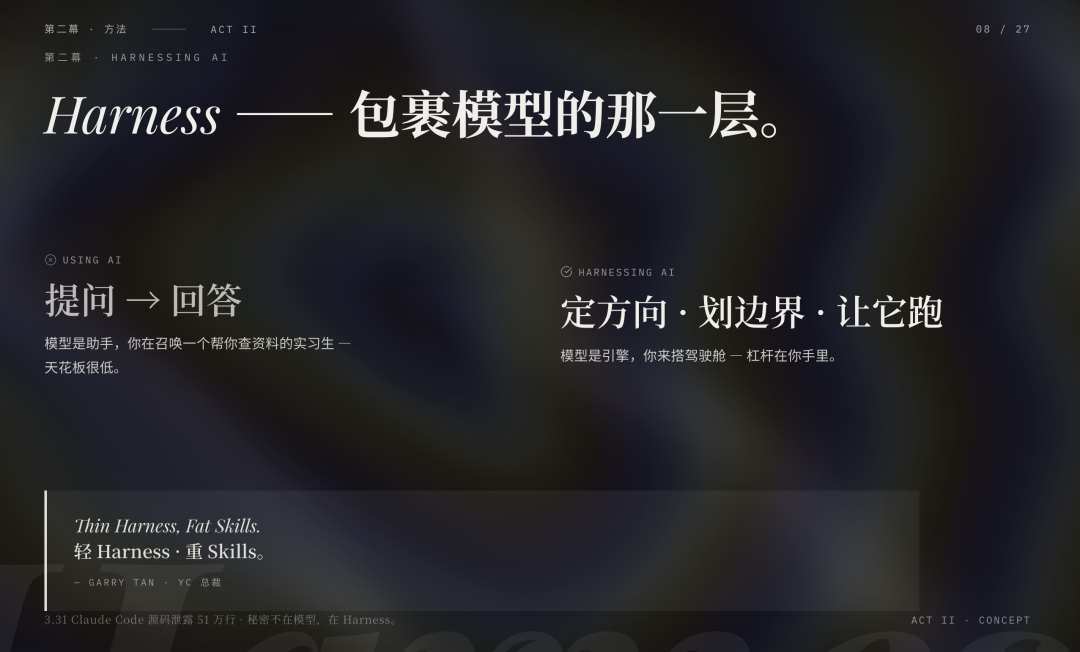
Guicang: I think it's the entire agent system itself. This definition has already been infinitely generalized, just like AGI.
Everything we think of today — prompts, skills, MCP, CRM — these are all parts of Harness. They ultimately converge into context, then pass to the model.
It's essentially an integrated process. If you look outward from the model, the first layer is context: the organization and management of context. Beyond that are various components: tool calling, function calls, MCP, scale, CRM, memory... all of these belong to Harness.
In a sense, everything outside the model counts as Harness.
For most people, as long as you're willing to spend money, buying Max for 200 RMB a month already brings tokens close to unlimited.
Q: What have you felt during the iteration process?
Guicang: I've gradually iterated out my own method.
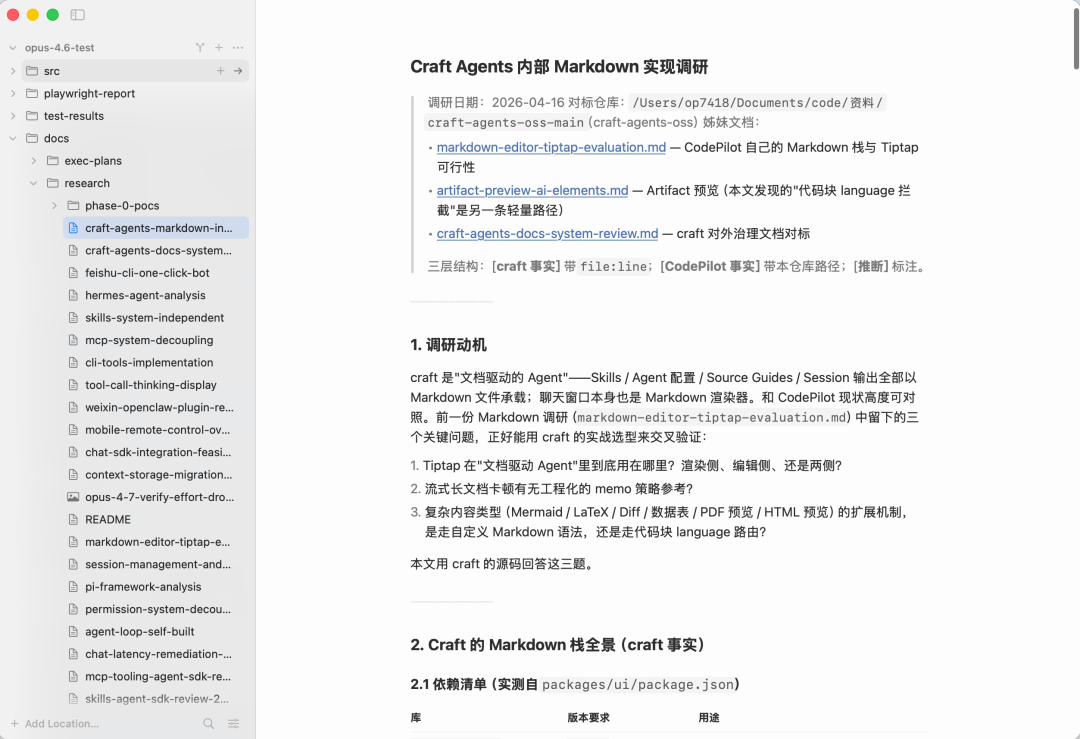
Because I hadn't used vibe coding to write a project this large before, the entire development process has now become documentation-driven. Everything is documents; the entire Harness is accomplished through documents.
There are three core documents: Claude Code documentation, directory routing documentation, and guardrail files.
Claude Code documentation is essentially the AI's constitution: what absolutely must not be done, what absolutely must be done.
Directory documentation contains the entry points and structure of all documents in the entire project.
Guardrail files protect two things: context, and interfaces. I'm a multi-provider platform that connects to various code plans. Once this breaks, users' entire software becomes unusable — this is a P0-level issue. Other bugs aren't even bugs.
I basically don't use the built-in planning mode in code anymore — I find it weak. I spend about 70% of my time on research. I constantly discuss technical solutions with AI, repeatedly review planning documents, then have it execute according to the documents. The more detailed your planning, the lower the probability of problems later.
This way it can complete tasks continuously over long periods.
Split a task into 10 passes, and it can finish them all in one night, automatically calling MCP, running tests, doing smoke tests.
Another particularly important thing is product thinking.
Because what you're building isn't for machines — it's for people. Vibe coding ultimately produces products, not just code. You have to constantly think: what does this feature mean for users? How should it be designed at the product level? How will it evolve in the future?
There are many things AI doesn't know.
First, it doesn't understand users' real runtime environments. AI defaults to a world where only macOS exists. If you build multi-endpoint products, it will inevitably forget Windows.
Second, it lacks domain-specific knowledge. For unseen, outdated factual information, it's extremely prone to errors. Like thinking Anthropic only updated to Opus 4.0 when it's actually at 4.7.
The scariest thing isn't that it doesn't know — it's that it thinks it knows, but what it knows is outdated. And outdated information is, essentially, wrong information.
The last issue is decision-making. AI doesn't know what's good, and doesn't know what you truly want. After long-term磨合, through memory and documents, it gradually develops a sense of your preferences. But when encountering something completely new, something you've never made a decision about before, it's still lost.
Q: How do you help it judge what's good and what's not?
Guicang: I judge myself. It just needs to give me sufficient information.
I actually don't write code myself — not a single line. To this day I haven't touched a single line of code in the entire software. I don't understand code either, beyond some HTML and CSS, and now I don't even need to touch those.
When I encounter something I don't understand, it explains it to me. If I understand, I make the judgment myself.
Q: Whether writing prompts before or writing code with AI now, an important component is research —沉淀ing knowledge.
Guicang: When I shared externally before, people often asked me what's most important. The sentence I said most frequently was: context is everything.
For users, you need to prepare sufficiently precise, sufficiently rich context for the agent; for developers, the core component in your agent is also context.
Context is everything.

No Upper Limit on What One Person Can Do
Q: What should an ideal AI Native product look like?
Guicang: I attended a meeting yesterday where everyone kept discussing product. But later I felt there's something more important than product itself: organization.
I hadn't realized this before because I've always worked solo. But later I discovered that when an organization itself is AI Native, what it produces naturally becomes AI Native product.
Looking at organization is sometimes more precise than looking at product.
Because the word "product" has already been generalized. Take Notion — it definitely wasn't designed as AI Native from the start, but now it's adding AI almost everywhere. Loosely speaking, it counts as AI Native; strictly speaking, it doesn't.
But if a company itself is AI Native, even if its product has nothing to do with AI, contains no AI features whatsoever, I still think it counts as AI Native.
Q: What will be the biggest organizational challenge for OPC?
Guicang: The biggest challenge remains contact with the physical world.
As a company, as a legal entity, as a natural person, you always need to interact with this world, to build trust. Corporate finance and tax, identity verification — these are actually the core challenges, and parts that AI can't solve in the short term.
But I think today, there's no longer an upper limit on what one person can accomplish.
Like me: one person writing hundreds of thousands of lines of code in 70 days, while also as a content creator independently updating 9 platforms, all with sustained updates. This was completely impossible before.
Now tokens are接近无限 for us. But when productivity rises, what truly matters changes.

Q: If CodePilot could only keep one feature, what would it be?
Guicang: Chat input box, plus a voice button.
Q: Why?
Guicang: Because agent products can ultimately all be stripped down to this. It's the most natural form. This is how I work myself.
Everything comes from context, and ultimately returns to the chat box.
AI can perceive all context; theoretically everything in the product it can perceive. As long as it can perceive, it can modify itself, iterate itself, self-upgrade.
When it breaks, it can even fix itself.
Q: What do you wish AI could do that it currently can't?
Guicang: Our internet infrastructure is limiting AI.
Even Vercel, which counts as one of the simplest tools, still has many complex parts inside. Server configuration remains cumbersome. And it's not AI Native itself.
What we truly need is AI Native infrastructure.
I shared a line before: AI's capability equals the tools you provide it.
Q: What changes do you expect in yourself a year from now?
Guicang: I hope AI can do more things for me, giving me more time to do offline things.
I think AI will definitely shift toward the physical world at scale within these two years.
I wrote an article during New Year. At the time many people felt the form of AI changing the physical world would be robots. But I've always believed that cars will be the first to truly落地 AI.
Because cars already have batteries, wheels, faster movement speed than robots — can go wherever they want.
Many electric vehicles are already like physical carriers for AI. They're multi-card concurrent networks, as stable as super Wi-Fi. They have large batteries, space, screens inside that can directly serve as secondary displays.
Now OPCs are increasing, and entire organizational forms are slowly disintegrating. If this combines further with AI and new ways of working, I think the future imaginative space here is particularly large.
Another thing that shocked me was hardware.
After building the e-ink device to replace Claude Buddy, I discovered China's hardware ecosystem is incredibly powerful. One device costs only 500 RMB; there's a smaller one at 200 RMB with microphone, full keyboard, Bluetooth, Wi-Fi, sound, camera, and it can run Linux itself.
You could completely install an agent inside, hang it on your backpack, and have it interact with your phone in real-time.
These things anyone can do now. 200 RMB, plug in a USB cable and start.
Most of the technology is already in place. Many things will happen faster than people imagine.

Intelligence Took Another Step Forward
Q: What release left the deepest impression on you?
Guicang: Still ChatGPT.
If you've followed closely enough, everything afterward was somewhat expected. But GPT came completely without expectation — the shock was greatest.
Next was Sora, then NanoBanana. Anything that makes me feel "intelligence" itself is improving particularly震撼s me.
I think what's truly important isn't aesthetics — it's intelligence itself. It took another step forward.
Q: Do you remember your first interaction with NanoBanana?
Guicang: The first time I had NanoBanana process some information requiring reasoning, and watched it display the layout on an image, I was extremely surprised. In that moment I realized our entire multimodal new era was coming.
Q: What's been most unexpected about CodePilot?
Guicang: My fitness coach left a deep impression.
Every time I rest between sets I chat with him, including about AI. He always called himself a "computer idiot" — couldn't even copy-paste properly, couldn't distinguish macOS from Windows.
But one day after training, I casually installed CodePilot for him.
Two days later he came back extremely excited, telling me he'd built something he'd always wanted to make.
He's been in this industry ten years, never took a day off, but during that period he took annual leave every day.
In just one month, he went from complete beginner to rapidly completing many foundational abilities that normally take computer science majors four years to accumulate. Later when I discussed things with him, he could follow along. He built many skills himself, even developed a software.
Q: What do you think is the threshold for shipping a product?
Guicang: There's a lot of product-building methodology sharing on X now.
From the moment you conceive the first version, even before writing the first line of code, you should ship it.
The moment the thought arises, you should post it first, then iterate continuously, continuously gather feedback.
Don't worry about no one seeing it — your users will find you themselves. By the time your first version actually launches, you may have already accumulated a user base.
The most important thing is avoiding perfectionism.
Especially designers — our group is naturally particularly concerned with quality, particularly wanting to refine and polish. I'm not saying perfectionism is wrong, but in the AI era of building products, rapid iteration and rapid exposure are extremely important.
Q: One sentence for developers still applying to Token Grant?
Guicang: Context is everything.