From Sierra to Jekka: The Boundaries of AI, Large-Scale Practice, and the Endgame

In the future, experimentation itself and time will be the anchors of social value distribution.
In China, few people seriously discuss "customer service." But if we want to accurately understand the boundaries of AI — especially its ability to communicate with humans — customer service is precisely a critical entry point. This also explains why Silicon Valley places such heavy emphasis on it: companies like Sierra and Decagon have made it their core focus. If readers can't shed their ingrained biases around the term "customer service," they can skip this interview.
About Jekka AI: The Jekka team hails from MSRA, Amazon, Google, Alibaba, and other leading companies, with substantial accumulated expertise in artificial intelligence. The company provides AI products with 80%+ independent resolution rates and 99%+ accuracy, serving millions of text and voice interactions daily and consuming hundreds of millions of tokens per day. In terms of both the number and scale of B2B clients served, it ranks among the best AI implementation companies worldwide. Jekka currently operates across the US, Singapore, Hong Kong, and mainland China. It is the first official model provider for TikTok and Youzan, and provides AI Agent services to numerous Fortune 500 companies both domestically and abroad, covering leading enterprises in e-commerce, logistics, unmanned economy, and other sectors.
Aaron, Co-founder of Jekka AI
Where are the boundaries of AI?
It's not just about AI winning Olympiad gold medals, conducting independent research, or viral demos that break the internet again and again. Demos only show the ceiling — a kind of idealized cleverness. What truly determines whether AI is "reliable" isn't its occasional peaks, but its stability and variance control in the worst-case scenarios.
Jekka has been constantly rebuilding its understanding of human boundaries, service, and intelligence. Founder Aaron says: "Large models are the hardest thing I've encountered in over a decade of entrepreneurship. Nothing else comes close."
Jekka's biggest difference from other AI companies lies precisely in its understanding of AI. Ninety-nine percent of this market is泡沫, and that泡沫 is often built on false premises — such as excessive faith in Scaling Laws, or the belief that "intelligence matters more than reliability."
He'd rather forget those still-fuzzy concepts, like AGI, and instead work bottom-up, understanding AI's boundaries through one test result after another. Ninety percent of Jekka's team is building test sets, testing processes, and testing tools. Even an intern's independent project can trigger new nodes that give the model stronger generalist capabilities. This is a story truly driven by curiosity.
The AI era is already different; we need to rethink customer service. The essence of customer service is serving human needs. As long as we're working, we're serving someone — from simple information delivery to becoming part of the product, the process, and the outcome. So "customer service is the starting point of AI, and will also be its endpoint."
AI itself needs to be defined. In Aaron's view, AI should be reliable, correctable, memorable, and capable of learning — able to do everything your colleague can do.
People are the most expensive, and also the cheapest. A single phone call might be worth $30, or it might cost nothing more than a steamed bun for a morning's conversation.
The most precious thing in the future won't be intelligence or labor, but that one attempt driven by your curiosity.
AI ≠ Human: Humans Are White Boxes, AI Is a Black Box
Q: Could you briefly introduce yourself and what you're currently working on?
Aaron: I'm the co-founder of Jekka AI. We provide human-level AI Agents and underlying models for Fortune 500 companies and tens of thousands of SMBs. "The capability to have an underlying model that delivers human-level AI" is our biggest difference from other Agent companies, including in communication ability and independent problem-solving.
Q: What prompted you to found Jekka?
Aaron: There were two important moments.
The first was the decision to work on AI. When I saw the GPT-3 demo, I knew I wanted to do this. I've always felt that entrepreneurship is fundamentally an expression of a person's curiosity: you're curious about the world, discover things no one has done yet, and want to research them yourself and make them happen.
The second key节点 was around the GPT-4 launch. At that time, the internet was flooded with demos of "what GPT-4 can do," all looking incredibly impressive — but when you actually tried them, the results often fell short of expectations. That gap frustrated me, and I couldn't help but want to try building it myself. I couldn't help wanting to deeply understand the principles, so naturally I chose to go deeper into the底层.
Q: You mentioned that Jekka recognized AI's potential very early on. Can you share a personally memorable moment of interacting with AI?
Aaron: We were shocked by the original ChatGPT not because it could write poetry or code, but because of its communication ability. For the first time, I felt a non-human presence that could communicate with us in human ways. That moment was profoundly震撼, and we must constantly remind ourselves: when we talk about AI, are we describing a broad concept, or that touching point that moves people?
Q: In developing Jekka, what "wow moments" have you experienced?
Aaron: Wow moments actually run through the entire process. AI is fundamentally something entirely new — from generating beautiful images, answering interesting questions, to even solving problems that humans themselves can't answer. All of these are delightful surprises.
But personally, my most wow moment was the重新理解 of human boundaries and self-boundaries. For instance, I once heard composer Chen Qigang and Dou Wentao discussing "whether AI can replicate humans." Chen Qigang said, "AI has no soul, it cannot replicate humans, the human soul cannot be captured." At the time I thought he was too dogmatic.
But later, while debugging Jekka, I curiously asked it to explain this view from Chen Qigang's perspective. It replied: "If I were Chen Qigang, I wouldn't believe AI could replace humans either." I found this神奇 and pressed further: "Why do you think that?"
Jekka told me: "Because AI cannot experience."
That moment made me realize that AI is no longer merely a tool-like, predictable existence. In some sense, it can be independently understood, respected, and even regarded as an individual worth engaging with.
Q: From initial Q&A to today's experience closer to "mutual understanding," how did Jekka build this "most human-like" AI对话能力?
Aaron: First, we can't understand AI purely as a tool. To build human-like AI, we must first answer "what is human." Humans aren't fully rational; they're a mixture of rationality and irrationality, with instincts, emotions, and patterns of language and thought.
In designing Jekka, we had to construct not just technology and functionality, but also imbue it with certain "human traits" — emotions, curiosity, modes of expression. It's this understanding that enables human-AI communication to truly differ from ordinary software.
Looking back, if we really want to create highly human-like AI, we need a cross-disciplinary team: solid STEM and programming capabilities, alongside deep exploration of human thinking, language, and the structure of human nature.
Q: How does Jekka specifically define and implement this exploration of thinking, language, and human nature?
Aaron: We have to step back and define AI first. I feel AI still lacks a unified standard today. Many consider machine learning to be AI, ChatGPT is called AI, and even the earlier BERT model was referred to as AI.
Everyone's understanding of AI differs throughout this process. For example, Ilya Sutskever (former Chief Scientist at OpenAI) said that being able to predict the next token equals being able to predict human thought. This is one definition of AI's essence. But with everyone defining AI differently, the AI products they create naturally differ as well.
In building Jekka, I tend to define AI as a form of language. This isn't a diminishment — because I believe language itself is one of humanity's great inventions throughout history. If a truly cross-species language existed, like in the Tower of Babel story, even God couldn't tolerate it.
In my view, AI is not only a cross-species mode of expression, but also a language that transcends entities. It can use human language to express the emotions of anything, even describe relationships between two objects. Once you have a definition, you naturally have boundaries. Within these boundaries, you'll discover that because AI transcends entities, it can neither be called "human" nor "non-human" — it's more like an existence between human and non-human.
If we want non-human and human to communicate, we must bridge the gap. In closing that gap, we need to understand human patterns of thinking, purpose, and emotions in appropriate contexts, then integrate these elements. Of course this is a technical problem, but if we can think at this level, it becomes easier to know what AI should do.
Q: At the model level, how does Jekka address the hallucination problem?
Aaron: When I first started the company, I gradually understood this problem through hands-on work. Initially seeing GPT-3, I didn't know its boundaries either — I just felt it seemed to already have human capabilities. After starting to build, within about a month of writing prompts and doing basic coding ourselves, we discovered that AI-human communication felt different, and this involved what people call hallucinations.
I was thinking: what is hallucination? Because both then and now, when people mention hallucinations, they often conflate it with "error." When AI answers incorrectly, we call it hallucination. But when humans make mistakes in communication, why isn't it called hallucination? Or why doesn't it cause the same pain? I feel that fundamentally, hallucination and error are two different things.
When humans do things, it's a "white box" process: observe first, then think about the essence of the problem, then reason, and finally reach a conclusion. Even if the conclusion is wrong, it doesn't matter — because you can ask "why did you think this" or "why was it wrong." After the other person explains, you can explore together, guard against or reflect on principles and facts, making errors easy to correct and communication smooth.
By contrast, the core thinking process of AI is fundamentally a "black box" — a string of numbers. The prompt functions as AI's eyes or ears: we describe the situation to it, and after a series of numerical computations, it produces a conclusion. If the conclusion is wrong, you can Google it or verify it, but you can't debug it the way you would a program — you can't identify which parameter went wrong, or which set of parameters, nor can you predict whether a fix might trigger new errors in other scenarios.
Once we understood this, we realized we couldn't rely on AI alone to solve the hallucination problem. We needed a "human-like" thinking model combined with AI to truly address it. This is the neural network-inspired control structure that Jekka developed in-house — organically integrating AI's generalization capabilities with the white-box process of human reasoning to serve our customers.
For enterprise services, this is critical, because you can't tell a company, "This thing might fail in the dumbest possible way." You must be able to strictly follow corporate SOPs and achieve 100% accuracy. Beyond Jekka, I haven't seen any better implementations yet.
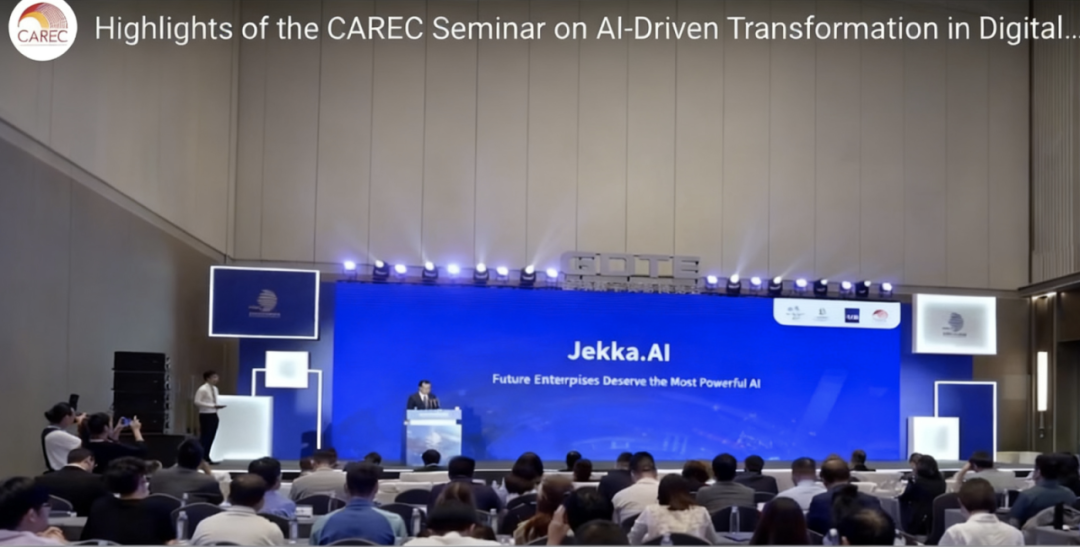
Jekka delivering a keynote at the Asian Development Bank Forum
Q: What do you think AI will be able to do in enterprise services and broader fields over the next 18 months that it can't do now?
Aaron: I think we've already achieved, to a considerable degree, enterprise-grade AI that meets corporate standards: fully following SOPs, solving over 80% of problems. These are outcomes built from hundreds of thousands or even millions of daily conversations and phone interactions.
What we can do next month — I can roughly say. What things will look like in three to five years — I can judge that too. But 18 months is an especially difficult interval to estimate.
However, one thing I can say with certainty: I know what AI can never do. For example, Ilya's claim that "predicting the next token equals predicting human thought." My definition of what AI cannot achieve is this: AI can never accurately predict the next token.
It can predict, but it cannot predict accurately. Building AI based on this understanding might save us from many detours.

From Sierra to Jekka
Q: Speaking of customer service, how do you view Sierra and Bret Taylor's argument that "the best enterprises will benefit most from this AI revolution"?
Aaron: I deeply admire Bret Taylor. In the OpenAI ecosystem, where information is most abundant, this technically-minded founder chose to build something that sounds unsexy: Sierra. Yet during a period of widespread decline in AI agent usage, Sierra is one of the few products still growing. He must have seen something.
I very much agree with his view. Bret's approach to serving large enterprises comes from first principles: the bigger the company, the greater the customer service volume. From a service perspective, limited resources should be directed toward larger clients.
From my perspective, even the best companies' customers remain underserved today. For example, when I pay for a bank's phone customer service, am I buying customer service? No — I'm buying the service itself. An interesting example: one of our unmanned-economy clients needs Jekka to handle the final user interaction, completing the last-mile delivery of their product. You can't have an unmanned vehicle for everything and then still have someone in an office making the final call, right?
Q: Sierra doesn't serve SMB customers. What's your take?
Aaron: Companies like Sierra can't do the SMB market not because they aren't smart, but because they can't deliver generalizable, reliable AI services. They're more like the Accenture of the AI era. It may not sound flattering, but that's the essence of their business model — an AI consultancy in a larger TAM space.
We believe the true value of next-generation AI lies in enabling every enterprise, every individual, to receive the service they deserve. Our technology can serve Fortune 500 companies and also a small business processing 100 orders a day. Of course, the go-to-market strategy behind that is a separate matter.
Q: What background initially caught your attention, making you feel there was an opportunity for Jekka's enterprise-grade service to emerge?
Aaron: We typically understand AI through two dimensions. One is AI's level of intelligence — OpenAI is clearly trying to push AI toward PhD-level capabilities to solve complex research-grade problems. The other is AI's degree of generalization: how much it can help you with in daily life, how broad its coverage of use cases.
We're also seeing many people try to push in this direction using AGI or agentic frameworks. I deeply admire these explorations, but honestly, both paths are extremely difficult. They are fundamentally research problems requiring simultaneous breakthroughs in science and engineering to truly expand boundaries.
However, people easily overlook a critical point: AI that isn't that "smart" and isn't that good at calling external tools, but can be sufficiently reliable — that's the origin point of enterprise applications. For example, if an AI can't even accurately answer "how many r's are in strawberry," or is still debating whether 9.1 or 9.8 is larger, yet is called a major breakthrough — that's not reliable AI. The hardest problems often hide in the simplest forms of expression.
From a technical perspective, if an AI can't even handle customer service problems well, it can't be AGI. Customer service was the first intuitive application people tried when ChatGPT came out. Because while it's simple and generalizable, it's extremely demanding on reliability. If it can't follow the most basic SOPs yet claims to reach PhD level, solve ACM problems, and win gold medals — that's somewhat unrealistic. Perhaps we can infer how far OpenAI is from AGI by observing Sierra's development.
Q: Looking at the present, what counts as reliable AI? Is it the SOP execution you just mentioned, or are there other criteria?
Aaron: I think first we need to understand how people work. For enterprises, "reliability" is the most important standard. When companies hire someone, the first requirement is "is this person reliable?" This assessment typically comes from two aspects:
First, they need basic general knowledge and common sense, with some reasoning ability. They may not be exceptionally strong, but at minimum they can understand what's being said and read situations correctly. Most basically educated people can reach this level. This part is somewhat subjective and requires us to first establish appropriate datasets covering common-sense questions.
Second, they must be able to work under the company's SOPs. Take car sales as an example: selling Li Auto and selling AITO involve completely different SOPs — one emphasizes experience, the other emphasizes mechanical performance. These aren't things you learn beforehand; they're "second training" after joining the company. A reliable person is essentially the combination of "general knowledge + SOP execution."
This is also what we focus on most when defining AI. If an AI can execute SOPs 100% of the time, it's already tremendously valuable in customer service, sales, and similar scenarios. SOP execution is quantifiable: not executing is 0, executing is 1. Our effort is directed at the process of getting AI to 100%.
Q: In reality, getting a person to execute SOPs isn't easy. When Jekka communicates with customers, how do you ensure it accurately identifies information and correctly executes requirements?
Aaron: This tests your understanding and definition of AI. We acknowledged from the start that AI is not like humans, which actually makes it easier to see both the advantages and limitations of its "non-human-ness."
For AI, its contextual processing ability far exceeds humans', so long SOPs aren't a problem. But issues typically arise in two areas:
First, how does it recognize and understand contradictions within SOPs? Because no matter how comprehensive, SOPs always have gaps and conflicts. Second, how does it handle conflicts between SOPs and human common sense? This is the harder part.
For example, a recent college graduate might solve problems that SOPs don't cover using common sense. But if AI lacks this ability, it's prone to errors. So in training, we focus heavily on how to identify these conflicts and give the model "white-box debugging" capability.
So-called white-box debugging means that when AI makes an error, we can quickly trace the root cause and promptly adjust the model's understanding. This process is both about discovering problems and about continuously digging deeper and rapidly debugging. This is precisely what enables AI to expand its capabilities quickly.
Q: Jekka's application scenarios extend far beyond customer service — it's more like talking to a person. How do you continuously optimize the experience so that customers feel pleased by the conversation itself?
Aaron: I've always felt that the boundary problem of AI itself is an extremely complex topic. The "how can AI have empathy or compassion" question I mentioned earlier — it fundamentally can't truly achieve this. We've also seen many ToC products try to have AI play a role, like a compassionate professional persona, then solve problems through preset configurations. But from our experience, relying solely on this approach tends to be rather one-dimensional and doesn't truly solve the problem.
So we use two frameworks to address this:
The first leans more toward rational, convergent logic. Conversations ultimately need to solve the user's problem; they must have a purpose, and this purpose should align with the user's interests. In other words, conversations must have convergence, continuously advancing toward a goal, making the world more efficient. This is the core function of how we build our models.
The second is more like divergent thinking. AI is like a vast network with an enormous number of nodes that need activation, much like brain cells. When we want it to be as comprehensive as possible during the convergent process, we need to activate relevant intermediate nodes through various means, allowing it to associate with a series of concepts, then combine these concepts to form a more comprehensive understanding.
For example, if someone casually asks, "Have you eaten today?" a human immediately understands the remark is essentially trivial. But getting AI to grasp "unimportant" is hard — it can't stay at the Q&A level. It needs to understand the underlying context: why does this sentence carry zero information in a conversation? Which associated concepts need activation for AI to "get" this conversational logic the way people do?
Q: We see many general-purpose agents that can handle tasks like making phone calls. Do you think convergent logic helps focus the problem better?
Aaron: That's why I said earlier that "the demo doesn't matter." People working on AI today include scientists, entrepreneurs, linguists — professionals from every field. The ultimate form of AI tends to touch all disciplines. The demo you see might be embedded in a phone call, a browser, or any number of scenarios executing a task.
But the problem is, a demo only shows the ceiling. Perfect human-to-human communication already converges toward sameness. What truly creates distance is the floor. The difference between companies at their worst is what matters. As a practitioner, I don't overindex on a demo's best performance, because that's like playing the lottery: try ten thousand times, and you'll eventually hit something stunning.
What really builds reliable AI isn't its occasional ceiling, but its stability and variance control in the worst scenarios. That's the foundation that can carry future applications.
Q: How long do you think before Jekka becomes the default choice? Like, when people think of customers or AI conversations, they think of Jekka?
Aaron: I don't think it will take long. Businesses and individuals typically go through several stages:
Stage one: they feel AI is worth exploring, so they start experimenting.
Stage two: they realize AI is complex, and everyone's understanding differs. Some immediately see its sophistication and complexity; others think, "Our internal team could build something similar." But that's a common bias.
In our development process, we've deeply understood that going from demo to truly deployed — a bot that's 100% accurate and more reliable than a human — demands extremely high team background, technical capability, and engineering control. Even taking Google and Amazon as examples, seemingly mature foundational modules like ASR and TTS still show massive variance in output stability. Not to mention concurrency, upstream-downstream collaboration, network integration, and other complex issues. If even they can't nail it, the odds of other enterprises solving it in-house are even lower. So ultimately, choosing a professional third-party product is inevitable.
Q: Will it become the norm for businesses to use AI agents to represent themselves? Like how everyone has a social profile today?
Aaron: Before that, we need to rethink "service." Today when people say customer service, they might think it's a small, unimportant function, even worry that AI will replace service jobs. But if you shift perspective, service is actually a luxury. Being able to give every customer a boss-level experience — that's the real value of service.
So before AI becomes a corporate "representative," what's more important is making AI truly serve, giving more customers a better experience. For example, even Apple, a company that cares deeply about experience — when you call AppleCare, you might pay and still wait twenty or thirty minutes to get through. You'll find that service isn't taken for granted; it's often treated as a "cost center." So the next step is for AI's real value to be democratizing service, rather than rushing to build so-called corporate agent personas.
Q: What pricing model is Jekka considering? Like Devin, paying per completed task?
Aaron: The biggest difference between AI and SaaS is cost structure. SaaS has near-zero marginal cost, while every AI computation requires tokens and compute, so it's more like infrastructure — like telecom networks. It has to be a recurring model: use it daily, pay daily. And not just usage fees, but tied to actual outcomes. The ultimate logic will probably look more like telecom.
Pay-for-outcome is a fantasy for many investors and AI entrepreneurs. Because outcomes themselves lack universal measurement standards. If you can't even pay employees by outcome, how could you pay an AI agent by outcome? So the solution for most businesses is: use outcomes to drive willingness to pay, but charge by usage.
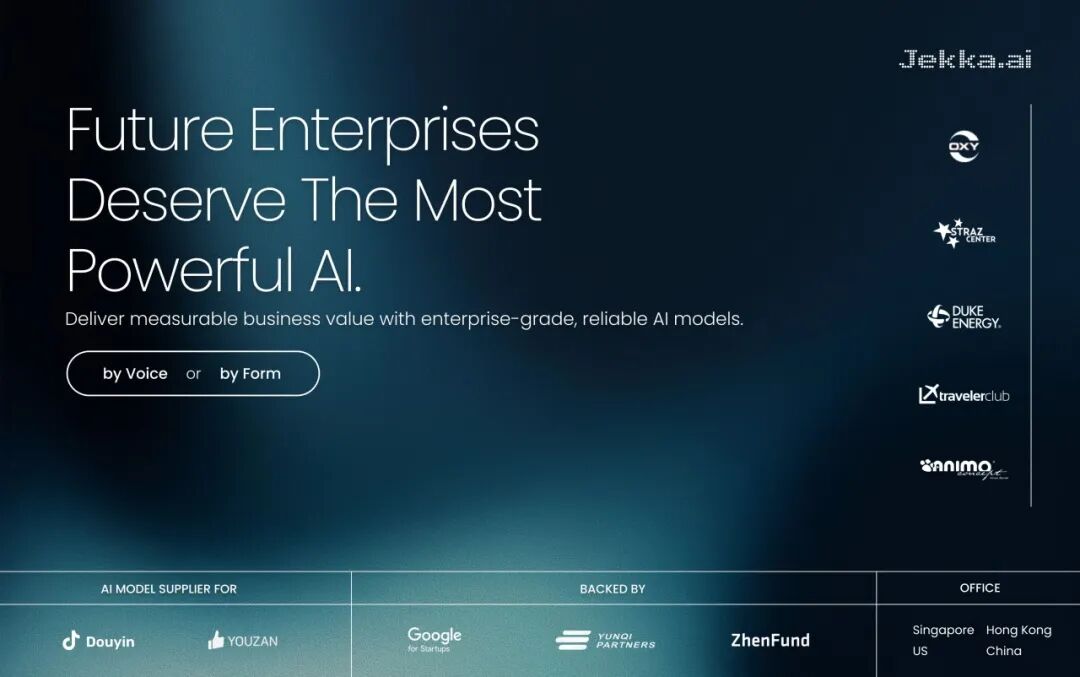
Jekka homepage
Q: As time accumulates, what compounding effects do you think Jekka will have?
Aaron: I think the biggest compounding comes from the AI industry itself. Choosing to work in AI means embracing compounding. First, it satisfies my curiosity. Second, AI is the defining direction of this era.
Along the way, I've had a few thoughts. First: what will AI's future actually look like? Of course, I can't accurately predict the future, but I suspect in ten years, the world will become a world of "extremely low friction."
Why do I say that? Because today, anything you do in a company — once the team grows — involves massive communication and coordination. Solving the problem itself often isn't the most time-consuming part; communication is. And if we understand AI as a "universal language," it will make exchange incredibly easy. As efficiency improves, the way everything gets done changes. Higher efficiency means cheaper labor. You could even say AI as compute is faster and more efficient than humans — that's the intuitive understanding.
But if you think deeper, humans expend enormous amounts of time on communication and collaboration. From a purely biological perspective, a single bite of food can stimulate countless neurons — in some sense possibly more efficient than an NVIDIA GPU. So the real bottleneck isn't "computation," it's "communication." When AI changes this, the entire logic of social production gets reshaped.
My second thought: if we treat AI itself as a language, it will precipitate all human expression and knowledge, bringing us into an era of "maximum intellectual concentration." But in such an era, intelligence itself also becomes cheap. For example, past ACM problems that only the world's top minds could solve five or ten years ago — today, any AI might "lottery-ticket" its way to an answer. In other words, the scarcity of intelligence is declining rapidly.
So my judgment of the future is that AI will give people more opportunity to try new things. Today's social mechanism rewards outcomes: make money, produce results, and the company survives. But in the near future — possibly within our generation — "time and trying" itself will carry greater weight in value creation, not just outcomes. This will have significant impact on how society distributes value.
As for where exactly things will go, who knows? That's also what I find so mysterious yet exciting.

The essence of communication is consistent
Q: Using AI agents for service, what do you think is Jekka's biggest advantage?
Aaron: I think the core advantage is that we have a relatively accurate definition of AI, and can derive downward from that definition to ultimately build a product that truly matches user needs. This is actually extremely difficult.
Today, whenever you talk about AI, two questions are unavoidable: how is AI controlled? How are prompts written? Writing prompts and controlling AI itself involves research. And in this process, we have some unique secret sauce that lets it execute SOPs exceptionally well. That's our special craft. Like Coca-Cola's formula, we won't lay it out in detail.
Just take prompt engineering — who should write prompts? The model provider? Or should companies hire their own people? Neither makes complete sense. Having OpenAI researchers write prompts for some e-commerce company clearly isn't realistic — they may understand the engineering, but their grasp of specific industries is insufficient to solve the problem well.
Conversely, the vast majority of companies don't have anyone who's received professional training to write out entire upstream-downstream workflows in perfect prompts. In this situation, to truly deploy AI, you must establish a complete end-to-end process and combine it with professionalized training for people.
Q: How does Jekka compete with Sierra, the star company in the customer service space?
Aaron: Facing competition requires reframing the question. We're not talking about customer service SaaS — we're serving every person who serves every customer in the world. If we can look at AI customer service without bias, the TAM in an AI context is so massive that we're all just players in it.
Besides, someone in the world always has to write the prompts. If Sierra writes them, then as I said earlier, Sierra becomes like a consulting firm — Accenture, essentially. If clients write them themselves, most clients aren't actually professional at this.
We believe there's a third path.
Q: In cases Jekka has observed, what's typically the merchant user's first demand?
Aaron: It's actually simple. Merchants want two things: first, get things done; second, make money. Because business is business. Whether completing tasks or generating profit, both essentially depend on a complete set of processes. Large companies have more rigorous processes; small ones may be looser. But at root, the merchant's core demand is: can AI stably and completely run the process through?
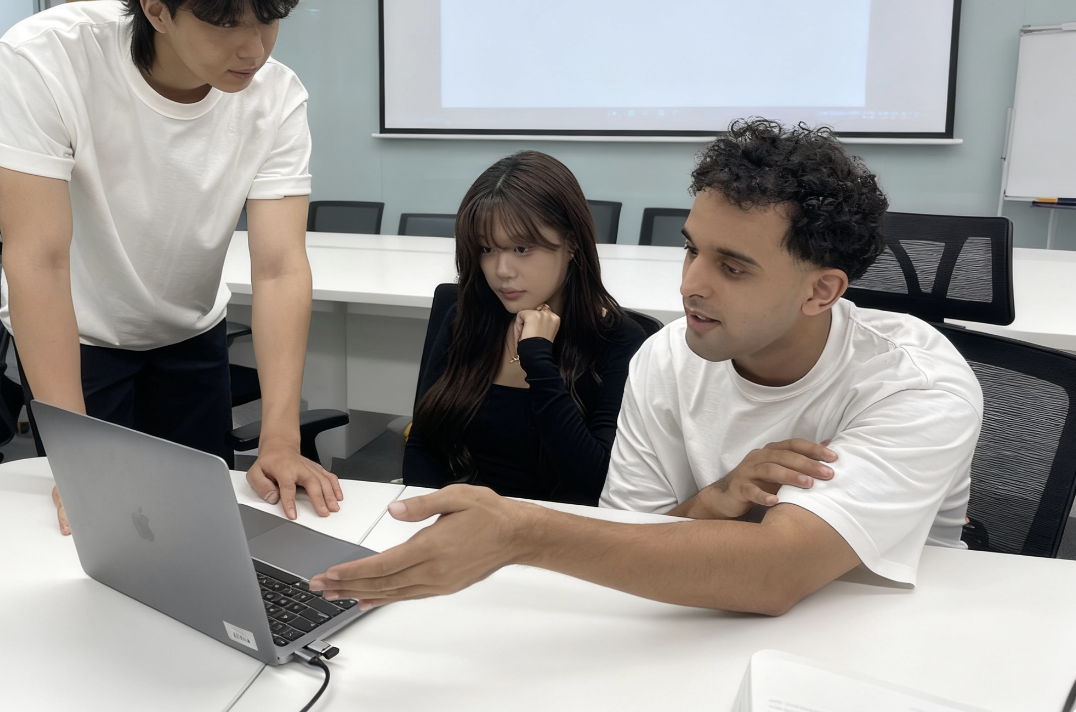
Jekka's Korea and Morocco teams collaborate closely to serve local clients
Q: In 3-5 years, how do you envision agents integrating into daily workflows? For example, what would it look like when you open an interface?
Aaron: I think the first source of value is making communication between people faster, more accurate, and more timely. Our product addresses the age-old problem of "poor communication between users and companies." This isn't new—so why have so many clients, even Fortune 500 companies, adopted it in just the past six months? Because the results are immediately visible.
Take one client: before using us, their consultation conversion rate might have been 3-4%. Within a day of implementation, it jumps to 8%, 10%, even 15%. This isn't because the AI is particularly "smart"—it's because "timely communication" itself creates enormous value. Anyone who's shopped online knows this experience: you message a merchant and get no response, so you switch to one that replies instantly and place your order. Whether someone responds promptly determines the outcome.
So if we're talking about what agents will bring in the next 3-5 years, I believe the first value is solving "immediacy." As long as communication between people no longer breeds misunderstanding due to time delays, and agreements can be reached as quickly as possible, many other things will follow. Including what I mentioned earlier: intelligence will become cheap, labor will become cheap, and society's distribution logic may shift in another direction.
Q: Jekka serves North American users as part of its international expansion. Have you noticed differences between domestic and overseas users? Or is the fundamental demand for communication actually the same?
Aaron: The fundamental demand for communication is the same, but expectations around communication differ. Take North America as an example. Many people say overseas clients are more willing to pay, and that's true. The reason lies in their stage of social development—hiring a service worker there might cost 2-3x what it does domestically, and domestic costs might in turn be 2-3x those in Southeast Asia. So at the level of the "price" of human beings, different regions are indeed different.
We often see similar discussions in books: why is the same burger more expensive in North America than in China? It's not because the ingredients or service itself differ, but because higher wage levels in North America make service scarce. For example, in North America you might wait a long time for someone to pick up the phone, whereas domestically you get a response within 1-2 minutes. Rapid response is a critical service metric domestically, but North American consumers don't have that expectation.
But from another angle, this means that in North America, whoever can deliver better service can create a massive competitive advantage. One of our North American logistics clients became the first company there to truly achieve 24/7 phone answering with on-the-spot problem resolution. None of their competitors could do this, so they established a generational lead. This is the fundamental difference between North American and domestic users at the demand level.
Q: Beyond 24/7 response, has Jekka achieved improvements in any other specific scenarios?
Aaron: I think 24/7 response itself is the most valuable yet most underestimated use case for AI globally. Its manifestation varies dramatically across countries.
For example, we have a Japanese client. Initially we assumed Japanese clients wouldn't have as strong a willingness to pay as North American ones, given that labor is more expensive in North America. But this client told me that in Japan, once you hire someone, it often implies long-term or even lifetime obligations. Combined with language constraints, they can only recruit locally.
But even finding part-time college students to do customer service is difficult. Even outsourcing to call centers in Dalian or the Philippines, costs remain high—a part-time customer service agent might cost 20,000-30,000 RMB per month, which is almost unimaginable domestically.
So the key issue isn't a static outcome, but the叠加 (stacking) of multiple factors: language density, demographic structure, per capita GDP, and so on. All of these determine how AI's value manifests in different regions.
Q: Many people now worry that AI will replace jobs, with customer service often cited as the first to go. What do you think?
Aaron: I don't like sensationalism. Some people are indeed peddling anxiety, saying you must learn AI or be eliminated.
But my own view is that humans are currently underserved. Customers aren't actually treated like bosses. At this stage, AI will only elevate customer service from simple service to more advanced service, and user expectations will rise accordingly.
As I mentioned earlier, many companies in China offer 24/7 service, while North America largely doesn't. Once you perfect 24/7, users' next demand might be: can I participate in product design? Can my reviews be better respected? Can I receive more valuable, even non-standardized, long-term services?
If customer service can transform from a cost center into a measurable part of unit economics and ROI, the impact on the industry would be enormous. Take that logistics client I mentioned: 24/7 availability, 80% of follow-up ratings are five stars, and they're handling 5x the call volume at the same cost. If communication is already this convenient, why do we still need to open a mobile app to place orders?
I've helped many e-commerce companies run the numbers: they treat customer service as a cost center and hire minimally. But customer service often creates value equivalent to 10-20% of pure profit. Theoretically, if they made customer service the fastest and most comprehensive, profits could increase. Many companies just haven't realized this yet.
The above is a世俗 (worldly) calculation. But the more fundamental reason is: humans deserve to be served.

Doing What Most Sparks Curiosity
Q: Would you consider Jekka internally an AI-first or AI-driven team? In building Jekka, how does this mindset manifest in communication or workflows?
Aaron: I think AI entrepreneurship has two basic requirements for teams. First, fully top-down output doesn't work. AI fundamentally requires constantly probing the boundaries of models or use cases through extensive practice. It's not like traditional software development, where you can hire qualified engineers and replicate what others have built.
AI is different—it often hits "blind spots" at certain points. You need it to complete a simple task, like counting numbers, and it simply can't do it, no matter how you debug GPT-5. So we strongly encourage everyone on the team to keep experimenting and to document these experiments.
So we build extensive infrastructure (Infra). This is also a major difference between AI entrepreneurship and traditional entrepreneurship. AI is a product of probability and statistics; its debugging is completely different from software programming. Software debugging is deterministic: input A always yields output B, so you modify if it doesn't. But with AI, you need to test at different time points, with different models, even changing a single word in a prompt. About 90% of our team is building test sets, test processes, and test tools.
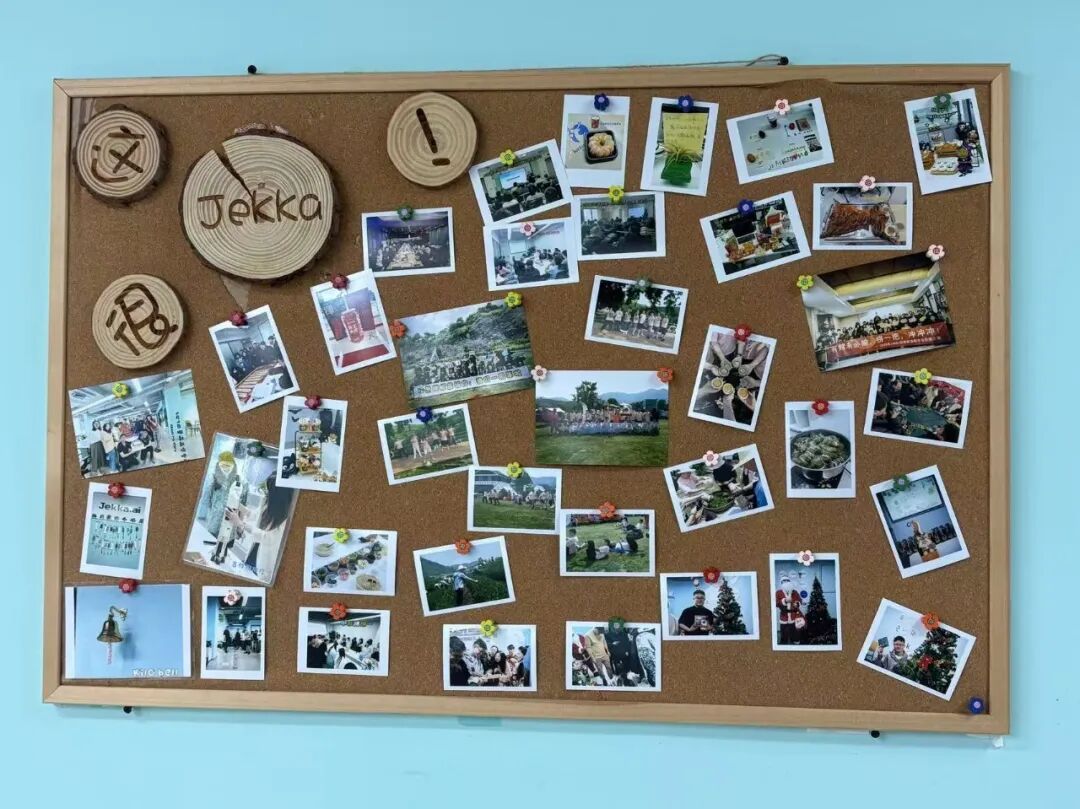
Jekka office photo wall
Q: Organizationally, would you say it's engineering-oriented or operations-oriented?
Aaron: AI isn't fundamentally a pure science subject—it's very感性 (intuitive), very much like the humanities. Our philosophy is: AI's boundaries are discovered through continuous exploration of cases and test results. Often these results come not from engineers or data scientists, but from users during usage or operations during debugging. So the key is how to get users, operations, technology, and algorithms into the same process,沉淀 (precipitate) the data, and complete testing—this is the core of efficiently developing AI applications.
Q: What criteria do you value most when building a team?
Aaron: As I mentioned earlier, the standard for AI is the minimum standard for people: they need common sense. But common sense is actually extremely scarce, somewhat counterintuitively.
We also particularly value curiosity. Because once all infra, test data, and tools are流程化 (systematized), what truly determines outcomes is individual curiosity—seeing what results from applying that curiosity to daily work. This confirms what I said earlier: the most precious thing in the future isn't intelligence or labor, but that attempt driven by your curiosity. This is already beginning to manifest internally at Jekka.
Q: Can you share an example of this "curiosity-driven" exploratory atmosphere on the team?
Aaron: Over the past two years, Jekka has mainly been doing two things: first, enabling effective convergence of problems—this is the core of our underlying technology; second, exploring how to activate different nodes to give AI stronger general knowledge and associative capabilities.
The second point simply can't be achieved through top-down approaches. Once, an intern (who later became a full-time employee), independently and based on a given命题 (proposition), used a "word cloud activation"-like method to replace human-readable prompts with human-unreadable word vectors, feeding different inputs into our test platform. The model performed better than before. No one could explain why it worked, but it indeed played an important role in the product flow. This is a typical curiosity-driven achievement. Of course, this requires good infra.
Q: You've experienced many ups and downs over more than a decade of entrepreneurship. What experiences do you think are worth sharing or replicating?
Aaron: I think the biggest change after more than ten years of entrepreneurship is mindset. At the beginning, you easily get influenced by various things around you, even forcing connections between external events unrelated to yourself and your own experiences, believing there are causal relationships. But now, I tend to first analyze and understand what I want to do more thoroughly, persist in my own judgment and grasp of opportunities, and care more about my true inner thoughts.
The world itself is a multi-dimensional, somewhat makeshift place full of opportunities everywhere. For people who love entrepreneurship, the core motivation is seeing a problem that's "just unbearable to watch" and feeling an intense urge to fix it yourself. Society has so many problems, so many dimensions—you can always find an entry point. So ultimately, follow your heart, and work on what you're most passionate about, what you find most interesting, what most sparks your curiosity.
Q: What's your superpower?
Aaron: I've never been quite sure whether I count as a humanities or science person. In high school I competed in Olympiads and won a national first prize; in my senior year I switched to humanities; when studying abroad I started with humanities, then switched to science near graduation; later I even did a Quant PhD. The whole process was constantly jumping between humanities and science, so I developed a strong ability to put myself in others' shoes, and to achieve self-consistency after doing so. I think this is quite an interesting, relatively unique ability among people around me.
Q: Listening to you, you seem to have both deep questioning and practical execution. Have there been key moments in your experience that shaped this way of thinking or these standards?
Aaron: Yes. For example, when you work in AI, you inevitably run into problems like "text-to-image" or "text-to-text." What is beauty? That question is inherently subjective. But because of my science background, I can't help but try to define what "beauty" actually is. I took art history as an undergrad, so I would think: when the folds of clothing and human proportions are in harmony, is that beauty? What about when things are exaggerated? Does AI-generated output fall into the former category, the latter, or does it fail to achieve "beauty" at all? This process forces me to deconstruct AI's capabilities and modes of expression. And that deconstruction is neither purely scientific nor purely humanistic.
Q: If you could say one thing to other entrepreneurs, what would it be?
Aaron: If there's one thing worth doing in this world, I believe AI is the most worth exploring right now. Entrepreneurship has nothing to do with the environment — people start companies even in the hardest conditions. It's an inner drive, an impulse. If you have that impulse, just do it. There comes a moment in a person's life when you must combine your sense of mission with that impulse. Regardless of success or failure, this transcends the mere fact of your individual existence in the world.
Q: If Jekka could rank first in keyword search, what word would you want it to appear alongside? Why?
Aaron: I want it tied to "human." At the functional and productivity level, Jekka will definitely become the best in the world — that's our core mission. But I want it even more to have humanity, to be bound up with human existence rather than isolated as an object or tool. It should be a bridge for communication, connecting people with each other and with things, genuinely contributing to human civilization. That's what I ultimately hope Jekka can achieve.

The audio version of this episode is also available on the ZhenFund podcast "True Words" — tune in!

Text | Cindy Podcast | Neya & Ruitong