In April this year, "distillation" unexpectedly broke into the mainstream.
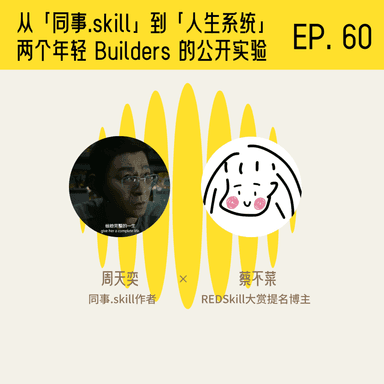
While large models were distilling training data, companies also began turning human experience into data that AI could learn from. Tianyi Zhou wondered: could a person be "distilled" into a Skill too?
He spent four hours using Claude to build the first version of "Colleague.skill." Within five days of launch, it had garnered 7.3k stars on GitHub; it has since accumulated 23k. Even more surprising was the derivative creation: "Ex.skill," "Celebrity.skill," and others emerged one after another. This project, which hadn't been held to particularly high expectations, eventually gathered over 100 creators and spawned more than 200 skills.
Cai Bucai (AI Version), an AI blogger with nearly 100,000 followers on Xiaohongshu, started from her own life. The first time she came to Beijing alone—renting an apartment, starting work, encountering a terrible landlord—she spent two weeks building "Life System.skill," storing her experiences and daily happenings in Obsidian, letting an Agent gradually understand her. She practiced saying no with it, practiced public speaking, and also discussed with it whether to leave a company.
Build the first version first, then ship it.
Vibe Coding is making the cost of starting something lower and lower; an idea can become a product in hours or days. But when everyone can wield the most powerful tools, what truly separates builders?
In this episode, we chat with Tianyi Zhou and Cai Bucai, starting from two skills: Are you afraid of being distilled? What can be handed off to an Agent, and what still needs to be done with your own hands? When AI can learn from more and more people's experiences, what can we still rely on to maintain our own context, taste, and expression?
Starting from a Skill 02:02 Four hours to "distill" a colleague into a skill 02:54 After open-sourcing "Colleague skill," derivatives came faster than updates 04:16 Alone in Beijing, she built herself a "life system" 05:34 Turning life experiences, behavioral patterns, and books read into an Agent's context 06:11 From GitHub to Xiaohongshu: how REDSkill lowered the barrier to using skills
Build in Public: Build First, Iterate Continuously 07:30 Building the first version isn't hard; keeping on iterating is 08:47 Should you be afraid of being "distilled," of being copied? 10:24 Build in Public brings more opportunities and faster feedback 11:37 Codex plus ChatCut replaced the intern they had planned to hire 15:01 Saving every conversation into Obsidian, building your own long-term Memory 17:15 One painful incident: AI quietly added a line of rm -rf 19:10 Fear of being criticized, of being seen by colleagues—then you'll stay stuck at step one
Everyone Can Vibe Coding; What Creates Distance? 21:27 More and more similar products; in the end, it may come down to taste 23:16 Guard against "taste pollution" from AI: look at more photography, visit exhibitions, and also read writing from before 2023 25:26 Surrounded by AI information daily, how do you build your own information flow? 27:42 Start from the friction points in your own life; build something sincere 29:58 Attention is all you need: code quality still correlates with human attention
When Agent Enters Work, and Life 32:07 Today's Agents aren't personal enough yet 34:51 Is an Agent an employee, assistant, mentor, or another self? 37:01 One person plus Agent could replace an entire collaboration team of the past 38:45 When Agents can do everything, what would you still want to do with your own hands? 39:13 AI can help with creation, but personal expression should be deliberately preserved 41:49 A product doesn't just change its users; it may also change its creator in return 44:51 After handing work to AI, how much can we actually trust it? 47:29 AI has made everything faster—so why are people busier and more anxious?
Advice for Young Builders 49:43 From 0 to 1 you can rely on Vibe Coding; from 1 to 100 you need to fill in product and technical skills 51:09 Without a technical background, how do you find your first entry point into the AI industry? 52:22 Building your own account may be the lowest-cost personal marketing 52:59 As AI grows stronger, Coffee Chats and offline exchanges actually become more precious 54:03 Many great products aren't thought up by one person; people from different backgrounds bring completely different problems and solutions
Colleague.skill
Created by Tianyi Zhou, it can read chat records, meeting notes, project materials, and more. It supports importing Lark, DingTalk, Slack, WeChat chat records, and Markdown documents, "distilling" a person's technical capabilities, communication style, and decision-making habits into a callable AI skill package for task delegation.
Life System skill
A personal system built by Cai Bucai using Claude Code and Obsidian. It records the user's past experiences and daily happenings, identifies recurring behavioral patterns, and provides advice combined with reading records. The usage instructions for Life System.skill have garnered tens of thousands of views on Xiaohongshu.
ChatCut
ChatCut is an AI tool that completes video editing through natural language. It allows you to create, edit, and refine video content through prompts, while integrating video generation, timeline editing, subtitle addition, voiceover recording, motion graphics processing, and audio cleanup into a single workflow.
ChatCut Codex integration tutorial: https://chatcut.io/chatgpt-plugin
Token Grant
"ZhenFund" and "Crossing" jointly launched "Token Grant," which will provide RMB 50,000 in token costs for each selected project, supporting you from the very beginning to build the next generation of AI-native products.
Executive Producers: Cindy, Yanyang, Ping, Coco, Phoenix
Post-production: Yanaego
Ci Hua Dang Zhen is a general business podcast produced by ZhenFund. The ZhenFund investment team will share the latest hot topics and industry insights with leaders from various fields here.
Founded in 2011, ZhenFund is one of China's earliest angel investment institutions. Since its inception, ZhenFund has been actively seeking out the best entrepreneurial teams and era-defining investment opportunities in artificial intelligence, chips and semiconductors, robotics and hardware, healthcare, enterprise services, new energy, cross-border expansion, and consumer lifestyle.
ZhenFund—your first stop for entrepreneurship!
View the episode transcript on Xiaoyuzhou