When Everyone Has Better Tools, What Do You Actually Want to Create? | Zhen Summer Fellowship
Each team will receive up to RMB 500,000.
How's Your Summer?
In 2023, GPT-4, Claude 2, and Llama 2 arrived in quick succession — the explosion of large language models left barely any room to breathe. We were still marveling that a model could understand language, answer questions, and perform tasks that only humans could do before.
That same year, we launched the ZhenFund Summer Grant.
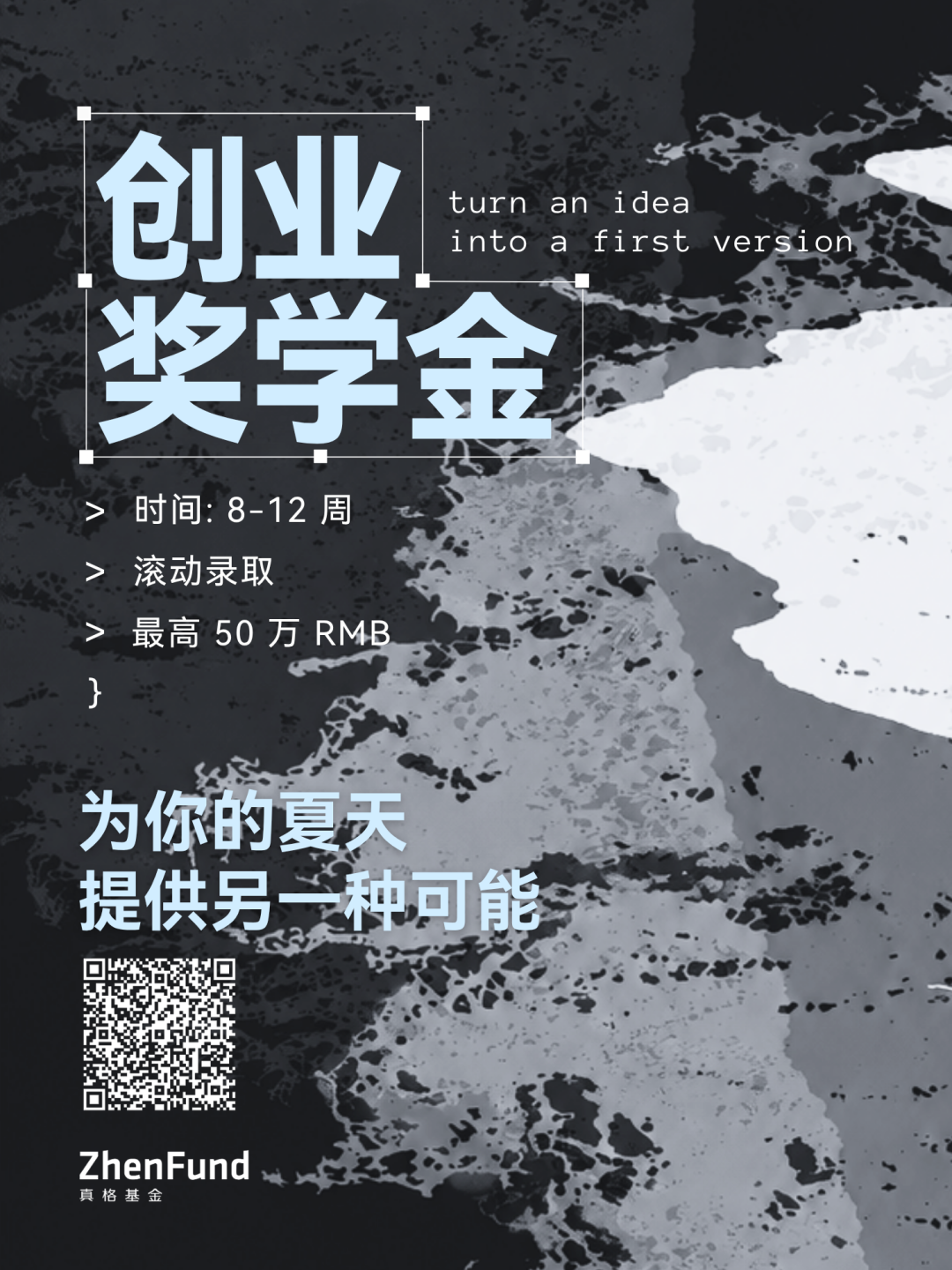
Up to RMB 500,000 per team, over an 8–12 week summer, to support young people in devoting themselves fully to something they truly wanted to build.
The idea was simple.
In a summer full of possibility, there might be a group of talented, idea-filled young people, in a dorm room, a garage, or somewhere along a journey, tinkering with something no one else yet believes in.
Some of them might have the chance to become the next great founders, but practical concerns would lead many to take an internship instead, entering the cycle of job-hunting and employment.
Today, Agents are already operating computers, calling tools, and completing entire workflows. Products like Claude Code, Manus, and OpenClaw have emerged one after another. Models are no longer just answering questions — they're starting to actually deliver results.
The barrier to starting a company is shifting too. In the past, an idea might require a full team and months to validate; now, one person and a few Agents could ship a first version over a weekend.
Technology makes creation easier, and also makes the real question sharper: when everyone has more powerful tools, what do you actually want to create?
Over three years, we've received applications from more than 1,000 students, and witnessed firsthand many stories that started with one summer and kept going.
Mark founder Zhenyi Tang first shared its雏形 with us in his Summer Grant application.
During the 2020 stay-at-home period, he taught himself design after watching a Blender tutorial on making donuts, eventually logging over 7,000 hours. From taking freelance commissions to doing concept design for H&M, Travis Scott, and SpaceX, he gradually realized he didn't want to create only for others — he wanted to build a brand of his own.
And so, Mark was born.
Among ZhenFund's new investments in 2025, 59% of founders are post-2000s.
Xinliang Zhang started from the RoboMaster competition and founded ARX, focused on embodied intelligence R&D, with products adopted by Pi and multiple top global teams; Aaron Qin also came to believe robots could change the world through RoboMaster, registering Manifold Tech in Room 709 of Lee Shau Kee Hall at HKU, then spending years running flight tests and "crashing drones" in a steam boiler room; Yilin Zhao and Ruohan Jiang, born in 2005, took leave from Columbia to turn their high school vision of a learning companion into Hyperknow, a general-purpose learning agent; Alex Liupincun, founder of indie game studio Silverbird, and Mushi Bo, founder of family companion robotics company Yueban Dynamics... they were all barely 20 when they set out to build their own ventures.
We want to provide a small amount of funding to open up another possibility for one summer.
To let you postpone the practical worries for a moment, to not rush into that internship or job just yet, but to find a few partners and build something from zero to one that you truly want to do — to try the joy of creating.
So this grant for young people isn't fundamentally about rushing to "answer" anything.
There are already too many people rushing to give answers. What we want to give you is a summer to find that "most fundamental unknown question."
Perhaps that's what entrepreneurship looked like at the very beginning.