Synthesia CEO: From Visa Rejection to $2.1 Billion Valuation | Z Talk

Everything ultimately comes down to two core things: distribution power, and great product.
Z Talk is ZhenFund's column for sharing perspectives.
Victor Riparbelli is the co-founder and CEO of Synthesia. The global leader in enterprise AI video raised $180 million in its latest funding round this January at a $2.1 billion valuation, currently serving over 1 million users and 60,000 enterprise clients.
In a recent interview, Victor reflected on his entrepreneurial journey and shared his thinking on fundraising for AI startups, the ongoing search for PMF, and the importance of product.
Victor's path to becoming a founder is equally thought-provoking. As a child, he was obsessed with World of Warcraft, learning strategy and decision-making through gaming. As an adult, he describes himself as a "jack of all trades, master of none" — his résumé was unremarkable, and he couldn't even stay in the US to start a company due to visa issues. Yet these varied experiences became the wellspring of creativity and sound judgment that would serve him as a founder.
This content comes from the 20VC podcast. Below is the full translated interview.

Key Takeaways
- Sustained PMF discovery is the CEO's job: Successful companies are built on a sequence of PMFs, with the core challenge being finding that initial spark. As scale increases, founders must keep hunting for the next PMF.
- Customer renewals are the signal of success for AI companies: Many AI startups focus too heavily on landing new contracts while neglecting renewals. But the critical signal isn't the signature — it's the renewal.
- A new content creation ecosystem for AI: Technical roles in content may shrink, while creativity, storytelling, and the ability to make content resonate will grow more important.
- Silicon Valley vs. London for startups: Silicon Valley has more top-tier talent but higher costs and lower loyalty. Valley talent treats their career as a portfolio of stock options from different companies, hoping one hits big. European talent is more loyal by comparison.
01
The Mistake Every Entrepreneur Makes
Harry Stebbings: About seven years ago, a Danish entrepreneur walked into my office and showed me his vision for the future. I didn't invest. It became one of my biggest regrets — one that keeps me up at night. Hard to believe it's been that long. Thank you so much for being here today.
Victor Riparbelli: Happy to be here. Though honestly, I do feel a bit sorry for you too.
Harry Stebbings: I feel the same way. I mentioned this to you before — if I'd invested in every company I met, I'd probably own stakes in you, Deel, Vanta, and ElevenLabs right now. God, what a thought. But let's talk about you today. Any exciting news to share?
Victor Riparbelli: We just closed our Series D, which is a milestone for us. The round was $180 million, led by NEA, with all existing investors participating.
We're very excited to enter 2025 with this capital, pushing the company to "escape velocity" and truly defining and dominating our space.
Harry Stebbings: Congratulations, truly amazing news. Thank you for making me feel my regret all over again.
We actually talked about your fundraising history before, and while it's not on today's agenda, I'd still love to hear it. Can you take us back to the seed round? People didn't understand your idea at all back then. What happened? What was that experience like?
Victor Riparbelli: This goes back to 2017, ancient history now. Simply put, we were a group of people who wanted to work on AI — my co-founders Steffen Tjerrild, Matthias Niessner, and I — and we had an idea about AI. At the time, GenAI wasn't nearly as well-known as it is now, but we believed AI would fundamentally transform content creation.
In 2017, when most people talked about AI, they thought of data analysis and decision-making — that was the mainstream direction. However, some early generative adversarial network (GAN) technology was already emerging, capable of generating new data rather than just analyzing existing data.
We saw this as world-changing technology that could completely disrupt content creation across video, voice, and music — though our focus was video. I went out with a polished deck and a grand vision seeking support. Most people thought we were crazy.
We told people directly: "Within ten years, you'll only need a laptop and your imagination to make a Hollywood film." But this didn't resonate at the time, especially in Europe. We were headquartered in London.
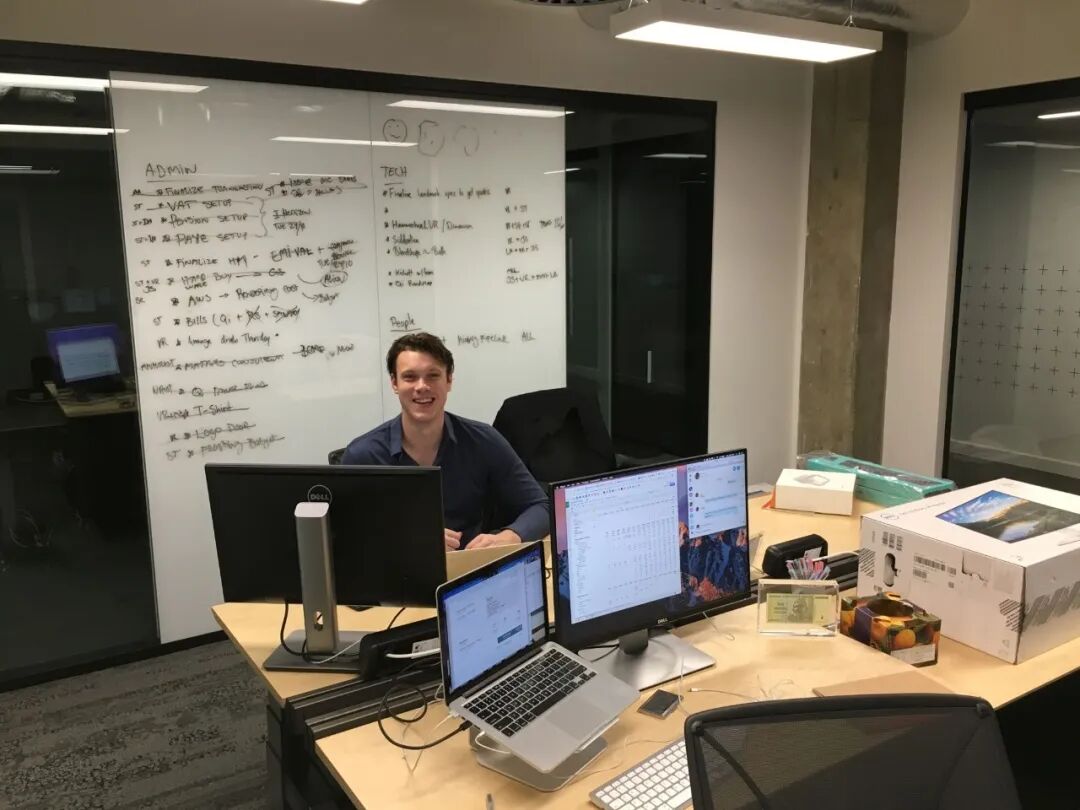
In 2018, Victor, co-founder Steffen, and a tiny team of three brainstormed Synthesia's future in a cramped office
Harry Stebbings: Why was that?
Victor Riparbelli: I think in Europe, VC was still dominated by people with private equity backgrounds. That mindset is fundamentally different from how technical people think. PE folks are financiers, not technologists. Our idea couldn't be quantified in an Excel spreadsheet, so virtually every investor rejected us — about 80 to 90 of them.
Harry Stebbings: Including podcast hosts?
Victor Riparbelli: Yes, including podcast hosts.
Harry Stebbings: They don't have the private equity excuse though, do they? How much were you trying to raise at the time?
Victor Riparbelli: For the first round, we wanted to raise $1 million and ended up getting it from Mark Cuban at a $5 million valuation. Today, the company is valued at $2.1 billion.
Harry Stebbings: He owns about 15% now?
Victor Riparbelli: Somewhere in that range.
Harry Stebbings: Then you tried to raise $7 million, right?
Victor Riparbelli: That came later. In 2017, we got started with $1 million from that first round. Over the next 12 to 18 months, we developed working technology and entered the market, initially focused on AI dubbing rather than the avatar technology we have today. We thought the timing was right and tried to raise $8 million — but that attempt completely failed.
During that period, we made virtually every mistake entrepreneurs make, and the whole fundraising process took nine months. In the end, we only raised $3.1 million. That kept us barely afloat until our Series A. By then, we'd finally found PMF and built a sustainable business. But those first two rounds relied entirely on our vision, and that story wasn't easy for people to understand at the time.
Harry Stebbings: By today's standards, with a team and vision like yours, you'd raise at least $5 to $10 million at something like a $40 to $50 million valuation. If you'd raised that larger amount back then, do you think you'd have achieved what you have today?
Victor Riparbelli: We discuss this often, and the answer is probably not. If we'd raised $8 million, we might have done more things, but they likely wouldn't have been the right things. In 2018, almost everyone wanted us to develop Deepfake detection technology — the outside world's understanding of AI video was almost entirely equated with Deepfakes — but we saw that as just a small slice of AI video.
With more money, we might have built teams to develop those technologies and lost our focus. Instead, limited capital forced us to concentrate on customers and product, trying to charge customers from day one, even if it was £500. I think this focus is what ultimately led us to PMF.
I'm a fan of smaller funding rounds because too much capital can sometimes cause teams to lose their discipline and direction.
Harry Stebbings: As an angel investor, how do you view startups raising $5 million at a $25 million valuation, or $10 million at $50 million? For these high-profile founders, is there a pattern you're seeing?
Victor Riparbelli: Getting too much money too early is unhealthy. Maybe some people can maintain discipline, especially serial entrepreneurs, but most will spend it on the wrong things. In any case, you can't spend your way to PMF. It takes time and deep market insight — things money can't replace.
Hiring product managers or salespeople won't solve it. Building a 20-person team might actually slow you down. It took us two full years to understand video from first principles while deeply learning what users actually needed.
PMF is a process that cannot be accelerated by capital. As a founder, understanding the market and customer is your responsibility.
Harry Stebbings: Do you think this journey really exists? Because to me, PMF isn't static. For example, you've found PMF in the creator space, but next you might need to pivot to SMB and find fit there. PMF is more like an ongoing serialized novel. Do you think the larger the team, the harder it becomes to manage?
Victor Riparbelli: Completely agree. In fact, I think successful companies are built on a sequence of PMFs, but the key is finding that initial spark that ignites early growth. Once you have that spark, you have a foundation to build on.
The larger a company gets, the more new products you need to develop and the more new PMFs you need to find. As a founder, I think this should always be on your mind — what's the next market? What's the next target product?
For us, we've already found multiple PMFs. And for those, you can hire really smart people to run them and turn them into excellent business lines and products. But finding the next PMF breakthrough and charting the company's strategic direction for the next few years — that responsibility always falls on the founder. You can't delegate that.
Harry Stebbings: You mentioned the importance of "capital constraints" and "Cockroach Mode." I heard that when you closed your Series B, you hadn't touched your Series A money; when you closed your Series C, you hadn't touched your Series B; and now with your Series D, you still haven't spent your Series C. So why raise at all?
Victor Riparbelli: I think when you have capital, you'll naturally find ways to use it. But for us, what's more important is that we've always focused on building a sustainable business, making sure we have good unit economics, and always having enough revenue to control our own destiny rather than relying on a VC-provided "parachute." So we've always maintained a disciplined spending strategy.
That said, capital is still a very important asset, provided you know how to use it efficiently. For example, building a great GTM team costs a lot of money. You need to hire a bunch of talented people, train them systematically, and it might take nine months before you see results. At the same time, keeping a healthy balance sheet is critical so you can seize any potential opportunities.
We want to build a very large company. I believe our space can absolutely produce a $50 to $100 billion business. If you want to win that market, bootstrapping alone is far from enough — that's a fairy tale.
02
Video Will Replace Text as the Dominant Form of Communication
Harry Stebbings: How does Synthesia become a $50 to $100 billion company? Can you paint that picture?
Victor Riparbelli: We're in the very early stages of a transformation in how people communicate. Right now, most communication is still text-based — emails, messages. Messaging is a great technology that moved the world forward, but it's not actually efficient at compressing and transmitting information.
When we translate ideas into text, we lose a massive amount of context. As humans, we're much better at consuming visual content — listening, watching, even experiencing things in the physical world. While we haven't achieved fully immersive experiences yet, high-fidelity formats like video and audio are clearly more efficient for training, communication, and entertainment.
The reason we use so much text today is simply that it's the only form of information storage and sharing that scales. But that's changing.
As technology develops, no longer requiring physical tools like cameras and microphones, the scalability of video and audio creation will reach the same level as text. Once that scalability is achieved, there's no reason to keep using text.
This might sound incredible, but I think we, or perhaps our children, may be among the last generations for whom reading and writing are the primary modes of communication. In the future, information consumption will shift much more toward video and audio.
Harry Stebbings: I can relate to that. Every night from midnight to 12:30, I'm on TikTok, taking notes on what transitions, music, and effects work better.
Victor Riparbelli: Same here! TikTok is a great example of how video becomes the default mode of information consumption. There's almost no text on the platform — even comments are often in video form. If you buy into this trend, then video-based communication is undoubtedly the future.
This trend isn't just about scrolling TikTok at midnight. If you're buying a piece of software, you'd much rather see an interactive video demonstrating its features than read a bunch of documentation or get on a phone call. That video might even have a human voice walking you through how to use it. Needing to read long articles or watch long videos is fundamentally a sign of poor product experience.
From day one of our company, we were clear that our target market wasn't traditional video creation. We focused specifically on converting text and slide content into video.
The potential of this market is virtually unlimited. Even capturing just 5% of it, this conversion capability alone is enough to build a $100 billion company.
Harry Stebbings: We'll dive deeper into the future direction later. But before that, I want to talk about fundraising. What do you think of the strategy of using funding to crush competitors, capture the market, and wield capital as a weapon?
Victor Riparbelli: If a company doesn't know how to use capital properly, it ends up backfiring. You might even make some unwise decisions.
Harry Stebbings: But does this round send a signal to the outside world: don't even think about challenging us?
Victor Riparbelli: That's certainly part of what fundraising does, but the more important goal is to build the best product in the space.
Every funding round sends signals to the outside world — hiring updates can affect how competitors and VCs perceive you, and so on. But I've always believed that management decisions shouldn't be based on competitors' actions. That's not a smart way to run a company.
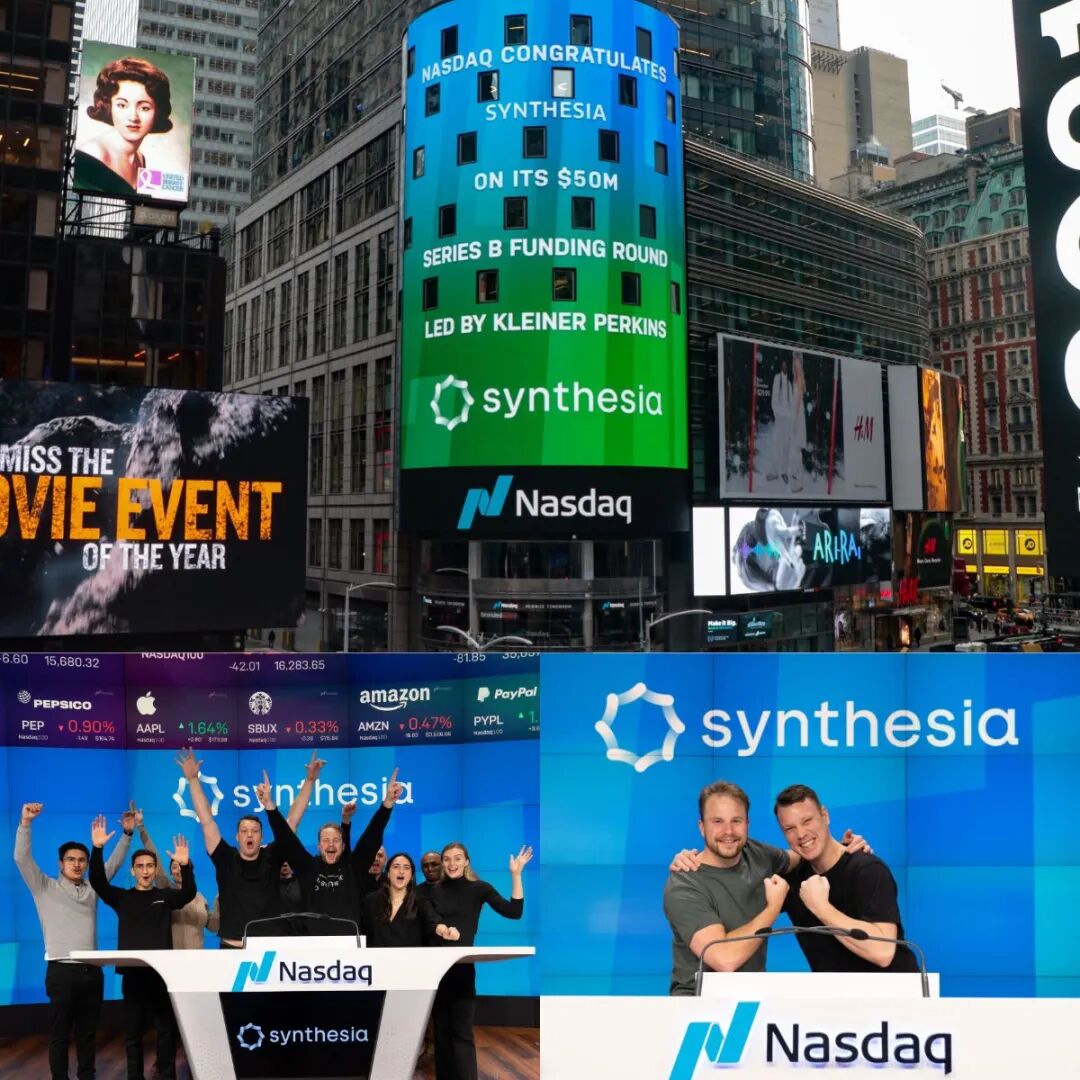
Synthesia announcing its Series B at Nasdaq
Harry Stebbings: So do you pay attention to what competitors are doing?
Victor Riparbelli: I do right now, especially since we have a lot of competitors. I think having competitors to "spar" with is, to some extent, a good thing.
For Synthesia, from Series A to B to C, the outside world didn't really understand how fast we were growing or how much users loved our product. Many people looking at us from the outside probably thought we were just doing some small innovation in the learning and training space — AI-generated videos, kind of interesting, but not enough to build something big.
But internally, it was completely different — we knew this was going to be a massive market, and learning and training was just the starting point.
From the outside, we might have looked like a "cute" British company doing some avatar animations, pretty fun, maybe just for making family videos. But for years, we were working hard to carve out our own market. It wasn't until later that the outside world gradually realized this wasn't just a flash-in-the-pan demo project, but an innovation area with deep potential.
One competitor even copied our mission statement word for word, along with all our communications. From product descriptions to marketing, they basically mirrored everything we did. As annoying as that is, that's the nature of capitalism, and it also proves our influence in a way.
You can learn a lot from competitors — what's working for them, what's going wrong. That observation is actually quite helpful for us.
Pioneering a completely new market category is really hard because beyond market feedback, there's almost no other reference point. By observing competitors' moves and how the market responds to them, we've gained many valuable insights. This has been especially important for our progress over the past 12 months. For example, in the second half of this year, we saw significant secondary growth, largely thanks to competitors doing a lot of market education for the entire category. And because we have a clear product advantage, we benefited significantly from that.
You don't have to be first to market. If you're good at fast follow, that's also a very powerful strategy. In a market where you have abundant feedback, a company operates better and can find the best solution to meet customer needs much faster. That's what matters most.
Harry Stebbings: Before we dive into your career background, I want to talk about the current AI landscape. Many CEOs tell me: "Harry, you tech enthusiasts keep promoting AI ROI for enterprises, but we're still waiting for actual results." Where do you think AI is in the hype cycle?
Victor Riparbelli: That's an accurate observation. I've found that many enterprise customers don't actually know what they need.
A lot of companies are told they need an AI strategy and to execute on it, so they're happy to engage in discussions and willing to allocate innovation budgets to AI projects. But the problem is, they don't know what they need, and they don't understand the technology well enough to judge how AI can serve their business needs.
This is both an opportunity and a challenge. For AI startups that aren't customer-centric, this could be a big problem. The good side is that customers have ample budgets and are willing to sign pilot or proof-of-concept contracts to show results to senior leadership. But when customers themselves don't know what they actually need, proving ROI becomes very difficult.
Harry Stebbings: Where do you think the problem lies? Is it in the implementation phase?
Victor Riparbelli: The problem is that to succeed as an AI company, you have to be extremely customer-centric.
You need to deeply understand customer needs and pain points, and be clear on how your product can solve those specific problems. This sounds obvious, but it's especially critical in AI. Right now, many companies have cool technology and are trying to convince customers to accept it as the solution. However, these companies often don't truly understand the customer's problem, leading to products that fail to address actual needs.
This results in customers spending large budgets without achieving expected outcomes. They might be reluctant to admit failure after investing $100,000, but they'll eventually walk away because the product didn't really deliver value.
This is a huge challenge for AI startups. They think they're providing value and on the right track, but once the customer's 12-month contract expires, problems concentrate and the risk of churn increases dramatically.
Harry Stebbings: Do you think we're in what's being called the "churn peak" right now?
Victor Riparbelli: Many companies are indeed experiencing this shock. What's unique about AI over the past few years is that customers have been extremely willing to try new things.
At the consumer level, a user might spend $30 a month to try out something novel without thinking too much about the cost. At the enterprise level, it's common to see a $50,000 contract to pilot an AI project.
But the signal that matters isn't the signature on the contract — it's the renewal.
Many AI startups are so focused on landing new deals that they neglect what happens next. If you're only chasing new customers rather than ensuring your existing ones stick around long-term, you're in for serious trouble — unless your product happens to be a perfect fit, which some do achieve.
Harry Stebbings: What do you think is the biggest misconception people have about the AI industry right now?
Victor Riparbelli: We are absolutely in a bubble. But that's not necessarily a bad thing. It's how capitalism works: a flood of capital enters the market, products proliferate, you try a thousand different approaches, and eventually the things that actually create value emerge.
This model is essentially a Darwinian process of innovation. That said, I do think a lot of money will be wasted on AI products that don't deliver real value, or on add-on features from cloud providers.
Harry Stebbings: What products are getting funded now that you don't think are that valuable?
Victor Riparbelli: Certain buzzwords always make me suspicious. When people talk about building AI agents that can perform all kinds of tasks, my guard goes up.
If you're too enamored with the technology itself, or too busy chasing the latest buzzword, that's usually a warning sign for me. I can give you a specific example — I really dislike when people refer to AI as "AI employees." It's a stupid framing, and it's counterproductive to building useful technology that people actually want to adopt.
Thinking of AI as "employees" that can do tasks for you is the wrong mental model. These are algorithms. They're software. You don't call Miro or Figma some kind of "AI employee" — they're just software tools that help you present designs.
I understand why people use that term — they think AI can make autonomous decisions. But that's not fundamentally different from the software we already have.
03
AI Goes Mainstream: Great Products Win
Harry Stebbings: Mark Zuckerberg said on a podcast that by mid-year we'll have AI as capable as mid-level software engineers. Do you agree?
Victor Riparbelli: Broadly speaking, the tech industry is very good at setting high expectations and then failing to meet them. My approach to these hype cycles is to stay optimistic but grounded.
I do believe we'll eventually have very powerful AI that can write software. But I'm much more focused on what's achievable today and in the next few quarters, and I calibrate my strategy based on that.
It's safe to say AI's capabilities in software development will keep improving. But talking to many developers, we're not at the point where AI can independently build a new social network. Software development is far more complex than that framing suggests.
Over the past two years, I've seen a lot of cool demos. That's a good starting point. But these technologies still need to be deployed at scale in production environments. It's fun to have AI generate a simple game like Tetris, but most software today is vastly more complex than that — involving technical support, human collaboration, customer feedback, and many other elements. I think we're still far from fully automating these processes. That said, in the next 6 to 18 months, the productivity of great software engineers will definitely increase significantly.
Some podcasts last year claimed that in the future, you could just tell an LLM "build me a Monday.com" and launch a product at one-tenth the cost. I think that's an incredibly naive view.
Technology and code matter, but actually building a company from scratch teaches you the process goes far beyond that. People who say things like that have probably never run a company.
Harry Stebbings: And that means you need to continuously update and improve these tools. Can you imagine maintaining 150 different internal tools?
Victor Riparbelli: Completely agree, that would be extremely difficult.
Harry Stebbings: From a realistic and rational perspective, everyone acknowledges that the commercialization of foundation models is accelerating. How do you see this trend?
Victor Riparbelli: I completely agree. Everything ultimately comes down to two things: distribution is king, and great products are king.
Of course, new-generation LLMs like GPT-5 will become more powerful, and there's a lot of anticipation around that. But I think the commercialization of text generation technology is already happening.
For most scenarios where AI is currently transforming the world, existing technology is already sufficient. The focus going forward will be on improving foundation models while building better products and service ecosystems around them.
We're also seeing intensifying competition. X (formerly Twitter) and Elon Musk's team are trying to catch up, and Anthropic has launched excellent products. Many people even prefer their models to OpenAI's.
OpenAI has indeed built a massive moat in the consumer market, which is extremely valuable.
Harry Stebbings: If you had $10 million to invest, and could choose between OpenAI at a $1.6 billion valuation, Anthropic at $600 million, or X at $500 million, which would you pick?
Victor Riparbelli: I'd choose X, because it has the greatest asymmetric upside — especially if Elon delivers on his promises as he has in the past. You may have heard he built a new dataset? I never bet against Elon, and I think X has enormous potential. Elon's involvement itself is a major advantage for X.
OpenAI has clearly succeeded in capturing consumers and becoming the primary destination for LLM usage. I think in the future, LLMs will be embedded in many different applications.
Owning X while simultaneously developing an LLM is a very powerful combination. Especially since real-time information can flow directly from X into the model, plus X itself has hundreds of millions of users who could theoretically use their LLM directly instead of relying on OpenAI.
Harry Stebbings: What do you think will ultimately determine the winner? Is it data? Some say X has an advantage because Elon controls massive compute. Or will OpenAI win on distribution?
Victor Riparbelli: Clearly, there's still room for scaling to improve, particularly beyond text into video, audio, 3D, and other modalities.
Harry Stebbings: So you think scaling laws will continue to hold?
Victor Riparbelli: I think they will continue to hold, but progress won't be linear. In the real world, it's not simply whoever has the most compute wins. There will always be technical breakthroughs — someone might develop a new algorithm that's 100x more efficient than current approaches.
What will determine success is the combination of compute, algorithms, and data. Right now, everyone is trying to give AI systems greater controllability. We've proven these technologies can replicate the real world very well — generating highly realistic video, audio, or text. But what we really need is deeper control.
Take my field: some video generation models are extremely powerful, like Sora and Runway's models. You input something, and the model almost always produces stunning results. But to make these models truly useful, we need higher-level control — like having the same character appear in different scenes, or having a character say specific lines.
Whenever you try to add these control features, the overall quality of the model tends to degrade, because now you're asking the model to follow your intentions rather than just replicate what looks "real." Achieving this control requires extensive algorithmic optimization.
Harry Stebbings: Is the lack of a control layer a problem or an advantage?
Victor Riparbelli: We need to distinguish between two types of control here: content moderation on one hand, and output control on the other.
The current experience is like a slot machine: you put something in, the model generates a result. If it's not what you wanted, you pull the lever again. That's frustrating, especially when you need a specific result and the model can't produce it. We need a degree of control to improve this experience.
As for content moderation, the direction there is worth watching. We're going through something of a "wind shift" — Zuckerberg recently scaled back content moderation efforts. Broadly speaking, I support this change. I don't think having humans moderate content is the right approach.
Products like Wikipedia have proven how powerful collaborative truth-seeking can be. Community Notes is trying to apply Wikipedia's approach to every piece of content. It hasn't fully solved the problem yet, but it's the right direction for achieving a certain level of content control.
The trickiest area is "gray content." We face similar issues — at Synthesia, when we do content moderation, we divide content into three categories: green content, which is 99.9% of everything and universally considered fine; red content, like hate speech or violence, which everyone agrees should be banned; and the hardest to handle is the gray area in between.
I think what Zuckerberg is relaxing now is control over this middle category. This content is very difficult to draw boundaries around. Take cryptocurrency content: when is it an enthusiastic entrepreneur introducing their new project, genuinely believing they can change the world? And when is it naked fraud, designed to induce well-meaning people to put in money? That line is extremely blurry and hard to define.
Harry Stebbings: Simply put, does Synthesia bear responsibility? Are you the arbiter of what's right and wrong? For example, if I publish an opinionated and potentially controversial statement, are you playing the role of "arbiter of truth"?
Victor Riparbelli: Yes, we are playing that role right now, and it's a deliberate decision. We've had extensive internal discussions about this, and the core question is how to approach this challenge. For me, everything comes back to the user level, because we're an enterprise product company.
We have to make sure avatars aren't used for weird or inappropriate online content. As a company, we don't feel any obligation to uphold some kind of "free speech" right. From a business standpoint, if someone pays us $30 a month to make controversial conspiracy theory content, that does nothing for us. These factors push us toward strict content moderation.
Our enterprise customers also don't want their brands associated with content that doesn't match their brand values. Economically, that kind of content makes no sense for us. So we've taken very strict measures, even if some people aren't happy about it.
Harry Stebbings: Before we go deeper on this, let's talk about models. Over the past 18 months, I've spoken with many investors, and some have been quite frank: Synthesia's achievements are remarkable, but they think OpenAI might move into this space too. How do you think about model providers expanding into the application layer?
Victor Riparbelli: That's classic "VC thinking" — too fixated on the technology itself. Many people mistakenly think Synthesia is an "avatar company," which is understandable because our website and marketing do emphasize avatars, and that's been a big part of how we rose to prominence.
But if you talk to our customers, they don't choose us because of avatar models. They choose us because we've optimized the entire video production workflow. Our platform, powered by AI, takes you from creative concept to final video publication without ever needing a camera or voice actor. We also provide editing tools similar to PowerPoint and Canva, plus an AI video player that supports multiple languages.
When customers sign million-dollar-plus contracts with us, the real reason is that we can deliver information in the most efficient, most engaging way possible — far beyond the model itself.
Of course, we also care about model R&D and will continue to stay ahead. Our focus is on human content presentation, while other companies like Sora and Runway are developing broader foundational video models. Going forward, we may be customers or partners of those companies.
We believe we'll win in this niche of voiceover and human content presentation. In the coming years, the companies that succeed will be those focused on workflow optimization, not those simply obsessed with AI models.
In 2025, model R&D will be one of our priorities, but more important is expanding the value chain — increasing demand from video publishers for our product, and guiding these users to our platform directly rather than relying on video platforms like YouTube.
This space will see the emergence of several large, capable foundational companies that will empower us — like OpenAI and Anthropic, which we're already using.
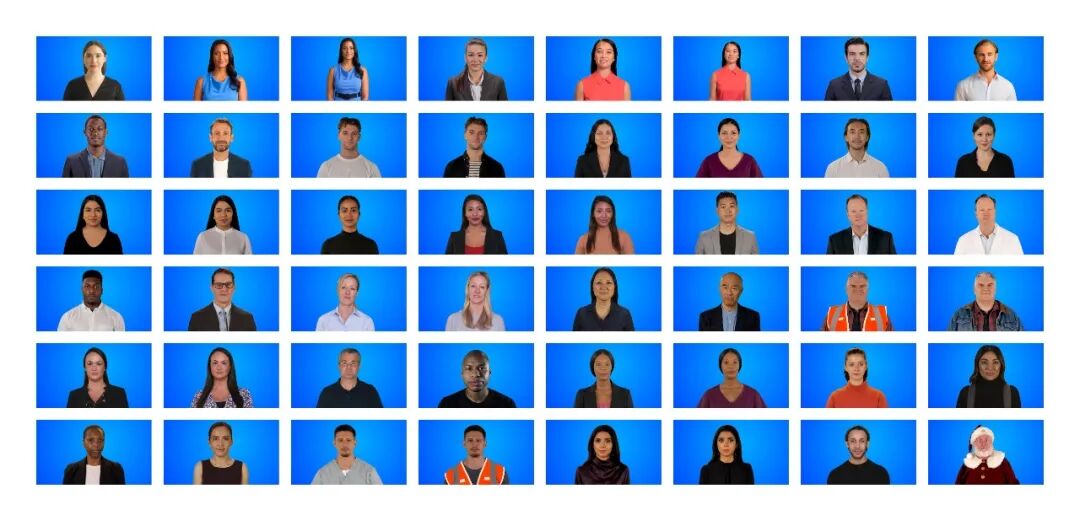
Synthesia's avatar personas (Image: VIA REUTERS)
Harry Stebbings: Which model provider do you primarily use right now? Has that choice changed?
Victor Riparbelli: We primarily use OpenAI right now.
Harry Stebbings: Are you shifting toward Anthropic?
Victor Riparbelli: Yes, we're moving some of our workloads to Anthropic and Gemini.
Overall, price is a significant factor. Some models perform better on specific tasks, but we also have many large-scale workloads, like content moderation, so price and infrastructure support are critical.
Harry Stebbings: Would you consider building your own models?
Victor Riparbelli: We'd only build our own models if we could be #1 in the world. For us, that typically means focusing on a narrow domain and tying it directly into a larger workflow.
We start from customer needs. If we can be #1 in a specific area and building a model offers significant advantages, then we'll build it ourselves.
Specifically, we want to be #1 in the world for human-facing-camera presentation and dialogue-driven content.
Harry Stebbings: In the future, will we have more small, vertical models, or just a few giant general-purpose models from the major players?
Victor Riparbelli: There will definitely be consolidation among the big companies. But vertical large models will also emerge in large numbers. Many enterprises will use open-source models, fine-tune them, and integrate them into their own platforms. If that counts as vertical, then we'll see many such models.
However, constantly talking about models themselves is the tech industry's inertia. Ordinary users will mostly interact with models the way they use ChatGPT. And in backend processes, much of the work will be LLM-driven.
Many companies will build their own vertical LLMs, but from a business perspective, rather than obsessing over models, it's better to focus on building great products and workflows.
Harry Stebbings: Last question on models! Everyone's been waiting for GPT-5 for a long time, waiting and waiting. Do you think it will exceed expectations or disappoint?
Victor Riparbelli: Replicating the sensational impact of ChatGPT's launch will be very difficult. Humans have this trait where our interest in new things saturates quickly.
We often forget how amazing GPT-3 itself was — you realize this when you actually use it. So my feeling is, when they release new technology, it will probably perform well, and there will definitely be a group of tech geeks excited by what new capabilities it enables.
Of course, maybe I'm wrong, and some superintelligent thing will emerge that self-improves and saves the world. But I think after a new product launches, most people won't particularly care. Because the bar for truly capturing mass attention is extremely high right now.
A lot of discussion now revolves around whether it's AGI. But these discussions are actually quite contentious — like, what counts as AGI? If you took ChatGPT back to England 200 years ago and showed it to people, they'd probably burn you as a witch.
If it were 50 years ago, people would think this is AGI — an all-knowing computer, absolutely incredible. Today, we might just call it a "stochastic parrot." As for which is true, I'm not sure.
But I believe the new technology will be powerful; it just probably won't replicate that culturally significant shock moment of ChatGPT's debut.
I mentioned earlier that a small group of people will pay close attention to how new technology performs on certain benchmarks. I think that's great. But for most enterprises globally, current models are already good enough to solve many problems.
04 In the Future, All You'll Need Is Imagination
Harry Stebbings: I love a quote from Eleanor Roosevelt, which I strive for though I'm far from achieving it. She said: "Great minds discuss ideas; average minds discuss events; small minds discuss people." With that in mind, let's talk about the future. What will content creation look like in five years?
Victor Riparbelli: In broad strokes, we've already democratized distribution through the internet — there are no "gatekeepers" anymore. Anyone can create a website and share content, which is incredibly powerful.
Next, we've already seen a certain degree of democratization in content creation. The proliferation of smartphones put cameras everywhere, and camera equipment has become dramatically cheaper. Thirty years ago, a professional filming setup might have cost a hundred times what it does now.
But what we're about to see is true democratization of content creation. This shift means we'll move away from relying on sensors to capture real-world content, toward entirely digitally generated content.
Think about text, as a fundamental building block of society — it's had a long evolution. From the invention of the printing press, to keyboards and computers, text is now fully digitalized, ubiquitous, and incredibly powerful.
A similar shift happened in music. We moved from capturing sounds in reality to digital creation. Most music today isn't played on real instruments — it's generated through software. I can synthesize almost any type of song on my computer, and this capability has completely transformed the music industry.
The same change will happen in video and audio. In the future, all you'll need is imagination to create.
The most direct impact of this change is that content creation costs will approach zero. For example, writing a book now costs almost nothing. And in the near future, from a technical standpoint, producing a Hollywood-level film will also cost close to zero. This means anyone can compete with Hollywood, and the best ideas and content will rise to the top.
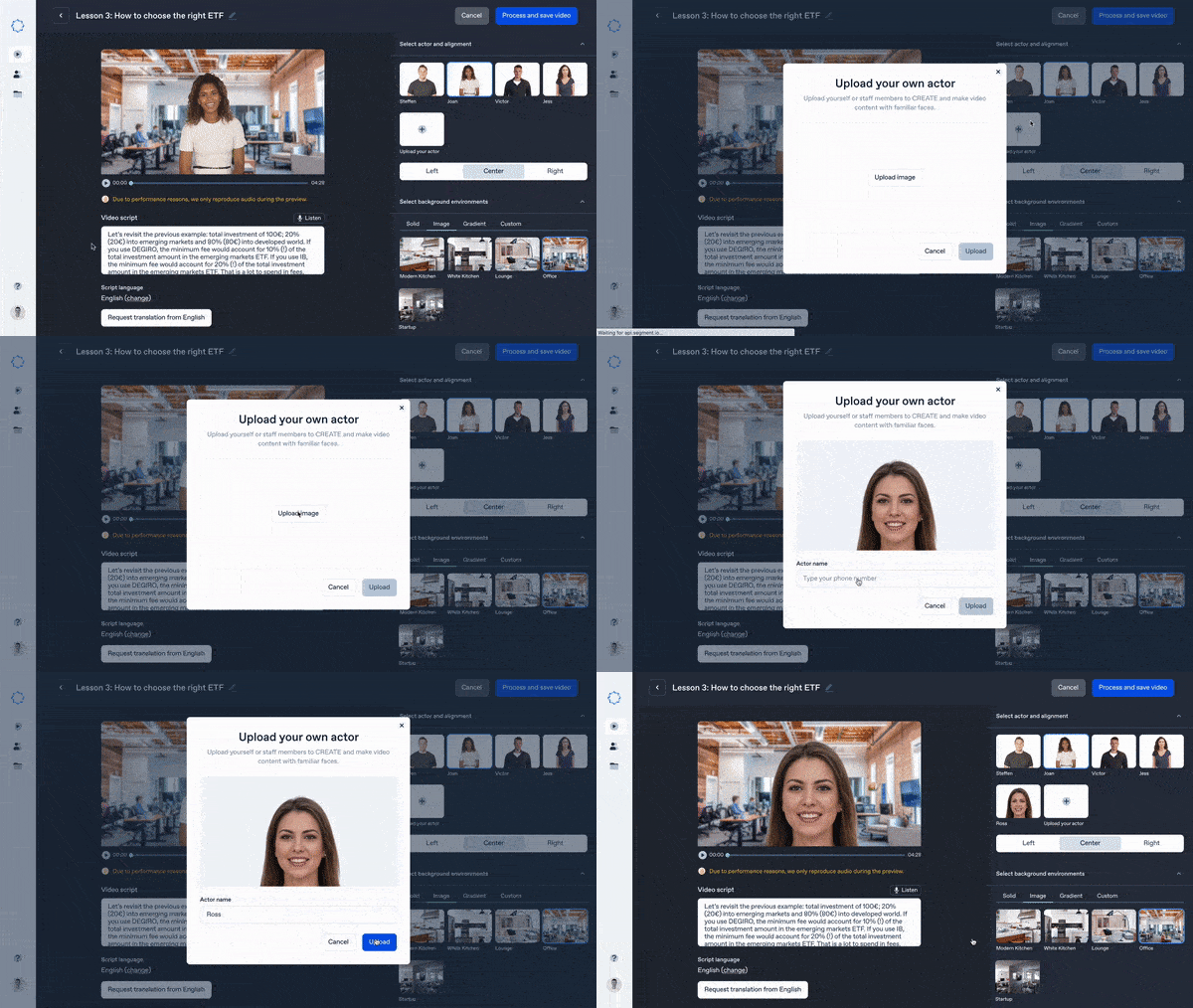
Synthesia's video production backend interface
Harry Stebbings: Though I think we're still far from achieving all this. As someone who creates content every day, I can genuinely feel the gap between current editing tools and what my team needs. These tools are nowhere near replacing human judgment. For example, deciding which clip works best as a cut — there might be multiple options, and this depends heavily on expertise.
Victor Riparbelli: I completely agree with you. When I say "all you'll need is imagination," I don't mean no skill required at all — I mean the technical barriers will drop dramatically. You won't need a professional camera, and you won't need to be a top-tier VFX master — many things will be automated.
However, this also means that storytelling, understanding content, and asking the right questions will become more important than ever.
What's foreseeable is that the value of "authentic content" will rise to unprecedented heights. Still, we'll always enjoy watching someone play piano live, or appreciating real human artists performing — these forms of creation will certainly endure.
Harry Stebbings: In five years, will we consume more human-created or AI-created content?
Victor Riparbelli: AI, without a doubt.
But the more important question is: which content actually gets presented to users? For example, if you look at YouTube, I don't know the exact data, but maybe 95% of videos get fewer than 10 views. That content already exists — but the question is, which content gets pushed in front of audiences.
Harry Stebbings: Exactly. When AI dramatically lowers the cost of content creation and massively increases supply, what does the future of content distribution look like?
Victor Riparbelli: I think about this a lot. I think TikTok is a really good example, though not everyone agrees.
Take my own TikTok feed — I'd say 90% of it is highly informational and educational. Music production, music I like, politics, tech, and sometimes I even see your face (laughs). It really is an outstanding content presentation platform.
What's special about TikTok is that it recommends based on your interest graph, not simply social connections. For instance, if you see something uninteresting, you quickly swipe past it because you know the algorithm will notice and reduce similar content. This approach is very effective, but I still think there's room for improvement.
For example, I'd want more control over the algorithm. I'd like to directly tell it which topics to stop showing me because I have absolutely no interest in them.
Additionally, TikTok uses the interest graph to effectively reach users who are deeply interested in specific areas. When you post something, the platform first pushes it to a few hundred people, then quickly gauges whether they like it. If the feedback is poor, the content gets "thrown in the trash"; if it's somewhat popular, distribution expands, thereby filtering for truly excellent content.
Judging from TikTok's user data, this approach clearly works.
Harry Stebbings: Should TikTok be banned?
Victor Riparbelli: I'm inclined to think this is more of a moral panic than a substantive issue. Obviously, TikTok has built an amazing product. I don't see it as a "brainwashing machine" or "propaganda machine."
Harry Stebbings: I share your view on social media. As you mentioned, it can be educational, or music-related. What I see is mostly motivational speeches, air fryer recipes, and workout tutorials. These things add positive value to my life.
Just as with diet — you can choose chocolate and sweets, or vegetables and fruits — everyone can design their own "content diet." So simply demonizing social media isn't fair.
Victor Riparbelli: Completely agree. In fact, there's a paradox here. Perhaps for you and me, we can harness algorithms to make them serve our life needs better.
That said, I can't deny I've wasted many hours scrolling short videos. Occasionally watching some mindless content is normal, but actually, there's a lot of excellent content being freely distributed, with algorithms working to judge its veracity.
Problems certainly exist, but we're gradually figuring out how to build a truly excellent media ecosystem. One driven by the public and experts, not journalists or politicians. At the same time, it retains some advantages of traditional media — like multiple layers of review before content is published.
The emergence of new things is the essence of human invention. Though exploration brings some negative effects, we're moving in the right direction. I'm very optimistic about the future.
Harry Stebbings: I think so too. The quality of content we consume today is fundamentally higher. This isn't a criticism of traditional media, but in VC, the quality of content I have access to is indeed far above what many journalists at major publications produce. That's because I focus on this day in and day out — it's the domain I love.
Victor Riparbelli: Exactly, completely agree. I spoke about similar topics in a TED talk a few months ago.
I made a fairly radical argument in that talk: We may be the last generation that can read and write. Regarding apps like TikTok, many people feel moral panic — like people's attention spans have dramatically shortened. These issues may indeed exist, but what if we're simply tired of lengthy, boring content?
In reality, a two-minute TikTok video might help us understand a topic better than a 20-minute YouTube video, and a 20-minute YouTube video might be more efficient than a 300-page book.
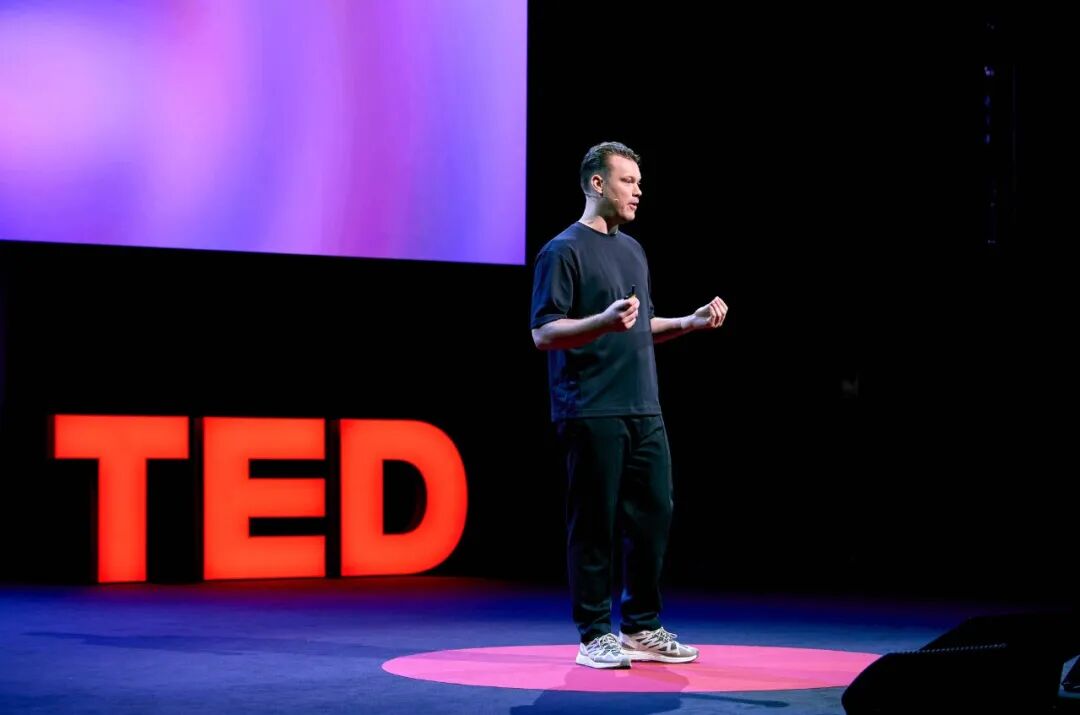
Victor speaking at TEDAI in October 2024
Harry Stebbings: What do you think of the argument that we're just dopamine addicts, preferring two-minute short videos over reading five-minute articles?
Victor Riparbelli: We're addicted to many things — you could say everyone is a dopamine addict to some degree. It's almost the leitmotif of modern life. I understand that perspective, but look at it another way: if you exercise every day, isn't that also a kind of "dopamine addiction"? Whatever we do that makes us feel good — in many cases, our behavior is driven by pursuing that feeling.
05
New Forms of AI-Generated Content Verification
Harry Stebbings: Another question is about identity abuse or fraud. How do you see the future of identity verification — including cross-platform verification and your own solutions?
Victor Riparbelli: I do think we need some level of identity verification on important platforms. Users need to know where content comes from: who created it, when, and how.
We could even extend verification to the content level itself. You know the app Shazam? You could imagine a Shazam-like tool that puts a "fingerprint" on every piece of internet content, telling users: "This image was originally uploaded by Harry five years ago."
In the future, this technology could go further. It could prompt you: "This image was partially made with Synthesia; what you're seeing now is a dubbed version." This is essentially labeling content with provenance and change records. With such a tool, every piece of content you browse, you could judge whether it's verified.
In the past, only celebrity accounts needed verification because people were impersonating famous figures to create accounts. Today, we may need to flip this logic: verify everyone and all content. If a piece of content has source information and clearly records its creation process, it could have a green checkmark; unverified content should be conspicuously marked as such. This mechanism could help users better assess content credibility, rather than only caring about verification badges on celebrity pages.
Harry Stebbings: But if some content is AI-generated, would it be seen as lower value for lacking a green checkmark?
Victor Riparbelli: No, actually we live in a world where most content is already "processed." The vast majority of photos on Instagram have been filtered or color-corrected. As technology advances, the boundary between content creation methods and authenticity will only blur further. Ultimately, content value should be determined by its own quality, not simply by how it was made.
You could create a video discussing a topic. Years later, perhaps no one can easily judge its authenticity, but that doesn't matter. What matters is whether the video clearly expresses your point. This is similar to how we approach movies now: we know they're fictional, but we care more about their quality than their filming techniques.
Of course, the creation process remains an important signal. It reflects the production context — time, creator, whether it's original or edited. Transparency around this information helps us build trust in content. Suppose you're watching a clip from our podcast; the system could prompt you: "This is clipped from Harry's full podcast. To watch the complete version, click here." Through these technologies, we can build a clear "content chain" that traces creative origins.
I mention Shazam because this problem first emerged as a business challenge for YouTube. Record labels told them: "Hey, people are uploading videos to YouTube using copyrighted music. If you don't solve this and pay up, we're suing you."
What did they do? YouTube's response was to quickly scan content when users uploaded videos, matching it against a database of billions of songs. If copyrighted music was detected, the platform would either delete the video or insert ads, with revenue shared to rights holders.
So what actually happens? You upload content, and within milliseconds, it's compared against a database of billions of songs. From just a few seconds of music, it rapidly identifies which song it is, and if it's copyrighted, takes appropriate action.
If we could apply this technology to content provenance, we could trace where a video originated. For example, when I upload an interview clip to YouTube, the system could recognize it's clipped from Harry's podcast and prompt users: "This is from content Harry published two weeks ago. To see the full version, click here." This content tracing technology would rely on a centralized database, ideally decentralized.
I don't love saying this, but this might be a blockchain system. Whenever you create content — whether making a video with Synthesia or filming with a camera — you could register it in the system immediately. When content is distributed across different platforms, users could check against the database to verify its source.
For instance, someone uses a five-year-old war photo claiming it's from yesterday's events somewhere. With such a system, users could immediately know this photo was uploaded five years ago, with community notes indicating it was taken by a BBC journalist seven years ago.
None of this is easy to implement, but we already have much of the technology to support such a content verification system. This would help us build an entirely new content ecosystem, fundamentally different from what exists today.
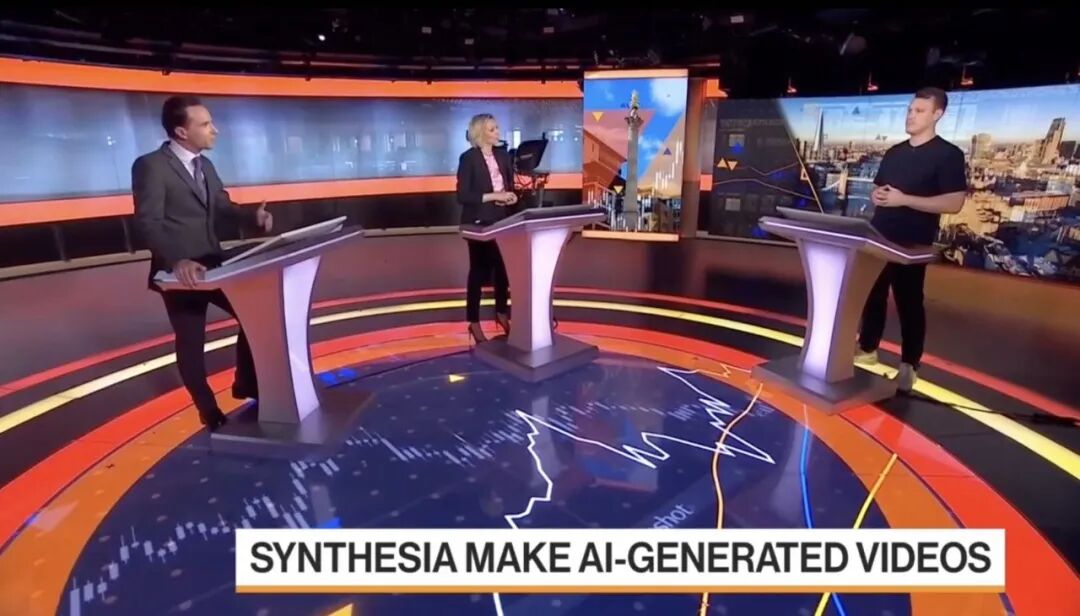
Victor discussing AI-generated video on Bloomberg
Harry Stebbings: How will this new content creation ecosystem reshape the labor market in the industry? Which jobs are at risk, and which ones will be created?
Victor Riparbelli: Highly technical roles like camera operation will likely fade away. The future will place far more emphasis on creativity, storytelling, and how to make content resonate. These elements are the core of great content — more important than ever.
Harry Stebbings: If you were a YouTube video designer or VFX artist today, what threats and opportunities would you face?
Victor Riparbelli: Actually, I think most roles will naturally transition into other areas, provided practitioners stay open to change. With visual effects, for instance, AI can handle the first pass — better than something slapped together carelessly, but far below what a skilled human can craft. However, if you integrate AI into your workflow, you can dramatically boost both efficiency and output quality.
Take a two-hour episode: AI can automatically surface every potentially interesting clip for you to choose from. If you're a VFX artist, your role might shift closer to that of a software engineer. With AI assistance, your productivity could improve a hundredfold — no longer needing twenty people to model someone's face for a digital clone. You just input commands or apply light controls.
I believe there will be more content creators in the future than there are today. Before the internet and personal computers, very few people could create text. In the 1930s and 1940s, for example, most people weren't involved in text creation — that work was typically done by secretaries or typists. Now, virtually everyone is constantly creating content.
The bottleneck for AI rapidly integrating into our daily lives isn't actually technological. As I mentioned earlier, we already have very powerful LLMs capable of impressive tasks. The real obstacle is human. People need to learn to use these technologies, trust them, pay for them, purchase them, and weave them into their lives. Technology has always developed this way — adaptation simply takes time.
Starting Up: London or Silicon Valley?
Harry Stebbings: Last question — as a Londoner, I love that you chose to build here. But it seems like an unusual choice. Why London?
Victor Riparbelli: Honestly, we chose London because I couldn't get into the US at the time. Before founding Synthesia, I didn't have a particularly impressive track record. The US has work visa requirements, and I had a hard time securing one. In the UK, I had some friends, so I decided to give it a shot — and that's how I ended up here.
Harry Stebbings: If you had been in the US, how would Synthesia be different?
Victor Riparbelli: I think our odds of success would probably have been higher on the US West Coast. There are many advantages there, especially as the American startup environment has matured over the past six or seven years. That said, I also see Europe advancing rapidly — the gap is narrowing.
Harry Stebbings: What are the advantages of working in London?
Victor Riparbelli: One major advantage is talent. This cuts both ways. Silicon Valley's ecosystem certainly attracts top-tier talent, but costs there are extraordinarily high, and loyalty is relatively low.
In Silicon Valley, many people view their careers as building a portfolio of stock options across different companies, hoping one hit brings massive wealth. That mindset is understandable, but it also means the employer-employee relationship is more transactional. If a company struggles, employees may jump ship quickly — you can lose a lot of great people within a few quarters.
By contrast, European talent tends to be more loyal. People place more value on working somewhere they enjoy, with excellent colleagues, solving interesting problems. While employees here are less enthusiastic about stock options, it also creates more stable teams.
If a company isn't doing well, new opportunities can lure them away, and you might lose many excellent people within a few quarters. In Europe, I think the mindset is somewhat different — people often view stock options more like a lottery ticket than part of their salary. In Europe, almost nobody knows anyone who got rich working at a startup. We don't have that many success stories.
Harry Stebbings: Do you think European attitudes are changing?
Victor Riparbelli: I do see some change, but it takes time.
At Synthesia, my employees may read a lot of news about startup successes, but they pay more attention to whether anyone they know personally made $2 million from a startup.
In Silicon Valley, nearly everyone knows someone who made serious wealth working at a startup. These direct success stories make people feel they could do it too. In Europe, that experience is still rare. Real change requires a larger ecosystem, more exits, and bigger companies. It will happen, but it takes time.
Harry Stebbings: Do people work just as hard?
Victor Riparbelli: I don't find that people in Silicon Valley work particularly hard. I have friends who've set up offices there, and the feedback I've heard doesn't include "people work incredibly hard." In fact, this is more of a personality trait than a geographic one. The average Silicon Valley software engineer doesn't work harder than their European counterpart.
Harry Stebbings: Why do you think the startup environment here is improving? I feel like the past six months have shown the opposite.
Victor Riparbelli: I agree — it all depends on what the new government does. I think they have a lot of good cards in hand, and many excellent companies are growing here.
London is cultivating global leaders, not just regional winners in certain sectors. For example, ElevenLabs is at the forefront of voice technology. Our company is a leader in enterprise AI video. There's also Wayve, doing outstanding work in autonomous driving. London has many such companies growing into global leaders.
That said, I hope the new government doesn't screw this up.
Harry Stebbings: How could they screw it up?
Victor Riparbelli: I think through the usual issues like over-taxation — everyone talks about these. What I think they can do is improve Britain's brand image.
Harry Stebbings: What do you mean?
Victor Riparbelli: We may disagree on this. But from my perspective, the UK is a relatively good place to start a company. I'm from Denmark, and frankly, it's terrible for entrepreneurship — nearly impossible.
UK tax relief schemes like SEIS and EIS have done a lot to improve the startup ecosystem. Although the UK venture capital ecosystem remains PE-dominated, it has genuinely progressed. Still, it could be screwed up. In fact, I've seen many people leaving, especially under the recent government.
Harry Stebbings: My phone rings almost daily with questions like "Where are you moving? Any advice? Where should I go?" These almost always come from founders of billion-dollar companies. If you were face-to-face with UK Prime Minister Keir Starmer, what advice would you give to keep the best developers and founders building here?
Victor Riparbelli: There are obvious measures — lowering corporate tax, continuing entrepreneur tax relief policies, making the UK more attractive. Compared to many European countries, the UK actually does well on these. But I think it's also about cultural attitude. Danish culture may be more negative. Moving to the UK, I've seen many positive aspects.
Most importantly: don't break what's working. For example, avoid raising taxes excessively, ensure excellent tax relief schemes continue, and keep encouraging job creation and economic productivity. At the same time, address brand-level issues like rising crime rates and increasing cost of living.
Harry Stebbings: Plus the consistent negative sentiment from a Labour government. They should stand up and say "London welcomes entrepreneurs" instead of constantly criticizing and devaluing the city.
Victor Riparbelli: Completely agree. This is indeed closely tied to the brand issue. While many want to go to America, plenty are also willing to come to London — especially Americans.
I've found it easier to attract people from Silicon Valley to London than to New York, which may sound counterintuitive. Many want to experience the European lifestyle, appreciate the cultural heritage, and enjoy London as a cultural melting pot. These are reasons I personally love London. With more effort on branding, London could attract more excellent talent to build here. But the foundation is maintaining existing good policies.
If you compare taxes between California and London, there's no dramatic difference. California's taxes are also high, and the startup environment isn't easy. However, the UK needs to double down on support and maintain positive momentum. As long as no major mistakes are made, and one or two companies with market caps exceeding $10 billion put down roots, the entire ecosystem will truly flourish.
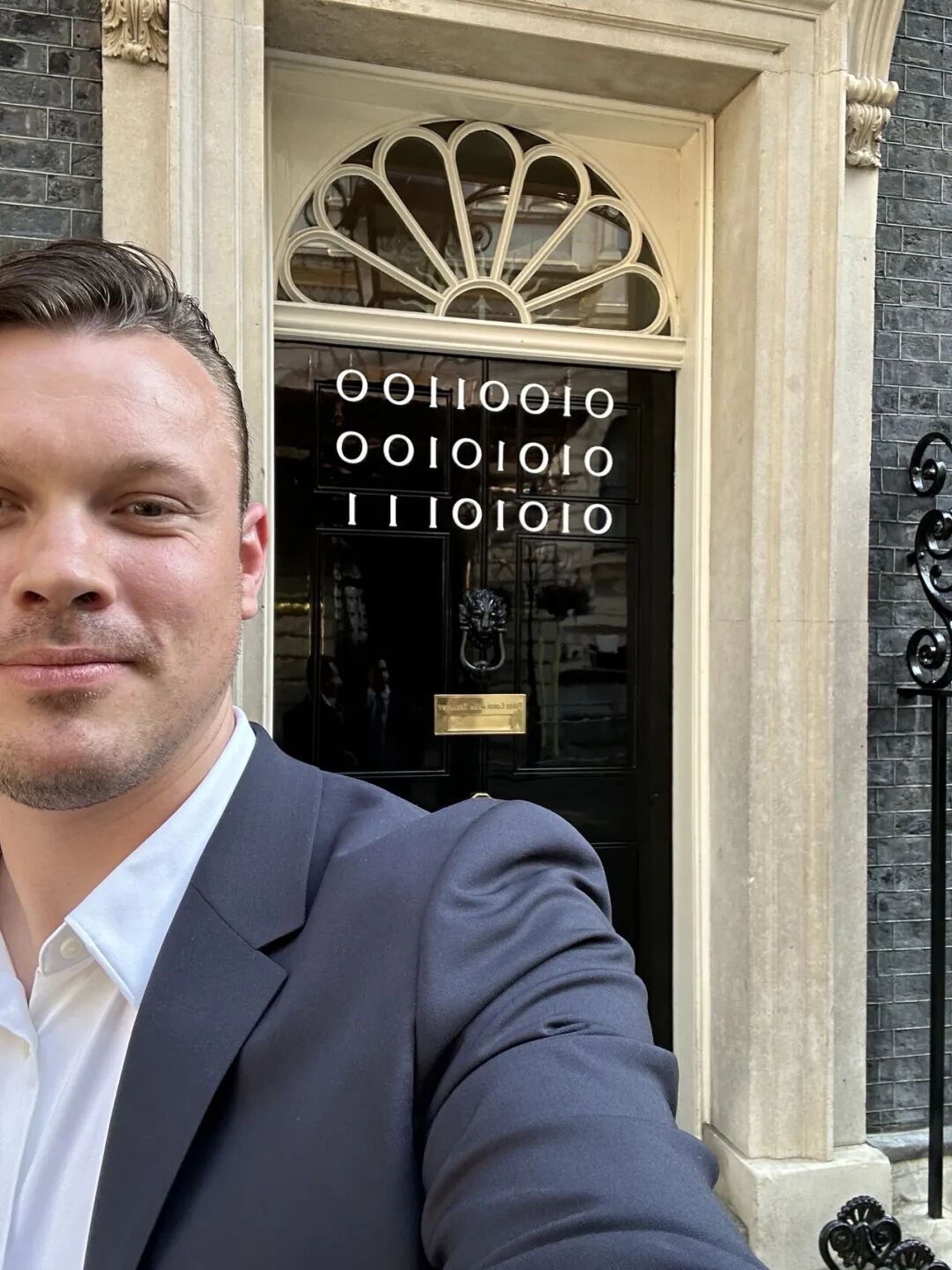
Victor is frequently invited to participate in discussions with the UK government and the Department for Science, Innovation and Technology (DSIT), and took a selfie in front of 10 Downing Street
Harry Stebbings: If several $10 billion-plus companies do emerge, where would they list? That's the key. I'm guessing Synthesia might choose the Nasdaq.
Victor Riparbelli: The London Stock Exchange, you know (laughs) — its big problem is that it needs liquidity injected into the system. I'm not a finance expert, so I don't know exactly how to fix it, but it's clearly a major issue. We've seen many excellent companies stumble because of this.
Harry Stebbings: Do you really think that's a problem? Liquidity can be found in any market. What matters is whether Synthesia's listing on the Nasdaq could also make a thousand employees at your London office millionaires through early equity?
Victor Riparbelli: I agree. Though this isn't one of the top three problems I think most need solving.
Harry Stebbings: Then what are the top three problems?
Victor Riparbelli: Keep tax relief policies for entrepreneurs — especially those who genuinely create value — and make them even better. That's incredibly attractive to founders.
Governments can do other things too, like subsidizing GPU costs, particularly to support building data centers in the UK. That's a real competitive advantage.
At the same time, avoid over-regulation. We haven't seen too much of it yet, but there's definitely been a shift in attitude from the last government to this one. Don't look to Europe as a model. Europe has a whole framework of AI regulation and almost no AI companies.
Stay the course, avoid major mistakes — that's what matters.
Games as Life: Decision-Making at the Core of Entrepreneurship
Harry Stebbings: Let's do a quick-fire round. What do you believe that most people around you don't?
Victor Riparbelli: I think playing video games might be one of the best ways for a kid to set themselves up for future success.
Harry Stebbings: Why do video games make someone better suited for entrepreneurship? Tobias Lütke, CEO of Shopify, once said that if you can run a gaming guild, it's more effective than going to university.
Victor Riparbelli: That's literally what I did back in World of Warcraft. We were the first generation to have access to complex strategy games.
Life is largely a process of decision-making, and video games are a microcosm of the universe. In games, you can repeatedly simulate different scenarios. Parents might think you're just playing Warcraft III and Red Alert, but what you're actually doing is training yourself to make rapid decisions at scale and understand the potential impact of each one.
Life is a game. Career is a game. Entrepreneurship is a game. Our generation was the first to have the opportunity to run so many decision simulations in a compressed timeframe through gaming. Before computers, this was unimaginable.
In the past, you couldn't simulate running a company — you just had to start and run one. Now, by playing RollerCoaster Tycoon, even getting to 20% of what a real theme park CEO does teaches you incredibly valuable lessons.
The decision-making ability and strategic sense you build through gaming are precious because games provide bidirectional feedback mechanisms. Compared to reading alone, video games offer continuous, immediate feedback — making them far more powerful.
Harry Stebbings: What trait has helped you succeed that you're embarrassed to admit?
Victor Riparbelli: I'm broadly knowledgeable but not deeply expert in any one thing. When I was young I wanted to be an artist, a programmer, a developer — but never truly mastered any single one. I still harbor dreams of making music.
I'm curious about many things across a wide range, including how elevators work and Norwegian black metal. I used to be frustrated by my scattered interests, feeling I couldn't focus deeply enough to become the best in the world at something — the best music producer, programmer, or AI researcher. But now I realize this breadth is my advantage.
In my role, decisions and creativity are central, and these often come from the subconscious. The richer the knowledge you have stored in your mind, the more it helps with analogy and pattern recognition — and the stronger your judgment becomes.
Harry Stebbings: Someone told me you're the company's "resident DJ." Another question — someone once said: "The heaviest things in life are not iron or gold, but unmade decisions." What path not taken bothers you?
Victor Riparbelli: I studied computer science and business in university, but I've always regretted not focusing on a single STEM discipline. Most of business school isn't practically useful — the core ideas number about ten, and once you grasp those, you're set. I should have gone deeper into technical fields.
Harry Stebbings: What have you changed your mind about in the past 12 months?
Victor Riparbelli: The recent AI boom has reinforced a lesson for me. The market has seen many new competitors raising lots of money, which can occasionally feel noisy — even creating impulse to mimic their moves. But I'm more convinced than ever: don't let others' actions make you anxious, and don't over-focus on competitors or industry trends. Always listen to your customers. They're the ones paying for your product and the ones you truly need to please.
Harry Stebbings: If your next company could only have one investor from your existing roster, who would you pick?
Victor Riparbelli: I'd choose Mark Cuban again. He was the one who truly believed in us when we had nothing, and I'll always be grateful for his trust.
Harry Stebbings: That's definitely making the highlight reel! What aspects of your parents' parenting would you deliberately avoid with your own children?
Victor Riparbelli: My parents' generation believed computers would make people socially isolated — that you were just sitting there chasing dopamine hits, much like how many people criticize TikTok today. But the reality is far more nuanced.
For me, playing video games was a social activity because you played with others online. They struggled to believe you could be friends with people you'd never met in person, tending to see gaming as wasted time. But in fact, strategy games develop decision-making skills. I'll encourage my children to play good computer games in moderation.
Harry Stebbings: Final question — you've already been through a secondary exit. Is it really as liberating psychologically as people say?
Victor Riparbelli: It really is. When you're no longer worried about financial pressure and don't have all your wealth tied to a single stock, you can indeed make more rational decisions.
I strongly recommend taking some money off the table through secondary exits when you have the opportunity. Without that exit mechanism, you might feel forced to consider selling the company earlier, leading to irrational choices.
Harry Stebbings: This has been one of my favorite interviews. It's remarkable to see someone I met years ago now sitting here as a guest. Thank you so much — this conversation has been fantastic.
Victor Riparbelli: Thank you, I've really enjoyed it too.
Translated by Cindy
Edited by Wendi
Recommended Reading