The First Streamer to Beat *Black Myth: Wukong* With Motion Controls — Defeating Bosses With a Wave of a USB Device

The next century-defining hardware company will emerge from China.
In the Three Realms and Four Continents of Black Myth: Wukong, in the rolling hills of Hyrule from The Legend of Zelda, in the vast world of Teyvat from Genshin Impact — plug a small USB device into your computer, and you become the protagonist. You run, you fly, you stumble into wonder, racing through worlds woven from light and shadow.
This is motion gaming: using your body to sense, to enter an imagined world.
Play and run, play and run — and Rong Sijia built Action&Link. On the path to helping more people enjoy movement, he himself shed over ten pounds.
From writing the first line of code for XPeng's Robotaxi to diving headfirst into motion gaming, he discovered a shared underlying logic between the two: visual signal in, control signal out. If these algorithms could achieve high-precision, low-latency "vision-to-control" conversion on a vehicle's computer, why not on a personal computer or game console? Gaming has always been one of the most cutting-edge arenas for algorithmic application. If this capability could be transferred to games, wouldn't that be the future of motion gaming?
In August 2024, the phenomenon that was Black Myth: Wukong delivered unprecedented visual and combat spectacle. Rong Sijia (@CyberLinker) went live with his gear, slaying demons while running in place — yet only one or two viewers tuned in that first night. Funding was the last thing on his mind; he just wanted to see one thing through. So he reviewed his streams obsessively, analyzing which lines kept viewers watching, which bosses drew the most interest. To better showcase how motion gaming synced with bodily rhythm, he even spent a week learning dance. Then on New Year's Day, January 1st, his Bilibili stream shot to #1 in the gaming category. Tens of thousands watched this "Destined One" take the field, making him the first person on the entire internet to complete the game with motion controls.
"Knowing one's destiny" carries many meanings. It can mean accepting what lies beyond human effort. It can also mean a person's awakening to what they most want to do with unwavering focus.
That day, as motion gaming proved itself in the livestream, Rong Sijia felt something shift: "My career as an employee probably ends here."
He believes the next great century-old hardware company will be born in China. Sports and entertainment are humanity's most ancient needs. Herodotus wrote in The Histories that people originally created games to find virtual solace amid hunger. Today, in an age of material abundance, games satisfy a higher longing — the connection between body and spirit, between person and world.
In Action&Link's player community, this connection is quietly taking root. More and more people are customizing motion sets for their favorite games, sharing them with fellow players. A small USB doesn't just connect person to game, reality to imagination — it connects people across the world who share a single passion.
The Action&Link Portal, the world's first entry-level full-body motion gaming peripheral, is about to officially launch — letting players adventure and move more immersively in whichever game worlds they love.
A century may seem distant, but every run brings the goal closer.

Leaving XPeng's Self-Driving Team to Build a Startup Turning Every Game Into a Motion Game
Q: Sijia, please introduce yourself and what you're working on now.
Rong Sijia: Hi everyone, I'm the founder of Action&Link (Dongyu Technology). Dongyu Technology was founded in 2023. We make intelligent motion gaming peripherals. Our goal is to turn all ordinary games into motion games — letting people play with their bodies, moving, exercising, and adventuring in worlds they love.
I did my undergrad at Sichuan University. During my first and second years, I competed in some robotics competitions and won second prize in the Ministry of Education's national robotics tournament. I later transferred to the University of Pittsburgh, majoring in mechanical engineering and computer science. After returning to China, I joined XPeng's Robotaxi project. I wrote the very first line of code for the remote driving system.
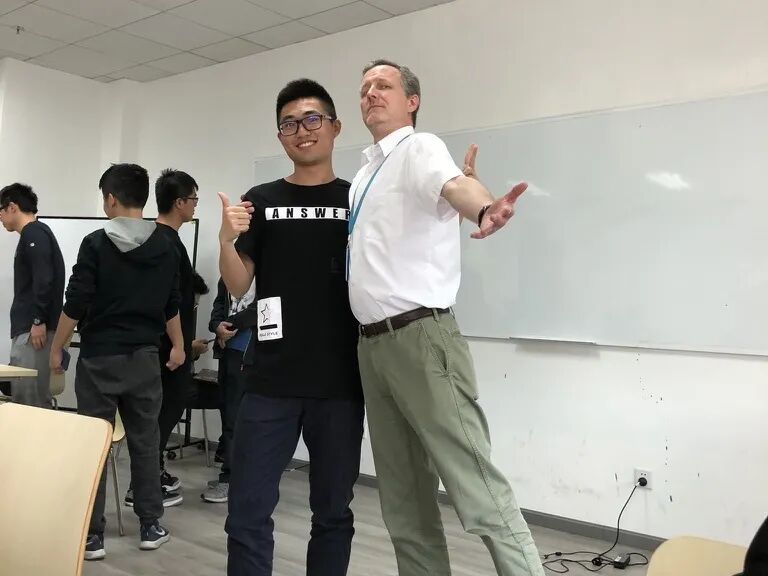
Rong Sijia (left) during his undergraduate years
For various reasons, the project didn't continue. I then joined a startup called Fitplay to work on open-world motion games, mainly responsible for the motion engine algorithms. We followed the traditional approach: developing algorithms, hardware, and a game simultaneously to create a complete motion game experience. But it never made it to market, which was a real shame.
I've always believed in this direction, though, and accumulated a lot of thinking along the way. So I decided to go out on my own and try a different approach. Instead of making a "dedicated" motion game, we wanted to make any game playable with motion controls.
I'm someone who genuinely loves gaming. Everyone has their "games of a lifetime" that they want to immerse themselves in more deeply. Since so many excellent games already exist, why rebuild from scratch? So what we're doing is taking motion technology itself to the extreme, making it seamlessly compatible with any game.
Q: I noticed you recently updated your logo. Could you share the story behind the name Action&Link and this new design?
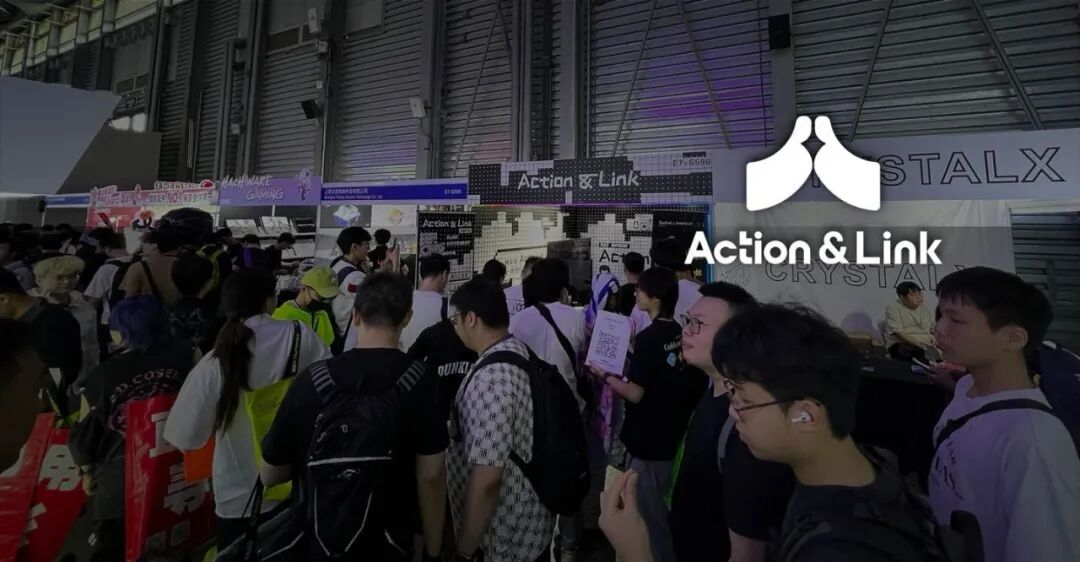
Rong Sijia: We chose Action&Link to express "linking real-world actions (Action) to the virtual world (Link)" — connecting your physical movements to your favorite game worlds. We want to be that bridge.
Our logo's design inspiration comes from the gesture of clapping hands or two thumbs touching. It symbolizes connection and interaction, because the most important thing in both gaming and sports is the connection between people. The logo carries both dynamism (Action) and linkage (Link), like two people interacting.
Q: Why did you leave XPeng's autonomous driving team for motion gaming?
Rong Sijia: Mainly personal interest. I've always loved games. As a kid, I was among the first users of Kinect — around elementary or middle school.
I left XPeng at the end of 2022, right when autonomous driving was transitioning from traditional perception-planning-control architecture to end-to-end approaches. We found that with new AI algorithms like Transformer, you could take camera image signals, process them through a series of steps, and directly output control signals.
That's the core framework of autonomous driving: image signals in, control signals out, vehicle controlled. And motion gaming is essentially similar: visually perceiving human motion, then converting it into control signals to drive the game.
I started thinking — if these algorithms can achieve highly precise, low-latency vision-to-control signal conversion on a vehicle computer, why not apply them to personal computers or gaming consoles? Gaming has always been one of the most cutting-edge arenas for algorithmic application. If this vision-to-control capability could be used in games, wouldn't that be the future of motion gaming?
Q: Is your latest product what you originally envisioned? What changed between idea and product?
Rong Sijia: From 2023 to now, the broad direction hasn't changed. There were some tactical adjustments in the details, but the path has been clear.
From the start, we used first principles to think through the endgame: visual signals in, control signals out. The core questions were how to acquire visual information at low cost and high efficiency, and how to make control signals compatible with more devices.
We did extensive research and validation early on, finding the optimal solution for this path. We hit some obstacles along the way and had to detour, but the overall direction never changed. Because this path itself is the shortest one.
Q: What user pain points did you observe early on? Why did you ultimately settle on your current product form?
Rong Sijia: I believe any technology without market support is a castle in the air. We took market validation very seriously from the beginning.
In 2023, we shot a few short videos and posted them on Bilibili to test market response. The first video went viral. That was essentially our first large-scale market research. It directly validated the direction's feasibility: if we could execute the technology well, there would be users willing to pay for such a product.
We also studied previous motion devices. Though they reached end-of-life, they were tremendously successful at their peak, shipping tens of millions of units. Consumer electronics at that scale inherently indicate a large enough market.
Q: What was in that first video? Did you already have a product then?
Rong Sijia: It was mainly a proof of concept. I knew in my own mind the technology would work, but we wanted others to see it, to believe it was really possible. We used a development board and our self-developed software to build a demo,打通 the entire technical pipeline: video signal input, computational processing, outputting control signals to manipulate the game.
Q: Which game did you film?
Rong Sijia: It was Genshin Impact, which was very popular at the time. Though honestly, I had a bit of personal bias. Initially I wanted to make a "Zelda motion edition" because that's my favorite game. But we hadn't yet developed the hardware-level capabilities to interface with Switch, so we started with Genshin Impact on PC, another favorite. Now we already support playing various games on Switch.

Rong Sijia experiencing Action&Link Portal with Genshin Impact world exploration

How Motion Control Works
Q: What exactly does the Action&Link product do?
Rong Sijia: Our core product right now is a motion controller called Action&Link Portal. It's a small USB device — you plug it into your computer, pair it with our app, and you can control any game you like using body motion.
We currently support PC, Switch, and both Android and iOS phones. For example, if you plug our device into a Switch, open the app, you can use motion controls to make Link run around Hyrule. You run, Link runs with you. You jump, Link jumps too.
Q: Do you emphasize the fitness aspect? What are the main use cases for users right now?
Rong Sijia: The core is immersive experience. But many of our users, beyond enjoying the thrill of running through different game worlds — Hyrule in Zelda, Teyvat in Genshin Impact — also use it as a way to move more and stick with fitness.
Our app automatically tracks daily exercise duration and step count, and encourages you to do more. Especially for people who want to game after work but also want to exercise. Like me — in school I could game all night, but after starting work I felt the need to exercise, yet didn't want to give up gaming. So combining the two would be perfect.
And we've actually achieved that: you're running in-game, gathering items, completing quests — it's like exercising on a treadmill. You finish a session drenched in sweat, very healthy. I've lost quite a bit of weight this way myself.
Q: On human-computer interaction, many people believe VR is the ultimate form, and motion gaming might just be a transitional solution. What do you think?
Rong Sijia: I think VR/AR in gaming can actually be considered a subset of motion gaming. Personally I don't rule out doing VR/AR — it's just that display technology isn't mature enough yet. VR/AR interaction is already responsive with low latency, but the devices themselves are too heavy, the wearing experience isn't good enough. What we're more focused on now is motion interaction itself — the "how humans output" part.
I believe the device that truly achieves immersive experience in the end might not necessarily be a headset. That might just be a transitional phase. What we're doing now is liberating human-computer interaction capability from the headset, making it work on ordinary monitors and TVs. In other words, what we're doing is: bringing VR interaction methods into the broader world of gaming.
Q: If I'm using Action&Link and want to experience "flying" in Zelda, how would I operate it?
Rong Sijia: Very simple. Say you're playing Zelda on Switch — plug in the device, open the app, then you just jump, and Link jumps with you. Jump again, or spread your arms, and you deploy the paraglider to fly.
We support user-customized motion mapping. You can set any motion to any in-game action — raise your hand to glide, turn your body to steer, control Link to fly up, down, left, right. Very fun.
Q: Do you update motions based on player feedback? Any memorable examples?
Rong Sijia: Yes. For instance, one user wanted the "turn head" motion to feel more natural, so we customized a mapping for him: when he looks left, the in-game camera turns left; look right, camera turns right. This essentially replaces the head tracking function of VR headsets — except we moved the display from the heavy headset to the more comfortable TV.
Q: Do you provide a default motion control scheme for each game?
Rong Sijia: Right, for most popular games we have official motion sets and operation guides. Users can start playing right out of the box.
At the same time, we also have many users who upload their own motion sets to the community, because we're a UGC-supported platform. People can design their own motion controls through no-code tools, share them with the community, and other players can use your designed motions to play their favorite games.
Q: Why did you choose to do hardware? Many companies are trying pure software solutions now.
Rong Sijia: This goes back to what we talked about earlier — "from video signal to control signal." Control signals are now almost all implemented through the HID (Human Interface Device) protocol — keyboards, mice, controllers, these input devices.
I don't know if people have ever thought about this: why can keyboards from any manufacturer plug into Mac or Windows and work immediately? This seems obvious now, but decades ago it wasn't like this. In the 80s, if you bought a keyboard, you had to install drivers on your computer, or it might only work with computers from the same brand. Peripheral compatibility was nowhere near as convenient as today. Getting to where we are now was the result of long-term protocol evolution and standardization in the industry.
Because all computers today natively support HID, if you want to make a universal product that "lets computers understand human motion," the most suitable approach is to make it hardware. Like keyboards and mice — no drivers needed, plug and play. That's the core reason we ultimately decided to do hardware.

UGC Community Growth: The Unexpected Discovery of Being the First to Complete Black Myth with Motion Controls
Q: How many users have uploaded motion sets to your community now? Are there any games where UGC content is more popular than the official scheme?
Rong Sijia: We have about 1,000 beta users now, with several dozen having uploaded motion sets. JX3 Online has a particularly good community atmosphere — not the most players, but everyone's eager to share their motion sets. It might not be the game with the largest user base, but it has the most UGC content.
Q: Speaking of hot games, you were also the first person on the internet to complete Black Myth: Wukong using motion controls. Can you talk about that experience?
Rong Sijia: Black Myth was super popular at the time, so I played it too. It's genuinely an outstanding domestic game — I hadn't expected a Chinese game could reach that level. We thought, since it's so good, we had to try it with our device. The results were surprisingly good. It worked with the game almost without any additional development or adaptation code. That was the first time we felt the product was ready for mass production and wider promotion.
Actually, Black Myth is difficult to control, but it also has a rhythm-game feel. The controls are just one or two buttons. You need to quickly respond based on monster feedback.
So we discovered Black Myth is also very well-suited for motion gaming: when monsters make moves, there's often an audio cue. You quickly make a motion — if you nail the timing, you hit the monster, see through their attack, or pull off something really flashy. That positive feedback is very strong, it pulls you into a loop. It's a bit hard at first, but once you get the rhythm, it gets very addictive. I highly recommend everyone try playing Black Myth with motion controls.
Q: I heard you also livestreamed the whole process? Did you run into difficulties when you first started streaming?
Rong Sijia: It was really hard at first. I knew nothing about streaming back then, a complete newbie. We just grabbed a PC, connected a TV, and started broadcasting. Almost nobody watched at first — maybe one or two people a day. The team was just starting to grow, the beta version was already on sale, and we wanted to quickly validate whether the product could work in the market, so the original intention was promotion.
I wasn't even thinking about fundraising then — I just wanted to push through on my own. So every day I worked like crazy, then reviewed: which sentences kept viewers watching longer, which boss fights concentrated the audience, what kinds of interactions worked better. Only later did I gradually realize how important interaction is — how to respond quickly, how to guide viewers. I learned bit by bit, improved step by step.
I remember very clearly, we started streaming on December 26th, and for a whole week there was almost no positive feedback. But on January 1st, New Year's Day, our stream suddenly blew up. We hit Top 1 streamer in Bilibili's Black Myth game category. Over 13,000 people were watching live that day — that was when we really went viral.
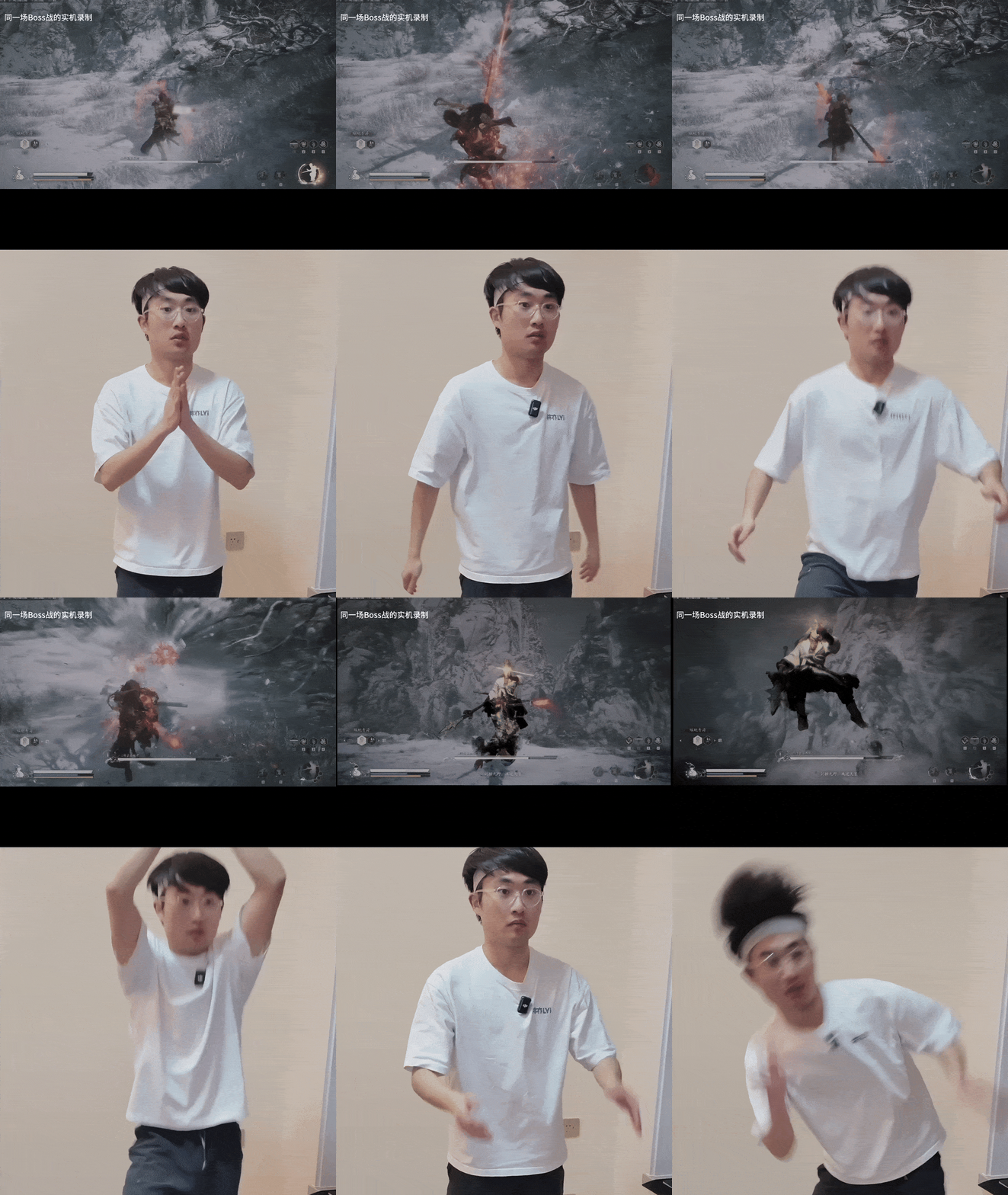
Rong Sijia (@CyberSpirit) livestreaming motion-control completion of Black Myth on Bilibili
Q: How many people bought your product because of that stream?
Rong Sijia: That one stream sold several dozen units. But more importantly, many people watched the replay afterward, and sales kept growing over the next two to three days. In total, that one stream probably brought in over a hundred orders. After that we streamed every day, kept reviewing. By April or May, sales were steadily climbing. At that point, livestream revenue alone could cover costs and break even.
Q: Did streaming and making videos help you?
Rong Sijia: Yes, a lot. Because motion gaming itself requires body coordination and a sense of rhythm — that helps with making videos and streaming. I even spent a week learning dance specifically to showcase the device, a little talent show. I like to take every detail to the extreme, fully committing within limited time.
Q: Was there any piece of user feedback that impressed you deeply, even influencing product decisions?
Rong Sijia: I think it might not be any single piece, but rather the overall trend. Our sample size is still not huge, but statistically, the people who like our product most are those who "want to exercise and also love gaming."
This user group is our core demographic. We've also thought about: in the short term, should the product lean more toward "immersive experience" or "helping users exercise"? Long-term these don't conflict — the more you do, the more immersive it gets. But short-term, while the technology isn't fully mature, we've decided to prioritize the "exercise + gaming" crowd. Helping them develop better exercise habits is the direction we'll focus on next.
Q: If I play games through your product, can I know how many calories I've burned?
Rong Sijia: Yes. We calculate consumption based on your height and weight, and unlike ordinary step-counting apps, we can accurately measure your real step count. As long as your height and weight are entered accurately, our calorie estimation is among the most precise on the market.
Q: Do you have any comments that left a particularly deep impression?
Rong Sijia: What impressed me most were still the early comments. One user posted on Xiaohongshu that when he used our product to play Horizon, seeing his beloved car running along with him, he was deeply moved in that moment.
I was moved too. On one hand, it was the first time I felt a user loved our product so much — made the past two years feel worth it. On the other hand, he gave us new inspiration. We hadn't thought before that racing games could be played with motion controls. In that moment I realized, the most important thing about building a community product is not limiting users' creativity. You need to give them as much space as possible, let them create, let them invent playstyles you never thought of.
My days as an employee probably end here
Q: Was founding Action&Link a natural decision? Was there a leap-of-faith moment?
Rong Sijia: I think it was pretty natural. I'd always planned to accumulate experience across different types of companies — big corporations, startups, try them all. And I did. I'd done a lot of 0-to-1 work, and done it pretty successfully. At that point, I felt like my days as an employee probably end here.
Right around then, I saw the opportunity in motion-control gaming — a huge market. I assessed it and felt my skill set was a strong match. The past two or three years have validated that I can run this business line on my own.
Q: If you had to describe yourself in one word, what would it be?
Rong Sijia: Focused. I like to take things to the extreme.
When I'm working on something, I wouldn't notice if the sky fell. Sometimes when I'm coding, I have no idea what's happening outside. I can enter that state completely even in a very noisy environment. And I don't care much what others think of me — I'm more focused on doing what I've decided to do well.
When I was a kid, if I really wanted something — say, that Iron Leaguer base model — and my parents wouldn't buy it, I'd find a way to earn it myself. I couldn't go out and work, so I'd help my grandparents at their place. They had a small vegetable garden, and I'd do chores to earn pocket money. It was a small thing, but that was my personality: whatever I wanted, I'd find a way to get it done.
Q: Going from working alone to building a team and running a company — how did your mindset shift?
Rong Sijia: At first I did it purely out of interest. I'm a developer by background, so I wasn't thinking very commercially. It was more exploratory — I wanted to solve problems that others hadn't cracked.
A lot of critical things in the startup process still need to be done by the founder personally. I think the founder has to have this ability: solving problems that others haven't solved, whether technical or in market communication.
So initially it was just me with one or two people, focusing on the hardest problems first. My habit is to bite off the tough stuff first. Issues like algorithm latency and accuracy — these have mature solutions in autonomous driving, but in motion-control gaming, there were still many unsolved gaps in between. I wanted to validate those gaps first, get the technology, business model, and operations running, then expand the team. Lower risk that way.
Q: After the team grew, did you face new management challenges?
Rong Sijia: Yes, honestly I wasn't in management roles at big companies before, so I did face quite a few challenges at first — like how to assign tasks reasonably, how to align everyone's progress. Later I developed a method: break tasks down extremely finely, as "atomic" as possible.
This actually benefited from my experience running the entire business alone. I know every link in this business chain very well. I particularly love an algorithm called Divide and Conquer. If you can break a big problem into a pile of solvable small problems, you've already solved more than half of it.
The rest is assigning these tasks to the right people, continuously aligning and giving feedback — positive feedback for good work, help to improve when it's lacking.
Q: What was the first major difficulty you encountered in your startup journey?
Rong Sijia: Not enough people, had to hire. We've brought on some interns as a transition, and also opened campus recruiting and social hiring. My habit is to first get my hands dirty solving problems myself, and only hire when I'm truly overwhelmed. I want to have personally done all the critical steps, so that when I hire later, I'm clearer about what kind of people I need.
Q: What traits do you value most when hiring?
Rong Sijia: Passion and problem-solving ability — just these two. If someone genuinely loves this thing and is self-driven, management costs go down.
Q: I saw you're also recruiting game motion-control testers on Xiaohongshu?
Rong Sijia: Yes, the most important thing for this role is genuinely loving games. The ideal state: they can turn their hobby into work, and work feels like play. They're happy, and we get better results.
Q: What's your favorite interview question?
Rong Sijia: What games have you played? Why do you like them?
Q: As CEO, what do you see as your most important job now?
Rong Sijia: I think it's constantly discovering problems, breaking them down, solving them. At every stage the company reaches, there are always some most critical problems. I need to first identify them, prioritize them, then assign them to the right people. Doesn't matter who solves it — the core is constantly solving problems.
Q: How has entrepreneurship affected your life?
Rong Sijia: Entrepreneurship, especially as the team grows, I've had to start planning my time more precisely. Before it was all in my head; now I put my schedule on the calendar so the team knows what I'm doing. Because I'm now the most central role in the team.
From a life perspective, on the surface not much has changed — still eat and sleep as usual. Just can't stop thinking about business. Even resting at home on weekends, I'll unconsciously think about work matters. I've always been used to keeping myself very busy, still am. It's just that work has completely merged into life. It becomes part of you, impossible to turn off.
Q: If the you who was still at XPeng back then came to apply at Action&Link, would you hire him?
Rong Sijia: I would. Why not? Passion for things, plus ability to solve problems — these two are enough.
Technology belongs to all humanity; patents only last 20 years
Q: What's the one thing you're most dissatisfied with about your product right now?
Rong Sijia: I think it's still a semi-finished product. It hasn't truly reached the point where I can say "you can play any game." Theoretically it can play any game, but for certain games, we have to admit the adaptability isn't good enough yet.
For example in FPS games, its precision control genuinely still can't match a mouse. So in our next-generation product, we'll make some more precise handheld control devices, add sensors, to assist users with more accurate menu-type interactions. Motion control isn't the most suitable approach for this part — probably needs to be solved with other sensors combined.
I think motion-control gaming should ultimately be tightly coupled with traditional gaming. Part motion, part non-motion — we want the product to eventually adapt well to all types of games.
Q: If you had to use a few words to describe your product's future evolution direction, what would they be?
Rong Sijia: Immersion. Uninterrupted immersion.
I just mentioned my dissatisfaction with the product is precisely that it's not immersive enough. It interrupts the user experience, which is why I call it a semi-finished product. In certain scenarios, like action parts in games, the experience is very good. But in menu interactions, the motion-control method isn't as smooth, breaks the spell.
I hope to achieve a very complete immersive experience in the future, where users can play through with our device from start to finish, always in motion-control mode, uninterrupted.
Q: For this "more immersive" direction, do you have a clear North Star metric?
Rong Sijia: I think the most basic thing is letting users complete an entire game with our device. For some games we can already do this; next is making this experience universal and standardized. Our Phase One goal is: users can complete all movement, attacks, story progression, menu interactions via motion control, completely uninterrupted.
Q: You mentioned the flow state of coding — are you someone who easily enters immersive states?
Rong Sijia: Yes, I easily get absorbed in things, a state of complete oblivion to the outside world. Maybe I'm genuinely single-threaded — my brain is like a CPU with one big core, all other small cores dormant. As long as I'm doing one thing, I'm fully focused on that one big core.
Q: Is there any game you particularly want to experience completely with your device, but can't yet?
Rong Sijia: Still Zelda. Mainly because the menu interaction isn't good enough with our product yet. Though for my favorite part — open-world exploration — it already plays great with motion control.
People love Zelda not because of clicking options in menus, but because of freely exploring, discovering, running, flying across Hyrule. So we can already do the exploration and adventure parts very well, but menus are that last missing puzzle piece.
Q: Why do you care so much about "immersion"?
Rong Sijia: I think immersion is like the flow state of coding — completely merging into it. In the game, you feel like you really are that character. In Zelda, you feel like Link adventuring, running, flying across Hyrule. That feeling is fantastic.
Before we were just simply pressing controller buttons, but if we can make it so when you turn your head the view follows, when you step forward the character moves — that immersion becomes much stronger. Your enjoyment comes from your senses, and the fun of gaming comes from the feedback loop: you input an action, it immediately gives you feedback.
The smoother this loop, the stronger your pleasure, the deeper the immersion. So our current direction is making this loop smoother, unbroken. Players stay in the "action-feedback-action-feedback" cycle, and they stay immersed. Excellent game design does this, constantly reinforcing positive feedback, keeping you in that loop. TikTok works on similar principles.
Q: Has anything recently upended your previous thinking?
Rong Sijia: I've more deeply realized the importance of brand. I knew brand mattered before, but I'm from a technical background, so I used to think technology was everything. Now I see it's not.
Technology patents expire — only 20 years — but trademarks can be renewed indefinitely. This actually illustrates something important: society only rewards technological innovation, not technological privatization. A company can monopolize a brand forever, but can never monopolize a technology forever.
Technology can help you build the foundation of a brand, but what truly brings long-term value is the brand itself.
So my current view is: Step one is producing leading technology, which of course matters; but step two is more critical — you need to efficiently convert that technology into long-term brand value.
I used to believe in the long-term commercial value of technology, but now I feel technology's moat is ultimately limited. Society wants technology to become public wealth for humanity. Technology patents expire in 20 years, while brands can continue. From a business perspective, this is an encouragement: technology can be shared, but the brand belongs to you.
Building a century-old enterprise — still 98 years to go
Q: Were there views you've consistently held, that others didn't believe, but you've recently seen gain wider acceptance?
Rong Sijia: I think it's doing hardware. I can sense that more and more investors are starting to pay attention to hardware projects. But I actually believed in this direction two or three years ago.
If we're talking about the next decade, or even the next century, and the emergence of another great, era-defining hardware company, I believe it will happen in China.
I've believed this for two years now. Because I want to build a century-old enterprise, a truly great company. And I'm in China, my family is in China, and I'm not leaving. So I figure the thing I should be doing is hardware entrepreneurship.
I believe that in a market this massive, the next hardware company as great as Apple will be born in China. So if I want to build a century-old enterprise, a genuinely great company, then I should be doing hardware.
Q: What are your observations on the future of China's gaming and hardware industries?
Rong Sijia: I believe that in the next ten years, China will lead the world in both of these fields and gain more global recognition.
Hardware is the area I know better. I've always believed that China will give rise to the greatest hardware company of the next century. Because we already have the foundational capabilities needed to build hardware: design, software, and supply chain.
First, design. I think Chinese aesthetics are improving rapidly, especially among the younger generation. There used to be products that just looked "so Chinese" at a glance because the design was poor. But now, with many Chinese companies' products, you can't tell whether they were designed domestically or abroad.
Second, software. This hardly needs explaining — China's software capabilities are already mature, with countless excellent internet and AI companies as proof.
Third, supply chain. We don't just have tremendous mass-production capacity; more importantly, the supply chain is remarkably friendly to startup teams. Many supply chain companies respond extremely quickly and are willing to collaborate with small entrepreneurial teams. I know many factory owners who are very supportive of small companies. Even if your volume is tiny, they're willing to help you make prototypes and refine your product. Shenzhen has already developed an entire ecosystem of "fast, small-batch, rapid-response" supply chain services.
As an ordinary person, even an independent developer, you can quickly build a prototype at home. This means startups can innovate and validate the market at lower cost and with greater speed.
In the last decade, China's supply chain advantage was "cost innovation." We were the "world's factory," but back then our response speed and flexibility were far inferior to what they are now.
In the next decade, China's supply chain advantage will be "experience innovation." Today, whether it's 3D printing, PCB prototyping, or digitized workflows, small teams can complete a hardware prototype within days. I think this rapid-response capability is China's enormous advantage. So I firmly believe that the world's strongest hardware company will emerge in China.
Q: China has the most diligent, the best entrepreneurs. Why will you be the ones to build the company you envision?
Rong Sijia: Our biggest advantage is probably first-mover advantage. At least up to now, I believe I'm the first entrepreneur in the world to build "intelligent motion-sensing gaming hardware peripherals." I believe the ceiling for this direction is extremely high.
I mentioned the ten-year, hundred-year vision just now, and this was also an important reason I chose this direction from the start. I'm definitely not looking to make a quick buck. Making quick money is actually easy — there are too many smart people in this world, and many of them can make money fast. But the hardest and most challenging thing is to build something lasting, to establish long-term moats or competitive advantages.
First, you have to look at whether this is an industry that will exist for the long term. In tech, peripherals sound a bit old-school, but precisely because of that, they may be more enduring. Take keyboards, for example — they run on the HID protocol, very old technology, yet they still exist today. This illustrates two things: one, society has long-term demand for this kind of thing; and two, the fact that there hasn't been much innovation for so long actually means there's enormous room for innovation. As underlying technology iterates, new opportunities will keep emerging.
Our corporate values have always been: health, happiness, sustainability.
These values align with fundamental human needs. Even in a future era of brain-computer interfaces, people will still need healthy physical activity; no matter how high productivity becomes, eating, drinking, and having fun remain essential. So I believe this industry will exist for the long term — that's the foundation.
Q: Ten years from now, what do you think your company will look like? Can you paint the picture in your mind?
Rong Sijia: I think there are many possibilities. Our vision is to let users interact with games in a more immersive, motion-based way, more naturally. What we've actually done so far is solve one core problem: how to let users move in games conveniently and immersively through motion.
This problem wasn't well solved even in the VR space before. Those treadmill-type devices, for instance, weren't particularly ideal solutions. Starting from this breakthrough point, we'll continue expanding to richer forms of interaction involving hands, the full body, and more. If display devices mature enough within the next ten years, we might also develop more integrated solutions — for example, combining computing units with display devices to provide a complete immersive interactive experience.
Of course, all of this depends on supply chain development. For instance, we definitely won't be making display panels ourselves within ten years, but advances in display technology will determine whether we can make head-mounted devices. So what I can predict now is just the direction: we want to create more universal, more accessible immersive gaming interaction solutions, so that more people can easily enter the world of motion gaming.
Q: In your ideal vision, what will gaming interaction look like in ten years? Will keyboards, mice, and controllers disappear?
Rong Sijia: I think in gaming, they very likely will disappear.
However, human demand for peripherals will still exist — it's just that the forms will become extremely polarized. One extreme will pursue input efficiency relentlessly. Keyboards and mice are widely used because their input efficiency is high enough. Human fingers are incredibly dexterous, and through learning, you can achieve extremely high input speeds — professional typists can type faster than they can speak. And it's become an industry standard; everyone learns this system from elementary school, so there's almost no replacing it.
To go further up, the only thing that might improve efficiency while remaining easy to learn would perhaps be brain-computer interfaces. But you can't just sit there all day controlling games with your mind. Brain-computer interfaces can't deliver the joy of physical movement, and they're not healthy.
So I believe that whether it's ten years, twenty years, or even a hundred years from now, when brain-computer interfaces are ubiquitous, humans will still need motion-based experiences. Future productivity may be extremely advanced, people may not have to do anything, but humans will still need exercise, still need joy. Sports and entertainment are humanity's oldest and most enduring two needs.
If we can stand at the intersection of these two industries and go deep, go solid, then whether it's ten years from now or a hundred years from now, our mission will still exist.
Q: In other words, in your view, the joy of gaming doesn't just come from interaction efficiency.
Rong Sijia: Right, interaction efficiency certainly matters, but joy isn't just about winning. Many games make you happy even when you lose. Joy comes from the process, from immersion, from the social experience of playing with friends.
Q: Users are actually there to share the joy of gaming with friends, to be together, in the same space.
Rong Sijia: Right, social interaction is a huge part of motion gaming. It brings families and friends together, facing the same screen, interacting with their bodies. That shared joy is something special.
Q: What's your superpower?
Rong Sijia: Extreme focus. Once I start doing something, it's very hard for anything happening outside to affect me.
Q: If you could say one thing to someone just starting out as an entrepreneur, what would it be?
Rong Sijia: Look before you leap, but once you're sure, go all in.
Q: Describe your company's organization in three words.
Rong Sijia: Diverse, innovative, cohesive.
Q: If Action&Link could rank first for one search keyword, what would you want it to be?
Rong Sijia: Joyful movement.
Q: You're about to release your mass-production product. Anything you want to say to users?
Rong Sijia: First, I want to thank the early users who supported us all along — they're the ones who kept me going. And to our new users, I want to say: welcome to join us, and together let's adventure and run in the worlds you love most.

Action&Link Portal is now open for reservations. Follow the "动御Action&Link" WeChat service account to get updates as soon as they're available.

This episode's audio content is also available on the ZhenFund podcast "此话当真" — welcome to listen!

Text | Cindy Podcast | Ruitong & Menmen & Neya