WAAC's final day really is different.

If we look through a child's eyes, what do we see?
When WAIC tickets first went on sale, July 20 was the only day that hadn't sold out.
Setting aside timing, there was just one thing that set the 20th apart: children under 12 were allowed in.
From babies in strollers to kids just starting school, the venue carried a different energy. Especially on the second floor, in the embodied intelligence hall, nearly every demo robot had a child sitting in front of it — playing chess, or lost in whatever was unfolding before them. We tend to look through adult eyes, weighing price, utility, and industry implications. But children simply gaze with eyes full of curiosity, seeing a companion.
Many parents asked: "What could this do at home? Just play?"
The kids couldn't contain their excitement, tugging at us to say: "I lost three games to it today, I can't win, I'm done!" Yet moments later, as soon as a seat opened up, they'd rush back to the board, chin in hand, thinking.
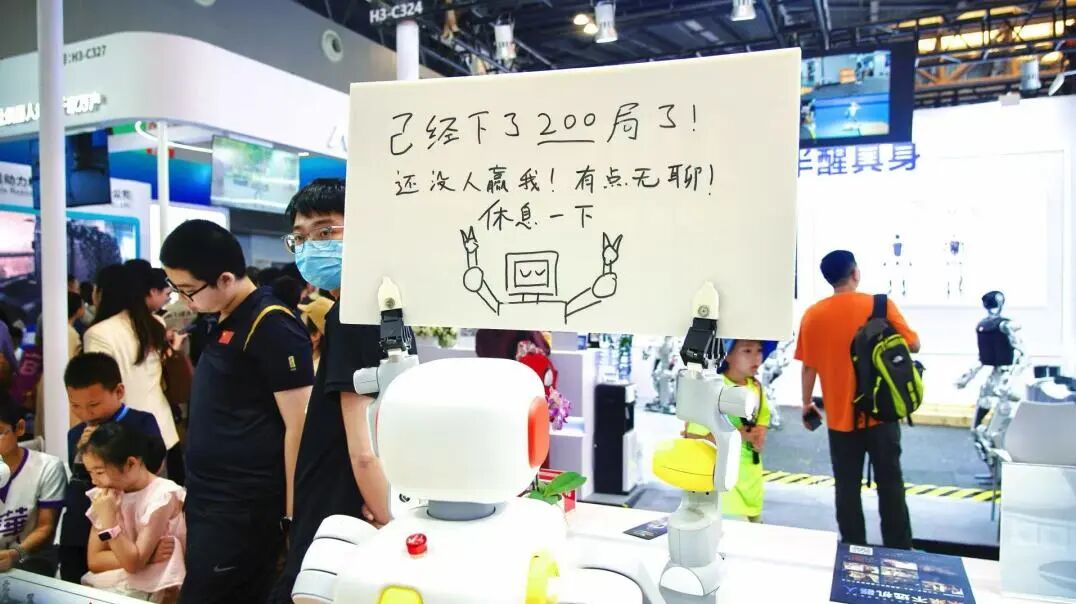
Monday in Shanghai was still crowded, but last night's rain had chased some of the heat away with the departing crowds. Walking through the venue on the final day, we found ourselves wondering: If we could see through a child's eyes, what would we see?
Many questions that puzzle us as adults might find their answers there.

"What could you do if I took you home?"
On the second floor of the embodied intelligence hall, one booth drew an especially dense crowd of children.
Because here, you could not only drink Coke — you could also challenge someone to a game of chess.
Standing there was Xiao Wei. This bow-tied Xiao Wei had remarkably expressive features. It would pause to think during games, hesitate, and after winning, couldn't help but lift the corners of its mouth with a hint of pride.
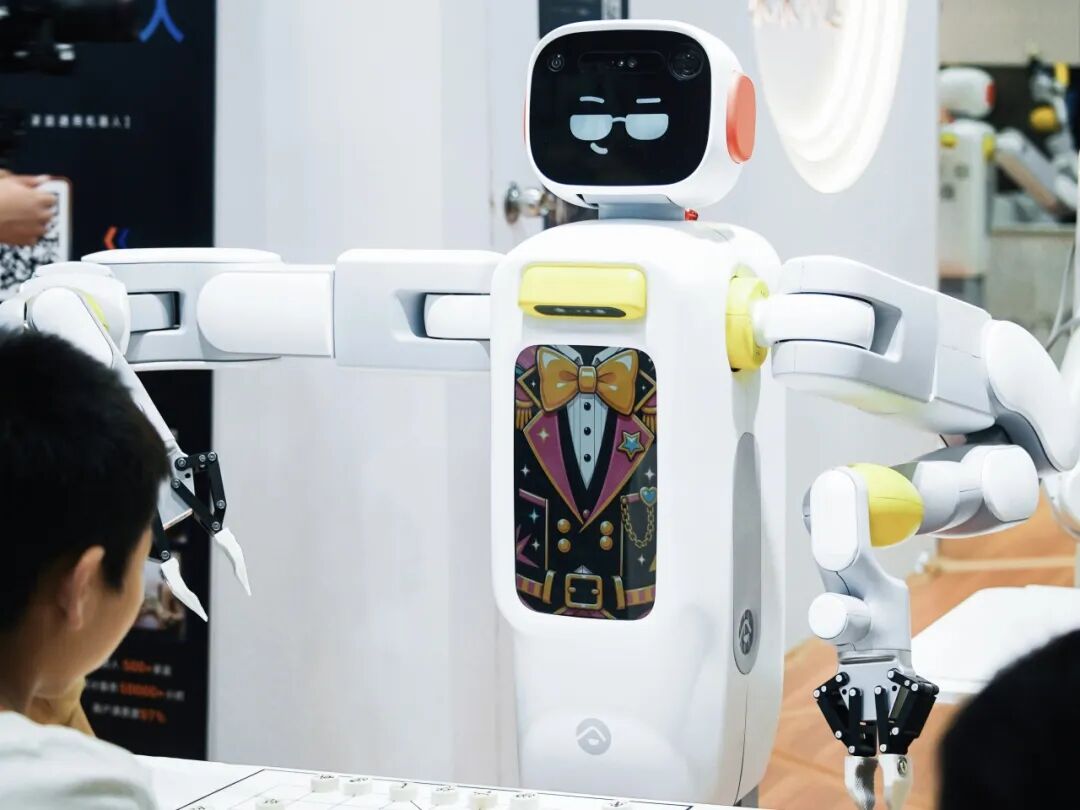
One visitor said this might be the "most approachable" robot at the show.
It was Weilai Buyuan's first time at WAIC. When asked if they'd heard any unexpected feedback, the staff beside Xiao Wei told us: "The chess difficulty was too high."
So the team quickly adjusted it to adaptive difficulty. Even if a user was a complete beginner, Xiao Wei could match their level.
Xiao Wei also tailors its emotional responses to each user's personality. That slight upturn of the lips, or that little fluster when outmaneuvered — these drew the children back again and again.
One kid pulled us aside: "I've played three games with it, lost all of them, I really can't beat it, I'm done!" But not long after, we saw him back in front of Xiao Wei, chin propped on his hand, contemplating his next brilliant move. The two players exchanged smiles.
More than function, playing chess is a form of companionship.
Weilai Buyuan's robot F2 had launched just three months earlier, designed for four main scenarios: caring for children, looking after pets, accompanying the elderly, and handling basic housework. Playmate, practice partner, caretaker, educational companion — after three years of technical accumulation and hundreds of design iterations, Weilai Buyuan had brought the home setting to the exhibition floor.
And today, children had truly stepped into a scene made for them.
The team told us that one of F2's defining features is that it was designed entirely for Chinese households.
You could feel it on the floor — parents and children alike loved this form factor. Its footprint, dimensions, height, and payload were all refined over years of iteration based on user feedback.
Parents on site had plenty of questions: "Can it sort toys and clothes? How? How does it open the washing machine door?"
The ring toss, organizing, chess, laundry, and block-building demos were just glimpses of home life, the result of three years of co-creation between Weilai Buyuan and its users.
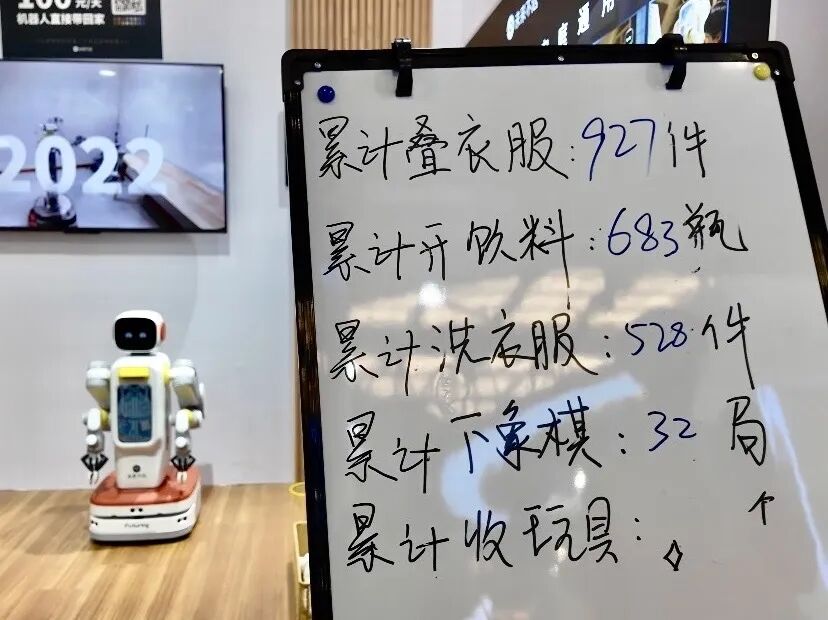
A whiteboard at the booth tracked Xiao Wei's output. By noon on the 20th, it had folded 927 pieces of clothing, opened 683 beverages, washed 528 items, and played 32 games of Chinese chess.
Children were curious about the process; parents wanted to know when these capabilities would actually make it into homes.
Few children paused at the "¥3,000/month" sign. But they could sit at the chessboard for half an hour, endlessly contemplating their next move.

Install one part, do one thing well
There's one robot brand many children may have seen before they even knew its name.
In The Wandering Earth II, until the very end, a group of robots remained on Earth to handle exploration, transport, and maintenance for humanity. Those robots were all from Youibot.
Today, at WAIC, many children also stood for long stretches outside a simulated factory's white space, watching robots complete their tasks one by one, following the entire process through to the end.
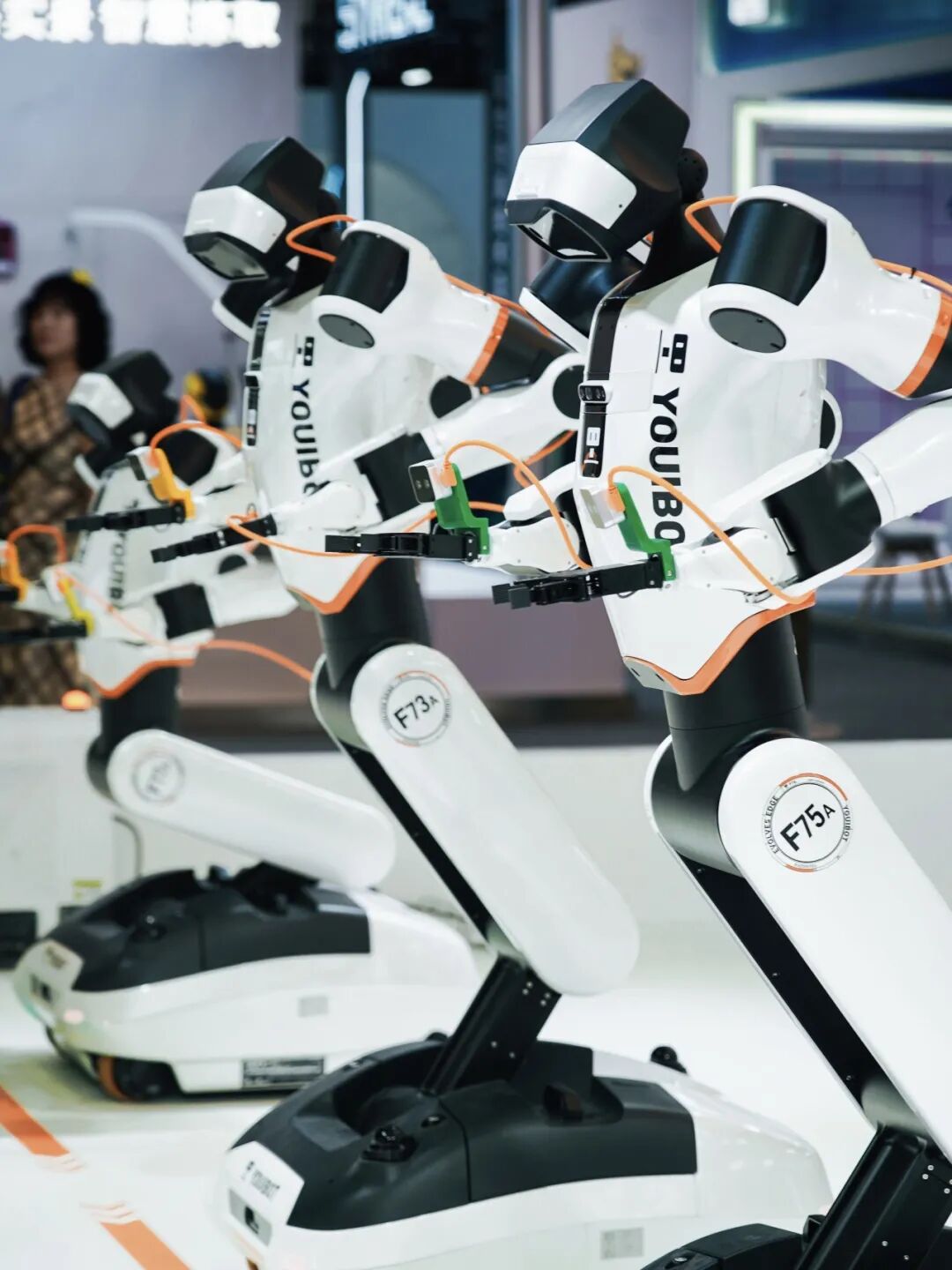
Five robots in the space, sharing one "brain."
A sorting order begins with raw bins leaving the warehouse, passing through multiple picking stations. Each robot picks one, two, or even several items needed for the order, placing them into the same fixture box, which flows to the line-side on the right, eventually going live.
The scene before us was an abstraction of a real production workflow.
Today, the vast majority of materials in industrial settings can be transported in standardized ways. But in many scenarios, peripheral, small-batch, or optional components are still overlooked. They're often placed haphazardly, introducing greater unpredictability into the production chain.
As the team put it: "You can't assemble an industrial product missing even one part."
For production data to truly form a closed loop, every raw material used needs to be brought into data management.
Here, no robot is an independent intelligent agent. Based on a "one brain, multiple forms" technical framework, they're controlled by a unified intelligence hub that directs multiple robot forms on site — a swarm of individuals collaborating to complete the work.
Every child standing there was also learning how to break something down step by step, then complete it step by step.
Science fiction, happening before their eyes.

"How do you beat AI at chess?"
On the other side of the hall, there was another chess master.
This yellow player had excellent eyesight. When its opponent made several extra moves at the start, it immediately waved its hand and said: "You moved too many pieces, I'm not playing."
But when the next game restarted, it was all focus again, battling across the Chu River and Han Border.
This was a robot from CrossWe.
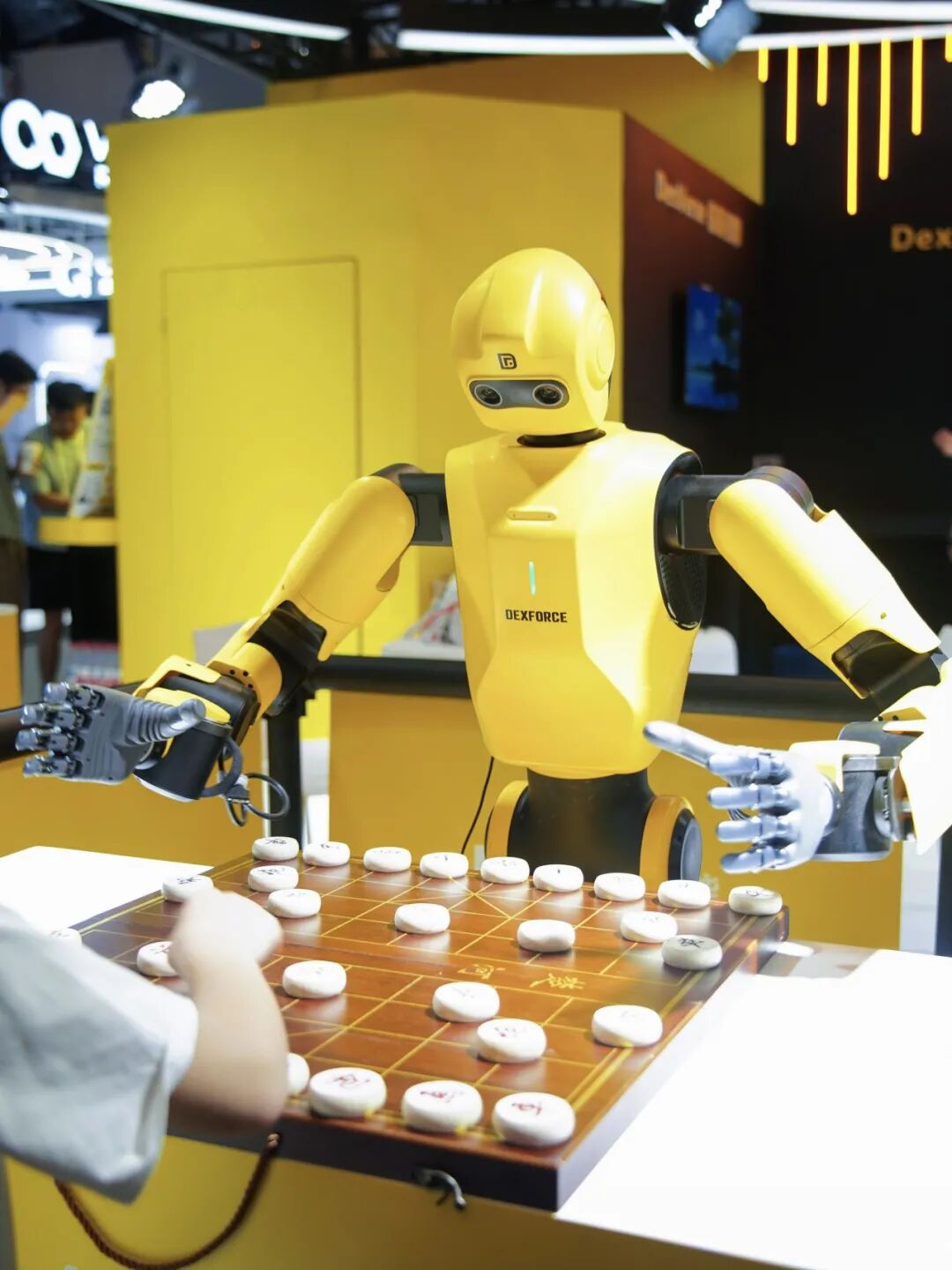
Nearby, another robot was demonstrating phone boxing.
Open the box, grab the phone, place it in the packaging, close the lid. The process looks simple, but demands extreme precision and stability. This, too, was a snapshot of CrossWe robots working in real factories.
At this year's WAIC, CrossWe also showcased the only robot in the entire exhibition capable of autonomously completing the full retail scanning workflow. The robot had to grab a bottle from a bin of randomly arranged products, locate the barcode hidden somewhere on the bottle, scan it, and return it to the correct position.
The real challenge was never "scanning" — it was "finding the barcode." In real retail environments, the robot doesn't know which way the barcode faces. It could be facing away from the camera, blocked by a hand, on the far side of the product, or shifting position as the robot grabs it. The robot must, like a human, observe, adjust its grip, replan its motion, and actively search for the barcode through continuous trial and error — rather than mechanically executing a preset trajectory.
This ability to "operate, observe, and decide simultaneously" is the core of what distinguishes embodied intelligence from traditional automation.
The WAIC venue showcased the power of imagination.
Children don't know what VLA means. They don't discuss embodied intelligence, commercialization, or cost. They're simply willing to sit at a chessboard for half an hour, watching a robot repeat the same motion, imagining how a distant factory might slowly come to life.
Maybe that's how imagination begins.