Conversation with YouWare's Ming Chaoping: They're Skeptical That AI Coding Is a New Form of Creation — and I'm Thrilled | Z Talk

The promising AI product founder chose a path few others dared to take.
Ming Chaoping is hot property. Ask China's 50 most active AI investors who the most sought-after AI product founder is, and the 1995-born Ming would be a top vote.
Last September, he left Moonshot AI to start his own company. Before even launching a product, he raised two consecutive rounds, hitting an $80 million valuation with several top-tier VC firms on the cap table.
Ming is also unusually low-key. In seven months of building, he has given zero interviews, attended no public events. Faced with repeated interview requests, his answer is always: "Wait until the product is more ready."
Now, Ming and his team have reached the moment to let the product speak. In early March, YouWare went live — then still a rough, hand-built prototype by Ming and a handful of colleagues. But the intuitive product direction was already set: YouWare aims to become a vibe coder community that sparks ordinary people's desire to create through coding.
The morning after launch, without any promotion, YouWare had over 1,000 user-uploaded projects. By day's end, nearly 4,000. Skepticism lingered: do that many people actually want to create with coding? What is the underlying urge to share coding creations?
Last week, in a three-hour interview with LatePost, Ming laid out in detail the demand insights and design thinking behind YouWare, along with his career history and entrepreneurial reflections.
Sitting across from this founder, you begin to understand why he is so persuasive to certain investors. Since graduating from Wuhan University's automation department in 2018, Ming has had three product stints: mobile imaging at OnePlus, CapCut app product at ByteDance, and at Moonshot AI, the music video generation product Noisee and Kimi's browser extension. That's sufficiently diverse experience spanning hardware, software, internet, and AI.
Like looking in a mirror, he finds product and entrepreneurship reflected everywhere in reading and life. From Sori Yanagi, designer of the Butterfly Stool, to a 14-day cycling trip in Japan, to waiting for a shutter moment under the Thai sun — Ming draws his own lessons:
- "There's a line in Yanagi's biography: 'Japanese designers can finally be themselves.' They went through a process from copying Western design to original work. I was deeply moved reading that. I thought, Chinese teams can be themselves today too."
- "In competitive cycling, when is the best moment to overtake? Some think it's downhill. Actually, it's uphill."
- "Everyone thinks AGI matters. You can shoot from above, below, the side. ByteDance can shoot with Leica; we might only have a phone. But in the end, it's not the equipment that determines the result — it's when and where you press the shutter."
There are moments when his ambition flashes cold and bright:
- "Of course I'd love to become an orchestration agent, but that's extremely hard. The probability of success might be 0.0001%."
- "I have two core pursuits in starting a company: it has to be fun, and it has to be big enough."
Yusen Dai, managing partner at ZhenFund, says Ming is the kind of founder with big ambition and small ego. What follows is Ming's seven-month CEO retrospective as a first-time founder.
At the end of 2024, ZhenFund became YouWare's angel investor at its founding. This interview is republished from LatePost. Here is the original text:

Too Many AI Products Offer Creation Capability; YouWare Wants to Spark Creation Motivation
Q: If you had to describe YouWare in one sentence, how would you say it?
Ming Chaoping: Vibe coder's community. Vibe coders are non-developers who can't write code but have creative desire and creative ability — designers, product managers, and myself included. The first version of YouWare was literally hand-built by me.
Q: You also offer a self-developed AI Coding Agent. For a startup, is doing both community and tool a good choice?
Ming Chaoping: I wouldn't divide it that way. The product is a whole; the essence is what problem it solves.
I've always served creators, and today's new form of creation is coding. How to spark this kind of creation? Fogg's Behavior Model still holds: motivation, ability, trigger.
Most AI products today only solve "ability" — giving you a simple enough dialog box that produces results, telling you anything is possible and expecting you to run with it. At that point most people are lost, because organizing language is exhausting.
We hope to give users "motivation" and "trigger" through community — because here there is creative sharing, content reference, and mutual help among creators. Just as when you shoot video today, it's often not because the tool is simple enough, but because you scroll TikTok, get moved by something, and feel the urge to create.
So we're not building community for community's sake; we want to spark more creation. It's about building an environment — user behavior and creative behavior are fundamentally determined by environment, not tools.
Q: So vibe coding can have another layer of meaning — not just using natural language to directly translate inspiration and ideas into programs, but the environment itself being a "vibe."
Ming Chaoping: Right. The same person, whether they're eating at the neighborhood food stall or a high-end Western restaurant, will behave completely differently.
Q: You started in September last year, and before the early March prototype of YouWare, you explored three product directions. How did you converge on the current form?
Ming Chaoping: Actually what we're building today is almost exactly what was in my original fundraising deck, but we took detours in between.
At the start we used Claude 3.5 as the base model, but the output wasn't good-looking or complete enough. I couldn't stand it — I wanted to polish and ornament. Because if something comes out at only 60 or 70 points, users won't want to create and share. I wanted it to elicit a "wow" from the start.
So we had to constrain it to some vertical scenarios. We tried three directions: generating web pages from Figma; turning Notion documents into websites with strong layout; aggregating Linktree content into web pages. But there was no MCP (Model Context Protocol, developed and open-sourced by Anthropic) ecosystem then; we had to work around with web scraping, which was awkward. The team's feeling from playing with these was: these products might be useful, but none was compelling enough to make people want to keep using them. In short, I felt something was off at the time, but couldn't articulate what.
Q: How did you figure it out later?
Ming Chaoping: After the Lunar New Year this year, my investors were coming to catch up. I talked with three investors over three consecutive days, getting clearer each day. After they all left, one night I couldn't sleep, and suddenly a lot of things clicked. It was like enlightenment.
Q: What did you realize?
Ming Chaoping: We started out thinking the model output wasn't good enough, so we tried to give it templates and frameworks to improve output quality. But this diverged from the most important trend of this era — intelligence keeps improving.
The old internet product mindset pursues controllability, making products 20% AI + 80% structure or engineering. But this means the portion that can be leveraged by the model is relatively small. When the next generation of models improves by 2x or even 10x, this product's upside becomes very limited.
So I suddenly realized: good companies must be empowered by the mainstream trend in a technology cycle. Just as Apple kept pushing the limits of Moore's Law, and ByteDance, in the form of short-video feeds, maximized mobile internet bandwidth speed and rapidly growing mobile users.
Today, judging an AI product's value should also look at whether its token consumption is accelerating or slowing. Is it maximizing the intelligence dividend?
So I tell the team: we have to ride the wave, stand steady on the surfboard — otherwise no amount of paddling helps. Our previous products were paddling against the wave. And as model capabilities and the agent ecosystem mature, those three attempts can also be realized more elegantly within YouWare — we've launched MCP servers supporting Figma and Notion, and can do one for Linktree in the future. I prefer the simplest possible solution: one approach that solves 10 or 100 problems, rather than 100 problems with 100 solutions.
Q: This is somewhat like what Manus says: "Less Structure, More Intelligence."
Ming Chaoping: Yes. Recently I've had some new understanding: from initially pursuing token consumption, to pursuing value per token.
Because after using many agent products recently, I found that with enough compute and time, they can indeed solve some problems, but there is also waste — time and compute spent on debugging, trying various paths. And most agents can only solve one person's one problem at a time; they can't be reused or shared.
Q: How does YouWare improve value per token?
Ming Chaoping: Choosing coding and community is precisely the pursuit of value per token.
First, converting intelligence into code is the path to maximizing token value. On one hand, code is reusable and is itself a high-value good. If AI can write code 24/7 at faster speed and greater bandwidth, this is a massive intelligence-to-productivity conversion and business opportunity.
On the other hand, code is what models are best at outputting. Natural language has strong context dependency and expression preference — "I'm happy today" said with different tones by different people produces completely different effects. But Chinese, Irish, Australian — the code they write is the same. Code has low information entropy, standardized expression, and low verification cost. With reinforcement learning, models' coding ability is still accelerating.
Community further amplifies the value of single tokens. When a vibe coding piece is placed in community, it can not only be reused but also spark others' creation and consumption. This exponential diffusion is the leverage we truly care about.

The Night I Hand-Coded the First Version, I Broke Out in a Cold Sweat
Q: You mentioned that you hand-coded the first version of YouWare. What was that process like?
Ming Chaoping: One night in early March, starting at 10 p.m., I worked with a few teammates to hand-code a demo using Cursor. We shipped it by one or two in the morning. Honestly, I broke out in a cold sweat that night.
Q: Excitement?
Ming Chaoping: No — fear, in hindsight. The team didn't understand why we were building this. I wrote in an internal blog post: this is something new, it will grow fast, and if I don't do this today, we'll miss a major opportunity.
Q: Some have described YouWare as following a "classical" product-building approach. Your homepage slogan was first "Vibe Coder's Instagram," and recently changed to "Not YouTube, YouWare" — both are products from the previous era.
Ming Chaoping: Instagram was genuinely a huge inspiration. It captured two major signals: first, it rode the wave of smartphone camera proliferation and the birth of the "mobile photographer" at exactly the right time. Before, photographers were people with Nikon and Sony cameras pressing shutters. When phone cameras went from 4 to 8 megapixels, a new population emerged that took photos with their phones — new photos globally increased a hundredfold, a thousandfold every day.
Second, early phone photos had lots of noise and color distortion. Instagram used "filters" to make photos look better, and gave people a community to share them — all of which encouraged more photo-taking and sharing, making mobile photographers even more numerous.
Vibe coding right now is the same dynamic. Many people are building the "cameras" for coding — Anthropic is leading the charge, OpenAI and Google Gemini are racing to catch up. But the bigger opportunity may lie in who captures this new wave of creators. AI coding will inevitably unlock new Snapchats, Instagrams, YouTubes, and TikToks.
I already see this group of people — on Twitter, YouTube, Xiaohongshu, WeChat official accounts, there are tons of people who never programmed before sharing how they built something small in a few days or hours. The momentum is still faint, but I believe it's worth betting on.
Q: Does history necessarily repeat? What might be different between the coding creation ecosystem and past image or video creation ecosystems?
Ming Chaoping: If you follow past development logic, there would be a shift from something relatively serious and labor-intensive like YouTube to something simple and spontaneous like Instagram. But now I think the Instagram phase might not exist at all. The ultimate coding in my mind is no longer humans writing code, but humans making selections.
For example — in the future, code generation might take about as long as loading a webpage, 200 or 300 milliseconds. Webpages won't be pre-written; they'll be generated in real-time when accessed. Code won't be written; it'll be selected from generated options.
At that point, creative behavior changes again. Everyone becomes a bit like a director — photographers and editors bring you things, and you just choose. Your ideas, taste, and creativity all manifest in selection.
Q: Where does the desire and ability to select come from? If the next generation of kids grows up selecting more and doing less hands-on work, will they be able to select well in the future?
Ming Chaoping: Something similar happened in history. When the camera was first invented, many believed painting would be replaced and the art form would collapse. What actually happened was that art became more diverse: Abstract Expressionism, Fauvism, Cubism — all kinds of movements emerged, and art became more flourishing. So I believe AI will actually stimulate human creativity more and give birth to more meaningful forms of creation.
There is a genuinely concerning situation right now: current AI products are all too efficiency-oriented. The world needs more diverse things. We're thinking through these trade-offs today. I want tools to be easy enough to use and effective enough, but I also want users to enjoy the creative process as humans and creators. Fun always matters.
Q: What's the possibility that this major trend you're betting on — coding becoming a widespread new form of creation — doesn't happen?
Ming Chaoping: I think it will definitely happen, and I'll find ways to make it happen.
This isn't just intuition — I've already seen the signs. Why did I hand-code the first version of YouWare that night in early March? Because I saw many people on Twitter screen-recording and sharing games they wrote with Grok 3. But screen recording is a lose-lose sharing format for both creators and consumers. It's not interactive; it can't fully convey the creativity and effect of a coding piece.
This shows that new forms of content creation no longer fit old content containers like Twitter. The new opportunity is designing a new sharing method for this new wave of creators: not having you paste a chunk of HTML to run locally, but giving you a URL where others can actually experience your work.
That's what our first version did — let users paste code written by DeepSeek, and we'd give them a shareable link. The morning after we launched, our servers had over 1,000 user projects. By that evening, nearly 4,000. The growth far outpaced a product we'd spent two months carefully polishing.
Later we added the boost feature — it's like Instagram's filters — and it became our most popular feature. Some users boost 60+ times a day. Japanese and Korean users are also using boost heavily.
This is a very early but clearly growing population. When you see someone prompting 500+ times a day, boosting 60+ times, spending hours building a webpage — you know, this thing has started.
Q: When people shared photos in the past, the underlying needs were "self-pleasure" and "social connection." What's the underlying need when vibe coders share the programs they make?
Ming Chaoping: Unchanged. Still those same needs. Technology changes, but human nature doesn't.
Q: Why haven't strong AI coding tools like Cursor or Lovable built sharing communities similar to YouWare? Do they not believe in this direction?
Ming Chaoping: I don't really see Cursor building a coding creation community. That's determined by the founder — he knows programmers, while I deeply understand creators' pain points and joys.
Q: There were also website and program sharing communities that emerged earlier than YouWare, like Glitch and CodePen. If they pushed AI coding sharing, how competitive would they be?
Ming Chaoping: First, what we're building isn't a "website creation" community — it's AI coding creation. Coding is fundamentally a flexible way of presenting information, and future coding creation will also combine with multimodal forms to produce even newer formats.
Returning to websites, which are what most people share right now — today AI coding lets more people UGC, giving them a chance to build things that previously only programmers and geeks could make. At this point, you need something to ignite ordinary people's desire to create.
The way to ignite it is finding that "magic category" with go viral potential, like Musical.ly's early lip-syncing. Our team has advantages here: first, we're sensitive to content and can create some viral hits; second, we're already continuously observing what users are creating and what content spreads better, so we can replicate and amplify viral hits faster. Communities like CodePen are more about serving programmers and geeks — they're not approaching this from a UGC angle, looking for that "lip-sync moment" or "filter moment."
Besides, I don't really worry about someone being the same as me. I worry more about someone in the same direction being different from me — have they found a better solution?

After 3 Hours of Thinking, I Decided to Abandon That Million-Visit Traffic
Q: YouWare did go viral in late March — visits spiked from thousands to over 1 million in two days. But it was driven by "melon-eating" [gossip consumption]. Is that what you wanted?
Ming Chaoping: It made me feel the power of this thing [the community]. A platform, simply by what it shows and doesn't show, implies value preferences.
A significant portion of those 1 million+ visits was indeed related to a certain big-company executive's sex scandal. The first wave of traffic was curiosity. Then more people flooded in after discovering they could use webpages to share gossip this way — so they made their own, and all kinds of gossip followed. But did we want the product to become this?
The next afternoon, I locked myself in a conference room and thought about this alone for three hours.
Q: You were thinking about whether to ban this stuff?
Ming Chaoping: Yes. Honestly, it was pretty painful. Essentially: do you abandon this 1 million visits, when in a few more days it might reach 2 million, 3 million?
Q: Your ultimate choice was to temporarily forgo this traffic.
Ming Chaoping: Yes. Something I'm proud of is that our team reached consensus on this very quickly.
The first rational consideration was: don't let the company take on risks it can't handle early on — this is bottom-line thinking. The second learning was that viral content has strong growth momentum; we need to repeat this strategy in a more controlled way, and I believe the team can do it.
What really tormented me was a values question — what gives me the right to ban certain content? This reminded me of a product I worked on at OnePlus called "Zen Mode." We brainstormed many solutions, like reminding users to take a walk, stop staring at their phones, etc. But behind that lies arrogance and judgment. Apple's approach is just showing screen time — presenting facts is more elegant and sophisticated than judging users.
That experience influenced me a lot. Today, building a community, I'm clearer on one thing: we can dislike certain content, not recommend it, but shouldn't directly judge it with platform values. Community tone and culture grow out of a series of small choices, bit by bit.
Q: If early ByteDance encountered a similar situation, what do you think they would have chosen?
Ming Chaoping: Probably wouldn't have shut it down immediately, but the risks involved are very large.
Q: Why could they afford that risk, and you couldn't?
Ming Chaoping: This kind of thing, at that time, probably wasn't as risky for early ByteDance. They were serial entrepreneurs who'd been through more. This is my first startup. Honestly, this [risk] is beyond my range.
You still have to respect objective facts. Everyone wants to succeed, but you need to think clearly about how big a thing you can handle at your current stage.
Q: What impact did cutting off that traffic have on YouWare's community atmosphere?
Ming Chaoping: One interesting thing is that YouWare has very little borderline content. We have Japanese users making games, design websites with strong visual styles, and especially lots of teachers creating interactive pages for visualizing formulas — but barely any suggestive content.
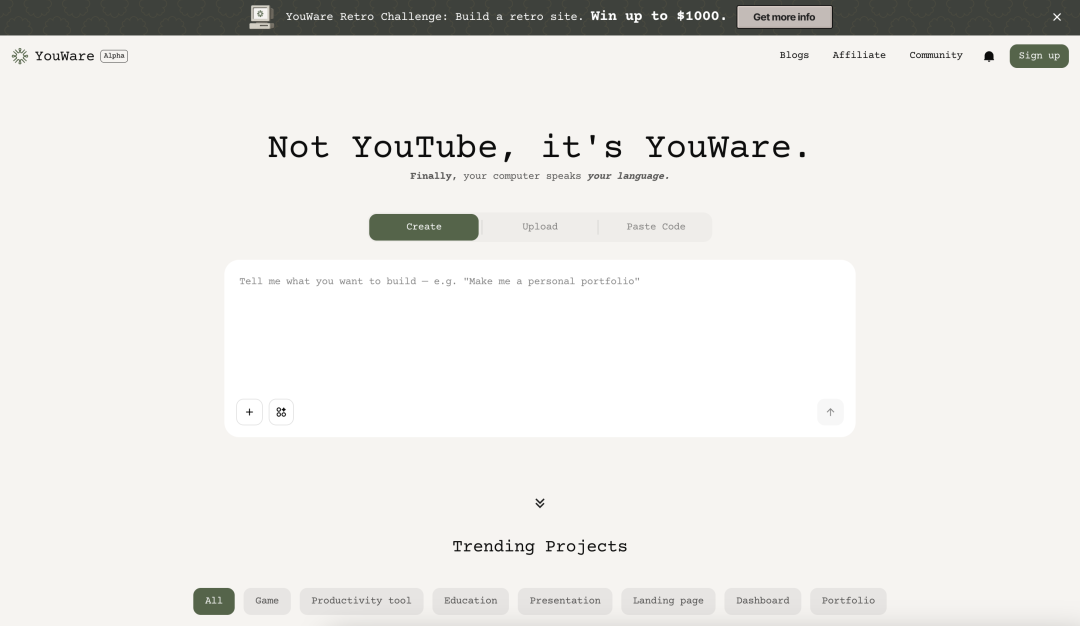
YouWare's interface uses a cream-white background with olive-green accents, giving it a calm, restrained feel.
I later realized that people do respond to their environment — when you enter a community and see creative work versus funny clips versus borderline content, it directly shapes what you do next. It's like walking into a library: you naturally don't speak loudly.
Q: How much of a community's atmosphere is determined by creators versus users? Reddit's founder once said, "The only way communities succeed is by giving up power."
Ming Chaoping: At least for now, we decide what content deserves to be rewarded.
Q: What's your current recommendation mechanism?
Ming Chaoping: No recommendations yet — pure popularity ranking. We'll add recommendations soon; we're hiring for it. Part of why I'm doing this interview is to recruit more talented people across the board.
Q: Bilibili, Xiaohongshu, Tieba — each has a distinct vibe and temperament. What do you think creates a community's personality?
Ming Chaoping: I think they used to be communities; today they're content platforms. A crucial characteristic of communities is that people gather based on shared interests or values to communicate and create together.
Content platforms are efficiency-driven. Their essence is making the pipeline of producing, distributing, and consuming content cheaper and more efficient, while managing diversity, quality control, and baseline moderation. That's a completely different logic.
Q: Do you think YouTube is still a community?
Ming Chaoping: No. That's why we're "not YouTube." Our company's first principle is Think Different. We barely do competitive analysis either, because you can't fully deduce what the next era's product looks like from past products.
Q: If you keep growing, with more users sharing vibe coding creations, will YouWare still be an interest-driven community?
Ming Chaoping: As you scale, becoming more like a content platform is inevitable because you have to think about efficiency. A sweet problem to have, of course.
For now, we want YouWare to be a tool and community that helps users unleash creativity. If becoming a platform makes that faster and better, I'll absolutely do it.
Q: You already have a cash incentive system — users earn varying amounts of Knots for publishing work, which can be exchanged for cash. Does this incentivize more creativity, or attract more people trying to game the system?
Ming Chaoping: Knot is YouWare's "reward model," calculated from views, recommendation scores, and other users' reactions (emoji feedback on YouWare). People gaming the system don't automatically earn Knots, because low-quality work doesn't get recommended.
We did this to validate: if nobody creates even when you pay them, the whole thing might not work. The result is that we've gradually reduced incentives — started at 100 views for $1, now it's a fuzzier Knots-to-cash relationship — and users keep creating. That's basically what I hoped for.
Q: Under what circumstances would you start paid acquisition?
Ming Chaoping: I'm both aggressive and patient about growth. We've raised a lot of money, but I don't want to spend millions on ads. That's not fun.
Q: What's your patient-yet-aggressive growth approach?
Ming Chaoping: Still go viral. Products that went viral in history share clear characteristics, whether by category or audience. Through various experiments and observations, we think two groups might work: designers and students. The former are creativity-driven, aesthetics-driven, with professional skills; the latter are time-driven, energy-driven, with disruptive creative power.
Q: I recently saw an experiment on your website — a retro programming competition with up to $1,000 in prizes.

YouWare's retro program/webpage creation competition landing page
Ming Chaoping: Yeah, like going back to Windows 98. Young people today really like this stuff, and they make great things. So we thought, why not try it?
Q: How much extra growth have Knot incentives and competitions brought?
Ming Chaoping: I roughly calculated: combined with some future business models, I don't think it's expensive. It might even break even.
Q: How do you design YouWare's business model?
Ming Chaoping: I think the bulk will come from advertising; subscriptions are to cover token costs. If I could, I'd make tokens free.
This isn't about how much money the company makes at this stage. For the company to thrive, creators need to keep creating here, which requires giving them incentives. The most sustainable incentive is letting them earn money themselves.
Two things recently boosted my confidence: First, a Gen Z colleague made viral content with over 100,000 views — a "six-character ID generator (bitter-life edition)" apparently related to fan circles. Then someone asked if they could put ads on the link. Second, a Twitter influencer with hundreds of thousands of followers put a personal site on YouWare with one Google Ad. My first reaction: this makes perfect sense.
We'll likely add a "switch" — if you're willing to run ads, we'll do targeted matching, and you might keep 100% of the revenue. This gives creators incentive to share their work more for higher traffic.
Three phases: First, we act as the advertiser — Knot incentives are essentially YouWare's official ad spend. Second, we split our ad revenue and third-party ad revenue with creators. Third, purely third-party ads incentivize creators.
Q: Will these designs launch this year?
Ming Chaoping: Absolutely. I've already told you about it, so we have to ship it — otherwise someone else will.

In the Future, There Will Be Two Types of Agents: Those That Orchestrate Others, and Those That Get Orchestrated
Q: YouWare's format seems replicable by many. What's your differentiation?
Ming Chaoping: Creator users, data, network effects.
Q: Network effects in AI products aren't obvious yet. Where will they come from?
Ming Chaoping: I recently had my second "epiphany," and it's about network effects. With so many Agents emerging, I started thinking: what's the difference between them, how will they interact?
In my mind, an Agents network may form with three layers of network effects: human-to-human, human-to-Agent, and Agent-to-Agent. I also understand why Google is pushing A2A (Agent to Agent protocol) — in the future, everyone might have their own Agent that communicates with millions of other Agents for you.
This network could be enormously valuable. First, there will be many Agents — many nodes — and network value is proportional to the square of node count. Second, communication bandwidth between Agents far exceeds human bandwidth. At that point, there may be two types of Agents:
- Orchestrator Agents, essentially like an OS, directly facing users;
- Task-specific Agents, called on demand to complete particular jobs.
For example, when a user says "I want to make a design," an Orchestrator Agent breaks down the need, matches tools, and might have 100 design Agents in its call list. Interestingly, search's page rank might become Agent Rank. Many people will probably wonder: should I become the Agent that gets called, or the one doing the calling?
Q: What's your answer?
Ming Chaoping: Of course I'd love to be an Orchestrator Agent, but that's very hard — maybe 0.0001% chance of success.
Q: If YouWare becomes a larger, more active community, does it have a path to becoming an Orchestrator Agent?
Ming Chaoping: Probably not. An important principle in startups is don't be radical. The more pragmatic approach is to first become a highly-ranked product in Agent Rank.
There are two models for that: one is becoming the most expensive, best Agent, serving a few users like Apple who want ultimate quality; the other is delivering 80% results at reasonable cost, serving more users — requiring good balance between cost, quality, and speed, plus differentiated experience.
This depends on who an Agent's early users are and what data it accumulates — we already have hundreds of thousands of user tasks, each with 5 to 10 steps of planning data behind it. That's experience, taste, preference, and differentiated capability.
Q: YouWare currently supports both creation with your self-developed AI coding Agent and importing code from external tools like Cursor and Figma. What's the split?
Ming Chaoping: About 70% create directly on our platform.
Q: How do you evaluate the capability of YouWare's self-developed AI coding Agent? How critical is building that Agent in-house to YouWare's success?
Ming Chaoping: The core value still comes from the model. We're just applying it well to our own scenarios. Based on user feedback so far, our Agent is in the top tier. In the long run, Agent capability will be one of our key moats.
Q: Who is most likely to build the scheduling-type Agent?
Ming Chaoping: Hard to predict. OpenAI, Anthropic, or Gemini probably can't do it either, because the hardware layer is still controlled by companies like Apple. They can intercept another layer closer to the user.
Q: Have you seen any opportunities in new hardware?
Ming Chaoping: I've studied glasses. Ray-Ban Meta popularized them, and many people want to replicate its features at half the price, but that leads to incoherent product design.
Meta's smartest call wasn't any specific feature like the camera or speakers — it was choosing to make sunglasses. Americans love wearing sunglasses; they wear them driving, outdoors. So why include a camera? So you can capture scenery and family while hiking or camping. And since sunglasses aren't worn all day, battery life demands are lower, which means less battery, which means lighter frames.
But if you try to replicate Meta's approach in prescription glasses that need to be worn all day, you need longer battery life, which makes them heavier, which means you can't wear them for eight hours — a design paradox.
I've thought that if I made glasses, I'd do extreme subtraction, keeping only one sensor: either a camera, but not for photos or video — instead, it periodically captures environmental information; or a speaker or microphone that records audio, so AI can process more offline data for you. For example, after a face-to-face discussion with whiteboard sketches, you open your computer or phone and your to-do list and schedule are already generated.
Behind this are two logics:
One, feeding physical world information to AI and telling it through prompts: who I am, what I'm doing.
Two, bringing AI into the real world, through embodied intelligence or other devices, so it's always "present," continuously understanding you.
That's the greatest value of devices like glasses. If you want to disrupt Apple, Google, or Microsoft, you need to capture context they can't access.
Q: You've thought about AI glasses in such detail — was this because you once considered starting a company in this direction, or did it come up while mapping out the Agent landscape?
Ming Chaoping: I have two core pursuits in entrepreneurship: it has to be fun, and it has to be big enough. "Big" means: could a new Apple or Google emerge?
You can't achieve that just by following. You have to do something different somewhere. So I did seriously research hardware and supply chains. The conclusion was that under current conditions, it might take two or three years to refine an AI glasses product with limited functionality.
Q: Which matters more to you, fun or big enough? Can a company stay fun after it gets big enough?
Ming Chaoping: Depends how you define fun. Fun comes from complexity. I don't know Zuck's or Lei Jun's real states, but I suspect they enjoy it. Elon Musk looks miserable, but he keeps going — that still counts as "fun" because the systems he can command are growing more complex.
Entrepreneurship is like leveling up in a game or playing Go: opening, positioning, calculation, endgame — every step is interesting. You may have opponents, you may not; the complexity itself brings pleasure.
Q: I talked with Yin Qi, founder of Megvii, a while back. He said he's past the stage of pursuing company-level or cognition-level upgrades — what matters most now is getting business results.
Ming Chaoping: That's brutal. Maybe one day I'll be like that too, but I hope not. I often tell my team: we assume we'll fail, because if there are two paths — one with a 1% success rate but not fun or big enough, another with a 0.001% success rate but fun and imaginative enough — I'll definitely choose the latter.
Q: You believe entrepreneurship is meaningless if it doesn't go big.
Ming Chaoping: Then it's not fun.

Just Treat Me Like an Idiot and Explain It Clearly, I Beg You
Q: Many investors believe in you because of your product insight and taste. You've been a PM at OnePlus, ByteDance's CapCut, and Moonshot AI. What's the core difference between them?
Ming Chaoping: At OnePlus, we made only one phone per year with no complete data infrastructure, so everyone relied on product sense and intuition. My mentor there was a genius product manager.
When he led user research, he didn't do interviews or surveys — he took us on the subway, from start to finish and back, observing how people used their phones: standing or sitting, earphones half-on or fully on, how they replied to WeChat, how they switched apps, whether they mis-tapped, what their battery level was. You'd think everyone leaves home fully charged in the morning, but many are at 10%. These details are hard to capture with data; you need observation.
In my first month at OnePlus, I also spent a month answering customer service calls, getting yelled at by users for a full month. That made me realize: the product system PMs build every day, users may not use it that way at all. To understand users, you have to enter their real scenarios.
At CapCut it was the same. When we worked on knowledge-content talking-head features, I'd edit ten such videos myself first. After editing, you naturally know what to build and what not to. But most product people won't even edit one clip; they think it's unimportant, that writing competitor analyses matters more.
Q: Was that CapCut's style or your own?
Ming Chaoping: CapCut itself had that style. It's a very special team within ByteDance — members all love creating. To this day, I edit our company's videos myself.
But on the other hand, when I first joined ByteDance, I experienced culture shock: at OnePlus, one version per year; at ByteDance, one version every two weeks. This continued for three years. I don't know how many versions, how many features, each feature requiring A/B tests.
This exposed me to massive amounts of data — a kind of affluent upbringing for product managers. Only after seeing enough successes and failures do you build better intuition. Later I developed an ability: when a feature launches, without looking at A/B tests, I can roughly judge its performance. Then I verify with real data, analyzing why I was right or wrong, getting more accurate next time. That's something incredibly powerful ByteDance gave you.
Q: Between intuition and data, which is closer to your product foundation?
Ming Chaoping: I still lean toward intuition. I don't believe in absolute rationality. "Rationality is persuasion of emotion."
My starting point is "I feel," then I use data to verify whether to adjust my intuition. ByteDance overall doesn't emphasize intuition. The benefit is everyone returns to the same data layer, easier to align — whether you're at 50 or 60, you can be pulled to 80. But it also extinguishes genius.
Q: Later you went from ByteDance to Moonshot AI, and you said this completed your transformation from internet product to AI Native product. What's the core difference between these two?
Ming Chaoping: There was another culture shock in between. ByteDance shocked me by showing how such a massive organization could deliver results so efficiently, all at 80-plus quality — astonishing systematic capability. Moonshot AI shocked me by being the first time I densely encountered so many geniuses, with fast brain speed, fast speaking speed, casually deriving mathematical formulas — terrifying.
Here I first supplemented academic perspective into product thinking — many product forms can't be built in one or two months. You need to bet on model capabilities and technical conditions one or two years out, thinking about how to work today so your product continues to be empowered by the next stage of intelligence. Before Moonshot AI, no one had talked to me this way; internet products didn't require it.
Q: Because internet technology is relatively certain, while AI applications now have uncertainty on both ends — model and product.
Ming Chaoping: Right. And from having this cognition in your head to actually not making mistakes in execution — there's still a large gap.
For example, those earlier attempts we discussed — of course I know not to over-polish, to trust models will get smarter, but once you start working, you can't help over-polishing. I think the model output isn't good enough, so I want to add templates, add constraints, want to control it to produce good results now.
Canva recently released a vibe coding feature too. I could tell at a glance: its essence is template selection, not model generation. For Canva, this may be stage-appropriate, because its users come for good-looking templates; Canva's advantages are its many designers, many templates, thick foundation.
But this also means Canva can be disrupted. For example, when Anthropic released Claude 4.0 today, Canva's vibe coding feature won't be leveraged. The next Canva will definitely look completely different.
Q: As someone without an AI background, what's your method for judging model evolution direction and pace?
Ming Chaoping: Two ways: reading papers and talking to people, mainly talking to people. Of the people I talk to most, 95% are in algorithms. Often I bring them questions — maybe something I didn't understand in a paper, maybe a problem in product design, or simply wanting to know what they're researching lately.
Q: How do you effectively communicate with top technical talent?
Ming Chaoping: Many people are afraid to ask technical questions, fearing exposure of what they don't know. But every time I just say: treat me like an idiot, explain it clearly, I beg you. You'll find the more you adopt this mindset, the more you learn. I've seen many people eager to prove they understand tech. Not necessary — if we don't know, we don't know.
Q: You've accumulated much product experience. What do you think is the most important kernel?
Ming Chaoping: One, users: you have to truly know how users use your product, which requires close observation.
Two, doing product scientifically: product has some artistic or emotional elements, but at least sixty to seventy percent can be completely scientific.
Three, beginning with the end in mind: base product reasoning on what may happen in the future, not what has already happened. This includes future technology maturity, market and competitive landscape, user mentality and behavior. This is probably the most important thing in the AI era.

Chinese Teams Today Can Also Be Themselves
Q: You've worked closely with entrepreneurs like Zhilin Yang. What qualities do you admire in him?
Ming Chaoping: Extremely humble, extremely hungry. To recruit people, he flew to Shenzhen on day one and talked with me for ten hours, then flew back the next morning at 7 a.m. He's also willing to bet on what he sees.
Q: At Moonshot AI, you initially built Noisee, but scaled it back in 2024. Was this because after betting on it for a while, you realized the direction was wrong?
Ming Chaoping: The main reason was that in spring 2024, Kimi blew up, and everyone decided to concentrate resources on doing Kimi well. I fully supported shutting down Noisee.
Because the best startup opportunities come from non-consensus. For example, I'm very happy today because I believe coding will become a new form of creation, but many people don't believe it — that's a startup opportunity. From Moonshot AI's perspective at the time, I felt that once Sora and Keling AI came out, there was no longer any opportunity for startups.
Q: MiniMax's Hailuo AI launched later than both Sora and Keling AI, yet its generation quality and user numbers are quite good.
Ming Chaoping: They've achieved decent differentiation — for example, emotional expression in characters is well done. But in the long run, if this feature proves highly valuable, products like Keling AI will also implement it.
Q: Why did you leave Moonshot AI to start your own company at the end of 2024? What signals of opportunity did you see?
Ming Chaoping: Actually, I felt my learning was slowing down. The first investor I met was Yuan Ye from 5Y Capital. He asked me why I wanted to start a company. I said it wasn't fast enough. He pressed further: What would be fast enough? I said: Doing it myself.
Q: What do you think are your qualities as a founder?
Ming Chaoping: Still building products — that's my favorite and most natural state. Recently I've also been trying to understand the company as a product itself. For example, writing a "founder manual" to tell the team how to work with me, what I care about and what I don't, giving them some insights.
Q: You've said that one major inspiration from Hackers & Painters was that a product is an extension of a product manager's values. When you view YouWare the organization as a product, what values does it extend?
Ming Chaoping: Our company now has ten principles. The two most important are: first, Think Different.** I'm quite radical on this point — I even encourage the team to "be different for the sake of being different." Because truly making something different is very hard; only by emphasizing "difference" to the extreme can you arrive at interesting solutions. This requires overcorrection — "aim for the top, and you'll hit the middle."
Second is Trust Default. For example, our company has no cap on annual leave, and we don't approve time-off requests. If you want to rest, just rest. I default to believing that the people I hire will be responsible to themselves and to the company.
Q: What are you dissatisfied with now?
Ming Chaoping: The team isn't aggressive enough. One of our principles is to ask sharp questions. But because people are familiar with each other, because they're nice, they aren't sharp enough.
Q: Isn't this also an extension of your own awareness? You're not a particularly confrontational person.
Ming Chaoping: Yes, I'm also very nice — this is something I'm dissatisfied with about myself. I even envy bosses who can slam tables and throw things, but I can't do it.
Q: Is that really necessary?
Ming Chaoping: I envy them because I believe overcorrection is needed, though of course this might lead to a team that's walking on eggshells.
Later I gradually found peace with it: don't make the same product, and don't pursue the same team atmosphere. Maybe my style, my personality is just this: everyone sits together, face-to-face, discussing problems — you don't necessarily need to slam tables to solve them.
Q: Your metaphor for entrepreneurship is also non-confrontational. Many entrepreneurs compare starting a company to war or competition. But in a pinned post on your social media, you compared entrepreneurship to a creative activity — street photography.
Ming Chaoping: Zero-sum game or positive-sum game, infinite game or finite game — is everyone grabbing for the same thing, or is everyone interpreting something from different angles? I lean toward the latter.
For example, everyone agrees AGI is important. You can shoot from above, from below, from the side. ByteDance can shoot with a Leica; we might only have a phone. But who shoots better in the end? Not necessarily the one with better equipment. What matters is when, from where, you pressed the shutter.
Why did I break out in a cold sweat earlier? If at a decisive moment when you should capture the shot, you don't press the shutter — that's dangerous. Because that moment may never come again.
Q: The mobile internet era had more obvious network effects and fiercer competition from the start. The batch of entrepreneurs who stood out during this phase shared a common trait of being fiercely aggressive. Now there's a new wave of AI entrepreneurs around your age, or who started around the same time — what common traits and values do you share?
Ming Chaoping: I think it's openness and confidence. Openness means international视野 — benchmarking globally from the start. Confidence means: we can be ourselves.
Why did I design YouWare's logo as a Chinese knot? In the biography of Sori Yanagi, a Japanese designer I greatly admire, there's a line: "Japanese designers can finally be themselves." They too went through a process from copying Western design to original creation. When I read this, I was deeply moved — I said Chinese teams today can also be themselves. We have our own taste, aesthetics, preferences, and we completely have the capability, resources, and talent to realize these things.
YouWare's logo incorporates Chinese knot elements. The engagement metric in the YouWare community, "Knot," refers to both a node and a Chinese knot
For this, I think we have to thank ByteDance and the big tech companies. They're the opponents startups least want to encounter, but they're also the soil where today's domestic product managers, engineers, and operations talent have grown. We can recruit these people because the big companies first built the systems and density.
Q: When you raised your first round, some firms bid up your valuation, but you ultimately chose the lower valuation from the firm you had spoken with first. Why?
Ming Chaoping: Valuation isn't the most important thing to me. What I value more is growth and what I can learn.
Q: The first investor you met, Yuan Ye from 5Y Capital, had previously invested in Kuaishou, which made a similar choice — at the time, DCM offered Kuaishou a $60 million valuation, while HSG offered $120 million. Hua Su and Kuaishou ultimately chose DCM, the first firm they had spoken with.
Ming Chaoping: His choice was much harder than mine. Respect. Impressive.
Q: When Zuckerberg faced a similar choice, he picked the higher valuation.
Ming Chaoping: As expected.
Q: Yusen Dai of ZhenFund says he believes one type of founder who can get things done has big ambition but small ego — he thinks you fit this quite well. How do you assess your own ambition and ego?
Ming Chaoping: Pretty much, yes. I also often tell the team that when I pick people, I care most about ambition. Have you thought about replacing me as CEO? If you have, that's not a demerit with me — it's actually a plus.
Q: Since starting your company, what things you once loved have you given up?
Ming Chaoping: Street photography, cycling — I rarely do these now. I used to enjoy solitude more, but now as CEO, maybe playing ball with the team, chatting in non-work settings is also quite important.
Q: Have you given up anything you consider important?
Ming Chaoping: I've accepted it all willingly. For example, work-life balance — this no longer exists. There's no life; this is my life. Seven days a week, every day at the company. I live in Zone A right next door; work is in Zone C. It's only a five-minute walk. I call this "early C, late A."
Q: In the AI application you're building now, what do you consider common sense that many people may not yet realize?
Ming Chaoping: AI is a technology, not user value itself, and certainly not commercial value itself. Some products have great experiences but terrible business models — they still won't make good companies. Take CapCut: it can be used for free, and when entering the US and Southeast Asian markets, it can降维打击 other paid editing software, because TikTok's business model is advertising. So founders must think not only about product experience but also about whether there's a more advanced business model.
Q: What do you think of the view that "the model is the application"?
Ming Chaoping: The model is an application, but the model isn't the only application.
Q: Between leaving ByteDance and officially joining Moonshot AI, from September to October 2023, you had a long cycling trip in Japan. Was this your longest period of solitude in the past two years? What were you thinking about?
Ming Chaoping: I was with a friend, but the cycling itself was solitary. We rode 1,400 kilometers in 14 days, roughly the distance from Shenzhen to Zhengzhou. At the time, I just wanted to see if I could persist — if I could finish, I'd have more confidence for entrepreneurship.
Actually, without that friend, I probably couldn't have finished alone. The learning was that two things matter in entrepreneurship: one, where you're going; two, who you're with.
On day two, my knees hurt so much I wanted to quit. But there was always someone ahead waiting for you, so you just had to keep riding with him, and gradually you adapted to that intensity. Later, you enter a flow state — it actually becomes easier. At that point, I only did two things: one, watch my heart rate, don't let it exceed 160 so I wouldn't burn out too fast; two, don't look up at the mountains, just look at your feet, every step, every pedal.

A photo Ming Chaoping took during his 2023 cycling trip in Japan: "Reached Kamakura, sixty kilometers left to Tokyo. Mount Fuji is very, very beautiful today"
Q: What was your feeling when you finally finished the 1,400 kilometers?
Ming Chaoping: I thought it was incredible. While cycling, many ideas came into my head. Later I wrote in a blog — in bicycle racing, when is the best time to overtake?
Some might think it's downhill. Actually, it's uphill. Top cyclists, when faced with an extremely difficult climb, will "snap" and ride hard, pushing explosive power, speed, endurance — this is when it's easiest to pull ahead.
This is like building a company — it can't always be this smooth. Today everyone is too smooth, always going downhill, everyone has the exhilarating feeling of flying. But we will definitely encounter uphill climbs, and the entire industry will encounter uphill climbs. The uphill — that's when we truly overtake.