Organizational Evolution and Breakthrough for Startups | Z Events

Business and organization are the two pedals of a company's bicycle.

Z Events is ZhenFund's events series.
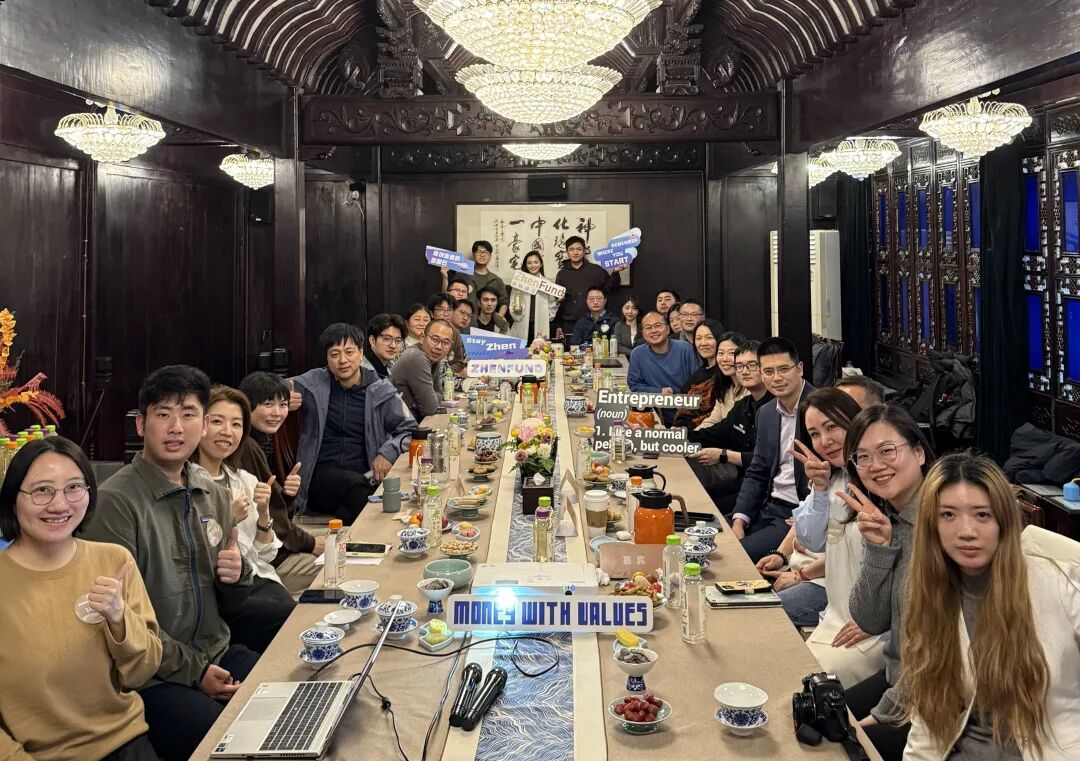
Recently, ZhenFund co-hosted a spring closed-door salon for portfolio companies in Hangzhou with TWS Jingshuo Consulting. We invited TWS Jingshuo Consulting's two founders, Winni Wei and Ming Mingluo; Qin Yazhou, former editor-in-chief of Zhihu; and Hui Niang, a former Alibaba organizational development expert, for roundtable discussions on "Founder IP Building" and "Scaling for Growth." Yuchen Li, VP of Product at ZhenFund portfolio company Infinigence AI, shared developments and the latest updates on AI software and hardware. A total of 22 founders and executives from portfolio companies attended.
Below is a partially redacted share-out from the salon. We hope you find it useful.

How to Build a Company Brand and Founder IP?

Qin Yazhou
Former Xinhua News Agency reporter, former VP and Editor-in-Chief of Zhihu

Winni Wei
Founder of TWS Jingshuo Think Tank
Startup founders have two paths for building personal IP. The first is to focus on sharing and analyzing cutting-edge developments in their own field — new technologies, products, and trends — demonstrating professional expertise and industry influence. The second is to share personal interests and hobbies beyond their professional domain, creating a fuller, more three-dimensional image.
The current media environment is generally more relaxed and friendly toward startups, but new variables and uncertainties are also increasing. Corporate brands face fresh challenges:
-
Consumption has become a new way for individuals to express their values. Consumers use brand choices to signal their social attitudes and value orientations, strengthening the social dimension of consumption itself.
-
Cross-group resonance of collective emotions is becoming normalized.
-
"Little guys" and "victims" gain more public support in conflicts with companies.
-
The golden window for crisis response — debunking rumors, revealing the truth — keeps shrinking.
An analysis of 100 recent cases that caused major damage to corporate brands found that the top reason was "inappropriate remarks" by entrepreneurs or executives, accounting for 22.1%.
At the same time, entrepreneurs need psychological readiness to withstand public pressure. With social media now a major channel for public information, mass sentiment is easily mobilized and even exploited, further increasing brand risk.
The responsibilities and value of government relations (GR) at tech companies: first, supporting business development — understanding the industry and business, handling product pipelines and government audit matters; second, risk prevention — respecting policy without being blindly submissive, maintaining a dynamic balance between compliance and red lines; third, exerting influence — helping the company achieve measured, appropriate visibility in both government and market perception, avoiding risks from over-promotion.
GR and PR approaches differ across business models for startups. In risk prevention, GR and PR should prioritize prevention over cure. Early-stage startups can outsource these functions to consultants, focusing energy on reaching core audiences, and build in-house teams only after scaling. If the founder isn't skilled at external IP building, they can cultivate a co-founder for this role.

Organizational Evolution from "Small and Beautiful" to "Scaled"

Hui Niang (Huang Ying)
Senior Organizational Development Advisor
Former Head of OD & OC at Taobao

Ming Mingluo
Co-founder of TWS Jingshuo Think Tank
- Challenges and strategies of scaling: The scaling process is painful. Companies face multiple cultural shocks, founders and teams experience anxiety, and need to balance product innovation with competitive response. Market information is critical to decision-making in this process. The CEO's brain is the company's most important algorithm — improving the probability of correct decisions requires high-quality information gathered through conversations with candidates in the market. This demands founders have open vision and generosity, and invest the time.
- Entrepreneurship as a founder's growth journey: In talent recruitment, integration, and organizational building, good founders must unify people and business, attending to both operations and organization. Based on conditions at the time, they must know when to attack and when to pull back, maintaining sharp business insight while developing deeper understanding of human nature, relationship-building, and how to drive systemic change — only then can they navigate the organization's various stages. From 0 to 1, 1 to 10, and 10 to 100, each phase requires different team combinations, organizational decisions, and configurations of business chains and functional lines.
- The importance of balancing business and organization: A company is like riding a bicycle — business and organization are two pedals that must both be pushed for long-term development. When business growth stalls, companies often restructure, expand categories, or iterate strategy; most of the time they're pushing the left pedal. Alibaba, by contrast, typically adjusts organization based on different business models and stages. When business isn't moving, rather than endlessly adjusting business targets and pumping up the team, they do organizational work. People often ask: what should we learn from Alibaba? Blindly copying Alibaba's practices is wrong. What to learn is how Alibaba balances business and organization. Any organization that loses this balance will have problems, because what outsiders see grows from its own business soil and organizational culture.
- The talent recruitment and development dilemma: Companies face recruitment difficulties when expanding — standards too high and no one can be hired, standards too low and people don't meet requirements. Some early hires lack growth potential, only meeting short-term needs, leaving no one available when developing a second growth curve. Some companies have overly homogeneous talent, skewing toward execution or depending on inertia from original approaches; once business scope expands or transforms, they hit bottlenecks. Companies need both internal development and external recruitment capabilities, emphasizing talent integration and blending diverse talent, building organizational culture that promotes exchange between old and new. New hire integration is fundamentally a question of organizational soil.

Software-Hardware Synergy and Heterogeneous Integration Building the Foundation for AI Computing Power

Yuchen Li
VP of Product at Infinigence AI
As AI technology accelerates, China's AI industry faces a dual challenge: fragmented ecosystems and mismatched computing power. China's AI computing ecosystem remains dispersed, without integration or unification. Meanwhile, structural contradictions in computing supply and demand are becoming increasingly acute.
On one hand, demand for large model training and inference is surging while supply falls short. On the other, computing resources are unevenly distributed with significant utilization gaps. Startups in particular face poor software-hardware compatibility and prohibitive computing costs.
Leveraging software-hardware synergy and heterogeneous integration technology, Infinigence AI has built the Infini-AI heterogeneous cloud platform, providing full-stack support for efficient, agile large model development while achieving the "impossible triangle" of high compatibility, high added value, and high cost-effectiveness — transforming heterogeneous computing power into standardized applications.
When computing power is no longer a shackle on innovation, we wish more pioneers the courage to find their breakthrough paths.