Yusen Dai of ZhenFund: From "No Need to Pay" to "Can't Live Without It," AI Is on Track to Shatter Humanity's Fastest Growth Records

The development of AI is a bit like boiling water — once it hits the boiling point, the arrival of the steam engine will spark a new industrial revolution.

Recently, Yusen Dai, Managing Partner at ZhenFund, sat down with @Kedaibiao Lizheng for an in-depth conversation on AI entrepreneurship. The dialogue centered on a shared conviction: genuine technological breakthroughs achieve organic reach without relying on marketing. DeepSeek is the example — it went viral globally the moment it launched. Manus is no different. Dai believes AI is bringing us back to an era where product quality alone wins users over. New products like Genspark, Manus, and Cursor are rapidly proving that as long as you create real value, you have a shot at crossing the chasm.
Hello everyone, I'm Yusen Dai, Managing Partner at ZhenFund.
At ZhenFund, we focus on writing the very first check for global Chinese entrepreneurs. In recent years, I've primarily focused on AI angel-round projects, leading and deeply participating in first-round investments in companies like Moonshot AI, Manus, AIWudance, Genspark, Infinigence AI, and Youware. ZhenFund has also made angel investments in globally influential AI applications like HeyGen, Opus Clip, and MaxAI.
In 2024, the industry was fixated on the arms race among large model companies. Everyone was asking: with all this money burned training foundation models, when will applications actually land, and where's the commercial value? We believe new technologies take time to mature — it's like paying tuition to send your kid to school; the early investment comes before they can earn money themselves. Fortunately, compared to other transformative technologies in history, generative AI is landing remarkably fast. This year, we've already seen AI applications start generating real, substantial revenue as model capabilities advance rapidly.
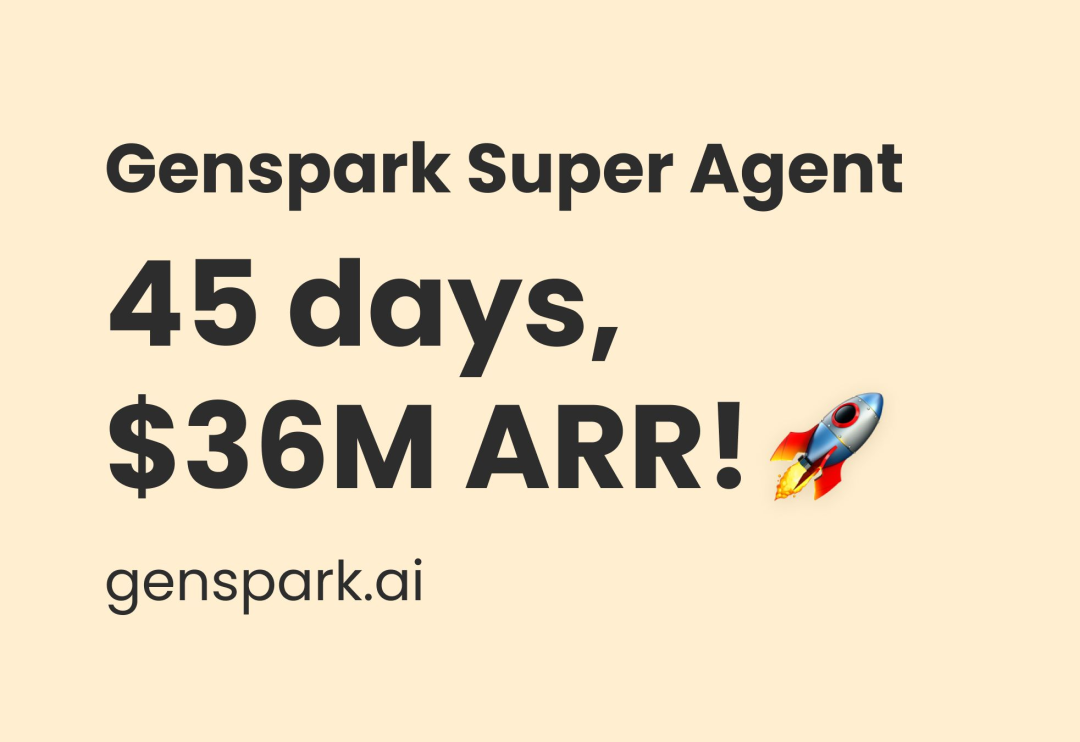
Take Genspark, which we invested in: it hit $36 million ARR just 45 days after launch. In the traditional SaaS era, that might have taken over a year. This demonstrates one thing: AI products are genuinely becoming more useful, and users are actually willing to pay for them.
We are witnessing the AI revolution enter a new epoch.

Eight Years Investing, Eight Years Building
Watching AI Actually Cross the Chasm
I was born in 1986 and got online in 1998, so I count as an internet native. From middle school on, I witnessed over two decades of the internet's sweeping evolution. At 22, I co-founded Jumei, riding the mobile internet wave; now in early-stage investing, I've been fortunate to catch the generative AI revolution. My personal experience is this: every major technological transformation in application deployment represents the best window of opportunity for entrepreneurs and investors alike.
I switched to investing in 2017, when mobile internet had already entered its second half. For young people, the odds of innovating all the way to the finish line were shrinking, replaced by veteran players and big companies subsidizing and burning cash — the O2O wars, the community group-buying wars. A flood of homogenized companies ended up competing on resources and efficiency. Back then, people were already debating: is mobile internet's innovation cycle over? We were angel investors in Xiaohongshu, and plenty of peers thought it might be the last major DAU product in China's mobile internet era.
When ChatGPT launched in late 2022, I was electrified. I stayed up until 4 a.m. using it, and it brought back memories of my first time using Google in 1999: a simple search box where you could ask anything in natural language, and get answers to everything. This is my vision of the ultimate product: packaging extremely advanced technology behind a radically simple interface, like magic that gives ordinary people extraordinary capabilities.
Early large models weren't smart enough yet, and hallucinated plenty, but for the first time, I felt AI wasn't just a hot topic in research circles — it was a product people could actually use. Before the generative AI wave, even though AlphaGo had defeated Lee Sedol and Ke Jie, and Tesla had rolled out FSD, AI remained distant from ordinary life. Talking about AI back then meant discussing R&D and future visions, still far removed from mass-market products.
ChatGPT was a genuine inflection point, making AI accessible to everyone and genuinely good. I've always loved the framework for understanding technological innovation called "Crossing the Chasm" — its central theme is how innovative technologies move from early markets into the mainstream. My intuition was immediate and strong: ChatGPT might be the first AI product to truly cross that chasm. Now, with 100 million monthly users globally, that thesis has been validated.
We used to categorize early successful entrepreneurs into four types: prodigies, veterans, scientists, and operators. But recently we've wondered whether we need to distinguish between "early stages of technological change" and "mature technology periods" — the profiles and playbooks that win may differ significantly across these eras. The past decade was mobile internet's maturity phase. In the second half, lower margin for error meant experience and resources mattered more; serial entrepreneurs who'd paid their dues in battle perhaps had better odds. Yiming Zhang, Xing Wang, Zheng Huang — all built their major companies on their third attempts.
With AI today, we're back in the early stage of technological transformation. Entrepreneurs need deep understanding of new technologies and sensitivity to opportunities at the margins of technological change — which creates openings for young founders. But AI also needs to land through mature forms like apps or websites, setting a higher bar for entrepreneurs: you must grasp frontier technology while possessing strong product execution capabilities. Many founders we've invested in — at Manus, Moonshot AI, Genspark, HeyGen, Youware — fit this profile.
Meanwhile, methodologies from mature industries, like A/B testing and precision user acquisition, aren't necessarily most effective in early-stage industries. For example, A/B testing excels at finding incremental differences between product variants, but early-stage technology often demands choices made without data — choose right and you're 10x from the start, choose wrong and you lose everything. After Transformer emerged, which technical path was superior, BERT or GPT? OpenAI didn't A/B test its way to the answer; it made a judgment call and executed, and in fact BERT performed better before model scale reached a certain threshold. Yet this capacity for choice is precisely the opportunity AI-native entrepreneurs have against tech giants.

Spending a Little Money to See the Future Is Actually Worth It
The difficulty of early-stage investing lies in its long feedback cycle. You invest in a project and wait 5-10 years to know if you were right. Some projects start with tremendous buzz but don't go the distance; others that seem less exciting may prove more valuable with time. Pop Mart is a case in point — nearly every Chinese VC looked at it, and everyone later lamented missing out.
This resembles training an AI model — a process of continuously adjusting weights to minimize the loss function. Training and optimizing this "model" of early-stage investing does take longer. But technological change is accelerating now; we can reference evolutionary paths that previously took decades or even centuries for new technologies, and compress them into very short timeframes. This is a good thing — otherwise we'd grow old before seeing any results. Covering in 5 or 10 years what previously took 100: while the developmental path can be learned from, our mentality must keep pace too. We need to adapt to faster, more dramatic change.
In reinforcement learning, environment design and reward design matter greatly. What are these when we're learning about AI? I believe one core element is continuously learning new technologies and experiencing new products.
First movers often reap substantial rewards. The earliest internet entrepreneurs, for instance, were typically the first to buy computers and get online; the first mobile internet builders were often the earliest iPhone adopters. AI products are already quite affordable now — maybe just $20 a month, the price of a meal, but it helps you see the future first and seize opportunities first.
The day the first true agent product Devin launched, I paid $500 to try it and was profoundly shaken. I wrote in my social feed: "Devin, as the first genuinely usable true agent product, may mark an important moment in human history. $500 buys two bottles of Moutai, or a Devin account to experience the future in advance." Manus's product design later drew considerable inspiration from Devin.
On another front, AI has also made execution more affordable. Previously, if you had an idea, you'd need to find people to code and design — a heavy process, hence the joke about having a great idea and only lacking a programmer. Now, using tools like Cursor, Manus, and Youware, you can quickly turn an idea into a demo, or even a usable product.
When execution is no longer scarce, I believe the crux of work becomes:
1) What you choose to do. This is human agency — subjective initiative. When we talk with entrepreneurs, we care deeply about whether they're the ones actually taking action, clear about what they want to do, finding ways to push forward, hiring, fundraising, building product, solving problems and pressing ahead when they hit obstacles.
2) What you choose. This is what people call taste. AI can generate many options, but the final choice still falls to humans. Midjourney gives you four images at a time; vibe coding offers multiple implementation paths — which do you pick? Perhaps someday AI's taste will surpass human taste, but for now, humans must decide. Agency and taste are the key differentiators between people in the AI era.
Willing to spend some money to experience products that might represent the future is, at its core, also an exercise in agency and choice.

If You Create Value for Users, There's Always a Way to Monetize
I often use an example to illustrate exponential growth:
Imagine a pond where lily pads double in area each day. Day one, just a small patch; day two, two patches; day three, four... and so on. If the entire pond is covered by day 30, then on the morning of day 29, half the pond would still be uncovered.
I believe AI's current development aligns with William Gibson's observation: "The future is already here — it's just not evenly distributed." AI models already surpass 99% of humans in writing, coding, mathematics, and reasoning. Many people are already using tools like Cursor, Manus, and Genspark to 10x their work speed — they see a completely different world. But for those who haven't experienced these products, nothing has changed.
Technology diffusion takes time, which is why we have the innovation diffusion curve from innovators and early adopters to the mass market. Now, we can visibly see that chasm.
Take Google as an example. When it first emerged, it was an advanced-technology-based, incredibly useful product with no profit model. Wall Street was full of skepticism: it didn't run ads, and even encouraged users to leave the site quickly — how could that make money? But in 2002, Google found its business model through AdWords and AdSense. Now search advertising is one of the internet industry's most lucrative money-printing machines.
This is instructive. Products driven by new technology often start as "users love it but no one knows how to monetize." Perfecting the business model takes time. I believe that as long as a product creates sufficient value for users, there will always be a way to extract and convert that value into revenue. Whether through subscriptions, advertising, or lead generation — the essence of business is creating more value for users and extracting profit from it.
You could also ask: if you were forbidden from using ChatGPT for life, how much would you pay? Many would name a very high price. This shows it's become an irreplaceable tool.
Of course, some say this revenue is "vibe revenue" — users pay once out of curiosity and leave. That risk exists. But I think the biggest difference between AI products and traditional products is their evolution speed. The car you buy doesn't evolve; an app might not update meaningfully for a year. But AI capabilities are advancing explosively. Two years ago you might have found ChatGPT useless; now it's entirely different.
Last year we witnessed many examples of model capability upgrades. SWE-bench, used to test AI's ability to complete GitHub coding tasks, is illustrative. In early 2024, GPT-4 scored only 4-5 points; by late 2024, o1 and o3 mini reached 60-70 points; by mid-2025, leading models broke 80 points, and Moonshot AI, our portfolio company, just released an open-source model that surpassed 60 points. This massive capability upgrade substantially increases user value and further drives retention.
So regarding whether AI can make money, we're growing increasingly confident.
In an industry's early days, talking about endgames is meaningless — the only thing that matters is getting in and executing. Think back to 2015: few could have foreseen today's ByteDance. Back then, people were still debating whether Toutiao had defensible moats. What seems inevitable in retrospect was anything but; those who lived through it know that the short-video track had already died once before — Vine and Miaopai never made it big. Many things only look obvious in hindsight; when you're in the thick of it, you're just fighting to break through. Rather than endgames, I focus on the present: who's using it, what value are they getting, and in what scenarios will value continue to be generated going forward.

Growth Hinges Not on Paid Acquisition But on Whether There's a "Magical Experience"
Paid acquisition was a required course in mobile internet's later stages, yet for many successful AI applications today, it's not the focus — sometimes not needed at all. The key is whether you can deliver a magical experience that drives organic word-of-mouth. When users suddenly encounter a product that's ten times better, the power of口碑 and organic growth far outstrips paid acquisition.
DeepSeek is the example: it went viral globally upon launch without spending a dime on marketing. Manus is the same. In recent years, user acquisition has become highly professionalized, with ever more growth specialists — but when the technological paradigm shifts, these mature methods may no longer apply.
I'm delighted that AI has brought us back to an era where product quality wins users over, where product managers make choices through judgment and move people through experience. Looking back at the early internet, paid acquisition wasn't yet a discipline — people relied on product, content, and word-of-mouth itself. Facebook, for instance: users who added a few friends would get hooked, showing excellent retention, and the product design itself facilitated viral spread. The "relationship status" feature, where everyone could see who'd gone single, was inherently conversation-starting.
On the choice between retention and new user acquisition. Growth people always say retention matters, but this carries an implicit premise: the product is universally appealing. Many niche products — Douban, Jike — have excellent retention; those still using them are true believers, but they've stopped growing. I believe in the early stages of technological revolution, having clear highlights that rapidly attract users matters more.
And when the technology itself is still imperfect, weaker retention is normal — the technology is still evolving. Looking back at Amazon's early days, there was little to buy and the experience was mediocre, but what mattered was the slope of product improvement.
In the AI era, ChatGPT is the archetype. Initially not that capable, many people tried it, chatted idly with AI, found little use, and retention was far from today's levels. Emotional AI products like Character.ai actually had higher retention then, because core users were highly sticky. But you'd gradually notice such products had relatively concentrated user bases — most people didn't feel the need. ChatGPT's demand proved more universal. Even if retention started mediocre, product capabilities improved rapidly alongside model progress, moving from "nice to have" to "must have," entering real high-frequency scenarios.
So rather than retention, I now prioritize whether an AI application has compelling highlights: first, whether the product has attraction in some scenario where users come on their own, without subsidies or paid acquisition; second, whether the product is rapidly improving, with a steep enough slope. This may be the biggest difference between driving growth in technological revolution's early stage versus its mature phase.

When AI Works for You, How Much Salary Would You Pay It?
I've been thinking that AI may enable a new business model: virtual employment.
Traditionally, we pay for tools based on their value plus our time cost. But hiring a person is different — you're essentially buying their time. Tools and employees operate on fundamentally different pricing logics.
Now if an agent can truly complete work for you, you might be willing to redirect some of what you'd pay an employee to it instead. At that point, its value far exceeds what we'd pay under traditional subscription models for tools.
A $100 tool subscription might feel expensive because you still have to operate it yourself. But if it saves you time, or even completes the task outright, that's an entirely different proposition.
We've also been saying lately: Attention is not all you need. This plays on the Transformer paper title "Attention is all you need."
Mobile internet business models were fundamentally built around "attention." You scroll short videos, browse feeds, and platforms monetize that attention. But human attention is finite — there are only so many people in the world, each with only so many hours in a day. With mobile internet penetration already so high, if your application requires sustained user attention, it's fundamentally a zero-sum finite game, competing for time against TikTok and Xiaohongshu.
But if AI can directly do things for you, liberating attention, the imagination space transforms entirely. You could have 10, 100 agents working in parallel. The real constraint becomes: what do you actually want them to do?
As long as AI genuinely creates value for me — say it saves or earns me $100 — paying it $20 could feel perfectly natural. This is no longer monthly subscription; it's more like "paying AI a salary."
This positive cycle can break through not just human attention limits, but also traditional subscription price ceilings. Now tools like Cursor and some AI products are already moving toward usage-based billing — how many tasks it completes for you, the system automatically tallies up.
Essentially, they're all heading toward "virtual employment."

The Value of AI Applications Will Only Grow
Do applications, or "wrappers," have long-term value? This has been debated for years. Some believe that as models grow more powerful, they'll swallow application value. I believe precisely the opposite: the more powerful models become, the more applications can create incremental value through proprietary context and environment.
First, the facts: when Cursor and Perplexity first emerged, many dismissed them as mere wrappers that model companies would soon eliminate. Yet even though ChatGPT launched search, Perplexity continues growing rapidly; every major model company has released its own coding product, yet Cursor remains the preferred AI coding tool, reaching $500 million in annualized revenue with its latest valuation approaching $20 billion.
So even when going head-to-head with general-purpose models, as long as an AI product solves problems and delivers unique value, it's not doomsday. Good products always have their place.
Second, the models available to application companies are also growing more powerful. If I run an application company, will model companies have models ten times better than mine?
In early 2023, this was a genuine concern: OpenAI had the people, the compute, the data, the money — if it achieved total dominance, training a 100-point model for its own products while application developers were stuck with 10-point models, there'd be no contest.
But now we see intense competition among leading model companies, with API gaps steadily narrowing. If application companies can consistently access near-SOTA model APIs, then combined with strong product design, user data, usage habits, and brand effects, they can potentially deliver superior experiences.
I've been developing a framework where AI application value accumulation occurs across three layers.
The bottom layer is model capability — relatively general and public, indeed requiring large model companies to provide through open-source models or closed APIs.
The middle layer is context not directly present in model weights, which subdivides further: first, public context like news reports used for search; second, organizational context like internal documents, processes, and data; third, personal context like user-AI interaction history, personal information, and preferences. Both organizational and personal context represent defensible moats that models can build.
Beyond context, there's the environment layer, encompassing various tools models can invoke — computer use, MCP, A2A protocols — as well as codebases models can modify and iterate upon.
As AI products mature, more value creation will occur in these context and environment layers — these constitute AI applications' moats.
What application entrepreneurs should truly focus on is anticipating what capabilities SOTA models will have 6-12 months from now, and preparing accordingly. As Steve Jobs quoted a legendary hockey coach: "I skate to where the puck is going, not where it has been."

For the First Time, We Can All Be (AI's) Boss
The emergence of agents capable of autonomously completing tasks means that for the first time, each of us can be a boss (to AI). Of course, being a good boss isn't easy and requires much learning.
Learning to be a good boss means trying the future more and using new AI products more. Just as when interviewing product managers, we'd ask them to open their phones and show their frequently used apps to gauge their understanding of mobile internet. The same applies now: experiential learning with AI products matters greatly. Whether Genspark, Manus, or Deep Research, you can try these new products and see to what extent AI can help you improve efficiency and save time.
Technological upgrades often bring organizational scaling laws. On one hand, new technologies let smaller teams accomplish more; on the other, they let large companies manage bigger operations. In the mobile internet revolution, we saw both Instagram — a mini-company of barely a dozen people when acquired for $1 billion — and Meituan, a super-company using technology to efficiently manage millions of delivery riders.
The AI revolution may push organizational scaling laws even further. By being the boss of more and better AI, Sam Altman predicts we'll soon see one-person unicorn companies, while large companies with more capital and compute may use more powerful AI to manage larger teams and handle more diverse businesses.
AI's development resembles boiling water: before it reaches boiling, it may only brew coffee, but once it hits 100 degrees, it unlocks the steam engine, bringing massive productivity transformation across industries.
We've already seen model capability advances in reasoning, research, coding, and increasingly more domains, delivering magical experiences to AI applications, and witnessing explosive growth in user numbers and revenue.
Perhaps this time, the water has truly boiled.


[
 ](
](