Qiming Venture Partners' Alex Zhou: 2025 Will Be the Year AI Applications Fully Take Off
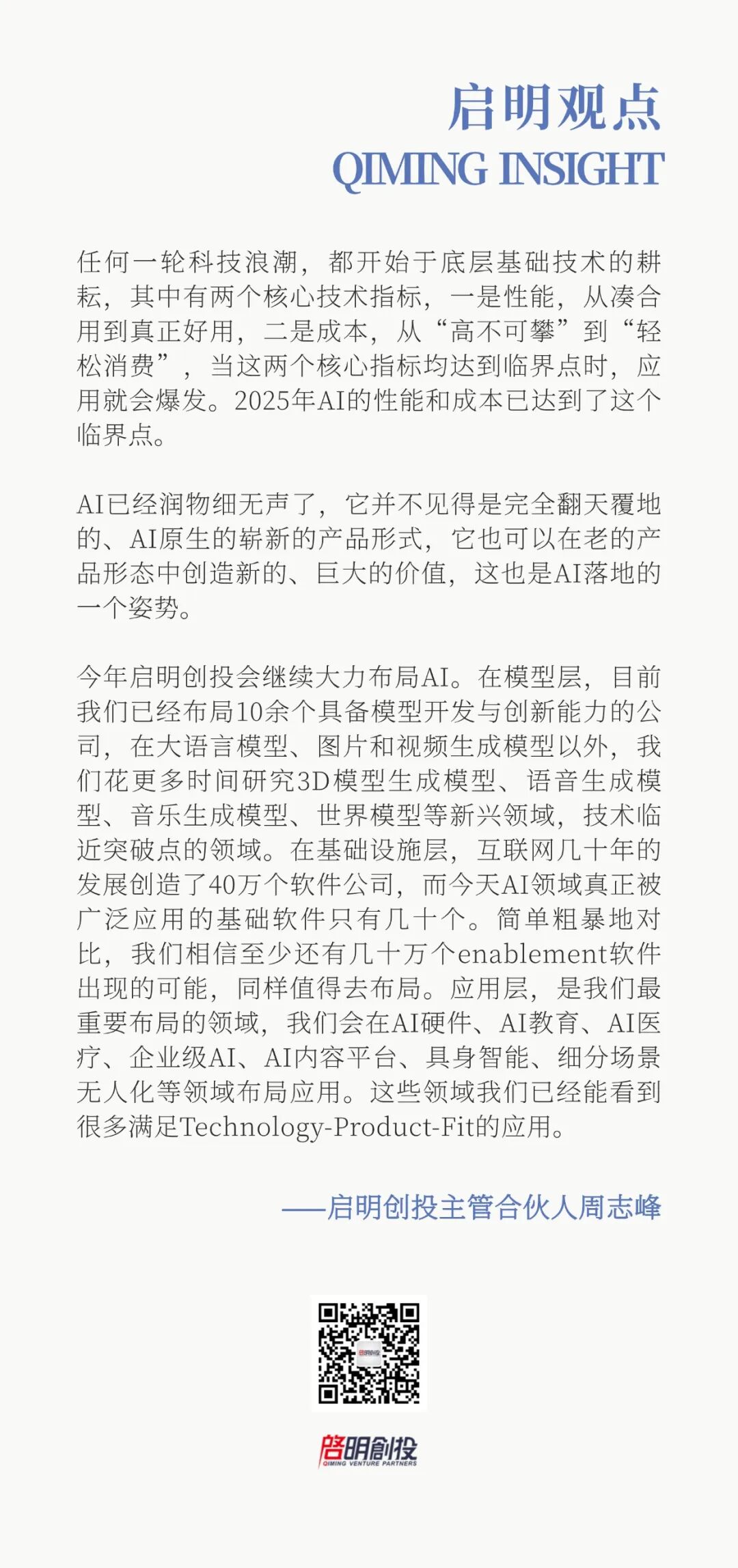
Every wave of technological change begins with foundational work at the infrastructure layer. Two core technical metrics drive this: performance, evolving from "functional" to "actually good," and cost, dropping from prohibitively expensive to easily affordable. When both metrics hit their tipping points, applications explode.

Editor's Note: Alex Zhou, Managing Partner at Qiming Venture Partners, delivered a keynote speech titled "2025: AI's Journey into Reality" at the 19th China Investment Annual Summit. He outlined Qiming's three-layer approach to AI investing — infrastructure, model, and application layers — and analyzed why 2025 marks the year AI applications achieve widespread deployment. He emphasized that cost optimization is equally critical as performance breakthroughs in driving AI commercialization, and shared Qiming's investment strategy for 2025.
This article is republished with authorization from the Qiming Venture Partners WeChat official account.
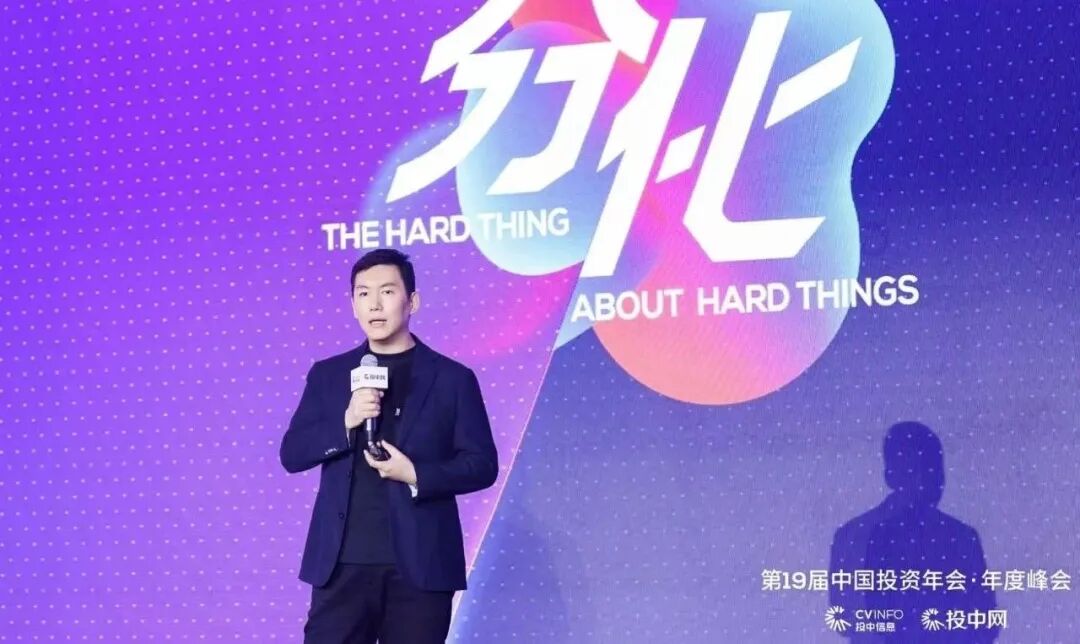
Alex Zhou, Managing Partner at Qiming Venture Partners
At the 19th China Investment Annual Summit co-hosted by ChinaVenture and ChinaVenture.com, Alex Zhou, Managing Partner at Qiming Venture Partners, was invited to deliver a keynote speech titled "2025: AI's Journey into Reality," sharing his insights on AI investing and his projections for how the AI market will evolve.
He argued that every technology wave begins with foundational infrastructure development, driven by two core technical metrics: performance, moving from "usable" to "good enough," and cost, moving from "prohibitively expensive" to "affordably accessible." When both metrics reach critical thresholds, applications explode. 2025 will be the year AI applications achieve comprehensive deployment.
Below is an edited transcript of his speech.
Hello everyone! My topic today is "2025: AI's Journey into Reality." I'll share from two dimensions: first, my projections for how AI will develop in 2025; second, what strategy we as investors should adopt to ride this wave of AI application deployment.
As one of the most active investors in China's AI sector over the past decade-plus, Qiming Venture Partners has focused on AI as a core investment area since 2013. We have cumulatively invested 10 billion RMB across more than 80 AI projects, with over 20 of these growing into publicly listed companies or unicorns, including UBTECH (09880.HK), the world's first listed humanoid robot company, and WeRide (NASDAQ: WRD), the world's first listed general-purpose autonomous driving company and first Robotaxi company.
01/
2025 Will Be the Year AI Applications Achieve Comprehensive Deployment
The liveliest area in the AI market over the past two years has been large models. We have invested in 14 leading companies in large language models, multimodal models, embodied intelligence models, and end-to-end autonomous driving models — a number that ranks among the highest in Asia. We also assist in managing the Beijing Artificial Intelligence Industry Investment Fund, which has reached 10 billion RMB in scale. These serve as "touchpoints" that provide us with more data to judge the trajectory of AI's development, better training our investment thinking models.
For years, Qiming Venture Partners has divided AI investing into three layers:
1) Infrastructure Layer (Enablement Layer), including enabling technologies such as toolchains, data software, AI security, and training/inference acceleration, as well as hardware foundations like AI chips and cloud computing platforms.
2) Model Layer. China has numerous model companies, but their strategies vary widely. Zhipu AI, for instance, is committed to building the "power plant" of the AI era, while Galaxy Universal and others are developing products and applications with massive industrial impact through core foundational model capabilities. In two or three years, people may no longer call them AI companies or model companies — they'll be defined as application companies. Many investors believe large model companies have no value. I completely disagree, because no company wants to do model R&D alone; everyone wants to build a valuable application company. It's just that at this stage, the underlying technology isn't fully mature, and innovating at the model layer is the best way to achieve differentiation. Today's so-called "model companies" will ultimately become application companies — this is the significance of investing in model innovation right now.
3) Application Layer. In the broader AI market, application-layer companies will dominate, representing an estimated 99% of all enterprises by number, and capturing 70%-80% of the value created by this AI technology wave. I believe 2025 will be the year AI applications achieve comprehensive deployment. Viewed through the lens of historical paradigm patterns, AI technology has indeed reached the stage where applications should take off.
02/
Why Not Last Year or the Year Before?
The reason is that every technology wave begins with foundational infrastructure development, driven by two core technical metrics: performance, moving from barely usable to genuinely good, and cost, moving from "prohibitively expensive" to "affordably accessible." When both metrics reach critical thresholds, applications explode. I believe AI's performance and cost have reached this inflection point in 2025.
Take the internet era as an example. The internet's core was "connection" — it used connection to drive the marginal cost of distributing information, goods, and services toward zero. Looking back at the internet's early development, the experience in the mid-1990s was still in the foundational infrastructure phase — 18.8Kbps dial-up speeds meant downloading a single image took nearly ten minutes. At that time, China's earliest ISPs charged 10 RMB per hour for dial-up access, while the national average monthly salary was only 400 RMB, enough for just forty hours of internet use. These dual constraints of performance and cost meant early applications were limited to text-based BBS forums, simple information browsing, and other tool-like functions — nothing else.
After 2000, as bandwidth improved and prices dropped, four platform-level directions emerged: social (instant messaging, social networks), entertainment (online video, online gaming), information (search engines, news platforms), and e-commerce (shopping platforms, online payments), spawning a dizzying array of internet applications that drove widespread deployment over the past two decades. So before a technology's performance and cost develop to a certain level, talking about applications is meaningless. Many people have doubted AI in recent years because hundreds of billions in investment haven't produced disruptive AI applications — but the fundamental reason is that the underlying technology simply hadn't matured.
From 2020 to early 2024, large language models led by OpenAI's GPT-3 and GPT-4 propelled AI into a period of rapid development. However, limited by model intelligence capabilities and high usage costs, the main applications that emerged were concentrated in narrow scenarios: productivity tools, chatbots, and coding assistants, with roughly 120 million monthly active users in China. Most users were still in exploration mode. AI technology was embedded primarily as a "tool enhancement" attribute.
03/
AI Commercialization: Cost Optimization Is Equally Critical as Performance Breakthroughs
In the past six months, AI model development has achieved breakthrough progress. From OpenAI's launch of the O1 model with exceptional reasoning capabilities in November 2023, to DeepSeek's release of the R1 model in January 2025, to OpenAI's heavyweight release this week of the O4 multimodal understanding and generation integrated model — a new generation of AI models has achieved leapfrog performance improvements. Driven by this technological iteration, AI usage costs have simultaneously shown a significant downward trend of over 100x annually. As both performance and cost metrics touch critical thresholds, we judge that 2025 will become a pivotal node for AI applications to transform from single-purpose tools into platform-level products — an evolution path that closely mirrors the application development trajectory of the internet era.
The internet's core was connection; AI's core is intelligence. Using human intelligence levels as a reference frame for AI capabilities: between 2022 and 2024, the best SOTA models from China and the United States scored around 70-80 on human IQ tests, equivalent to Forrest Gump's IQ of 78 in the film — below normal human levels, typically coming across as a bit slow and wooden, capable of completing certain tool-like, auxiliary tasks only after extensive guidance. This matches our impression of AI large model products from those years. After reasoning models emerged in late 2024, technical breakthroughs from post-training to test-time compute scaling raised model IQ test scores to 120 for the first time. At 120, a model surpasses 75% of human intelligence globally. This week's newly released O4 model reaches nearly 140, approaching genius-level human intelligence. So new-generation AI models should be capable of work that exceeds human performance.
In the core drivers of AI commercialization, cost optimization is equally critical as performance breakthroughs. During a recent business trip to the United States, in conversations with multiple American tech giants and AI companies, DeepSeek became the must-discuss opening topic. This company's breakthrough value lies not only in engineering architecture and algorithmic innovation, but in its extreme cost control — compressing model usage costs to 2%-5% of comparable OpenAI models. DeepSeek has also catalyzed further industry advancement: Google's subsequent Gemini model achieved an additional 64% cost reduction. This will accelerate AI commercialization into an era of "universal affordability." For enterprises or consumers using AI products, not only can they improve productivity and experience, but the economics finally work out.
Let me give two examples. Yuaiweiwu, one of our portfolio companies, provides AI-driven teaching assistants that solve the "impossible triangle" of the education industry — for decades, educational products and models could only achieve two out of three: personalization, low cost, and high quality. I believe AI teaching assistants will comprise a very high proportion of education over the next decade. Through AI teaching assistants, we can truly achieve individualized instruction and education for all.
In social networking, Wink, an overseas social platform we invested in, demonstrates how AI disrupts traditional matching approaches in dating and matchmaking. By real-time parsing of user behavior and vague expressions, AI can infer users' deep needs — from physical traits to value orientations — like an experienced matchmaker. These are capabilities no online social software has ever possessed before.
AI is already transforming things quietly and invisibly. It doesn't necessarily have to be completely earth-shattering, entirely AI-native novel product forms. It can also create new, massive value within existing product forms — this too is a posture of AI deployment.
This year, Qiming Venture Partners will continue to aggressively deploy in AI. At the model layer, we have already positioned ourselves in 10-plus companies with model development and innovation capabilities. Beyond large language models and image and video generation models, we are spending more time researching emerging domains like 3D model generation, voice generation, music generation, and world models — areas where technology is approaching inflection points. At the infrastructure layer, decades of internet development created 40,000 software companies, while today only several dozen foundational software products are widely used in AI. Crudely comparing, we believe there is potential for at least tens of thousands more enablement software products to emerge, which is equally worth deploying in. The application layer is our most important deployment focus; we will invest in applications across AI hardware, AI education, AI healthcare, enterprise AI, AI content platforms, embodied intelligence, and unmanned solutions for vertical scenarios. In these areas, we can already see many applications that achieve Technology-Product-Fit.
To sum up, the general public focuses on disruptive AI applications that emerge out of nowhere, but I believe AI will be more like the morning glow, slowly illuminating our living spaces — seemingly intangible, yet imperceptibly reshaping the contours of life.
Source | ChinaVenture
Past Highlights
Qiming Perspectives | Alex Zhou, Qiming Venture Partners: "Super AI Applications" Likely to Emerge This Year Qiming Stars | Multiple Qiming Portfolio Companies Win Touzijia 2025 Robotics Industry Conference · Gold Flint Awards Qiming Headlines | Qiming Venture Partners and Portfolio Companies Win Multiple Awards Including "ChinaVenture Rankings" 2024 Top 5 Best VC Firms in China

Founded in 2006, Qiming Venture Partners currently manages 11 USD funds and 7 RMB funds, with total assets under management reaching $9.5 billion. Since its inception, the firm has focused on investing in early and growth-stage outstanding enterprises in Technology and Consumer (T&C) and Healthcare sectors.
To date, Qiming Venture Partners has invested in over 580 high-growth innovative companies, of which more than 210 have gone public on the New York Stock Exchange, NASDAQ, Hong Kong Exchanges and Clearing Limited, Shanghai Stock Exchange, and Shenzhen Stock Exchange, or exited through M&A and other means. Over 80 companies have become recognized unicorns or super-unicorns.
Many Qiming portfolio companies have grown into the most influential companies in their respective fields, including Xiaomi (01810.HK), Meituan (03690.HK), Bilibili (NASDAQ: BILI, 09626.HK), Zhihu (NYSE: ZH, 02390.HK), Roborock (688169.SH), UBTECH (09880.HK), WeRide (NASDAQ: WRD), Insta360 (688775.SH), Gan & Lee Pharmaceuticals (603087.SH), Tigermed (300347.SZ, 03347.HK), Zai Lab (NASDAQ: ZLAB, 09688.HK), CanSino Biologics (688185.SH, 06185.HK), Schrödinger (NASDAQ: SDGR), MicroPort EP MedTech (688617.SH), Sanyou Medical (688085.SH), Amoy Diagnostics (300685.SZ), Berry Genomics (000710.SZ), SinoCellTech (688520.SH), Yuanxin Technology, Insilico Medicine, MediLink Therapeutics, LaNova Medicines, Zhipu AI, StepFun, Biren Technology, and others.