Qiming Headlines | 2025 WAIC "Qiming Venture Partners · Entrepreneurship and Investment Forum—Venture Capital Ignites the AI Technology and Application Resonance Cycle" Successfully Held

From AI 1.0 to AI 2.0, Qiming Venture Partners has invested in over 100 AI projects, with portfolio companies spanning the entire AI industry chain. The firm has helped catalyze the rise of multiple sector-defining companies and stands as one of the most active and influential investment institutions in artificial intelligence across China and Asia.

On July 28, Qiming Venture Partners hosted the 2025 World Artificial Intelligence Conference (WAIC) forum "Qiming Venture Partners · Entrepreneurship and Investment Forum — Venture Capital Unlocks the AI Technology and Application Resonance Cycle" at the Blue Hall of Shanghai World Expo Center. Renowned experts and scholars, top investors, and leading entrepreneurs gathered to share and exchange views on AI technology breakthroughs, cutting-edge trends, and application deployment.
From AI 1.0 to AI 2.0, Qiming Venture Partners has invested in over 100 AI projects, with portfolio companies spanning the entire AI industry chain, helping multiple benchmark enterprises rise to prominence. It is one of the most active and influential investment institutions in artificial intelligence in China and across Asia.
Duane Kuang, Founding Managing Partner of Qiming Venture Partners
Duane Kuang delivered the welcome address. He noted that as one of China's earliest and most comprehensively positioned investors in AI, this marked Qiming Venture Partners' third consecutive year hosting the forum. Through this distinctive sub-forum, Qiming Venture Partners aims to connect innovation, entrepreneurship, and venture capital, bringing together distinguished speakers whose candid insights will provide valuable, actionable information for the industry and the broader AI ecosystem.
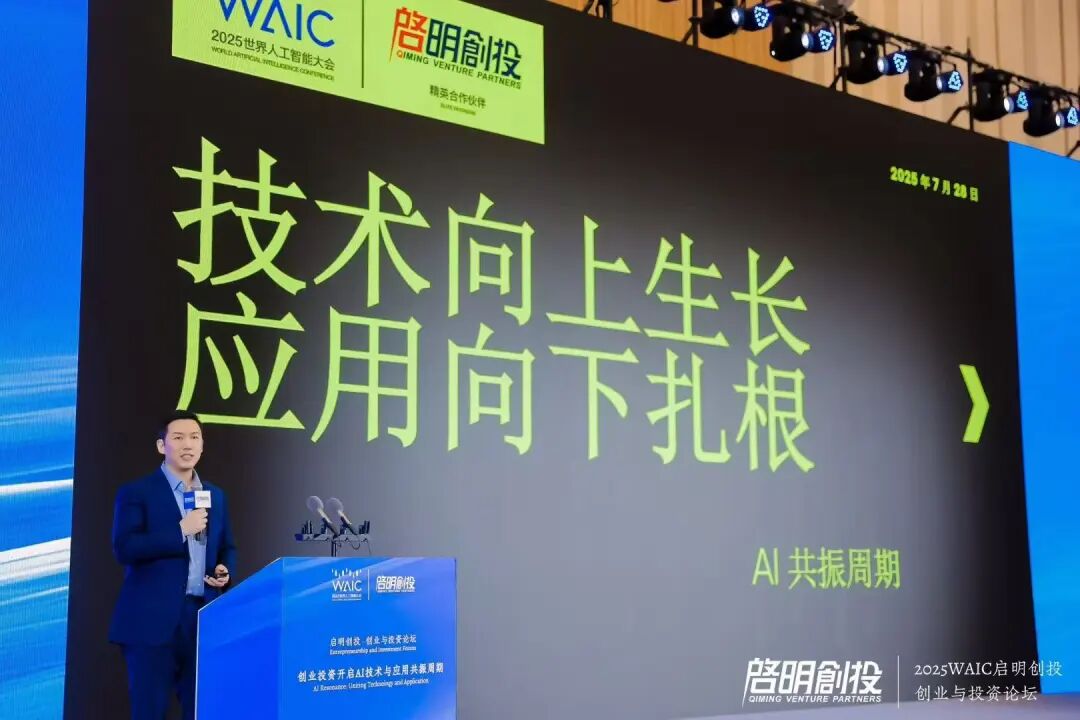
Alex Zhou, Managing Partner of Qiming Venture Partners
In his opening speech titled "Technology Growing Upward, Applications Taking Root — The AI Resonance Cycle and the 2025 Top 10 AI Outlook," Alex Zhou, Managing Partner of Qiming Venture Partners, explained that AI has entered a "technology-application resonance cycle" this year. On one hand, technology continues to grow rapidly upward with no visible ceiling. On the other hand, improvements in performance and cost have made it "usable," enabling large-scale application deployment that is taking root deeply and solidly like tree roots, creating tremendous value.
Hu Qi, Executive Director of Qiming Venture Partners
Alex Zhou and Hu Qi, Executive Director of Qiming Venture Partners, then released Qiming Venture Partners' Top 10 AI Outlook for the third consecutive year, covering foundation models, multimodal models, AI Agent, AI infrastructure, AI applications, and Embodied Artificial Intelligence.
The 2025 Qiming Venture Partners Top 10 AI Outlook includes:
Foundation Models
Outlook 1: In the next 12-24 months, a 2-million-token context window will become standard for top-tier AI models. More refined and intelligent context engineering built around larger context windows will become one of the core drivers advancing AI models and applications.
Multimodal Models
Outlook 2: A general-purpose video model is expected to emerge within 12-24 months, capable of handling video generation, reasoning, and task understanding — driving innovation in video content creation and interaction.
AI Agent
Outlook 3: In the next 12-24 months, Agent forms will evolve from "tool assistance" to "task undertaking." The first true "AI employees" will enter enterprises, broadly participating in core processes such as customer service, sales, operations, and R&D. No longer merely assistants, they will possess collaborative capabilities, proactive feedback, and the ability to own OKRs, driving the shift from cost tools to value creation.
Outlook 4: Multimodal Agents will become increasingly practical, integrating visual, voice, sensor, and other multi-source inputs for complex reasoning, tool invocation, and task execution — achieving breakthroughs first in healthcare, finance, legal, and other industries.
AI Infrastructure
Outlook 5: In the AI chip sector, more domestically designed and domestically manufactured GPUs will begin mass delivery. Meanwhile, next-generation AI cloud chips innovating in 3D DRAM stacking and converged computing will also emerge in the market.
Outlook 6: In the next 12-24 months, token consumption will increase by 1-2 orders of magnitude. Cluster inference optimization, edge inference optimization, and hardware-software collaborative inference optimization will become core technologies for reducing token costs on the AI infrastructure side.
AI Applications
Outlook 7: The AI interaction paradigm shift will accelerate within two years. As user dependence on mobile screens diminishes and natural interaction methods like voice gain importance, this will catalyze the birth of AI-native super applications.
Outlook 8: Vertical scenario AI applications hold tremendous potential. An increasing number of startups will leverage deep industry expertise to cultivate niche segments, rapidly achieving product-market fit, and differentiating from tech giants through a "Go Narrow and Deep" strategy.
Outlook 9: The AI BPO (Business Process Outsourcing) model will achieve commercial breakthroughs in the next 12-24 months, evolving from "delivering tools" to "delivering results." Through outcome-based pricing, it will rapidly expand in process-standardized industries such as finance, customer service, marketing, and e-commerce.
Embodied Artificial Intelligence
Outlook 10: Embodied intelligent robots will first achieve large-scale deployment in picking, handling, and assembly scenarios, accumulating massive first-person robot perspective data and tactile manipulation data to build a closed-loop flywheel of "model-embodiment-scenario data." This flywheel will drive model capability iteration, ultimately pushing general-purpose robots toward mass deployment.
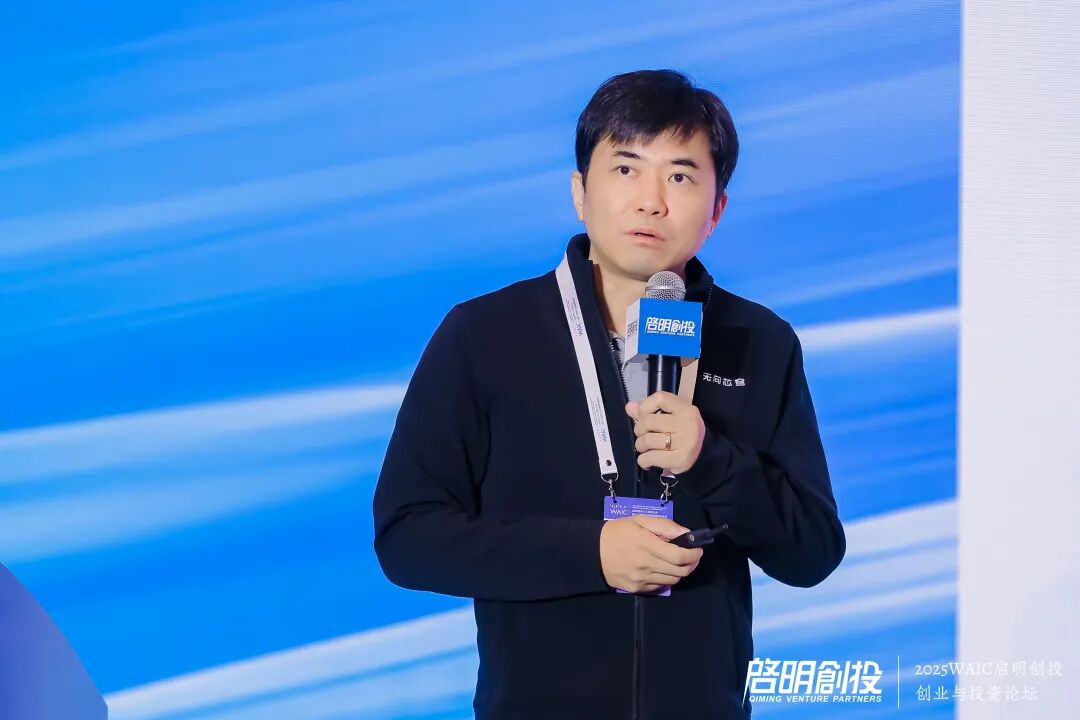
Yu Wang, Tenured Professor and Department Head of Department of Electronic Engineering, Tsinghua University, and Founder of Infinigence AI
When algorithmic innovation meets hardware breakthroughs, how does hardware-software collaboration drive paradigm shifts in AI technology? In his speech titled "Hardware-Software Collaboration Advancing AI Infrastructure Evolution," Yu Wang, Tenured Professor and Department Head of Department of Electronic Engineering, Tsinghua University, and Founder of Infinigence AI, pointed out that in the process of transforming AI into actual productivity, Token — as the fundamental unit of large model input and output — has become one of the most critical production factors in the intelligence era. The past value chain was driven by electrical power improving computing capacity to complete simple tasks. Now it has evolved into converting electrical power to computing capacity, then generating Token to support complex task execution. Accompanying this shift, the core metric for evaluating infrastructure effectiveness is also changing — the traditional "computations per joule (TOPS/J)" is being replaced by "effective Tokens processed per joule (Token/J)." Optimizing Token efficiency per unit of energy consumption will be the central proposition for infrastructure and system design in the AI 2.0 era.
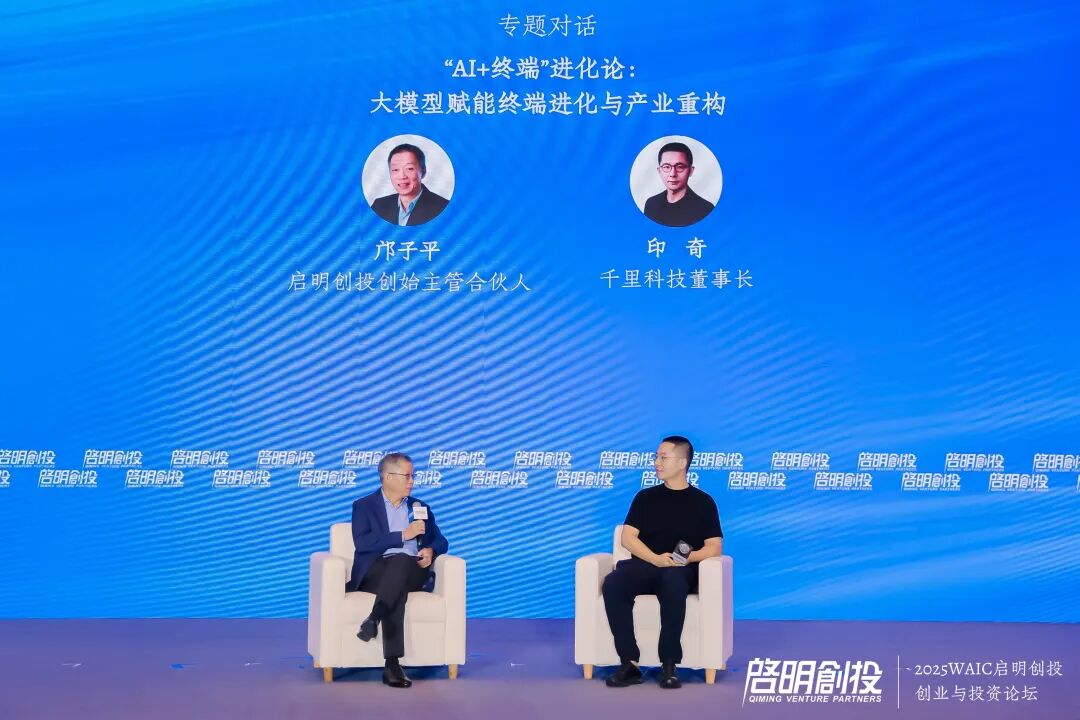
Duane Kuang, Founding Managing Partner of Qiming Venture Partners (left) and Qi Yin, Chairman of Qianli Technology (right)
Amid the large model wave, the convergence of AI and terminals is accelerating and reshaping industrial landscapes. Smart vehicles, industrial terminals, and more are being revitalized through AI empowerment. Qi Yin, Chairman of Qianli Technology, and Duane Kuang, Founding Managing Partner of Qiming Venture Partners, engaged in a featured dialogue on "'AI + Terminal' Evolution: Large Models Empowering Terminal Evolution and Industrial Restructuring."
Qi Yin identified two core trends in the AI terminal domain. First, hardware, operating systems, and services will deeply integrate. Hardware will become increasingly carrier-like — its form factor matters less than how an end-to-end AI Agent service is defined and delivered. Second, AI operating systems will undergo fundamental changes within the next year. For example, current smartphones are entirely human-controlled terminals; they will evolve toward "human-machine collaboration," with machines executing many complex tasks in the background. Precisely because of these changes in AI Agent services and operating systems, the AI terminal domain will spawn many different hardware forms before gradually converging. This space offers significant opportunities for both giants and startups.
Wei Liu, Former Tencent Distinguished Scientist and Technical Lead of Hunyuan Large Model, and CEO of Video Rebirth
As digital technology continues pushing boundaries, video generation has evolved from a content tool into a critical element for building virtual worlds. In his keynote "From Video Generation to World Models," Wei Liu, Former Tencent Distinguished Scientist and Technical Lead of Hunyuan Large Model, and CEO of Video Rebirth, stated that video generation models represent the optimal path to building world models — a technical direction that could become the key breakthrough for AI's leap from perception to cognition. Video Rebirth defines a video-native world model as the combination of a world simulator and a world predictor. Current mainstream DiT architectures, while possessing strong spatiotemporal simulation capabilities, suffer from critical limitations including lack of causal reasoning and inability to interact or intervene. The company is committed to addressing these issues through technological upgrades, building proprietary technical propositions and model paradigms, and ushering in a "ChatGPT Moment" for video generation by launching the first true video-native world model. Liu emphasized that AI needs not only grand narratives but also the creation of convincing reality. By entering world models through video generation, Video Rebirth aims to achieve important technological innovations during this critical period for breakthroughs in AI cognitive capabilities, providing significant support for the development of artificial general intelligence.
Huaiting Zhang, Founder and CEO of Yuaiweiwu
In the current era of rapid AI advancement, how to truly land technology in application scenarios and find sustainable development paths amid the entrepreneurial wave is a topic many practitioners are jointly exploring. In his keynote "Reflections and Practice in AI Application Entrepreneurship," Huaiting Zhang, Founder and CEO of Yuaiweiwu, stated that the entrepreneurial opportunity in AI applications lies in using generative AI technology to transform services into manufacturing, breaking the impossible triangle of large-scale (personalization), high quality, and low cost. The core reason we have not yet seen explosive commercial deployment of AI applications is that large models still suffer from hallucinations, inaccurate reasoning, and uncertain outputs. This demands that teams working on AI applications understand both business and AI technology, balancing model uncertainty with business fault tolerance. They should first close the business loop, use business needs to drive gradual AI capability deployment, and identify data flywheels suited to their specific scenarios. In the intelligence era, cross-disciplinary talent density and a pragmatic, innovative corporate culture are keys to organizational building, while human-machine collaborative work paradigms form the foundation of enterprise operations.
William Hu, Managing Partner of Qiming Venture Partners (left) and Feng Ren, Co-CEO and Chief Scientific Officer of Insilico Medicine (right)
When artificial intelligence meets biomedicine, a revolution in drug R&D is quietly unfolding. Feng Ren, Co-CEO and Chief Scientific Officer of Insilico Medicine, and William Hu, Managing Partner of Qiming Venture Partners, engaged in a featured dialogue on "AI-Driven Next-Generation Drug Discovery: Precision Target Mining and Clinical Value Creation."
Dr. Ren noted that traditional drug R&D relies primarily on human knowledge and experience, which carries inherent limitations. AI can break through the ceiling of human cognition, using algorithms to synthesize and analyze massive datasets, bringing many unimaginable breakthroughs in target discovery, molecular generation, and beyond. He believes that as AI deeply penetrates the entire drug R&D process, AI-driven drug discovery is evolving from the 2.0 stage to the 3.0 stage. The emergence of large models enables us to build super-intelligent agents for biomedicine, allowing AI to participate not only in molecular design and generation but also in decision-making. Regarding future directions, Dr. Ren stated that AI pharmaceutical companies must possess not only proprietary core technologies but also deeply engage in actual drug R&D scenarios, driving technology toward real-world deployment and commercialization.
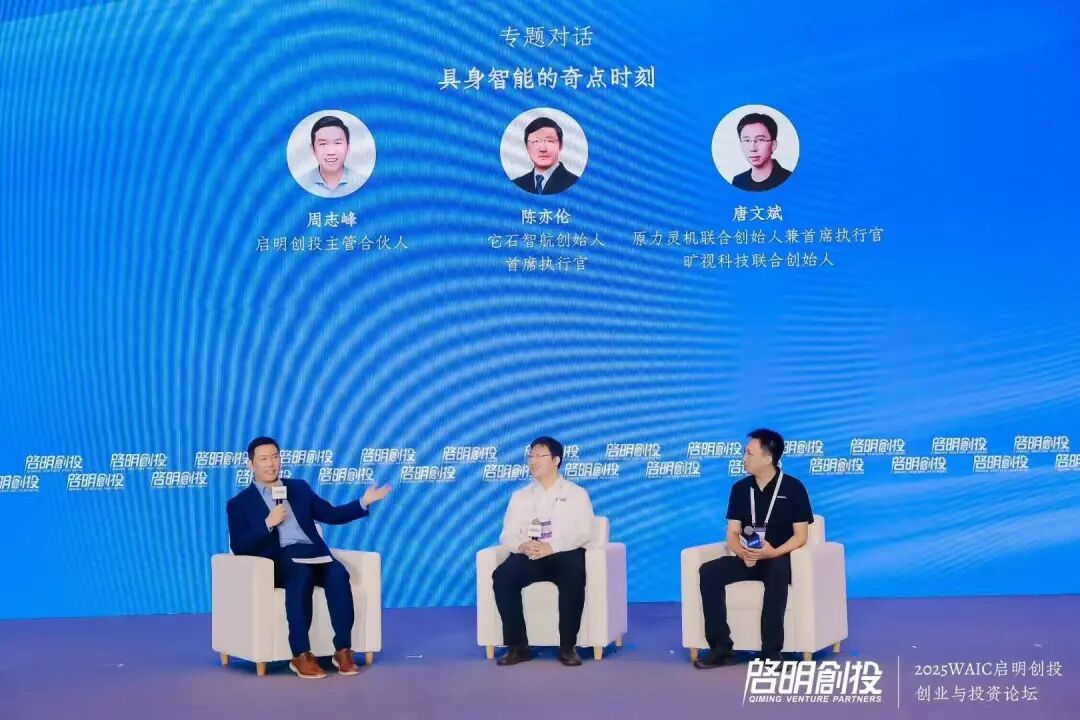
Alex Zhou, Managing Partner of Qiming Venture Partners (left), Yilun Chen, Founder and CEO of Tashi Zhihang (center), and Wenbin Tang, Co-founder and CEO of Yuanlingji Technology, and Co-founder of Megvii (right)
In the featured dialogue session "The Singularity Moment of Embodied Artificial Intelligence," Alex Zhou, Managing Partner of Qiming Venture Partners, served as moderator, joined by Yilun Chen, Founder and CEO of Tashi Zhihang, and Wenbin Tang, Co-founder and CEO of Yuanlingji Technology, and Co-founder of Megvii.
Chen stated: "Embodied Artificial Intelligence is currently the hottest subfield in the AI market. Embodied technology is progressing at exponential speed, and we are already standing at the early window of the singularity's arrival." He identified four major trends in current Embodied Artificial Intelligence technology: maturing robot embodiment control technology, end-to-end technology expanding from autonomous driving to robotics, accumulating data poised to unleash Scaling Law, and the emergence of high-degree-of-freedom dexterous hand solutions. He also believes that Embodied Artificial Intelligence and autonomous driving share common origins in task scenarios and underlying technology — model technologies can be reused, engineering capabilities can be transferred, and the autonomous driving industry's experience and insights can aid exploration and deployment in Embodied Artificial Intelligence. Finally, on赛道 selection, Tashi Zhihang follows a "golden triangle" logic of high value, large scale, and high difficulty: choosing real needs that users deeply care about, markets with substantial space, and problems that previous-generation robot technology could not solve — ultimately achieving the AGI end goal for general-purpose robots.
Tang shared core perspectives on technological development, entrepreneurial logic, and scenario deployment in Embodied Artificial Intelligence, demonstrating profound insight into this emerging赛道. He emphasized that his entrepreneurial初心 has always been robotics — starting with logistics robots at Megvii, now diving into Embodied Artificial Intelligence. His greatest confidence still comes from deep faith in technology, particularly the significant advances in large models, CoT, and Agent capabilities. Tang believes two necessary conditions for robots to evolve from specialized to general-purpose: precise perception capability of the physical world, and planning and reasoning capability for complex tasks.
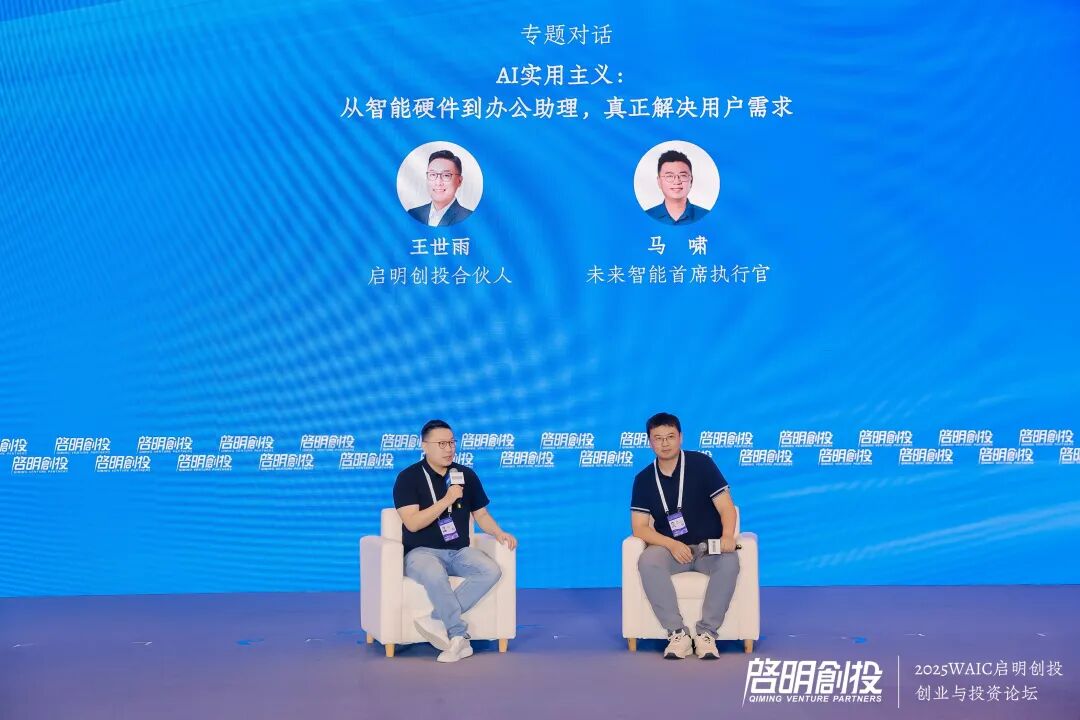
Shiyu Wang, Partner of Qiming Venture Partners (left) and Xiao Ma, CEO of Future Intelligent (right)
As AI technology moves from laboratories to life scenarios, "pragmatism" is becoming the core standard for evaluating its value. In the featured dialogue session "AI Pragmatism: From Smart Hardware to Office Assistants, Truly Solving User Needs," Shiyu Wang, Partner of Qiming Venture Partners, served as moderator, engaging in dialogue with Xiao Ma, CEO of Future Intelligent.
Ma shared Future Intelligent's entrepreneurial journey from smart hardware into office scenarios. He noted that the key to AI hardware success lies in balancing foundational hardware capabilities with AI value-added services, using iFlytek AI earphones as an example to emphasize the "5+X" strategy — first delivering core experiences in sound quality, battery life, design, noise cancellation, and comfort, then layering on unique AI features such as AI recording and transcription, AI summarization, translation, and AI voice replacement. He believes that data accumulation and vertical scenario depth in the large model era are core competitive moats for startups. Future Intelligent will build an "perception + workflow closed-loop" office ecosystem through hardware entry points, differentiating from tech giants.
PAST REVIEWS

Founded in 2006, Qiming Venture Partners currently manages 11 USD funds and 7 RMB funds, with total assets under management reaching $9.5 billion. Since its inception, the firm has focused on investing in outstanding early and growth-stage companies in Technology and Healthcare.
To date, Qiming Venture Partners has invested in over 580 high-growth innovative enterprises, of which more than 210 have gone public on the New York Stock Exchange, NASDAQ, Hong Kong Exchanges and Clearing Limited, Shanghai Stock Exchange, and Shenzhen Stock Exchange, or exited through M&A and other means. Over 80 portfolio companies have become recognized unicorns or super-unicorns.
Many Qiming Venture Partners portfolio companies have grown into the most influential companies in their respective fields, including Xiaomi (01810.HK), Meituan (03690.HK), Bilibili (NASDAQ:BILI, 09626.HK), Zhihu (NYSE:ZH, 02390.HK), Roborock (688169.SH), UBTECH (09880.HK), WeRide (NASDAQ:WRD), Insta360 (688775.SH), Gan & Lee Pharmaceuticals (603087.SH), Tigermed (300347.SZ, 03347.HK), Zai Lab (NASDAQ:ZLAB, 09688.HK), CanSino Biologics (688185.SH, 06185.HK), Schrödinger (NASDAQ:SDGR), MicroPort CardioFlow Medtech (688617.SH), Sanyou Medical (688085.SH), Amoy Diagnostics (300685.SZ), Berry Genomics (000710.SZ), GenScript ProBio (688520.SH), Yuanxin Technology, Insilico Medicine, MediLink Therapeutics, LaNova Medicines, Zhipu AI, StepFun, Biren Technology, and others.