Qiming Venture Partners Backs Three Honorees on MIT Technology Review's 2024 Innovators Under 35 China List

After eight years, the "35 Innovators Under 35" selection has evolved into a distinctive innovation ecosystem whose diversity has injected unique vitality into China's technological development — particularly in AI, where the results have been especially striking.

Recently, the 2024 China region list of MIT Technology Review "35 Innovators Under 35" was officially announced. This list captures the still-burning spark of innovation in young talent's eyes, and records how that spark has ignited into the era-defining force reshaping our world.
Three elite professionals from Qiming Venture Partners portfolio companies made the list: He Wang, assistant professor at Peking University and founder and CTO of Galaxy Universal; Guohao Dai, associate professor at Shanghai Jiao Tong University and co-founder and chief scientist of Infinigence AI; and Xiangyu Zhang, chief scientist at StepFun. Yuan Qi, distinguished professor at Fudan University, director of Shanghai Academy of AI for Science, and founder of Infinite Light Year, was invited to serve as a judge.

He Wang, assistant professor at Peking University, founder and CTO of Galaxy Universal
(Entrepreneur)
Guohao Dai, associate professor at Shanghai Jiao Tong University, co-founder and chief scientist of Infinigence AI
(Pioneer)
Xiangyu Zhang, chief scientist at StepFun
(Pioneer)
Selected for
"35 Innovators Under 35" China region list
He Wang (32)
Assistant professor at Peking University,
Founder and CTO of Galaxy Universal
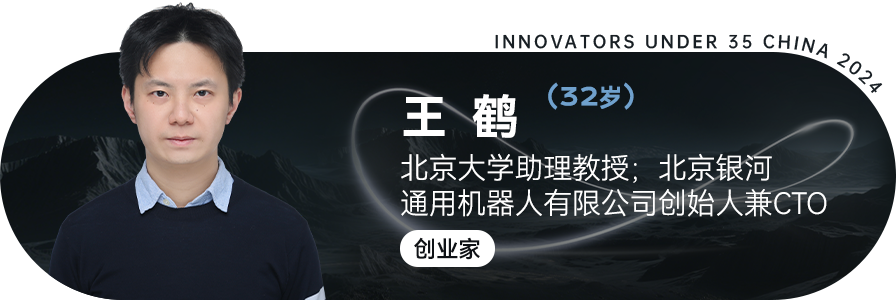
He Wang developed the first end-to-end embodied grasping foundation model using synthetic data, breaking through data and generalization bottlenecks, with potential to advance general-purpose embodied robots toward large-scale commercialization.
He Wang's research focuses on embodied intelligent robots, using AI to give robots generalizable capabilities so they can complete complex tasks in challenging environments, addressing societal challenges such as aging populations and labor shortages.
To solve the problems of insufficient data and high collection costs in embodied intelligence, he built high-precision, high-fidelity embodied synthetic big data, advancing embodied skill generalization learning and embodied foundation models. His research achieved breakthroughs in areas including generalized grasping and end-to-end embodied foundation models.
He proposed DexGraspNet, a large-scale million-level dexterous hand dataset, improving simulation data generation efficiency by 50x. Based on this, his team developed the UniDexGrasp++ algorithm, achieving high-success-rate generalized grasping on thousands of objects.
He also released GraspVLA, an end-to-end embodied grasping foundation model. This model was pre-trained entirely on synthetic big data, using one billion frames of "vision-language-action" pairs, mastering generalized closed-loop grasping capabilities and the ability to complete foundation model pre-training without large-scale real-world data. Through few-shot fine-tuning, the generalist foundation model can quickly become a specialist for designated scenarios. This technical approach offers numerous advantages including massive data, high generalization, and low cost, solving critical challenges in embodied intelligence development, with potential to lead end-to-end embodied foundation models toward large-scale commercialization in 2025.
He founded Galaxy Universal in May 2023, serving as founder and CTO. The company has completed RMB 1.3 billion in financing.
Guohao Dai (32)
Associate professor at Shanghai Jiao Tong University,
Co-founder and chief scientist of Infinigence AI
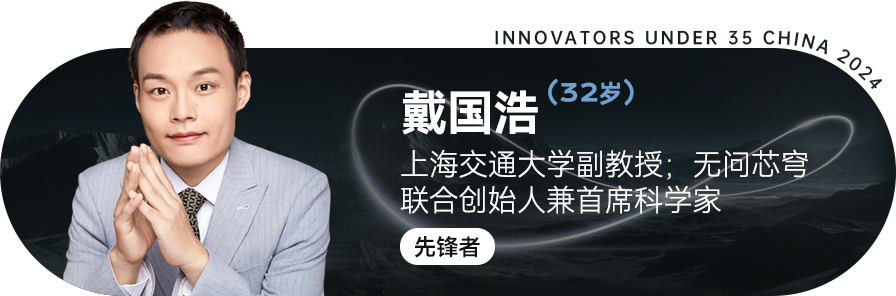
Guohao Dai proposed innovative sparse computing hardware-software co-optimization methods, significantly improving the computational efficiency and energy efficiency of artificial general intelligence, effectively alleviating the computing power bottleneck in the large model era.
Artificial intelligence, particularly the rapid advancement of large language models, is propelling humanity into the artificial general intelligence (AGI) era. However, the resulting massive computational demands have led to insufficient computing power and high energy consumption, becoming core challenges for further AI industry development.
Guohao Dai has long dedicated himself to sparse computing and hardware-software co-design research. His core methodology is based on prior-knowledge-driven structured sparsity, machine-learning-driven dynamic compilation, and fine-grained parallel sparse architectures. By reducing task volumes and improving hardware utilization, his approach achieves performance surpassing high-end process and high-computing-power hardware on chips with lower process nodes and peak computing power, improving equivalent computing power by an order of magnitude and significantly enhancing AGI computational efficiency and energy efficiency.
In 2023, Guohao Dai co-founded Infinigence AI to industrialize these sparse computing acceleration technologies and address larger-scale computing power demands in practical applications. Starting from hardware-software co-optimization fundamental research, he further expanded into diversified heterogeneous industrial scaling approaches, increasing the overall available computing pool in the AI era. The company has already launched a series of edge and cloud intelligent solutions. On the edge side, these include the full-modality understanding edge model Megrez-3B-Omni, the edge-side dynamic sparse engine SpecEE, the first customized LLM inference LPU IP FlightLLM, and the first video generation model customized inference LPU IP FlightVGM. On the cloud side, these include the inference engine FlashDecoding++, the semi-disaggregated inference scheduling system Semi-PD, and the inference system communication acceleration solution FlashOverlap. He has achieved efficient collaborative deployment and operation of large model algorithms on multiple chip types on both edge and cloud, providing key technical support for computing power democratization and sustainable development in the AGI era.
Xiangyu Zhang (34)
Chief scientist at StepFun
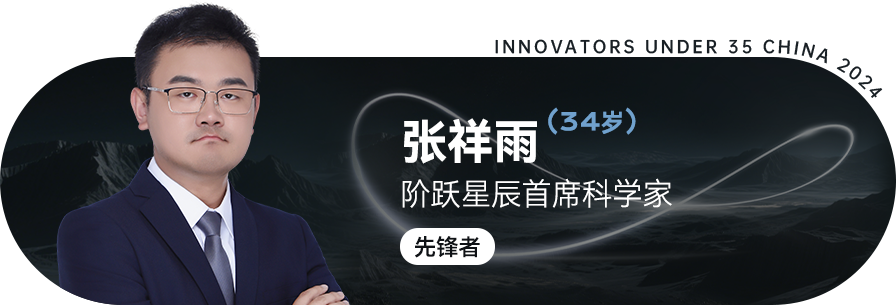
Xiangyu Zhang proposed one of the industry's earliest multimodal large model architectures integrating image-text generation and understanding, and released China's first 100-billion-parameter native multimodal large model.
Xiangyu Zhang is dedicated to researching the design, training, and optimization methods of general neural networks, continuously improving model practicality and intelligence levels.
He proposed RepVGG, introducing the idea of re-parameterization: during training, a more complex structure can be used to achieve high accuracy, while at inference time it is equivalently transformed back to a simple structure (such as VGG) to facilitate hardware inference. Subsequently, based on the same re-parameterization approach, through in-depth analysis of existing vision Transformers (ViTs), he proposed RepLKNet, an ultra-large convolutional kernel architecture distinct from ViTs, which outperformed mainstream ViTs while being simple to deploy.
Xiangyu Zhang currently serves as chief scientist at StepFun. Unlike many large model companies that chose large language models as their starting point, StepFun began directly training native image-text multimodal large models from image-text interleaved corpora. He proposed DreamLLM, one of the industry's earliest multimodal large model frameworks integrating image-text generation and understanding.
Based on this framework, StepFun released Step-1V, China's first 100-billion-parameter native multimodal large model, launched almost simultaneously with Google's first model of this type, Gemini 1.0. Its multimodal understanding capability was significantly higher than the then-mainstream vision-language separated architectures. Subsequently, they also released the trillion-parameter MoE foundation model Step-2, the video generation large model Step-Video, the image-text-speech triple-modality understanding large model Step-1o, and the reasoning model Step R-mini.
In 2017, DeepTech partnered with MIT Technology Review to formally bring the "35 Innovators Under 35" selection to China, focusing on and uncovering young innovative forces in China's emerging technology sectors. After eight years, this selection has formed a unique innovation ecosystem, whose diversity has injected distinctive vitality into China's technological development — particularly in the AI domain, where its performance has been especially prominent.
Source | MIT Technology Review
Past Coverage

Qiming Venture Partners was founded in 2006. Currently, the firm manages 11 USD funds and 7 RMB funds, with total assets under management reaching $9.5 billion. Since its inception, Qiming Venture Partners has focused on investing in outstanding early and growth-stage companies in the Technology and Consumer (T&C) and Healthcare sectors.
To date, Qiming Venture Partners has invested in over 580 high-growth innovative companies, of which more than 210 have gone public on the New York Stock Exchange, NASDAQ, Hong Kong Exchanges and Clearing Limited, Shanghai Stock Exchange, and Shenzhen Stock Exchange, or exited through M&A and other means. Over 80 companies have become recognized unicorns or super-unicorns in their industries.
Many Qiming Venture Partners portfolio companies have grown into the most influential companies in their respective fields, including Xiaomi (01810.HK), Meituan (03690.HK), Bilibili (NASDAQ:BILI, 09626.HK), Zhihu (NYSE:ZH, 02390.HK), Roborock (688169.SH), UBTECH (09880.HK), WeRide (NASDAQ:WRD), Gan & Lee Pharmaceuticals (603087.SH), Tigermed (300347.SZ, 03347.HK), Zai Lab (NASDAQ:ZLAB, 09688.HK), CanSino Biologics (688185.SH, 06185.HK), Schrödinger (NASDAQ:SDGR), MicroPort EP MedTech (688617.SH), Sanyou Medical (688085.SH), Amoy Diagnostics (300685.SZ), Berry Genomics (000710.SZ), GenScript ProBio (688520.SH), Yuanxin Technology, ClinChoice, Belief BioMed, Biren Technology, and others.