Qiming Star | Light Years Beyond's Qi Yuan: AI for Science Should Create Products Serving Thousands of Industries
The ultimate goal of AI for Science is to achieve an "AI Albert Einstein" — capable of discovering entirely new, unknown scientific laws. But before that ambitious vision becomes reality, a more practical target is to build an "AI Doraemon": a form of inclusive intelligence that can empower every industry and sector.

Editor's Note: Recently, Yuan Qifeng, distinguished professor at Fudan University, director of the Shanghai Academy of AI for Science (hereinafter referred to as "SAIS"), and founder of Infinite Light-Year — a portfolio company of Qiming Venture Partners — sat down for a conversation with Yuan Lanfeng, deputy director of the Department of Science Communication at the University of Science and Technology of China. Yuan argued for integrating real-world problems with foundational technological innovation. Using the Fuxi Weather Foundation Model, the Nuwa Life Foundation Model, and the Suiren Matter Foundation Model as examples, he shared how AI is being applied to crack key scientific problems in high-value industrial scenarios. On how to ensure that more people and industries benefit from AI technology, he pointed out that engineering optimization and open-source ecosystems are what can systematically deliver inclusive intelligence, and introduced the scientific intelligence infrastructure built on this philosophy. Yuan also shared his thoughts on the ultimate and near-term goals of AI for Science.
This article is republished with permission from the Qiming Venture Partners WeChat official account.
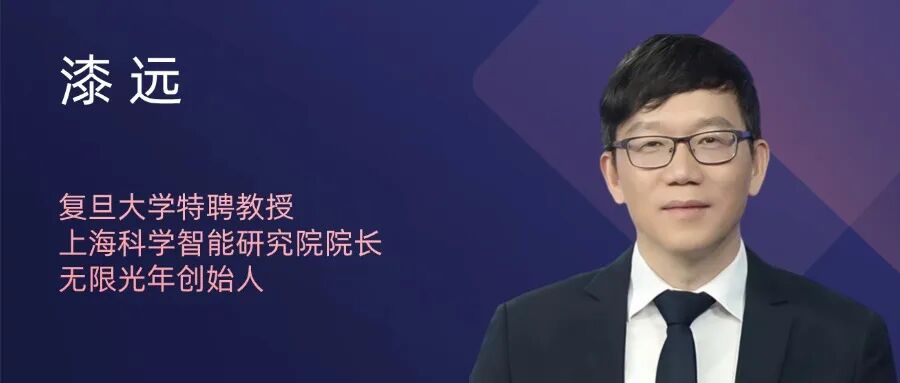
Yuan Qifeng, distinguished professor at Fudan University, director of the Shanghai Academy of AI for Science, and founder of Infinite Light-Year
As artificial intelligence technology penetrates every field at an unprecedented pace, scientific research is undergoing a disruptive transformation. The traditional research paradigm is being reshaped by AI, and AI for Science has emerged as the most closely watched focus in the scientific community. So when will AI for Science experience explosive growth on the scale of DeepSeek, truly achieving technological democratization and changing people's lives?
In the new tech observation program "Anchor Point" on Dragon TV, Yuan Qifeng, distinguished professor at Fudan University, director of the Shanghai Academy of AI for Science, and founder of Infinite Light-Year, engaged in an in-depth dialogue with Yuan Lanfeng, deputy director of the Department of Science Communication at the University of Science and Technology of China, and offered his answer: the "DeepSeek moment" for AI for Science will be the realization of an "AI Doraemon" — he hopes that AI for Science can produce products serving thousands of industries, becoming an empowering tool within reach for professionals in every field, and truly entering ordinary people's lives.
01/
AI Is a New Paradigm
For Research and For Business
At the outset of the program, Yuan Lanfeng posed the core question: when will AI for Science have its DeepSeek moment? Yuan believes this moment is accelerating toward us, currently at the eve of explosion. The SAIS he leads is precisely such a strategic new R&D institution focused on AI for Science, where AI experts, domain scientists, and engineers collaborate closely to explore AI's limitless possibilities in science.
At SAIS, vertical-domain scientific foundation models such as the Fuxi Weather Foundation Model, the Nuwa Life Foundation Model, and the Suiren Matter Foundation Model are extending AI's reach to the cutting edge of research. These systems, named after ancestors of Chinese civilization, carry the mission of using artificial intelligence to crack key scientific problems in high-value industrial scenarios.
The practical value of the Fuxi Weather Foundation Model was validated during predictions for Super Typhoon Bebinca in 2024. While most institutions predicted the typhoon would make landfall somewhere along the coast from Taizhou, Zhejiang to Qidong, Jiangsu, "Fuxi" locked onto Shanghai's Pudong district as the most likely landing point five days in advance, continuously refining its track through dynamic forecasts updated every six hours. The system has already partnered with China Pacific Property Insurance and China COSCO Shipping, among others, to provide meteorological support for ocean route planning, while also being applied to solar and wind power efficiency optimization in the new energy sector.
Taking the two foundational scenarios of life science — micro-level genes and macro-level phenotypes — as its starting points, the Nuwa Life Foundation Model is dedicated to providing foundational model capabilities for product platforms such as gene-based innovative drug R&D and digital twin diagnosis and treatment, breaking traditional genetic regulation and biomechanical computation models to achieve leapfrog prediction of life states. For siRNA, which can effectively intervene in disease-causing genes and target disease causes more precisely than traditional drugs, the team used a multimodal foundation model to legally parse patents and generate an siRNA database, then built an AI foundation model based on this database for virtual screening of siRNA drugs, reducing multi-target drug efficacy prediction error from 40% to 8% during experimental validation.
The Suiren Molecular Foundation Model focuses on core challenges in materials science, dedicated to building general-purpose tools for understanding the molecular world. In battery R&D, the model constructed a potential screening library of 929 molecules to train generative models, accelerating exploration of new lithium battery electrolyte formulations; in sustainable materials, it screened over 7 million virtual molecules to identify sustainable polymer material monomers meeting various performance requirements, helping improve degradation properties of common materials and reduce environmental pollution; drug discovery is another important application scenario, where through combining AI with computational methods, the team identified a dynamic binding pocket for a previously undruggable target within one month (difficult to capture through traditional lab methods or AlphaFold 3) and screened experimentally validated active molecules.
"AI is a new paradigm, a paradigm for research and also a paradigm for business," Yuan said: "You have to immerse yourself in the water to truly explore, find your anchor point, and combine real problems with foundational technological innovation. This is an important reason why I do both research and entrepreneurship."
This practical philosophy is validated by the collaboration model between DeepMind and Isomorphic Labs: although DeepMind, as a Google-affiliated research institute, focuses on foundational research, its "research-application" dual-wheel architecture with Isomorphic Labs has already created over $3 billion in commercial value by providing AI drug discovery services to pharmaceutical companies. This cross-boundary synergy reveals the dual nature of the AI paradigm — both a breakthrough research methodology and a sustainable business model innovation — offering key insights for solving the problem of how AI for Science can "move from the lab to industry."
02/
Engineering Optimization and Open-Source Access
Can Systematically Deliver Inclusive Intelligence
DeepSeek's emergence has drawn attention not only for its technological breakthroughs, but more importantly for the inclusive intelligence brought by engineering optimization and open-source ecosystems, enabling more people and industries to use AI technology.
When DeepSeek's large model compressed training costs to one-tenth of traditional methods and inference costs to one yuan per million tokens, behind this lay engineering breakthroughs: low-rank decomposition technology reducing parameter redundancy, communication-computation parallelization improving resource utilization, and GPU/CPU heterogeneous scheduling breaking tool constraints. In developing the Suiren Molecular Foundation Model, the SAIS team restructured Fortran-based toolkits and GPU communication architectures, improving molecular dynamics simulation efficiency by 10 times and directly saving 90% in computing costs. "Algorithms are like ideas, but without engineering there is no 'body,'" Yuan put it.
On open-source access for AI for Science, Yuan used AlphaFold as an example: the model achieved breakthroughs during development by relying on open-source genomic data and underlying analysis tools, and after its success open-sourced its predicted protein structures. Researchers from 19 countries, totaling 2 million, have driven application innovations in drug discovery and disease mechanism analysis based on these open-source results. This validates the critical role of a virtuous cycle of "using open source — contributing to open source" for the development of scientific intelligence.
This systematic thinking emphasizing engineering and openness is driving SAIS to build a foundation for the scientific intelligence ecosystem. Compared to large language models like DeepSeek, vertical-domain scientific foundation models are more diverse and particularly need toolchain and data platform support.
The one-stop AI4S featured intelligent computing software platform, jointly developed by the SAIS-Infinite Light-Year Joint Laboratory with various departments at Fudan University, is like a research-oriented version of Cohere, integrating platforms, models, and application tools to serve multiple universities and research institutions. The platform currently integrates frontier models including DeepSeek and AlphaFold 3, and has completed deep adaptation with 6 domestic GPUs and 10 domain models.
The scientific corpus platform, led by SAIS and jointly built with multiple partners, made its public debut at the 2024 World Artificial Intelligence Conference. It features full-chain capabilities from data collection, processing to management and modeling, ensuring efficient data processing, trustworthiness, and secure interoperability. The platform has already open-sourced a series of high-quality scientific corpora including an siRNA drug discovery dataset, an organic molecule QM computation dataset, and the Fuxi medium-range weather forecast foundation model dataset.
Additionally, SAIS and Fudan University have for three consecutive years hosted the World AI for Science Competition, opening up scientific problems to attract young people and enterprises to participate, jointly advancing innovation and application of scientific intelligence.
03/
The Next "Anchor Point" for AI for Science
Is "AI Doraemon"
"Scientific intelligence must ask: what is a real product, and how does it address societal needs?" Yuan noted that DeepSeek reached 100 million users in one month, with one core reason being its product-oriented thinking — pursuing usability and low costs. AlphaFold 2 and AlphaFold 3 are excellent technological breakthroughs, but may not necessarily be called products.
In his view, the ultimate goal of AI for Science is to achieve an "AI Albert Einstein" — capable of discovering new, unknown scientific laws. But before reaching this grand goal, the more realistic target is to build an "AI Doraemon" — a kind of inclusive intelligence that can empower thousands of industries. He used the successful application of the Fuxi Weather Foundation Model in typhoon prediction and the breakthrough of the Nuwa Life Foundation Model in siRNA drug design as examples, emphasizing the value of AI for Science in solving real problems.
"'AI Albert Einstein' is a metaphor for being able to make scientific discoveries, but it's not one person's discovery — it's actually everyone pooling their wisdom to solve a very challenging scientific problem. DeepSeek is more like a Doraemon, able to empower many people and many industries, conjuring up a tool to help you solve problems when you need it," Yuan explained vividly.
Looking ahead, Yuan hopes that AI for Science can produce products serving thousands of industries, becoming an empowering tool within reach for professionals in every field, and truly entering ordinary people's lives.
Source | Shanghai Academy of AI for Science
PAST HIGHLIGHTS

Founded in 2006, Qiming Venture Partners currently manages 11 USD funds and 7 RMB funds, with total assets under management reaching $9.5 billion. Since its inception, the firm has focused on investing in outstanding early- and growth-stage companies in the Technology and Consumer (T&C) and Healthcare sectors.
To date, Qiming Venture Partners has invested in over 580 high-growth innovative companies, of which more than 210 have listed on the New York Stock Exchange, NASDAQ, Hong Kong Exchanges and Clearing, Shanghai Stock Exchange, and Shenzhen Stock Exchange, or exited through M&A and other means. Over 80 portfolio companies have become recognized unicorns or super-unicorns.
Many companies in Qiming Venture Partners' portfolio have grown into the most influential players in their respective fields, including Xiaomi (01810.HK), Meituan (03690.HK), Bilibili (NASDAQ:BILI, 09626.HK), Zhihu (NYSE:ZH, 02390.HK), Roborock (688169.SH), UBTECH (09880.HK), WeRide (NASDAQ:WRD), Gan & Lee Pharmaceuticals (603087.SH), Tigermed (300347.SZ, 03347.HK), Zai Lab (NASDAQ:ZLAB, 09688.HK), CanSino Biologics (688185.SH, 06185.HK), Schrödinger (NASDAQ:SDGR), MicroPort EP MedTech (688617.SH), Sanyou Medical (688085.SH), Amoy Diagnostics (300685.SZ), Berry Genomics (000710.SZ), Genor Biopharma (688520.SH), Yuanxin Technology, ClinChoice, Belief BioMed, Biren Technology, among others.