Qiming View | Duane Kuang: China's AI Investment Is Not Overheated, It Deserves Capital from Around the World
AI will bring enormous benefits to humanity, and it will also represent the greatest investment opportunity over the next decade.

On March 23–24, the China Development Forum 2025 Annual Meeting was held in Beijing. At the panel discussion on "Inclusive and Equitable Development of Artificial Intelligence," Duane Kuang, Founding Managing Partner of Qiming Venture Partners, joined fellow delegates in an in-depth discussion on balancing AI development with safety and promoting global AI governance through shared collaboration. He argued that AI will bring enormous benefits to humanity and represents the single greatest investment opportunity over the next decade. Kuang shared his views on inclusive AI development across four dimensions.
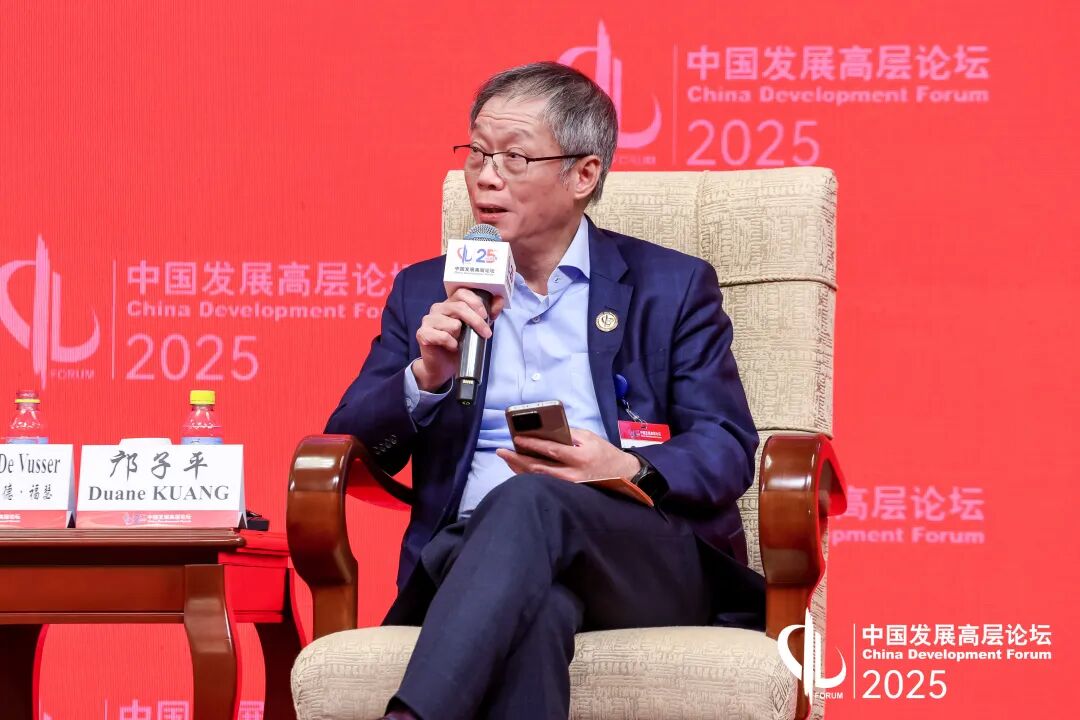
Duane Kuang, Founding Managing Partner of Qiming Venture Partners
The following is a transcript of his remarks.
Qiming Venture Partners is a 19-year-old venture capital firm. We primarily invest in technology and healthcare in China, and we are among the most active funds investing in AI in the country. Our view is that AI will bring tremendous benefits to humanity and will be the biggest investment opportunity over the next ten years. I'd like to share a few points:
-
The internationalization of AI. We believe AI will benefit all of humanity. The problems AI solves are shared by all of us, and the benefits it brings should be shared by everyone. The foundational datasets used to train AI are universal — whether for language models, multimodal models, or reasoning models, there is no such thing as a "Chinese-trained" reasoning model versus an "American-trained" one. Therefore, artificially restricting certain models to certain markets is difficult to justify. It hinders both AI development and the diffusion of AI's benefits.
-
China's AI market holds enormous potential — something we can see from the remarks by leaders of major Chinese banks who participated in our panel discussion, and from the rapid growth of Chinese AI consumer apps. Moreover, China's AI talent pool is globally competitive. Yet AI investment in China lags far behind the United States. Here are the 2025 AI spending commitments announced by major American corporations: Amazon at $100 billion, Microsoft at $80 billion, Alphabet (Google's parent company) at $75 billion, Meta at $65 billion, and the Stargate initiative by OpenAI, SoftBank, and Oracle, which plans to invest $500 billion in the coming years. By comparison, announced or market-estimated spending by China's internet giants includes Alibaba at roughly RMB 380 billion (approximately $52 billion) over three years, or about $17 billion annually; ByteDance, as a private company, has not disclosed a figure, though market speculation puts it at roughly $20 billion per year; and Tencent, estimated by the market at about $15 billion per year. As you can see, these figures fall far short of what major U.S. tech companies are spending. The gap is equally wide between American and Chinese venture capital firms investing in this space. According to CB Insights, U.S. VC investment in AI was $40 billion in 2023 and $76 billion in 2024. Zero2IPO's figures show Chinese AI fundraising at approximately $10.5 billion in 2023 and $14 billion in 2024 — roughly a fourfold difference between the two countries. Of course, this gap hasn't been entirely bad news for China so far. Both large enterprises and venture funds in China have had more room to rationally assess what constitutes reasonable investment scale. DeepSeek's global breakthrough has indeed prompted a reassessment of AI infrastructure spending. But however one evaluates it, the answer is clear: China's AI industry still faces a massive investment shortfall and is far from overheating. As Chinese foundation models like DeepSeek mature and prices continue to fall, we believe 2025 will be the year of AI application explosion in China. If the development of mobile internet offers any historical parallel, China's application development teams may well be the strongest in the world, and AI investment opportunities in China will only grow more diverse and vibrant.
-
The internationalization of AI investment. China's AI market has broad prospects, and investment is far from overheated. It should attract capital from around the world. China has grown increasingly open to investment in recent years, including in AI. The United States, meanwhile, has made certain adjustments both in outbound capital flows and in foreign investment into domestic companies. Many friends from Western countries might say that since there are already plenty of good AI investment opportunities in the West, there's no particular need to come to China. But investment markets change quickly. We believe global investor demand to invest in Chinese AI will only grow louder in the coming years. At the same time, China has produced numerous outstanding super-app companies in mobile internet over the past decade-plus, and Chinese investors have accumulated valuable experience in this domain. If Chinese investors deploy capital globally in AI applications, we believe they will bring unique insights — a positive development for global AI advancement. Cross-border AI investment benefits all parties.
-
Finally, on the topic of international AI governance, or this panel's theme of "inclusive and equitable development of AI," my view is that international governance of AI must be premised on the internationalization of AI itself — including the exchange of people, the exchange of technology, open investment, and the free flow of products and services. China and the United States are the two great powers of global AI. Mutual understanding and trust are essential for technological development and for the safe development of AI. As Professor Yuval Noah Harari just mentioned in his speech. The prerequisite for international AI governance is an open global community, where each side is embedded in the other. On inclusive fronts, such as AI applications in new drug discovery and climate change, we should cooperate wholeheartedly. On national security and other matters, we should engage in dialogue, draw clear boundaries, and compete fairly in civilian domains and investment, learning from each other's strengths. If we can do this, AI will surely bring a better future to all relevant countries and to humanity as a whole.
Past Highlights
Qiming Perspectives | Duane Kuang: AI as a Priority for Tech Investment, China's Engineering and Product Design Capabilities Radiating Globally The World Is Embracing Chinese Technology

Founded in 2006, Qiming Venture Partners currently manages 11 USD funds and 7 RMB funds, with total assets under management reaching $9.5 billion. Since its inception, the firm has focused on investing in outstanding early- and growth-stage companies in the Technology and Consumer (T&C) and Healthcare sectors.
To date, Qiming Venture Partners has invested in over 580 high-growth innovative enterprises. More than 210 of these have gone public on the New York Stock Exchange, NASDAQ, Hong Kong Exchanges and Clearing Limited, Shanghai Stock Exchange, and Shenzhen Stock Exchange, or have exited through M&A. Over 80 portfolio companies have become recognized unicorns or super-unicorns.
Many Qiming portfolio companies have grown into the most influential players in their respective fields, including Xiaomi (01810.HK), Meituan (03690.HK), Bilibili (NASDAQ:BILI, 09626.HK), Zhihu (NYSE:ZH, 02390.HK), Roborock (688169.SH), UBTECH (09880.HK), WeRide (NASDAQ:WRD), Gan & Lee Pharmaceuticals (603087.SH), Tigermed (300347.SZ, 03347.HK), Zai Lab (NASDAQ:ZLAB, 09688.HK), CanSino Biologics (688185.SH, 06185.HK), Schrödinger (NASDAQ:SDGR), MicroPort EP MedTech (688617.SH), Sanyou Medical (688085.SH), Amoy Diagnostics (300685.SZ), Berry Genomics (000710.SZ), GenScript ProBio (688520.SH), Yuanxin Technology, ClinChoice, Belief BioMed, Biren Technology, and others.