Qiming View: Technology Grows Upward, Applications Take Root Downward — Releasing the AI Resonance Cycle and Top 10 AI Predictions for 2025

This year, AI has entered a "resonance cycle of technology and application." On one hand, the technology continues to grow rapidly upward with no obvious ceiling in sight. On the other hand, it has become "good enough" in terms of performance and cost for large-scale deployment to take root and grow solidly, like tree roots digging deep — creating massive value in the process.
On July 28, during the 2025 World Artificial Intelligence Conference (WAIC), Alex Zhou, Managing Partner at Qiming Venture Partners, delivered a keynote speech titled "Technology Growing Upward, Applications Taking Root — The AI Resonance Cycle and the Release of 2025 AI Top 10 Outlooks" at the Qiming Venture Partners · Entrepreneurship and Investment Forum — Venture Capital Unleashing the Resonance Cycle of AI Technology and Applications. He also unveiled the "2025 Qiming Venture Partners AI Top 10 Outlooks."
Zhou believes that AI has entered a "resonance cycle of technology and applications" this year. On one hand, technology continues to grow rapidly upward with no visible ceiling. On the other hand, technology has become "usable" in terms of performance and cost, and large-scale applications have begun to take root — like tree roots digging deep and growing solidly, creating enormous value.
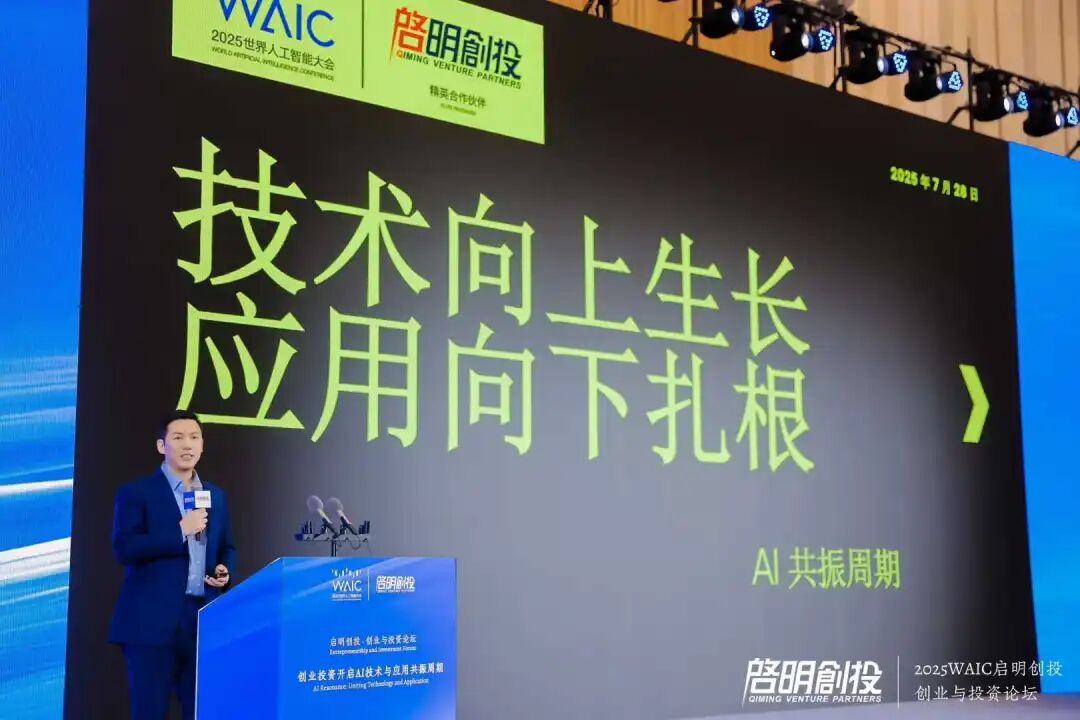
Alex Zhou, Managing Partner at Qiming Venture Partners
The following is an edited transcript of Zhou's speech.
Once a year, we meet again. I'm especially glad to gather once more with old and new friends — whether here in person or watching online — at the WAIC Qiming Venture Partners Entrepreneurship and Investment Forum. Those familiar with our forum know that I always kick things off with this "prelude," setting the stage for the speeches and discussions that follow.
This year, my title is "Technology Growing Upward, Applications Taking Root." Why this name? I recall that at our first WAIC forum in 2023, I shared a personal feeling: being an AI investor is exhausting. At that time, American large model companies were releasing new models in rapid succession. I often woke up at 3 or 4 a.m. to grab the limited invitation codes after their launches, rushing to try out the latest large model technology. Last year, I said AI was getting increasingly lively, but with any "big wave," there's a lot of noise. As an investor, how to "quiet yourself down," how to truly form independent judgments, and how to deploy capital based on your own thinking — these are exceptionally difficult things. This year, I feel the AI industry has reached a new stage: on one hand, technology is still growing rapidly upward with no visible ceiling; on the other hand, technology has become "usable" in terms of performance and cost, and we're seeing "applications beginning to land at scale" — like tree roots digging deep and growing solidly, creating enormous value. So this year, AI is in a very special phase — "the resonance cycle of AI technology and applications." Qiming Venture Partners has extensive coverage across the AI industry chain and has invested in many Chinese AI companies. Our information and perspectives aren't "armchair theorizing" — they're the result of integrating firsthand information from the industry, which forms the basis of my ten-minute share today. From an investor's perspective, I'm still willing to be "exhausted," because this is the hottest赛道.
Consider this: in the first half of 2025, AI accounted for over 50% of global investment. One sector capturing half of global investment shows that: even though the large AI model industry has been growing for two to three years, people still believe "its potential remains enormous." More and more investors are "voting with real money," continuing to pour capital into AI.
Over the past six months, many have asked: "Is pre-training nearing its end? Is the ceiling for large models approaching? Is Scaling Law no longer working?" But looking at how capital is "voting," that's not the case. In 2024, model companies raised $33 billion, nearly 20% of total global venture capital for the year.
This also shows that large models are still developing at high speed. Over the past 12 months, large models have made many new breakthroughs, such as MoE architecture, synthetic data, longer context windows, and more. If I were to summarize one or two of the most critical technical advances, the first would definitely be reasoning capability. Previous large models relied on pre-training with trillions of tokens to compress information. When you asked a question or prompted it, it was merely "transferring information" to us human users. Now, with reasoning capability, it can perform deeper logical thinking — "reasoning forward, reflecting backward" — possessing very complex capabilities. The effects are remarkably clear. Around this time last year, we were talking about GPT-4o, which was then the latest and strongest model. But by human IQ testing standards, it scored below 70. Remember Forrest Gump from Forrest Gump? His IQ was 75, making him a "mildly intellectually disabled" person. So at that time, large models were only at the level of "mildly intellectually disabled humans," capable only of simple applications, not complex tasks. But now, the latest reasoning models, such as the "Step-3" model released by StepFun last Friday, have reached an IQ of around 120. What does this mean? Of the 8 billion people globally, 87% have IQs between 90 and 120. In other words, large models have already surpassed the IQ level of nearly 80% of humanity. This is extremely significant progress.
Another key development is "multimodality." In the past, we spoke of "large language models," but language is just one dimension of human perception and interaction. If we can integrate speech, images, video, and even future IoT multi-dimensional information, the model's perception of and interaction with the world becomes far richer and more colorful. Beyond language-dominated foundation models, image and video generation models have also made great strides. In May this year, Google's "Veo 3" could already generate highly realistic videos with automatically added sound effects, dialogue, and background noise, making it feel "like a real-world video recording." Our portfolio company Shengshu Technology also just released its next-generation video model. It supports input of reference images for "up to seven subjects" (people, animals, cars, etc.) and maintains "high consistency" of these subjects in the generated video.
Now let's talk about Agent. This has been the hottest topic since March this year. Agent exploded in popularity because foundation model capabilities improved: larger context windows, ability to use external tools, with the core being enhanced "reasoning capability." Now there's even talk of an "Agent's Moore's Law" — task processing complexity doubles every seven months. We can look forward to what heights Agent intelligence will reach after another one or two "seven-month cycles."
Earlier this year, DeepSeek's V3 and R1 models shocked the world with their excellent "inference cost" performance — just 5% of OpenAI's corresponding models. Since then, global large model teams have been racing to reduce costs through engineering optimization. Google reduced costs significantly below DeepSeek's, and StepFun's latest model achieves much lower inference costs than DeepSeek, with even better performance on domestic chips — inference efficiency up to 300% of DeepSeek-R1 — thereby achieving another major reduction in inference costs. Now mainstream foundation models, even full-size large-parameter models, have inference costs down to roughly $1 per million tokens, nearly a 100x decrease from last year.
Having covered AI technology breakthroughs, let's look at AI applications. The product everyone knows, ChatGPT, was the igniter of this AI wave. In July 2023, when we first held our forum at WAIC, ChatGPT had fewer than 100 million weekly active users; by the summer of 2024 when we held our forum, it was 200 million; and now it has "roughly 800 to 900 million weekly active users." AI applications are developing very rapidly.
Harvard Business Review recently summarized a trend — AI products are moving from assisting creativity to deep interaction. In the past, we used AI for creative tasks like image generation and copywriting, referencing its ideas. But now, therapeutic companion products have become the most common use case, helping users find emotional outlets and serving as digital companions.
Token call volume also reflects application momentum. Doubao, for instance, saw its call volume grow over 100x in 12 months.
There has also been progress in AI hardware. Our portfolio company Future Intelligent's translation earbuds have surpassed 1 million users. Plaud AI, a Chinese team focused on the North American market, has also broken past one million users.
Humanoid robots are beginning to land first in China. For example, two weeks ago, UBTECH (editor's note: a Qiming Venture Partners portfolio company) signed the world's largest humanoid robot order; AgiBot and Unitree also won commercial contracts for real-world deployment scenarios.
Another trend is "globalization." In the past, internet companies were "local kings first, then overseas expansion"; but now, AI products are "born global." Kuaishou's Keling AI, for instance, derives 80% of its web traffic from overseas. Shengshu Technology's video generation platform Vidu AI surpassed 10 million users within three months of launch, with over 80% also coming from overseas.
At the end of each of our shares, and most importantly, we challenge ourselves once again to discuss our top ten outlooks for the next 12 to 24 months.
Foundation Models
Outlook 1: In the next 12-24 months, 2-million-token context windows will become standard for top-tier AI models. More refined and intelligent context engineering built around larger context windows will become one of the core drivers advancing AI models and applications.
Multimodal Models
Outlook 2: General-purpose video models are expected to emerge within 12-24 months — models capable of handling generation, reasoning, and task understanding in the video modality, driving innovation in video content generation and interaction.
AI Agent
Outlook 3: In the next 12-24 months, Agent forms will evolve from "tool assistance" to "task undertaking," with the first true "AI employees" entering enterprises to broadly participate in core processes such as customer service, sales, operations, and R&D. They will no longer exist merely as assistants but will possess capabilities for collaborative work, proactive feedback, and bearing OKRs, driving a shift from cost tools to value creation.
Outlook 4: Multimodal Agents will continue toward practical utility, capable of fusing visual, voice, sensor, and other multi-source inputs for complex reasoning, tool invocation, and task execution, achieving breakthroughs first in industries such as healthcare, finance, and law.
AI Infrastructure
Outlook 5: In the AI chip sector, more "domestically designed" and "domestically manufactured" GPUs will begin mass delivery; meanwhile, next-generation AI cloud chips innovating in 3D DRAM stacking and converged computing will also make their mark in the market.
Outlook 6: In the next 12-24 months, token consumption will increase by 1-2 orders of magnitude. Cluster inference optimization, edge inference optimization, and hardware-software collaborative inference optimization will become core technologies on the AI infrastructure side for reducing token costs.
AI Applications
Outlook 7: The paradigm shift in AI interaction will accelerate over the next two years. As user dependence on phone screens weakens and natural interaction methods such as voice gain importance, this will drive the birth of AI-native super applications.
Outlook 8: AI applications in vertical scenarios hold enormous potential. An increasing number of startups will leverage industry expertise to deeply cultivate niche segments, rapidly achieving product-market fit, and competing differentially with large companies through a "Go Narrow and Deep" strategy.
Outlook 9: The AI BPO (Business Process Outsourcing) model will achieve commercial breakthroughs in the next 12-24 months, moving from "delivering tools" to "delivering results," and rapidly expanding in process-standardized industries such as finance, customer service, marketing, and e-commerce through "pay-for-results" models.
Embodied Artificial Intelligence
Outlook 10: Embodied intelligent robots will first achieve scaled deployment in scenarios such as picking,搬运, and assembly, accumulating large volumes of first-person robot perspective data and tactile operation data, building a closed-loop flywheel of "model-embodiment-scenario data." This flywheel will drive iterative improvement in model capabilities, ultimately pushing general-purpose robots toward large-scale deployment.

Qiming Venture Partners was founded in 2006. Currently, Qiming Venture Partners manages 11 USD funds and 7 RMB funds, with total assets under management reaching $9.5 billion. Since its inception, the firm has focused on investing in outstanding early and growth-stage companies in Technology and Healthcare.
To date, Qiming Venture Partners has invested in over 580 high-growth innovative companies, of which more than 210 have listed on the New York Stock Exchange, NASDAQ, Hong Kong Exchanges and Clearing Limited, Shanghai Stock Exchange, and Shenzhen Stock Exchange, or exited through M&A and other means. Over 80 companies have become recognized unicorns or super-unicorns.
Many Qiming Venture Partners portfolio companies have grown into the most influential companies in their respective fields, including Xiaomi (01810.HK), Meituan (03690.HK), Bilibili (NASDAQ:BILI, 09626.HK), Zhihu (NYSE:ZH, 02390.HK), Roborock (688169.SH), UBTECH (09880.HK), WeRide (NASDAQ:WRD), Insta360 (688775.SH), Gan & Lee Pharmaceuticals (603087.SH), Tigermed (300347.SZ, 03347.HK), Zai Lab (NASDAQ:ZLAB, 09688.HK), CanSino Biologics (688185.SH, 06185.HK), Schrödinger (NASDAQ:SDGR), MicroPort EP MedTech (688617.SH), Sanyou Medical (688085.SH), Amoy Diagnostics (300685.SZ), Berry Genomics (000710.SZ), GenScript ProBio (688520.SH), Yuanxin Technology, Insilico Medicine, MediLink Therapeutics, LaNova Medicines, Zhipu AI, StepFun, Biren Technology, and others.