Dialogue | AI Computing Power Reconstruction: The Innovation Path of AI Chips From Cloud to Edge | WAIC 2026
How to use edge computing to ignite an intelligent transformation in hardware like robots, consumer devices, and vehicles — and kick off the second half of the campaign for AI to fully take over the physical world.

The "Qiming Venture Partners · Entrepreneurship and Investment Forum — The Evolution from Compute Origins to Application Deployment," hosted by Qiming Venture Partners as part of the 2026 World Artificial Intelligence Conference (WAIC), was successfully held on July 19 at the Shanghai World Expo Center.
During the panel discussion "AI Compute Reconstruction: The Path of AI Chip Innovation from Cloud to Edge," moderated by Nan Chen, Executive Director at Qiming Venture Partners, three leaders of edge-compute-focused AI chip companies — James Chen, Founder and CEO of SpacemiT; Wu Qiang, Founder and CEO of Houmo AI; and Liu Ruiju, General Manager of Edge & Terminal Computing Product Line at Axera — discussed how edge computing is igniting an intelligent transformation across robots, consumer devices, and automobiles, kicking off the second half of the battle for AI's full takeover of the physical world.
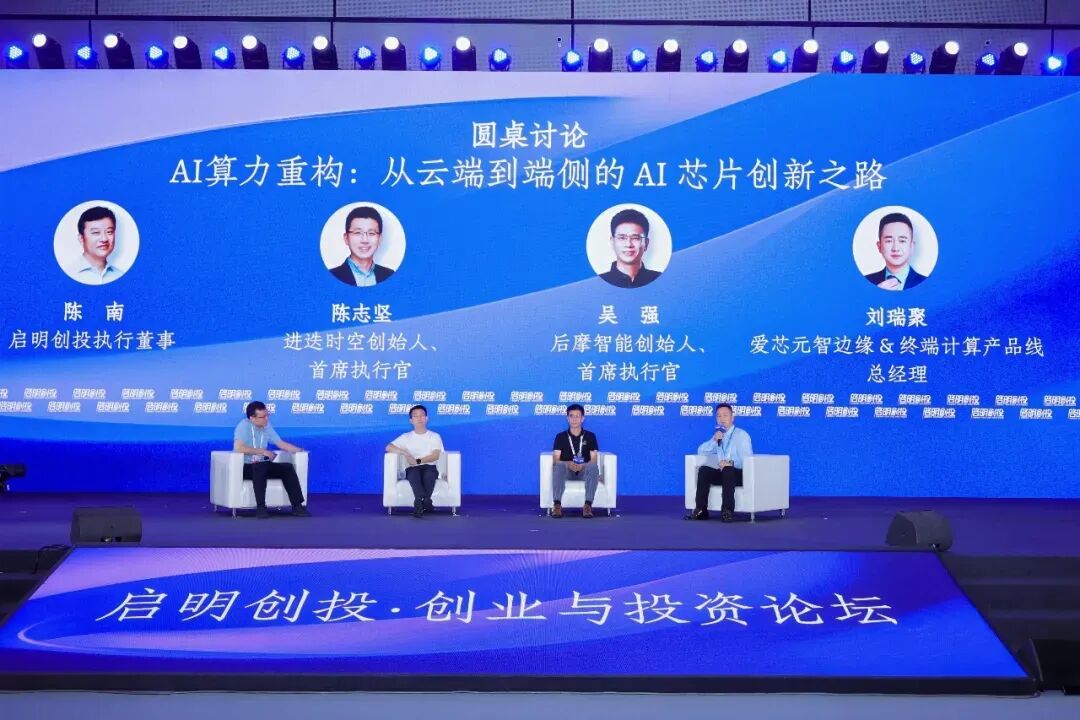
Nan Chen, Executive Director at Qiming Venture Partners; James Chen, Founder and CEO of SpacemiT; Wu Qiang, Founder and CEO of Houmo AI; Liu Ruiju, General Manager of Edge & Terminal Computing Product Line at Axera
James Chen, Founder and CEO of SpacemiT, stated: "The integration of edge and cloud is reconstructing the AI compute landscape, and the open RISC-V architecture could become the critical path for domestic chips to break through in global competition. Over the next 5–10 years, cloud and edge computing will not develop in isolation — humanoid robots and local offline large-model inference will open up high-value incremental markets on the edge side. The opportunities in this wave of AI compute are unprecedented. Domestic chip companies have the potential to leverage massive local scenarios to build up technical capabilities and ecosystems, cultivating semiconductor design leaders that can rival international top players and achieve global breakthroughs across the full spectrum from edge to data center."
Wu Qiang, Founder and CEO of Houmo AI, argued that large models are accelerating their migration from cloud to edge, creating vast new must-have application scenarios. However, running billion-parameter models locally imposes extreme demands on chip compute, power consumption, and cost — the "high compute, low power, low cost" impossible triangle. This structural tension creates a defining opportunity for edge AI chips. To address industry pain points, Houmo AI is focused on large-model edge AI chips, using a compute-in-memory innovative architecture to fundamentally solve the data movement bottleneck, crack the industry's triangular constraint, and help large models land in various intelligent terminals. With domestic edge AI developing rapidly and broad market prospects ahead, Houmo AI will leverage its core technical advantages and extensive product deployment experience to push China's edge AI industry to the forefront globally.
Liu Ruiju, General Manager of Edge & Terminal Computing Product Line at Axera, noted that as an edge and terminal AI inference chip company, Axera has built an AI computing foundation of "perception + compute" through self-developed NPU and AI-ISP core technologies, iterating across multiple generations to accumulate deep deployment experience and accessible toolchains in fragmented markets. The key to edge-side competition lies in effective compute within cost, power, and size constraints — not极限算力. Drawing on China's massive industrial chain and consumer market, which drives a virtuous cycle of "scenario-data-model-compute," the company will continue launching high-efficiency chips to empower embodied intelligence, AI Agents, and more, truly bringing AI to thousands of industries. The edge compute companies that meet industrial demands will inevitably be in China.
Selected excerpts from the discussion:
01/
Targeting the Opportunity of the Era of Everything Intelligent
Nan Chen: Hello everyone! It's a great honor to moderate this discussion. Let's return to the forum's origin point: compute. At WAIC this year, you can see cloud compute is like "a raging fire." But looking at the edge side, if we examine the performance of established edge compute companies, especially what's been reported in the past six months, it's been quite impressive.
But the three companies here, I believe as startups, will be different from them. I have a brief question. If you had to summarize in one sentence: how is our generation of edge chip companies different from previous ones? Please also take this opportunity to introduce your companies.
James Chen: Thank you. I'm James Chen from SpacemiT. SpacemiT is a full-spectrum compute chip company based on the next-generation open-source instruction architecture RISC-V. By full-spectrum, we mean that we believe the endgame for next-generation compute chips should be unified architecture across terminal, edge, and cloud — the RISC-V architecture. It shouldn't be fragmented. For example, right now phones use ARM architecture, while the cloud uses X86. The entire software stack doesn't communicate, creating massive ecosystem fragmentation and development costs. So the endgame is building a next-generation open-source instruction architecture for full-spectrum compute chips.
Our company's Phase 1.0 focuses on doing terminal and edge well. The product characteristic of this phase is integrating strong CPU compute and strong AI compute on a single chip, similar to NVIDIA's recently announced GB10 chip.
Nan Chen: So you're coming at this from the angle of open architecture and instruction set. What about you, Wu?
Wu Qiang: Good afternoon! Houmo AI builds large-model edge AI chips using a compute-in-memory technical approach. Traditional edge chips are for AIoT scenarios with small compute and small models, but recently the large-model trend is moving from cloud to edge. So what we want to do is chips that can run models with tens of billions, hundreds of billions, even trillions of parameters — with larger compute, running larger models, while maintaining low power and low cost. That's what we're trying to do.
Nan Chen: Understood — so this generation of large models must support hundreds of billions to trillions of parameters.
Wu Qiang: We want to pull edge intelligence close to cloud-level capability. That's our goal.
Nan Chen: Very clear.
Liu Ruiju: Good afternoon! I'm Liu Ruiju from Axera. Axera is a chip company focused on edge and terminal AI inference, which listed on the Hong Kong Stock Exchange in February 2026. Axera's main product forms include visual terminal AI chips, edge AI chips, AI inference cards, and AI inference servers. All of Axera's core IP is self-developed — for example, our NPU is self-developed, and our architecture supports both large models and traditional CV networks. We have extensive accumulation in CV, and in the large-model era we've built large-model architecture that can achieve high energy efficiency.
02/
Playing to Your Strengths in a Trillion-Level Market
Nan Chen: The three companies each have their own characteristics, but one thing is common: everyone is targeting the opportunity of the era of everything intelligent. The cloud market is already widely recognized as a trillion-level market, but there's a saying about the edge market: if done well, it could be a hundred markets of ten billion each; if done poorly, it becomes a hundred markets of one hundred million each. Given this special situation, what is the core starting point and foothold for our companies to develop markets and achieve sustainable growth? Axera entered commercialization back in the CV era, and made a very successful transition to Transformer when large models arrived. How did you achieve this?
Liu Ruiju: The edge market is extremely fragmented. Axera has spent seven or eight years since 2019 continuously refining itself, going through multiple generations of chips to accumulate experience, especially in comprehensive industry solution deployment. We've built up considerable technology to address various segmented market demands. But the "last mile" of solution closure still varies, so we accumulated substantial know-how in the CV era. In the large-model era, we build on this foundation — for example, we've made dedicated architectural innovations for large models. Essentially, combining small models + large models together can significantly boost deployment efficiency in this area.
Nan Chen: So it's an upgrade path from the previous era.
Liu Ruiju: Right, an upgrade with some reusable accumulation on top.
Nan Chen: Houmo AI is a completely new company. You recently released the Manjie M50 series. How do you view the relatively fragmented market?
Wu Qiang: I think the cloud is a confirmed, broad consensus — a trillion-level market. Edge large models are just beginning, but in the future they could develop into a hundred markets of a hundred billion each. We feel this deeply because after our M50 launch, many scenarios that previously used cloud are shifting — because edge lacked compute before, but increasingly, due to privacy and other reasons, more demands require doing large models locally, not the small models of the previous CV era. This demand became especially noticeable this year after OpenClaw Lobster emerged. Now there's a term called Agent Computer — it's a new species, particularly in 2B scenarios like finance and law. My feeling is that there will definitely be many tracks, and at minimum it's a market reaching hundreds of billions. We're targeting general large models, and this market is huge. We have confidence in this.
Nan Chen: With so many markets in front of us, which ones would you definitely not do right now? Or which ones must you definitely do?
Wu Qiang: What we do are universal things. For example, accelerating edge-side large models — they have high data privacy requirements, and are sensitive to power consumption and cost. These are their commonalities. There are many application scenarios, and we serve many application companies — some in finance, law, home, including robotics — but the underlying layer is similar for us. As for what we don't do? There are things. For example, we don't do training right now. Also, we don't do specialized chips for specific vertical scenarios. But the underlying logic and core of relatively general large-model acceleration chips are the same, and we can do all of that.
Nan Chen: I wonder if you agree with Wu's positioning, Zhijian? We also do general compute, and we even have CPU — our compute is richer, so theoretically more scenarios. But markets have sizes; some are worth pursuing, some aren't. So for you, are there markets you definitely won't do? Markets you must capture?
James Chen: From our company's perspective, any chip company's birth is about laying out for future trends ahead of time. Looking at the familiar giants — Intel launched its first CPU in 1971, Apple and Steve Jobs launched the first personal computer in 1976, IBM entered with IBM ThinkPad in 1981. NVIDIA too — NVIDIA started making GPUs in 2003. Looking across chip giants, they all laid out for future incremental markets.
Our company focuses on two areas: first, something like Agent computers; second, Physical computers. Another major characteristic of ours is integrated graphics with both CPU and certain GPU capabilities.
Nan Chen: But you must have reasons for choosing this combination. Dr. Wu also talked about compute-in-memory earlier, but you emphasize having CPU plus integrated — these two paths in the edge market represent different choices. What's the path where you most want to play to your strengths?
James Chen: First, adapt to local conditions. I think the first thing companies must consider is: where are future trends, where are markets, where is the evolution of future computing forms? Based on this, what chips should we provide? That's point one.
Second, where is the company's core competitive advantage? You must leverage strengths and avoid weaknesses, playing to differentiated competitive advantages. On markets, I've already spoken. Next, the compute forms of cloud and edge are different — cloud compute is called disaggregated, where CPU capability is done extremely well, and cloud does cloud capability extremely well. But for terminals and edge, our company believes more strongly that the future must be single-chip integration, simply because single-chip integration can solve more problems.
For example, Agent Computers can solve more problems. We'll have massive agent orchestration work — browsing web pages, scraping web data, feeding scraped data to AI for processing, AI outputting results to continue executing a subtask. This involves frequent interaction. If two independent chips, the interaction cost and latency are huge. Single-chip interaction cost efficiency is very high. Physical AI is similar — its real-time performance and efficiency are higher. It's just that single-chip has shortcomings: our AI capability is hardware-fixed, lacking flexibility, so we can only hit key node gears. The gaps between gear one and gear two are areas we can't cover, requiring other chips to provide support.
Wu Qiang: Let me add — in the GPU era, Intel's CPU and NVIDIA's discrete GPU each had their markets. Today, returning to the AI era, Zhijian's CPU plus integrated NPU and our discrete NPU actually each have their markets, and we can even cooperate. We currently have many customers where we work with Zhijian — he does CPU, we do AI acceleration cards.
Nan Chen: Understood. Axera does both, and multiple markets too. From this angle, how do you view these two approaches?
Liu Ruiju: Compared to cloud, our edge compute advantage is maximizing efficiency in extremely small form factors, or running effective compute under cost constraints. Unlike cloud, which pursues极限算力, we find balance in an "impossible triangle." So the scenarios we target lean toward terminal and edge product forms. The Agent applications mentioned earlier are also our landing markets, including future forms of embodied intelligence. Embodied intelligence is developing very rapidly — various robot bodies are becoming increasingly flexible. They have brains now but they're not very usable, often overheating, needing rest after short use. This is what our companies need to solve: how to ensure sufficient battery life, no overheating, continuous operation for one to two months. That's our advantage.
03/ Finding Balance in the "Impossible Triangle" as Much as Possible
Nan Chen: We're drawing on past practical experience in surveillance and autonomous driving — scenarios that required deploying large edge compute under special environmental constraints. Edge scenarios are extremely rich, but each company's starting point or technical characteristics differ, and chosen product forms vary greatly. With cloud large models developing so well today, standing at this point in time, or looking three to five years ahead, does the edge side really need to run 100B models, a hundred billion parameters? What product forms exist today? What innovations can we look forward to in three to five years? Please share with actual cases.
Wu Qiang: Actually, they already exist today. There's now a product called AI Pocket, which can run about 100B models. It's like a power bank that plugs into a laptop, doing meeting minutes and such in offline, no-network states. There are already many such products.
Nan Chen: It's portable, completely battery-powered.
Wu Qiang: Many people ask us: last year we talked about cloud large models, this year we're focusing on edge large models — where's the demand? First category: it's on the edge itself. Second: hybrid. Some parts need edge compute, while relying on cloud simultaneously — physical on edge, virtual in cloud. Third: Chat products like Doubao, which run in cloud. I think different scenarios have different demands for edge computing.
One thing: the edge side needs more intelligent capabilities. On one hand, today's 100B model is equivalent to six months ago's 300B or 1000B model. On the other hand, there are many chip companies whose capabilities are also getting stronger.
Model serving has an impossible triangle, and chip serving also has one: "intelligence level, power consumption, cost." What we want to do is improve efficiency to satisfy this impossible triangle, but each company uses different methods — we use compute-in-memory, others use different approaches. This is the trend we see in edge large-model development.
Nan Chen: Any additions, Zhijian?
James Chen: Now is the first year of gradual large-model application adoption. At this stage, what people most want when using large models is the highest intelligence model, so everyone wants to leverage cloud because its intelligence is high enough and its interaction is simple enough. But in the future AI compute market, cloud will definitely grow massively, and I believe terminals and edge will also grow massively, because overall AI token generation will grow exponentially. Taking our company as an example, our token consumption basically doubles every month.
Second, there are many things that cloud simply can't solve and must use edge — first is real-time performance; second is privacy and security. For example, we don't want to upload confidential contracts to cloud. Or in the future, when everyone has their own digital twin or even digital employee, at least one point must stay on the edge: context. The context from my large model training represents my personal characteristics — it's my digital twin. I can put the large model base in cloud, but my context must stay on this terminal. I categorize this uniformly as security; third is economics. The overall law of large models is similar to Moore's Law in integrated circuits — two ends: performance keeps rising, model size keeps falling. So in the future, 100B, 200B models like DeepSeek — DeepSeek V4 Flash version is only 285B, its intelligence far exceeds V3 version. On the other hand, if my 200B, 300B model can reach today's 2000B intelligence, there's opportunity to install locally. And if local one-time purchase cost is lower than cloud consumption cost, that's the economics it brings.
These are the main three aspects.
Nan Chen: Dr. Wu spoke from the scenario angle, you from the industry development law angle. Liu, your company has extremely rich landing scenarios. Standing at a three-to-five-year time horizon, what demands does edge large model place on us? Why will edge large-model landing arrive quickly? Where does its inevitability lie?
Liu Ruiju: For example, now a family averages at least three phones. Three phones, replacing one every two years, each with average memory of 512GB. As phones iterate and annual storage capacity needs grow, each phone replacement is extremely painful — data transfer takes about an hour, and data accumulates continuously. So now many families have demand for AI NAS (Network Attached Storage). NAS has a problem: its data is massive. As data volume grows, finding a picture or photo becomes extremely inefficient, potentially taking very long. With AI, traditional NAS with local compute modules becomes AI NAS — not only finding photos, but generating a memoir from years of photos. That becomes very interesting. Of course, some say can cloud compute solve this? But most families probably dare not put their NAS data on cloud.
Nan Chen: Returning to privacy and security issues.
Liu Ruiju: From the scenario perspective, such scenarios will only increase.
04/
China Has the Most Suitable Soil for Edge Chip Companies to Grow
Nan Chen: Because domestically we're already accustomed to the extremely fast innovation speed of various intelligent terminals around us, and China's consumer electronics as a downstream industry also has very strong global competitiveness. This seems to create excellent opportunities for us. I wonder if you all think that under such good opportunities, compared to previous international edge giants, where do innovation opportunities mainly lie for us as new chip companies? Have some scenarios already emerged? And is China the most suitable place to build this type of product?
James Chen: Including now, China is an application innovation powerhouse. In the future, application innovation will be in China, chips will be in China, and production capacity will be in China. Ten years from now (2035 to 2045), China's overall compute chips will rise massively, even exporting globally at scale. I think that's point one.
Second, from our company's perspective, I still call it differentiated competition. I believe existing large markets aren't suitable for startups — it must be future incremental markets that suit startups. So whether we look at Physical AI or Agent AI, they have some characteristics — Physical AI requires extremely strong single-core CPU performance, and Agent AI is actually similar. So looking at NVIDIA's GB10 chip with twenty large cores, each core's performance is stronger than cloud CPU single-core performance. This is because Physical AI needs very fast computation, otherwise latency is long. Massive work is done by CPU — the cerebellum is CPU. The time is extremely short, real-time response is extremely strong.
Meanwhile, Agent AI is also a large task that I break down through large models into many small tasks that CPU executes frequently, so it needs to be fast, requiring very high single-core performance. Our company's essence is pulling single-core performance extremely high. Basically, markets with very high single-core performance are either the United States or China — basically traditional CPUs, new CPUs are gone — then we combine with AI.
Nan Chen: This is already completely not as simple as having sufficient compute and low power consumption.
James Chen: We still prefer to face future markets and play to our differentiated competitive advantages. Second, compete in uncharted or sparsely populated territory, not in "extremely内卷" areas.
Nan Chen: How do you think about this, Dr. Wu and Liu?
Wu Qiang: I think this domestic wave of AI will promote our semiconductor companies, AI inference companies, to develop at the forefront globally. I've been to Shenzhen very frequently recently. You'll discover all kinds of intelligent hardware in China, especially after Lobster came out this year. Many customers found us with demands — not just algorithms and scenarios, but also hardware form factors. This provides input for us including next-generation chip definition. So I think compared to foreign chip companies, we've definitely gotten more first-hand information. It will promote our ecosystem software iteration, hardware iteration, and subsequent chip design. So I believe it will push us startup companies to the forefront globally on this new track.
Nan Chen: Liu?
Liu Ruiju: I very much agree with the previous two shares. China has the world's largest and most complete manufacturing industry chain, and the world's largest consumer market. This brings massive application scenarios to support AI iteration and validation, forming a virtuous cycle of scenario, data, model, and compute — an advantage that overseas countries don't possess, thereby accelerating our product iteration speed and progress. So if there's opportunity in the future to meet more industrial demands, I believe it will definitely happen with Chinese companies.
Nan Chen: The previous generation of mobile edge brought success to companies like Qualcomm and MTK. But listening to your shares, this round's opportunity lies in: as long as we bring true large-model intelligence to various edge applications, we have opportunity. Our actual mission is to create the compute origin point and wait for applications to land.
Finally, please share in one sentence: in the next three to five years, as pioneers in the edge domain, what kind of "world-class seedlings" do we hope to grow the edge market and our companies into?
James Chen: I think it's still about strengthening the home base, must capture the next key major category — Agent AI and Physical AI. Simultaneously, capture the ecosystem position for the next key software era, which is RISC-V, because in five, ten, fifteen years, this trend will only go up, not down. So our company, besides doing applications and capturing super-terminal major categories, must also secure all RISC-V key software node ecosystem positions.
Nan Chen: So it looks like the RISC-V AI mission falls on your company's shoulders.
Wu Qiang: I think edge large-model chips bring change to the industry by making free token factories on the edge possible, helping popularize and democratize large models. But doing edge large models is challenging — how to solve the impossible triangle: high intelligence, low power, low cost. Essentially, the challenge for the coming years is how to push efficiency to the extreme to solve the impossible triangle. Houmo AI hopes to use compute-in-memory innovative architecture to solve the extreme efficiency problem, to help drive this change, to promote large model popularization and democratization.
Nan Chen: Very pure — using extreme efficiency to let more edge devices use intelligent large models. Liu, please share.
Liu Ruiju: In the next three to five years, Axera will build on our previous accumulation in AI-ISP and our NPU to make higher-efficiency chips. Simultaneously, based on our years of toolchain refinement, we'll enable more industry customers to quickly and easily grasp and apply our AI compute, truly empowering thousands of industries.
Past Reviews

Qiming Venture Partners was founded in 2006. Currently, Qiming Venture Partners manages 11 USD funds and 7 RMB funds, with total assets under management reaching $9.5 billion. Since its establishment, it has focused on investing in outstanding companies in the early and growth stages of Technology and Healthcare Innovation.
To date, Qiming Venture Partners has invested in over 580 high-growth innovative companies, of which more than 210 have listed on the New York Stock Exchange, NASDAQ, Hong Kong Exchanges and Clearing Limited, Shanghai Stock Exchange, and Shenzhen Stock Exchange, or exited through mergers and acquisitions. More than 80 companies have become recognized unicorns or super-unicorns in their industries.
Among Qiming Venture Partners' portfolio companies, many have grown into the most influential companies in their respective fields, including Xiaomi (01810.HK), Meituan (03690.HK), Bilibili (NASDAQ:BILI, 09626.HK), Zhihu (NYSE:ZH, 02390.HK), Roborock (688169.SH), Hesai Technology (NASDAQ:HSAI, 02525.HK), UBTECH (09880.HK), WeRide (NASDAQ:WRD, 00800.HK), HyperStrong (688411.SH), Insta360 (688775.SH), Unisound (09678.HK), Biren Technology (06082.HK), Zhipu AI (02513.HK), Gan & Lee Pharmaceuticals (603087.SH), Tigermed (300347.SZ, 03347.HK), Zai Lab (NASDAQ:ZLAB, 09688.HK), CanSino Biologics (688185.SH, 06185.HK), Schrödinger (NASDAQ:SDGR), APT Medical (688617.SH), Sanyou Medical (688085.SH), AmoyDx (300685.SZ), Sinocelltech (688520.SH), Insilico Medicine (03696.HK), AusperBio, Yuanxin Technology, MediLink Therapeutics, Leads Biolabs, StepFun, and others.