Dialogue | Glimpsing the Future of the Humanoid Robotics Industry

Whether you're an "early wave" or "late wave" in the humanoid robot industry, only companies that achieve genuine technical breakthroughs and translate them into real-world applications will survive. UBTECH believes that as long as you persist and do the hard but right things, opportunity will follow.

The humanoid robotics industry is currently undergoing a critical leap from technology validation to commercialization. As a leader in humanoid robots and a pioneer in intelligent service robots, UBTECH (09880.HK), a Qiming Venture Partners portfolio company, is one of the very few companies globally with full-stack humanoid robotics capabilities, and has been the first to achieve real-world deployment of humanoid robots.
At Qiming Venture Partners' 16th RMB Fund Annual Meeting and Investor Summit, Duane Kuang, Founding Managing Partner of Qiming Venture Partners, and Zhou Jian, Founder, Chairman of the Board, and CEO of UBTECH, held a dialogue on "Envisioning the Future of the Humanoid Robotics Industry." The two discussed the current state and application scenarios of the humanoid robotics industry, the potential of embodied artificial intelligence technology to improve cost-effectiveness and work efficiency, and UBTECH's core competitive advantages.
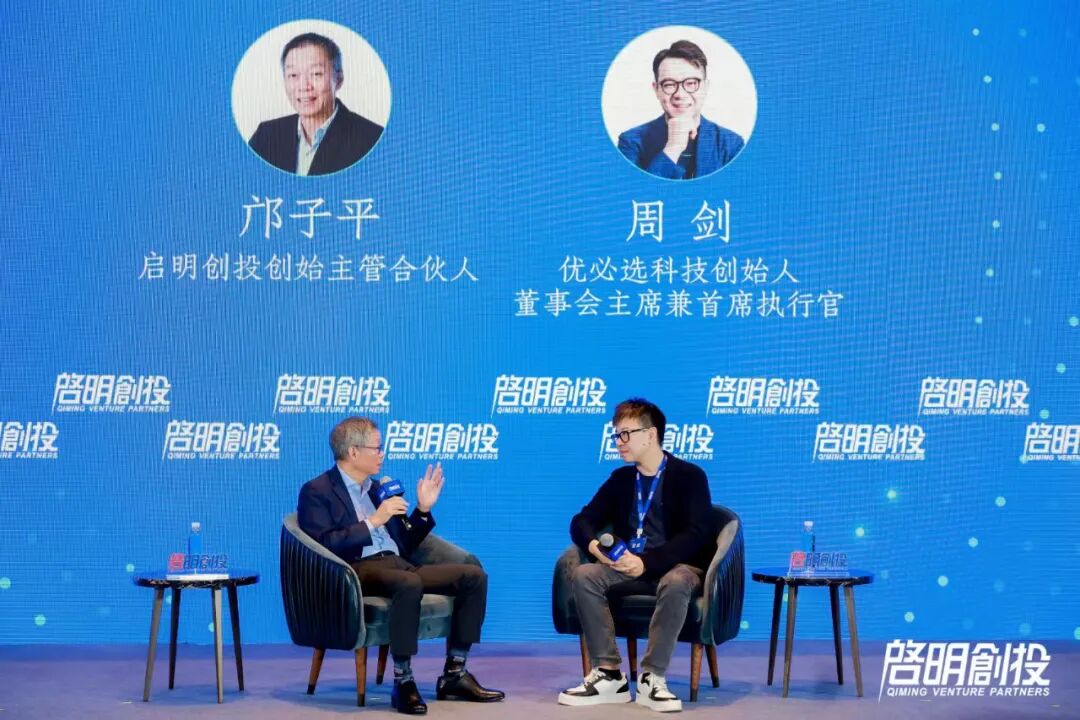
Duane Kuang, Founding Managing Partner of Qiming Venture Partners (left), and Zhou Jian, Founder, Chairman of the Board, and CEO of UBTECH (right)
Regarding the emergence of new competitors in the industry, Zhou stated that UBTECH welcomes both partners and competitors in the humanoid robotics space, emphasizing that the market is vast with numerous sub-sectors. He also noted that embodied artificial intelligence requires robots to possess capabilities for autonomous recognition and understanding, environmental perception, and task execution — setting an extremely high bar for all startups' technical capabilities. Whether "early wave" or "late wave" players in the humanoid robotics industry, only companies that achieve genuine technological breakthroughs and translate them into real-world applications can establish themselves; UBTECH firmly believes that as long as we persist in doing the hard but right things, opportunity will follow.
On the economic assessment of commercializing humanoid robots, Kuang pointed out that deploying one or two humanoid robots in a factory for demonstration purposes is somewhat feasible, but from a practical benefits perspective, deploying just two doesn't make much economic sense. A batch of robots is needed to unlock their true value.
The following is an edited and condensed transcript of the dialogue.
01/
Application Scenarios Are Critical for Humanoid Robots
Kuang: First, let me introduce the person sitting next to me — Zhou Jian, Founder, Chairman of the Board, and CEO of UBTECH. His WeChat nickname is "Father of Robots," and he's also the father of that humanoid robot running outside the venue. Everyone is eager to hear Zhou Jian share UBTECH's story of building humanoid robots.
Let me throw out a few questions to get us started. Humanoid robots have been extremely hot lately. I personally, along with the Qiming Venture Partners team, am very optimistic about the direction and future development of this industry. But there's also plenty of noise in the market — some dismiss it as hype, questioning why spend so much money developing a humanoid robot that can at best do a somersault. What's the point?
First, I'd like to ask President Zhou to analyze what stage the entire humanoid robotics industry is at today? And combining that with what UBTECH is already doing, about to do, and planning to do — please share with us.
Zhou: Thank you, President Kuang. Qiming Venture Partners has been with us for nearly ten years now, and I'm deeply grateful for your companionship.
Let me answer your question. There has always been considerable debate about humanoid robots in the market. Speaking of stages, there's an important topic we can't avoid — can humanoid robots be used immediately? There's one crucial word: scenarios.
If humanoid robots want to enter homes or scenarios requiring highly generalized capabilities right now, honestly no robotics company globally can achieve this today — especially entering Chinese households. The biggest challenge in Chinese homes is the extreme complexity of scenarios. Cups come in different types — teacups, water cups, even vacuum flasks. Such scenarios demand very high generalization capabilities from humanoid robots, which remains difficult to achieve today even with the support of large language models, specifically in the embodied intelligence domain of the physical world. However, if we look at scenarios structurally — such as material handling or SPS sorting in an automotive factory — this is achievable for humanoid robots through continuous training combining simulation data with real-world onsite data.
Many people have expectations for humanoid robots and want to know when they'll be usable. Is it too early now? Is it even necessary to make them humanoid? Currently, we're collaborating with multiple automotive factories globally, including Dongfeng Liuzhou, Geely Auto, FAW-Volkswagen Qingdao Branch, Audi FAW, BYD, and BAIC Group. The consensus is that humanoid robots are the most versatile form. I actually wanted to build a quadruped robot at first — people thought quadruped robots were more stable, wouldn't fall in factories, and wouldn't damage parts. Later we realized that to work like humans, we'd need to make the quadruped robot as tall as a horse just to reach screws on upper levels.
From the perspective of future costs, footprint, and overall production line flexibility, quadruped robots still fall short of humanoid robots in intelligent manufacturing scenarios. So after discussions with all our clients, we found that humanoid robots are the most versatile and best conform to human ergonomics. For example, raising its arms allows it to retrieve items from high shelves, while it can also bend down to move a box from the floor. Currently, humanoid robots are the optimal solution.
But there's another crucial question: can clients accept the cost? Last time, the Chairman of the Board and board members of Mercedes-Benz visited UBTECH for exchange. Currently, labor costs in Europe and America are significantly higher than in China. So they believe a humanoid robot priced around 400,000–500,000 RMB is entirely acceptable — roughly a two-year payback period. And humanoid robots have many advantages; for instance, they can work 24 hours given sufficient battery life.
Under these circumstances, I believe this year is a critical stage for mass production of humanoid robots. UBTECH plans for 1,000 units of production capacity in 2025, with expected deliveries of several hundred units. In 2025, assuming smooth deployment across various scenarios, we optimistically estimate humanoid robot deliveries will reach thousands of units in 2026; and by 2027, we hope to achieve delivery volumes in the tens of thousands.
I must emphasize that humanoid robots will first achieve large-scale application in structured scenarios, such as intelligent manufacturing. The second step will be commercial service scenarios, and finally home scenarios.
02/
Humanoid Robots Need to Help Humans Solve Real Problems
Kuang: Returning to industrial scenarios, there are many misconceptions about humanoid robot applications in this space. Humanoid robots weren't invented last year. Looking purely at the economics, their costs seem difficult to recover. Deploying one or two humanoid robots in a factory for demo purposes is feasible, but from a practical benefits perspective, deploying just two doesn't make much economic sense. In reality, a batch of robots is needed to unlock their true value. What exactly should this "batch" number be? I've also seen from your introductions that in factories, unmanned guided vehicles (AGVs) work in coordination with your humanoid robots, forming a new-era unmanned logistics system where humanoid robots are an important component. How does this economic calculation work?
Zhou: First, I want to emphasize one point: humanoid robot applications in factories cannot be remote-controlled. Truly advanced humanoid robots must be based on embodied intelligence — the VLA model. This model combines vision, language, and action, enabling robots to perceive, recognize, and understand objects, then conduct decision-making and reasoning, ultimately forming a closed loop of action. If this pathway is established, there's no need for constant human assistance or remote control of the robot. Pre-programmed robots cannot meet the demands of complex scenarios like automotive production lines. The advantage of humanoid robots lies in this: if this limitation can be overcome, they will demonstrate tremendous potential in cost-effectiveness and work efficiency. The key question currently under consideration is whether humanoid robots' work pace can match factory production efficiency.
For example, moving a box from Point A to Point B — humanoid robots currently operate at 30–40% of human worker efficiency. In the future, if humanoid robots can reach approximately 70% of human worker efficiency, factories will consider large-scale deployment. Currently, no humanoid robotics company has been able to accomplish such tasks at scale, because it also involves depalletizing and palletizing, requiring boxes to be stacked neatly. Otherwise, during trailer transport, the boxes could collapse. If humanoid robots can achieve certain efficiency levels while also enabling autonomous recognition — able to quickly deploy and complete the action regardless of where the container is placed — then clients will be willing to pay.
Kuang: This is very interesting. Sometimes when we watch these pre-shot videos, humanoid robots appear extremely agile, doing these tasks almost like humans. But observing them in real scenarios, they seem relatively slow. However, humanoid robots possess unique advantages: they don't need rest, can operate continuously around the clock, giving them significant cost and efficiency advantages in long-term operation.
Zhou: Currently, some humanoid robots that emphasize locomotion capabilities have actually removed sensors, reduced degrees of freedom, and may only stand 1.2 meters tall. They cannot handle production line work, and there's no possibility of them even bringing you a glass of water.
Moreover, these humanoid robots lack embodied intelligence and cannot intelligently move and manipulate objects. I don't consider this the correct direction for humanoid robots in the embodied intelligence industry. Humanoid robots need to possess high intelligence, perception, decision-making, and reasoning capabilities — at the physical level, they must help humans execute tasks and solve real problems.
A full-size humanoid robot needs at least 40+ degrees of freedom; one with autonomous battery-swapping capabilities may have even more. Dual-arm load must reach at least 15 kilograms. Automotive companies have also approached other companies' humanoid robots, but none could meet factory requirements, ultimately choosing UBTECH's humanoid robots for practical training.
For industrial scenarios, Tesla and Figure in the United States have also released some humanoid robot training videos. Personally, I feel UBTECH has advantages in this area. Some humanoid robots' lower limb joint biomimetic designs draw on biological movement characteristics (such as ostriches), taking a different technical route from ours. We combine planetary reduction and linear joint technologies to achieve our goals, with very close cooperation with upstream and downstream supply chain partners.
Kuang: You just brought up another topic I wanted to discuss. In this broad field of embodied intelligence humanoid robots, what are the differences between China and the West? I believe China is even leading. Comparing China and international players, where do our advantages lie? How far have we progressed now? What do you think the most advanced international level roughly looks like? And as they continue developing, how dependent will they be on China's supply chain?
Zhou: Excellent question — this is something we continually reflect on internally. Currently, Tesla's Optimus robot demonstrates very high whole-body movement coordination, not limited to lower limb or upper body movements. Evaluating from an algorithm separation perspective, if we had to select the king of the first tier of humanoid robots globally, I personally believe it would be Optimus.
Kuang: Tesla's Optimus robot?
Zhou: Yes. However, I haven't seen its latest progress in integrating large models and vertical domain models. In previous demonstrations, we've seen it possesses basic functions like object sorting, and companies like Figure are also advancing similar work. Unlike the high reduction ratio planetary gear structures common domestically, Optimus's linear actuator design has certain advantages in energy efficiency ratio and dynamic response, helping improve humanoid robot endurance and movement efficiency. Optimus is also closer to human body force patterns in tasks like heavy object lifting — this design philosophy is leading.
Speaking of supply chain, Tesla, Figure, and other companies have over 80% of their component partners in China. I believe no one can bypass China on the supply chain front — currently only China has the capability to produce according to their requirements. Tesla is willing to invest substantial funds, and many factories in China's Yangtze River Delta region are willing to open molds and produce for them. I believe China's supply chain holds a core position in this field.
03/
Doing the Hard but Right Things
Kuang: I'd like to raise a somewhat controversial topic. UBTECH was once a national brand, appearing on the CCTV Spring Festival Gala four times. Mention humanoid robots and UBTECH was the name everyone brought up. In the past two years, quite a few emerging companies have entered the humanoid robotics space. This is a sensitive topic — usually people might ask privately, but I'm asking you directly today. Why is everyone now talking about these new companies? UBTECH is one of the very few humanoid robotics companies actually moving boxes in factories, yet somehow people seem to think UBTECH is yesterday's company, and now everyone's talking about today's companies. I always tell these friends that new companies may have new attempts, but UBTECH has the strength — it's impossible that they're not making these attempts, they are making these attempts, but what can truly be deployed are still those areas where we've cultivated long-term. How do you view the idea that the waves behind drive on those before?
Zhou: First, we're not part of the early wave right now — the humanoid robotics industry has just begun, it's still in a very early stage. This market is enormous, and we very much welcome all humanoid robotics partners and even competitors. Take Apple as an example — its current market cap is approximately $3.7 trillion. A family of three, each using an iPhone, represents $3,000–5,000 in value. Humanoid robots will likely be priced around $20,000–30,000 in the future. Even if a household has just one humanoid robot — not counting the large numbers deployed in factories and commercial scenarios — theoretically, in five years, humanoid robots will be 5–10 times the market size of mobile phones. In other words, in the future, there will be a humanoid robotics company globally that occupies the same position Apple holds in the mobile phone world. This market is large enough, with many sub-sectors, and no single company can eat the whole cake.
Second, I keep emphasizing that we're not the early wave — we're still the late wave. Just as BYD developed for nearly 30 years before becoming a leader in the new energy vehicle industry, the difficulty of the humanoid robotics industry far exceeds that of automobiles. Because automobiles are a product of dual integration — intelligent driving data can be shared across different brands. But applying UBTECH's data to another humanoid robotics company would be affected by differences in degrees of freedom, movement ranges, and significantly reduced data applicability. This requires a decoupling process, so every company has its own advantages.
Third, humanoid robots cannot cut corners on hardware. Recently, we jointly released Tiangong Xingzhe, a full-size research and education humanoid robot with the Beijing Humanoid Robot Innovation Center. Standing 1.7 meters tall, it makes no compromises on hardware, delivers powerful performance, and is priced at just 299,000 RMB. Within the industry, no full-size humanoid robot (1.6 meters or taller) of comparable grade is priced below 500,000 RMB.
Currently, emphasizing humanoid robots' locomotion capabilities has become a standard demonstration item for many companies. Through reinforcement learning, this isn't particularly difficult technology to achieve. However, once embodied intelligence is involved — requiring robots to autonomously recognize, understand, perceive, and execute actions — this presents a massive threshold for all startups. Without substantial R&D investment, it may be very difficult to succeed in this field.
About ten years ago, I once said: most service robotics companies today will fail. I was heavily criticized by many people at the time. Today, I believe that if a humanoid robotics company's funding is below 1 billion RMB, it will face enormous challenges. Because the capital requirements in this field are massive. Supply chain integration, resource allocation, and AI investment — including vision, navigation, and vertical domain models across all dimensions — require substantial financial support. If you're simply manufacturing hardware and performing some movements, there are many specialized hardware manufacturers and algorithm developers in the market who can provide such services and help you with fundraising.
If you want to succeed in this field, without investment exceeding 1 billion RMB and spending two to three years or more on R&D, it's very difficult to have much opportunity. So I believe whether late wave or early wave, the wave that ultimately emerges is the best wave. As long as we persist in doing the hard but right things, we will have opportunity — this is my current view, and facts are now confirming this perspective.
04/
Once a Humanoid Robotics Company Breaks Through,
Its Scale Will Far Exceed the Mobile Phone and NEV Markets
Kuang: Finally, two questions. You just mentioned scenarios are very important. A relatively general-purpose humanoid robot in a complex scenario without very specific pre-programming — for example home scenarios, and we've also discussed care scenarios before. Please predict the development of humanoid robots over the next 3–5 years, 10 years, and 20 years.
Zhou: This is somewhat difficult. Previously I was fairly confident that humanoid robots could enter homes — this depends on the specific home environment.
Kuang: Into factories within 3 years?
Zhou: Into factories within 3 years is no problem — it's just a matter of what specific work tasks it undertakes, whether just sorting or applying logos, driving screws, or moving boxes. For home scenarios, I mean homes requiring relatively strong generalization capabilities — this also depends on the specific scenario. If the home scenario is a uniformly designed apartment with only one or two types of cups, fixed colors, and standardized sofa configurations, in such cases, environmental standardization facilitates the improvement of humanoid robots' generalization capabilities. With a relatively less cluttered environment, I think there's opportunity.
Kuang: 5 years or 8 years?
Zhou: The most conservative estimate in our industry is generally 9–10 years. Optimistically, in 5–6 years we might see humanoid robots with capabilities as powerful as Tesla's Optimus, exceeding my imagination — there may be opportunity. I previously found 7–8 years relatively acceptable; I currently feel it may need about 8 years, but I don't rule out the possibility of further AI development. Currently, large language models offer limited help for real-world tasks like humanoid robots moving boxes, because such tasks involve friction, volume, and other onsite data, for which internet data has limited applicability.
Kuang: Final question — UBTECH and Qiming Venture Partners have had excellent cooperation, yes?
Zhou: Excellent. First, as I said from the beginning, Qiming Venture Partners invested in us before UBTECH's first appearance on the CCTV Spring Festival Gala. Actually, we had a small wave of popularity after the Gala, when the humanoid robotics industry wasn't as hot as it is today. Qiming Venture Partners has always been an important shareholder, providing long-term support to UBTECH, including Alex (editor's note: Alex Zhou, Managing Partner of Qiming Venture Partners) who serves as a non-executive director of UBTECH. I believe such patient capital is what enables UBTECH to grow, persist in humanoid robotics, and continue moving forward.
Second, throughout our cooperation, Qiming Venture Partners has provided us with assistance far beyond just funding — assistance that continues to bring positive impact to UBTECH to this day.
Finally, I understand that Qiming Venture Partners' LPs and upstream/downstream resources are extremely rich. Going forward, around the humanoid robotics field and our own industry positioning, there remain many opportunities for continued cooperation. As we achieve the goals we set for this year, I believe UBTECH's market recognition will continue to grow, and we will play a greater role in the upstream and downstream industry chain. I believe future competition in humanoid robotics will focus primarily on ecological platforms, while other aspects will gradually converge.
However, the humanoid robotics supply chain currently appears even more complex than the automotive industry. Success won't come from simply persisting for 10 years — it may require 20 or 30 years of persistence to have a chance of breaking through. Once successful, this industry's scale will far exceed that of the mobile phone and new energy vehicle markets.
Kuang: Thank you very much. Let's give a warm round of applause to President Zhou for joining us today to share his insights. Let's cheer for UBTECH — thank you!
Past Reviews
Qiming Viewpoint | Duane Kuang, Qiming Venture Partners: China's Technology Going Global Is Timely
Dialogue | Exploring the "Uncharted Territory" of AI Entrepreneurship with StepFun

Founded in 2006, Qiming Venture Partners currently manages 11 USD funds and 7 RMB funds, with total assets under management reaching $9.5 billion. Since its inception, the firm has focused on investing in early and growth-stage outstanding enterprises in Technology and Consumer (T&C) and Healthcare sectors.
To date, Qiming Venture Partners has invested in over 580 high-growth innovative companies, of which more than 210 have listed on the New York Stock Exchange, NASDAQ, Hong Kong Exchanges and Clearing, Shanghai Stock Exchange, and Shenzhen Stock Exchange, or exited through mergers and acquisitions. Over 80 portfolio companies have become recognized unicorns or super-unicorns in their respective industries.
Many of Qiming Venture Partners' portfolio companies have grown into the most influential companies in their fields, including Xiaomi (01810.HK), Meituan (03690.HK), Bilibili (NASDAQ:BILI, 09626.HK), Zhihu (NYSE:ZH, 02390.HK), Roborock (688169.SH), UBTECH (09880.HK), WeRide (NASDAQ:WRD), Insta360 (688775.SH), Gan & Lee Pharmaceuticals (603087.SH), Tigermed (300347.SZ, 03347.HK), Zai Lab (NASDAQ:ZLAB, 09688.HK), CanSino Biologics (688185.SH, 06185.HK), Schrödinger (NASDAQ:SDGR), MicroPort EP MedTech (688617.SH), Sanyou Medical (688085.SH), Amoy Diagnostics (300685.SZ), Berry Genomics (000710.SZ), GenScript ProBio (688520.SH), Yuanxin Technology, Insilico Medicine, MediLink Therapeutics, LaNova Medicines, Zhipu AI, StepFun, Biren Technology, and others.