Qiming ESG | Peking University Think Tank Releases "International Landscape of AI Governance" Report, Mapping Global AI Governance at WAIC 2026
This report is a landmark research output from Peking University's China and Global Development Initiative, produced with support from Qiming Venture Partners, reflecting its sustained commitment to global AI governance and cross-border regulatory coordination.

From July 17 to 20, the 2026 World Artificial Intelligence Conference (WAIC) and High-Level Meeting on Global AI Governance was held in Shanghai. After eight years of continuous cultivation, WAIC has evolved into a highly influential industry event in global artificial intelligence, serving four core functions: "technology weathervane, application showcase, industry accelerator, and governance forum." On the afternoon of July 19, the "Qiming Venture Partners · Entrepreneurship and Investment Forum — The Evolutionary Journey from Computing Power Origin to Application Landing," hosted by Qiming Venture Partners, took place as scheduled at the Shanghai World Expo Center, the main venue of WAIC. This marked the fourth consecutive year that Qiming Venture Partners has hosted a dedicated forum at WAIC. At the forum, Wang Dong, Executive Director and Professor of Peking University's Institute for Global Cooperation and Understanding, represented the research team in releasing the report The International Landscape of AI Governance. 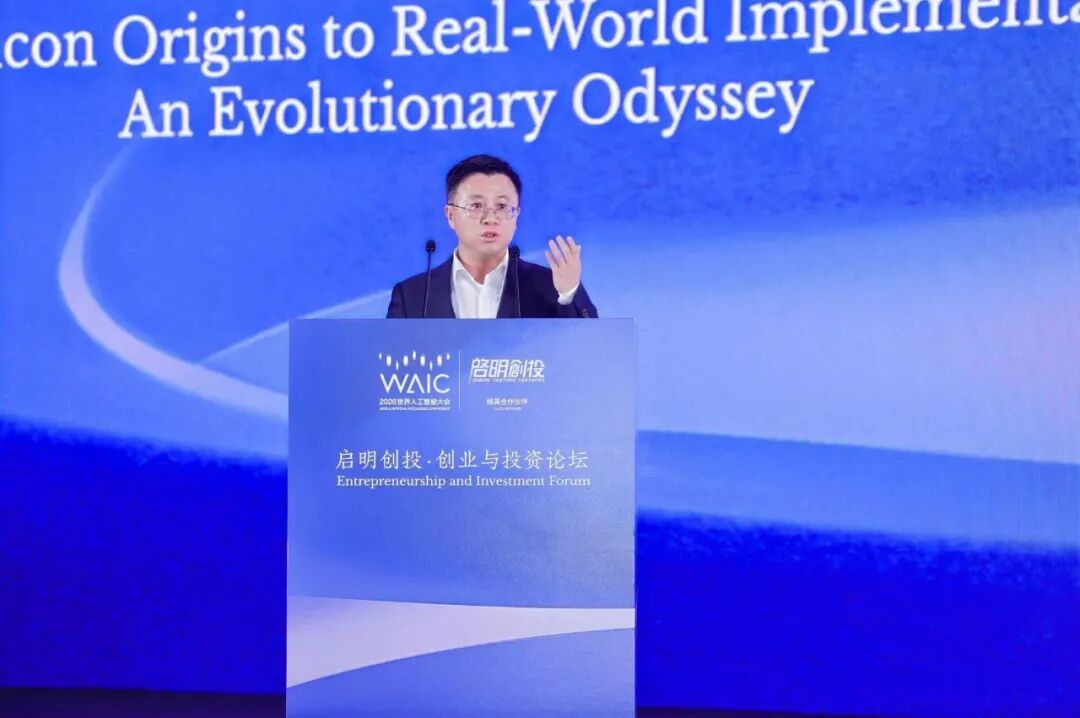 Wang Dong, Executive Director and Professor of Peking University's Institute for Global Cooperation and Understanding
This report represents a landmark research achievement by Peking University's Institute for Global Cooperation and Understanding, supported by Qiming Venture Partners, in its sustained efforts to explore global AI governance and cross-national regulatory coordination pathways. It is the Phase One output of the research project "Building Global Consensus on AI Guardrails." Grounded in the broader trend of global digital transformation, the report provides solid theoretical support and practical reference for bridging governance gaps between nations, building multilateral dialogue bridges, and forging international consensus on the safe development of AI. It aims to help the world collectively advance AI for good and safeguard shared human prosperity in the intelligent era through collaborative governance.
Currently, AI is accelerating its entry into information dissemination, education, healthcare, finance, industry, public governance, and national security. While unleashing innovative potential and driving economic and social development, it has also introduced a series of cross-sector, cross-regional, and cross-border risks. Grounded in the reality of rapid AI technological iteration and the accelerated evolution of global governance rules, the report catalogs types of AI risks, major governance tools, and governance practices across different countries, regions, international organizations, and frontier enterprises, seeking to present a comprehensive picture of current global AI governance.
The report first categorizes current AI risks into three types: systemic risks, malicious use risks, and malfunction risks, and proposes three corresponding governance tools: ethical guardrails, technical guardrails, and regulatory guardrails. In terms of country and regional comparisons, the report systematically analyzes the governance frameworks of representative regions and countries including China, the United States, the European Union, ASEAN, the OECD, and frontier AI enterprises.
Through comparing regional governance similarities and differences, the report finds that current global AI governance exhibits a pattern of "converging principles, diverging pathways." All parties generally agree on principles such as safety, transparency, accountability, and human-centeredness, yet significant differences remain in development priorities, regulatory intensity, liability allocation, and institutional approaches. Building on this analysis, the report further identifies several governance red lines that must be strictly guarded, covering model reliability, fairness safeguards, high-risk use prevention, and cyber attack defense. Meanwhile, the report notes that in areas such as runaway risk prevention, transparency and accountability mechanisms, regulatory sandbox construction, and labor market transition responses, there exist governance yellow lines that require further strengthening and improvement.
Looking ahead, the report argues that the international community should establish dynamic governance systems capable of adapting to rapid technological iteration, promote rule alignment and mutual recognition of outcomes across countries in areas such as risk assessment, content labeling, safety testing, incident reporting, and liability tracking, while further clarifying the responsibility boundaries of governments, enterprises, academic institutions, and social organizations, to form a global AI collaborative governance system that balances innovative vitality with safety and controllability.
Past Highlights
Qiming Weekly | Top 10 News from Qiming Venture Partners Portfolio Companies Vol.25, 2026.8.11
Qiming Venture Partners was founded in 2006. The firm currently manages 11 USD funds and 7 RMB funds, with total committed capital reaching $9.5 billion. Since its inception, Qiming Venture Partners has focused on investing in outstanding early and growth-stage companies in Technology and Healthcare.
To date, Qiming Venture Partners has invested in over 580 high-growth innovative companies, of which more than 210 have gone public on the New York Stock Exchange, NASDAQ, Hong Kong Exchanges and Clearing Limited, Shanghai Stock Exchange, and Shenzhen Stock Exchange, or exited through mergers and acquisitions. Over 80 companies have become recognized unicorns or super-unicorns in their respective industries.
Many companies in Qiming Venture Partners' portfolio have grown into the most influential players in their fields, including Xiaomi (01810.HK), Meituan (03690.HK), Bilibili (NASDAQ:BILI, 09626.HK), Zhihu (NYSE:ZH, 02390.HK), Roborock (688169.SH), Hesai Technology (NASDAQ:HSAI, 02525.HK), UBTECH (09880.HK), WeRide (NASDAQ:WRD, 00800.HK), HyperStrong (688411.SH), Insta360 (688775.SH), Unisound (09678.HK), Biren Technology (06082.HK), Zhipu AI (02513.HK), Gan & Lee Pharmaceuticals (603087.SH), Tigermed (300347.SZ, 03347.HK), Zai Lab (NASDAQ:ZLAB, 09688.HK), CanSino Biologics (688185.SH, 06185.HK), Schrödinger (NASDAQ:SDGR), APT Medical (688617.SH), Sanyou Medical (688085.SH), AmoyDx (300685.SZ), Sinocelltech (688520.SH), Insilico Medicine (03696.HK), AusperBio, Yuanxin Technology, MediLink Therapeutics, Leads Biolabs, StepFun, among others.