Qiming Venture Partners Portfolio Company Zhipu AI Open-Sources GLM-5: From Code to Engineering, the Best Open-Source Model for the Agentic Engineering Era

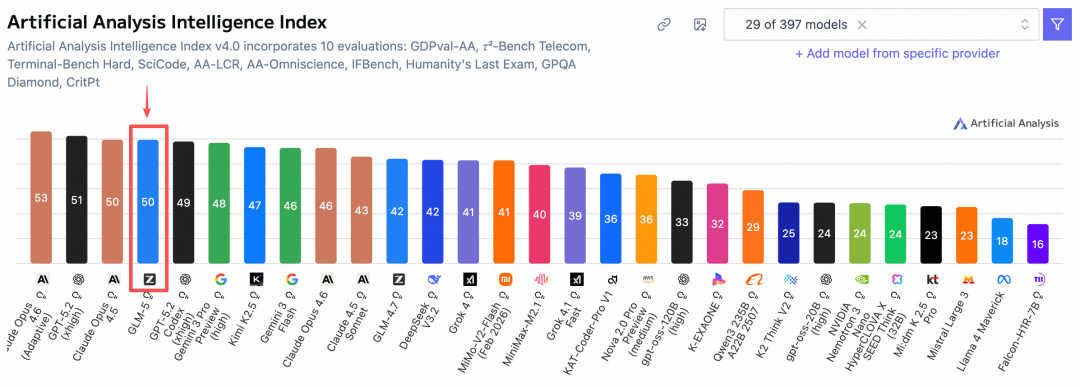
On the authoritative global Artificial Analysis benchmark, GLM-5 ranks fourth worldwide and first among open-source models.

Today, Zhipu AI, a Qiming Venture Partners portfolio company, launched and open-sourced GLM-5.
A growing consensus is emerging in academia and industry: large language models are evolving from writing code and frontends to engineering complete systems and executing major tasks — from "Vibe Coding" to "Agentic Engineering."
GLM-5 is the product of this transformation. It achieves state-of-the-art open-source performance in coding and agent capabilities, with a real-world programming experience that approaches Claude Opus 4.5, excelling at complex systems engineering and long-horizon agent tasks.
On the authoritative global Artificial Analysis leaderboard, GLM-5 ranks fourth worldwide and first among open-source models.
01/
Larger Foundation, Stronger Intelligence
GLM-5's new foundation provides a solid base for the evolution from "writing code" to "writing engineering":
- Expanded parameter scale: Scaled from 355B (32B active) to 744B (40B active), with pre-training data increasing from 23T to 28.5T tokens. The larger-scale pre-training compute significantly improves the model's general intelligence.
- Asynchronous reinforcement learning: A new "Slime" framework supports larger model scales and more complex RL tasks, improving post-training efficiency. An asynchronous agentic RL algorithm enables continuous learning from long-horizon interactions, fully unlocking the pre-trained model's potential.
- Sparse attention mechanism: First integration of DeepSeek Sparse Attention, maintaining lossless long-context performance while dramatically reducing deployment costs and improving token efficiency.
02/
Coding Capability: Aligned with Claude Opus 4.5
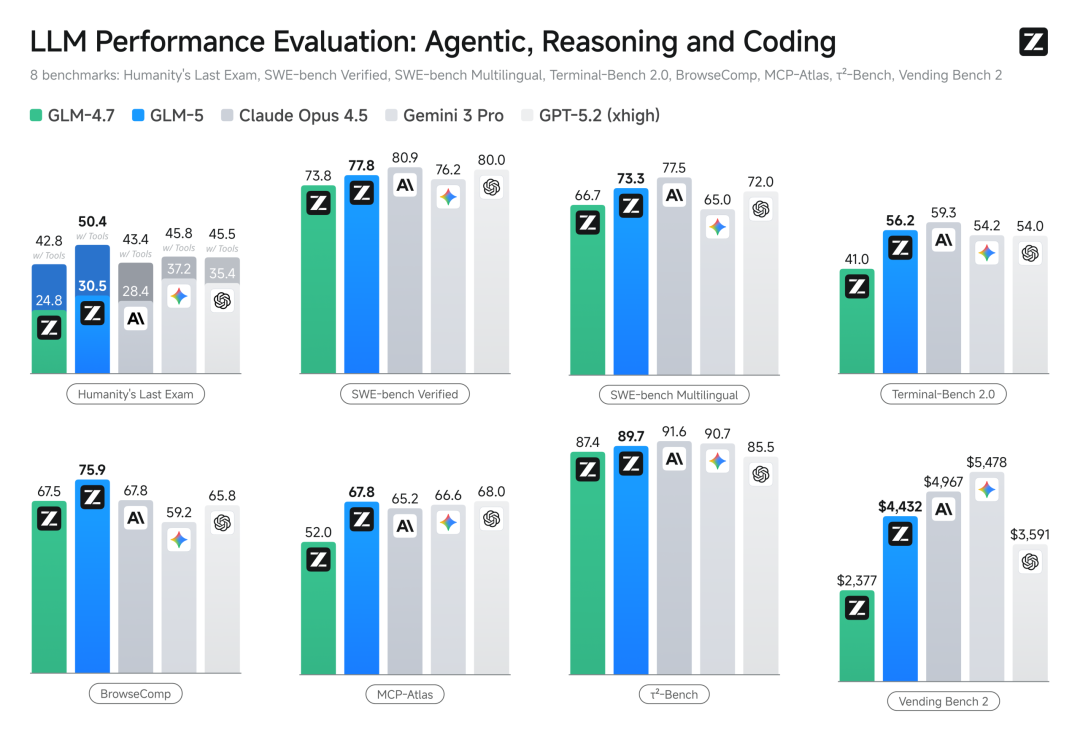
GLM-5 achieves alignment with Claude Opus 4.5 in programming capability, scoring state-of-the-art results among open-source models on industry-standard benchmarks. It achieves 77.8 and 56.2 on SWE-bench-Verified and Terminal Bench 2.0 respectively — open-source SOTA scores surpassing Gemini 3 Pro.
In 2026, large models need to move from "knowing how to write" to "knowing how to complete" — especially end-to-end execution of large-scale tasks. GLM-5 is a "systems architect": built not just for crafting polished demos, but for reliably delivering production results.
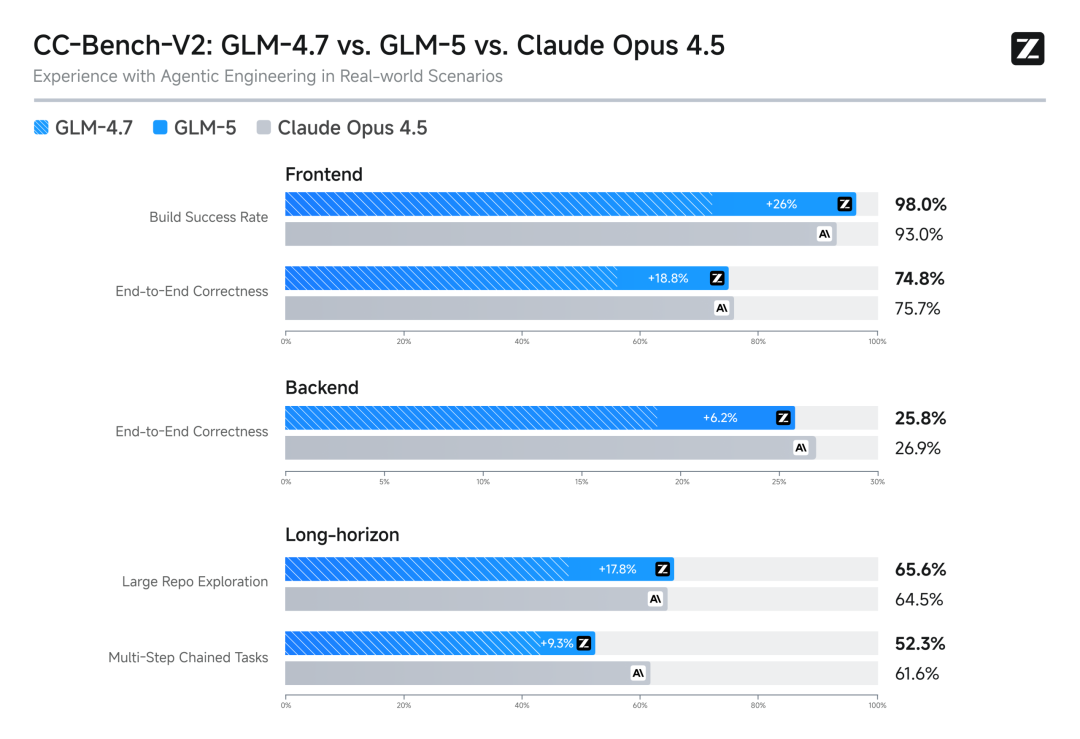
On internal Claude Code evaluation sets, GLM-5 significantly outperforms GLM-4.7 across frontend, backend, and long-horizon tasks (average improvement exceeding 20%), capable of autonomously completing agentic long-horizon planning and execution, backend refactoring, and deep debugging with minimal human intervention — an experience approaching Opus 4.5.
03/
Agent Capability: SOTA Long-Horizon Task Execution
GLM-5 achieves open-source SOTA in agent capabilities, ranking first among open-source models on multiple evaluation benchmarks: top performance on BrowseComp (web search and information comprehension), MCP-Atlas (tool use and multi-step task execution), and τ²-Bench (planning and execution in complex multi-tool scenarios).
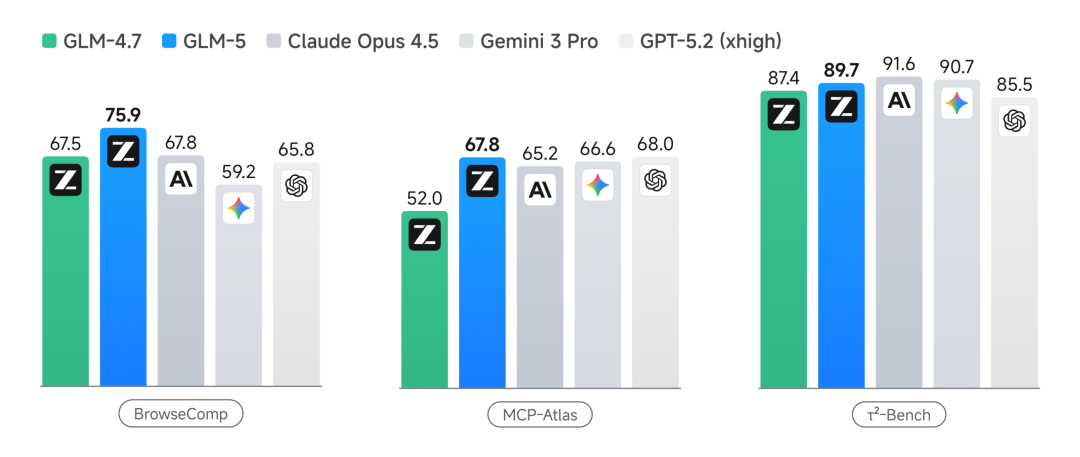
On Vending Bench 2, which measures operational capability, GLM-5 achieves the top score among open-source models. The benchmark requires managing a simulated vending machine business over a one-year period; GLM-5 reached a final account balance of $4,432, with operational performance approaching Claude Opus 4.5, demonstrating exceptional long-term planning and resource management.
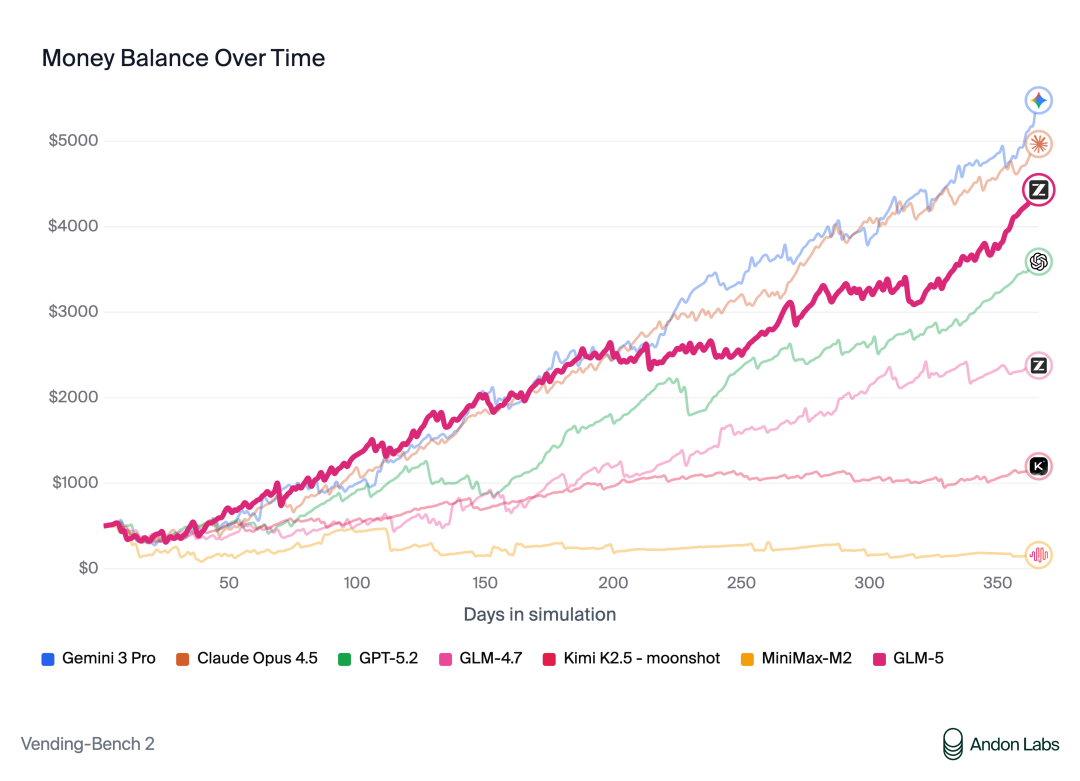
These capabilities are core to Agentic Engineering: models must not only write code and complete engineering tasks, but maintain goal consistency over long horizons, manage resources, handle multi-step dependencies, and become truly Agentic-Ready foundation models.
04/
Domestic Chip-Powered Online Inference Clusters
The GLM series is beloved by developers worldwide. After the GLM Coding Plan went viral globally, Zhipu had to implement purchase limits. For this GLM-5 launch, robust domestic chip support ensures stable, efficient online service.
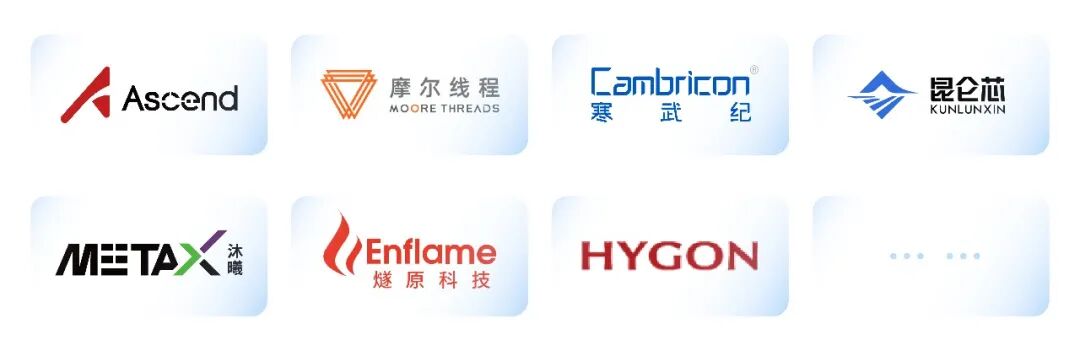
GLM-5 has completed deep inference optimization for Huawei Ascend, Moore Threads, Cambricon, Kunlunxin, MetaX, Suiyuan, and Hygon domestic compute platforms. Through low-level operator optimization and hardware acceleration, GLM-5 now runs with high throughput and low latency on domestic chip clusters.
05/
Agentic Engineering in Action
Scenario 1: End-to-End Application Development
After launching anonymously on OpenRouter (as "Pony"), many developers used GLM-5 to build applications that actually work, are playable, and are deployable.
Developers have created side-scrolling puzzle games, agent-interactive worlds, and a paper-sharing "Douyin"-style app with GLM-5 — all available for download or submitted for app store review. See the GLM-5 showcase at showcase.z.ai. These cases demonstrate GLM-5's ability to deliver deployable products end-to-end in complex systems engineering.
Scenario 2: General Agent Assistant
GLM-5's strong agentic tool-calling capabilities make it an ideal foundation for general agent assistants.
With GLM-5 integrated into OpenClaw, users get an intelligent intern that can search websites, curate information on schedule, post updates, code, and more. Zhipu has released an AutoGLM-powered OpenClaw, supporting one-click integration with Lark bots on the official website — reducing setup from hours to minutes for a dedicated 24/7 intelligent assistant.
Scenario 3: Z Code Full-Cycle Programming
When GLM-5 evolves to run complete closed loops, programming tools must be rebuilt around this capability. Enter Z Code. Users simply describe their requirements; the model automatically breaks down tasks, with multiple agents concurrently handling coding, command execution, debugging, preview, and submission across the full development cycle.
On Z Code, users can even remotely direct desktop agents from their phones to solve engineering tasks that previously took much longer.
Notably, Z Code itself was developed entirely with GLM model participation.
Scenario 4: Direct Office Document Output
GLM-5's enhanced complex systems engineering and long-horizon agent capabilities enable direct conversion of text or materials into .docx, .pdf, and .xlsx files.
On Z.ai and Zhipu Qingyan, users can have GLM-5 directly output product requirement documents, lesson plans, exam papers, spreadsheets, financial reports, flowcharts, menus, and more.
06/
Open Source and Access
Starting today, GLM-5 is open-sourced simultaneously on Hugging Face and ModelScope, with model weights under MIT License.
GLM-5 is included in the Max user plan; Pro support will follow within 5 days. Zhipu will gradually expand access to bring GLM-5 to more users. GLM Coding Plan supports Claude Code, OpenCode, and other mainstream development tools.
GLM Coding Plan upgrades to the Agentic Engineering experience:
- Official OpenClaw integration: Configure in just a few simple steps to quickly launch agent workflows;
- Limited AutoGLM-OpenClaw gift for Pro/Max users: Connect cloud-based personal AI assistants to Lark for long-task execution in office scenarios;
- New GLM in Excel benefit: A natively Excel-adapted AI plugin supporting natural language interaction in the sidebar, deeply empowering data processing and spreadsheet workflows (Beta period: Max users only, plan credits applicable).
1. Official API Access
- BigModel platform: https://docs.bigmodel.cn/cn/guide/models/text/glm-5
- Z.ai: https://docs.z.ai/guides/llm/glm-5
- OpenClaw integration docs: https://docs.bigmodel.cn/cn/coding-plan/tool/openclaw
2. Online Experience
- Z.ai: https://chat.z.ai
- Zhipu Qingyan APP/Web: https://chatglm.cn
3. Open Source Links
- GitHub: https://github.com/zai-org/GLM-5
- Hugging Face: https://huggingface.co/zai-org/GLM-5
- ModelScope: https://modelscope.cn/models/ZhipuAI/GLM-5
4. Agent
- AutoGLM: https://autoglm.zhipuai.cn/?channel=AutoGLM_OpenClaw&redeem_modal_open=1
- Z Code: https://zcode.z.ai/cn
5. Blog
Past Coverage
7 AI IPOs in 7 Months, Qiming Venture Partners: Investing in AI Is the Greatest Certainty in Chinese Investing Over the Next Two Decades Qiming Stars | Zhipu AI, Pioneer and Leader of China's AGI, Successfully Lists on the Hong Kong Stock Exchange | Bilingual Qiming View | Qiming Venture Partners' Alex Zhou: Zhipu AI's Successful IPO Is a Major Confidence Boost for China's Long-Cycle Sectors

Founded in 2006, Qiming Venture Partners currently manages 11 USD funds and 7 RMB funds, with total assets under management reaching $9.5 billion. Since inception, the firm has focused on investing in early and growth-stage outstanding enterprises in Technology and Healthcare.
To date, Qiming Venture Partners has invested in over 580 high-growth innovative companies, with more than 210 exiting through listings on the NYSE, NASDAQ, Hong Kong Stock Exchange, Shanghai Stock Exchange, and Shenzhen Stock Exchange, or through M&A. Over 80 portfolio companies have become recognized unicorns or super-unicorns.
Many Qiming Venture Partners portfolio companies have grown into the most influential players in their respective fields, including Xiaomi (01810.HK), Meituan (03690.HK), Bilibili (NASDAQ:BILI, 09626.HK), Zhihu (NYSE:ZH, 02390.HK), Roborock (688169.SH), Hesai Technology (NASDAQ:HSAI, 02525.HK), UBTECH (09880.HK), WeRide (NASDAQ:WRD, 00800.HK), HyperStrong (688411.SH), Insta360 (688775.SH), Unisound (09678.HK), Biren Technology (06082.HK), Zhipu AI (02513.HK), Gan & Lee Pharmaceuticals (603087.SH), Tigermed (300347.SZ, 03347.HK), Zai Lab (NASDAQ:ZLAB, 09688.HK), CanSino Biologics (688185.SH, 06185.HK), Schrödinger (NASDAQ:SDGR), MicroPort EP MedTech (688617.SH), Sanyou Medical (688085.SH), Amoy Diagnostics (300685.SZ), SinoCellTech (688520.SH), Insilico Medicine (03696.HK), Hope Medicine, Yuanxin Technology, MediLink Therapeutics, LaNova Medicines, StepFun, and others.