Morning Star | He Wang: Robots That Can Actually "Work" Aren't Afraid of Price Wars

Galaxy Universal prioritizes user experience, focuses on its areas of competitive strength, and starts from actual demand to ensure its robots address real pain points in the market. The company wants humanoid robots to perform genuinely valuable work, allowing Embodied Artificial Intelligence to create meaningful intelligent value.

Editor's Note: Recently, Qiming Venture Partners portfolio company Galaxy Universal announced the completion of a new RMB 1.1 billion funding round. Since its founding, Galaxy Universal has adopted a technical paradigm of pre-training with simulated synthetic action datasets and post-training with real-world data, leading the rapid iteration of global embodied large-model technology. In terms of scaled application deployment of robots, Galaxy Universal has made significant progress in smart retail, industrial, and healthcare scenarios.
He Wang, assistant professor at Peking University and founder and CTO of Galaxy Universal, discussed with 36Kr the company's original product design intent — building humanoid robot products to automotive-grade or even above-automotive-grade standards. He analyzed why Galaxy Universal has been able to develop higher-quality, more generalizable models. Wang also emphasized that Galaxy Universal prioritizes user experience, focuses on its areas of strength, and approaches from the perspective of demand to let robots truly address existing pain points in the market. The company hopes humanoid robots can perform value-generating work, allowing embodied intelligence to truly create intelligent value. Looking ahead, he stated that Galaxy Universal will continuously advance new skills, ensure it remains at the forefront of the industry, and is committed to making general-purpose robots serve thousands of industries and millions of households.
This article is republished with authorization from the Qiming Venture Partners WeChat official account, with editing and abridgment.
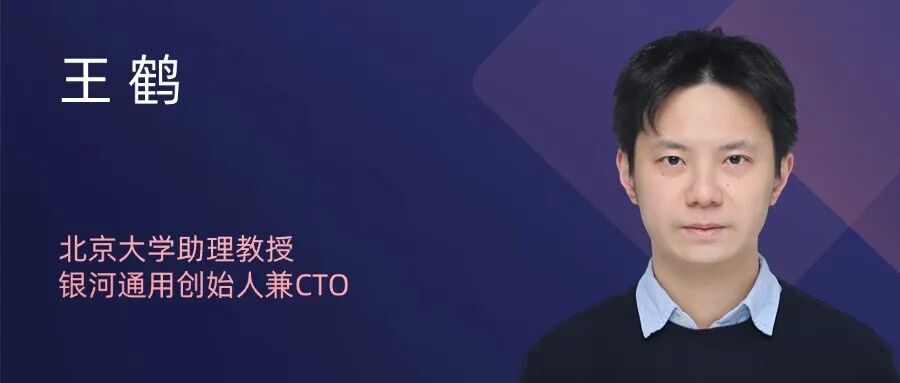
He Wang, assistant professor at Peking University and founder and CTO of Galaxy Universal
"Besides dancing and doing backflips, what else can humanoid robots do?"
He Wang, assistant professor at Peking University and founder and CTO of Galaxy Universal, may be the most qualified person to answer this question. The company he founded, Galaxy Universal, is a unicorn in China's embodied intelligence sector and the most brain-focused company in the industry's first tier.
Since its founding in May 2023, Galaxy Universal has released only one robot body product, Galbot (G1), but has launched multiple embodied large models. The company has directed most of its resources and funding toward embodied large-model R&D, committed to improving robots' generality and generalizability.
In Dr. Wang's view, the race to build humanoid robot bodies is driving robot prices down to the cost of raw steel — signs of a price war are already emerging in the market. Only improvements in embodied intelligence model capabilities can give humanoid robots greater value.
General-purpose embodied large models represent the "uncharted territory" of human frontier technology. Yet Wang, bearing this grand proposition, speaks about the current state of embodied model development with surprising "conservatism" and pragmatism:
"I especially don't recommend talking about embodied AGI. Many companies want to achieve embodied AGI in one step — I don't agree with that."
"Embodied intelligence models still have many immature aspects. It may take five to ten years before they can do any kind of work."
"A large amount of research results have continued to emerge over such a long time, but scalable, producible products have never actually landed."
Currently, many domestic embodied intelligence model manufacturers are keen on "flexing their muscles": demonstrating their models' generalization capabilities through demos of complex operations like "folding clothes, shaving, pulling zippers." Galaxy Universal, meanwhile, is heads-down tackling "less complex" mobile, pick, and place skills — its naming for its embodied manipulation model is also relatively "plain": the foundational grasping large model GraspVLA.
Wang told 36Kr straightforwardly that Galaxy Universal is also developing skills like hanging clothes on hangers, but such complex operations remain research achievements, still far from deployment and productization.
The embodied intelligence model skill closest to real-world deployment is the relatively "simple" "Mobile, Pick and Place." Galaxy Universal is working to deploy this skill first in pharmacy, retail, and other select scenarios.
According to reports, Galaxy Universal has partnered to launch the world's first humanoid robot smart retail solution, currently operating nearly 10 24-hour unmanned pharmacies in Beijing where Galaxy Universal's humanoid robots continuously and automatically pick medicines with precision and deliver them to riders.
Galaxy Universal plans to open 100 unmanned retail stores this year across Beijing, Shanghai, Shenzhen, and other cities. This application scenario has already achieved marketization and is expected to bring Galaxy Universal nearly RMB 100 million in revenue this year.
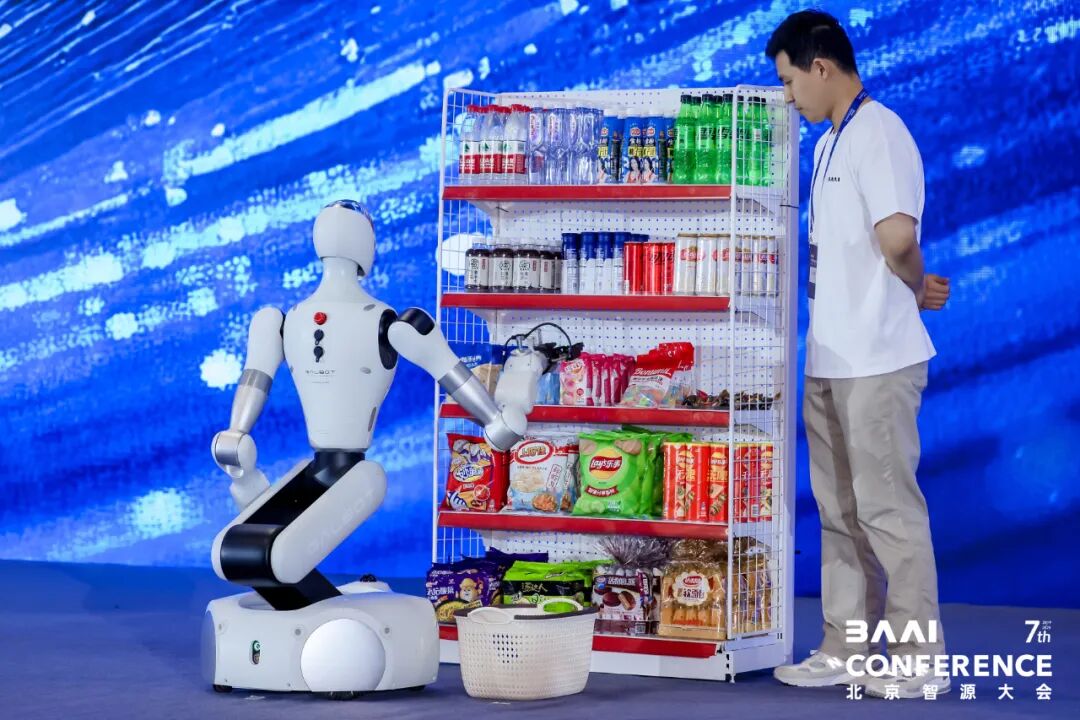
At the recent BAAI Conference opening ceremony, Galaxy Universal's robot Galbot performed a live on-stage demonstration at the main forum. Under Wang's voice commands, the robot autonomously and precisely moved to the correct position and retrieved a beverage from a shelf, achieving fully autonomous execution of complex shelf grasping and delivery — with no teleoperation and no pre-collection of scene data.
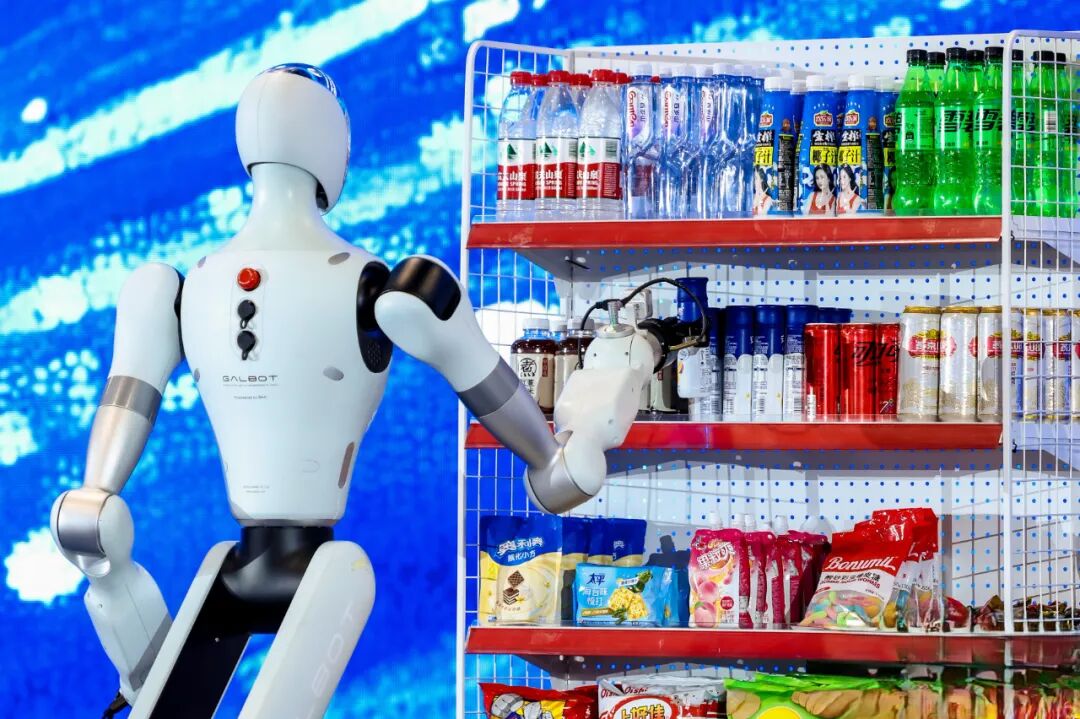
Galaxy Universal demonstrating grasping and delivery at the BAAI Conference
Wang candidly stated that embodied intelligence entering any scenario requires some data preparation to create a 100% successful product. The "Mobile, Pick and Place" skill continues to be updated, and Galaxy Universal has chosen to start with retail shelf scenarios, gradually improving operational generalizability.
In Wang's view, thoroughly solving the generalization problem for "simple" operations like "Mobile, Pick and Place" would already be an important milestone in the entire history of human embodied intelligence and robotics. By his estimation, the maturation of this skill could open a new market worth hundreds of billions of RMB, helping humans complete heavy labor across retail, front warehouses, automotive factory SPS sorting, and other scenarios.
From a generalization perspective, if an omnipotent humanoid robot is 100, a robot mastering "Mobile, Pick and Place" is 10, and deploying "Mobile, Pick and Place" in retail shelf scenarios is merely "1."
Galaxy Universal has currently achieved the breakthrough "from 0 to 1" and is advancing toward the ultimate goal of general embodied intelligence.
Below is the full transcript of 36Kr's conversation with He Wang.
01/
Welcome Performances Are Just a Flash in the Pan
Train Robots for High-Value Work
36Kr: How large is your team currently?
Wang: We have over 100 people now.
36Kr: That seems smaller than peers in the same tier.
Wang: At this stage we're still focused on the product R&D team. Galaxy Universal currently has one humanoid robot product, Galbot G1, centered on core needs in industrial, retail, and service scenarios, with main skills being mobile, pick, and place operations.
I believe this skill can build a complete closed-loop skill set across various broad scenarios in industry, commerce, and services, rather than doing many divergent small skills or numerous all-category robot products, because that would require a much larger workforce.
36Kr: Galaxy Universal has only made one body but released multiple models — are you tilting more resources toward models?
Wang: Actually, we have more members doing "hardware" than "software," which may differ from outside perceptions. People might assume Galaxy Universal only makes one product, so it doesn't need many hardware engineers. In reality, our robot standards differ significantly from many peers.
If a robot is only used for research, as a hardware platform, or to show a 5-minute demo, this presentation format doesn't demand high product reliability. The gap from a robot that can truly work 24 hours is enormous, because it can't actually be deployed.
Galaxy Universal's hardware has undergone multiple rounds of intensive iterative upgrades around one product, so we can truly achieve 24-hour robot operation in unmanned pharmacy scenarios. If hardware issues required engineers to come on-site for repairs, costs would be very high. So our product design intent is to build humanoid robot products to automotive-grade or even above-automotive-grade standards.
36Kr: What about financial investment?
Wang: As an embodied large-model company, our largest investment is still in model R&D. But this isn't achieved by stacking people, because no company has ever built good models by piling up model training staff. Rather, it's about building the entire closed-loop team from data infrastructure to model training and testing. Computing costs account for a large portion here. In fact, some genius-level figures in model development work at companies that aren't large in headcount.
36Kr: Emphasizing synthetic data is a very distinctive tag for Galaxy Universal. However, many peers also say they use simulation data, combined with internet videos, real-robot data, etc. — what's the difference?
Wang: Those who don't know how can't use synthetic data well, so some people say simulation is "toxic" and so on. Galaxy Universal's current achievements owe much to synthetic data playing a very important role. Based on our self-developed synthetic data technology, our embodied large model training costs have been greatly reduced. We also emphasize virtual-real integration, allowing our embodied large models to truly run at the global leading edge. This precisely shows we can truly use synthetic data well.
For example, internet video data can be downloaded by anyone. Slightly higher in barrier is teleoperation. The embodied robots we currently deploy in supermarket and retail environments use teleoperated real-world data, but its proportion is far lower than simulated synthetic data.
The synthetic data approach requires manufacturers to have solid graphics, physics simulation, physics rendering, and automatic action synthesis pipelines, including a full set of infrastructure for verification closed loops — requiring long-term accumulation and core technical know-how. These accumulations are also a key reason why Galaxy Universal can build better and more generalizable models.
36Kr: Your robot body uses a wheeled chassis. Can we understand that Galaxy Universal focuses more on developing the robot's upper limb manipulation capabilities?
Wang: It depends on where the emphasis lies — on the product side, we take deployment needs as our guide.
Currently, the vast majority of customers considering their own needs, such as doing mobile, pick, and place work in factory and supermarket retail scenarios, all require chassis-based designs. Bipedal robots tend to generate noise and have short battery life. Our wheeled chassis robots only need charging every 6-8 hours, giving them a natural advantage over bipedal designs.
From an R&D perspective, Galaxy Universal has full-stack layout across all of embodied intelligence, with arrangements for bipedal humanoid robots too, but at this stage it's not a product that can be truly widely applied on the product side.
36Kr: Welcome and performance scenarios have emerged this year, with peers aggressively entering them — why hasn't Galaxy Universal seized this market?
Wang: My view is that these flashy scenarios are a flash in the pan. Markets aren't ultimately won by a wave of traffic. What truly survives is good user experience.
Galaxy Universal always prioritizes user experience. For example, there are many lobby welcome robots, but they mainly do trivial work. What we're doing is next-generation reception robot products that customers will want to use and that can truly assist human workers. If we can achieve this, I believe vast markets are yours to explore.
So it's not that we won't do it — we're already laying groundwork, currently in a process where many point technologies form lines, and lines form surfaces.
02/
"Mobile, Pick and Place" Has Huge Market Space
But Technology Is Not Yet Fully Mature
36Kr: Do investors pressure you much on commercialization?
Wang: Investors have given us tremendous support, not only in financial investment but also in strategic synergy resources. Currently, we already have solid deployment results, and the company should have considerable revenue scale this year.
36Kr: What about the education and research market — have you laid out there?
Wang: I think it's a matter of different priorities. How profitable is the education market really? What's its ceiling in unit numbers? In fact, numerous bipedal companies have already joined the competition for the education market. Galaxy Universal will focus on areas where we have advantages, approaching from the perspective of demand to let robots truly satisfy existing pain points in the market.
What Galaxy Universal cares about isn't selling humanoid robot bodies as raw steel material, because the consequence of a race to the bottom in humanoid robots is that everyone trends toward pricing by material cost. What we expect is for humanoid robots to engage in value-generating work, letting embodied intelligence truly create intelligent value.
36Kr: Do you see this price war trend in the market now?
Wang: Yes, prices are being slashed crazily, down to the low tens of thousands of RMB, and someone may quote even lower in the future. We actually welcome the entire industry driving rapid hardware cost reductions through fast hardware iteration. Supply chain cost reductions also benefit Galaxy Universal.
The question is what problems robots at this price point can actually solve. What we focus on now is high-value work. Our robots sell for several hundred thousand RMB each, yet customers are still very willing to use them because this significantly alleviates the labor cost pressure of three-shift workers. This is also why we (expect to) achieve 100-million-level revenue.
36Kr: You sell for several hundred thousand — why can customers still accept this?
Wang: As I mentioned above, the psychological expectations for cheap humanoid robots from other sellers versus our scenario-deployed robots are different. Our product maturity and reliability requirements are different.
Galaxy Universal's robots can work continuously for a month without a single error — this is our core competitive advantage. I call our robots "scenario-deployed robots," while the ones on the market for research and mall performances are "R&D platform robots."
36Kr: You mentioned Galaxy Universal's main skills center on mobile, pick, and place, but some argue that these "PPT operations" (Pick, Place, and Transfer) can solve limited practical problems and adapt to limited application scenarios.
Wang: First, I don't accept the "PPT operations" framing. I prefer "Mobile, Pick and Place," which is also the more internationally recognized expression.
Currently in retail, warehousing, automotive factory SPS sorting, and other scenarios, what we see is large numbers of employees doing "mobile, pick, and place" work. If someone thinks this market has limited development space, it may be because they haven't truly understood market demand. What I see is a potential market of hundreds of thousands of units, higher than current global industrial robot total output value.
36Kr: Why haven't these "mobile, pick, and place" robots been widely deployed yet?
Wang: The "Mobile, Pick and Place" skill is far from mature. Even technologically leading robots like Google DeepMind's RT can't achieve deployment. Like Galaxy Universal's smart retail demonstration at the BAAI Conference, having robots handle picking, delivery, and shelving — I haven't seen other manufacturers replicate this, especially daring to do live on-site demonstrations.
36Kr: Many manufacturers show off more complex operations like robots pulling zippers, shaving, and folding clothes, with their investors treating these as relatively high technical achievements.
Wang: Many manufacturers are presenting non-deployable, non-productizable research highlights as their products. We need to think: when will a clothes-folding robot actually be productized? At this stage, can it meet efficiency requirements, flatness requirements, and generalization requirements?
Having this research result doesn't mean the robot product sells better — this logic doesn't hold. In fact, large amounts of research results have continuously emerged over such a long time, but scalable, producible products have never actually landed.
We are also developing new skills, including hanging clothes on hangers. Behind Galaxy Universal's synthetic data are millions of virtual clothing assets. But honestly, practical, deployable clothes-folding hasn't been achieved by anyone yet.
36Kr: Of Galaxy Universal's disclosed deployment scenarios, mainly pharmacies, factories, and retail, which are marketized and which remain at the POC (Proof of Concept) stage?
Wang: Pharmacy and retail scenarios are already fully marketized — a large portion of our revenue comes from this.
Factory scenarios remain at the POC stage, because some factory work has very high requirements for cycle time, accuracy, and reliability. Especially in high-end precision manufacturing, like new energy vehicle production lines, even one minute of downtime causes enormous losses. Including Tesla and Figure AI, everyone is at the POC stage, polishing products to eventually integrate them into new production lines.
Galaxy Universal has delivered many industry benchmark POC projects globally, such as SPS sorting POC at an internationally renowned automaker, material box handling and sunroof transfer POCs at Mercedes-Benz, and handling POCs at ZEEKR. Galaxy Universal's progress is quite fast. But truly converting this scenario into production lines still needs some time.
36Kr: These automakers aren't your investors.
Wang: Right, the automaker partners I just mentioned are not our investors. Automotive manufacturers themselves have strong automation needs, so they've established strategic cooperative relationships with us.
The Embodied Intelligence Industry Is Relatively "Chaotic"
Few People Truly Willing to Do Practical Work
36Kr: You've released multiple models. Besides the embodied grasping foundational large model GraspVLA, are other models commercialized? Such as the recently released product-level end-to-end navigation large model TrackVLA.
Wang: We will develop TrackVLA toward C-end products. It can interact well with people in scenarios, including doing everything from industrial inspection to supermarket follow-and-carry work. We're currently working with partners and scenario parties to push TrackVLA model applications.
Our models can also generalize across different robot dogs. Navigation capabilities are easier to generalize across different bodies than manipulation capabilities.
36Kr: Some industry companies have partnered with Physical Intelligence (PI). Would using top-tier models enable faster commercialization?
Wang: I don't know the specific details of their PI partnerships. What I understand is that PI is extensively collecting real-robot data from various manufacturers. From a data perspective, I don't agree with PI's approach. Cross-body, large volumes of different robot data are low-quality data for robot training.
36Kr: If we compare global first-tier embodied intelligence model capabilities to AI large models, what stage are they at?
Wang: This is difficult to analogize — embodied intelligence models involve higher dimensions.
For example, in autonomous driving, people talk about L1-L5, with autonomous driving centered on the single task of driving. Embodied intelligence covers many tasks — you might be good at "Mobile, Pick and Place" but not necessarily able to hold a baby or help an elderly person get up.
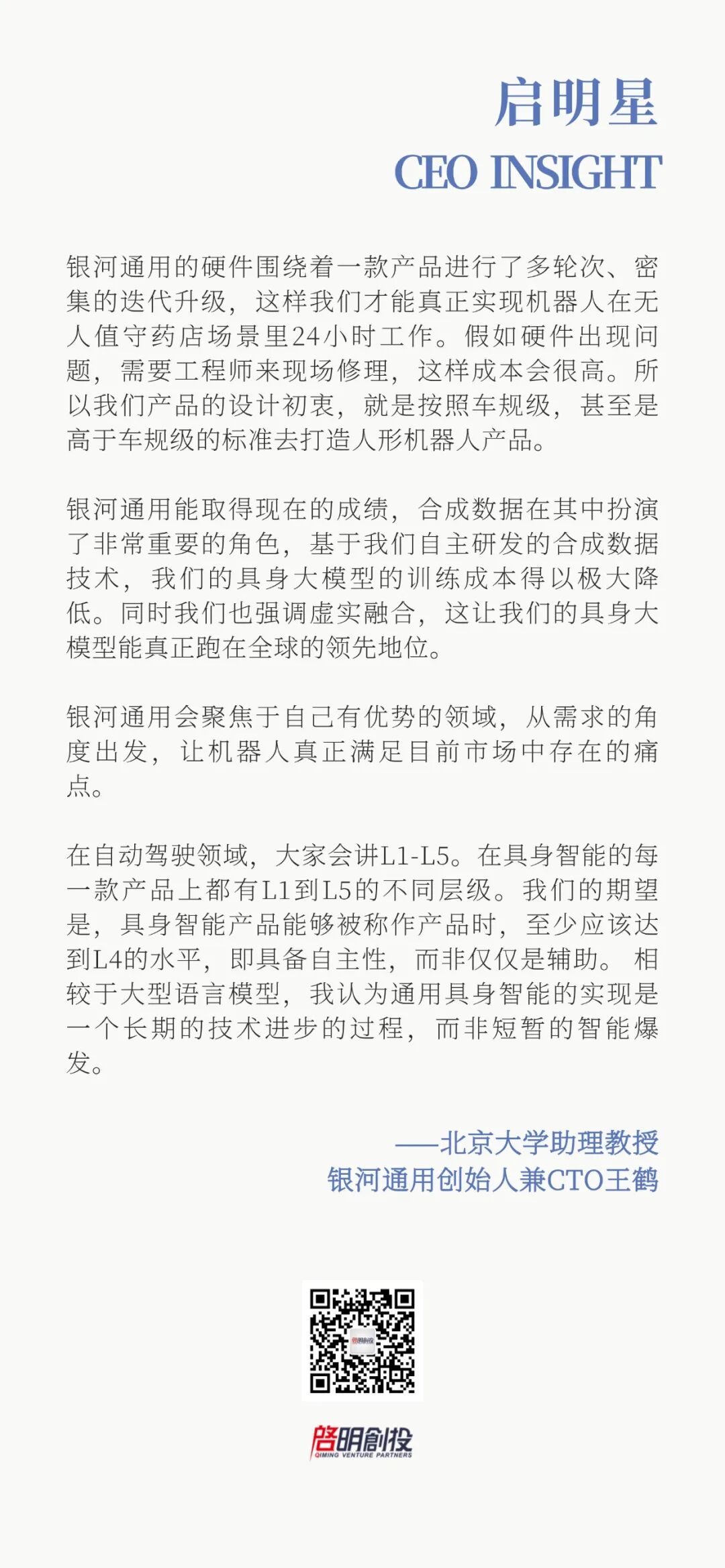
On each embodied intelligence product, there are different levels from L1 to L5. Our expectation is that when embodied intelligence products can be called products, they should at least reach L4 level — possessing autonomy, not merely assistance.
Compared to large language models, I believe general embodied intelligence is a long-term technological progress process, not a brief intelligence explosion.
36Kr: So the "ChatGPT moment" for embodied intelligence models is still quite distant.
Wang: Yes. ChatGPT demonstrated general question-answering capability, while embodied intelligence models wanting to do any kind of work still have much to do from hardware and sensors to data collection, with many immature aspects — it may need five to ten years.
When we humans work, besides vision, language, and action (Vision-Language-Action), we also use hearing, smell, taste, touch, and temperature perception to varying degrees across different tasks. So VLA models are just a starting point — if we want to reach human-level embodied intelligence, we need to continuously integrate new modalities.
What can VLA do now? I think it's to first make "Mobile, Pick and Place" very generalizable, doing it well in a scalable, replicable scenario — like all retail stores, all factory sorting lines. If this can be achieved, it will be a milestone in the entire history of human embodied intelligence and robotics. Its significance is no less than today's robots achieving "lights-out factories."
36Kr: Are industry peers heading toward this milestone, or pursuing other technical breakthroughs?
Wang: I think there are few people in the industry truly willing to do practical work, and many willing to sell hardware, sell platforms. After selling things to users, they don't need to be responsible for functionality — there are many such manufacturers. Among those truly willing to do models, many do academic research, and few truly do deployable model products. These two "few"s have led to the relatively "chaotic" state of the embodied intelligence industry.
36Kr: For "Mobile, Pick and Place" to deploy in service industries like pharmacies and convenience stores, what remains to be improved?
Wang: Embodied intelligence entering any scenario requires some data preparation. Whether synthetic data, small-scale real-robot data collection, or even scenario-based reinforcement learning, these are needed to create a 100% successful product.
What we currently pursue isn't doing all "Mobile, Pick and Place," but first centering on shelves, even supermarket shelves, ensuring good generalization first, and finally everyday environments with things placed variously. So this path isn't as simple as people think.
36Kr: Beyond "Mobile, Pick and Place," what will be Galaxy Universal's next milestone moment, and what technical reserves have you made?
Wang: Galaxy Universal has several top industry scholars working together to push forward research innovation. From a research perspective, we will continuously advance new skills, including legged robots and dexterous hand research — this is also a field where I've received multiple Best Paper awards, representing more ultimate end-effector and body skill learning.
For R&D, our strategy is to lead and always ensure we're at the front line. Galaxy Universal's mission is to let general-purpose robots serve thousands of industries and millions of households.
Source | 36Kr
Authors | Fangyu Wang; Editor | Jianxun Su
Past Reviews

Founded in 2006, Qiming Venture Partners currently manages 11 USD funds and 7 RMB funds, with total assets under management reaching USD 9.5 billion. Since its establishment, the firm has focused on investing in outstanding early and growth-stage companies in Technology and Healthcare.
To date, Qiming Venture Partners has invested in over 580 high-growth innovative companies, of which more than 210 have listed on the New York Stock Exchange, NASDAQ, Hong Kong Exchanges and Clearing, Shanghai Stock Exchange, and Shenzhen Stock Exchange, or exited through M&A and other means. Over 80 portfolio companies have become recognized unicorns or super-unicorns in their industries.
Many Qiming Venture Partners portfolio companies have grown into the most influential companies in their respective fields, including Xiaomi (01810.HK), Meituan (03690.HK), Bilibili (NASDAQ:BILI, 09626.HK), Zhihu (NYSE:ZH, 02390.HK), Roborock (688169.SH), UBTECH (09880.HK), WeRide (NASDAQ:WRD), Insta360 (688775.SH), Gan & Lee Pharmaceuticals (603087.SH), Tigermed (300347.SZ, 03347.HK), Zai Lab (NASDAQ:ZLAB, 09688.HK), CanSino Biologics (688185.SH, 06185.HK), Schrödinger (NASDAQ:SDGR), MicroPort EP MedTech (688617.SH), Sanyou Medical (688085.SH), Amoy Diagnostics (300685.SZ), Berry Genomics (000710.SZ), GenScript ProBio (688520.SH), Yuanxin Technology, Insilico Medicine, MediLink Therapeutics, LaNova Medicines, Zhipu AI, StepFun, Biren Technology, and others.