Morning Star | He Wang of Galaxy Universal: Focused on Developing Embodied Artificial Intelligence Multimodal Large Model General-Purpose Robots, Offering Cross-Domain Generalization Solutions
From day one, Galaxy Universal locked in three core loops: in-house hardware R&D to ensure reliability; proprietary intelligence development; and building its own database.

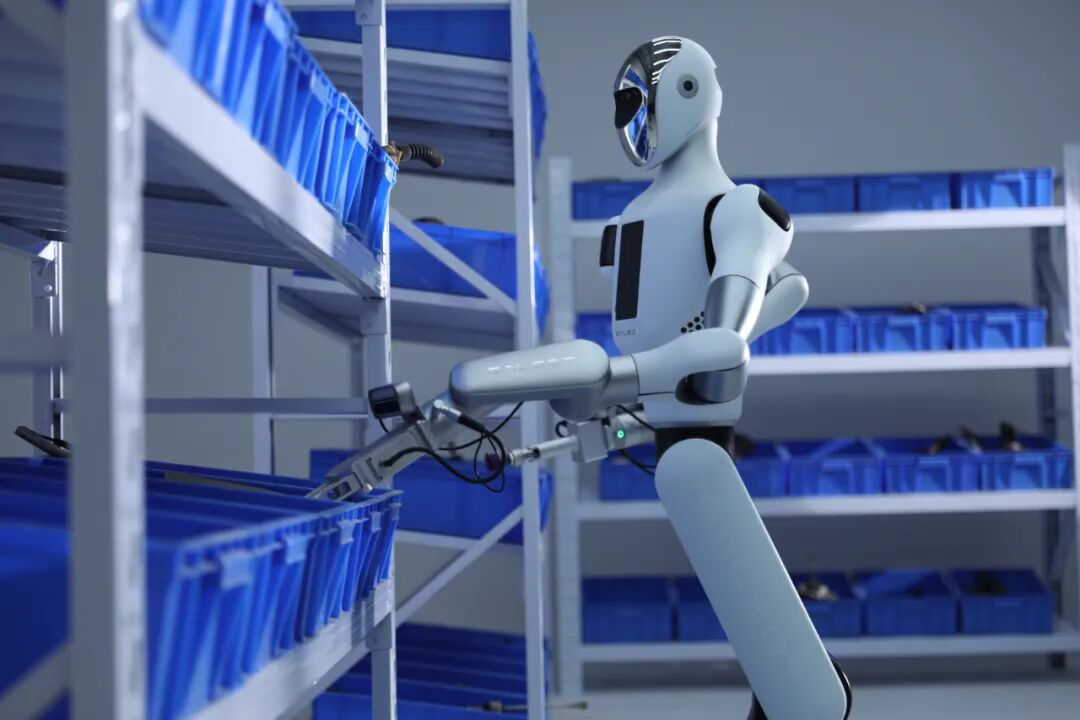
Editor's Note: Recently, Qiming Venture Partners portfolio company Galaxy Universal became the first to deploy NVIDIA's Jetson Thor inside its self-developed embodied AI large-model robot, the Galbot G1 Premium. At World Robot Conference 2025, the Galbot G1 Premium completed its global debut in an industrial bin-handling scenario, demonstrating fluid motion performance alongside real-time visual processing and motion planning capabilities. Galaxy Universal is committed to driving technical breakthroughs and scaled deployment of embodied AI, making robots reliable partners for humans across urban life, industrial production, healthcare, and other scenarios.
He Wang, assistant professor at Peking University, founder and CTO of Galaxy Universal, and BAAI scholar, previously shared with China Entrepreneur magazine what sparked his entrepreneurial journey, how the Galaxy Universal team thinks about technology roadmapping, and two key lessons from his experience — the ability to maintain holistic control over engineering execution and scientist-grade forward-looking vision. Wang noted that intense focus on the key technologies for industrial deployment is the core reason for Galaxy Universal's rapid growth. Looking ahead, he said the endgame for embodied AI is permeating every industry and every household, which requires step-by-step evolution of both robot hardware and the AI behind it. Galaxy Universal is currently pushing full throttle toward this goal.
This article is republished with authorization from the Qiming Venture Partners WeChat official account, with editing and abridgment.
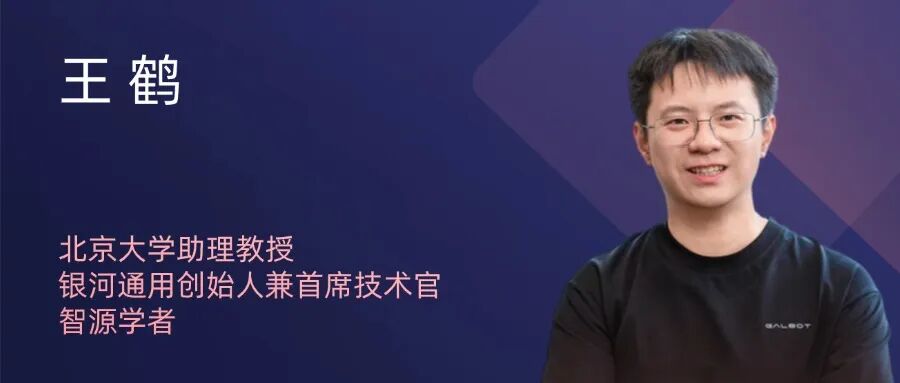
He Wang, assistant professor at Peking University, founder and CTO of Galaxy Universal, and BAAI scholar
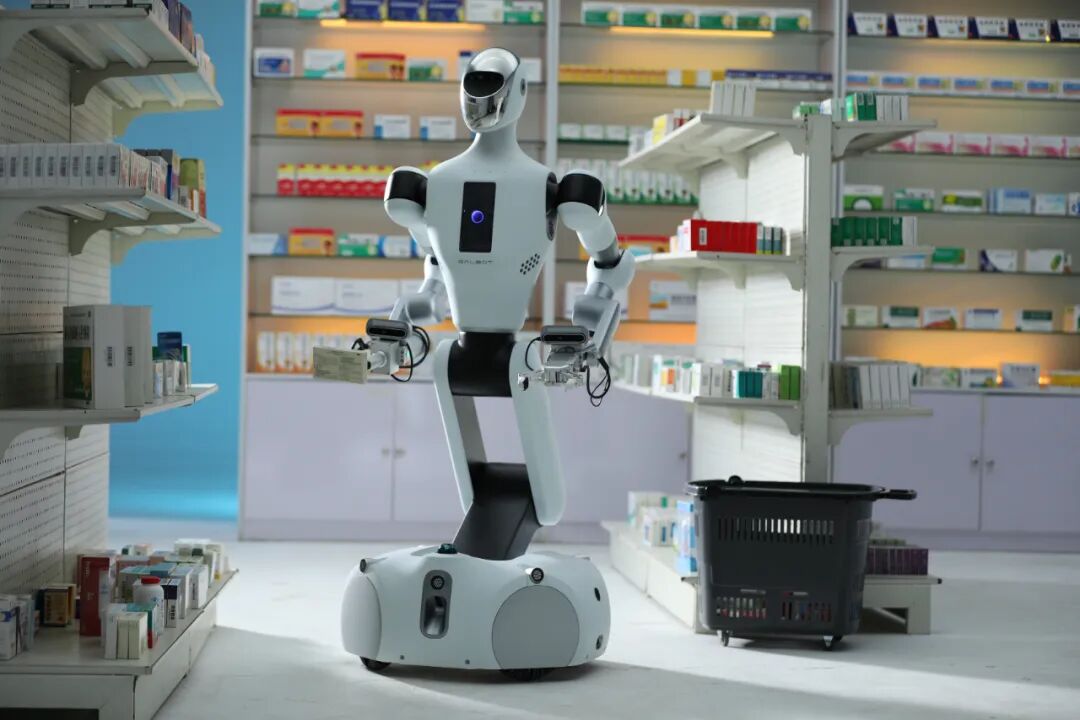
When a late-night urgent medication order comes in, inside a 24-hour retail pharmacy in Beijing, a Galaxy Universal Galbot G1 robot's arm precisely locks onto, grabs, and packages the medicine, then hands it to the courier arriving for pickup.
Similar scenes play out in more complex offline retail environments. At the 2025 BAAI Conference, He Wang gave a live demonstration — when he issued the command "Galbot, I'm hot and hungry, get me something to eat," the robot, without any teleoperation, autonomously planned its path in a 1:1 recreated supermarket scene, identified and grabbed cookies and drinks from the shelves, and delivered them.
Driven by an interest in artificial intelligence, He Wang shifted his research focus from semiconductor devices to computer vision during his PhD at Stanford University in 2016. His background in physics and other fields led him to an entirely new research direction: how to help AI enable robots to understand the world, interact with it, and model and simulate the world to solve data problems behind robotics — what has become the hot concept in robotics in recent years, "embodied AI."
In 2021, Wang returned to China to join the Center on Frontiers of Computing Studies at Peking University, establishing the Embodied Perception and Interaction Lab. As one of the few young scientists in China researching embodied AI, Wang was soon discovered by numerous investors. In May 2023, he co-founded Galaxy Universal with former ABB robotics expert Tengzhou Yao, with "synthetic data-driven + multimodal large models" as the core technical path, focusing on the R&D of embodied AI multimodal large-model general-purpose robots, providing cross-domain generalization solutions for commercial, industrial, and medical scenarios.
In just over two years since its founding, Galaxy Universal has completed cumulative financing exceeding 2.4 billion yuan, with investors including major investment platforms and renowned institutions such as Qiming Venture Partners, as well as strategic investments from industry players, with repeated follow-on investments from existing shareholders.
As a leading company in embodied AI in terms of funding and valuation, Galaxy Universal has preliminarily achieved scaled deployment of general-purpose robots: the company has currently signed contracts for 100 smart pharmacies. According to Wang, the team is expanding robot solutions to broader smart retail scenarios, covering digital products, scenic area cultural and creative goods, and more. "In the second half of this year, people may see Galaxy Universal robots operating convenience stores in core scenic areas and downtown districts of many cities," Wang said.
01/ Advancement
In 2023, Wang, who had recently joined Peking University, hadn't yet considered starting a company. As the concept of embodied AI gradually gained traction with the boost of large models, many investors approached Wang hoping he would lead a venture. In March 2023, Google launched its PaLM-E model, touted as both multimodal and capable of manipulating robots. "Looking back today, PaLM-E wasn't a truly end-to-end embodied AI model, but its release made people realize embodied AI could be combined with multimodal large models to build a general-purpose robot system. If I didn't start a company then, it might be too late," Wang said.
Wang candidly admitted he had two shortcomings at the time: first, he had no prior experience in hardware mass production, "since embodied AI ultimately has to land in product applications"; second, he knew nothing about business financing.
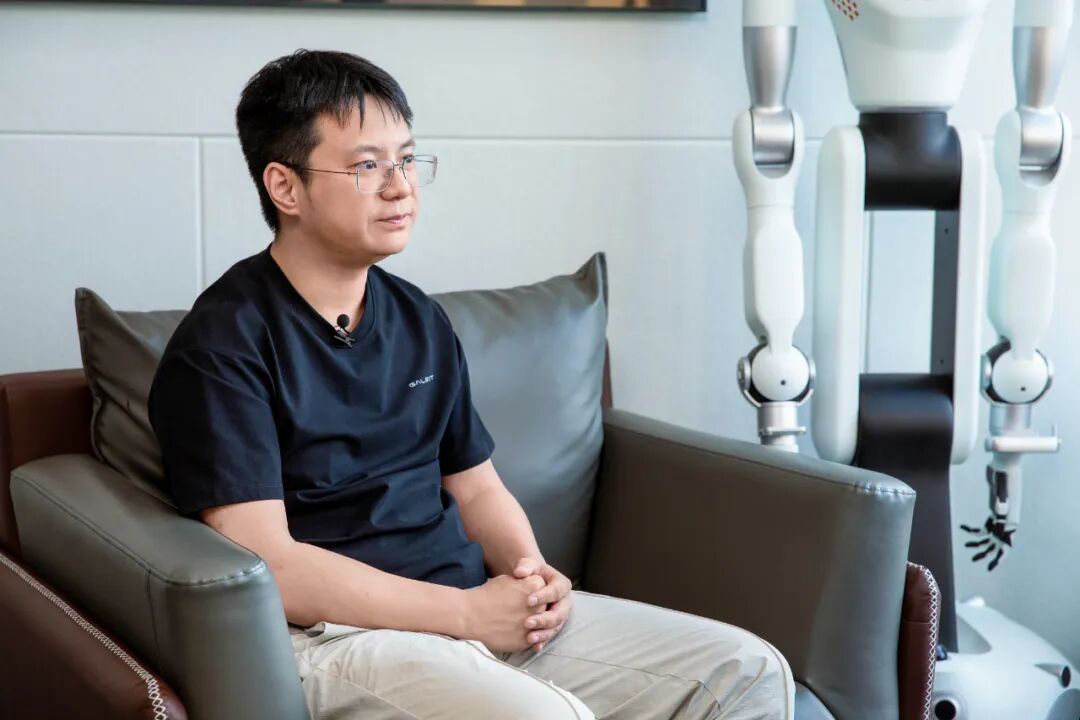
Photo | Deng Pan
Through investors' introductions, Wang quickly found several partners with hardware experience and commercial operational capabilities. Shared interests led them to rapidly reach consensus: "if we're going to do it, start immediately." Wang noted that from the birth of the entrepreneurial idea in April 2023, to team assembly, company registration, and completion of the first angel funding round, the entire process took only one month.
In May 2023, Galaxy Universal was founded. At the start, Wang and the team's idea was to combine action modalities with multimodal large models to create a general-purpose robot solution that could see, understand, and work. This idea was remarkably bold and unique at the time, so in the early stages, Wang could attract investor funding with existing technical achievements.
But as the company developed, product landing became key to successful fundraising. Wang recalled that he was frequently challenged by investors, asked about product direction and landing feasibility.
After the second funding round, the company's valuation was $80 million, yet many angel investors told him that if they had met him earlier, they would have invested at a lower valuation. "Today embodied AI is almost the hottest investment field, but in the first half of 2023, many people considered it very risky. Convincing investors it was worth betting on was extremely difficult at the time," Wang revealed.
In subsequent fundraising experiences, Wang and his team faced "intense" challenges from investors. Especially during the refinement of Galaxy Universal's first product (unmanned retail/pharmacy robot), Wang had to answer every time he met investors: what exactly should it look like, could it deploy quickly, was there ROI, which features would make the numbers work, and so on.
02/ Goals
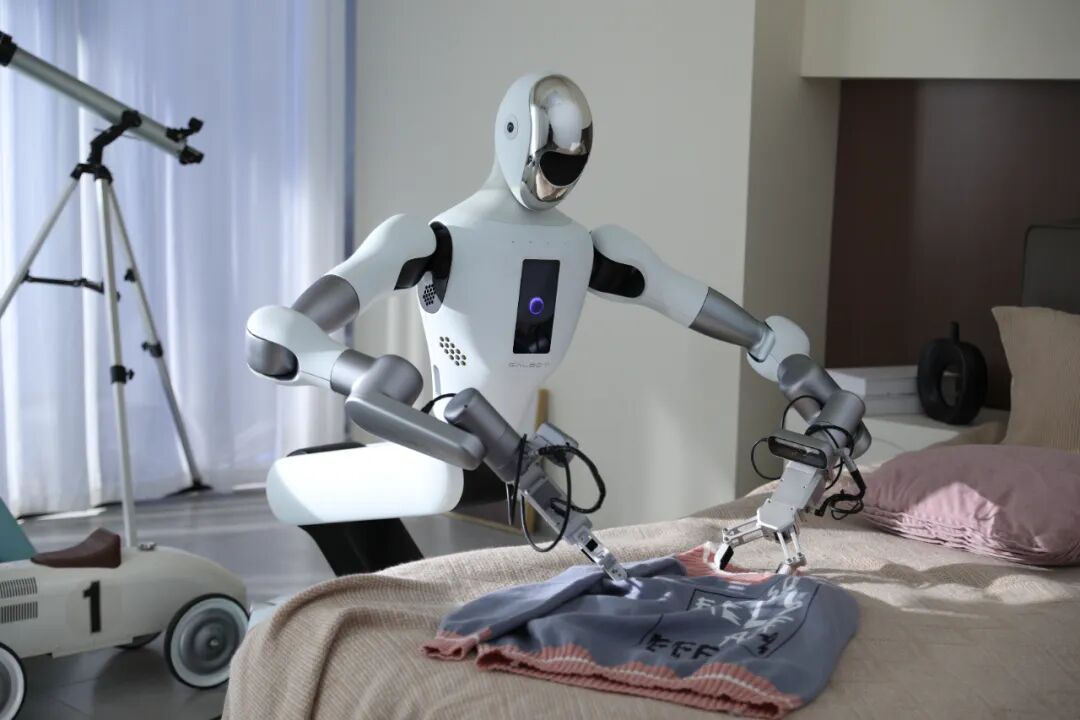
In June 2024, Galaxy Universal officially released its first-generation embodied AI large-model robot, the Galbot. Unlike humanoid robots in most people's minds, the G1 did not use bipedal legs but instead adopted a "foldable leg + wheeled chassis" structure.
This appearance faced considerable controversy. For instance, as a scientist, why wasn't Wang researching the coolest bipedal robots? Some investors also questioned the cutting-edge nature of this approach.
In Wang's view, bipedal stability is currently inferior to wheeled chassis. "We believe the first phase of landing focuses on upper-body hand-eye-brain coordination, with a lower body that can elevate and descend — low enough to reach the ground, high enough to reach over two meters, with hands that can reach into shelves to grab goods. That's sufficient," Wang said.
Wang believes embodied AI lands gradually, and when planning the technology roadmap, the Galaxy Universal team divided it into what can land now, what can land in the near future, and what needs to be done with a long-term view.
"As founder and CTO, I must balance near-, medium-, and long-term product R&D needs, laying out the full chain from research to landing. This is a huge personal challenge," Wang admitted. When technology truly moves toward application, hardware control, algorithm deployment, and other issues explode all at once. "You need to find reliable, low-cost solutions that can actually be delivered. This forces me and the team to keep learning."
After starting the company, Wang summarized two key insights about doing technology in an enterprise:
First, holistic control over engineering landing. As CTO, you can't only understand science; you need sharp judgment on engineering problems and the ability to maintain holistic control.
Second, scientist-grade forward-looking vision. In Wang's view, if a technology enterprise loses the guidance of top scientists, it will inevitably decline in the long run.
Embodied AI is no exception. Wang believes it needs to "lay eggs along the way" while also looking up at the stars. "Today's wheeled solution, humanoid hardware in five years, and C-end普及 in 15 years are three completely different technical stages. If lacking scientist-grade forward-looking vision to anticipate the next step, companies will quickly have their阶段性成果 harvested by giants," Wang said.
Wang predicts the endgame market size for embodied AI will be a trillion-level market of "car unit price × phone sales volume." "At a robot unit price of 100,000 yuan, if a company can reach annual shipments of 10 million units, that corresponds to at least 1 trillion yuan in output value, and the company will transform into an unshakeable industry giant," Wang said.
In Wang's view, if Galaxy Universal can deploy 1,000 robots this year, it needs to break through ten thousand in two to three years, and hit 100,000 units in another three years, to maintain the company's position as an industry leader. Any stagnation would plunge the company into cutthroat red-ocean competition.
03/ Focus and Endgame
In Wang's view, Galaxy Universal's current development path is to first use a stable architecture to commercialize, converting core hand-eye-brain coordination capabilities into productive forces. While the company continues investing in cutting-edge research on legged robots, current bipedal robot technology maturity remains insufficient.
On the other hand, vertical-domain robots like vacuum robots, welding robots, and window-cleaning robots all have strong markets and are easy to land, but in Wang's view, these technologies don't lead the future. "These things aren't our original intention in building general-purpose robots. Only by using truly useful technology to lead the industry forward, tackling scenarios that no one could do before, and where those scenarios have output value and high growth potential, can we reassure investors," Wang said.
Wang's habit of focus began with middle school physics competition training and continued through his academic and entrepreneurial career. Before graduating from Stanford, having already received his Peking University offer, he began recruiting students remotely and guiding their experiments. After returning to China, he devoted himself fully to embodied AI.
After founding Galaxy Universal, he completely focused his research on key technologies for industrial landing. "Either don't do it, or do it with success as the only goal, mobilizing all resources and energy, researching only technologies that can push embodied AI commercialization, never wasting time on impractical directions." Wang believes this intense focus strategy is the core reason for Galaxy Universal's rapid development.
In January 2025, Galaxy Universal released GraspVLA, the world's first end-to-end embodied AI large model pre-trained on billion-level simulated synthetic action data, achieving zero-shot generalization capability.
However, Wang was not satisfied with this. In his view, embodied AI is the soul behind the hardware, but hardware determines the ceiling of general-purpose robots. When Wang first joined Peking University in 2021, he used several domestic and foreign robots. As he described it, at the time students spent 95% of their time repairing or debugging robots, with only 5% actually spent on research. "If we don't have our own hardware, who can we trust?" Wang reflected.
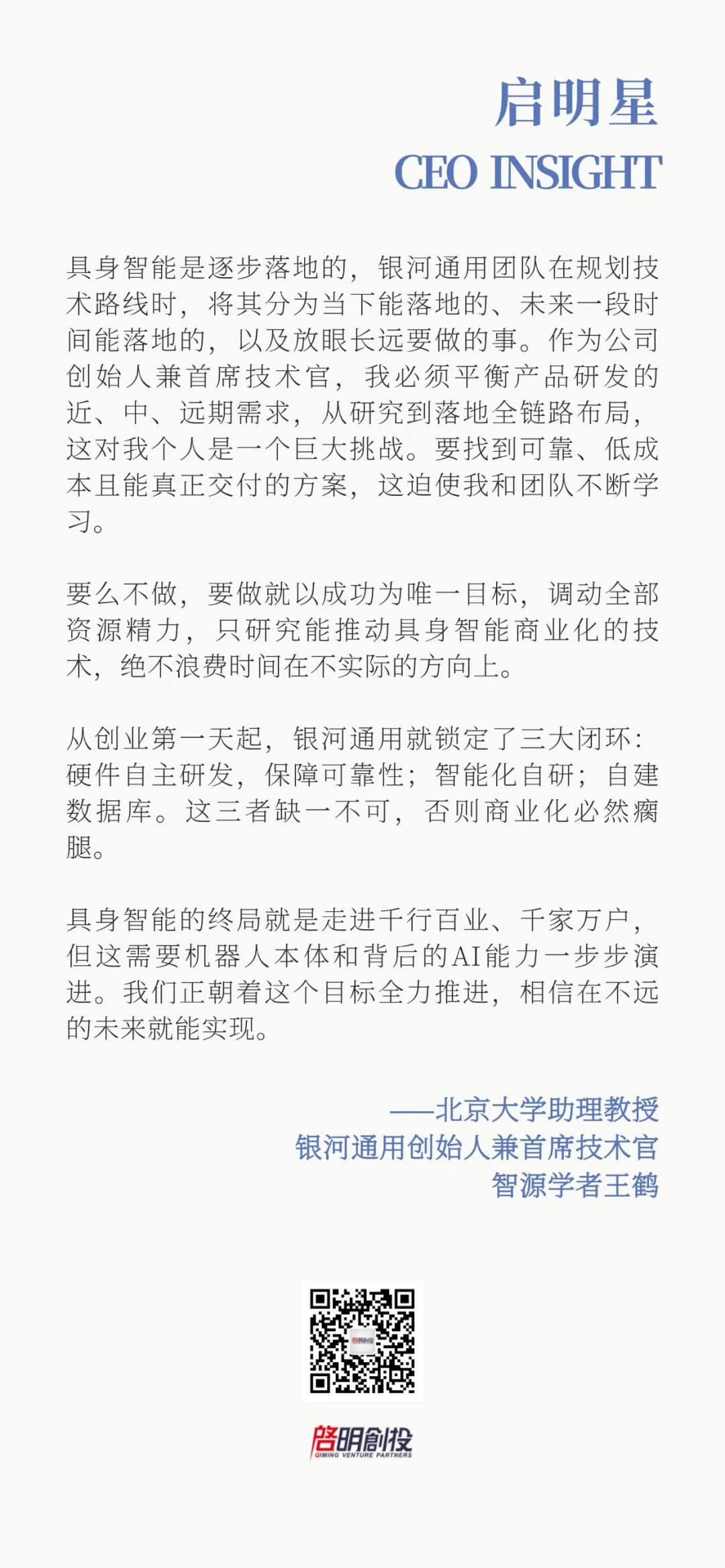
Therefore, from day one of founding, Galaxy Universal locked in three closed loops: self-developed hardware to ensure reliability; self-developed intelligence; and self-built databases. "All three are indispensable; otherwise commercialization will inevitably limp," Wang said. It was only with the addition of partners in hardware and commercialization that Galaxy Universal's founding came together.
In 2025, while breaking through the embodied AI general model GraspVLA, Galaxy Universal is also accelerating commercialization capabilities, globally releasing GroceryVLA, an end-to-end embodied AI large model for retail scenarios, and TrackVLA, a product-level end-to-end embodied navigation large model, powering its scaled deployment in offline unmanned retail markets.
"We have already signed cooperative agreements with partners for 100 smart retail stores, and are rapidly expanding to other commercial domain customers," Wang revealed. Beyond pharmacy scenarios, the company is simultaneously pushing commercialization toward broader unmanned retail scenarios, including digital products, scenic area cultural and creative goods, and convenience store vending.
Galaxy Universal's layout in industrial domains is also accelerating. To date, Galaxy Universal has established strategic cooperation with multiple leading manufacturing enterprises and delivered commercial orders for factory-floor applications. Wang predicts that next year, Galaxy Universal's industrial scenario deployments will likely replicate this year's expansion curve in offline retail, achieving high-speed growth.
In June this year, Bosch China, Boyuan Capital (a market-oriented investment platform under Bosch Group), and Galaxy Universal signed a strategic cooperation memorandum. Boyuan Capital and Galaxy Universal also announced the joint establishment of a joint venture company, "Boyin Hechuang," to promote the industrial application of embodied AI technology in automotive and industrial manufacturing.
"The endgame of embodied AI is entering every industry and every household, but this requires step-by-step evolution of both robot hardware and the AI behind it," Wang emphasized. Only when humanoid robots can truly perform various human labors will the industry truly mature. "We are pushing full throttle toward this goal and believe it will be achieved in the not-too-distant future," Wang said.
Source | China Entrepreneur magazine
Author | Kong Yuexin
Editor | Ma Jiying
Previous Articles
Qiming Star | He Wang of Galaxy Universal: Robots That Can Truly "Work" Aren't Afraid of Price Wars Qiming Viewpoint | Alex Zhou of Qiming Venture Partners: Advancing China's Technology Innovation Through Investment Qiming Star | 6 Qiming Venture Partners Portfolio Companies Selected for 36Kr 2024 Embodied AI Innovation Application Cases

Founded in 2006, Qiming Venture Partners currently manages 11 USD funds and 7 RMB funds, with total committed capital reaching $9.5 billion. Since its inception, the firm has focused on investing in outstanding early and growth-stage companies in Technology and Healthcare innovation.
To date, Qiming Venture Partners has invested in over 580 high-growth innovative companies, of which more than 210 have listed on the New York Stock Exchange, NASDAQ, Hong Kong Exchanges and Clearing Limited, Shanghai Stock Exchange, and Shenzhen Stock Exchange, or exited through M&A and other means. Over 80 companies have become recognized unicorns or super-unicorns.
Many Qiming Venture Partners portfolio companies have grown into the most influential companies in their respective fields, including Xiaomi (01810.HK), Meituan (03690.HK), Bilibili (NASDAQ:BILI, 09626.HK), Zhihu (NYSE:ZH, 02390.HK), Roborock (688169.SH), UBTECH (09880.HK), WeRide (NASDAQ:WRD), Insta360 (688775.SH), Gan & Lee Pharmaceuticals (603087.SH), Tigermed (300347.SZ, 03347.HK), Zai Lab (NASDAQ:ZLAB, 09688.HK), CanSino Biologics (688185.SH, 06185.HK), Schrödinger (NASDAQ:SDGR), MicroPort EP MedTech (688617.SH), Sanyou Medical (688085.SH), Amoy Diagnostics (300685.SZ), Berry Genomics (000710.SZ), GenScript ProBio (688520.SH), Yuanxin Technology, Insilico Medicine, MediLink Therapeutics, LaNova Medicines, Zhipu AI, StepFun, Biren Technology, and others.