Qiming Venture Partners' Kan Chen: AI's Transformation of Biomedicine Is Already Evident
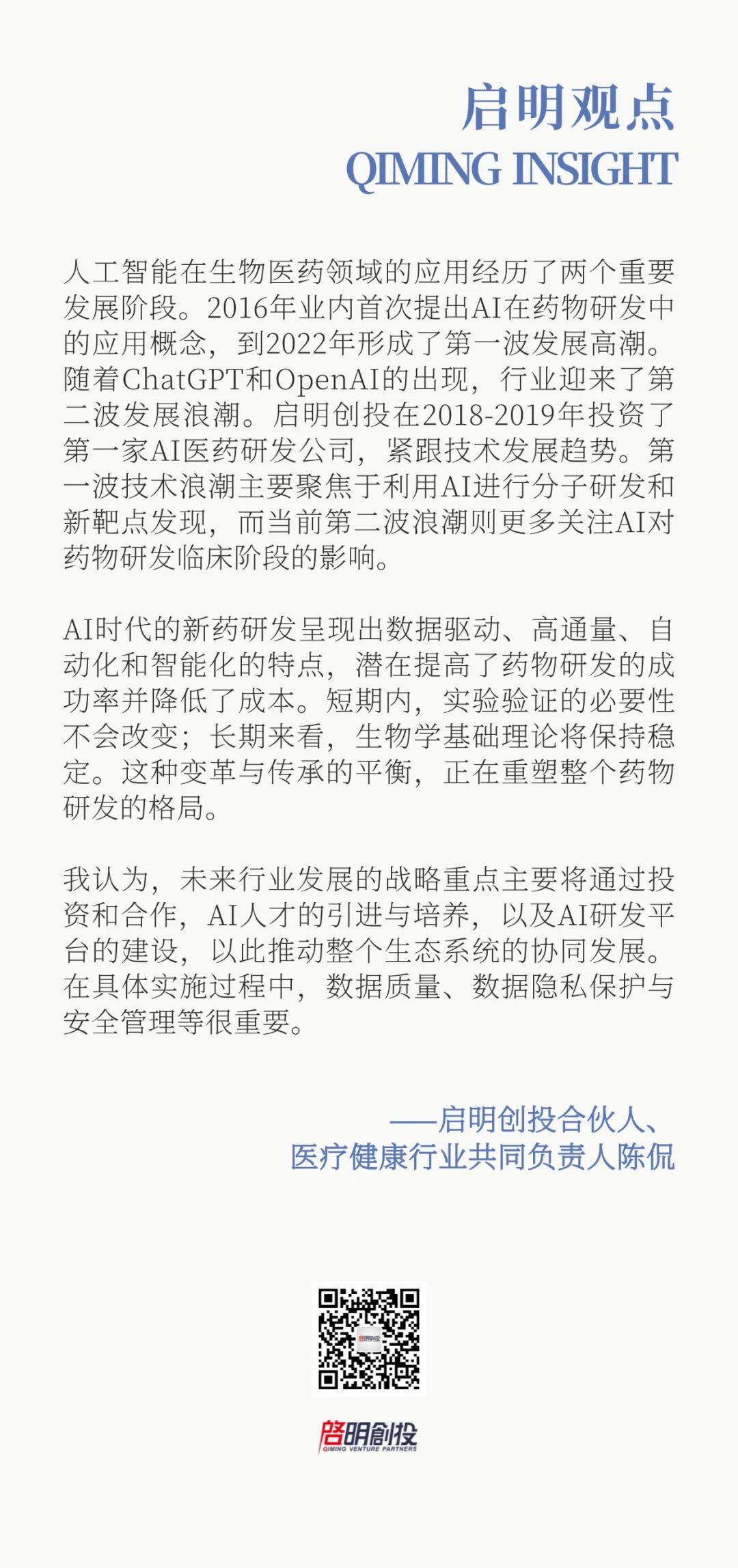
In the AI era, drug discovery is taking on the characteristics of data-driven, high-throughput, automated, and intelligent processes, potentially improving success rates and lowering costs. In the near term, the necessity of experimental validation will remain unchanged; over the long run, the foundational theories of biology will stay stable. This balance between transformation and continuity is reshaping the entire landscape of pharmaceutical R&D.

Editor's Note: At the 19th Annual China Investment Conference, Kan Chen, Partner at Qiming Venture Partners and Co-Head of Healthcare, delivered a keynote address. He outlined two major developmental phases in the application of artificial intelligence to biomedicine, as well as Qiming's systematic investment approach in this space. Chen also analyzed what is changing and what remains constant in AI-era drug discovery across target identification, molecular design, preclinical experimentation, and clinical trials, and shared his views on future strategic priorities and core challenges facing the industry.
Reprinted with permission from the Qiming Venture Partners WeChat account.
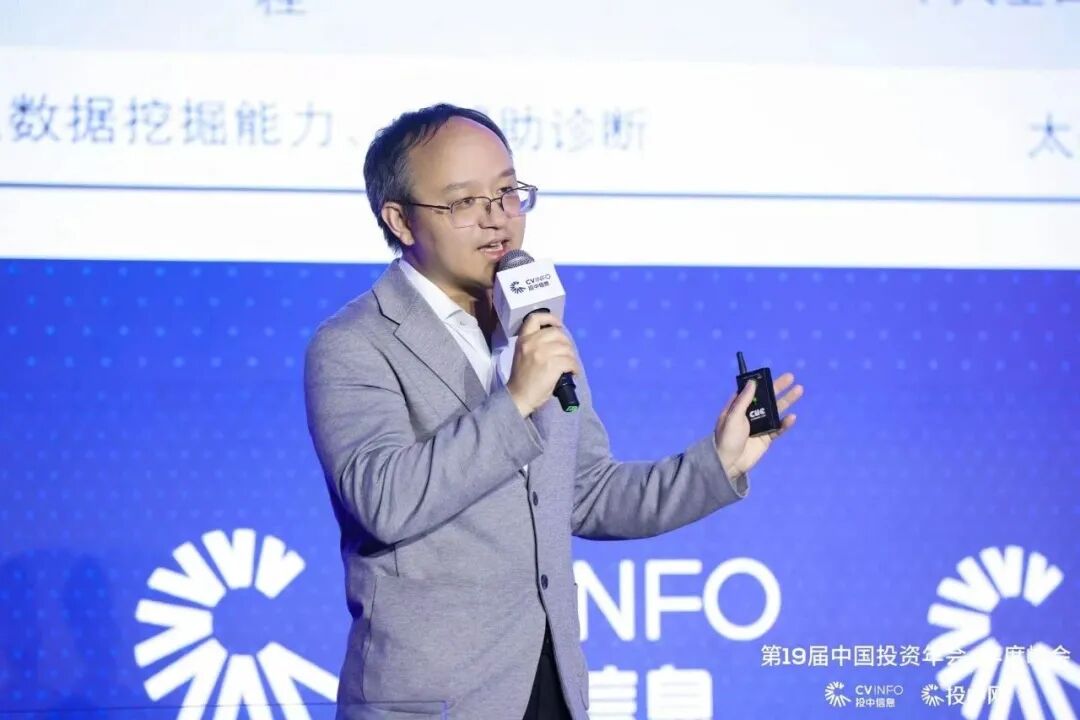
Kan Chen, Partner at Qiming Venture Partners and Co-Head of Healthcare
"Domestic pharmaceutical companies are rapidly advancing their adoption of AI technology, and AI's transformative impact on the biopharma industry is already evident."
At the 19th Annual China Investment Conference, hosted by ChinaVenture and ChinaVenture.com, Kan Chen, Partner at Qiming Venture Partners and Co-Head of Healthcare, spoke on the theme "What Changes and What Endures in the Biopharma Industry in the AI Era," offering a detailed analysis of how the pharmaceutical sector is actively embracing AI.
Chen believes that future strategic priorities for the biopharma industry will focus on driving ecosystem-wide synergistic development through investment and partnerships, the recruitment and cultivation of AI talent, and the construction of AI R&D platforms. In implementation, data quality, privacy protection, and security management will be critical. The core challenge at present is the scarcity of interdisciplinary talent — existing professionals typically specialize in either biomedicine or AI alone, with very few capable of spanning both domains.
The following is an edited transcript of Chen's remarks, prepared by ChinaVenture.
Qiming Venture Partners began investing in "AI + healthcare" quite early. From Qiming's perspective, I'd like to share some thoughts on what is changing and what remains constant in the biopharma industry during the AI era.
First, AI technology has entered a mature phase of practical application. Breakthroughs led by OpenAI and ChatGPT are profoundly reshaping industries across the board. The biopharma sector has long grappled with high R&D costs, lengthy timelines, and substantial risks. AI is inherently suited to accelerating development processes, reducing costs, and improving success rates — which explains the intense industry focus on AI's transformative potential for biopharma.
In fact, this transformation is already underway. Leading pharmaceutical companies are actively recruiting talent from the tech sector for CTO and other key positions. This organizational restructuring clearly signals that traditional drugmakers are embracing the AI technology transition.
01/
Pharma Companies Are Actively Embracing AI+
Domestic pharmaceutical companies are rapidly advancing their adoption of AI technology. Hengrui Medicine recently incorporated AI adoption metrics into its year-end KPI evaluation system — a move that fully demonstrates the company's determination to deeply integrate AI with drug R&D. Yunnan Baiyao, Fosun, and other pharmaceutical groups are also embracing AI.
In medical devices and diagnostics, AI-powered medical imaging companies are widely adopting Transformer-based multimodal data analysis to improve diagnostic accuracy. In clinical trial services, contract research organizations (CROs) are integrating AI across every stage of clinical trials.
On the healthcare IT front, AI medical agents are effectively alleviating the doctor-patient imbalance at tertiary hospitals, boosting physician productivity while reducing workload. In genetic diagnostics, companies are applying AI to genetic data analysis and pathology report generation. Internet healthcare platforms are also comprehensively introducing AI to enhance service capabilities.
The application of AI in biopharma has gone through two important developmental phases. The concept of AI in drug discovery was first proposed in 2016, culminating in a first wave of development by 2022. With the emergence of ChatGPT and OpenAI, the industry entered a second wave. Qiming Venture Partners invested in its first AI drug discovery company in 2018–2019, closely tracking technological trends. The first wave focused primarily on leveraging AI for molecular R&D and novel target discovery, while the current second wave pays more attention to AI's impact on the clinical stages of drug development.
Qiming Venture Partners has made systematic investments at the intersection of AI and drug discovery. In 2018, we invested in Schrödinger (NASDAQ: SDGR), which uses computational platforms to simulate small molecule-target interactions; the company later listed on Nasdaq, and Qiming realized strong returns. Three years before the OpenAI wave, Qiming began positioning in generative AI drug discovery, investing in Insilico Medicine, which uses generative AI technology to design molecules and recently completed an $110 million financing round.
The FDA recently made an important policy adjustment: under new guidelines, animal models will no longer be mandatory for future drug development filings. Based on this trend, we preemptively invested in Emulate, the global leader in organ-on-a-chip technology, as a replacement for animal model testing.
In AI chemistry, we have made key investments in two CRO companies: MagnesiumRX Chemistry and Temedica. Traditional chemical synthesis relies on chemists to design routes and manually conduct experiments, while MagnesiumRX has achieved intelligent transformation of experimental operations through automation — a revolution comparable to the automotive industry's shift from internal combustion to electric vehicles. Temedica, meanwhile, is dedicated to providing one-stop wet-and-dry-lab integrated service solutions for novel drug R&D companies.
In the clinical research domain, our investments include PureLife Life Sciences, which focuses on decentralized clinical trial models that break through the geographic constraints of traditional research centers — patients complete enrollment, drug receipt, and vital sign monitoring remotely, making this model particularly suitable for chronic disease trials. Qiming has also invested in Aisa Medicine, Medidata, and Yongyi Technology, among other innovative companies. These represent our initial deployments in "AI + pharma," with more to come.
02/
The AI Era:
What Changes and What Endures in Novel Drug R&D
Regarding what changes and what endures in novel drug R&D during the AI era, I'll analyze this across four dimensions: target discovery, molecular design, preclinical experimentation, and clinical trials.
In target discovery, traditional methods relied primarily on laboratory experiments using cell culture and animal models — low-throughput and time-consuming. A major transformation brought by AI is the introduction of digital twin capabilities. We can currently simulate organisms as simple as the nematode with its 300 cells, and future prospects include data modeling of human organs. Combining digital twins with laboratory experiments dramatically increases screening throughput and speed. Another important breakthrough is AI's ability to break through human cognitive inertia and propose counterintuitive, unconventional hypotheses. What remains unchanged is that target discovery still requires deep theoretical grounding in biology, ultimate validation of drug targets still depends on cell and animal models, and the data-driven essence of the process does not change.
In molecular design, traditional methods depended on chemists designing a limited number of compounds for synthesis and testing. In the AI era, tens of thousands of molecules can be computationally simulated, with optimal structures filtered before synthesis, vastly expanding the chemical exploration space. AI can also simultaneously optimize multiple parameters — PK/PD properties, affinity, efficacy, safety, and more. But the fundamental requirements for drug-like properties remain constant, and animal experiments are still ultimately required to validate efficacy and safety.
The transformation pattern in preclinical experimentation is similar to that of target discovery and molecular design.
The clinical trials domain has undergone significant change with the emergence of AI technologies like ChatGPT and DeepSeek. Traditional clinical research required manual completion of patient recruitment, protocol design, outcome analysis, and safety monitoring. Now AI agents can rapidly generate clinical protocols, intelligently match subjects, and automatically analyze trial data — substantially improving efficiency and reducing costs. But the accuracy of clinical data, ethical review, compliance requirements, and scientific design principles remain unchanged.
Overall, novel drug R&D in the AI era is characterized by data-driven, high-throughput, automated, and intelligent processes, with the potential to improve success rates and reduce costs. In the near term, the necessity of experimental validation will not change; in the long term, foundational biological theory will remain stable. This balance between transformation and continuity is reshaping the entire drug R&D landscape.
I believe future strategic priorities for industry development will focus on driving ecosystem-wide synergistic development through investment and partnerships, the recruitment and cultivation of AI talent, and the construction of AI R&D platforms. In implementation, data quality, privacy protection, and security management will be critical. The core challenge at present is the scarcity of interdisciplinary talent — existing professionals typically specialize in either biomedicine or AI alone, with very few capable of spanning both domains.
Even when such interdisciplinary talent cannot be found, how to effectively enable collaboration between biopharma professionals and AI specialists is itself a challenge. This difficulty stems from fundamental differences in working patterns between the two fields: biopharma R&D must strictly comply with regulatory requirements, with every change requiring FDA or NMPA approval; AI model debugging, by contrast, is relatively flexible and can be decided autonomously. Enabling these two types of professionals with different mindsets to work together is also a challenge for managers.
Successful examples of integrating AI with pharmaceutical R&D have already emerged internationally — for instance, Formation Bio, a new type of company that employs AI agents and various AI technologies end-to-end to accelerate the R&D process. These enterprises operate completely differently from traditional pharmaceutical companies; they represent a new generation of AI-native biotech firms. We expect to see more such innovative companies emerging in both China and the United States.
Source | ChinaVenture
P R E V I O U S H I G H L I G H T S

Founded in 2006, Qiming Venture Partners currently manages 11 USD funds and 7 RMB funds, with total assets under management reaching $9.5 billion. Since its inception, the firm has focused on investing in outstanding early- and growth-stage companies in Technology and Consumer (T&C), Healthcare, and other sectors.
To date, Qiming Venture Partners has invested in over 580 high-growth innovative companies. More than 210 of these have gone public on the New York Stock Exchange, Nasdaq, Hong Kong Exchanges and Clearing, Shanghai Stock Exchange, and Shenzhen Stock Exchange, or exited through M&A and other means. Over 80 portfolio companies have become recognized unicorns or super-unicorns.
Many Qiming Venture Partners portfolio companies have grown into the most influential players in their respective fields, including Xiaomi (01810.HK), Meituan (03690.HK), Bilibili (NASDAQ: BILI, 09626.HK), Zhihu (NYSE: ZH, 02390.HK), Roborock (688169.SH), UBTECH (09880.HK), WeRide (NASDAQ: WRD), Gan & Lee Pharmaceuticals (603087.SH), Tigermed (300347.SZ, 03347.HK), Zai Lab (NASDAQ: ZLAB, 09688.HK), CanSino Biologics (688185.SH, 06185.HK), Schrödinger (NASDAQ: SDGR), MicroPort EP MedTech (688617.SH), Sanyou Medical (688085.SH), Amoy Diagnostics (300685.SZ), Berry Genomics (000710.SZ), GenScript ProBio (688520.SH), Yuanxin Technology, ClinChoice, Belief BioMed, Biren Technology, and others.