Qiming Stars | Pusillabio's Song Yangzhou: Using a Single Swab to Make the 'Top Killer' Nowhere to Hide
The value of a technology isn't determined on the day it's launched, but on every day thereafter — when it's repeatedly tested, refined, and put to use again and again.

Editor's Note: Every year, millions of people worldwide contract tuberculosis, and over a million die from it. This disease remains the world's deadliest single infectious disease, yet its greatest threat is not that it's untreatable — it's that it so often goes undetected. Traditional testing methods have significant limitations. Qiming Venture Partners portfolio company Prenetics founder Professor Songyang Zhou and his team broke through critical technical barriers to create a palm-sized, portable, and effective testing platform that uses tongue swab sampling with standardized collection protocols, designed for deployment in developing countries. This Chinese innovation has been incorporated into the WHO's 2026 tuberculosis testing guidelines and will be rolled out across 13 countries, bringing new force to global TB control and embodying the warmth of technology for good. On the occasion of the 31st World TB Day, the Gates Foundation once again reported on Songyang Zhou's team's research and practical progress, reprinted here with authorization from the Qiming Venture Partners WeChat account.
Every year, 10 million people worldwide contract tuberculosis. Over 1 million die.
To this day, it remains the deadliest single infectious disease on Earth.
But tuberculosis is not an incurable disease. It is a disease that is difficult to detect in time.
01/ The "Invisible" Patients
The long-established "gold standard" in medicine has been detecting TB pathogens from sputum samples.
The problem: not everyone can produce sputum. The elderly, children, and HIV patients — roughly 20% of suspected cases — simply cannot cough it up.
When a patient cannot produce sputum but TB is suspected, doctors have limited options. They can flush the lungs with lavage fluid to "wash out" sputum, an excruciating procedure; or they can work with scant or poor-quality sputum samples, which reduces diagnostic accuracy.
Then there are those who have no symptoms at all — no cough, no fever, no discomfort. They don't seek medical care, and their lungs may show no obvious abnormalities on X-ray. Yet the bacteria they exhale are enough to infect those around them.
For these carriers, existing detection methods are virtually powerless. Diagnosis often only comes once symptoms finally appear.
These missed cases become the transmission chain that tuberculosis cannot break.
02/ The Limits of Detection
Even those who can produce sputum may not receive timely diagnosis.
Because the barriers to testing are extraordinarily high.
Mainstream testing equipment requires complex protocols, trained specialists, and central laboratories or major hospitals. From sample submission to results takes at least four or five hours. Add in transport time, and results often take one to two days. In remote areas, even longer.
"Take Indonesia — over 17,000 islands. Each small island might have at best a clinic. Samples from these islands to a central lab could take several days," Songyang Zhou explains.

In the Manaus region, local residents must travel by boat for one hour to reach a community hospital
Image source: Gates Foundation
It's not just distance — the cost is prohibitive too.
A single instrument runs tens of thousands of dollars. Each test costs at least $8. "Even with ample WHO funding, they can't cover half the people who need it."
03/ Putting the Lab in Your Pocket
What Songyang Zhou and his team set out to do was "liberate" nucleic acid testing from central laboratories. "Only then can nucleic acid testing reach homes, communities, and grassroots levels."
Over several years, they broke through key technical bottlenecks, enabling direct testing from minimally processed samples and fundamentally simplifying the workflow. By adopting new technology that eliminates repeated heating and cooling cycles, they also dramatically shrank the instrument's footprint.
The result: a testing device the size of a palm, costing under $200. Anyone can operate it after watching a short video, with results in 30 minutes, powered by a portable charger.
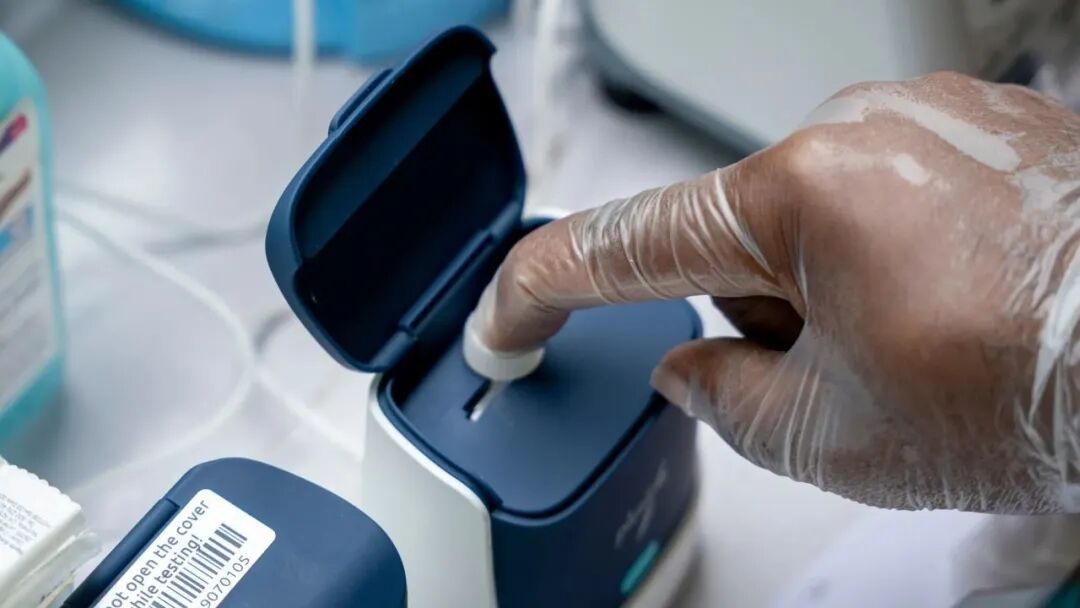
A palm-sized testing device makes it possible to bring nucleic acid testing to grassroots communities
With this new platform, they had something like a master key capable of detecting many diseases. But which door to open first?
The team decided: tuberculosis. Because it represents the greatest burden in global public health, and because that 20% had never had effective access to testing.
But how to reach those 20%? Sputum samples remained unobtainable.
04/ Microscopic Evidence on the Tongue
Songyang Zhou thought of tongue swabs.
Researchers had long speculated that TB bacteria might be present on the tongue. The problem: there were so few. "Compared to a full tube of sputum, the sample volume might be dozens or hundreds of times smaller."
This meant sensitivity and specificity had to be extraordinarily high.
But the team discovered that with their new platform, simply touching a swab to sputum yielded identical results to testing a full tube.
"We thought, maybe that tiny amount on the tongue would be enough," Songyang Zhou says.
The bigger challenge was establishing sampling standards. Where on the tongue surface to sample, with what pressure, for how long — initially, there were no answers.
After repeated trials, they settled on 30 seconds. But they quickly found that 30 seconds of sampling the back of the tongue couldn't be guaranteed in real-world conditions.
Patients became uncomfortable, impatient. For these cases, the standard procedure could be split into two segments: scrape once, pause, then scrape again.
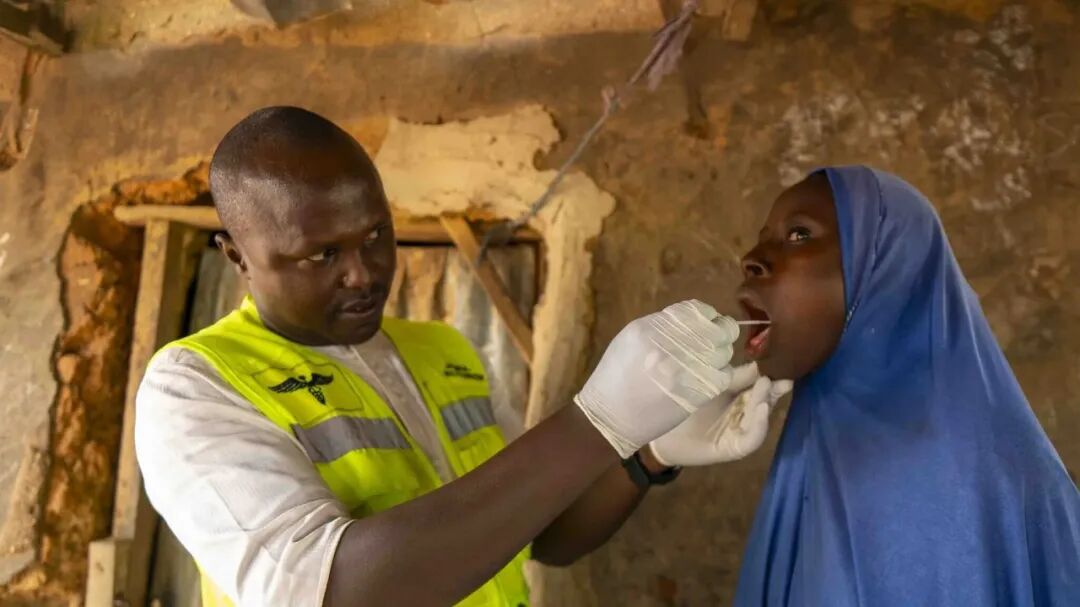
Local residents receiving tongue swab testing on site
Yet even with such granular detail, collection quality remained inconsistent — different technicians produced widely varying results.
So they went back to the field.
Through careful comparison, the team identified the problem: pressure. Those who collected better samples shared one commonality — their swabs were bent. A slight curve meant greater surface contact and easier sample collection.
They added a simple phrase to the training manual: "bend the swab." This one sentence transformed intuition into standard, and sample quality improved markedly.
05/ Real-World Challenges
Product built, standards established — but this was only the beginning. The true test came when the product entered real-world use.
Over 80% of global TB cases occur in developing countries, where those who need this product most also present the harshest challenges.
In some regions, power is unreliable — only a few hours of electricity per day. So the team redesigned the instrument with a universal port, allowing a portable charger to power it.
Some places lack even clinics, relying on grassroots health workers who travel constantly. So the instrument had to be light enough to fit in a backpack.
Additionally, it needed to withstand 50°C heat, and training videos had to enable anyone to operate it after a single viewing.

A nurse at the Fatima Community Health Center transports vaccines and medication by boat
Image source: Gates Foundation
"What works in the lab may not work in reality. Sample storage, temperature, electricity, operator comprehension — these are problems you never anticipated but absolutely exist," Songyang Zhou says. "You have to keep iterating, making sure the product works in the most difficult environments."
Every challenge, every piece of feedback, became technical standards for the next version. And this testing solution, through continuous iteration, evolved from experimental concept to a system that could actually function in the real world.
06/ The Possibility of Change
Based on global data and practice including that from Songyang Zhou's team, in February 2026 the World Health Organization updated its tuberculosis testing guidelines, incorporating tongue swab testing for the first time. With support from the Global Fund, 13 countries will begin pilot implementation.
This means that in remote areas and resource-limited communities, point-of-care TB diagnosis is gradually becoming possible.
"Our product can reach communities, intercept transmission early, remain affordable, and actually double the detectable population — perhaps contributing to the goal of ending TB by 2030. That's our greatest satisfaction."
A technology's value isn't determined on its launch day, but in every day it is repeatedly validated, refined, and ultimately used.
That is what makes truly remarkable innovation.
Past Coverage
Qiming Stars | Prenetics Signs Project Cooperation Agreement with Gates Foundation
Qiming Weekly | Top 10 News from Qiming Venture Partners Portfolio Companies Vol.10, 2026.3.24

Founded in 2006, Qiming Venture Partners currently manages 11 USD funds and 7 RMB funds, with total assets under management reaching $9.5 billion. Since its inception, the firm has focused on investing in outstanding early and growth-stage companies in Technology and Healthcare innovation.
To date, Qiming Venture Partners has invested in over 580 high-growth innovative companies, of which more than 210 have listed on the New York Stock Exchange, NASDAQ, Hong Kong Exchanges and Clearing Limited, Shanghai Stock Exchange, and Shenzhen Stock Exchange, or exited through M&A and other means. Over 80 portfolio companies have become recognized unicorns or super-unicorns.
Many Qiming Venture Partners portfolio companies have grown into the most influential players in their respective fields, including Xiaomi (01810.HK), Meituan (03690.HK), Bilibili (NASDAQ:BILI, 09626.HK), Zhihu (NYSE:ZH, 02390.HK), Roborock (688169.SH), Hesai Technology (NASDAQ:HSAI, 02525.HK), UBTECH (09880.HK), WeRide (NASDAQ:WRD, 0800.HK), HyperStrong (688411.SH), Insta360 (688775.SH), Unisound (09678.HK), Biren Technology (06082.HK), Zhipu (02513.HK), Gan & Lee Pharmaceuticals (603087.SH), Tigermed (300347.SZ, 03347.HK), Zai Lab (NASDAQ:ZLAB, 09688.HK), CanSino Biologics (688185.SH, 06185.HK), Schrödinger (NASDAQ:SDGR), MicroPort EP MedTech (688617.SH), Sanyou Medical (688085.SH), Amoy Diagnostics (300685.SZ), SinoCellTech (688520.SH), Insilico Medicine (03696.HK), Hope Medicine, Yuanxin Technology, MediLink Therapeutics, LaNova Medicines, StepFun, and others.