Q&A | Qiming Venture Partners' Wang Shiyu and Future Intelligent's Ma Xiao on Building Truly Valuable AI Hardware

In the large-model era, data accumulation and deep cultivation of vertical scenarios are the core moats for startups. Future Intelligent will build a "perception + workflow closed loop" office ecosystem through hardware entry points, forming differentiated competition with tech giants.

The 2025 World Artificial Intelligence Conference (WAIC) "Qiming Venture Partners · Entrepreneurship and Investment Forum — Venture Capital Unleashing the Resonance Cycle of AI Technology and Applications," hosted by Qiming Venture Partners, was successfully held on July 28 in the Blue Hall of Shanghai World Expo Center.
During the dialogue session, Qiming Venture Partners partner Wang Shiyu and Future Intelligent CEO Ma Xiao discussed the topic "AI Pragmatism: From Smart Hardware to Office Assistant, Truly Solving User Needs."
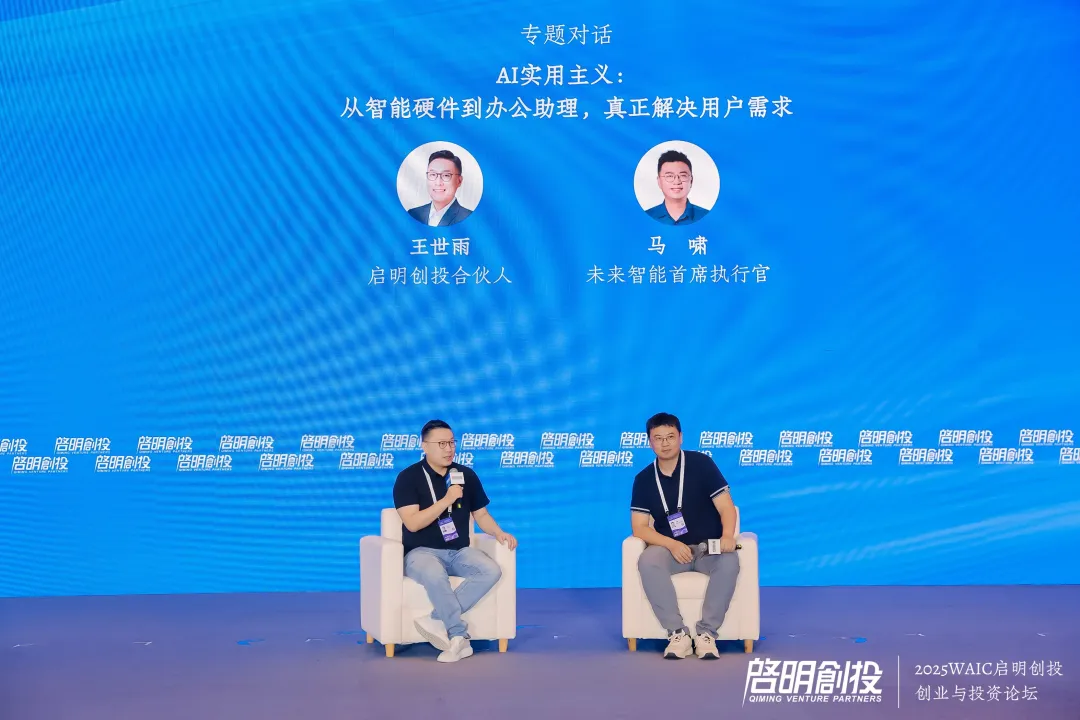
Wang Shiyu, Partner at Qiming Venture Partners (left), and Ma Xiao, CEO of Future Intelligent (right)
Ma Xiao shared Future Intelligent's entrepreneurial journey of entering the office scenario through smart hardware. He pointed out that the key to successful AI hardware lies in balancing basic headphone hardware capabilities with AI value-added services. Using the iFlytek AI headphones as an example, he emphasized the "5+X" strategy — first nailing core experiences like sound quality, battery life, design, noise cancellation, and wearing comfort, then layering on distinctive AI features such as AI recording and transcription, AI summarization, translation, and AI voice replacement. He believes that data accumulation and deep cultivation of vertical scenarios in the large model era form the core moat for startups. Future Intelligent will build an office ecosystem with a "perception + workflow closed loop" through hardware entry points, differentiating itself from tech giants.
Below is an excerpt from their conversation.
01/
Focus on Hardware Value First
Then Add AI Value on Top
Wang Shiyu: Let's start with a brief self-introduction from Mr. Ma.
Ma Xiao: Hello everyone, I'm Ma Xiao. Our company is Future Intelligent, focused on the vertical domain of AI + office hardware. Our main product currently is the iFlytek AI headphones. I suspect some audience members are using our product to take notes right now. It's a headphone with excellent basic hardware, plus AI features for recording, summarization, and abstract generation.
The company has been around for about three years, mainly focused on office and hardware directions.
Wang Shiyu: Let me add a few words. The iFlytek AI headphones, as a headphone hardware product that has emerged in recent years — especially AI hardware combining AI capabilities — ranked No. 1 in the AI headphone category on Tmall and JD.com during this year's 618 shopping festival. In the thousand-yuan headphone category, which includes core players like Apple and Huawei, Future Intelligent has already ranked in the top three, with quite impressive performance.
First question: when you were developing headphones, it was still the previous generation of AI. Could you explain why you chose such a market — large but also crowded with established players?
Ma Xiao: It was a gradual narrowing-down process. Our team's predecessor was at iFlytek, where we worked on AI assistants for many years. We developed various smart assistants on Android phones. We started in 2011, when the buzz around Siri was comparable to today's generative AI, and many startups emerged. But by 2013 or 2014, we noticed people weren't using them much anymore — what happened?
We summarized and identified problems with the previous generation of AI:
First, the scope was too broad, setting user expectations too high, leading to a large gap between actual experience and expectations.
Second, many commercial links simply didn't work. Claiming everything was useful, but everything was mediocre. We learned from that lesson this time around and thought: since it's all AI and can't solve that many problems, what to do? Start from the most segmented, simplest vertical scenarios where users can immediately experience practical value. So we gradually explored and found that headphones were a promising direction — on one hand, many users already own headphones, often more than one pair; on the other hand, beyond communication needs for calls, headphones are also important personal devices we carry around. If we add useful AI functions to this device, would users buy in? So we started experimenting in 2018. The first attempt failed. We tried again in 2019, and it wasn't until the 2022 attempt that we achieved relative success and suddenly opened up the market.
Wang Shiyu: 2022 happened to coincide with the AI 2.0 era.
From a user needs perspective, what do you think they care about most for the headphone scenario? What was the most important reason for success after 2022?
Ma Xiao: That's a good question. There are many traditional major manufacturers in headphones who have been at it for years with strong user recognition. We paid a lot of tuition after entering. The crucial point is balancing user demands for headphones versus their demands for AI.
To expand on this topic: many consumer products, and even embodied intelligence, face similar questions. How important is AI? How important is the hardware itself? We eventually summarized some lessons through "blood, sweat, and tears": Headphone products must follow the "5+X" rule — "5" being the five basic attributes headphones must get right: sound quality, battery life, design, noise cancellation, and wearing comfort. If these aren't done well, like our mistake in 2019: we made headphones with strong AI features, thought we were unbeatable, launched them, and user feedback was "this headphone feels plasticky, probably worth about 100 yuan, why are you charging me seven or eight hundred?" The business model failed. The features might have worked, but whatever price you charge, the quality must match the best ordinary headphones at that price point.
Then there's "X" — features others don't have but you do. Once you have that, users feel they've bought a great headphone for over 1,000 yuan that also has AI features to help with translation, or recording and note-taking at conferences without typing, with the large model providing summaries and key points afterward — then it feels worth it, and the whole business model works.
In summary, for all AI hardware, don't just focus on AI features. Sometimes AI features are made too broad, too fragmented, too esoteric**, while neglecting the hardware's inherent value — that's commercially difficult to succeed with.**
Wang Shiyu: I find that deeply resonant.
Actually, my team invests in AI and consumer hardware projects, some also application-related. Over the past two years, one particularly strong realization: when investing in projects combining consumer scenarios with AI, whether hardware or software, sometimes you have to set AI aside first. We're investing in AI-enabled something (a product), but we need to first discuss whether this something itself works. As Mr. Ma just said, what's the core of AI headphones? Strip away the AI, and it first needs to be a good pair of headphones. The experience revolution brought by AI is added value.
From what we've seen across AI investment in China's consumer scenarios, scenario prioritization is indeed key. AI features will demonstrate company differentiation over the long term, but the prerequisite is getting (the hardware and application itself) right.
02/
More Data Collection
More Powerful AI Brain
Wang Shiyu: Second topic — you mentioned headphones are just the first vehicle for entering the office scenario, nicely serving media professionals, lawyers, salespeople, and others with frequent meetings and long recording needs, with summarization and other scenarios to follow. Beyond headphones, what's your future planning across the entire office scenario? What are the integration points with AI? Could you share with everyone?
Ma Xiao: This has been a continuous strategic thinking direction for us. We didn't have it all figured out on day one of entrepreneurship — it's a bit like "jumping off a cliff and building the plane on the way down."
We initially wanted to use AI headphones for recording. Then large models arrived, and our understanding evolved. We suddenly realized the previous problem was the brain (AI) wasn't good enough — the previous generation of AI brains had low efficiency, and every industry direction required enormous effort, massive labeling, data, and research into many skills and paradigms. Now large models have made the brain extremely powerful. But there's a thinking pitfall: assuming it can do everything. In reality, large models are like humans — our brains upgraded from elementary school to PhD level, but what's most lacking is perception of the world. Take the office domain: if relevant data collection is insufficient, it's like Director Wang having a super PhD assistant who, on his first day, doesn't sufficiently understand your needs; if he works with you for three years, he'll know all your meeting information, meeting habits, email habits — then he becomes tremendously useful, even if he's just a vocational school graduate.
So our philosophy is: when the AI brain becomes powerful, perception remaining strong enough is still most important — and this is easily overlooked. For example, hearing clearly and seeing accurately. We put tremendous effort into developing this headphone because it's not just a traditional headphone for listening and calls — it needs to perceive surrounding sounds, and recordings need to be accurate. For instance, how to record at 10 meters with noise? Traditional headphones only pick up the wearer's voice — how to make listeners in the back row record what I'm saying clearly? This requires extensive modification of "hearing." So AI iteration can't just focus on how to make brain functions more vertical — AI also needs to better perceive surroundings. It's a bit like robots, except robots didn't exist before; once robots appeared, the industry started iterating. Headphones were already existing products, so people overlook them and assume hardware innovation on headphones isn't that interesting. In reality, integrating "hearing" and "seeing" into products requires substantial work to make office data dimensions more three-dimensional. The more three-dimensional the data, like an assistant who hears more and sees more, the better the results.
This is our main direction for future office hardware iteration: first, hearing clearly and seeing accurately; second, like the concept Jensen Huang proposed, AI currently just does recording, but media and finance professionals also need to distill recordings into PPTs, reports, forming content that matches work habits, then sending to subordinates or colleagues — but this requires AI to start from a single point and gradually complete corresponding work within closed loops of workflow and task flow. These are the company's two main paths in the AI direction.
Wang Shiyu: One is data collection — more data means understanding you better; the other is using the super brain to connect workflows.
Mr. Ma is still being modest. I know what their next-generation product looks like. They should launch a fairly era-defining office scenario product in the second half of the year, especially suitable for users with heavy recording scenarios and desk work — stay tuned.
03/
Hardware Will Become an Indispensable Entry Point for the Next Generation of AI Operating Systems
Wang Shiyu: Final question — on competition. How do you view major tech companies? They don't have less data than startups, and money and talent go without saying. You've surely been asked this many times. Can you answer concisely today: with giants in this field, what are your competitive advantages and disadvantages?
Ma Xiao: Excellent investors like Qiming Venture Partners certainly understand: if Nokia could have done phones well, there would be no Apple. Industries are always evolving, and the core lies in grasping factors that may undergo tremendous change in the future.
Good companies have sharp awareness of points needing improvement. If they can position ahead of time, they have opportunities to surpass giants. The headphone domain is a "red ocean" with giants everywhere — how do we compete? How do office hardware compete? I believe the industry is undergoing massive change. If we look from the end to the beginning, what will future hardware look like? Can large models only be used on phones and computers? Can they be used on various intelligent terminals? Can they become an OS? If they become an OS, what devices can better demonstrate their value? From this perspective, various hardware have opportunities — not necessarily headphones, maybe glasses or other devices.
First, you need this awareness. Second, I believe we have the capability to develop and surpass giants.
More pragmatically, how does AI compete with giants?
First, facing numerous consumer electronics giants (like traditional headphone manufacturers), we laid out vertical scenarios earlier. There are two "moats" here: the traditional business "moat," including brand, channels**, ultimately returning to the "moat" in consumer mindshare direction; and the new data "moat" added by AI — the earlier you serve users, the more users trust you and entrust their data to you, which becomes the core competitiveness of future AI. Competing with consumer electronics giants requires defending these two "moats," creating innovative categories while guarding core data assets.
Second, the rise of internet giants was about transforming commerce with internet tools, transforming commercial profit models with internet technology, thereby mastering the core of commercial profit models — information supply, supply-demand interaction platforms. In this situation, internet enterprises emphasize "fast" — only by being fast can they defeat competitors and hope to become one of the few giants in the industry, obtaining relatively higher profits.
But hardware is exactly the opposite. Simply pursuing speed makes it hard to do well. The internet first makes a certain function excellent, then iterates continuously. But take headphones: if any of sound quality, design, battery life, and other functions isn't done well and you rush to launch saying "we can iterate," it's devastating. Therefore, internet giants may not have as much patience for hardware as we do. Additionally, the internet mainly runs on phones and PCs, with data barriers between them.
I believe hardware has unique value "anchoring." For example, today's Office data and note-taking software data can't interoperate because the system doesn't open interfaces. How to make them interoperate? If there's a visual device that can see your screen, it can completely "anchor" it. So hardware has unique value. Based on these, I'm quite confident that "hardware will become an indispensable entry point for the next generation of AI operating systems."
Wang Shiyu: Let me summarize: using hardware as a unique entry point to accumulate private, exclusive data is a very core highlight for AI hardware startups competing with giants.
Source | IPO Zaozhidao
Qiming Stars | Future Intelligent Raises Tens of Millions in Pre-A+ Round, Qiming Venture Partners Co-Leads Qiming Perspectives | Qiming Venture Partners' Wang Shiyu: Innovation Must Fit Scenarios, Sustainable Growth Becomes Core Element Qiming Headlines | 2025 WAIC "Qiming Venture Partners · Entrepreneurship and Investment Forum — Venture Capital Unleashing the Resonance Cycle of AI Technology and Applications" Successfully Held

Founded in 2006, Qiming Venture Partners currently manages 11 USD funds and 7 RMB funds, with total assets under management reaching $9.5 billion. Since its inception, it has focused on investing in outstanding early and growth-stage enterprises in Technology and Healthcare innovation.
To date, Qiming Venture Partners has invested in over 580 high-growth innovative enterprises, of which more than 210 have listed on the New York Stock Exchange, NASDAQ, Hong Kong Exchanges and Clearing Limited, Shanghai Stock Exchange, and Shenzhen Stock Exchange, or exited through M&A and other means. Over 80 companies have become recognized unicorns or super-unicorns in their industries.
Many companies in Qiming Venture Partners' portfolio have grown into the most influential companies in their respective fields, including Xiaomi (01810.HK), Meituan (03690.HK), Bilibili (NASDAQ:BILI, 09626.HK), Zhihu (NYSE:ZH, 02390.HK), Roborock (688169.SH), UBTECH (09880.HK), WeRide (NASDAQ:WRD), Insta360 (688775.SH), Gan & Lee Pharmaceuticals (603087.SH), Tigermed (300347.SZ, 03347.HK), Zai Lab (NASDAQ:ZLAB, 09688.HK), CanSino Biologics (688185.SH, 06185.HK), Schrödinger (NASDAQ:SDGR), MicroPort EP MedTech (688617.SH), Sanyou Medical (688085.SH), Amoy Diagnostics (300685.SZ), Berry Genomics (000710.SZ), GenScript ProBio (688520.SH), Yuanxin Technology, Insilico Medicine, MediLink Therapeutics, LaNova Medicines, Zhipu AI, StepFun, Biren Technology, and others.