Qiming Venture Partners' William Hu: From 'Chasing Concepts' to 'Evaluating Global Data,' China's Pharma Innovation and Investment Logic Is Being Rebuilt
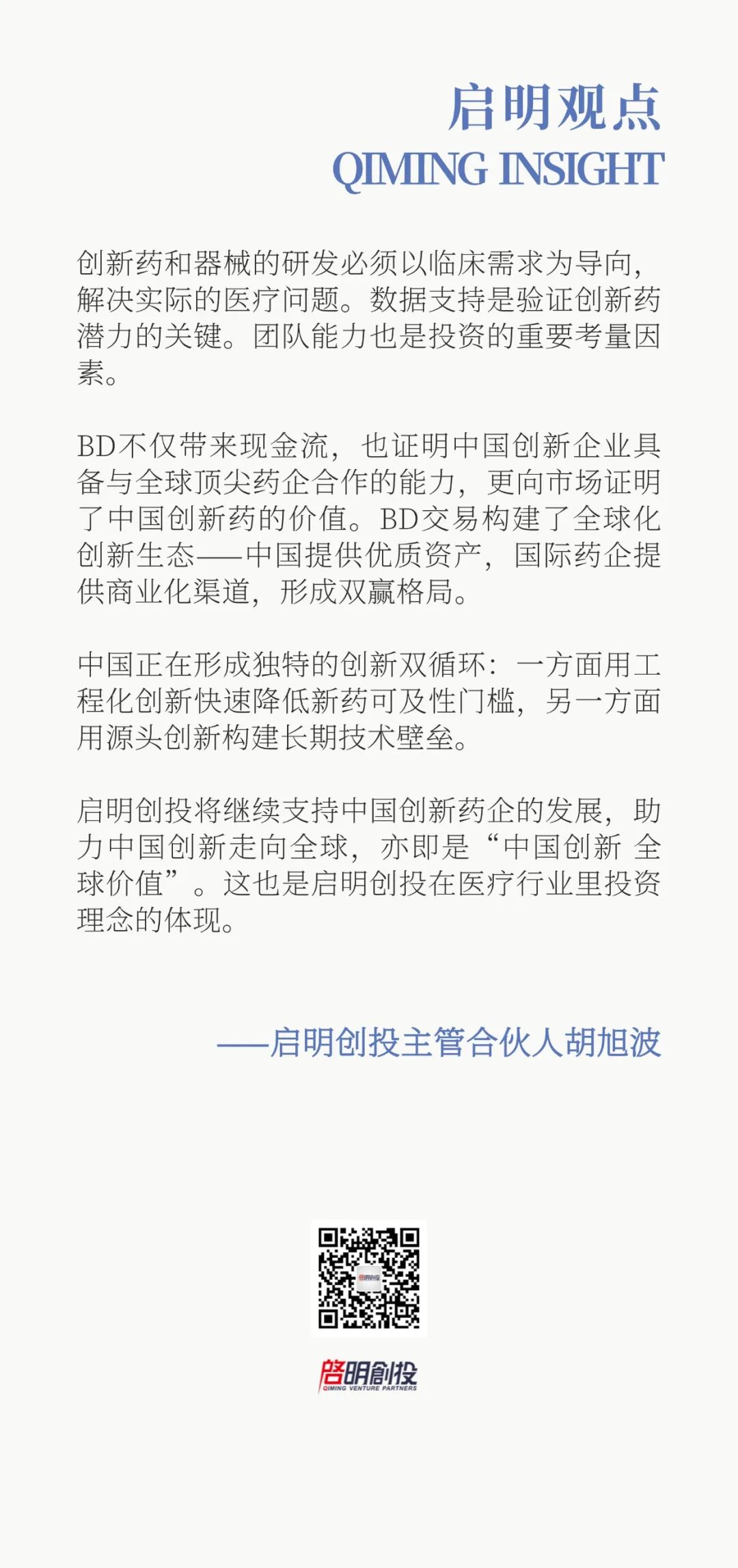
Qiming Venture Partners will continue to support the development of China's innovative pharmaceutical companies, helping Chinese innovation reach the global stage — in other words, "China Innovation, Global Value."

Editor's Note: Recently, William Hu, Managing Partner at Qiming Venture Partners, sat down with VBData to discuss the firm's contrarian investment approach in 2024, its framework for evaluating investment targets, and how BD deals are shaping a globalized innovation ecosystem. On the most fundamental shift in China's innovative drug industry, he noted that a dual innovation loop is taking shape: engineering-driven innovation is rapidly lowering the accessibility threshold for new drugs, while originator innovation is building long-term technological moats. Looking ahead, Hu emphasized that clinical value is the core of innovative drugs, global collaboration is a critical trend, and operational efficiency is the key competitive advantage for Chinese biopharma companies.
This article is republished with permission from Qiming Venture Partners' WeChat account.

William Hu, Managing Partner at Qiming Venture Partners
"Chinese innovative drugs are truly gaining recognition from the global pharmaceutical community, with clinical data being validated worldwide." This is how William Hu, Managing Partner at Qiming Venture Partners, describes the current state of Chinese innovative drugs.
During the "winter period" for innovative drugs, Hu led his team in making the pivotal decision to continue investing heavily in Chinese innovative drugs. That call has since been vindicated by the significant rebound of the industry in 2025, most directly visible in capital markets: Hong Kong-listed innovative drug companies have repeatedly hit new highs, with share prices generally rising 2-3x, and some firms even surging over 5x. The primary market is also showing a clear trend of "money coming back."
"After the pandemic in 2022, we boldly predicted that Chinese innovative drugs would capture around 30% of the global market. The latest license-in/license-out and BD transaction data shows that China's share has already approached 40%," Hu noted. This breakthrough has not only exceeded expectations but marks China's transition from a "period of skepticism" to a "period of validation." The shift in attitude among international investors is particularly crucial — institutions whose main battlefield was previously Nasdaq have been reallocating massively to Chinese innovative drug assets in the first half of 2025. "They regret missing the Hong Kong opportunity, which sends a strong positive signal."
For Qiming Venture Partners, its countercyclical investment strategy has also been validated by this rebound. From 2024 through June 2025, Qiming deployed substantial capital in innovative drugs and medical devices, ranking among the top five global VC investors by deal value during that period — and the only Chinese firm in that group. "Moving when the market is cold allows you to capture truly valuable assets at reasonable valuations." Hu gave VBData an example of one innovative drug company that had been seeking funding for half a year without success; Qiming not only invested but proactively added another 100 million RMB to its commitment. The decision was heavily questioned at the time, but in retrospect it proved to be a "critical decision."
For the future of innovative drugs, Hu defines the direction with three keywords: clinical value, global collaboration, and operational efficiency. Chinese innovative drugs have moved past the "can we do this" stage; now the question is "who can do it better." "The next five to ten years will be the golden development period for Chinese innovative drugs. Among the world's top ten pharmaceutical companies in the future, there will definitely be Chinese names."
Years from now, this judgment may well be vindicated once again.
01/
Reconstructing Innovation and Investment Logic
Hu views 2024 as "the best window for investing in innovation." Sentiment was low and valuations had returned to rational levels, yet Qiming made a remarkably bold call: deploying roughly 4 billion RMB over 12 months focused on innovative drugs and medical devices. "When most funds froze out of fear, we saw a historic opportunity where Chinese innovation was being undervalued."
This conviction stemmed from a judgment about the nature of the industry — innovative drug R&D is a long-cycle endeavor, and market sentiment fluctuations反而 create opportunities to position.
Qiming's contrarian investments in 2024 were rooted in a deep understanding of industry cycles. Innovative drug investing requires courage and foresight; investors who have been through the ups and downs are better able to stay rational when markets turn cold.
Hu says that investing requires courage and forward thinking. If you believe in a company's innovative capabilities, then valuation dislocations caused by market sentiment are precisely the best investment opportunities.
Qiming's portfolio is concentrated in innovative drugs and medical devices. Its current strategy allocates 40-50% of capital to innovative drugs, 40-50% to medical devices, and the remaining 10% to AI applications in healthcare and new service delivery models.
For screening investment targets, Qiming has established a rigorous evaluation framework.
First, unmet clinical needs are the core consideration. Hu believes that innovative drug and device R&D must be oriented toward clinical needs, solving real medical problems. For example, Qiming recently invested in a medical device company that had little name recognition in the industry, but whose products had won strong recognition from physicians in clinical settings. Qiming even saw its potential global value and encouraged the company to boldly go global.
At the same time, Hu emphasizes that data support is key to validating the potential of innovative drugs. Qiming focuses not just on preliminary clinical data, but comprehensive data that demonstrates product efficacy and safety. Innovative drugs are fundamentally a data-driven industry.
Additionally, team capability is an important investment consideration. In Hu's view, an excellent team needs R&D capability, operational excellence, and market expansion ability. Especially in innovative drugs, teams need to maintain resilience in challenging environments and continuously push products forward.
It is understood that during the so-called "winter period," against a backdrop of difficult fundraising and declining valuations, Qiming adhered to these standards and persisted in investing in — and even increasing allocations to — many high-quality innovative companies, seizing investment opportunities.
The valuation bubble of 2021 and the industry winter that followed 2022 came at a time when relevant innovative drug R&D data was still limited. Much capital chose to "step back," which objectively accelerated industry consolidation. In Hu's view, after hot money receded, what remained were long-term investors who truly understood innovative drugs. "Over the past year, many listed pharmaceutical companies have made excellent progress on their products, with share prices repeatedly hitting new highs. The secondary market has now formed a stable investor base; even if share prices pull back 20%, professional institutions won't easily exit, because they recognize these companies' innovative capabilities. This stability provides a healthy capital foundation for the industry."
And in the past two years, as more clinical data has emerged and the industry has explored business models, BD deals have become prevalent, also bringing "fresh capital" to Chinese innovative drugs.
Since the second half of 2024, the Hong Kong innovative drug sector has risen continuously, with some companies' share prices gaining 3-5x. In Hu's view, BD deals have become an important catalyst for these price rises, and this also represents a process of investment perception repair: "BD not only brings cash flow, but also proves that Chinese innovative companies have the ability to collaborate with top global pharmaceutical companies, and further proves the value of Chinese innovative drugs to the market."
As international investors participate more deeply, the valuation framework for Chinese innovative drugs is aligning with global standards. Hong Kong-listed innovative drugs were long undervalued; by 2025, valuations have gradually converged with Nasdaq, marking market maturation. Hu emphasizes that this convergence is not merely valuation expansion, but logic optimization — shifting from "looking at concepts" to "looking at clinical data," and from "looking at the domestic market" to "looking at global potential."
Notably, there has been industry controversy about BD deals being "selling young seedlings." On this, Hu is clear: if the transaction price is reasonable, BD is value validation rather than "selling young seedlings." In one deal exceeding $10 billion, for instance, the upfront payment alone reached several hundred million dollars, with substantial milestone payments to follow. Such deals provide powerful momentum for corporate development, not short-term cash-outs. More importantly, BD deals are building a globalized innovation ecosystem — China provides quality assets, international pharma provides commercialization channels, creating a win-win pattern.
02/
Engineering Innovation Dividend
Hu believes the most fundamental change in China's innovative drug industry is the shift in R&D capability from "single-point breakthroughs" to "collective breakthroughs." It's not one or two companies performing well, but five to ten companies all producing impressive clinical data. In multiple sub-fields, Chinese innovative drugs have already achieved global leadership: China's bispecific antibody R&D is world-leading, ADC transaction values are repeatedly hitting new highs, and CAR-T has achieved globally breakthrough innovation. This collective breakthrough has shattered the entrenched skepticism about "whether China can do innovative drugs."
"China is forming a unique dual innovation loop: on one hand, using engineering innovation to rapidly lower the accessibility threshold for new drugs; on the other, using originator innovation to build long-term technological moats," Hu points out.
Hu analyzes that the capability and efficiency of Chinese R&D teams are important drivers of the rise of Chinese innovative drugs. "China's engineering innovation capabilities are reflected not only in strong technical competence, but also in demonstrating significant advantages in cost control and efficiency improvement. In the United States, validating the early concept for an innovative drug might cost $100 million; in China, the same process might require only 100 million RMB. This cost advantage is systemic and difficult to surpass in the near term." Hu believes this cost advantage makes Chinese innovative drug companies more competitive in global markets.
For this wave of engineering innovation dividend, Hu predicts that for at least the next decade, China's engineering innovation dividend will remain an important pillar of the Chinese innovative drug industry, because China has abundant reserves of biomedical engineering talent, a complete industrial chain covering drug discovery through commercialization, and sustained government investment in biopharma infrastructure.
At the same time, Hu also emphasizes that in addition to driving cost reduction and accessibility, Chinese innovative drugs are also building long-term technological moats through originator innovation. Over the next decade, we will definitely see more globally first-in-class drugs emerge.
However, Hu also candidly notes that while China has made certain progress in originator innovation, true originator innovation requires longer-term accumulation and validation: "Originator innovation requires ten or even twenty years to validate; it's not achieved overnight. China currently has multiple teams attempting originator innovation, but successful cases are still relatively few. China needs more time to validate whether these originator innovations can truly translate into clinically effective drugs."
03/
China Innovation, Global Value
The rise of Chinese innovative drug companies is not merely domestic market success, but a manifestation of global value. With commercialization exploration in recent years, the global value of Chinese innovative drug companies can now be realized through multiple pathways, including collaboration with major international pharma companies, license-out transactions, and building independent global sales systems.
"We hope that by investing in Chinese innovative drug companies, we can push Chinese innovation onto the global stage and benefit patients worldwide," Hu notes. Qiming will continue supporting the development of Chinese innovative drug companies, helping Chinese innovation go global — that is, "China Innovation, Global Value." This is also the embodiment of Qiming's investment philosophy in the healthcare sector.
Hu states that the first step for Chinese innovative drug companies to go global is integrating into the global innovation system and becoming an important component of it. But this doesn't mean Chinese pharma companies must immediately become multinational corporations. Rather, they can convert their R&D capabilities into actual commercial value through collaboration with major international pharma companies. As mentioned above, through BD deals, Chinese pharma companies can sell their compound R&D capabilities to major international pharma companies, achieving win-win outcomes.
"For most Chinese innovative drug companies, becoming a globally operating multinational pharma company is an enormous challenge. Building a global operations system requires massive organizations, abundant human resources, and long-term capital investment. Currently, only a few Chinese companies have preliminarily established such systems. Through years of effort, they have made significant progress in global clinical research systems and product commercialization. Their market performance is strong, but they have also paid enormous capital costs." Hu points out that such success is not easily achieved; founding teams must excel at seizing opportunities and strategic planning, but such success stories are not common.
Hu believes that mainstream pharma companies will more often choose to focus on becoming important components of the global innovation system, rather than rushing to build global operations systems.
Hu also summarizes the future development of Chinese innovative drugs with three keywords: clinical value, global collaboration, and operational efficiency.
Clinical value is the core of innovative drugs. Chinese innovative drug companies must be oriented toward clinical needs, solving real medical problems. Only products that truly satisfy clinical needs can gain recognition in global markets.
Global collaboration is an important future trend. Chinese innovative drug companies need the capability for global collaboration, engaging in broad partnerships with major international pharma companies and other innovative drug companies. Through collaboration, Chinese innovative drug companies can enter international markets faster and enhance their competitiveness.
Operational efficiency is the core competitive advantage of Chinese innovative drug companies. Hu points out that Chinese innovative drug companies need efficient operational capabilities to respond to fierce market competition. "China's innovative drug competitive advantage is built on operational efficiency. Without operational efficiency, Chinese innovative drug companies will struggle to stand out in global markets."
Hu believes that the next decade will be a critical period for Chinese innovative drug companies to rise in global markets. Chinese innovative drug companies will continue demonstrating their strength on the international stage, contributing more to global pharmaceutical industry development. "Qiming Venture Partners will continue supporting this process, helping Chinese innovation go global. We believe the rise of Chinese innovative drug companies will reshape the global pharmaceutical industry landscape and bring more choices and hope to patients worldwide."
Source | VBData**
Author | Ping Zhu
Previous Articles
Qiming View | William Hu, Qiming Venture Partners: Decoding the Ecosystem Logic Behind Innovative Drug M&A Integration Dialogue | Building Surgical Robots for the Tip of the Pyramid Qiming Honors | Qiming Venture Partners Named Top 5 Global Healthcare VC Investor for 2024

Qiming Venture Partners was founded in 2006. The firm currently manages 11 USD funds and 7 RMB funds, with total assets under management reaching $9.5 billion. Since its inception, Qiming has focused on investing in early and growth-stage outstanding companies in Technology and Healthcare.
To date, Qiming Venture Partners has invested in over 580 high-growth innovative companies, of which more than 210 have listed on the New York Stock Exchange, NASDAQ, Hong Kong Exchanges and Clearing Limited, Shanghai Stock Exchange, and Shenzhen Stock Exchange, or exited through M&A and other means. Over 80 portfolio companies have become recognized unicorns or super-unicorns.
Many companies in Qiming's portfolio have grown into the most influential players in their respective fields, including Xiaomi (01810.HK), Meituan (03690.HK), Bilibili (NASDAQ:BILI, 09626.HK), Zhihu (NYSE:ZH, 02390.HK), Roborock (688169.SH), UBTECH (09880.HK), WeRide (NASDAQ:WRD), Insta360 (688775.SH), Gan & Lee Pharmaceuticals (603087.SH), Tigermed (300347.SZ, 03347.HK), Zai Lab (NASDAQ:ZLAB, 09688.HK), CanSino Biologics (688185.SH, 06185.HK), Schrödinger (NASDAQ:SDGR), MicroPort EP MedTech (688617.SH), Sanyou Medical (688085.SH), Amoy Diagnostics (300685.SZ), Berry Genomics (000710.SZ), Sinocelltech (688520.SH), Yuanxin Technology, Insilico Medicine, MediLink Therapeutics, LaNova Medicines, Zhipu AI, StepFun, Biren Technology, and others.