Qiming Venture Partners | Robochallenge Global Progress and Ecosystem Partnerships Announced | WAIC 2026

Driving innovation through benchmarking, advancing standardization through openness, and actively fostering deep collaboration between industry, academia, and research.

The "Qiming Venture Partners · Entrepreneurship and Investment Forum — From Compute Origin to Application Landing: The Evolution Journey," hosted by Qiming Venture Partners as part of the 2026 World Artificial Intelligence Conference (WAIC), was successfully held on July 19 at the Shanghai World Expo Center.
At the conference, Wenbin Tang, founder and CEO of Yuanli Lingji, announced the latest global developments for RoboChallenge, including new results from the embodied foundation model leaderboard, outcomes from real-robot challenges at top international academic conferences such as CVPR and ICRA, and the latest progress on EAI-Bench, officially launched at the AI for Good Global Summit in Geneva. He also unveiled the new cohort of RoboChallenge international organizing committee members and ecosystem partners. Built on an open, shared real-robot evaluation platform, RoboChallenge connects models, robot bodies, developers, and industry partners to jointly build a global open ecosystem for embodied intelligence and advance China's embodied intelligence technology, standards, and ecosystem onto the world stage.
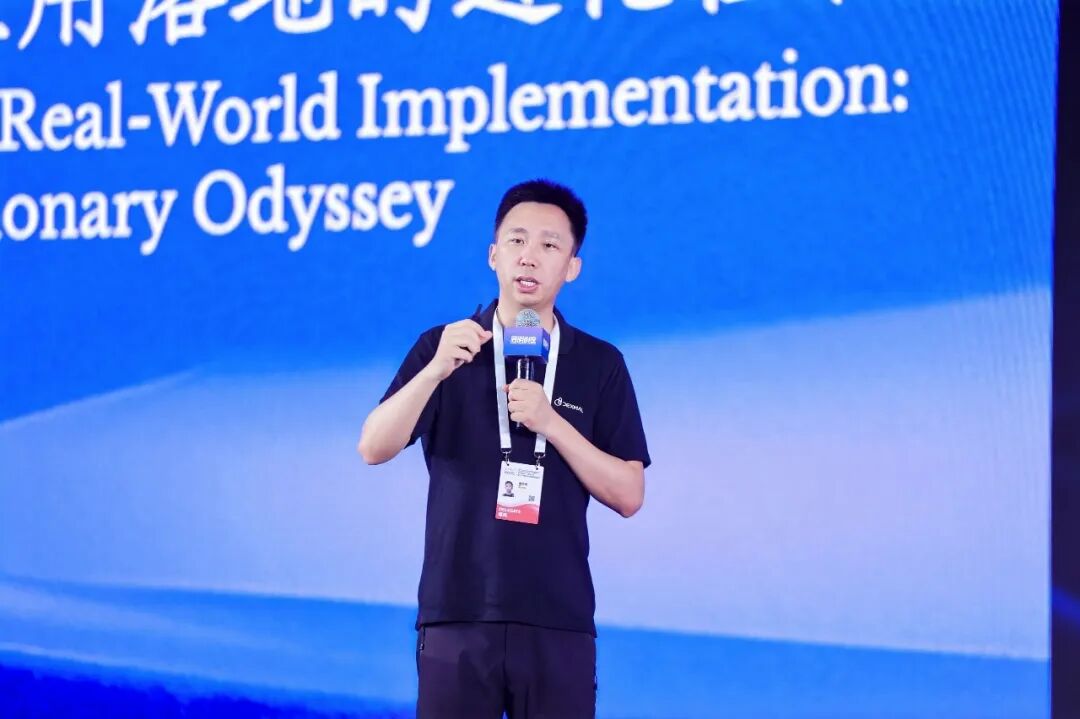
Wenbin Tang, founder and CEO of Yuanli Lingji
"Together with Qiming Venture Partners, Yuanli Lingji will build RoboChallenge into a public-benefit, neutral evaluation platform for embodied intelligence," Tang said. "We insist on driving innovation through evaluation and advancing standard-setting through openness, actively promoting deep collaboration between industry, academia, and research. We want more scenario stakeholders to clearly see the technical boundaries of current embodied models and accelerate the push to bring robots into reality."
Below are selected excerpts from Wenbin Tang's speech.
Hello everyone! I'm Wenbin Tang from Yuanli Lingji. Today I'm not representing Yuanli Lingji, but RoboChallenge. RoboChallenge is an embodied intelligence evaluation platform that we launched together with Hugging Face. Let me first share with you where our industry stands today.
You've probably seen quite a few physical demonstrations here at the venue today, and you've likely watched many impressive demo videos. What can today's robots actually do? What level have they reached? And for many investors here — can you actually tell which model is better? Honestly, it's very difficult. We just showed many benchmarks, so what benchmarks exist in embodied intelligence right now? Are there leaderboards? Actually, yes. Let me share a few with you. For example, the most famous evaluations in embodied intelligence are called RoboTwin and LIBERO, where current success rates are 99%. But have we really achieved 99% with today's technology? I think we all know the answer. There are also peers trying to create evaluations and A/B tests similar to large language models — Robo Arena is a very good evaluation platform. But we've also seen some chaos in the industry: certain well-funded companies have been caught cheating on platforms to boost their rankings, and were ultimately disqualified by officials.
So this industry urgently needs everyone to steadily advance technological progress. No one doubts the massive application prospects of embodied intelligence, but we must move forward step by step. What the industry needs right now is a real, fair, large-scale, real-robot-based, open evaluation system. Such a system can help us objectively measure today's technological progress and promote co-creation and collective advancement across the entire industry. This industry isn't built by one company alone. All the progress in large language models, too, came from continuous innovation by multiple companies, pooling collective intelligence, to ultimately achieve good results. I believe embodied intelligence is the same.
So last July, we launched a project with Hugging Face called RoboChallenge. RoboChallenge's goal is to build a unified, open, large-scale, real-robot-based evaluation platform. As you can see from the slides, we used four research-commonly-used robot models and didn't include our own — no private agenda. We also selected different scenarios, including kitchen, home, and school environments, with varied test objects: flexible objects, rigid objects, and memory-based tasks. Through this approach, we've attracted many peers to participate in evaluation. Take the Table 30 task as an example — you can see many embodied intelligence companies on the leaderboard attempting submissions. We hope this approach lets everyone see where models stand today. So this was our first step: RoboChallenge Table 30.
How does this evaluation work? Our evaluation method is called Specialist. The robot you imagine is one where you tell it what to do, and it can start working in any environment, with any object — that's what a robot should be. We call this zero-shot testing: it should work out of the box. But all evaluations today are Specialist tests. What does this mean? We actually have an embodied foundation model. If today we want the model to do the dishes, for example, we need to collect a series of dishwashing data, then do post-training on this model for that specific task, turning it into an expert model for dishwashing called a Specialist, and then we test its success rate. So for Table 30's thirty tasks, what you're actually testing isn't one model, but thirty models. This is actually quite far from the intelligence we want to achieve.
The Table 30 evaluation has been running for about a year, and we're moving toward a more powerful state: Generalist. We want these thirty tasks to be done with just one model. We can't just make an expert model for each task — that's overfitting to some degree. We want this model to see corresponding task data. So after RoboChallenge launched the Generalist evaluation, you can see the tested performance immediately dropped — but this is precisely the necessary path toward true embodied intelligence.
So from now on, RoboChallenge is fully transitioning from expert models and single-task models to multi-task models, and we will further push toward zero-shot testing — evaluation under arbitrary instructions and arbitrary environments.
We've also made many interesting observations through RoboChallenge. Today's models still perform relatively well on rigid tasks, but on flexible tasks — like handling towels and clothes — success rates are much lower. So in our new evaluation version, we've added many flexible tasks like folding clothes, removing cat hair, and tying knots. We hope to drive more rational, more challenging, and more representative embodied intelligence evaluation through more complex tasks. So we've officially launched Table 30 V2, moving from single-task to multi-task. We've added dual-arm collaborative tasks and diversified robot models. We believe embodied models can transfer across robot bodies — just as humans can complete many tasks not only with both hands, but also with chopsticks. This is the intelligence we hope to advance right now.
Let me share some data. Since RoboChallenge launched, our platform has conducted tens of thousands of tests, bringing together companies from China, the United States, Singapore, Japan, the United Arab Emirates, and other countries. In February this year, we released an annual RoboChallenge report that detailed the true algorithmic performance across various evaluations. We can see that many rigid scenarios are already performing quite well — pick and place, for example. But flexible object handling remains very difficult. And even with our single-task models, the current success rate is only 64%, not 99%. Given this reality, it's hard to say whether embodied intelligence has reached its so-called ChatGPT moment. To make Scaling Law advance more quickly, we need our models to become more intelligent, so that embodied intelligence can come to our side one day sooner.
We've also partnered with collaborators to hold two competitions at CVPR and ICRA through RoboChallenge, where we've gathered large numbers of Table 30 V2 tasks and various scenario-based tasks. We've pushed many official flagship events and gained significant attention. These two competitions attracted over 500 developers from more than ten countries, completing over 500 algorithm submissions and evaluations.
So, to some extent RoboChallenge has become the world's largest real-robot competition platform, and we hope it evolves from an evaluation platform into infrastructure connecting the entire embodied intelligence community. So in Silicon Valley, Europe, and at events hosted by Qiming Venture Partners during NVIDIA GTC, we've exchanged with many developers and peers. Additionally, RoboChallenge worked with the Ministry of Industry and Information Technology's CAICT to release EAI Bench at the United Nations AI for Good conference. This project is led by CAICT, a professional evaluation institution under MIIT, with technical support provided by RoboChallenge.
Our goal is to establish a neutral, public-benefit, non-profit embodied intelligence platform through this approach. Of course, some might ask: isn't Yuanli Lingji a model company? Are you the referee or the player? I'd say, first, we're certainly not qualified to be referees. We're not any company's referee. But I believe that today's embodied intelligence development requires us to be down-to-earth and progress together with many companies. Yet any model company that doesn't know how to evaluate cannot possibly build good models. At the entire industry level, if we don't know how to conduct evaluation, it's very difficult to push this technology forward. So we urgently need such an evaluation system to advance the entire industry and help us reach the day of embodied intelligence sooner.
So going forward, we will build RoboChallenge into a public-benefit, neutral platform. We're especially grateful to Qiming Venture Partners, who will play an important role in participating on this platform.
We hope to drive innovation through evaluation, and we hope to build out standards through this open approach, promoting industry-academia-research collaboration, letting more scenario stakeholders see where today's models have reached, and pushing robot technology further into real-world application.
Yuanli Lingji is an embodied intelligence model company. Our goal isn't to do evaluation, but we believe evaluation is important because only then can everyone progress. So we're doing this as a public-benefit initiative. I also welcome everyone to try out the DM05 model we released two weeks ago.
I believe that before July, none of the open-source embodied models published by domestic companies were as good as π0.5. So you'll see many companies claiming they've surpassed π0.5 on leaderboards, but how many developers would actually abandon π0.5, abandon American models, and use Chinese models? Unfortunately, none. So we need a very objective, real, truth-seeking and pragmatic attitude, moving forward step by step. We hope to advance together with everyone through one model iteration after another, through evaluation.
PAST REVIEWS
Qiming Weekly | Top 10 News from Qiming Venture Partners Portfolio Companies Vol.25, 2026.8.11

Qiming Venture Partners was founded in 2006. The firm currently manages 11 USD funds and 7 RMB funds, with total assets under management reaching $9.5 billion. Since its inception, Qiming Venture Partners has focused on investing in outstanding early- and growth-stage companies in Technology and Healthcare innovation.
To date, Qiming Venture Partners has invested in over 580 high-growth innovative companies, of which more than 210 have gone public on the New York Stock Exchange, NASDAQ, Hong Kong Exchanges and Clearing, Shanghai Stock Exchange, and Shenzhen Stock Exchange, or exited through M&A and other means. Over 80 companies have become recognized unicorns or super-unicorns.
Many Qiming Venture Partners portfolio companies have grown into the most influential companies in their respective fields, including Xiaomi (01810.HK), Meituan (03690.HK), Bilibili (NASDAQ:BILI, 09626.HK), Zhihu (NYSE:ZH, 02390.HK), Roborock (688169.SH), Hesai Technology (NASDAQ:HSAI, 02525.HK), UBTECH (09880.HK), WeRide (NASDAQ:WRD, 00800.HK), HyperStrong (688411.SH), Insta360 (688775.SH), Unisound (09678.HK), Biren Technology (06082.HK), Zhipu (02513.HK), Gan & Lee Pharmaceuticals (603087.SH), Tigermed (300347.SZ, 03347.HK), Zai Lab (NASDAQ:ZLAB, 09688.HK), CanSino Biologics (688185.SH, 06185.HK), Schrödinger (NASDAQ:SDGR), APT Medical (688617.SH), Sanyou Medical (688085.SH), AmoyDx (300685.SZ), Sinocelltech (688520.SH), Insilico Medicine (03696.HK), AusperBio, Yuanxin Technology, MediLink Therapeutics, Leads Biolabs, StepFun, and others.