Dialogue | William Hu and Insilico Medicine's Ren Feng on How AI Is Driving Next-Generation Drug Discovery
For AI drug discovery companies, it's not enough to possess proprietary core technologies — they must also embed themselves deeply into the practical scenarios of pharmaceutical R&D, driving those technologies toward real-world implementation and commercial translation.

The 2025 World Artificial Intelligence Conference (WAIC) "Qiming Venture Partners · Entrepreneurship and Investment Forum — Venture Capital Unleashing the Resonance Cycle of AI Technology and Applications," hosted by Qiming Venture Partners, was successfully held on July 28 at the Blue Hall of Shanghai World Expo Center.
At this forum, Feng Ren, Co-CEO and Chief Scientific Officer of Insilico Medicine — a Qiming Venture Partners portfolio company — and William Hu, Managing Partner at Qiming Venture Partners, engaged in a featured dialogue on "AI-Driven Next-Generation Drug Discovery: Precision Target Mining and Clinical Value Creation."
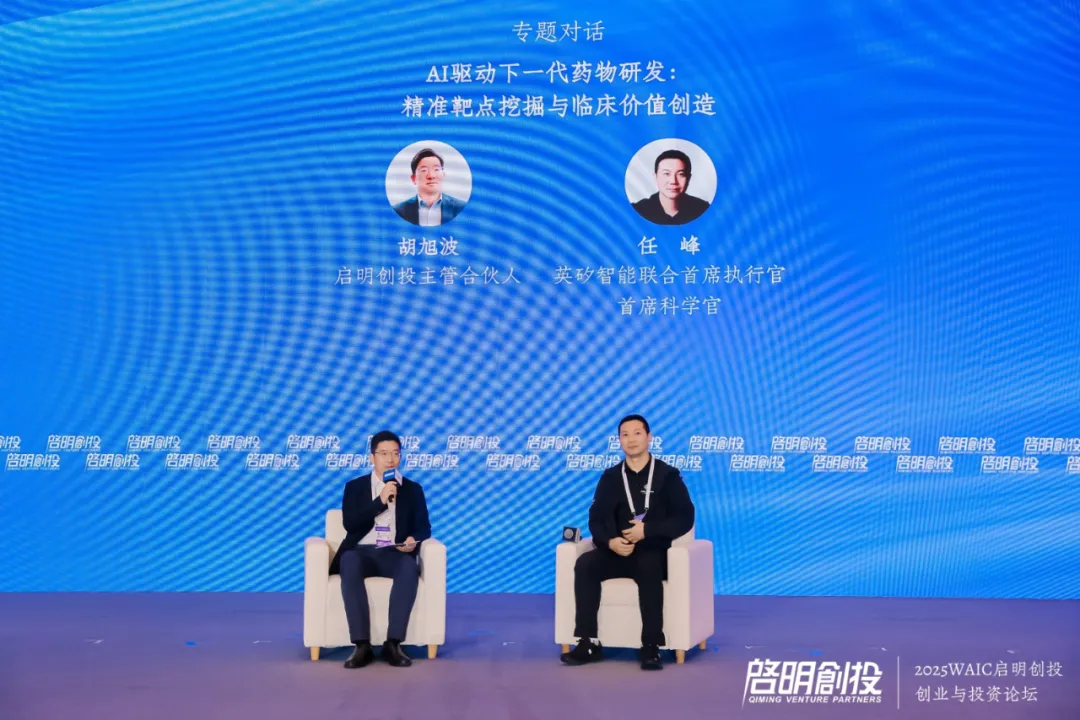
William Hu, Managing Partner at Qiming Venture Partners (left), and Feng Ren, Co-CEO and Chief Scientific Officer of Insilico Medicine (right)
Dr. Ren noted that traditional drug discovery relies primarily on human knowledge and experience, which carries inherent limitations. AI, however, can break through the ceiling of human cognition by using algorithms to synthesize and analyze massive datasets, delivering breakthroughs in target identification and molecular generation that exceed human imagination. He believes that as AI penetrates deeper into the full drug discovery workflow, AI-driven drug discovery is transitioning from the 2.0 phase to the 3.0 phase. The emergence of large models offers the prospect of building super-intelligent agents for biomedicine — enabling AI not merely to assist in molecular design and generation, but to participate in decision-making itself. Looking ahead, Dr. Ren emphasized that for AI drug discovery companies, possessing proprietary core technology is necessary but insufficient; they must also embed themselves deeply in real-world drug discovery scenarios to drive genuine technology deployment and commercial translation.
Below are excerpts from the dialogue.
01/
Future drug discovery is one of the most core domains for AI application
William Hu: I'm especially grateful to Dr. Ren for joining this conversation — I've been looking forward to it. I was chatting with some colleagues from NVIDIA not long ago, and they mentioned they're placing particular emphasis on one industry: pharmaceuticals. They've assembled a dedicated team to empower the entire sector.
For insiders in novel drug R&D, I think everyone is observing cautiously; for outsiders, it's more like watching from a distance.
First, Dr. Ren, could you give us a macro-level overview of where AI-driven pharmaceutical R&D currently stands? In which areas can it already replace traditional manual approaches, and in which areas has it been confirmed that AI can play a significant role?
Feng Ren: I think the reason they say future drug discovery is one of the most core domains for AI application is that as the low-hanging fruit gets picked, the bottlenecks in traditional innovative drug R&D are becoming increasingly apparent — our investment keeps rising while output keeps falling. This is because traditional drug discovery relies on human knowledge and experience, which has limitations. Human energy is finite; in my lifetime, I can only read so many papers and work on so many projects. There's no way to exhaust all possibilities in the world. But AI is different. By using AI to ingest vast amounts of existing data and applying algorithms to synthesize and summarize historical data, we may break through the upper limits of human knowledge and achieve results in target discovery and molecular generation that exceed what humans can imagine.
Right now, AI empowers us mainly in two areas: first, helping us find novel, reliable targets related to disease; second, molecular design. Whether for small molecules or antibodies, AI enables efficient generation and optimization, helping us better design small-molecule or protein drugs with good drug-like properties, safety, and efficacy.
William Hu: Let me summarize with two keywords: target discovery, and molecular design and generation.
02/
A "milestone project" in AI-driven drug discovery
William Hu: In my view, Insilico Medicine is the best AIDD (AI-driven drug discovery) company globally. I understand there's a compound for treating IPF (idiopathic pulmonary fibrosis) that, a few years ago, the company took roughly 18 months and just over $2 million to advance from target discovery to molecular design, and it should now be in Phase II clinical trials. This should be a major milestone for the entire AIDD field. Could you walk us through the micro-level details of what this process actually entailed? What can you share with us?
Feng Ren: This is indeed a milestone project in the AI-driven drug discovery field.
In 2019, we initiated a research program targeting idiopathic pulmonary fibrosis. We chose this disease because it's known as "the cancer that isn't cancer" — patients have an average life expectancy of only 3–5 years after diagnosis, and they're mostly elderly. The disease is characterized by patients losing lung function at roughly 7% per year. Currently approved treatments are immunosuppressive or anti-inflammatory drugs; none were specifically designed to combat fibrosis, and their efficacy is poor with significant side effects.
We wondered whether we could use AI to identify a target closely linked to IPF and develop a drug that not only addresses symptoms and inflammation but also fights fibrosis. So we collected extensive multi-omics data from fibrosis patients — including transcriptomics, genomics, and more — and used our AI tool PandaOmics to analyze differences between these patients and healthy individuals across multi-omics datasets. Through this approach, we identified a completely novel target: TNIK. This is a brand-new target; currently, only Insilico Medicine has a drug in clinical development against it. In the second step, we used our AI molecular design platform Chemistry42, leveraging the 3D structure of this target protein to design small molecules that could inhibit the protein's activity.
So this project employed AI platforms in both the target discovery and molecular generation phases, because AI not only helps us undertake highly innovative projects but also boosts our efficiency. From target discovery through molecular generation to the PCC (preclinical candidate) stage, we spent $2.6 million and 18 months total. Traditional approaches would require tens of millions of dollars in R&D investment and four and a half years. So with AI augmentation, we dramatically accelerated R&D efficiency.
This program has now completed Phase 2a in China, and we've actually observed reversals in lung function in patients, whereas previous drugs could only slow the rate of decline. Our candidate drug could potentially offer a transformative treatment for IPF patients.
William Hu: Thank you. We've also had portfolio companies design drugs for IPF, and it's genuinely difficult to develop. If one day we can truly develop this drug through our own AI platform, the impact would be immeasurable — and the commercial value could potentially reach tens of billions of dollars.
03/
AI can currently only help generate results It cannot yet make decisions
William Hu: Moving to the next question — Insilico Medicine was founded in 2014, and Qiming Venture Partners was fortunate to invest early. It's now 2025, and everyone is talking about large models. As someone who participated in this journey early on as Co-CEO and Chief Scientific Officer, what do you think this era means for AIDD? How will it change the core capabilities you need to build and your business development going forward?
Feng Ren: I think the advent of the large model era has, at least for us, improved efficiency across the board. To give the simplest example: we used to rely on software engineers to write code and build models for analyzing biological data. Now over 70% of our code is written with the help of large language models; our internal engineers just run the code, check for errors, and make modifications. Overall operational efficiency has improved substantially.
But from another perspective, at this stage, AI can only help us generate results — it cannot help us make decisions. We can integrate AI as a more intelligent tool into drug discovery, but the final decisions still rest with people, with scientists. So I believe replacing scientists with AI is impossible under current circumstances.
Why is this the case? We always say AI has three core elements: algorithms, computing power, and models. But beyond these three elements, you need a human to use it. If we could leverage large models' knowledge-learning and reasoning capabilities to help us build a super-intelligent agent — say, a drug discovery agent that has read all the literature, studied the problems humans have encountered in drug development, and understood how humans make decisions... If we could truly develop such an agent one day, it might replace the vast majority of scientists. Then AI wouldn't just generate results — it would make decisions too. So I think large models may eventually enable us to build a true super-intelligent agent for biomedicine, one that every company doing R&D would need for decision-making support.
04/
AI-driven drug discovery is transitioning from the 2.0 phase to the 3.0 phase
William Hu: That's an incredibly exciting vision, and it leads perfectly to my next question. We know autonomous driving can be divided into five levels, L1 to L5, with L5 being fully autonomous driving. Everyone predicts autonomous driving will make major breakthroughs in the coming years, especially in the next year or two. If we apply the autonomous driving framework to AIDD, AI-driven pharmaceutical R&D would go through several stages: first, tools and software; second, partial automation; third, full workflow automation; fourth, full automation except for decision-making (which still requires human involvement, as you mentioned); fifth, complete automation including decisions about what drugs to develop, what targets to pursue, and how to conduct R&D.
Which stage are we and most industry peers at? 2.0 or 3.0?
Feng Ren: I think we're at best in the 2.0 phase. The so-called 1.0 phase was using computers to aid drug design and discovery, which existed 30 years ago and was based on physical calculations. The popular term then was CADD (Computer-Aided Drug Design), all based on physical computations.
As generative AI matured around 2013–2014, we no longer had to rely solely on physical calculations for drug design. We could use generative algorithms — drawing on the synthesis and summarization of existing knowledge and data — to have AI generate entirely new molecules from scratch. This marked our transition from the 1.0 to the 2.0 phase.
As AI penetrates the full workflow, we'll gradually enter the 3.0 phase. But I believe we won't reach 4.0 unless a super-intelligent agent specifically designed for drug discovery emerges, because at the 4.0 stage, such an agent would need to help us make decisions. If no such agent appears, we'll remain stuck at 3.0 for a long time.
William Hu: Like autonomous driving — Tesla did a lot of pioneering work, accumulated massive data, and iterated continuously. China also has many excellent companies that have made attempts. If there's anything preventing AIDD from evolving from 3.0 toward 4.0 and 5.0, what do you think it is?
Feng Ren: Right now, data is definitely the biggest bottleneck constraining AI development, especially high-quality data. We have massive amounts of data, but quality varies wildly. Data labeling and cleaning require enormous human and material resources, particularly for public data. So we lack high-quality, large-scale, machine-readable data to train our models and intelligent agents. That's the first aspect.
The second aspect is that anything related to large models requires a feedback mechanism. For example, when ChatGPT is trained, many people need to evaluate whether its answers are reliable. If we're truly going to build a drug discovery intelligent agent, we'd likely need large numbers of scientists to provide human feedback on the agent's judgments — telling it whether its decisions are correct or incorrect. Unlike general-purpose models like ChatGPT, where anyone can provide feedback, specialized models can only be evaluated by domain scientists. Such talent is scarcer, and the feedback costs are higher. This is what I see as the greatest challenge in training a biomedical AI super-intelligent agent for drug discovery: it's extremely difficult to obtain high-quality feedback to further improve the agent's intelligence.
05/
For AIDD companies The future will be scenario-driven
William Hu: Do you feel that in this relatively niche AIDD field, it will ultimately be the deep-pocketed big pharma companies that play the major role — perhaps launching the most powerful models, including the intelligent agents you mentioned — or will independent companies like ours, with AIDD as our core vision, become the world's best by continuously improving our products and services?
Feng Ren: My personal view may not represent the industry's perspective, but I believe AIDD companies like Insilico Medicine will be the "latecomers" bringing AI tools. Our advantage lies in technology; what we're working to break through is scenario-based application. Meanwhile, multinational pharma companies' strengths are their deep roots in biomedicine, their massive data reserves, and their extensive talent pools. Given enough time, they can import technology from outside and achieve its deployment in real scenarios.
So I believe that for AIDD companies, the future will definitely be scenario-driven — you need not only your own technology but also your own scenarios, continuously achieving technology deployment in scenarios, and more critically, finding your own path to commercial translation. We're also seeing multinational pharma companies building AIDD capabilities internally. Looking ahead, I think AIDD companies and multinational pharma companies will mostly have a complementary, collaborative relationship, each playing different roles in the biomedical development chain.
William Hu: One last question — we collaborate with big pharma, we have license-outs, and we have internal pipelines. So ultimately, will we be an innovative drug company with AI as our core capability, or an AIDD company that does BD partnerships with all pharma companies? Which direction are we leaning toward?
Feng Ren: We ultimately want to become an innovative drug company with AI as our core technology, focused on deeply cultivating application scenarios rather than specializing purely in technology.
We want to develop into a company with core AI technology that has also built its own internal application scenarios — for example, drug discovery scenarios. Only in this way can technology be deployed and achieve commercial translation; otherwise, having technology alone presents a major challenge for commercialization.
Competition is fierce now. Whoever can achieve commercialization first will likely gain the most advantageous position in the competition. Our primary commercialization scenario is biomedicine, though we'll also explore other life science-related domains.
Source | IPO Zaozhidao
PAST REVIEWS
Qiming Perspectives | William Hu, Qiming Venture Partners: China's Innovative Drug Industry Is Experiencing Collective Breakthroughs Qiming Stars | Feng Ren, Insilico Medicine: Generative AI Technology May Transform the Biomedical Industry Qiming Headlines | 2025 WAIC "Qiming Venture Partners · Entrepreneurship and Investment Forum — Venture Capital Unleashing the Resonance Cycle of AI Technology and Applications" Successfully Held

Qiming Venture Partners was founded in 2006. The firm currently manages 11 USD funds and 7 RMB funds, with total assets under management reaching $9.5 billion. Since its inception, Qiming Venture Partners has focused on investing in outstanding early- and growth-stage companies in Technology and Healthcare innovation.
To date, Qiming Venture Partners has invested in over 580 high-growth innovative companies, of which more than 210 have gone public on the New York Stock Exchange, NASDAQ, Hong Kong Exchanges and Clearing Limited, Shanghai Stock Exchange, and Shenzhen Stock Exchange, or exited through M&A and other means. Over 80 portfolio companies have become recognized unicorns or super-unicorns.
Many Qiming Venture Partners portfolio companies have grown into the most influential companies in their respective fields, including Xiaomi (01810.HK), Meituan (03690.HK), Bilibili (NASDAQ: BILI, 09626.HK), Zhihu (NYSE: ZH, 02390.HK), Roborock (688169.SH), UBTECH (09880.HK), WeRide (NASDAQ: WRD), Insta360 (688775.SH), Gan & Lee Pharmaceuticals (603087.SH), Tigermed (300347.SZ, 03347.HK), Zai Lab (NASDAQ: ZLAB, 09688.HK), CanSino Biologics (688185.SH, 06185.HK), Schrödinger (NASDAQ: SDGR), MicroPort EP MedTech (688617.SH), Sanyou Medical (688085.SH), Amoy Diagnostics (300685.SZ), Berry Genomics (000710.SZ), Sinocelltech (688520.SH), Yuanxin Technology, Insilico Medicine, MediLink Therapeutics, LaNova Medicines, Zhipu AI, StepFun, Biren Technology, and others.