12,000 Stars in One Week: A Dark Horse Emerges in a Hot Sector. A Conversation with Zhang Jiayuan of Multicam: How to Rewrite the Rules of "Human-AI Collaboration"?
The New Home Court for "Multiple People + Multiple Agents."
"Multi-human + Multi-Agent": The New Playing Field.
👩 Interviewer: Miss Yi
🥷 Editor: Crossing
🧑🎨 Layout: Zeooo.cc
Zhang Jiayuan is back with his new product Multica, which racked up 12k GitHub Stars in one week.
This time, what he wants to explore is:
When AI Agents are already good enough, how does a team smoothly collaborate with multiple agents?
Multica pays homage to Multics, the 1964 operating system — a "multi-user, multi-tasking" pioneer that ultimately failed but inspired the Unix world for half a century. Today, it's making new history. Less than three weeks after launch, the product has already delivered a stunning track record:
Consecutive appearances on GitHub Trending, 12k Stars gained in one week, and "on average, one Agent task is triggered every 10 seconds" on the platform. And the team supporting all this? Just 4 humans + a dozen-plus AI Agents.
During the past two weeks of surging user numbers and Agent tasks, what kind of high-intensity work state has the team been in? In the open race of "multi-human + multi-Agent," what is Multica's moat? Can the "unreplicability" that Zhang Jiayuan claims really hold up?
Below is the full transcript of the conversation between Crossing and Zhang Jiayuan, founder of Multica.
Rapid Fire
🚥 Crossing
Age?
👦🏻 Zhang Jiayuan
30
🚥 Crossing
MBTI and zodiac sign?
👦🏻 Zhang Jiayuan
INTJ + Virgo
🚥 Crossing
One sentence on your programming origin story?
👦🏻 Zhang Jiayuan
Started self-teaching programming in middle school (about 15 years ago), initially to write games for a certain study device; the first programming language I encountered was BBK Basic.
🚥 Crossing
One sentence on your current company and product?
👦🏻 Zhang Jiayuan
Multica is a platform where humans and AI agents work together in the same workspace — Where humans and AI agents work as one team.
🚥 Crossing
Funding status?
👦🏻 Zhang Jiayuan
Two funding rounds completed, with returning investors from a top-tier dollar fund; a new round is about to begin.
🚥 Crossing
Commercialization status?
👦🏻 Zhang Jiayuan
The product isn't commercialized yet. Planning to try commercialization in May this year.
🚥 Crossing
Team size?
👦🏻 Zhang Jiayuan
4 humans + a dozen different Agents working together.
🚥 Crossing
One sentence on what you were doing before founding?
👦🏻 Zhang Jiayuan
Before founding, I was at TikTok. My previous product was DevvAI (AI search engine + AI Coding), used by nearly a million developers.
A Name with a Touch of Romance
🚥 Crossing
When did the Multica project officially start?
👦🏻 Zhang Jiayuan
Actually less than 4 months. The timeline of Multica's birth looks roughly like this:
January 2026: The idea first appeared in my journal. At the time we were still thinking "make a better local Coding Agent."
February 2026: We started building the first prototype, continuing the local Agent approach.
Late February - March 2026: The team started using it internally first, but then hit two pain points — Context silos + multi-Agent management issues. So we made a small directional pivot, from "single-player local Agent" to "multi-human, multi-Agent collaboration platform."
April 1, 2026: The new product soft-launched on a personal account, so it's been about 2.5 weeks now.
Late April 2026: We're planning a formal global launch.
🚥 Crossing
How was the "multi-human multi-Agent collaboration" idea born?
👦🏻 Zhang Jiayuan
There was one week when we were simultaneously pushing three relatively independent features. In the old mode, I would open local Claude Code, start 3-5 sessions, and take turns talking to Agents, writing one then reviewing one.
But the problem was, when a feature needed another colleague's product judgment, the entire collaboration chain broke. I had to screenshot the Agent's conversation history and send it on Lark, the colleague would read it and reply, then I'd paste the feedback back into the local terminal, and the Agent would continue...
A tiny collaboration action could interrupt me for 20 minutes.
At that point we thought: Why is the Agent's collaboration space an isolated local terminal, while the human collaboration space is Lark or Linear? Is it possible to unify them into the same space?
So, following this line of thinking, we built Multica's first prototype — a kanban board like Linear, but with participants that include both humans and Agents.
After our team used it for a week, we realized this wasn't just an efficiency optimization of "merging two collaboration spaces." In fact, it fundamentally transformed the shape of task delegation:
From "human drives Agent" to "batch-create Issues → Agents autonomously execute → humans review and decide upon completion."
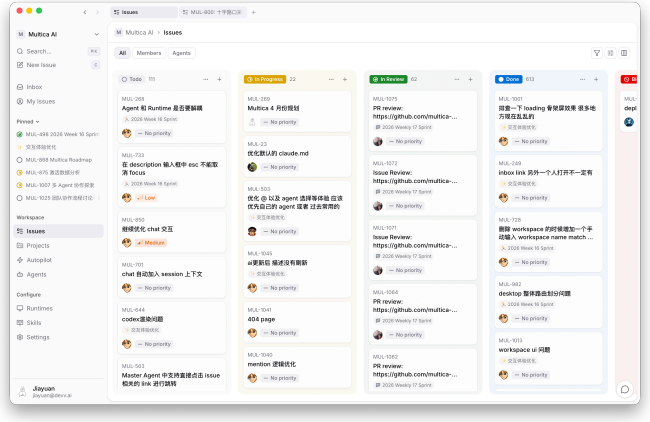
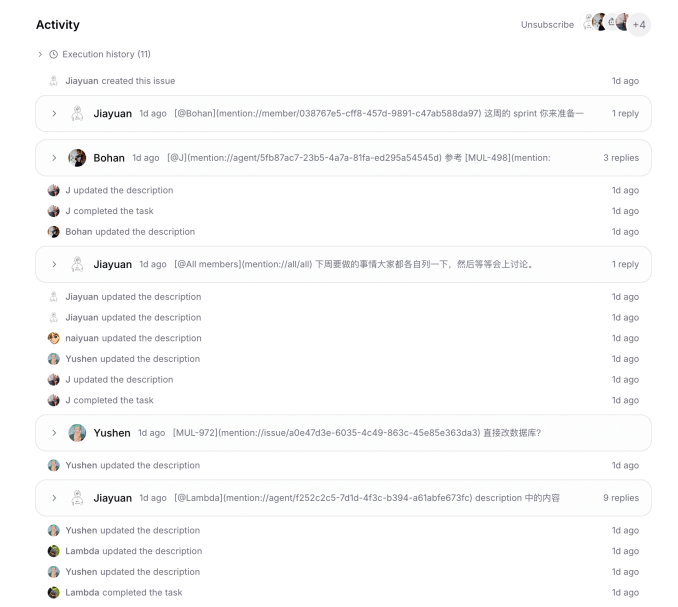
The image below is very intuitive — it's our internal development task board for Multica.
Agents are simultaneously processing 20+ tasks, with another 60+ tasks already completed and awaiting further review or decisions:
🚥 Crossing
How did you determine it was the right timing back then? What opportunity did you see that others didn't?
👦🏻 Zhang Jiayuan
Before launching Multica, we had already been in the AI programming tools space for over 3 years: from the earliest DevvAI, to later Devv Code, iterating all the way through. We had developed a pretty strong "feel" for how this field was evolving.
What made me feel "this is the right timing" came from the intersection of two things:
First, model capabilities had reached an inflection point.
Coding-related benchmarks kept getting pushed higher, and local Coding Agents had already reached the point where engineers didn't need to care about code details, only reviewing final results.
This meant "Human in the Loop" could be further compressed, moving from "multi-turn dialogue" toward "direct task delegation."
Second, we kept hitting concrete pain points in our own practice.
When everyone on the team was using local Coding Agents, the bottleneck had clearly shifted from "individual efficiency" to "team collaboration." We judged that the real playing field for the next phase had arrived — from local Agent to "multi-human + multi-Agent."
🚥 Crossing
Why name it Multica?
👦🏻 Zhang Jiayuan
We figured out the naming and product positioning simultaneously.
The name Multica carries a bit of romance about our product. It comes from the history of operating system evolution:
Multics (1964) — full name Multiplexed Information and Computing Service, jointly developed by MIT, Bell Labs, and others. One of the earliest time-sharing operating systems, but the project ultimately didn't succeed.
Unix (1969) — Ken Thompson and Dennis Ritchie from the Multics team learned from its lessons and made a leaner version. The name Unix itself is a pun on Multics — replacing "Multi" with "Uni." Unix became the ancestor of virtually all mainstream operating systems: Linux, FreeBSD, macOS, iOS, and Android all trace back to it.
Multica (2026) — we replaced Service with Agent from Multics, signifying the evolution from "multiplexed computing service" to "multiplexed agent collaboration."
Most people know Linux, but not necessarily Multics. If you understand the complete history of operating systems, you understand the homage behind this name.
"4 Humans + a Dozen-Plus Agents": A Day in Their Life
🚥 Crossing
What does the product form that satisfies "multi-human multi-Agent" specifically look like?
👦🏻 Zhang Jiayuan
Multica's product form is a kanban-style interface, similar to Linear or Jira, but with participants that include both humans and Agents.
Its operational core contains four concepts:
Agent Runtime — register your local Agent runtime environment to the platform.
We don't build another Agent ourselves; we connect to whatever Agent users already have. Currently supported: Claude Code, Codex, OpenClaw, Cursor, Hermes Agent, and others.
Whatever Agent you're using now, you can continue using it in Multica. Our team has registered multiple machines (personal computers, Mac minis, etc.), and the Agent on each machine is called upon as a Runtime.
Agent Profile — specific roles created based on Runtime.
Each Agent is equivalent to an AI employee, with its own memory, Skills, ability to self-iterate, and definable roles and Instructions.
Right now, we're also exploring more granular division of labor internally — for example, Agents dedicated to development versus those focused on GTM.
Issue (Task Unit) — Create an Issue → Assign it to an Agent or a human → Execute → Notify relevant parties for review upon completion.
Within an Issue, you can @ other team members (human or Agent) to enable multi-party collaboration.
Inbox — Aggregates everything requiring your personal attention.
We only need to check our Inbox each day. Click in and you see the full context — no switching between multiple tools.
Typically, a 5-10 person team's workflow looks like this: Set weekly goals in the weekly meeting → Agents batch-create Issues → Some assigned directly to Agents, some to humans → Agents execute automatically → Upon completion, @ relevant people for review → Humans give feedback directly in the same Issue → Agents iterate based on feedback.
Throughout the entire process, all context lives in one place — no back-and-forth between Lark, local terminals, and project management tools.
🚥 Crossing
Within your team, how do Agents work throughout a typical day?
👦🏻 Jiayuan Zhang
Multica has permeated every point in time. A typical day looks something like this:
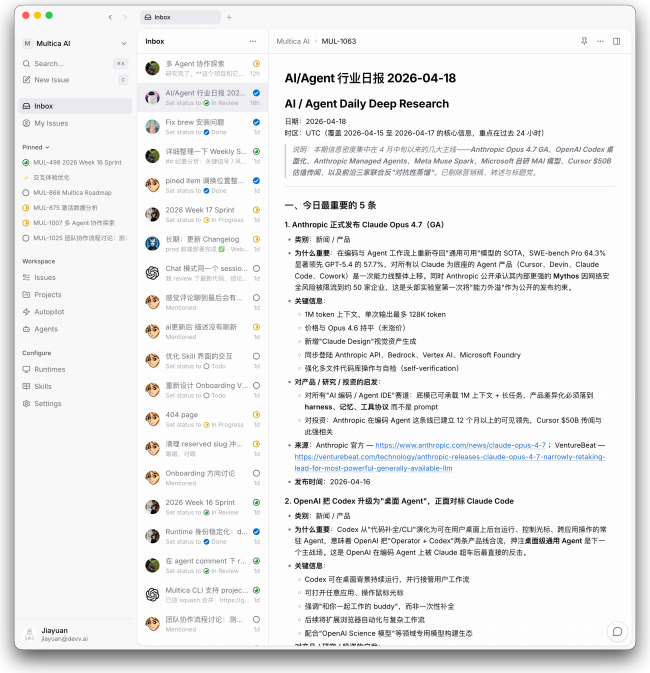
Morning: The Research Agent sends an AI/Agent industry briefing on schedule, summarizing and analyzing noteworthy developments from the past 24 hours. Meanwhile, the Data Analysis Agent produces yesterday's analytics report — if it detects an anomaly in a core metric (say, activation rate dropping after a feature launch), it automatically creates a fix Issue and assigns it to the relevant decision-maker.
Daytime: The GitHub Agent continuously reviews all incoming external Issues and PRs — automatically analyzing root causes for bugs, aligning feature requests against the internal roadmap to determine acceptance, and converting confirmed tasks into internal Issues in the workspace. Each colleague's Coding Agent pushes tasks forward according to schedule, with discussions unfolding in Issues, @-ing other colleagues or Agents to make decisions together.
After code is produced: The Code Review Agent conducts an initial review of every code segment before handing it to a human for final confirmation.
6 PM: The Deploy Agent triggers on schedule — automatically testing all code submitted that day, packaging web and desktop builds, pushing to production, and finally updating the changelog and announcing the release.
🚥 Crossing
What are the humans doing?
👦🏻 Jiayuan Zhang
Making final decisions. For example:
-
Participating in and guiding how Agents should work (or letting Agents figure out how to do things themselves)
-
Prioritizing what needs a decision
-
Quality control on final output
-
Day-to-day, mainly watching the Multica Inbox — it functions as each person's "email inbox," where everything requiring my attention gets aggregated.
One point worth emphasizing: every Agent provides decision-making material to humans. All material accumulation and discussion leaves a trace in the same Issue. When a month later you want to review "why did we make this decision then," simply open that Issue and the full context is right there.
🚥 Crossing
Using this "multi-human, multi-Agent collaboration," what's your biggest takeaway?
👦🏻 Jiayuan Zhang
My core feeling is this: We feel more like we're "running a team" rather than "using a tool."
Agents have become roles that proactively initiate work, rather than tools passively waiting for instructions.
Before, using a local Coding Agent, it only started working when I opened the terminal. Now I open my Multica Inbox and usually find a pile of completed Agent work waiting for my review.
I want to share a small story about putting an Agent on night shift.
A couple weeks ago, at 2 AM one night, I was lying in bed and suddenly wanted to tweak a product interaction detail. In the past, this kind of inspiration either got forgotten by morning, or I'd have to get up and do it myself.
This time, I simply created an Issue in Multica, assigned it to an Agent, and went to sleep. When I checked my Inbox in the morning, the PR was already created and tests had run — waiting for my review. Confirmed, merged, deployed, done.
This experience of "putting an Agent on night shift" is something local Agent mode can't provide. Because local Agents need someone keeping the terminal open.
🚥 Crossing
The most natural approach for many teams is to start by plugging Agents into Slack. But why did you feel this wasn't enough? For teams already collaborating with Agents in Slack, what's the first change they'd notice after switching to Multica?
👦🏻 Jiayuan Zhang
Slack-integrated Agents are indeed the most natural entry point right now, but that's not the form factor we're aiming for.
Imagine the collaboration form 6 months, a year, or even further out:
In a team, you might have a few people plus dozens, hundreds, even thousands of Agents; tasks being pushed forward in parallel at any given moment could number in the hundreds.
At this scale, the IM paradigm quickly breaks down.
On one hand, human bandwidth and attention are completely insufficient. Message streams are designed to capture attention by nature — they can't sustain this scale of parallel work. On the other hand, when a channel is simultaneously running the context of hundreds of tasks, the channel itself becomes noise. Context completely dissolves —
Agent-to-Agent collaboration, human-to-Agent collaboration, and human-to-human discussion, all crammed into the same timeline, become impossible to distinguish.
This is also why we didn't choose the IM form factor from the start.
I believe Slack / Lark-integrated Agents will be an intermediate transitional form — it lets more people get started with the lowest barrier to entry, but it's not the endgame.
Long-term, it will inevitably return to a task-centric dispatch model.
Not because kanban is "better" than IM, but because only this form can truly sustain large-scale parallel collaboration between humans and Agents. This is the position Multica wants to bet on early.
Humans Are the Slowest Node in an AI Team
🚥 Crossing
User growth has exploded this past week. Share some real usage numbers?
👦🏻 Jiayuan Zhang
First, some data to ground the intuition.
Week-over-week (WoW) comparison for the past two weeks:
| Metric | WoW |
|---|---|
| New users | +37% |
| New workspaces | +33% |
| New Agents | +134% |
| New Issues | +574% |
| New Agent tasks | +387% |
This past week, our entire team has been executing at high intensity.
Shipping product iterations. Dozens of product updates, bug fixes, and optimizations daily — specifics at multica.ai/changelog.
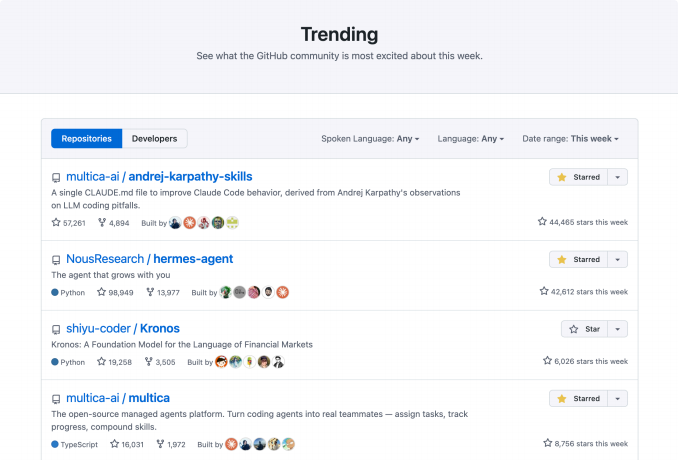
Building the open-source community. Growth on GitHub has been very fast these past two weeks. This week (4.13-4.18) we ranked #4 on GitHub Trending; incidentally, the #1 project on Trending is also ours.
Talking to users. We continue having one-on-one conversations with early users, collecting feedback and rapidly converting it into product changes.
One point I want to emphasize: GTM — currently entirely organic growth, no paid acquisition, driven by the product itself plus the open-source community.
🚥 Crossing
What does this performance validate? What new signals have you discovered?
👦🏻 Jiayuan Zhang
The most critical signal here isn't "how much it grew," but rather a stratification: user count is growing linearly, while Issue and Agent task counts are growing exponentially.
This shows that each user's dependence on Agents is deepening rapidly during usage, with usage scenarios shifting from "trying it out" to "daily workflow."
Moreover, looking at Agent providers running on the platform — Codex, Claude, Hermes, Gemini, OpenCode, OpenClaw, Copilot, and others — all have real workload share.
This also confirms our positioning of "not building Agents, but building the Agent collaboration layer." Users can bring whatever model they want and run it. We don't compete head-on with any Agent vendor; the stronger their capabilities, the greater our value.
🚥 Crossing
Any other new discoveries?
👦🏻 Jiayuan Zhang
Mainly three.
First, trusting Agents is a process. When we first switched from "personal Agent" mode to "Multica Agent Team" mode, we ourselves felt uneasy, worried that AI output quality wouldn't be good enough, afraid to really let go of tasks.
But as we built out the surrounding infrastructure piece by piece — letting Agents automatically code review, run integration tests, providing isolated environments for each task — we found that Agents can actually complete tasks very well.
Additionally, what truly determines an Agent's capability ceiling isn't the model itself, but the harness you build around it.
Second, something that might sting a lot of people, and also our deepest realization over the past two weeks: humans are the slowest node in an AI team. In other words, human attention remains the bottleneck of the entire system.
Right now, the Agents on our team are actually in Idle mode a lot of the time. Because the final decision-making authority for every task still rests with humans — after an Agent completes a task, it has to wait for someone to review it and give feedback before it can enter the next cycle.
Multica is gradually reducing this bottleneck through mechanisms like batch dispatching, asynchronous review, and Inbox aggregation, allowing one person to manage more Agents simultaneously.
I have a fairly strong hunch: in the future, the core metric for measuring the efficiency of an AI Native organization might be "Agent Idle Rate." The lower the Idle Rate, the more fully an organization is utilizing Agent productivity, and the more "AI Native" it is.
Third, you really don't need that many people.
In an AI Native organizational form, human headcount is no longer a prerequisite for expansion. On the contrary, every additional person increases communication overhead and dilutes Agent execution efficiency.
This is the most direct and strongest realization we've had over the past two weeks.
What Is Irreplaceable About Humans?
🚥 Crossing
With this kind of AI-heavy R&D model, do you worry that thinking gets "outsourced"?
👦🏻 Zhang Jiayuan
This is something we've discussed very seriously internally. I'll address it on two levels.
First, engineers' "work focus" is shifting.
On an AI Native team, the time engineers spend "writing code" is dropping rapidly. What's replacing it is more time spent on three things:
First, defining problems. Breaking down fuzzy requirements into Issues that Agents can execute independently is a new craft. A good Issue description determines half the output quality.
Second, review and judgment. An Agent can quickly produce five solutions, but which one is more architecturally sustainable, which one is more friendly to future evolution — that still requires human judgment.
Third, architecture and taste. Code details can be handed to Agents, but overall architecture, API design, product feel — this "high-level taste" is becoming more important too. It's the "foundation" for Agent autonomous execution.
So, regarding "outsourced thinking" — low-level repetitive thinking, like "how should this code be written" or "how should this API's parameters be ordered" — outsourcing these to Agents won't make people dumber. Instead, it frees up mental energy.
On the other level, high-level judgment and taste, like "who should this product serve" or "what will this architecture look like in three years" — these can't be outsourced. And precisely because of Agents' existence, they're becoming more scarce and more critical.
To summarize: in an era where Agents can do everything, human taste and judgment become the ultimate anchor of value. This is also "the most un-copyable thing" about Multica.
🚥 Crossing
How many people does Multica have now?
👦🏻 Zhang Jiayuan
We're currently a team of 4 humans + a dozen-plus Agents.
Internally, we're in the habit of counting Agents as "colleagues" too. So from a humans + Agents perspective, you could also say we're a 20-person team.
This is also our experiment with the AI Native organizational form.
Code Can Be Copied, But These Three Things Can't
🚥 Crossing
Which products would you list as competitors? What's the difference between Multica and them?
👦🏻 Zhang Jiayuan
The players in this space roughly fall into a few categories:
First, "cloud Agent platforms" like Devin / Factory. They're taking the route of "building the strongest Agent ourselves, end-to-end cloud execution."
Second, "local Agent + light collaboration" platforms like Cursor / Claude Code. They'll likely expand team collaboration capabilities on top of their existing foundation.
Third, traditional project management tools (Linear / Jira) + AI plugins. They might cut in from the other end, adding Agents to existing workflows.
The essential differences between Multica and them, I think, are on two levels:
First, on Agent strategy.
We're not building another Agent — we're building the "collaboration layer for Agents." We don't compete head-on with model vendors / Agent vendors.
Whether you're using Claude Code or Codex right now doesn't matter. Multica is the platform that lets them be scheduled, collaborate, and leave traces within a team workspace.
Second, on the collaboration unit.
From Day 1, we were designed for "multiple humans + multiple Agents." Local Agent tools are naturally single-human-centric; "expanding into" multi-human collaboration would face many fundamental rearchitecting challenges. But we started from the architecture of boards, Issues, and Inbox — naturally a team perspective.
🚥 Crossing
Cursor and Claude Code will very likely launch similar features. In such an obvious赛道, what's the most un-copyable part of Multica?
👦🏻 Zhang Jiayuan
I wrote an article specifically discussing this question.
In the AI era, code itself is no longer a moat. Any single feature could be copied by an Agent in a day.
Every day, the core question we ask ourselves as a team is: in your product, what cannot be copied in a short time?
Our answer is these three barriers:
1. Taste and Judgment
Taste is the accumulation of time compounding. It's composed of everything you've seen, read, and all your cognition and aesthetics combined; judgment is choice based on cognition. Neither can be copied in a PR.
Take a Multica example: our product design language uses Issue / Inbox / Profile, rather than the Chat / Code that AI Coding tools in the industry more commonly use.
Behind this choice is a judgment — we believe the future form of AI products should converge toward "team collaboration tools," not toward "IDEs."
The judgment may or may not be right, but it's determined by "what we believe."
2. Data
A Workspace continuously accumulates context as a team uses it: communication records, decision processes, project knowledge, Agent memories and Skills. This context creates usage inertia (switching cost) with extremely high migration cost.
Over time, the data barrier strengthens, and first-mover advantage becomes more pronounced.
3. Distribution and Entry Point
Our goal is to make Multica the native Agent platform for AI Native small teams.
Among these, open source is the key strategy. Our code is fully open source — teams that want to copy can fork it directly. But the product itself isn't the barrier; distribution is.
🚥 Crossing
What commercialization paths have you considered?
👦🏻 Zhang Jiayuan
We're planning to start preliminary commercialization attempts in May 2026. The core logic is: platform free + cloud compute charges.
To use a more intuitive analogy: it's a bit like "bring your own ingredients, use the kitchen for free; if you want to use the restaurant's prepped dishes, that's extra" —
-
You can connect Agent tools you're already paying for — Claude Code, Codex, Cursor, etc. — into Multica, and on the platform uniformly manage team tasks and collaboration traces (this part is completely free).
-
If for certain tasks you want to directly use cloud Agents hosted by Multica itself (no local machine usage, no environment setup, can run 7x24), this part will be billed by Token consumption.
We only charge when you actually use cloud compute, not for the collaboration platform itself. This is also our fundamental positioning of "building the collaboration layer, not the Agent."
🚥 Crossing
Current fundraising progress?
👦🏻 Zhang Jiayuan
We've completed two previous funding rounds, with existing investors being top-tier USD funds.
We expect the next funding round to open in early May. Mainly for expanding cloud Agent compute infrastructure, and open-source community building.
🚥 Crossing
How do you assess the market space and opportunity for AI programming tools?
👦🏻 Zhang Jiayuan
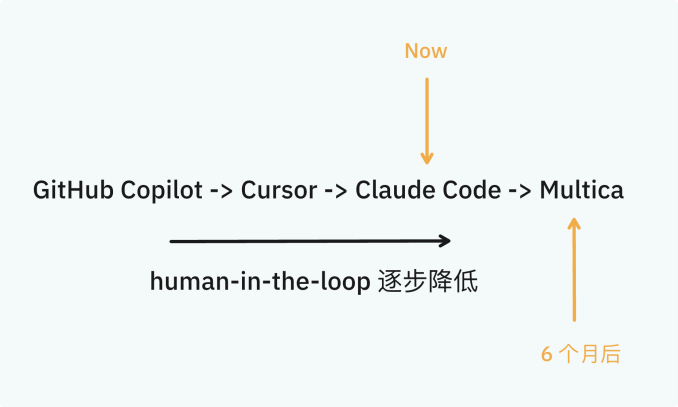
I divide the evolution of coding tools into four stages, with the core variable being the gradual reduction of Human in the Loop. We're currently in the transition period from stage three to stage four.
Stage One: Code completion (GitHub Copilot). AI assists with snippet completion; most code still handwritten by engineers. Very high human intervention.
Stage Two: AI editor (Cursor). Through sidebar interaction, AI can write large code blocks, but humans need continuous guidance.
Stage Three: Local Coding Agent (Claude Code / Codex). Autonomously completes complex tasks based on requirements; humans only need to review results. Medium-low human intervention.
Stage Four: Task dispatcher (Multica's focus). Directly dispatch tasks to Agents; Agents execute fully autonomously, no multi-round chat needed. Very low human intervention.
The trend is clear: human intervention will continue to decrease, and the final work form is "dispatch task, wait for result." Next, the real bottleneck will shift from "can Agents complete tasks" to "how does a team efficiently organize multiple Agents to work together."
This is precisely the timing for Multica to enter.
We stand at a historical inflection point
🚥 Crossing
Finally, what lasting mark do you hope Multica can leave on this world?
👦🏻 Zhang Jiayuan
We don't care that much about outcomes.
To come back to the name Multica itself — we pay homage to Multics, an operating system that ultimately failed but inspired the entire Unix world. From Multics to Unix, humanity spent five years finding the right form for "multi-user, multi-tasking" computing, and for the half-century that followed, nearly all software ran on that paradigm.
I believe we stand at a similar inflection point today: AI Agents will reshape the fundamental form of team collaboration. Future software teams won't be "a few people using tools," but "humans and Agents working as equal collaborators."
What Multica aims to do is provide the first version of the answer for this future form.
And even if Multica ultimately doesn't become the name that's remembered — that's okay.
As long as someone, fifty years from now, looks back at this period and mentions Multica alongside Multics in the same breath — saying, well, there were some early attempts in that era — then we will have accomplished what we set out to do.
Crossing is looking for independent writers to cover AI product and model reviews. If you've written articles like "Hands-on with PixVerse C1" or "Hands-on with LibTV," please contact zeo0811@gmail.com. Your email should include: ① a brief bio, ② AI review articles you've written. We offer competitive compensation. We look forward to observing and documenting the AI era together 🎪