Another Player "Pulls the Trigger" — Zhipu AI's "Deep Think" Enters the 2025 AI Agent Battle

The core driver behind AutoGLM Rumination is the "brain" newly developed by Zhipu Qingyan — the Rumination model.
2025 is bound to be the year of AI Agent warfare.
In early March, the launch of Manus was like a starting gun, telling all AI practitioners that you don't need to be obsessed with underlying technology to build an AI Agent product that amazes everyone.
From ChatBot to Agent, 2025 will be a pivotal moment for the paradigm shift in toC AI product interactions. Crossing will follow and share the latest developments in this "Year of Agent Warfare."
At today's Zhongguancun Forum, Zhipu AI — the first among the "AI Six Little Dragons" — unveiled its own intelligent agent product, named: AutoGLM Rumination.
It not only possesses deep research capabilities (Deep Research), but can also execute specific operations (Operator), making it a typical AI Agent that "thinks while acting."
In Crossing's recent heavyweight piece "20 Questions on AI Agent", we used 20 carefully crafted questions to try to understand the past, present, technical breakthroughs, and future potential of AI Agents together. So after receiving an invitation to test AutoGLM Rumination, we tested and discussed it together in the Crossing members' group, and could clearly feel everyone's enthusiasm for various AI Agent products during this period.
Although AutoGLM has far from sparked the same wave of discussion as Manus, and opinions in the members' group were mixed, after reviewing various reports, we still believe that "Rumination" is a product worth knowing about and trying out.

"AutoGLM Rumination" can tackle complex open-ended questions, conducting real-time reasoning and search, rapidly browsing web pages, and ultimately generating long-form reports with cited sources, ensuring transparency and verifiability of content.
Chinese AI products have long been known for their "generosity" — whether it's Moonshot AI or Hailuo AI, or Doubao and Quark with their added deep-thinking capabilities, or today's Agent Rumination from Zhipu, almost all are provided to users for free.
Rumination is now fully available on the Zhipu Qingyan web version, PC client, and mobile app, and can be experienced for free, without limits.
To emphasize again, the key points are: free, unlimited. Click "AutoGLM Rumination" on the left side of the client to access it.
There should be no paywall between intelligent agents capable of complex tasks and ordinary people.

1. AutoGLM Rumination
Reviewing Zhipu's technical roadmap, AutoGLM Rumination's development has gone through multiple stages: starting from the GLM-4 base model, gradually evolving to the GLM-Z1 reasoning model, then to the GLM-Z1-Rumination rumination model, and finally forming today's AutoGLM model.
Zhipu plans to open-source key models and technologies on April 14 to promote the prosperity and progress of the entire industry ecosystem.
Upholding the vision of "enabling machines with human-like thinking capabilities," Zhipu has been committed to the R&D of AGI foundation models, currently reaching the technical level of L3-Agentic LLM.
The core driver of AutoGLM Rumination comes from the "brain" newly developed by Zhipu Qingyan — the Rumination model.
Through reinforcement learning, this model endows AI with the capabilities of self-criticism, reflection, and even deep rumination, thereby achieving efficient integration of long-chain reasoning and task execution. Its technical foundation is Zhipu's self-developed full-stack large model system, combining GLM-4's general foundational capabilities, GLM-Z1's reflection mechanism, GLM-Z1-Rumination's rumination characteristics, and AutoGLM's automated operation capabilities.
We've summarized the underlying model's technical architecture. In short, the key components of AutoGLM Rumination are:
- New base model GLM-4-Air-0414
- New deep-thinking model GLM-Z1-Air
- Rumination model GLM-Z1-Rumination
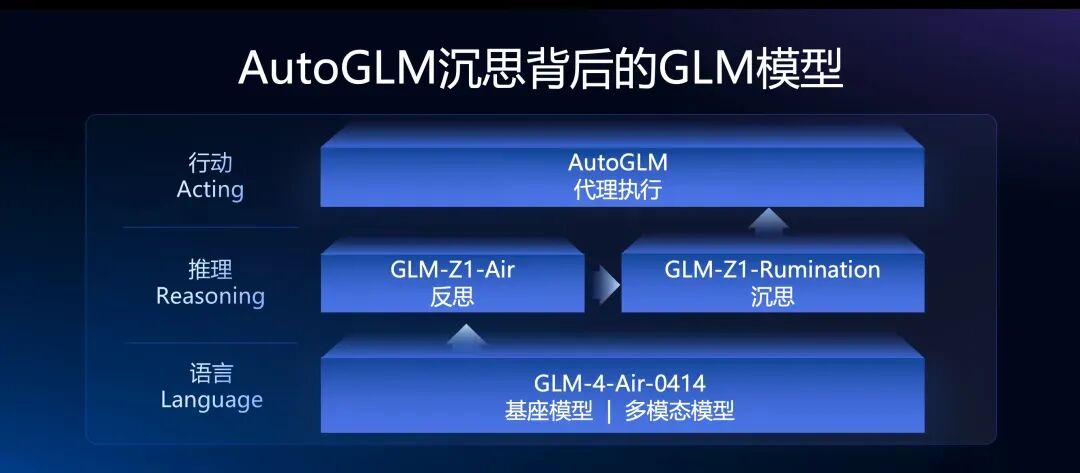
Zhipu first launched the new base model GLM-4-Air-0414, with 32B parameters. To adapt it for intelligent agents, they added more code and reasoning data during pre-training, and optimized tool calling, web search, and code generation capabilities during alignment, making the model stronger at agent tasks.
Based on this, Zhipu added reasoning data and enhanced general capabilities, launching the deep-thinking model GLM-Z1-Air.
Then, building on GLM-Z1, through extended reinforcement learning training, they enhanced the model's long-range reasoning and tool usage capabilities, creating the rumination model GLM-Z1-Rumination.
At this point, the three puzzle pieces forming AutoGLM Rumination are complete.
2. Examples
AutoGLM Rumination's official channels offer several examples.
First is electronics product comparison.
For instance, inputting the prompt:
Help me compare two products: I'm considering buying a MacBook Air and a Xiaomi laptop. Requirements: — I travel frequently for business, need a laptop with long battery life and light weight, and also care about performance and after-sales service. Please compare A and B in terms of specifications, battery life tests, and user reviews, list the pros and cons of each, and give a recommendation based on my needs.
Zhipu Qingyan outputs a detailed summary.
Second is impact of generative AI technology.
Inputting the prompt:
The disruptive impact of generative AI technology on future knowledge production models. Specific requirements: compare the paradigm differences between traditional academic research and AI-assisted research; select at least 5 typical fields (such as medicine, law, literature, economics, art, etc.) for in-depth research case studies; word count requirement: over 10,000 words
Because the prompt contains requirements for content professionalism, AutoGLM Rumination can call arXiv content to generate technical reports with detailed literature references.
Another example is Hong Kong travel guide.
AutoGLM Rumination can automatically browse content within the Xiaohongshu platform, ultimately designing a travel guide with detailed supporting evidence.
Inputting the prompt: I'm going to Hong Kong for 3 days, please help me design a travel guide, making sure to check real user reviews on Xiaohongshu for each attraction.
Beyond Zhipu's own examples, to test its deep research and practical operation capabilities, I input a relatively complex prompt:
"Help me analyze what major moves various internet giants might make in the AI direction in Q2 2025."
After receiving the instruction, AutoGLM Rumination quickly launched its analysis mode. It first sorted out current AI technology hotspots and key industry information about major internet companies.
Then through web search, it browsed dozens of web pages, including industry reports, news developments, and expert commentary.
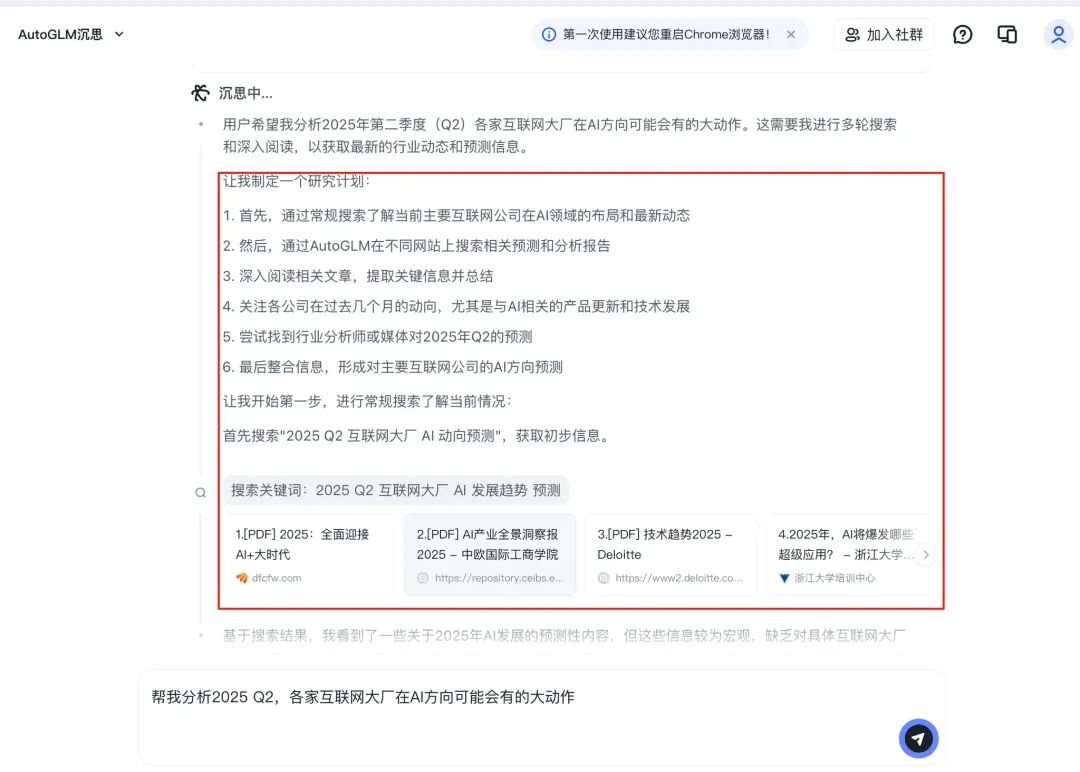
After a long period of thinking, Zhipu, through its "rumination," ultimately produced a lengthy report.
By briefly organizing the research plan provided by Zhipu's AutoGLM Rumination, we can see that Rumination provides a clear research plan structure and objectives:
- Define research subjects
- Information collection
- Technology trend analysis
- Strategy prediction
- Comprehensive report
Without any human supervision throughout, it can automatically output a logically clear, structurally complete research framework with specific, well-defined, and layered objectives.
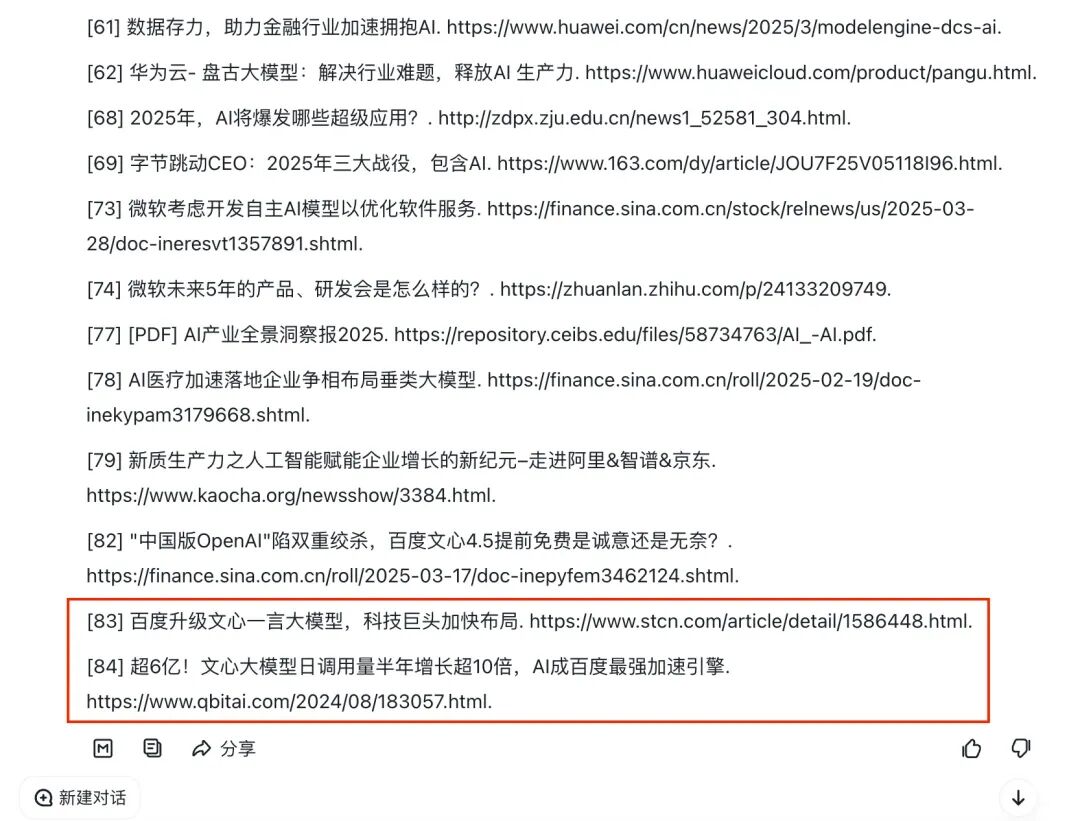
Looking at the source information in the final output report, in just a few minutes, Zhipu AutoGLM Rumination consulted multiple information sources including PDFs, Zhihu, and news portals, totaling 84 sources, completing the retrieval and integration of massive amounts of information.
This process is fully automated — it can quickly filter key points from complex web data and organize them into a logically clear analytical framework. Efficient search and summarization capabilities achieve seamless connection from information collection to output delivery.
3. 2025 Is Destined to Be a Year of AI Agent Takeoff
With today's launch, Zhipu's strategic focus is becoming increasingly clear: breaking through in Agentic GLM development and accelerating Agent deployment.
At the technical level, relying on self-developed large model technology, Zhipu continues to deepen its Agent base models with logical reasoning and deep thinking capabilities, while advancing optimization of general base models, then moving to intelligent agent framework design and application deployment, gradually realizing its vision of enabling machines with human-like thinking and action capabilities.
Furthermore, Zhipu plans to build an Agentic LLM platform to provide support for ecosystem partners, enabling them to leverage Zhipu's model and intelligent agent capabilities to develop intelligent agent applications deeply tailored to industry, regional, and scenario-specific needs.
We all remember the shock that Manus brought us that early morning it debuted, when the boundaries of AI technology were redefined.
We hope that the first shot fired by Zhipu with "AutoGLM Rumination" among the AI Six Little Dragons will make the 2025 AI Agent warfare even more exciting.
Go for it, Zhipu!