2026: The End of Software, the Fall of Engineers, the Death of Mediocrity

The real beginning comes after the end.
After the apocalypse is when the real beginning starts.

👩 Author: Shirley
🥷 Editor: Koji
🧑🎨 Layout: NCon

In the first month of 2026, U.S. software stocks experienced an unprecedented stampede.
At the end of January, Microsoft tumbled nearly 12% the day after issuing weak cloud guidance, dragging down ServiceNow in enterprise workflow and Salesforce in customer management alongside it.
In February, Anthropic launched Cowork, an enterprise workflow offering, plus several companion plugins. Thomson Reuters, a century-old legal data company, plunged nearly 16% in a single day — wiping out almost one-sixth of its market cap.
For the full month of January, the S&P North American Software Index fell 15%, its worst month since the 2008 financial crisis. Meanwhile, the semiconductor index surged. Wall Street dubbed this trade "long hardware, short software," and gave the selloff a new name:
SaaSpocalypse
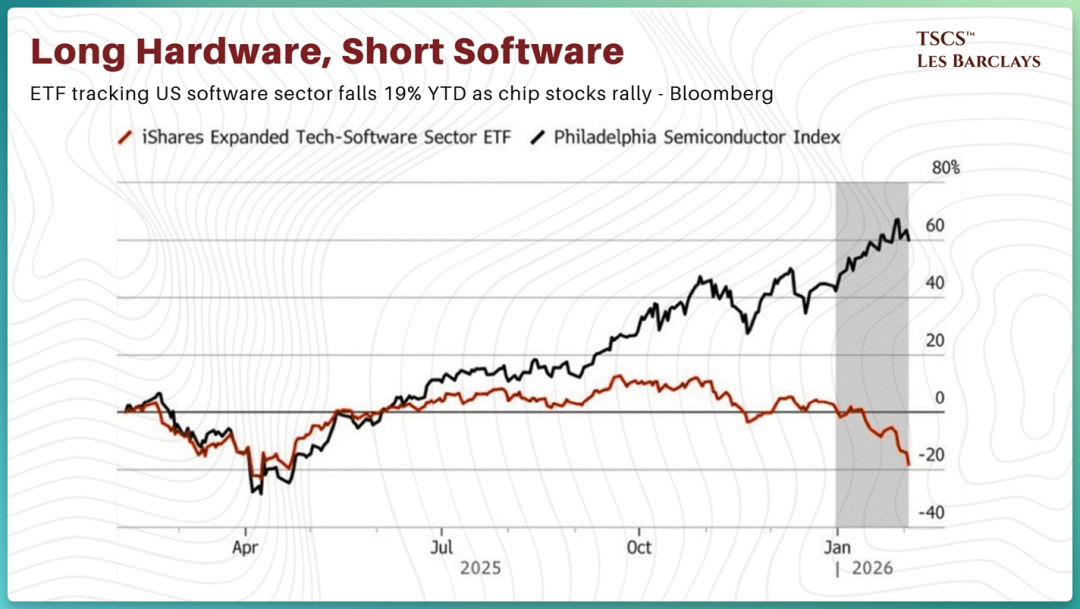
The panic wasn't just on the trading screens. In the months that followed, from Block to Oracle, the U.S. tech industry shed tens of thousands of jobs.
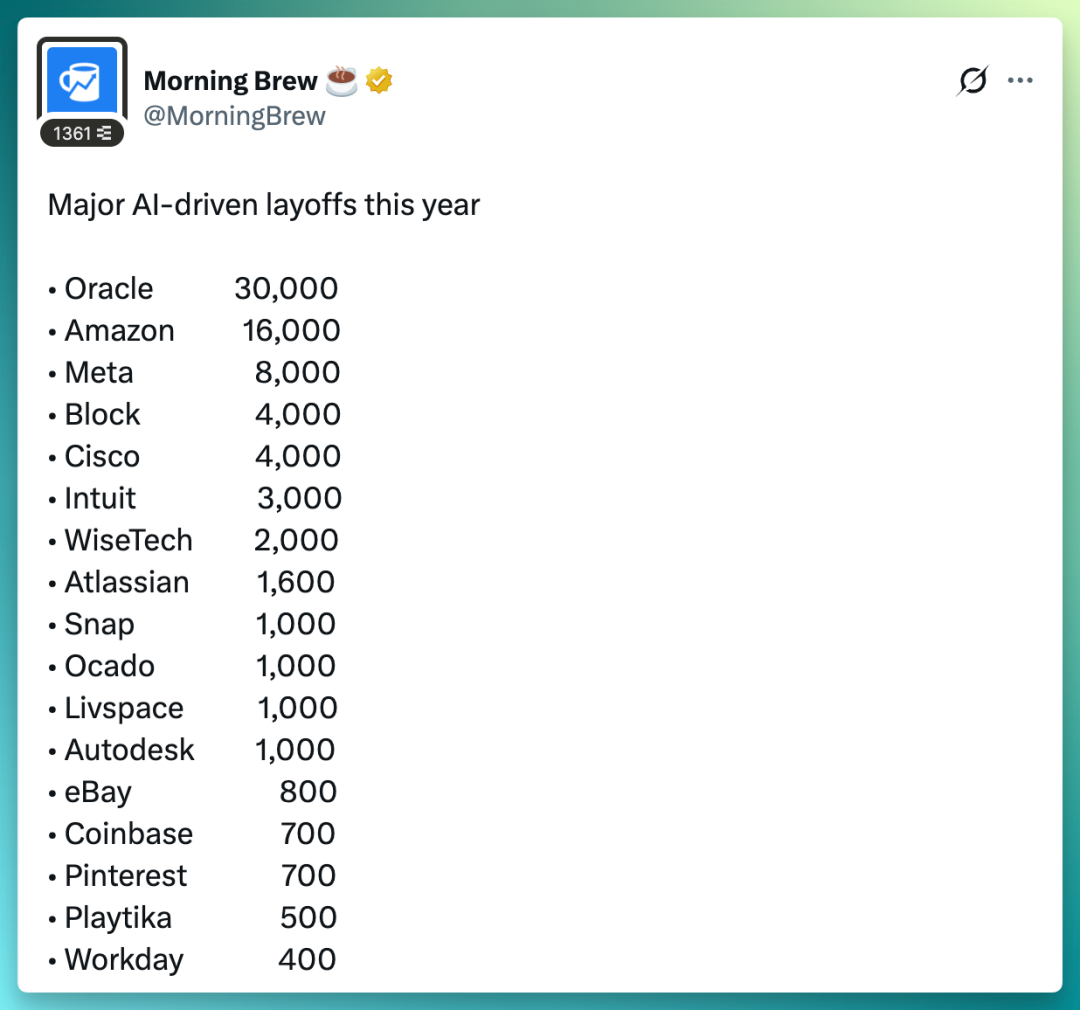
A veteran engineer with twenty years of experience lost his job. He clearly remembered the moment in 2022 when he first saw AI write code:
It took me five seconds to cycle through every emotion, and then I understood: okay, my career is over.
As a Business: What's Being Shorted Is the SaaS Middle Layer
Behind this panic, a set of "iron laws" governing business logic is starting to loosen.
For the past two decades, the software industry's most successful business model has been SaaS: packaging functions that enterprises need into a user interface, then charging a per-seat subscription fee for every user who logs in.
Salesforce manages customer relationships, Workday handles human resources, Atlassian coordinates projects — every company is a variation on the same logic. The interface is the product, and the interface is the moat.
The deeper a workflow is embedded, the thicker the muscle memory employees accumulate, and the higher the cost of replacing a system. This stickiness — "can't leave once you're used to it" — has been the core driver of SaaS valuations for the past twenty years.
The emergence of AI agents is fundamentally undermining this foundation.
In April, Salesforce CEO Marc Benioff posted a message on X — calm in tone, but loaded with implications:
All AI agents can access Salesforce Headless 360 directly via API, no browser required.
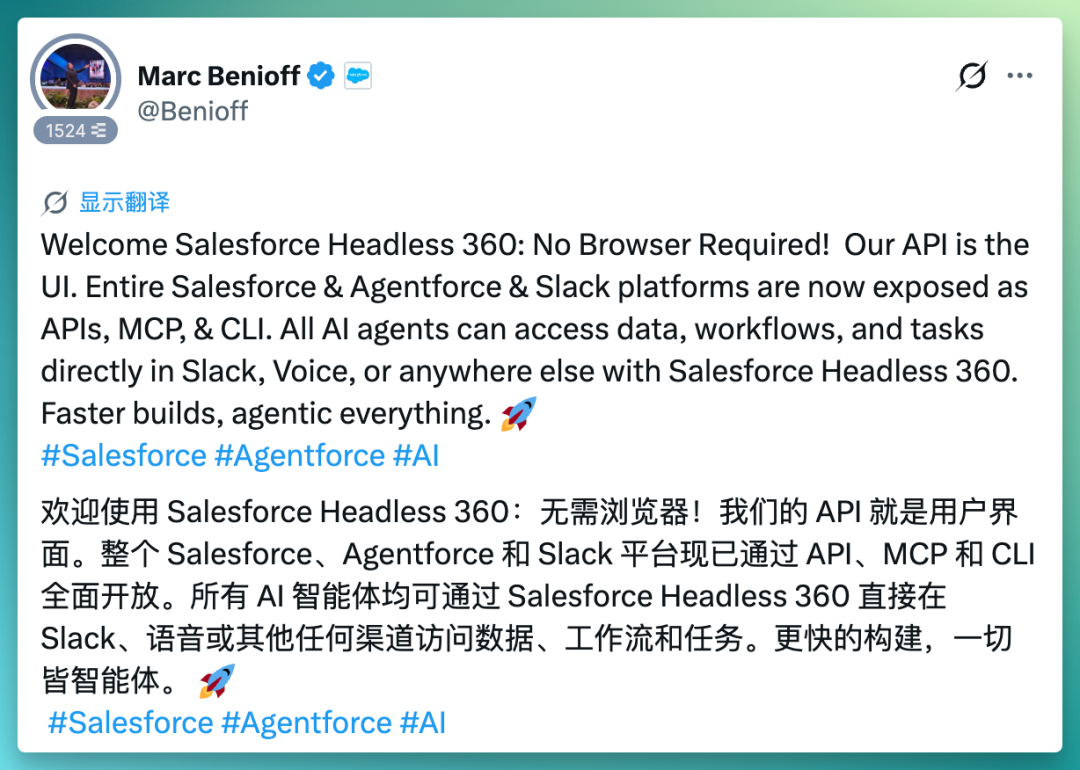
The commercial empire built on "interface" had made its own interface optional.
This move raises a deeper question: if you strip away a piece of software's user interface and expose its backend database directly, what remains? How is it fundamentally different from an ordinary database plus a set of APIs?
In Is Software Losing Its Head?[1], a16z offers an analytical framework: for AI agents to actually do things for enterprises, the hardest part isn't writing code — it's understanding the unwritten rules that never made it into documentation.
For example, contracts over $100,000 need VP approval, European operations must pass privacy compliance review first, and strategic customer discounts can only bypass finance at quarter-end. These rules are precisely the "context" that AI must master before it can act safely.
AI has dramatically reduced the cost of rebuilding the first 80% of any system. The remaining 20% — edge cases, approval workflows, compliance requirements — remains the dividing line between a "working prototype" and a "true replacement."
So we find that what the market concentrated its short bets on were almost all middle-layer businesses whose value fell in that "first 80%": legal information services centered on data distribution (Thomson Reuters), project management tools distinguished by workflow coordination (Atlassian), and highly standardized online legal services platforms (LegalZoom)...
Their common trait: their moats happened to sit squarely in the region most easily replicated by AI.
Backend systems that manage financial ledgers, data platforms involving compliance audits — these belong to that insurmountable "20%." This "20%" either concerns legal liability or touches regulatory compliance; no organization is eager to entrust it to an AI agent that might make mistakes.
Additionally, there's a more structural reason behind this: switching costs. Take a16z's switching cost spectrum as an example:
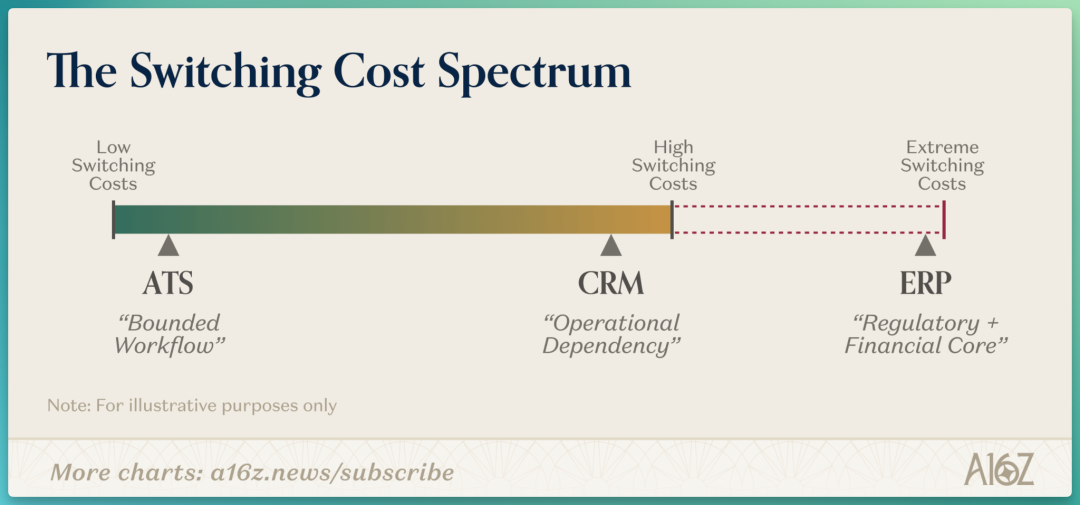
ATS (Applicant Tracking System) serves a bounded process. Once a candidate is hired or rejected, records are essentially archived. Replacing it is troublesome, but doable.
CRM (Customer Relationship Management) is a system that sales teams read from and write to daily — managing rhythm, approval flows, forecasting logic all wrapped inside. Replacement means migrating active, real-time data while reconstructing operational habits that were never documented.
ERP (Enterprise Resource Planning) handles company ledgers, payroll, and audit trails. Auditors, accountants, and regulators are all direct stakeholders; any migration has to bring them along.
a16z likens replacing a CRM to "open-heart surgery"; replacing an ERP is "open-heart surgery while the patient is running a marathon."
The arrival of AI agents hasn't collapsed the entire spectrum, but it has extracted one layer from it.
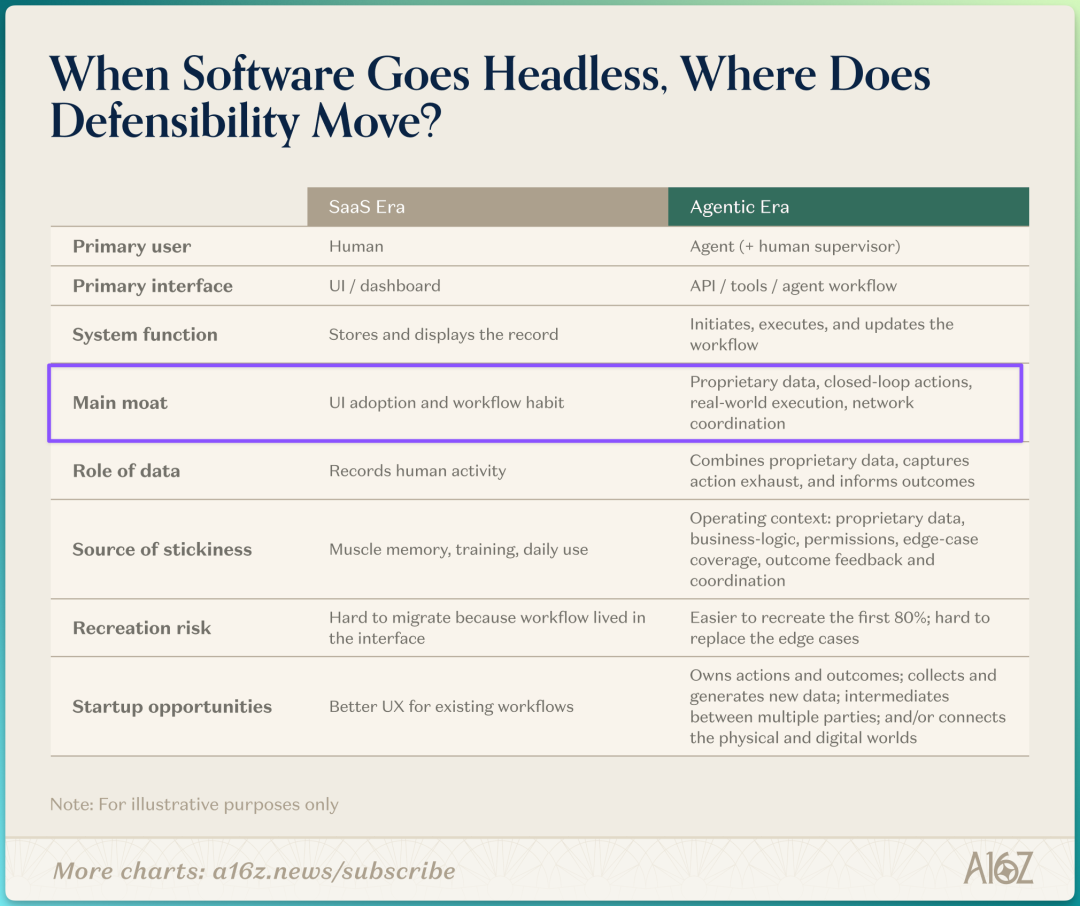
Systems that previously maintained high switching costs through interface habits and muscle memory are being bypassed directly by AI APIs; while the data, permissions, and compliance responsibilities at the bottom — capabilities AI doesn't easily possess — remain firmly in place.
What's dying here is precisely the middle-layer SaaS whose value is concentrated at the top and whose foundation carries little compliance weight.
But this only explains "which ones will die, which ones will survive." A larger question remains unanswered:
If AI is eroding the foundation of existing software, will the total amount of software shrink, or grow?
As a Product: Software Is Liquefying
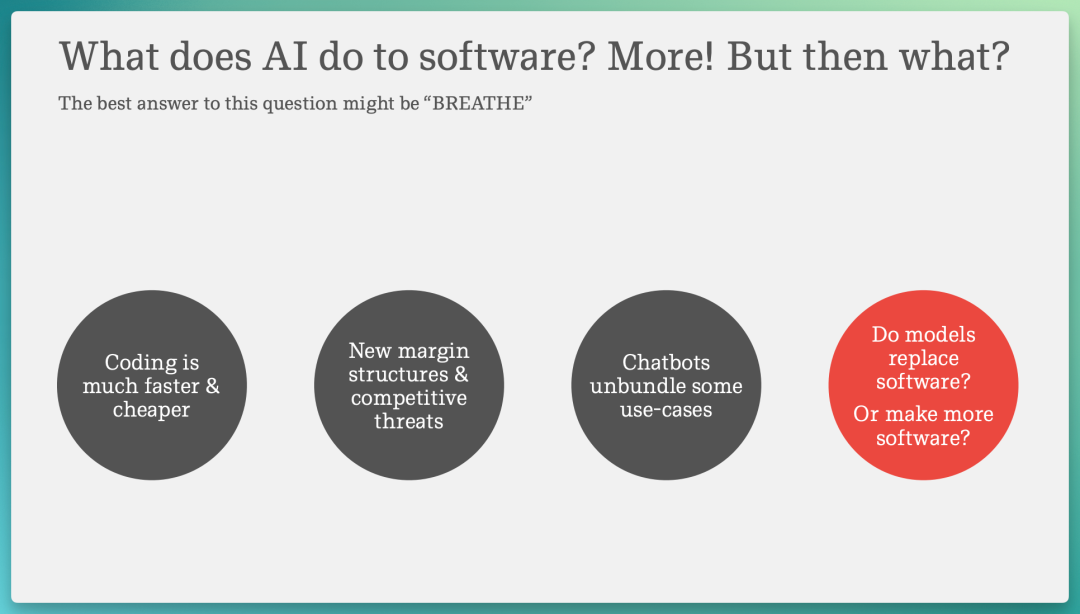
If the SaaS middle layer is being eroded, intuition says software should decrease. In his Spring Final[2] report this May, tech analyst Benedict Evans posed this contradiction as an open question:
Is AI replacing software, or creating more of it?
He placed the question inside a red circle, leaving it on the right side of the page without rushing to an answer.
But perhaps the answer lies in a 19th-century economic law.
In 1865, British economist William Stanley Jevons noticed a paradox: the more efficient steam engines became, the more coal Britain consumed. Improved efficiency didn't reduce resource consumption — it made coal cheaper and more accessible, which in turn spawned factories and uses that had never existed before, leading to net growth in total consumption. This phenomenon later became known as the Jevons Paradox:
Jevons Paradox: when technological progress improves resource use efficiency, total consumption of that resource rises rather than falls due to expanded demand.
And Token is following the same path.
The chart below from JPMorgan Chase shows the relationship between AI large model inference cost and performance (March 2023 – October 2025). The horizontal axis is cost per million tokens; the vertical axis is model performance score.
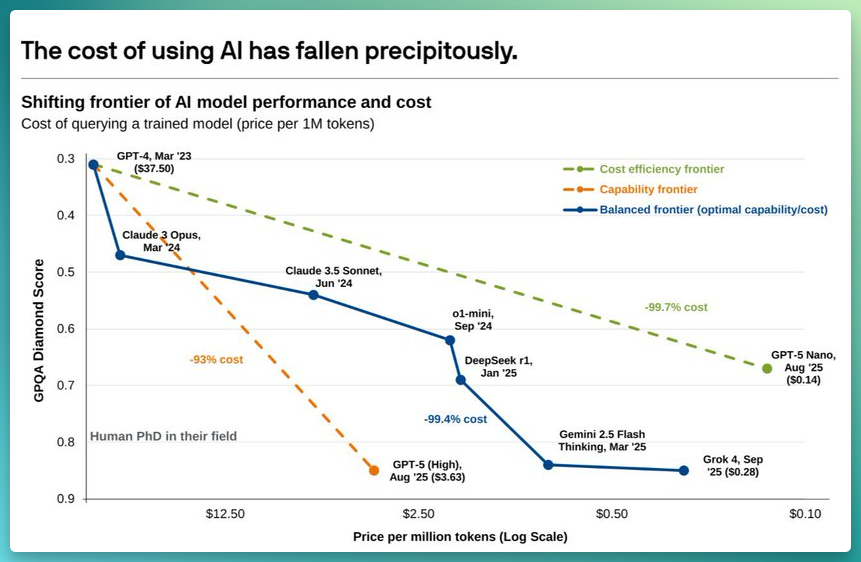
From GPT-4 in March 2023 to Grok 4 in September 2025, the blue solid line extends continuously toward the lower right, demonstrating the mainstream iteration trend of "smarter and cheaper" AI large models.
When GPT-4 first launched, the cost per million tokens was as high as $37.50. Just two years later, GPT-5 High dropped to $3.63, with its performance score surpassing human PhD level.
Over two years, inference costs for mainstream models at the optimal balance point of performance and cost fell by over 99%.
But total Token consumption isn't decreasing — it's climbing exponentially.
Peter Steinberger, creator of OpenClaw, recently shared his API bill on X: in the past 30 days, he consumed 603 billion tokens through the OpenAI API, with monthly spending exceeding $1.3 million.
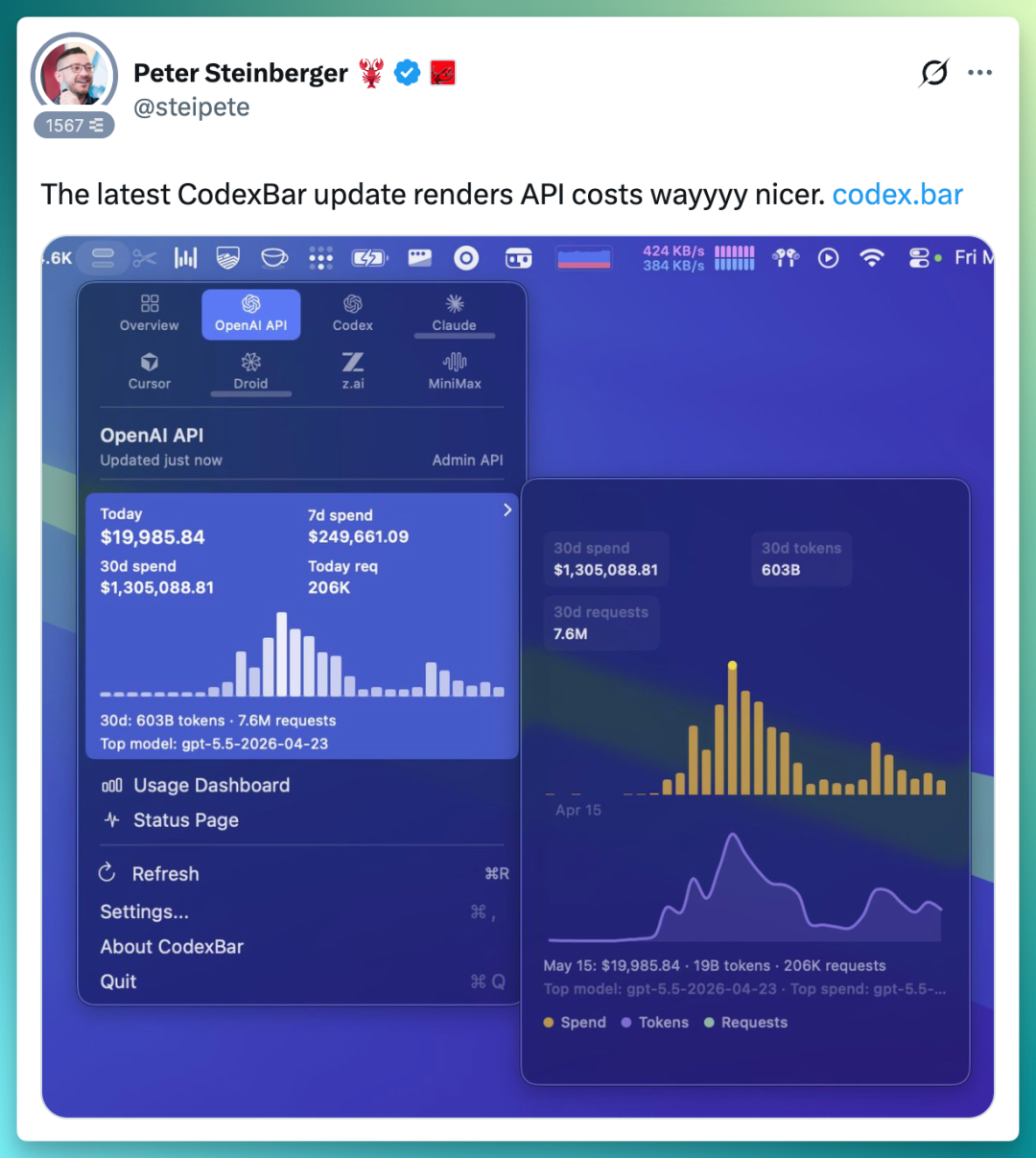
This isn't a centralized deployment inside a large company — it's an individual-level experiment.
Thus, the Jevons Paradox has a more modern version in the AI era: every drop in Token price doesn't just make existing software cheaper to run — it unlocks a batch of software that previously couldn't exist.
Before Vibe Coding became reality, building a feature meant requirements documents, architecture design, code implementation, testing, deployment — every step required someone present. Now you describe what you want in natural language, and AI makes it appear.
A nearly 50,000-star open-source project on GitHub, OpenDesign[3], is a very typical example.
Previously, designers' workflows revolved around Figma — dragging and dropping components, adjusting spacing, annotating cuts. When Anthropic released Claude Design in April, it demonstrated for the first time another possibility: LLMs directly outputting deliverable design artifacts.
But OpenDesign goes further than "assisted design."
As seen in the video, a user provides a GitHub link in Codex, and the agent automatically calls OpenDesign, grabs the operation path, renders the frontend page. Then the user simply enters relevant prompts in the dialog box, and Codex calls the corresponding workflow and plugins to automatically generate complete slides.
This workflow simply didn't exist two years ago. It's not an upgraded Figma — it's a new product spawned by falling Token costs, shifting from "drag-and-drop tools" to "agent + context workflows."
OpenDesign isn't an isolated case. What makes it work isn't just cheaper Tokens, but the fact that software is transforming from fixed-form products into on-demand generated media.
And media needs pipelines. Once software becomes media, it needs more than just models — it needs an entirely new infrastructure: protocols for connection, payments for settlement, distribution for installation capability.
In Big Ideas 2026[4], a16z summarizes this shift in one sentence:
The optimization target of software design is shifting from "visual hierarchy" to "machine readability."
Protocol Layer: MCP Is Becoming the New USB Interface
MCP (Model Context Protocol), introduced by Anthropic in late 2024, addresses a seemingly simple problem: getting AI to know how to talk to external software.
Before MCP, connecting AI to each new tool required writing a separate adapter. Claude calling Slack was one integration, calling GitHub another, calling internal company systems a third.
MCP standardizes this: any application builds an MCP server once, and all MCP-supporting AI (Claude, ChatGPT, Cursor, Copilot, etc.) can call it directly. Hence it's often compared to "the USB interface of the agent era" — a universal connection standard.
Data from Digital Applied shows that as of May 2026, 41% of enterprise software teams have deployed MCP agents in production environments; GitHub repositories tagged with mcp-server have reached 15,926, with monthly downloads exceeding 97 million.
In December 2025, Anthropic donated MCP to the Agentic AI Foundation under the Linux Foundation. Today, MCP has evolved from one company's product into public infrastructure for the entire industry.
Payment Layer: The 90-Day War, and the Cooled Truth
In the second half of 2025, global payment giants began密集布局 AI agent payments: Coinbase moved first with x402, Google released AP2 in September with over 60 partners, and Visa and PayPal announced TAP and Agent Ready respectively in October.
They all address the same problem: agents need a machine-native payment form — instant, per-use, independent of human approval. Of those pursuing this vision earliest and with the most imagination, x402 leads.
x402 resurrected the HTTP 402 (Payment Required) status code, idle since the early internet, allowing agents to pay per call for any open API using stablecoins. Take this comparison chart from x402's official protocol documentation:
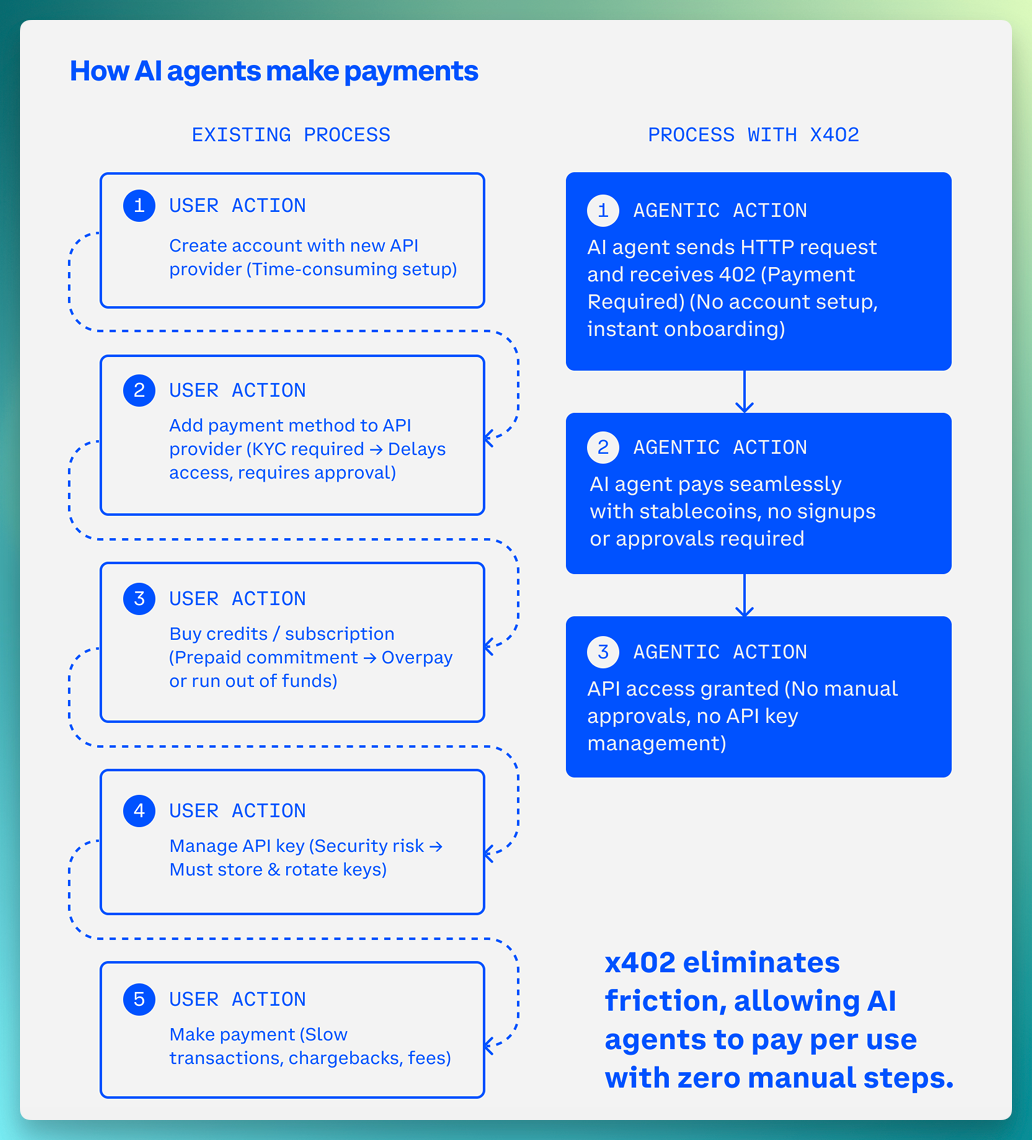
On the left, the five steps required in traditional payment flows: account opening, KYC, buying subscriptions, managing API keys, payment. On the right, the three steps an agent completes in x402: make request, settle with stablecoin, get access.
The difference isn't just step count — it's underlying assumptions. The former assumes human approval at every step; the latter assumes autonomous machine decision-making with instant settlement. As of April this year, x402 has accumulated 170 million transactions and $50.6 million in GMV.
But zoom in, and the story isn't as optimistic as imagined.
x402's real on-chain daily transaction volume fell from $3.8 million in November 2025 to approximately $28,000 in May 2026. The daily volume curve resembles the "brief spike + long-tail decay" pattern common to many meme coins.
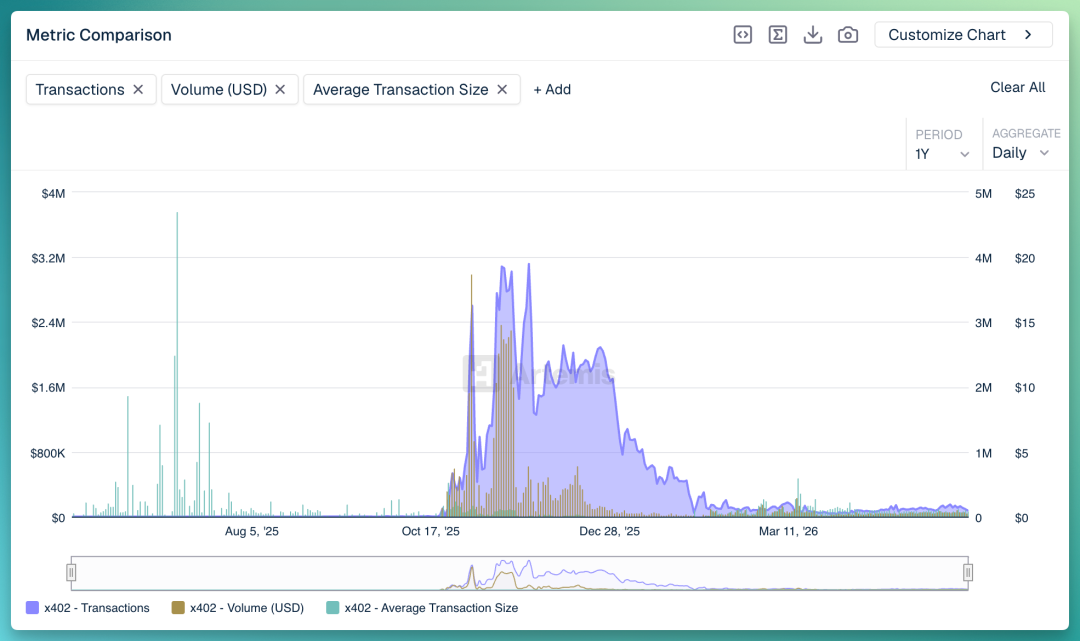
More telling is the green line in the chart below: gamed transactions have long maintained a 40%-80% share. In other words, of the portion that appears to still be running, at least half isn't real machine economy.
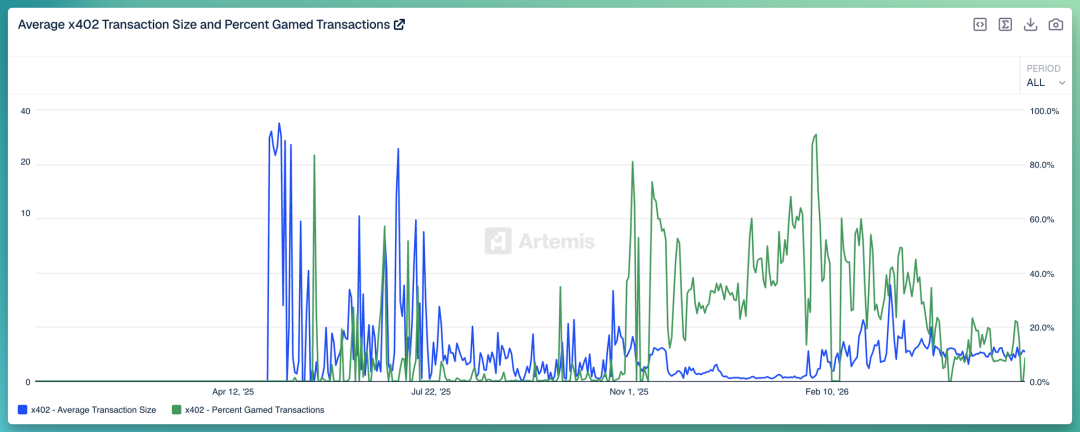
Payment channels are built, but real demand hasn't caught up.
Distribution Layer: npm for the Agent Era
If protocols solve "how to talk" and payments solve "how to settle," then the distribution layer solves "how agents acquire capabilities."
Browserbase is a concrete illustration. This company building headless browsers for agents (Series B, $40 million raised, $300 million valuation) recently launched browse.sh[5], a browser skill marketplace for agents.
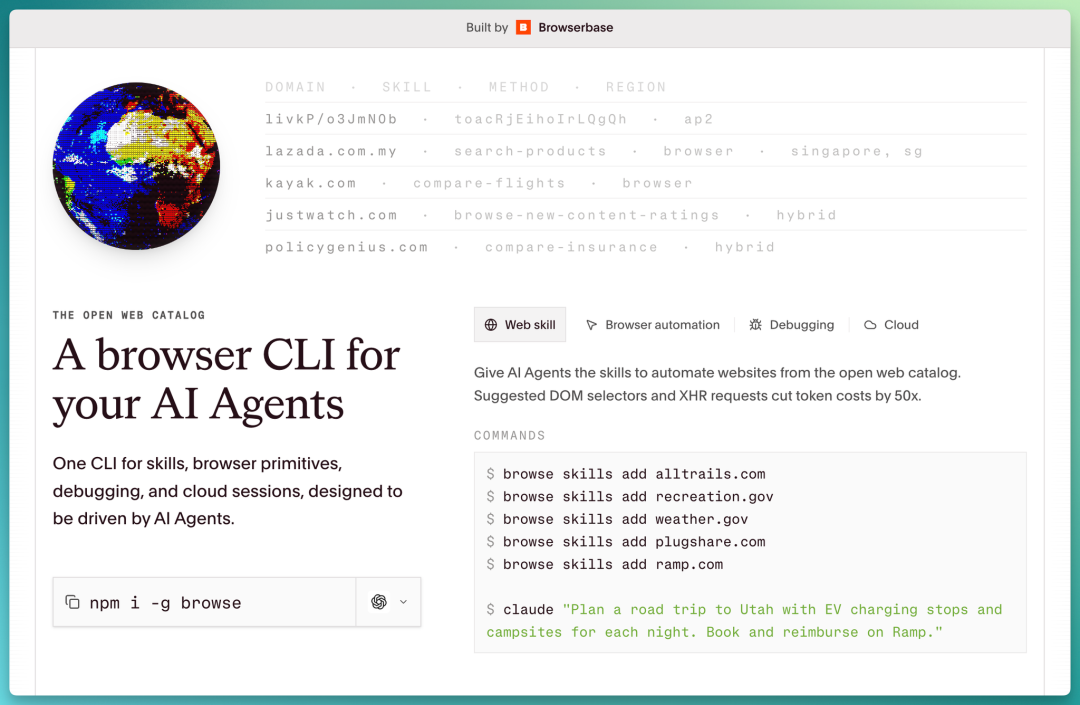
Any agent can install pre-built skills like "search for products on Amazon," "book a room on Airbnb," or "make a reservation on OpenTable" with a single command.
Take "competitive analysis on Amazon" as an example. As shown, simply open Codex and enter
npm i -g browse,
browse skills add amazon.com/search-products-5170mf command lines and corresponding prompts, and Codex automatically completes search, product selection, and deep research:
Just as npm once unified code package distribution, Browserbase and its ilk aim to do the same for agent capabilities.
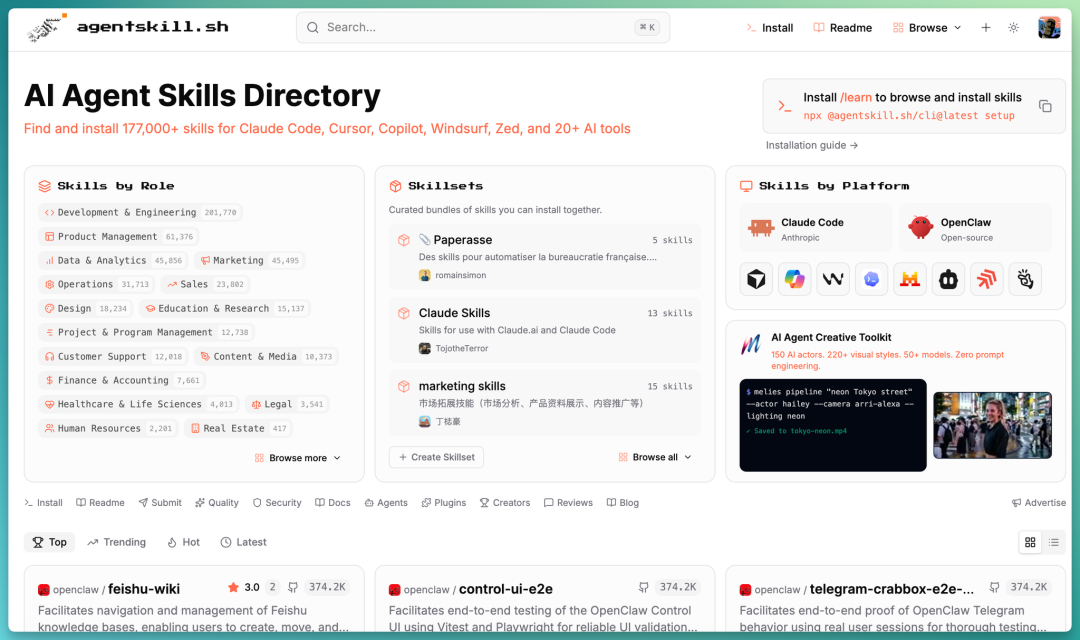
Beyond browse.sh, there's skills.sh[6] from Vercel, and agentskill.sh[7] encompassing 177,000 skills — all packaging agent skills into searchable, installable, distributable market forms.
None of this is unfamiliar. Twenty years ago when the internet was emerging, we needed DNS to locate websites, Stripe to collect payments, OAuth for login, AWS to run servers — the entire infrastructure existed to make web pages work.
The agent era is compressing and replaying the same story: protocols, payments, distribution — all must be rebuilt for a new kind of "user" (agents). Infrastructure isn't just being added; its underlying logic is being rewritten.
In The Fall of the Nerds[8], Noah Smith describes the above transformation in one sentence:
Software is no longer the craftsman's work, but a medium that can be generated on demand.
But from "freely generable" to "actually deployed," there's friction. Connecting software to real business pipelines still requires substantial human effort to understand business logic,打通 data permissions, and handle compliance boundaries.
And where has that person whose professional identity was "building software" gone?
As a Professional Identity: The Geek Is Evaporating
Economic historian Robert Allen noticed an anomalous historical moment when studying the Industrial Revolution:
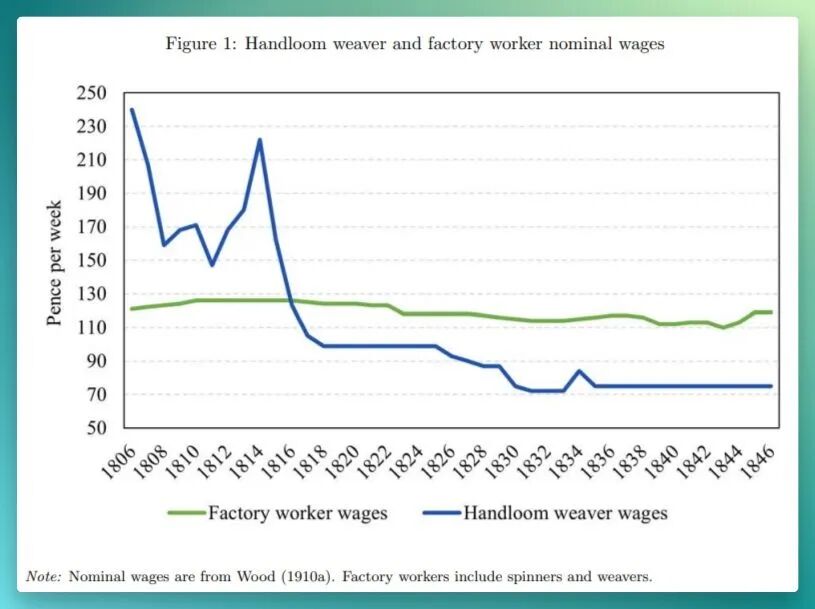
The power loom wasn't born in the era when handloom weaving was most declining. On the contrary, it entered commercialization during the years when handloom weavers' wages were highest.
In the 1780s, factory spinning efficiency surged dramatically, increasing demand for weavers and driving wages skyward. It was precisely during this golden period that even relatively inefficient early power loom prototypes were pushed to market because they replaced expensive labor. After the power loom matured, handloom weavers' incomes collapsed.
The story of software engineers is structurally almost identical.
In 2011, Silicon Valley godfather Marc Andreessen wrote his famous assertion in The Wall Street Journal: "Software is eating the world." For the decade that followed, this sentence was cited repeatedly as the era's通行证.
Nonprofit Code.org raised $12 million from Bill and Melinda Gates to teach underprivileged children programming; the Obama administration promoted the "Computer Science for All" initiative, listing coding as "a new basic skill necessary for economic opportunity and social mobility";
On the eve of the 2020 U.S. presidential election, Joe Biden went viral for telling a group of struggling miners they should "spend time programming, not crawling into dirty mines."

People responded. From 2009 to 2024, computer science graduates surged from under 70,000 to over 250,000; in the job market, developers' median base salary grew 24% during the same period, reaching more than double the U.S. median wage.
"Learn to code" became career advice drilled into a generation.
But good times didn't last. AI's emergence is devouring entry-level software engineering positions.
According to Stanford University HAI Research Center's 2026 AI Index Report, at the commercial application level, AI has brought 26% productivity gains to software development while also triggering clear employment compression: since 2024, employment rates for U.S. junior developers aged 22-25 have dropped nearly 20%, while the number of senior developers continues to increase.
Even X platform product lead Nikita Bier couldn't resist posting:
We're a few weeks away from a world with no designers, no engineers, just a third mysterious role.
Stack Overflow's traffic decline is the quietest footnote to this transformation.
This Q&A community that once gathered global engineers' experience now resembles more of a "museum from ancient times."
Looking solely at community activity (new question volume), by end of 2025 its level has fallen over 90% from its pandemic-era peak in 2020. Traditional Q&A communities are no longer the default entry point; engineers get answers directly from AI.
Noah Smith, citing economic historian Brad DeLong, calls this community the "engineering practice community":
It quietly disbanded, without announcement, without ceremony...
But the dissolution of community doesn't equal the disappearance of those people. What's truly disappearing is mediocre space.
Silicon Valley investor Naval put it directly: nobody wants number two. When AI can already cover 80% of software development work at extremely low cost, mediocre applications will attract no attention, and mediocre engineers will only accelerate out of the game.
Software engineers remain among the most leveraged people on the planet — but only if they know where their advantage lies. AI-generated code has bugs, has architectural flaws, and knowing where the problem is, why it's wrong, requires not faster generation speed but deeper understanding.
Thus the "third mysterious role" in Nikita Bier's words begins to take clear shape.
This role already has a new name: FDE, Forward Deployed Engineer.
This position originated at Palantir. In 2010, their engineers were embedded with special forces in Afghanistan, collecting feedback during the day, writing and releasing code updates at night. Software must be built in the environment where it runs. That logic still holds today; only the battlefield has shifted to enterprises.
Take Anthropic's description of this role as an example: FDEs need to embed within client organizations, collaborate with clients to build AI applications, deliver MCP servers, sub-agents, and agent skills, while feeding problems from the client site back to product and engineering teams.
This role's capability requirements aren't as singular as traditional software engineers, but rather demand the intersection of three capabilities — Engineering, Product, and Customer.
Most engineers possess only one or two of these; FDEs need all three operating simultaneously.
Therefore, this role is no longer a traditional engineer in the conventional sense, but he must understand Systems Thinking: knowing who maintains system state, knowing where feedback comes from, knowing what deleting one component will trigger.
In a probabilistic world where AI is mostly correct and occasionally absurd, he is the orchestra conductor.
The engineer laid off at the beginning won't return to what he was twenty years ago — but he doesn't need to.
When software becomes flowing medium, human value migrates from "writing code" to "understanding systems," from "craftsman" to "conductor."
Software hasn't died; it's just transformed from product to medium. The geek hasn't disappeared; they've simply shifted from the person who writes code to the person who makes systems actually work.
Crossing is seeking independent contributors to write AI product and model reviews.
If you've written articles like: "Hands-on: PixVerse C1", "Hands-on: LibTV", please contact zeo0811@gmail.com. Email should include: ① personal introduction, ② AI review articles you've written.
We offer competitive compensation. Looking forward to observing and documenting the AI era together with you 🎪
References
[1] Is software losing its head?: https://a16z.com/is-software-losing-its-head/
[2] Spring Final: https://static1.squarespace.com/static/50363cf324ac8e905e7df861/t/6a0af5d0484fbf5fe9a7743e/1779103184855/2026-Spring-AI.pdf
[3] OpenDesign: https://github.com/nexu-io/open-design
[4] Big Ideas 2026: https://a16z.com/newsletter/big-ideas-2026-part-1/
[5] browse.sh: http://browse.sh/
[6] skills.sh: http://skills.sh/
[7] agentskill.sh: http://agentskill.sh/
[8] The Fall of the Nerds: https://open.substack.com/pub/noahpinion/p/the-fall-of-the-nerds?r=7dnfkb&utm_campaign=post-expanded-share&utm_medium=web
[9] https://hai.stanford.edu/ai-index/2026-ai-index-report: https://hai.stanford.edu/ai-index/2026-ai-index-report
[10] https://browse.sh/: https://browse.sh/
[11] agentskill.sh: https://agentskill.sh/
[12] https://www.x402.org/: https://www.x402.org/
[13] https://en.wikipedia.org/wiki/Jevons_paradox: https://en.wikipedia.org/wiki/Jevons_paradox
[14] https://x.com/vasuman/status/2057177266984226892?s=20: https://x.com/vasuman/status/2057177266984226892?s=20