Entering the Arena, 2026! Shanghai Crossing Open Mic: 10 Speakers on Record
Turn perspectives into products, and curiosity into action.
On May 24, 2026, Crossing hosted its 22nd AI Open Mic at Shanghai AI Hacker House. The open mic is a signature format of Crossing's offline salons — 120 to 150 people in the room, with 10 to 15 speakers taking the stage for 10 minutes each to share their AI products and thinking.
There was no unifying theme for this edition, but all 11 speakers converged on the same question: When AI can do everything, what should founders focus on?
Whisper Zhen Wang, Founder/CEO of Yuan Sheng Wan Wu
Zhen Wang opened with a somewhat surprising claim:
An AI company is progressively de-AI-ing itself.
He studied at Shanghai Jiao Tong University, then worked on QQ at Tencent and on consumer products at Douyin. After seeing ChatGPT in 2023, he joined TikTok founder Louis's new company to build AI companions. But he discovered that while users would chat with AI for eight hours a day, he himself couldn't last 30 minutes — "because it keeps spitting out tokens that feel uncannily familiar."
So he set a principle:
Build something where you yourself are the power user.
From AI information filtering to desktop pets to ADHD coaching assistants, he tried five or six directions. All failed. He finally converged on his current product: Trooly AI, which helps product people recruit real users for 45-minute in-depth interviews at scale. In six months: 12,000+ interviews, 400+ clients across China, three funding rounds closed.
He also shared an interesting internal finding: his team members almost universally dislike reading AI-generated documents.
Give me the raw prompt, not AI-written classical Chinese.
So this company, which started building with AI in 2023, now bans AI from writing internal documents. It insists on hiring real people and conducting real interviews.
An AI-powered user interview company that refuses to let AI conduct interviews. Keep hiring. Believe that exceptional people far outweigh AI. Make users' voice matter.
Edward, Founder/CEO of Vibe Island
Edward comes from a design background and is also an OPC.
The problem he posed is one many are encountering: when you have a dozen Claude Code and Codex windows running tasks in the background, how do you know which one needs you?
He noticed a product pattern: the iPhone's Dynamic Island. When you're waiting for a ride or a delivery, the notch area shows the delivery driver's distance or the license plate — key information without switching apps.
So he built Vibe Island: a cute little character lives in your Mac's notch, reflecting the real-time status of all your background coding agents. When a task needs your decision, the island expands into a window where you can approve, reject, or enter hands-off mode — no need to switch back to the terminal.
At the right moment, with the least friction, bring your attention back to where it belongs.
He also invested heavily in sound design: not generated audio files, but custom-coded sound effects — task started, executing, completed, authorization needed — each state with a unique sonic signature, adjustable in pitch and speed.
Most distinctive is his onboarding: he made it a "movie opening." The entire screen dims first, then a narrative walkthrough guides you through understanding the product form, only arriving at the payment page at the end. Installing an app can itself be a story.
Gaoming Wu, Cofounder of Jingying Technology
Gaoming Wu is a serial entrepreneur. He said his talk would differ from the previous two — not inspiration-driven, but problem-driven: When technology collapses production costs in an industry, the real opportunity isn't "doing the same thing cheaper and faster," but reconstructing the feedback system so the entire system evolves faster.
This insight comes from his consecutive entrepreneurial experiences.
In 2019, he and his team incubated Fengdu Novel. Under the assault of giants, rather than competing head-on for content and acquisition scale, they reconstructed the feedback loop. While other platforms required authors to write 300,000 words before publishing, they let authors go live at 20,000 words, enabling rapid experimentation and iteration within the loop. They eventually grew to 3,600+ authors, with DAU reaching over ten million. At this stage, humans were in the system loop.
In 2023, Jingying Technology became one of the first companies to dive into AI short drama globalization. The core strategy wasn't simply cost reduction — it was that when costs dropped to one-tenth, content could shift from "limited production" to "massive concurrent experimentation." Unlike traditional live-action short drama companies, Jingying pushed content experimentation frequency to the extreme. By November 2025, their AI-produced short drama climbed to #1 on the overseas monthly bestseller list. At this stage, humans + AI Copilot were in the system loop.
In Wu's view, both experiences point to the same proposition: What the content industry truly lacks isn't production tools, but an evolution system. His current conviction: After Coding Agent, content entertainment will be the next industry restructured by Agent. At this stage, Agents will be in the system loop.
Coding Agent emerged first not just because models improved, but because code inherently has an environment: documentation, APIs, compilers, tests, and runtime feedback. The content industry historically lacked such an environment — shooting, editing, distribution, and feedback were all slowed by physical-world and organizational friction.
Wu believes that in building Agent-native entertainment systems, efficiency isn't the endpoint of competition — evolution speed is. Jingying Technology will continue increasing investment in Agent infrastructure for the content entertainment industry, building a content environment where Agents can plug in, collaborate, and self-evolve.
Tom, Founder/CEO of Refly AI
They spent two days over the last weekend before May Day building an open-source product. Within 20+ days, it reached nearly 50K DAU, competing alongside Gamma and Canva. Over 250 contributors from 20+ countries joined the community, 1,500+ PRs were merged, and they accumulated 57.1k stars.
Tom's team has gone fully AI-native: PMs consume $1,000 in tokens daily writing code in Cursor; growth people have become full-stack GTM engineers.
What's the core conviction?
For the first time, models have crossed from functional coding to possessing aesthetic capability. We have the opportunity to transition from coding AGI to design AGI.
This is the structural opportunity he identified. His second learning is fully automated open-source community operations: global issues receive minute-level response times, PRs go through automated AI code review — developers report that "5-6 PRs can get merged in a day" — whereas in traditional open-source projects, two months without a merged PR is normal.
His third learning is channel selection: GitHub is the Xiaohongshu of the AI era; Twitter is GitHub's shadow. As long as your product is genuinely valuable and your thinking shines bright enough, these channels will amplify you infinitely.
Huamao Fang, Google Cloud Architect
This Google Cloud architect, responsible for startup customer solutions, distilled two main threads of Google's AI strategy: foundational model iteration, and agent deployment.
On the model front, he quoted:
"The limits of my language mean the limits of my world." In much of the past AI development, developers had to introduce extensive engineering workarounds to compensate for model shortcomings. Google's approach is to have the models solve these problems themselves: natively multimodal Gemini 2.5, image generation with Imagen, video generation with Veo, and the newly released Omni model — the goal is any data in, any data type out.
He gave an example: previously, image generation relied on endlessly refining prompts, with no multi-round editing or cross-context consistency. Many AI tools tried to solve this through engineering hacks, but Google believes this should be a native model capability.
On agents, he said: In the beginning was the act. The model is day zero, not day one. Whether a product can ship in production depends on the capabilities built around the model for interacting with the physical world. From basic code execution, to MCP and sandboxing, to computer use, to fully autonomous 24-hour agents — Google is atomizing and opening all of these capabilities to developers.
Finally, the Google for Startups program: eligible startup teams can receive up to $350,000 in Google Cloud credits.
Ziheng Xiang, Founder/CEO, Deep Optica
When you hear AI and mining, you might expect a pretty gritty picture — but what Ziheng Xiang brought was South African gold mines, Mongolian copper mines, the Iranian desert.
He came from a quantum computing background, and the question he's gotten most since starting his company is: "There's so much to do in AI — why'd you pick mining?"
The answer is hardcore: The global copper shortfall by 2040 is 10 million tons — equivalent to the annual output of the world's top ten mines. If that gap isn't filled, data center costs will spike sharply and cloud services could become unaffordable. And getting a mine from intent to extraction takes a median of 17.98 years. If you want new production online by 2040, you have to start now.
What AI does in mining: First, data cleaning — using vibe coding to turn all drilling data into clean data in half an hour. Second, training AI on surface data (geology, geophysics, satellite imagery, geochemistry) to generate 3D subsurface structural models, improving mineral discovery efficiency.
They're already working with government agencies in Mongolia, the Middle East, South America, and Africa.
"We also want to go to space eventually — Mars has minerals, the moon has minerals. You can't ship copper from Earth, you have to mine locally."
Vivian, Chief of Staff, Paperboy
Vivian previously ran the "YUE" startup accelerator at HSG and did early-stage investing at Xiaohongshu. She discovered Paperboy while looking at deals, then joined the team herself.
She opened with a survey: "Who here considers themselves a boss or manager?"
Her thesis: In the future, everyone in the world should be a boss and manager. You're already using Claude Code, using Codex — each of you is already a manager, managing different agents.
Paperboy builds OS-level context capture. The earliest Paperboy interface was a small orb sitting in the corner of your screen, continuously capturing what was on your display. Watch you for thirty minutes, and it fully understands what kind of worker you are.
Vivian demoed Paperboy live: open a candidate's WeChat profile, tell Paperboy "evaluate this candidate." No need to explain what evaluate means, or what a candidate is. Paperboy knows your hiring style, what your team needs, and your work habits (you like storing candidates in Notion) — so after evaluating, it enters the candidate into Notion directly.
The most interesting evolution: they've made the interface into an IM and group chat format. Everyone on the team has their Paperboy in the group; the boss assigns tasks by having their Paperboy message your Paperboy. Each Paperboy in the group carries its user's skills and context, so they can "learn from each other's strengths" and collaborate. Vivian herself created a two-person group with her Paperboy, with the rule "you never reply, you're just here to see," using it as a running notepad. When she needs to ask team members questions, she goes to their Paperboy first — protecting everyone's focused work time.
Paperboy is for managers. And everyone will be a manager in the future.
Kevin Zhang, Family Office Investor
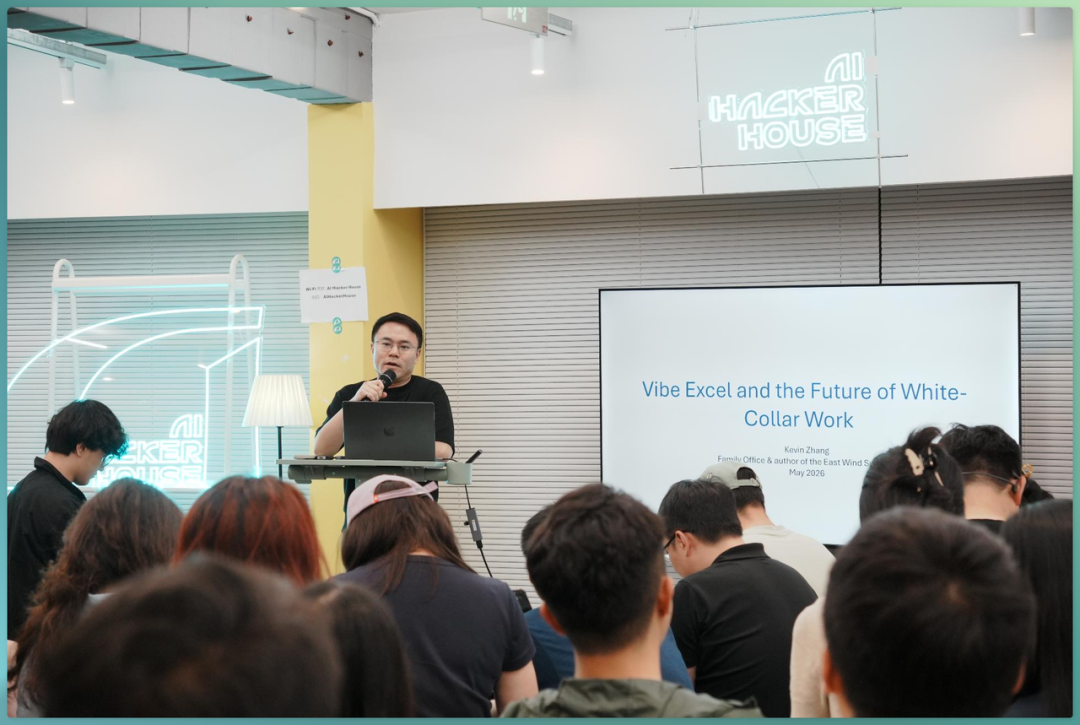
Kevin is a family office investor who writes a Substack called East Wind. His talk addressed a macro question: How far has AI actually progressed in white-collar work beyond coding?
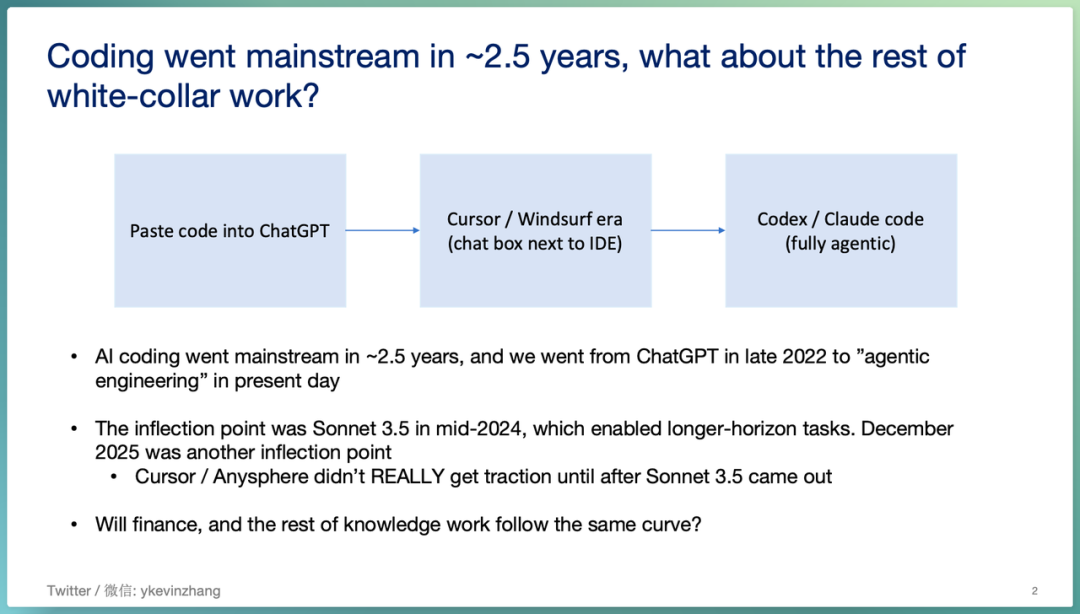
He traced the evolution in coding: 2023 was copy-pasting into ChatGPT → the Cursor/Windsurf era → mid-2025 fully autonomous agents → by late 2025, Opus and Claude models can reliably complete complex tasks.
But in finance, we're still stuck at 2023. Excel plugins can't do end-to-end modeling, debugging prompts takes longer than doing it yourself, and there's no version control like you have with code.
More critically: Code can be fixed with more code, but investment decisions can't be undone once made.
The bottleneck for AI adoption is no longer at the model layer or the harness layer — it's at the adoption inertia layer.
Early adopters are already reaping the benefits. Startups are growing fast, indie developers are earning solid ARR. But these easy wins will quickly get competed away.
If anyone can build, distribution becomes the only moat.
The next wave of opportunity lies in using AI for things that aren't software and don't follow the traditional VC playbook. For example, there's a weight-loss drug company in the United States where two brothers use AI for go-to-market, tracking over a billion dollars in sales.
Oratis, COO of Doudou AI
Oratis has been working on AI interactive entertainment since 2022. He's been asking himself: How do you build a product that's ten times better than previous digital entertainment experiences?
He divides user needs into two categories: saving time and killing time. On the saving time side, progress has been explosive — from ChatGPT to Cursor to Codex, each generation represents a step change. But on the killing time side, we've basically only moved from roleplay to multi-modal roleplay, with no real generational leap.
His core insight: To surpass the experience of Douyin and gaming, you have to "break the shelf."
The essence of Douyin is: creators continuously feed in content → it forms a content shelf → gets distributed to users based on consumption signals. To surpass that, content shouldn't pre-exist in a database — it should be generated in real time as the user consumes.
Content I generate for you in real time through AI is fundamentally different from content recommended to you through algorithms.
He also distilled two addictive mechanisms from using Claude Code: continuous affirmation (the AI keeps saying "this plan is amazing, I'll execute it right away") and godlike feeling (the sense of creative control). His goal is to extend this positive feedback loop from developers to every ordinary user.
Enther, Founder/CEO of Bridge.Surf
His product is called Bridge.Surf. Within a week of launch, it hit Twitter's trending topics three times, racked up 930,000 views, and built a 200,000-person waitlist.
Enther offered an insight: humanity's virtualization is already complete — documents, code, meetings, transactions, socializing, it's all online. And yet now we're desperately trying to give AI embodiment, building humanoid robots.
When humans didn't have industry, they could only invent religion, imagining God in human form. Today we've finally created something smarter than ourselves, and we're doing the same thing all over again.
Bridge.Surf's core philosophy: Chatting doesn't matter, getting the job done matters. It uses a Dynamic Island interaction — the AI proactively recommends tasks it thinks you need to do, and task progress is continuously notified through the Dynamic Island, so you don't need to stare at a chat window.
Their company is called AFK — Away From Keyboard. They want users as far from the keyboard as possible, worrying as little as possible.
They discovered: In the AI era, the boundary between software and content has disappeared.
Whatever Bridge.Surf does, the output is either operating traditional apps for you, or a directly deployed, domain-name-ready, downloadable website — you don't need to know what GitHub is.
Their computer use benchmarks hit SOTA, attracting attention from teams at Anthropic, Codex, and Cursor.
In the past, chat was a destination. In the future, chat is more like a protocol.
Siqi, Head of Product at Pika
Siqi was the only remote guest in this session. 6 a.m., dialing in from Silicon Valley. She previously worked on social recommendation at Douyin and TikTok, and now leads product at Pika.
She wasn't here to talk about Pika's video generation models. She was here to talk about how she and her AI agent "47" had been living together for the past three months.
47 is my AI. I built it three months ago, and now it's part of my life. Three stories.
First: Her long-distance boyfriend was flying in for a business trip to the US, arriving at 10 a.m. — but she had a product design meeting at 10. So 47 joined the meeting on Siqi's behalf. When she got back to the office, she asked 47: "What did they talk about today? Anything that needs a decision?" 47 gave her a full debrief, and she relayed the recommendations to the group to move things forward. At Pika, everyone has their own AI agent. Your agent represents part of you inside the company.
Second: Her boss often asks "How's the project going? What do the numbers look like?" Before, she'd see the message and type out a reply by hand, or go ask engineering. Now 47 handles the back-and-forth in the three-person group chat first, clarifying what exactly the boss wants to see. Eighty percent of that repetitive communication is eliminated.
Third: She introduced 47 to her mom. Now her mom asks 47 things like "How's Siqi been lately?" In the group chat with her boyfriend, 47 sends cute messages while she's asleep.
The sign that you truly have your own AI isn't how much it does for you — it's when you start introducing it to everyone you know.
The question Siqi left us with: Should everyone have their own AI in the future? You define its appearance, its personality. It knows everything about you. It's your best confidant and work partner. When your AI meets your friend's AI, humans and AI will live together in a digital world. And right now, no social platform can support that.
🚥 Turn opinions into products, turn curiosity into action, turn uncertainty into direction for the next iteration.
This open mic had no unifying theme, but eleven talks converged on one consensus: In the AI era, the scarcest resource isn't technical ability — it's taste. Knowing what's worth doing, and what's worth caring about.
At the next AI open mic, bring your questions, your demo, and the answers you want to test with your own hands. See you there!
Crossing has hosted 22 AI open mics, with over 200 next-generation AI founders and active builders contributing remarkable talks. To get first notice of upcoming events, follow the Crossing WeChat account!
Crossing is looking for freelance writers to review AI products and models.
If you've written pieces like Hands-on with PixVerse C1 or Hands-on with LibTV, please contact zeo0811@gmail.com. Your email should include: ① a brief bio, ② AI review articles you've written.
We offer competitive rates. Looking forward to observing and documenting the AI era together 🎪