How Will AI Agents Serve the Consumer Goods Industry in 2026? | Hands-On Testing of MetaNovas

What's Blocking Brand Innovation from Going Agentic?
What's Blocking the Agent-ization of Brand Innovation?
👦🏻 Author: Jingshan
🥷 Editor: Koji
🧑🎨 Layout: NCon

It's 2026, and AI Agents have already shifted into "transforming every industry" mode. Whether it's AI for Science or specific functions like R&D, marketing, product, and content, Agents have shown considerable potential.
But most of the time, each department still operates its own AI tools, with humans passing information between one broken chain and the next. R&D runs one system, marketing another, operations yet another — data lives and dies where it's generated.
The bigger the brand, the more glaring this fragmentation.
Plenty of AI tools have emerged, but most amount to "slapping a more AI-powered tool onto a single link in the chain." Few have actually touched the way the chain itself is broken.
Recently, a product called MetaClaw entered this brand business chain, attempting to string together the entire consumer goods operation — from materials R&D to brand operations — inside a unified Agent OS framework.
🚥
MetaClaw isn't publicly available yet, but the Crossing team secured early access and ran a hands-on test.
We approached it from the perspective of a consumer goods CEO, going deep into MetaClaw's full system to see how it runs.
What's Blocking the Agent-ization of Brand Innovation?
If you break down the complete operating chain of a consumer brand, you'll find it's far more complex than it seems.
From raw materials to shelf, a brand passes through at least these stages: raw material screening and formula R&D, market insight and product greenlighting, content seeding and product page production, channel distribution and operations optimization, user feedback and product iteration. Each has its own dedicated team, tools, and data.
This division of labor is normal in itself. The problem lies at the seams.
MetaNovas is doing two things simultaneously.
At the foundation is AI for Science — essentially an AI-driven materials discovery system. Its core function is using AI to accelerate consumer goods ingredient innovation and product R&D, replacing the labor-intensive steps of manually combing through literature and running experiments with model-driven initial direction-setting.
On top sits MetaClaw Agent OS, the focus of this test — a full-chain brand management Agent operating system covering market insight, product greenlighting, content generation, marketing deployment, and customer service.
The interesting part of stacking these two layers: R&D data produced at the foundation can flow directly as input for product greenlighting in the upper Agent OS. Meanwhile, user feedback and market data generated by the Agent OS can feed back into R&D direction-setting below.
Sounds complex. Let's move into the more intuitive hands-on section.
From a Brand CEO's Perspective: How MetaClaw Runs
MetaNovas's overall product logic simulates the real organizational structure of brand management and innovation. From the moment you enter the system, your identity is the CEO of this "brand."
Beneath the company are brands; beneath brands are projects, executed through multi-department collaboration. Each department is a Parent Agent, which in turn deploys Child Agents to complete specific tasks. The entire hierarchy maps fairly closely onto a real consumer goods company's org chart.
Next, using a "sunscreen consumer product" brand as an example, let's walk through the specific flow.
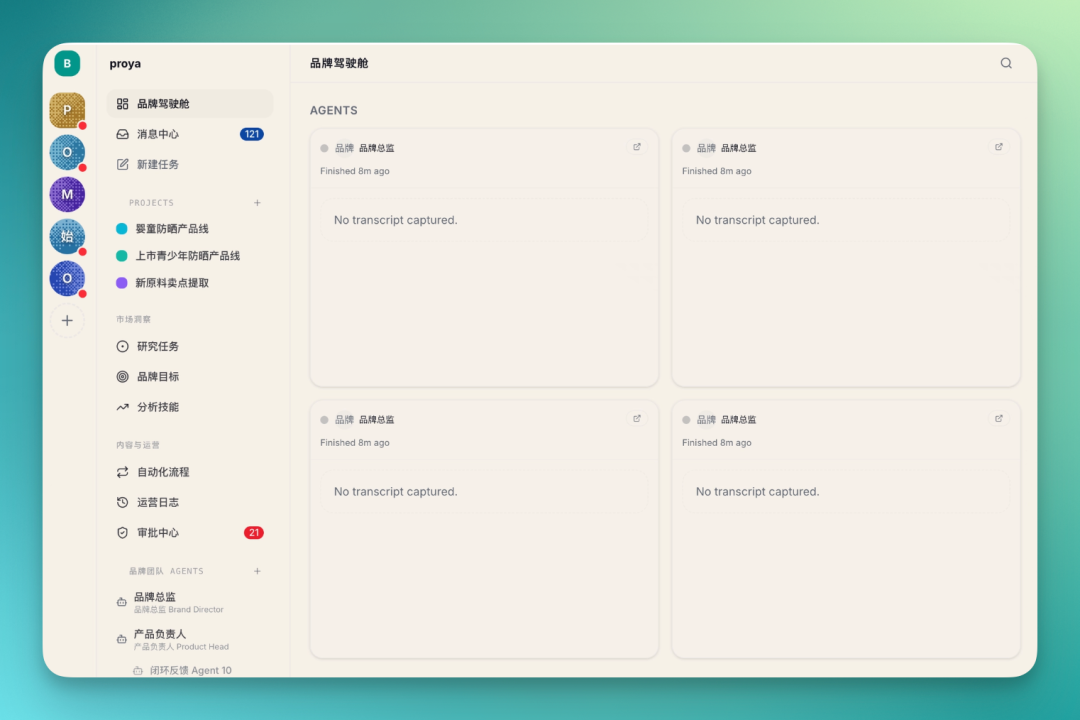
The far left of the main page shows multiple brands in parallel; the right side is the current brand's overall operations panel:
After entering a brand, the first thing you see is the Brand Cockpit. You do only one thing here: see the big picture. Which Agents are running, which tasks are in progress, how the data looks, what's happened recently — it's all on this screen:
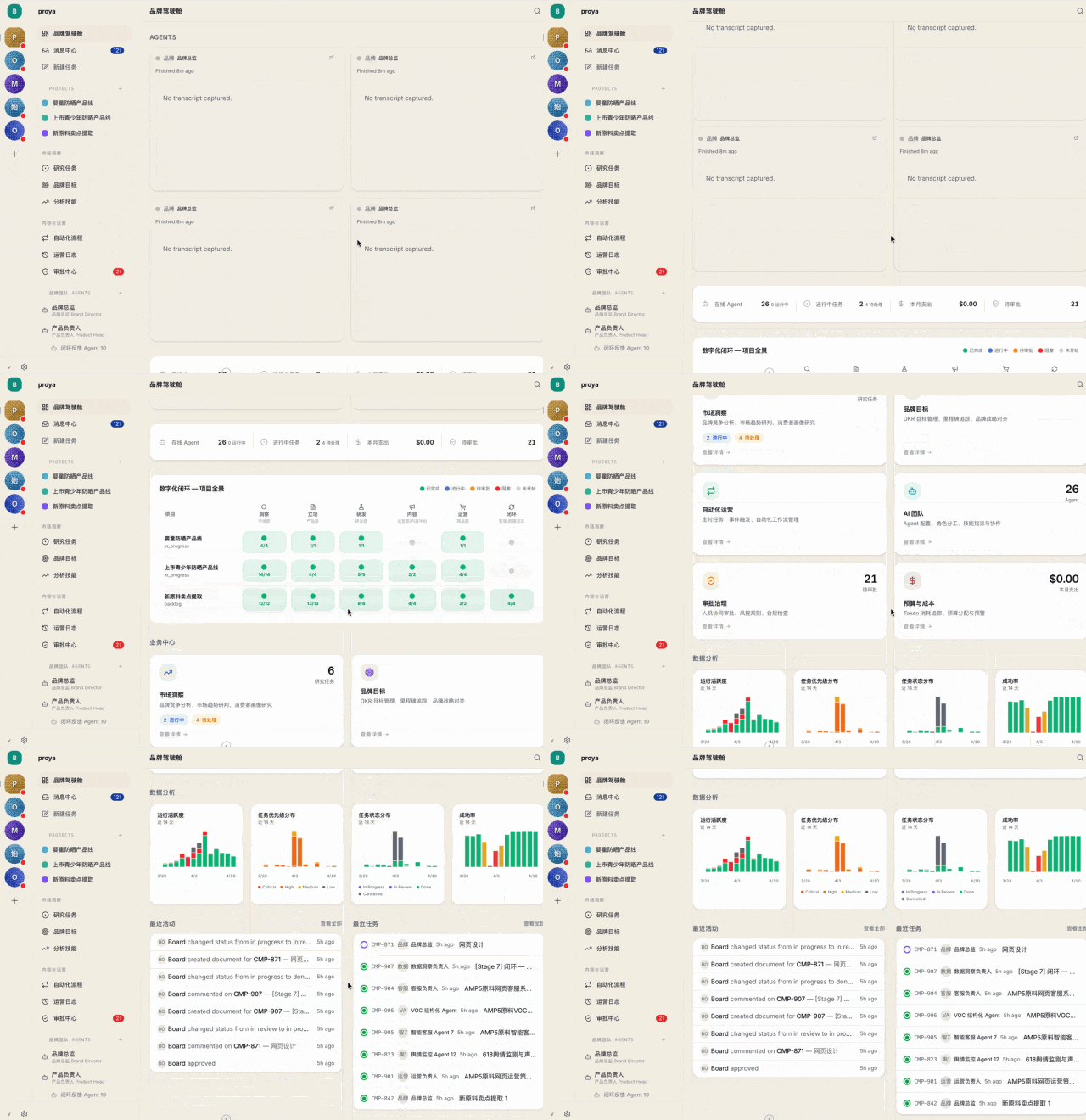
In the brand we tested, 26 Agents were running simultaneously at that moment, with a queue of pending tasks and several nodes awaiting human approval before advancing to the next stage. The overall feel closely resembled the live operations floor of a real brand.
These 26 Agents weren't handling the same type of task. Instead, they were running in parallel across different departments and different projects — some conducting market research, some generating content, some waiting on upstream approvals. From the cockpit view, the entire brand's operating state was readable: which lines were progressing normally, which nodes were stuck, you could basically tell by switching to this panel.
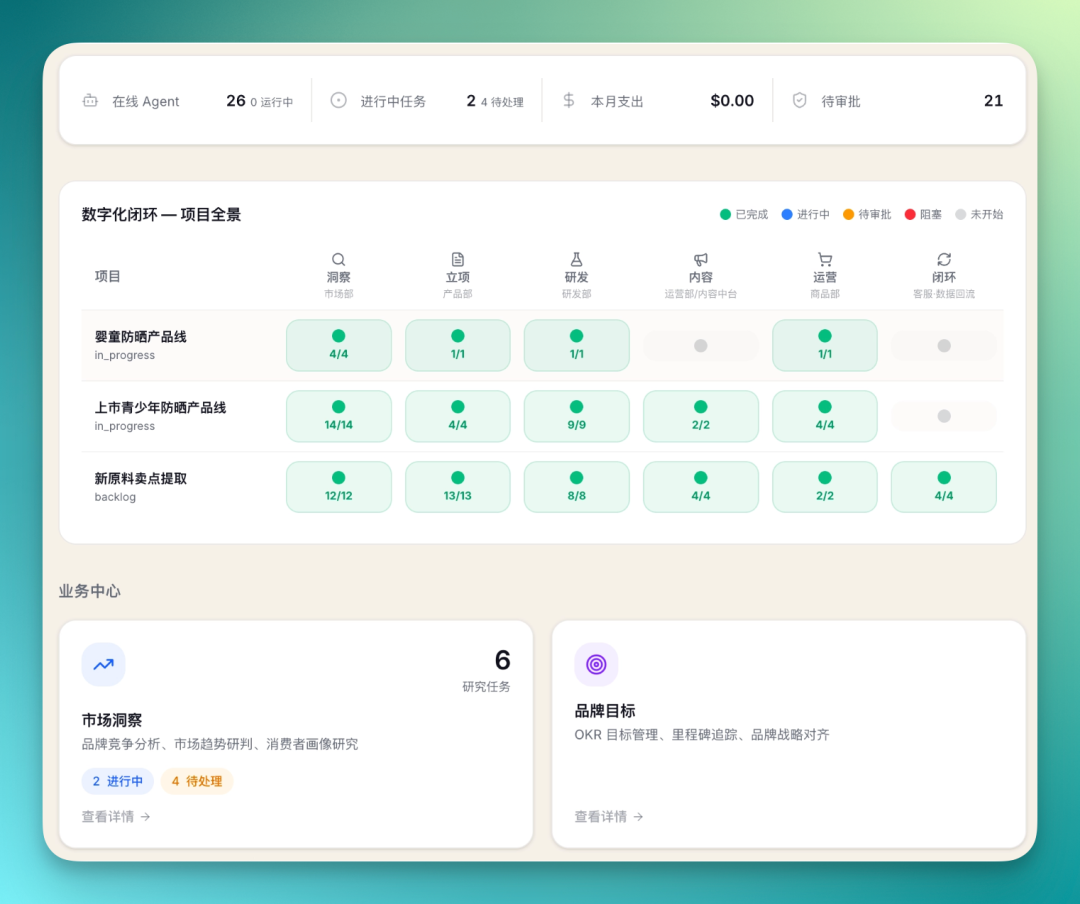
The full project overview under a brand — for instance, this sunscreen brand with multiple product lines, involving coordination across Marketing, Product, R&D, and other departments:
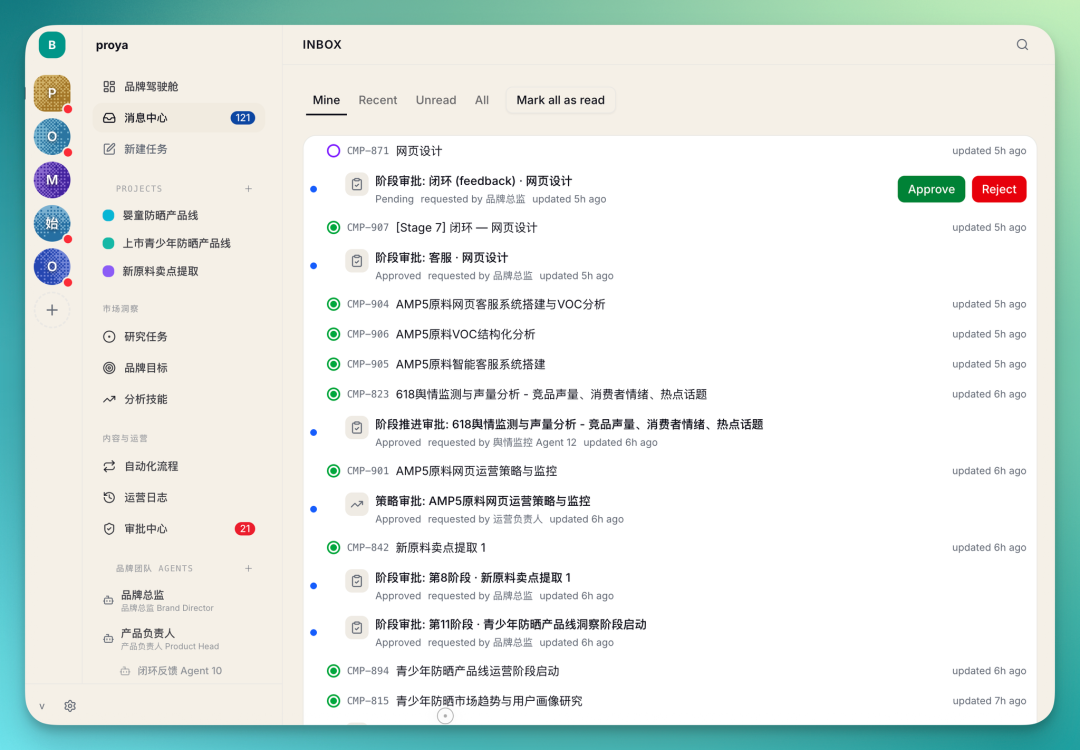
All log records of Agent execution flow into a Message Center resembling an inbox. Think of it as: all your Agent employees, whether Parent or Child, sending regular work reports to the CEO. What's completed, where decisions are needed — it's all aggregated here:
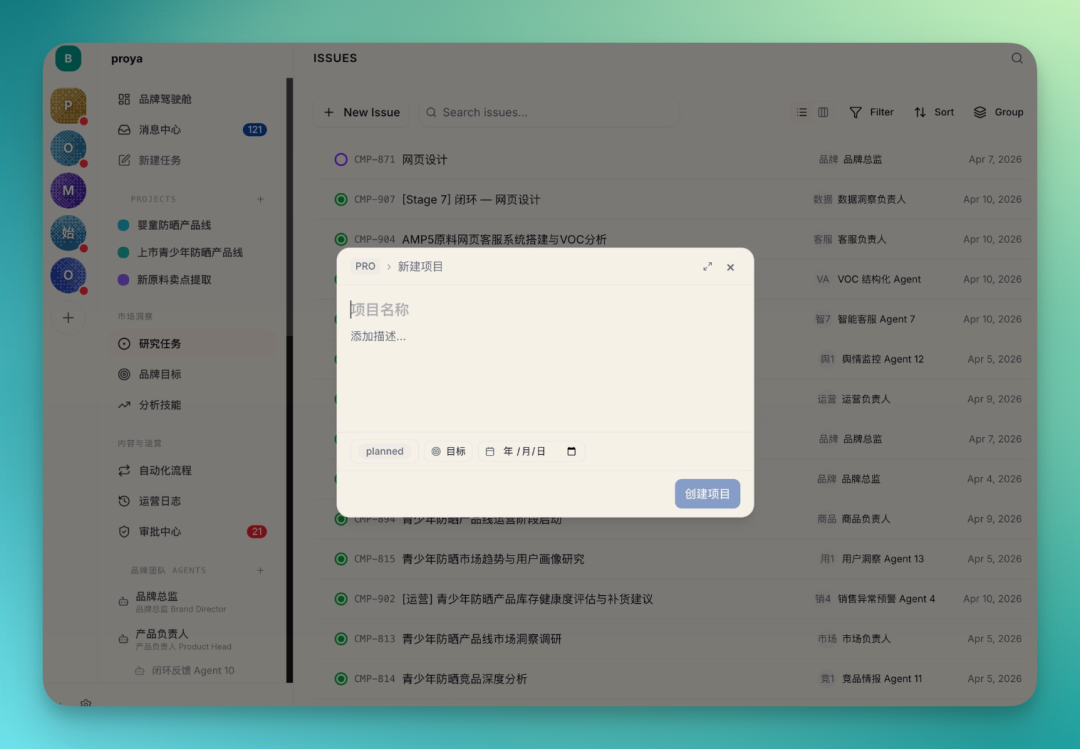
During testing, creating a new project proved far more intuitive than it appeared.
Click "Research Tasks" on the left, create a project directly, set goals and timeline. The system's logic simulates a real brand-building company, structuring the various tasks across the operations chain while simplifying the entry barrier:
After project creation, large tasks are first assigned to the corresponding Brand Director Agent — the Parent Agent for the entire project, effectively the general manager of this business line. It then breaks down sub-tasks according to business needs, distributing them to functional Child Agents for execution.
This breakdown happens automatically. You only need to set the broad direction and goals at the top level; the Brand Director Agent determines which Child Agents to deploy and in what sequence based on task nature. For cross-departmental composite tasks, it simultaneously pulls in relevant functional leads to handle their respective segments.
You don't need to manually direct every Agent. It feels more like briefing an experienced project manager than writing an execution manual.
You can also build out your brand team structure yourself, configuring functional roles one by one — Brand Director, Product Lead, Content Creative, Customer Service Lead, and so on:
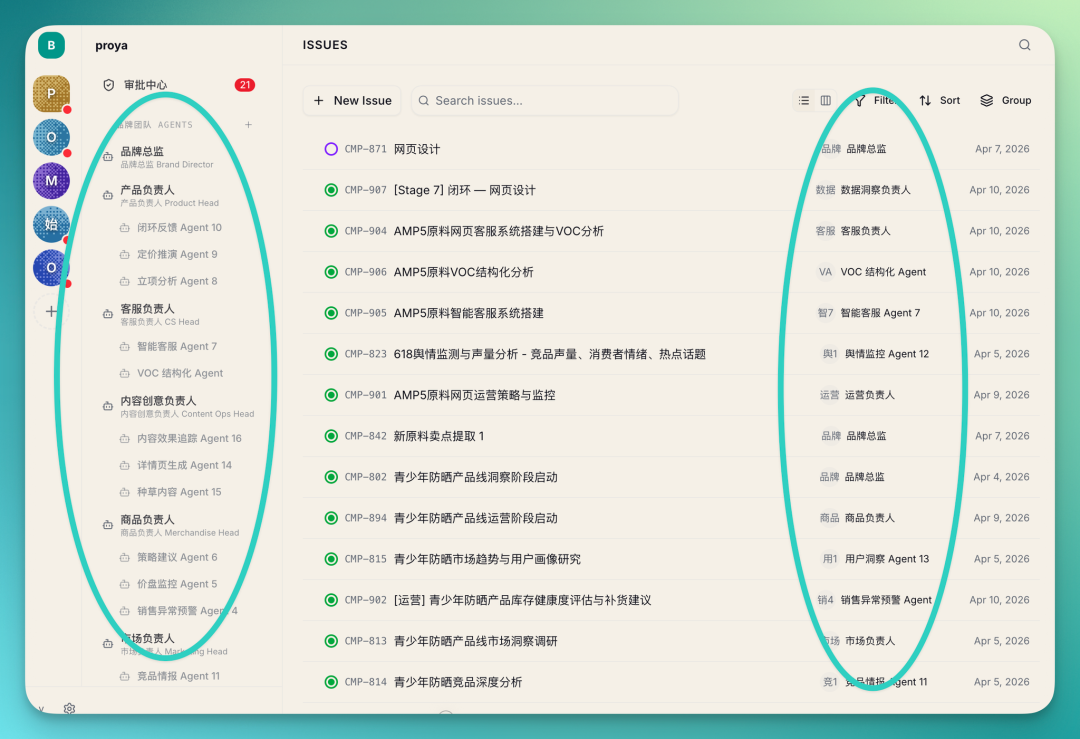
Each Parent Agent has its own dedicated system panel, recording its responsible task progress, historical execution results, deployed Skills, and budget details called during task execution:
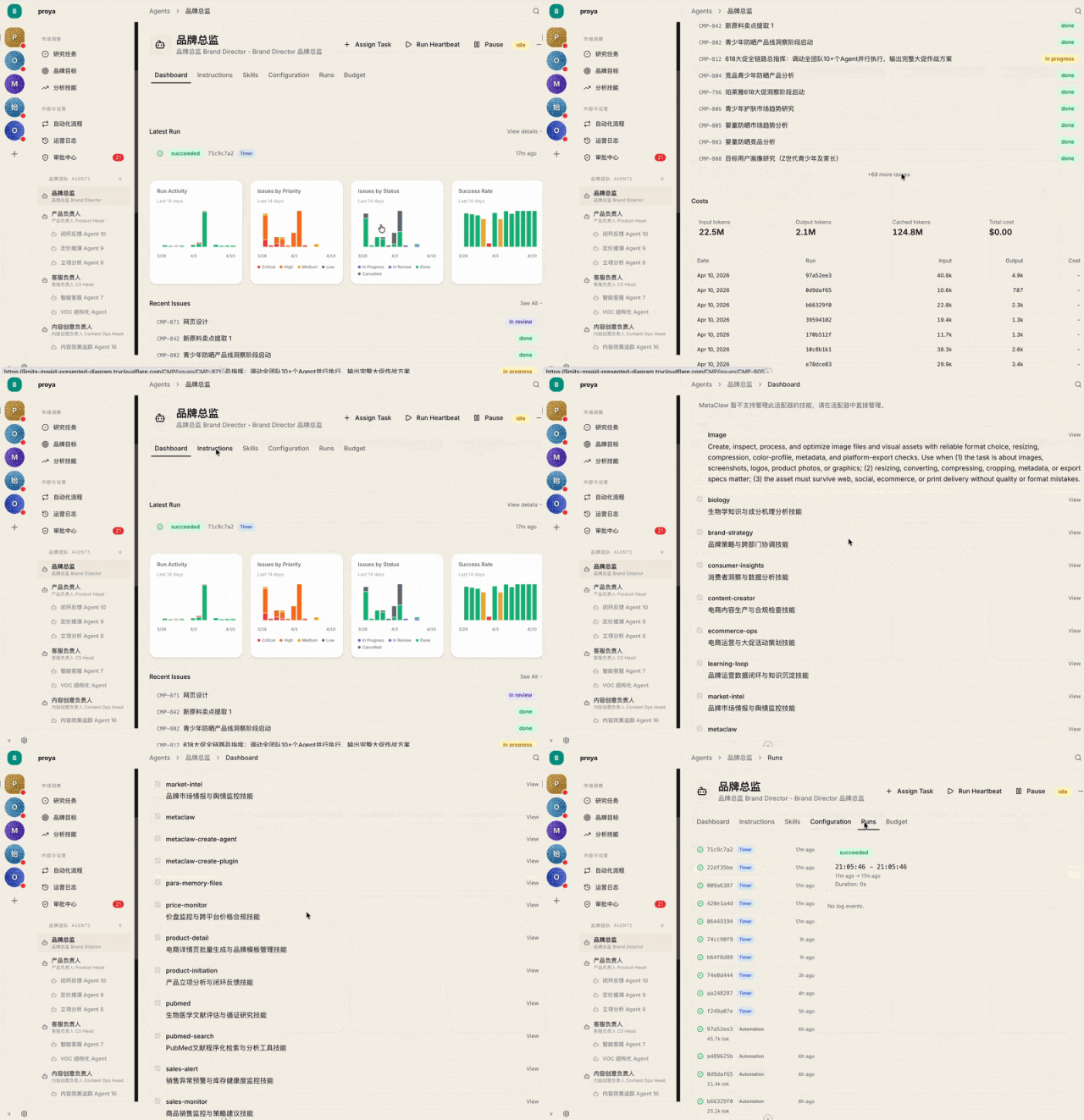
Taking the Product Lead Agent from our test as an example, entering its panel shows all recently processed tasks and their status:
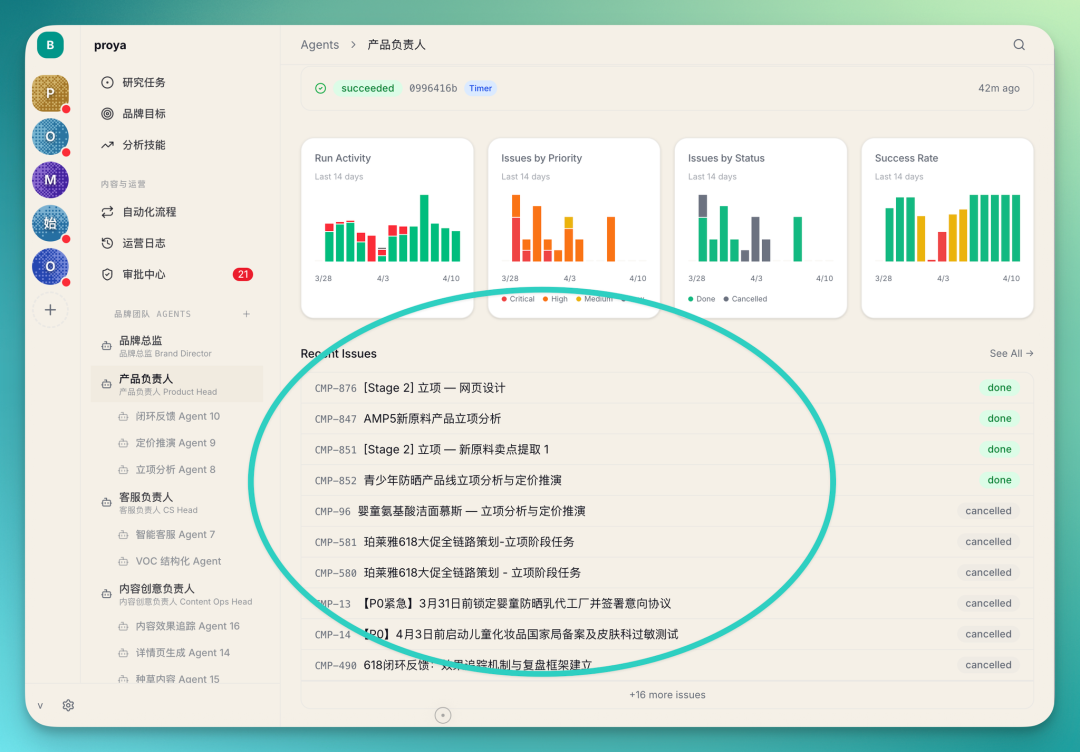
One of its Child Agents, specialized in raw materials research, output a complete research report covering greenlight recommendations, opportunity and challenge analysis, and preliminary pricing strategy:
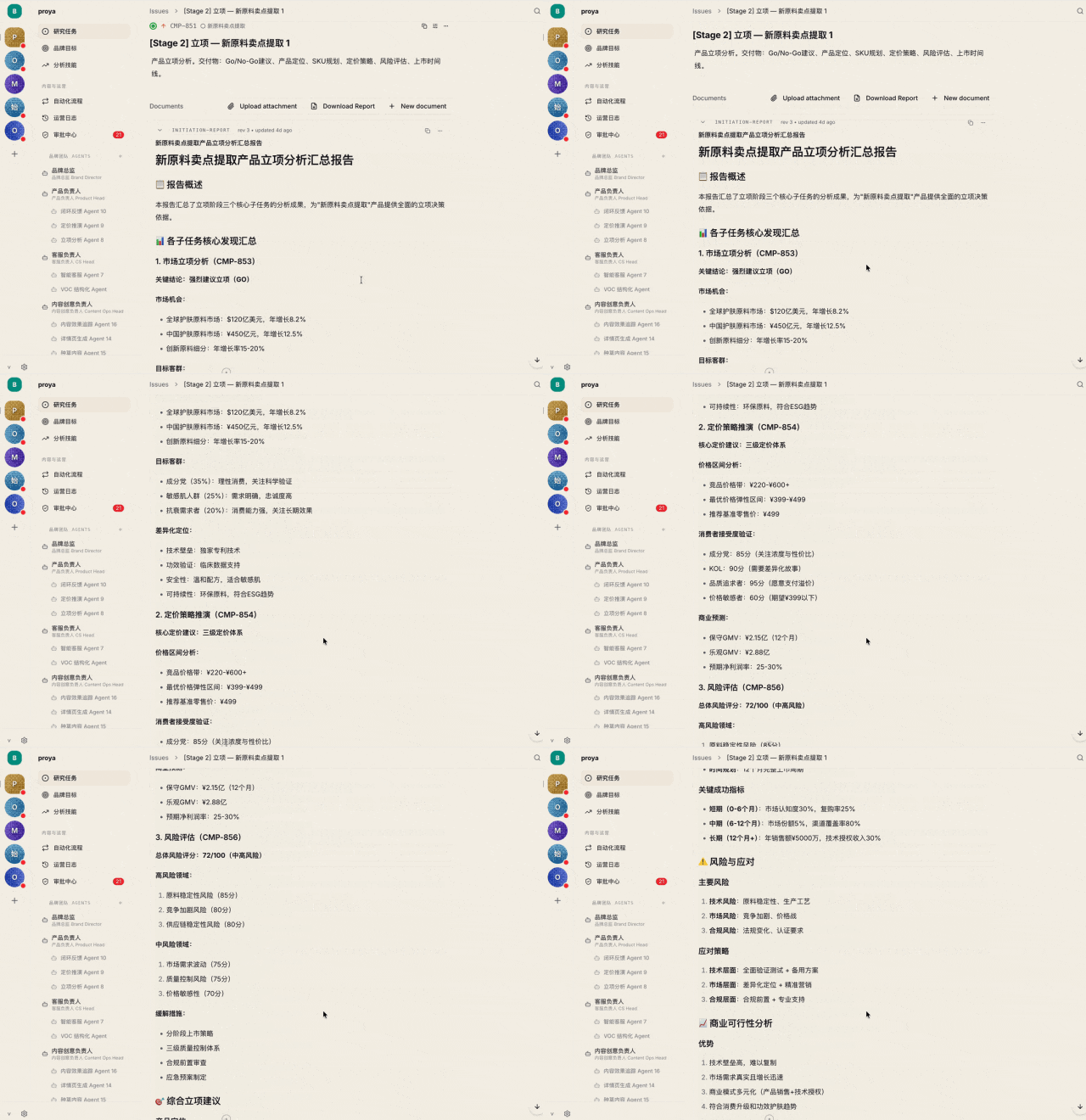
This report's content volume was substantial, covering competitive comparison, raw material market status, target audience analysis, potential risk warnings, and pricing recommendations with price range judgments.
Individually, this kind of workload typically requires considerable time to compile. Here it's the output of a single Child Agent task run. Of course, the quality of Agent-generated content still needs human judgment, but as a first draft and framework, the starting point is usable.
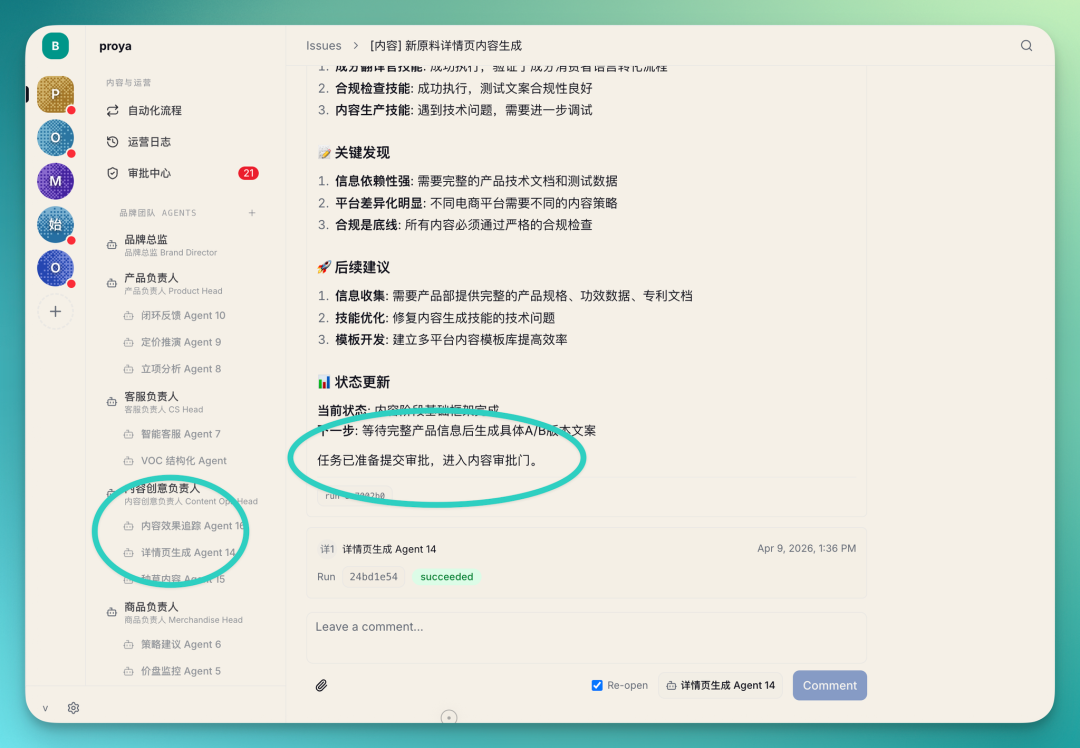
MetaClaw has one design that's fundamentally different from many "multi-Agent" products: the workflows of departmental Agents are serialized — each task automatically flows to the next according to business logic, rather than everyone managing their own patch independently.
For example, after the Content Creative Agent completes a new ingredient product page draft, outputting full copy and structural report, the task status automatically becomes "Pending Approval" and flows into the "Content Approval" department for next-step processing. The entire chain stays connected:
Most multi-Agent systems coordinate by splitting one task among several Agents, each doing their part, then aggregating results. But consumer brand business processes have strong sequential dependencies: content needs product direction before it can be written; product direction needs market research before it can be set; research needs competitive analysis before it can proceed.
MetaClaw's serialized design follows this real business chronology — each step's output becomes the next step's input, and tasks don't jump the gun by starting before they should.
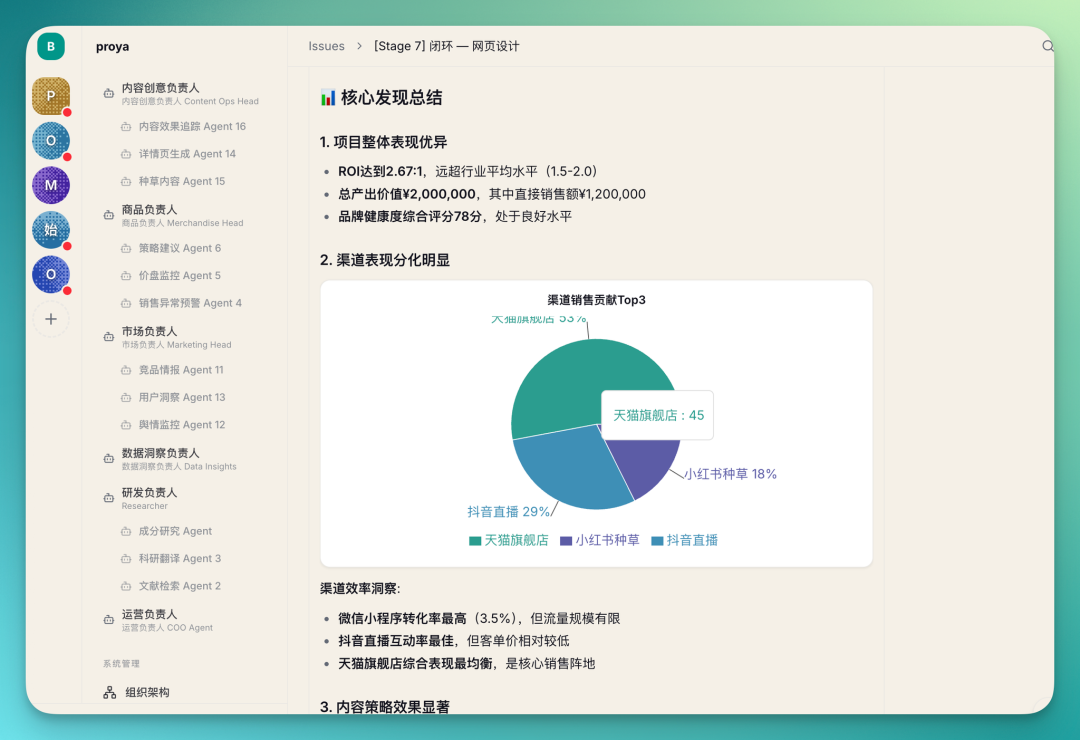
In the specific web design project, the same pattern applied: after execution completes, the system generates visualized channel performance analysis charts and archives a project summary:
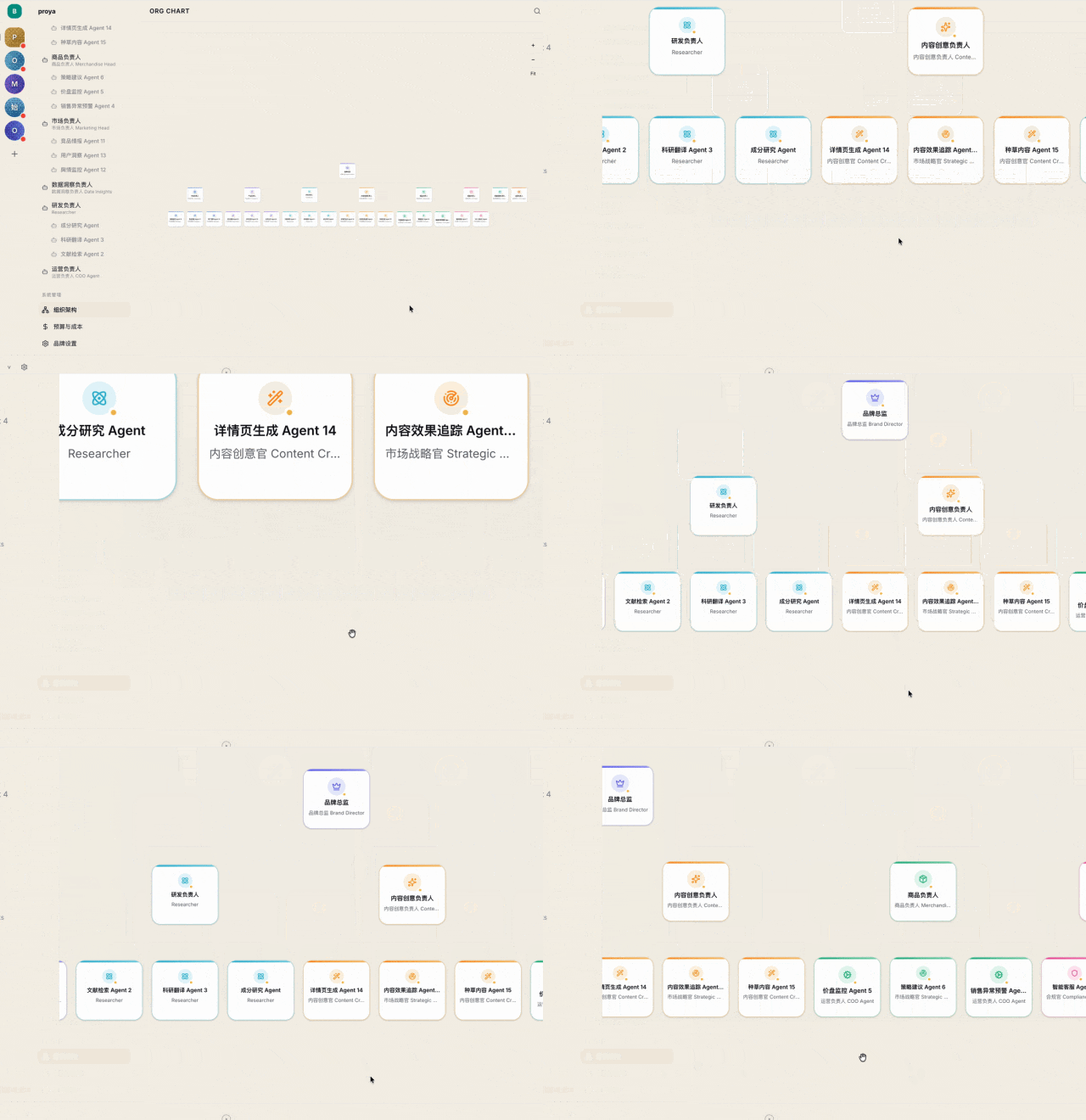
As more Agents accumulate under a brand, MetaClaw visualizes all Agents in an org chart format — Parent Agents, Child Agents, their respective functional scopes, and hierarchical relationships at a glance:
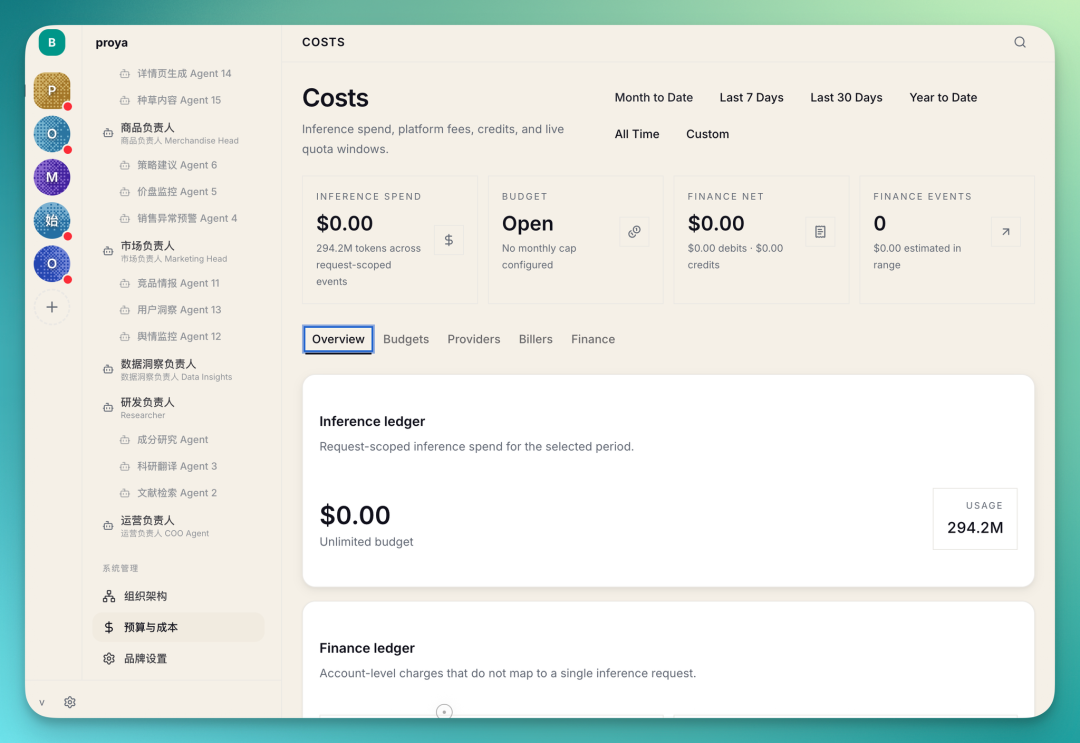
All budget consumption, cost allocation, and key milestones during brand building are recorded in the underlying Budget and Cost panel:
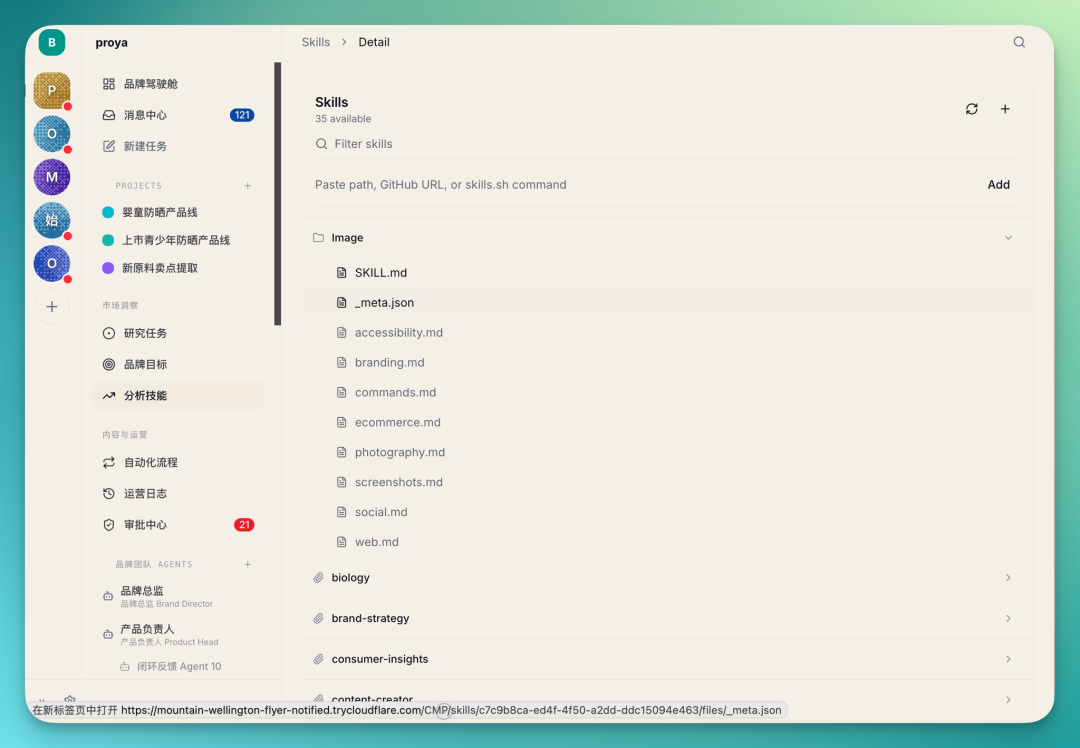
For Agent capability expansion, MetaClaw offers a fairly open approach: directly paste a GitHub link or upload locally to load new Skills for an Agent, extending the types of tasks it can handle:
Throughout the operation, the human user as brand CEO has only one core responsibility: approving at key nodes.
Whenever an Agent completes a phase-level task, it flows to you for a decision: "approve to next stage" or "send back for rework." Execution details don't require intervention, deployment doesn't require follow-up — the CEO is the final decision layer of the entire system, not the execution layer:
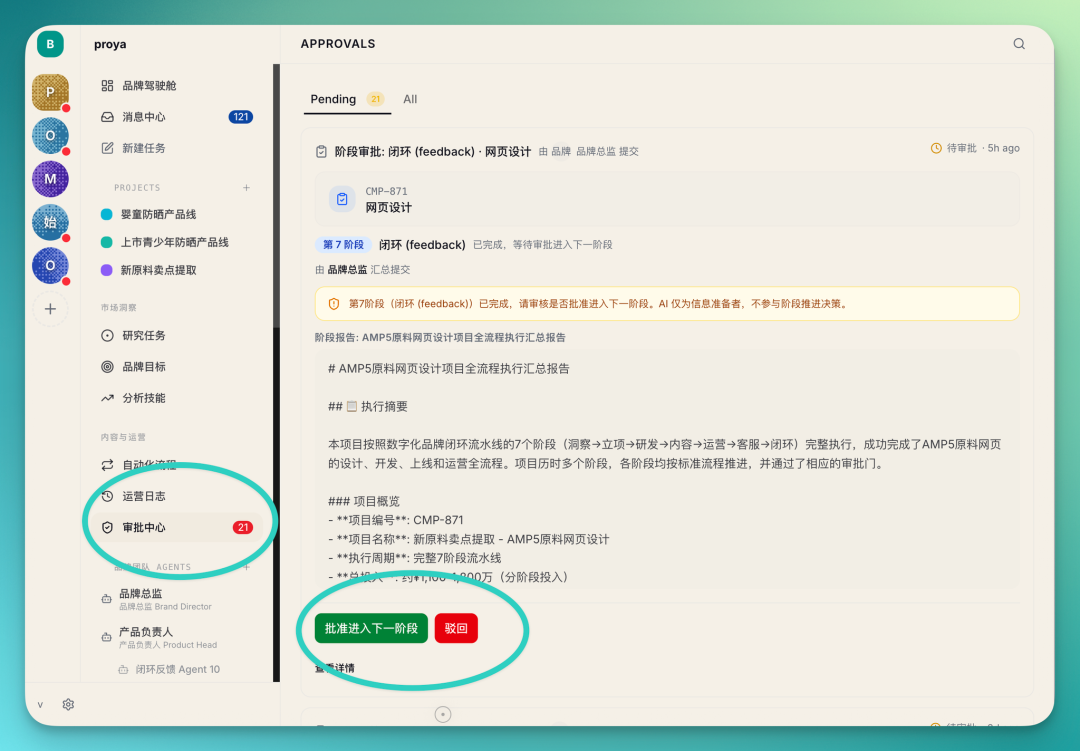
One design detail worth noting: MetaClaw's approval nodes don't surface every task. Only steps involving brand direction judgment, budget decisions, or upstream-downstream handoff impact require the CEO's sign-off. For other detail tasks, Agents complete and flow them autonomously, without consuming decision-layer attention.
Using it creates a fairly clear sense of authority and responsibility — you know what you should manage and what you don't need to.
All Agent execution records also aggregate into an Operations Log, searchable by time, department, and task type, facilitating post-hoc review of any decision node's specific execution:
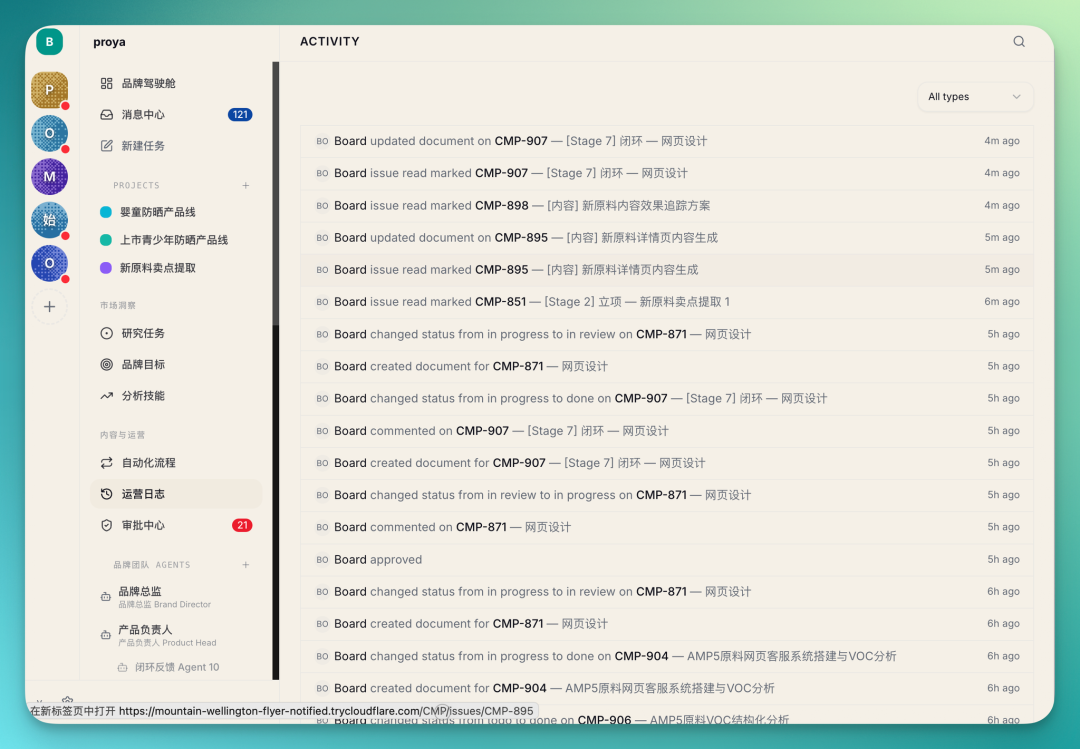
For a brand, this log also serves as the work archive of the entire Agent team — problems can be traced to source, and good performance is documented.
After completing the test, it's worth stepping back to ask: What is MetaClaw solving, or attempting to solve?
The particular difficulty of the consumer goods industry is that its operating chain is among the longest of any sector. Raw materials, R&D, product, content, channels, customer service — each link is an independent professional domain. Connecting them requires an OS layer that understands the logic of the entire chain. There are many AI product manager and AI CMO Agent products now, but no matter how smart a single tool or single-role Agent is, it likely can't reach this position.
If explained in one sentence, roughly:
The way AI impacts the consumer goods industry may differ from what most people imagine. Equipping each department with faster tools isn't the endpoint; getting an Agent OS to串联 the entire business chain's operation may be the real direction.
However, this path itself is still early. Getting a brand to truly hand its core business chain to an Agent OS involves not just technical issues — organizational adaptation, data permissions, decision trust, and other supporting problems, none of them easy, all of them difficult, and collectively, friction remains a factor that can't be ignored.
🚥
MetaClaw officially opens for testing in April. How brands actually use it in practice and what real experiences get shared then — that's the interesting part.
From AI for Science to the brand shelf, running the entire chain through Agents — whether this can truly work, more data will speak soon.
Crossing is looking for independent writers to cover AI product and model reviews.
If you've written similar articles: "Hands-on: PixVerse C1", "Hands-on: LibTV", please contact zeo0811@gmail.com. Email should include: ① personal introduction, ② AI review articles you've written.
We offer competitive rates. Looking forward to observing and documenting the AI era together 🎪