After Raising $30 Million, This Company Handed the "Steering Wheel" to AI | An Interview with CREAO

AI for the Employee, or the Employee for AI?
AI for Employees, or Employees for AI?
👩 Interviewer: Ms. Yi
🥷 Editor: Crossing
🧑🎨 Layout: Zeooo

In 2026, a new inflection point is emerging for AI.
Large models keep evolving, but "conversation" is no longer novel. Enterprise customers are asking a more pragmatic question: How much actual work can this thing do for me?
Attention has shifted from "how big is the model" to "how reliable is the agent." OpenAI, Google, and Anthropic have each launched agent orchestration frameworks, while startups are drilling into more vertical scenarios — legal, finance, marketing, customer service. The race has moved from "the battle of a hundred models" to "the battle of a hundred agents."
In this agent competition, CREAO is a distinctive presence. This Silicon Valley startup that got an early start — how does it plan to compete with the giants? Where does its moat lie? Why are users willing to pay $1,440 per year for a subscription?
With these questions in mind, we sat down for a long conversation with Kai Cheng, CREAO's founder and CEO, and Peter Pang, CTO. They spoke candidly about real product data, the source of their technical barriers, the complete AI Native development workflow, and major strategic pivots — all disclosed by CREAO for the first time.
Rapid-Fire Q&A
🚥 Crossing
Age?
👦🏻 Kai Cheng
36
🧑💻 Peter
38
🚥 Crossing
Alma mater?
👦🏻 Kai Cheng
Undergraduate in Mathematics, University of Toronto; Master's in Statistics, Columbia University
🧑💻 Peter
PhD in Physics, Stony Brook University
🚥 Crossing
MBTI and zodiac sign?
👦🏻 Kai Cheng
ENTJ, Gemini
🧑💻 Peter
INTP, Pisces
🚥 Crossing
One sentence to describe your current company and product?
👦🏻 Kai Cheng
CREAO, based in Silicon Valley. We build Agent OS — a platform for users to create, manage, and run AI agents.
🚥 Crossing
Funding status?
👦🏻 Kai Cheng
From early last year to now, we completed three rounds within one year, totaling roughly $30 million.
🚥 Crossing
Revenue and profit?
👦🏻 Kai Cheng
The new 3.0 product has been live for two weeks, and the numbers are better than expected, but specific amounts aren't disclosed yet.
🚥 Crossing
Team size?
👦🏻 Kai Cheng
Around 20 people
🚥 Crossing
One sentence on what you were doing before this?
👦🏻 Kai Cheng
Founded Yuyi Technology in 2016 and served as CEO, providing AI solutions to 500+ global enterprises.
🧑💻 Peter
Worked as an Applied Scientist at Apple and Meta, led core system development for LLaMA 3.
CREAO: An Agent OS for Work Automation
🚥 Crossing
First, briefly introduce what kind of company CREAO is. And why, in 2026, are you still building a "general-purpose agent"?
👦🏻 Kai Cheng
Let me answer the first question.
CREAO is an AI company based in Silicon Valley. Our core mission is simple: make AI actually work in real work scenarios.
CREAO's starting point was very down-to-earth. When large models emerged in 2023, everyone was excited. But look inside enterprises, at actual work scenarios — nobody was really using AI. We had served some large companies, like Procter & Gamble, who were willing to pay 20,000 RMB for a single prompt. Twenty thousand, for one prompt. That tells you how desperate people were, and how little they knew where to start.
So from day one, we focused on one problem: regardless of what model sits underneath, how do you make people and work scenarios genuinely more efficient? And if possible, fully automated.
🧑💻 Peter
I'll add to that. As for why we're still doing a "general agent" in 2026 — we don't fully agree with that label.
We're not building another ChatGPT. We're building Agent OS — a platform for users to create, manage, and run agents. This isn't general chat. It's work automation.
The competition in this space is far from over. In fact, the real competition is just beginning.
Previously, everyone was competing on "who can chat more like a human." Now it's "who can reliably complete tasks." Entirely different game. You need to build a complete harness system — memory, self-healing, context management. These are real moats, not something you slap an API layer over.
Currently, 80%-90% of agents built on our platform are being reused, steadily executing work tasks — not the disposable kind you chat with once and discard.

🚥 Crossing
CREAO — why that name?
👦🏻 Kai Cheng
Lots of people ask this.
The origin is actually quite plain. Our earliest direction was synthetic data, and the concept we proposed was "using AI to create AI," so we took the root "Crea" from "Create." But all the domains were taken, so we improvised and came up with CREAO — sounds decent enough.
I think once a name becomes a real brand, it naturally gains meaning. Before that, no amount of backstory helps.
ARPU at 5-6x Comparable Products
🚥 Crossing
Your 3.0 product — Agent OS — has been live for two weeks. How's it actually performing? Any concrete numbers — paid orders, average deal size?
👦🏻 Kai Cheng
We officially launched on March 31. Less than two weeks in, growth is exceeding our own expectations. But I can't disclose specific amounts right now.
Currently, registered users are between 300,000 and 400,000, with 85%-90% using it in work scenarios. Agent reuse rate — the proportion of users who keep using what they built — is 80%-90%. Completely different from 1.0, where people built something and never touched it again.
ARPU (average revenue per user) is roughly 5-6x that of comparable products. We're on monthly subscription plus credit consumption, priced highest in our category, but users are willing to pay. Many have opted for annual subscriptions.
🚥 Crossing
Who's paying $1,440 per year? What's the user profile like — can you give one or two concrete examples?
👦🏻 Kai Cheng
The core user profile is very concentrated — lawyers, finance professionals, CPAs, marketers. Lawyers are currently our most concentrated vertical.
Case one: we ourselves are the deepest power users. Inside CREAO, AI has permeated nearly every function. Product release notes are auto-generated by AI from changelogs. Feature demo videos are AI-produced. Daily social media posts are AI-orchestrated and auto-published. Health reports are auto-generated from the database... Roughly 85%-90% of GTM work is completed by the product itself.
For example, Peter spent two weeks using CREAO's agents to rebuild the entire product architecture.
Case two, a North American lawyer. He built several agents on CREAO to automate contract review, case research, and client correspondence. Work that previously required a paralegal, he now handles alone. The agents run stably every month.
The logic for why these people pay premium prices is simple: they're not calculating "how much is this AI tool worth," they're calculating "how much labor cost does this agent save me." A lawyer's or accountant's time costs far more than $120 per month.
🚥 Crossing
Lawyers, accountants — these clients are extremely sensitive about data security. What product-level designs have you implemented to earn their trust?
🧑💻 Peter
The most critical thing: we provide an independent Sandbox environment for every single user request. Every single one. User code, data, and context are fully isolated. API keys are managed through a Secret Key Management system, encrypted at rest, unviewable after creation, and only called as environment variables inside the Sandbox.
At the infrastructure level, everything runs on AWS with auto-scaling and circuit breakers for automatic rollback — if metrics degrade post-deployment, the system rolls itself back. We have a complete monitoring and alerting system.
🚥 Crossing
If you had to summarize right now, what do you think are the most important things for building a great agent product?
🧑💻 Peter
First, the harness system. OpenAI published the concept of "harness engineering" this February: engineering teams' main job is no longer writing code, but making agents work effectively. We reached this conclusion before they published it.
Second, memory and context management. The more you use it, the more the agent understands you — it's a flywheel.
Third, self-healing loop. This is also core to our system. Every morning it auto-runs health checks: AI analyzes error patterns, auto-generates tickets. After fixes, the system re-checks, and tickets auto-close when bugs are resolved. This forms a self-healing closed loop.
Fourth, reliable infrastructure. Independent Sandboxes, six-stage deployment pipelines, triple AI code review — these "boring" engineering tasks are precisely the foundation of user trust.
"We Redesigned Everything Around AI"
🚥 Crossing
Who are your benchmark competitors? What products do users typically compare you to? And what do you see as the fundamental difference?
👦🏻 Kai Cheng
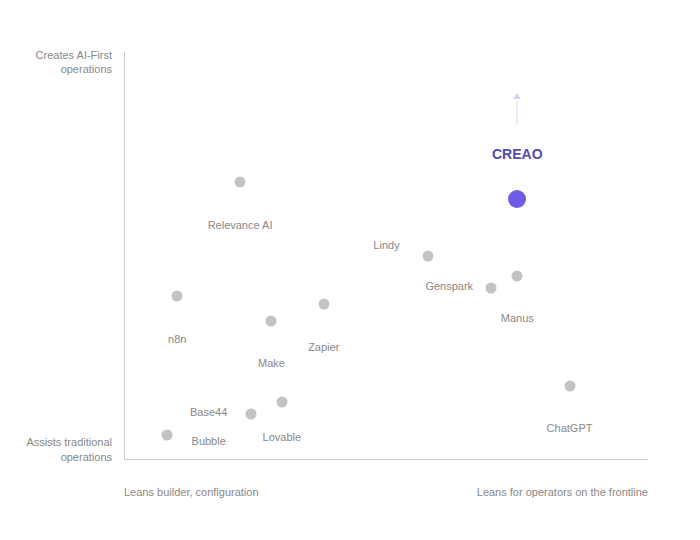
First, our positioning is Agent OS. We're not primarily benchmarking against any single product, but against future entry-level products for work scenarios.
Users often compare us to a few categories: First, workflow automation tools like Zapier, Make, n8n — these are rule-driven, users design the flow themselves; we're AI-driven, natural language description suffices.
Second, conversational products like ChatGPT, Claude — assistant-type, one conversation at a time; we build repeatable running agents.
Third, code agent platforms like Cursor, Replit — can build but lack persistent scheduling.
Plus, various vertical AI tools. These may work well in a single domain, but users' work is multi-dimensional — that's our advantage.
🧑💻 Peter
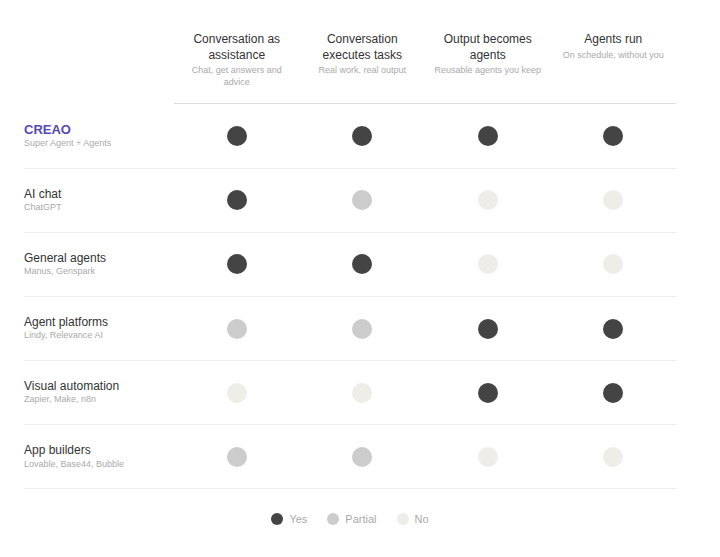
Our uniqueness is that we're probably the only product covering all four capability layers simultaneously: Assist, Execute, Create repeatable agents, and Run/Orchestrate/Improve.
But the more important difference isn't the feature list — it's that we redesigned everything around AI.
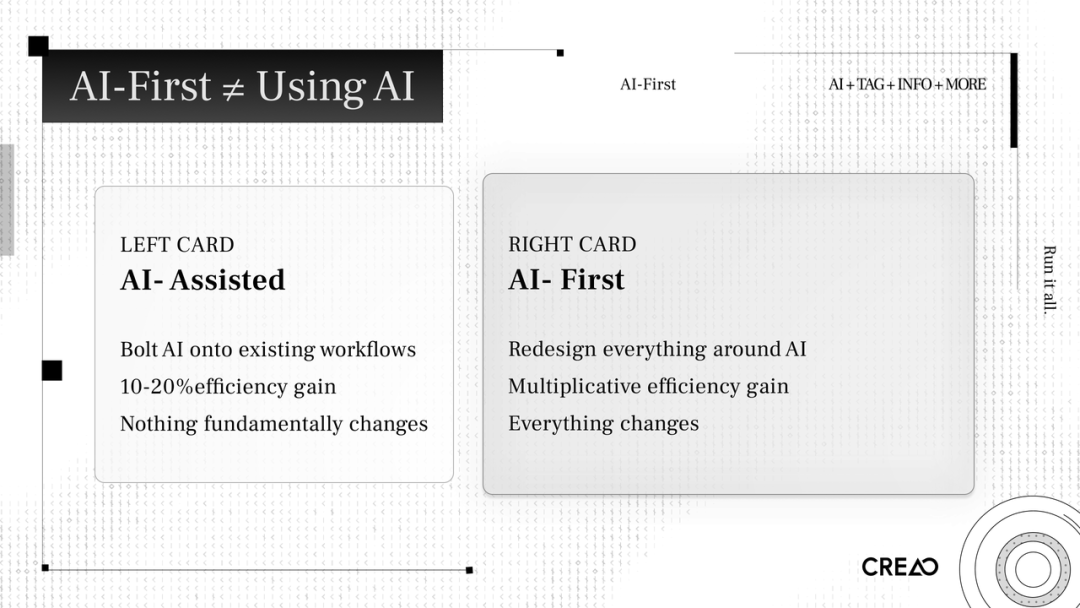
Most companies are "AI-assisted" — adding a Copilot to existing workflows, 10%-20% efficiency gains, but no structural change. We're "AI-first" — redesigning processes, architecture, and organization so AI becomes the primary builder, with humans providing direction and judgment.
That difference is multiplicative.
🚥 Crossing
Have you challenged any benchmarks? Is there any leaderboard that demonstrates your advantage?
🧑💻 Peter
Frankly, no. Traditional benchmarks don't apply well to agent products.
Two reasons. First, agents focus on multi-step execution, not single-turn text generation quality. Second, and more importantly: tasks that agents execute in work scenarios rarely have standard feedback loops. Writing an article, producing an analysis report — there's no right answer, making subjective quality judgment difficult.
So we haven't focused on leaderboard climbing. Our benchmark is operational data — user retention, paid conversion, DAU. The rise of these metrics is more persuasive than any ranking.
🚥 Crossing
You repeatedly mention "labor work" as very important. Can you give a concrete example of what happens if this isn't done well, where exactly does the user experience suffer?
🧑💻 Peter
Take AI-generated PowerPoints.
Every AI product can do this; underlying model differences are minor. Differentiation comes down to templates.
Compare two platforms. Platform A invested heavily in designers and frontend engineers, accumulating 500+ high-quality templates covering business reports, educational slides, marketing plans, investor pitches. Platform B has only 20 generic templates.
User says "make a Q2 marketing review deck": Platform A can recommend the most suitable template based on industry, historical preferences, usage memory — the output is ready to use. Platform B generates something that looks like "generic AI slides," and the user spends significant time adjusting.
That's the value of labor work. AI capability is the foundation, but templates, prompt engineering, scenario adaptation — these human-polished elements determine the final 20% of experience gap. And that 20% often determines whether users renew.
But it's not just templates. I wrote in an engineering blog: you need people with "product taste." They can glance at AI-generated UI and know what's off, spot problems before users complain.
This judgment AI can't yet replace.
"We're Only 25 People, Transition Friction Is Minimal"
🚥 Crossing
Claude recently launched Managed Agents. The differentiation advantage of building your own harness has clearly been leveled — everyone is somewhat back at the same starting line. In this situation, how does your advantage show?
🧑💻 Peter
Let me acknowledge a fact: in the AI era, specific product features themselves won't become massive differentiators. Whatever you have today, others may have in three months.
So our competitive edge was never "I have a harness and you don't." Claude's Managed Agents did lower the barrier. But the question isn't having a harness, it's organizational iteration speed.
Here's a number. Last Tuesday, we launched a new feature at 10am, finished A/B testing by noon, killed it by 3pm because data was poor, and had a better version live by 5pm. Three months ago, that cycle would have taken six weeks. Over the past 14 days, we've averaged 3-8 production deployments per day.
Also, Claude's Managed Agents are more like API-layer capabilities. What we built is a complete delivery system — six-stage deployment pipeline, triple AI code review, self-healing loop, auto-triage engine. Each tool handles one stage; none tries to do everything.
And then there's the small-company transition advantage. Large companies face enormous resistance going AI native. We're only 25 people. Transition friction is minimal.
🚥 Crossing
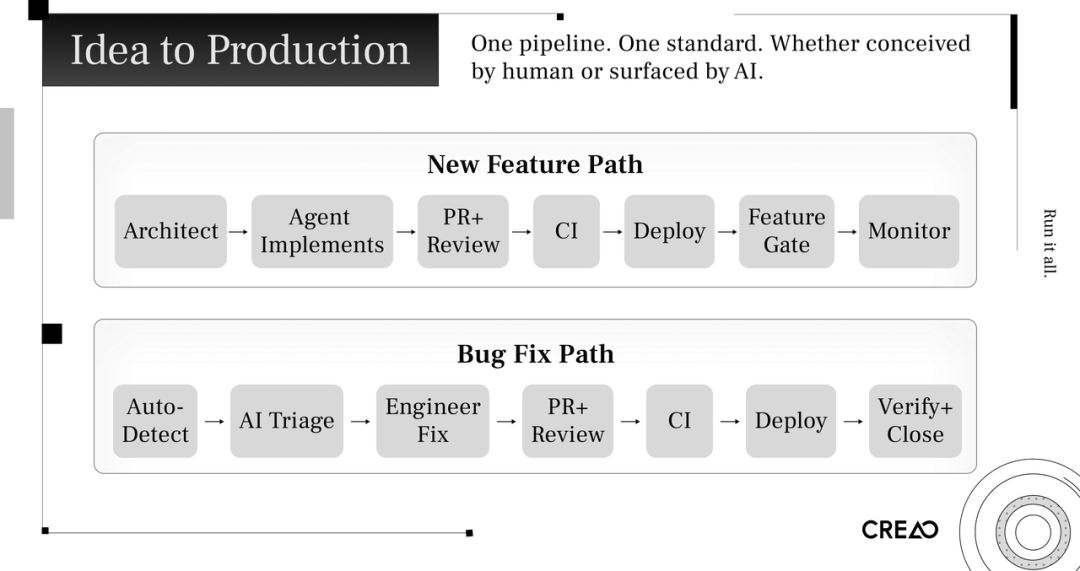
You internally use an "AI Native" approach to product development, going from idea to launch in just hours. Can you walk through this process — how was some real feature completed within a day?
🧑💻 Peter
Sure, I'll walk through the actual development flow.
Step one: Architect defines the task. The architect writes a structured prompt — not a traditional PRD, but directly AI-readable instructions including codebase context, goals, and constraints.
Step two: Agent auto-decomposes the task, plans implementation path, writes code, and writes test cases along the way.
Step three: Triple AI review launches in parallel. On PR submission, three parallel Claude reviews auto-trigger — code quality, security review, dependency scan. Human reviewers only look at strategic risk, not line-by-line correctness. At 8 deployments a day, no human reviewer can maintain attention across every PR.
Step four: Six-stage deployment pipeline. It includes: validate CI → build deploy Dev → test Dev → deploy Prod → test Prod → release. No stage can be skipped, no manual override. The pipeline is deterministic, so agents can predict outcomes and reason about failures.
Step five: Feature flag gradual rollout. Every feature launches behind a feature gate — team-only first, then gradual ramp, then full rollout or kill. Kill switch can instantly shut off a feature without redeployment.
Step six: Results-driven A/B testing. Data says this direction is wrong? Kill it immediately, team moves to next iteration.
The result: past 14 days, averaging 3-8 production deployments per day. Under the old model, two weeks might not complete a single launch.
🚥 Crossing
Looking back at two years of entrepreneurship, what were the key technical breakthrough moments?
👦🏻 Kai Cheng
Three phases.
Before 2026, we were in 1.0 phase, doing vibe coding.
At that time, we benchmarked against Lovable, Replit — using coding approaches to help users build apps. But we hit a problem: what got built lacked AI capabilities, so usage rates were low.
The turning point came in February 2026, with Opus 4.6's release. Peter judged at the time: "What Opus 4.5 couldn't do, 4.6 can." This leap was decisive — coding agents jumped from junior to senior level.
We made a bold decision then — unify all code into a single monorepo. Our logic: let AI see the full picture. Fragmented codebases are invisible to agents. Only with unification can agents understand the entire system.
That was also the 2.0 phase, February-March 2026. We spent one week designing the new architecture, then another week having agents rewrite the entire codebase themselves. Yes, we used our own agents to rebuild the platform.
Currently, post-March 31 launch, we're in 3.0 phase — Agent OS.
CREAO Key Timeline:
| Time | Event |
|---|---|
| End of 2024 | Company preparation, core team formation |
| Late January 2025 | Company officially established |
| June 2025 | Team fully staffed, formal product building begins |
| September 2025 | Vibe coding product launches |
| June-August 2025 | Decision to pivot from vibe coding direction |
| February 2026 | Opus 4.6 release triggers architecture rebuild; entire technical architecture rebuilt in two weeks |
| March 9, 2026 | Formal pivot to Super Agent product |
| March 31, 2026 | 3.0 Agent OS launches |
CTO Personally Coding Until 3am
🚥 Crossing
Two years in, does today's state match your expectations? Any key moments you feel you missed?
👦🏻 Kai Cheng
Product revenue-wise, exceeding expectations. But what the team cares more about is our own product usage depth. Take marketing: roughly 85%-90% is already automated, 10% still needs human touch — we want to keep improving that.
On whether we missed timing? We don't think so. In November 2025, we decided to pivot from vibe coding. At the time, vibe coding was still growing, but we judged its ceiling to be limited.
If there's one biggest lesson, it's that traditional processes are too slow.
Peter said something that stuck with me — "Spending months thinking about something, then finishing it in two hours, makes no sense."
So we made the AI native transition, compressing decision cycles from "months" to "days," dramatically improving efficiency.
Our CTO, Peter himself, also shifted from management mode to builder mode. Peter is hands-on now, coding from 9am to 3am daily, transforming from manager to system architect.
"Data Decides, Not Who Decides"
🚥 Crossing
What's the internal decision-making mechanism? When you two disagree, how do you decide?
🧑💻 Peter
Core principle — validate ideas with results, not determine direction by authority.
When a new idea emerges, we don't first hold meetings to debate. We let AI analyze which parts can be directly validated and which need human judgment. What can be tested, gets tested — A/B testing, data analysis, log monitoring to collect feedback. Data decides, not who decides.
Another change: post-transition, my relationships with co-founders and engineers actually improved. Previously, most internal interaction was alignment meetings — discussing tradeoffs, arguing priorities, technical decision disputes. Necessary under traditional models, but draining.
We still chat now, but about other things — non-work topics, light conversation. Because we're no longer arguing over work that systems can easily handle.
The PM role is also changing. Traditional PMs spend weeks researching, designing, writing specs. But when an agent can implement a feature in two hours, a weeks-long planning cycle becomes the bottleneck. PMs need to evolve into product architects who can keep pace with iteration speed, or exit the build cycle.
🚥 Crossing
In an AI First environment, do employees feel "managed" by AI? How do you balance human creativity and initiative?
👦🏻 Kai Cheng
This is a very real question. I won't pretend everyone is happy.
Peter has discussed this frankly internally. We divide engineers into two categories.
One is Architects — one or two people. They design SOPs teaching AI how to work, build testing infrastructure, integration systems, triage systems. They determine architecture and system boundaries, define standards for "good." This role requires deep critical thinking — you criticize AI, don't follow it.
The other is Operators — everyone else. AI assigns tasks to people — triage system finds bugs, creates tickets, presents diagnostic results, assigns to appropriate people. Humans investigate, validate, approve fixes. AI submits PRs, humans review risks.
We made an unexpected discovery: junior engineers adapt faster than senior engineers. Junior engineers feel empowered — AI amplifies their impact, they don't have a decade of habits to unlearn. Senior engineers struggle most — two months of their work, AI finishes in an hour. Years spent building scarce skills, suddenly the moat disappears. Hard to accept.
But our principle: we won't fire an engineer for introducing a production bug. We improve review processes, strengthen testing, add guardrails. Same with AI — if AI makes a mistake, we build better validation, clearer constraints, stronger observability.
🚥 Crossing
You've repeatedly mentioned "efficiency" as the most critical variable in this race. What specific configurations have you made to improve efficiency?
👦🏻 Kai Cheng
In this era, organizational efficiency is the biggest competitive guarantee. Whoever makes their company 10-20x more efficient than peers gains the advantage.
The most important thing we did was let AI permeate every function, not just engineering. Product release notes, feature demo videos, daily social media posts, health reports — all auto-generated by AI.
If engineering operates at agent speed while marketing still moves at human speed, marketing becomes the bottleneck. Any human-involved link will become a bottleneck.
Also, founders' roles transform. I previously spent 60% of time on management; now it's 90% on building systems and tools. Traditionally, founders empower teams, train people. Under the new system, founders must get their hands dirty first.
🚥 Crossing
What else can be improved?
🧑💻 Peter
In the future, one-person companies will become common.
In the future, one architect plus agents can do the work of 100 people. Many companies won't need a second employee.
After Raising $30 Million
🚥 Crossing
Let's talk current funding status?
👦🏻 Kai Cheng
We've completed three rounds, totaling over $30 million. The latest round was led by Prosperity7 Ventures and Matrix Partners China, with continued follow-on from existing shareholders including Yunqi Capital, MONOLITH, Hillhouse, HSG, and Hua Capital.
There will be new funding plans soon, but specifics aren't disclosed yet.
🚥 Crossing
You've mentioned "in the future" vision multiple times. How do you break that down into executable concrete steps?
🧑💻 Peter
We set task goals at 3-month, 6-month, and 1-year horizons.
Current phase: humans tell AI what tools to build for what tasks, users have full control. We expect in 3-5 months, AI will know what tools to build itself — users just say "process this week's legal documents," and AI auto-determines which agents are needed, how to orchestrate them. Humans only confirm at key nodes.
In a year, AI can auto-complete most work, humans only review final results.
CREAO's Roadmap:
| Timeline | Key Milestones |
|---|---|
| Next 3 months | Agent auto-orchestration launches; deep vertical industry templates; new user scale |
| Next 6 months | AI auto-building agent capability初步上线; large enterprise customer pilots; multi-agent collaboration matures |
| Next 12 months | SMB-to-enterprise expansion path proven; AI auto-completes majority of work tasks |
At interview's end, Kai Cheng again emphasized CREAO's core metric always remains: are users actually using the product to complete work, and is the ratio of human labor replacement continuously improving.
For CREAO, the more pressing question may be:
In 2026, with giants entering, capital cooling, and enterprise customers still观望, how does a ~20-person team turn an "interesting project" into a "sustainable business"?
Crossing is seeking independent contributors to write AI product and model reviews.
If you've written similar articles: Hands-on with PixVerse C1, Hands-on with LibTV, please contact zeo0811@gmail.com. Email should include: ① personal intro, ② AI review articles you've written.
We offer competitive compensation. Looking forward to observing and documenting the AI era with you 🎪